WIRELESS BODY AREA NETWORKS
INTRODUCTION TO WIRELESS BODY AREA NETWORK
 The core elements of body-centric communication
are Wireless Personal Area Network (WPAN),
Wireless Sensor Network (WSN) and Wireless
Body Area Network (WBAN).
 WBAN represents a system comprising of a
network among wearable computing devices.
 The IEEE 802.15 Task Group 6 defines the
communication standard for WBAN as a system
“optimized for low power devices and operation on,
in or around the human body (but not limited to
humans) to serve a variety of applications including
medical, consumer electronics, personal
entertainment and other”
 The area of BAN designates communication as on-
body, from off body to on body sensors and even
among implanted nodes (in-body).
Body Area
Networks
Sports
Fitness
Health care
Medical
Defence
Entertainment
Sources of images: www.rheinmetall-defence.com; www.sciencedaily.com;us.playstation.com; www.etri.re.kr
Application Area
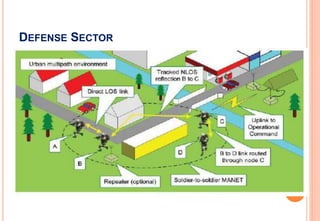
DEFENSE SECTOR
HEALTH CARE APPLICATIONS
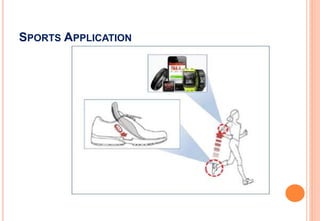
SPORTS APPLICATION
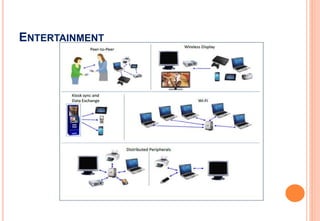
ENTERTAINMENT
4000
5000
6000
7000
8000
9000
2014 2015 2016 2017 2018
Consumer applications
Health-care applications
Industrial applications
Other applications
Projected growth of revenue for wearable systems in different applications from 2014 to 2018
(Recreated from [1])
PROJECTED GROWTH IN WEARABLE INDUSTRY
“Wearable Electronics and Technology Market by Applications-2020”. [Online]. Available: http://www.marketsandmarkets.com/Market-Reports/wearable-
electronics-market-983.html
Frequency spectrum allocation for WBANs in different countries
FREQUENCY ALLOCATION
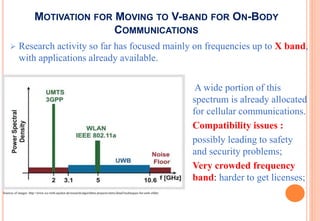
MOTIVATION FOR MOVING TO V-BAND FOR ON-BODY
COMMUNICATIONS
 Research activity so far has focused mainly on frequencies up to X band,
with applications already available.
A wide portion of this
spectrum is already allocated
for cellular communications.
Compatibility issues :
possibly leading to safety
and security problems;
Very crowded frequency
band: harder to get licenses;
Sources of images: http://www.ice.rwth-aachen.de/research/algorithms-projects/entry/detail/techniques-for-uwb-ofdm/
Advantages of millimetre wave frequencies for BANs
Transmission of large amount of data
(uncompressed audio and video
streaming, entertainment)
Higher transmission speed
Data encryption
Energy confinement: reduction of
interference and signature (military,
medical)
Unlicensed frequency
bands
Millimetre waves for BANs: Advantages
Compact
devices
STANDARDIZATION
Evolution of IEEE 802.11 standard
Evolution of IEEE 802.15 standard
MOVING TO V-BAND FREQUENCIES FOR ON-BODY
COMMUNICATIONS
Atmospheric Absorption for Millimeter wave
frequencies over 1km
 Due to high level of
atmospheric
absorption and
resulting range
limitations
successful
transmission occur
with:
 Reduced off-body
radiation: enabling
short links
 Highly secured
transmission path is
possible
Sources of image: http://ops.fhwa.dot.gov/publications/viirpt/sec5.htm
MOVING TO V-BAND FREQUENCIES FOR ON-BODY
COMMUNICATIONS
 One possible solution would be to move to higher frequency bands : FCC has
opened an unlicensed frequency band around 60GHz and many countries are
using it.
 Given the smaller wavelength and the higher free space attenuations at such
frequencies, it is easier to confine the signal around the human body.
Country
Frequency Band
[GHz]
USA 57.05-64
Canada 57-64
Europe 57-64
Japan 59-66
Australia 59.4-62
Korea 57-64
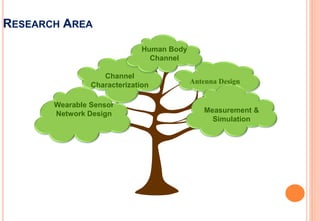
Channel
Characterization
Human Body
Channel
Measurement &
Simulation
Antenna Design
Wearable Sensor
Network Design
RESEARCH AREA
CHARACTERIZATION OF ON-BODY CHANNEL
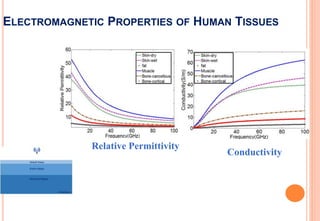
 The human body is hostile to
electromagnetic waves propagation due
to it’s lossy dielectric properties.
 Being a dispersive medium dielectric
properties of human body change with
frequency and it influences channel
characteristics.
 Being electrically large compared to the
operating microwave frequency, body
parts will scatter and absorb the
propagating waves.
ELECTROMAGNETIC PROPERTIES OF HUMAN TISSUES
Relative Permittivity
Conductivity
ON BODY CHARACTERISTICS: DEPTH OF PENETRATION
VARIATION OF CHANNEL CHARACTERISTICS
Different Shapes
On Body propagation channel is subject specific
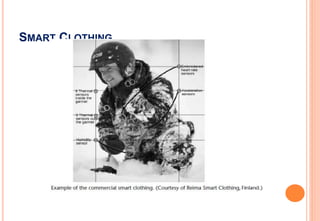
SMART CLOTHING
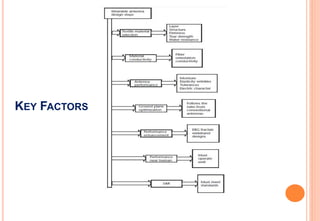
KEY FACTORS
TEXTILE MATERIALS
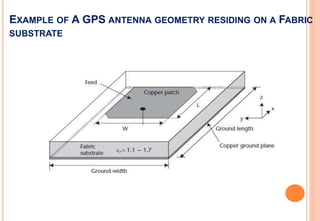
EXAMPLE OF A GPS ANTENNA GEOMETRY RESIDING ON A FABRIC
SUBSTRATE
ANTENNA CHARACTERISTICS
Measured return loss of two antennas with
different thicknesses
Measured S11 results of patch antenna bending
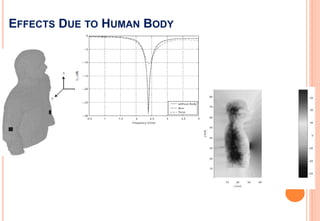
EFFECTS DUE TO HUMAN BODY
HIGH FREQUENCY ANTENNA DESIGN
CONCLUSION
 Over the past few years, body-centric wireless
communication systems have attracted significant interest
from both the academic and industrial community.
 From remote patient monitoring to augmented reality,
presence of wearable technology for improving and
extending the quality of life can be seen almost everywhere.
 However the antenna design of a WBAN involves critical
analysis of the effects of Human body and other parameters.
 An efficient sensor network involves optimized antenna
performance ,particular channel specification with scalable
performance

Wireless Body Area Networks

  • 1.
  • 2.
    INTRODUCTION TO WIRELESSBODY AREA NETWORK  The core elements of body-centric communication are Wireless Personal Area Network (WPAN), Wireless Sensor Network (WSN) and Wireless Body Area Network (WBAN).  WBAN represents a system comprising of a network among wearable computing devices.  The IEEE 802.15 Task Group 6 defines the communication standard for WBAN as a system “optimized for low power devices and operation on, in or around the human body (but not limited to humans) to serve a variety of applications including medical, consumer electronics, personal entertainment and other”  The area of BAN designates communication as on- body, from off body to on body sensors and even among implanted nodes (in-body).
  • 3.
    Body Area Networks Sports Fitness Health care Medical Defence Entertainment Sourcesof images: www.rheinmetall-defence.com; www.sciencedaily.com;us.playstation.com; www.etri.re.kr Application Area
  • 4.
  • 5.
  • 6.
  • 7.
  • 8.
    4000 5000 6000 7000 8000 9000 2014 2015 20162017 2018 Consumer applications Health-care applications Industrial applications Other applications Projected growth of revenue for wearable systems in different applications from 2014 to 2018 (Recreated from [1]) PROJECTED GROWTH IN WEARABLE INDUSTRY “Wearable Electronics and Technology Market by Applications-2020”. [Online]. Available: http://www.marketsandmarkets.com/Market-Reports/wearable- electronics-market-983.html
  • 9.
    Frequency spectrum allocationfor WBANs in different countries FREQUENCY ALLOCATION
  • 10.
    MOTIVATION FOR MOVINGTO V-BAND FOR ON-BODY COMMUNICATIONS  Research activity so far has focused mainly on frequencies up to X band, with applications already available. A wide portion of this spectrum is already allocated for cellular communications. Compatibility issues : possibly leading to safety and security problems; Very crowded frequency band: harder to get licenses; Sources of images: http://www.ice.rwth-aachen.de/research/algorithms-projects/entry/detail/techniques-for-uwb-ofdm/
  • 11.
    Advantages of millimetrewave frequencies for BANs Transmission of large amount of data (uncompressed audio and video streaming, entertainment) Higher transmission speed Data encryption Energy confinement: reduction of interference and signature (military, medical) Unlicensed frequency bands Millimetre waves for BANs: Advantages Compact devices
  • 12.
    STANDARDIZATION Evolution of IEEE802.11 standard Evolution of IEEE 802.15 standard
  • 13.
    MOVING TO V-BANDFREQUENCIES FOR ON-BODY COMMUNICATIONS Atmospheric Absorption for Millimeter wave frequencies over 1km  Due to high level of atmospheric absorption and resulting range limitations successful transmission occur with:  Reduced off-body radiation: enabling short links  Highly secured transmission path is possible Sources of image: http://ops.fhwa.dot.gov/publications/viirpt/sec5.htm
  • 14.
    MOVING TO V-BANDFREQUENCIES FOR ON-BODY COMMUNICATIONS  One possible solution would be to move to higher frequency bands : FCC has opened an unlicensed frequency band around 60GHz and many countries are using it.  Given the smaller wavelength and the higher free space attenuations at such frequencies, it is easier to confine the signal around the human body. Country Frequency Band [GHz] USA 57.05-64 Canada 57-64 Europe 57-64 Japan 59-66 Australia 59.4-62 Korea 57-64
  • 15.
    Channel Characterization Human Body Channel Measurement & Simulation AntennaDesign Wearable Sensor Network Design RESEARCH AREA
  • 16.
    CHARACTERIZATION OF ON-BODYCHANNEL  The human body is hostile to electromagnetic waves propagation due to it’s lossy dielectric properties.  Being a dispersive medium dielectric properties of human body change with frequency and it influences channel characteristics.  Being electrically large compared to the operating microwave frequency, body parts will scatter and absorb the propagating waves.
  • 17.
    ELECTROMAGNETIC PROPERTIES OFHUMAN TISSUES Relative Permittivity Conductivity
  • 18.
    ON BODY CHARACTERISTICS:DEPTH OF PENETRATION
  • 19.
    VARIATION OF CHANNELCHARACTERISTICS Different Shapes On Body propagation channel is subject specific
  • 20.
  • 21.
  • 22.
  • 23.
    EXAMPLE OF AGPS ANTENNA GEOMETRY RESIDING ON A FABRIC SUBSTRATE
  • 24.
    ANTENNA CHARACTERISTICS Measured returnloss of two antennas with different thicknesses Measured S11 results of patch antenna bending
  • 25.
    EFFECTS DUE TOHUMAN BODY
  • 26.
  • 27.
    CONCLUSION  Over thepast few years, body-centric wireless communication systems have attracted significant interest from both the academic and industrial community.  From remote patient monitoring to augmented reality, presence of wearable technology for improving and extending the quality of life can be seen almost everywhere.  However the antenna design of a WBAN involves critical analysis of the effects of Human body and other parameters.  An efficient sensor network involves optimized antenna performance ,particular channel specification with scalable performance