
Body Area Network (BAN)
Presented by:
o Nishant Kumar (CSE – 10114017)
 IIIT Kalyani
Date :13-02-2018
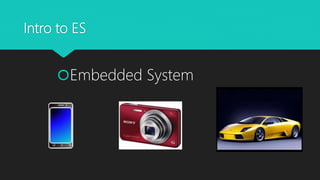
Intro to ES
Embedded System
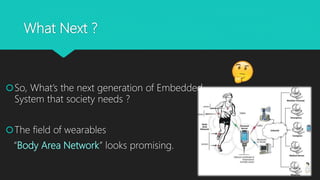
What Next ?
So, What’s the next generation of Embedded
System that society needs ?
The field of wearables
“Body Area Network” looks promising.
History
Before the intro of BAN, the only device
similar to this kind of technology was called
“ Life Alert Emergency Response System”.
LAERS seems to do basically same things so
what’s so great about it ?
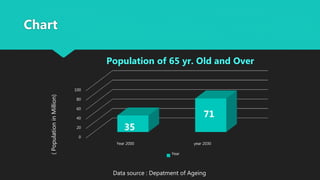
Chart
0
20
40
60
80
100
Year 2000 year 2030
Population of 65 yr. Old and Over
Year
35
71
(PopulationinMillion)
Data source : Depatment of Ageing
History
This means that more the older people,
there is greater the need for ways to
monitor their medical status and keep them
safer without forcing them to live at or
near hospital
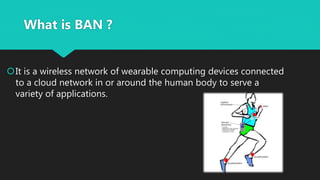
What is BAN ?
It is a wireless network of wearable computing devices connected
to a cloud network in or around the human body to serve a
variety of applications.
BAN
 A body area network (BAN) is the interconnection of multiple computing devices worn
on, affixed to or implanted in a person’s body.
 Also referred as WBAN,WSN
 Connecteverything youcarryonyou and withyou
 Offer “Connected User”experience
 The latest international standard for BANs is the IEEE 802.15.6 standard.
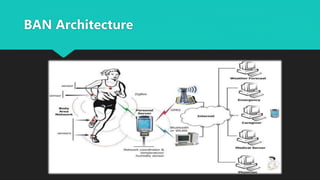
BAN Architecture
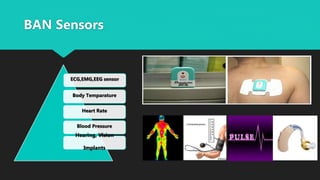
BAN Sensors
ECG,EMG,EEG sensor
Body Temparature
Heart Rate
Blood Pressure
Hearing, Vision
Implants
BAN Sensors
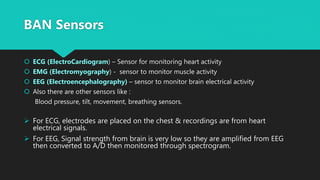
 ECG (ElectroCardiogram) – Sensor for monitoring heart activity
 EMG (Electromyography) - sensor to monitor muscle activity
 EEG (Electroencephalography) – sensor to monitor brain electrical activity
 Also there are other sensors like :
Blood pressure, tilt, movement, breathing sensors.
 For ECG, electrodes are placed on the chest & recordings are from heart
electrical signals.
 For EEG, Signal strength from brain is very low so they are amplified from EEG
then converted to A/D then monitored through spectrogram.
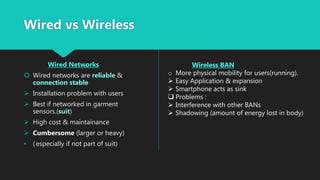
Wired vs Wireless
Wired Networks
 Wired networks are reliable &
connection stable
 Installation problem with users
 Best if networked in garment
sensors.(suit)
 High cost & maintainance
 Cumbersome (larger or heavy)
• (especially if not part of suit)
Wireless BAN
o More physical mobility for users(running).
 Easy Application & expansion
 Smartphone acts as sink
 Problems :
 Interference with other BANs
 Shadowing (amount of energy lost in body)
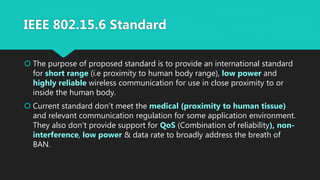
IEEE 802.15.6 Standard
 The purpose of proposed standard is to provide an international standard
for short range (i.e proximity to human body range), low power and
highly reliable wireless communication for use in close proximity to or
inside the human body.
 Current standard don’t meet the medical (proximity to human tissue)
and relevant communication regulation for some application environment.
They also don’t provide support for QoS (Combination of reliability), non-
interference, low power & data rate to broadly address the breath of
BAN.
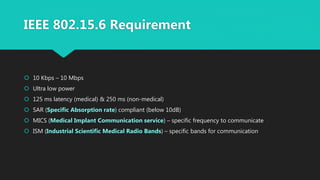
IEEE 802.15.6 Requirement
 10 Kbps – 10 Mbps
 Ultra low power
 125 ms latency (medical) & 250 ms (non-medical)
 SAR (Specific Absorption rate) compliant (below 10dB)
 MICS (Medical Implant Communication service) – specific frequency to communicate
 ISM (Industrial Scientific Medical Radio Bands) – specific bands for communication
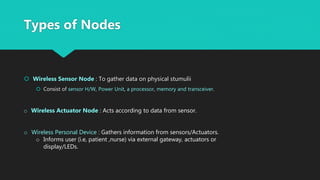
Types of Nodes
 Wireless Sensor Node : To gather data on physical stumulii
 Consist of sensor H/W, Power Unit, a processor, memory and transceiver.
o Wireless Actuator Node : Acts according to data from sensor.
o Wireless Personal Device : Gathers information from sensors/Actuators.
o Informs user (i.e, patient ,nurse) via external gateway, actuators or
display/LEDs.
Energy
 Sensing, communication, Processing
 Wireless communication most power hungry
 Batteries : largest part of sensors, Weight (Bulky)
 Implanted requires 5yrs+ lifetime
 Cost & convenience penalty
Energy Consumption Making Energy
 Energy Scavenging delivers small amount of energy.
 Human gait (person manner of walking)
 Temperature difference. (body -> Environment)
 Vibration of body (run, walk, dance)
 Bottom Line
Right now we are unable to create amount of energy needed to run system.
Effect of Energy on Body
 During communication Body produce heat (Not good for BODY)
 Absorption by surrounding tissue
 Dangers of laptop on lap
 Energy consumption need to be minimized
 To save battery
 To prevent body damage
Security
 WBAN security requirements
 Data confidentiality
 Transmitted data is strictly private
 Can only be accessed by authorized personal
 Encryption before sending it using a secret key
 Data Integrity
 Ensure received information not tempered
 Inspect by reffering MACs.
 Data Freshness
 Gurantess data is recent not replayed
 Old data can cause disruption
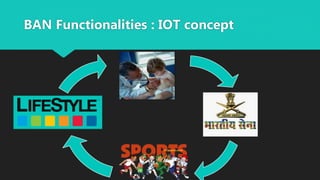
BAN Functionalities : IOT concept
Applications of BAN
 Health Care
 Entertainment and Sports
 Body Sensor Networks
 Fitness Monitoring
 Etc.
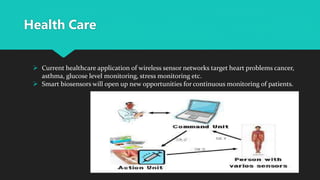
Health Care
 Current healthcare application of wireless sensor networks target heart problems cancer,
asthma, glucose level monitoring, stress monitoring etc.
 Smart biosensors will open up new opportunities for continuous monitoring of patients.
Entertainment and Sports
WBAN In Entertainment, Fitness and Sport
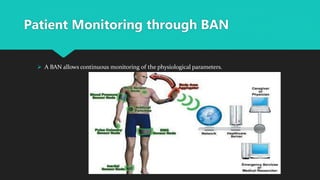
Patient Monitoring through BAN
 A BAN allows continuous monitoring of the physiological parameters.
Challenges
1. Hardware-centric Challenges
• Interoperability
• System and Device-level Security
• Data Consistency
• Interference
2. Human-centric Challenges
• Cost
• Constant Monitoring
• Consistent Performance
Advantages and Disadvantage of BAN
• Time and Energy Saving.
• Patients no need to connect to machine for monitoring.
• Continuous patient monitoring
• Ease in recovering lost military personel
• Sport coaches monitor their athelete performance
Advantages:
Disadvantages:
 Wired network-restriction between the body Movement
 Interference of the multi devices that share the channel
 Lack of integration-sensors
 Non existent support for massive data
Conclusion
 A WBAN is expected to be a very useful technology with potential to offer
a wide range of benefits to patients, medical personnel and society
through continuous monitoring and early detection of possible problems.
 The current technological evolutions will bring us closer to a fully
operational WBAN that acts as an enabler for improving the Quality of
Life.
Future Scope
 The future market of WBAN is growing rapidly in the field
of medical as well as in the entertainmentindustry.
 We believe that WBAN systems will allow a dramatic shift
in theway people think aboutand manage their health.
 This provide more proactive preventive healthcare that will not
only improve the quality of life, but will also reduce healthcare
costs.
Thank You for your Attention
धन्यवाद !!

Body Area Network Presentation

  • 1.
    Body Area Network(BAN) Presented by: o Nishant Kumar (CSE – 10114017)  IIIT Kalyani Date :13-02-2018
  • 2.
  • 3.
    What Next ? So,What’s the next generation of Embedded System that society needs ? The field of wearables “Body Area Network” looks promising.
  • 4.
    History Before the introof BAN, the only device similar to this kind of technology was called “ Life Alert Emergency Response System”. LAERS seems to do basically same things so what’s so great about it ?
  • 5.
    Chart 0 20 40 60 80 100 Year 2000 year2030 Population of 65 yr. Old and Over Year 35 71 (PopulationinMillion) Data source : Depatment of Ageing
  • 6.
    History This means thatmore the older people, there is greater the need for ways to monitor their medical status and keep them safer without forcing them to live at or near hospital
  • 7.
    What is BAN? It is a wireless network of wearable computing devices connected to a cloud network in or around the human body to serve a variety of applications.
  • 8.
    BAN  A bodyarea network (BAN) is the interconnection of multiple computing devices worn on, affixed to or implanted in a person’s body.  Also referred as WBAN,WSN  Connecteverything youcarryonyou and withyou  Offer “Connected User”experience  The latest international standard for BANs is the IEEE 802.15.6 standard.
  • 9.
  • 10.
    BAN Sensors ECG,EMG,EEG sensor BodyTemparature Heart Rate Blood Pressure Hearing, Vision Implants
  • 11.
    BAN Sensors  ECG(ElectroCardiogram) – Sensor for monitoring heart activity  EMG (Electromyography) - sensor to monitor muscle activity  EEG (Electroencephalography) – sensor to monitor brain electrical activity  Also there are other sensors like : Blood pressure, tilt, movement, breathing sensors.  For ECG, electrodes are placed on the chest & recordings are from heart electrical signals.  For EEG, Signal strength from brain is very low so they are amplified from EEG then converted to A/D then monitored through spectrogram.
  • 12.
    Wired vs Wireless WiredNetworks  Wired networks are reliable & connection stable  Installation problem with users  Best if networked in garment sensors.(suit)  High cost & maintainance  Cumbersome (larger or heavy) • (especially if not part of suit) Wireless BAN o More physical mobility for users(running).  Easy Application & expansion  Smartphone acts as sink  Problems :  Interference with other BANs  Shadowing (amount of energy lost in body)
  • 13.
    IEEE 802.15.6 Standard The purpose of proposed standard is to provide an international standard for short range (i.e proximity to human body range), low power and highly reliable wireless communication for use in close proximity to or inside the human body.  Current standard don’t meet the medical (proximity to human tissue) and relevant communication regulation for some application environment. They also don’t provide support for QoS (Combination of reliability), non- interference, low power & data rate to broadly address the breath of BAN.
  • 14.
    IEEE 802.15.6 Requirement 10 Kbps – 10 Mbps  Ultra low power  125 ms latency (medical) & 250 ms (non-medical)  SAR (Specific Absorption rate) compliant (below 10dB)  MICS (Medical Implant Communication service) – specific frequency to communicate  ISM (Industrial Scientific Medical Radio Bands) – specific bands for communication
  • 15.
    Types of Nodes Wireless Sensor Node : To gather data on physical stumulii  Consist of sensor H/W, Power Unit, a processor, memory and transceiver. o Wireless Actuator Node : Acts according to data from sensor. o Wireless Personal Device : Gathers information from sensors/Actuators. o Informs user (i.e, patient ,nurse) via external gateway, actuators or display/LEDs.
  • 16.
    Energy  Sensing, communication,Processing  Wireless communication most power hungry  Batteries : largest part of sensors, Weight (Bulky)  Implanted requires 5yrs+ lifetime  Cost & convenience penalty Energy Consumption Making Energy  Energy Scavenging delivers small amount of energy.  Human gait (person manner of walking)  Temperature difference. (body -> Environment)  Vibration of body (run, walk, dance)  Bottom Line Right now we are unable to create amount of energy needed to run system.
  • 17.
    Effect of Energyon Body  During communication Body produce heat (Not good for BODY)  Absorption by surrounding tissue  Dangers of laptop on lap  Energy consumption need to be minimized  To save battery  To prevent body damage
  • 18.
    Security  WBAN securityrequirements  Data confidentiality  Transmitted data is strictly private  Can only be accessed by authorized personal  Encryption before sending it using a secret key  Data Integrity  Ensure received information not tempered  Inspect by reffering MACs.  Data Freshness  Gurantess data is recent not replayed  Old data can cause disruption
  • 19.
  • 20.
    Applications of BAN Health Care  Entertainment and Sports  Body Sensor Networks  Fitness Monitoring  Etc.
  • 21.
    Health Care  Currenthealthcare application of wireless sensor networks target heart problems cancer, asthma, glucose level monitoring, stress monitoring etc.  Smart biosensors will open up new opportunities for continuous monitoring of patients.
  • 22.
    Entertainment and Sports WBANIn Entertainment, Fitness and Sport
  • 23.
    Patient Monitoring throughBAN  A BAN allows continuous monitoring of the physiological parameters.
  • 24.
    Challenges 1. Hardware-centric Challenges •Interoperability • System and Device-level Security • Data Consistency • Interference 2. Human-centric Challenges • Cost • Constant Monitoring • Consistent Performance
  • 25.
    Advantages and Disadvantageof BAN • Time and Energy Saving. • Patients no need to connect to machine for monitoring. • Continuous patient monitoring • Ease in recovering lost military personel • Sport coaches monitor their athelete performance Advantages: Disadvantages:  Wired network-restriction between the body Movement  Interference of the multi devices that share the channel  Lack of integration-sensors  Non existent support for massive data
  • 26.
    Conclusion  A WBANis expected to be a very useful technology with potential to offer a wide range of benefits to patients, medical personnel and society through continuous monitoring and early detection of possible problems.  The current technological evolutions will bring us closer to a fully operational WBAN that acts as an enabler for improving the Quality of Life.
  • 27.
    Future Scope  Thefuture market of WBAN is growing rapidly in the field of medical as well as in the entertainmentindustry.  We believe that WBAN systems will allow a dramatic shift in theway people think aboutand manage their health.  This provide more proactive preventive healthcare that will not only improve the quality of life, but will also reduce healthcare costs.
  • 28.
    Thank You foryour Attention धन्यवाद !!