Faculty Of Computing
Review On
Wireless Body Area Network
By Fentahun Yersie
Bahir Dar Institute of Technology
Introduction
 A Wireless Body Area Network consists of small,
intelligent devices attached on or implanted in the
body which are capable of establishing a wireless
communication link.
 These devices provide continuous health monitoring
and real-timfeedback to the user or medical
personnel. Furthermore, the measurements can be
recorded over a longer period of time, improving the
quality of the measured data.
Count...
 Generally , two types of devices can be distinguished: sensors and
actuators. The sensors are used to measure certain parameters of the
human body, either externally or internally. Example measuring the
heartbeat, body temperature or recording a prolonged electrocardiogram
(ECG).
 The actuators (or actors) on the other hand take some specific actions
according to the data they receive from the sensors or through interaction
with the user.
 In order to realize communication between these devices, techniques from
Wireless Sensor Networks (WSNs) and ad hoc networks could be used.
However, because of the typical properties of a WBAN, current protocols
designed for these networks are not always well suited to support a WBAN.
WBAN Architecture
Cont...
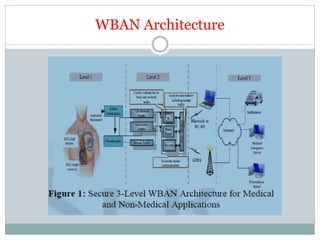
Level 1 contains inbody and on-body BAN Nodes (BNs) such as
Electrocardiogram (ECG) – used to monitor electrical activity of heart.
Oxygen saturation sensor (SpO2) –used to measure the level of oxygen.
Electromyography (EMG) – used to monitor muscle activity .
Level 2 contains a BAN Network Coordinator (BNC) that gathers vital
information from the BNs and communicates with the base-station.
Level 3 Contains a number of remote base-stations that keep patient’s
medical/non-medical records and provides relevant (diagnostic)
recommendations.
The traffic is categorized into on demand, emergency, and normal traffic.
On-demand traffic is initiated by the BNC to acquire certain information.
Emergency traffic is initiated by the BNs when they exceed a predefined
threshold.
Normal traffic is the data traffic in a normal condition with no time critical and
on-demand events.
Cont...
The normal data is collected and processed by the
BNC. The BNC contains a wakeup circuit, a main
radio, and a security circuit, all of them connected to
a data interface.
The wakeup circuit is used to accommodate on-
demand and emergency traffic. The security circuit
isused to prevent malicious interaction with a
WBAN.
WBAN Applications
WBANs have great potential for several applications including
remote medical diagnosis, interactive gaming, and military
applications.
the in-body and on body applications . In-body applications
include monitoring and program changes for pacemakers and
implantable cardiac defibrillators, control of bladder function, and
restoration of limb movement .
On-body medical applications include monitoring heart rate, blood
pressure, temperature, and respiration.
On-body non-medicalapplications include monitoring forgotten
things, establishinga social network, and assessing soldier fatigue
and battle readiness.
WBAN MAC Requirements
 Sensor nodes are battery powered with limited battery power.
 MAC protocol's objective is to reduce energy consumption.
source of energy waste
collision
Overhearing
Idle listening
Cont...
 WBAN MAC should support simultaneous operation on inbody is called
Medical Implant Communications Service (MICS) and on-body
frequency bands/channels [Industrial, Scientific and Medical (ISM) or
Ultra Wide Band (UWB)] at the same time. It means, that should
support Multiple Physical layers (Multi-PHYs) communication.
 The important factors are scalability and adaptability to changes in the
network, throughput, bandwidth utilization and delay. The position of
the human body network topology, the node density and the position of
the human body should be handled rapidly and successfully. MAC
protocol for a WBAN should consider the electrical properties of the
human body and the diverse traffic nature of in-body and on-body
nodes.
Conclusion
A Wireless Body Area Network (WBAN) is the network of low-powered devices for
measuring and monitoring physiological parameters such as Electrocardiogram
(ECG),blood pressure, Electromyography (EMG) etc.
These devices could be wearable or could be implanted inside the body.
that communicate wirelessly to a monitoring station known as the
Base Station.
The limited number of nodes in a WBAN environment gives us an opportunity to
relax constraints in routing protocols.
Considering these constrains in mind,existing have tried to improve the network
life-time of the network; energy of the network as well as the path loss of the
link being established between the nodes.
References
 A Review on Wireless Body Area Network
Kiran1, Pooja Ahlawat2
 Latré, B., Braem, B., Moerman, I., Blondia, C., & Demeester, P. (2011).
A survey on wireless body area networks. Wireless Networks, 17(1), 1-18
.
 Chen, M., Gonzalez, S., Vasilakos, A., Cao, H., &
Leung, V. C. (2011). Body area networks: A survey.
Mobile Networks and Applications, 16(2), 171-193.
?
Thank you !

Wireless body are network

  • 1.
    Faculty Of Computing ReviewOn Wireless Body Area Network By Fentahun Yersie Bahir Dar Institute of Technology
  • 2.
    Introduction  A WirelessBody Area Network consists of small, intelligent devices attached on or implanted in the body which are capable of establishing a wireless communication link.  These devices provide continuous health monitoring and real-timfeedback to the user or medical personnel. Furthermore, the measurements can be recorded over a longer period of time, improving the quality of the measured data.
  • 3.
    Count...  Generally ,two types of devices can be distinguished: sensors and actuators. The sensors are used to measure certain parameters of the human body, either externally or internally. Example measuring the heartbeat, body temperature or recording a prolonged electrocardiogram (ECG).  The actuators (or actors) on the other hand take some specific actions according to the data they receive from the sensors or through interaction with the user.  In order to realize communication between these devices, techniques from Wireless Sensor Networks (WSNs) and ad hoc networks could be used. However, because of the typical properties of a WBAN, current protocols designed for these networks are not always well suited to support a WBAN.
  • 4.
  • 5.
    Cont... Level 1 containsinbody and on-body BAN Nodes (BNs) such as Electrocardiogram (ECG) – used to monitor electrical activity of heart. Oxygen saturation sensor (SpO2) –used to measure the level of oxygen. Electromyography (EMG) – used to monitor muscle activity . Level 2 contains a BAN Network Coordinator (BNC) that gathers vital information from the BNs and communicates with the base-station. Level 3 Contains a number of remote base-stations that keep patient’s medical/non-medical records and provides relevant (diagnostic) recommendations. The traffic is categorized into on demand, emergency, and normal traffic. On-demand traffic is initiated by the BNC to acquire certain information. Emergency traffic is initiated by the BNs when they exceed a predefined threshold. Normal traffic is the data traffic in a normal condition with no time critical and on-demand events.
  • 6.
    Cont... The normal datais collected and processed by the BNC. The BNC contains a wakeup circuit, a main radio, and a security circuit, all of them connected to a data interface. The wakeup circuit is used to accommodate on- demand and emergency traffic. The security circuit isused to prevent malicious interaction with a WBAN.
  • 7.
    WBAN Applications WBANs havegreat potential for several applications including remote medical diagnosis, interactive gaming, and military applications. the in-body and on body applications . In-body applications include monitoring and program changes for pacemakers and implantable cardiac defibrillators, control of bladder function, and restoration of limb movement . On-body medical applications include monitoring heart rate, blood pressure, temperature, and respiration. On-body non-medicalapplications include monitoring forgotten things, establishinga social network, and assessing soldier fatigue and battle readiness.
  • 8.
    WBAN MAC Requirements Sensor nodes are battery powered with limited battery power.  MAC protocol's objective is to reduce energy consumption. source of energy waste collision Overhearing Idle listening
  • 9.
    Cont...  WBAN MACshould support simultaneous operation on inbody is called Medical Implant Communications Service (MICS) and on-body frequency bands/channels [Industrial, Scientific and Medical (ISM) or Ultra Wide Band (UWB)] at the same time. It means, that should support Multiple Physical layers (Multi-PHYs) communication.  The important factors are scalability and adaptability to changes in the network, throughput, bandwidth utilization and delay. The position of the human body network topology, the node density and the position of the human body should be handled rapidly and successfully. MAC protocol for a WBAN should consider the electrical properties of the human body and the diverse traffic nature of in-body and on-body nodes.
  • 10.
    Conclusion A Wireless BodyArea Network (WBAN) is the network of low-powered devices for measuring and monitoring physiological parameters such as Electrocardiogram (ECG),blood pressure, Electromyography (EMG) etc. These devices could be wearable or could be implanted inside the body. that communicate wirelessly to a monitoring station known as the Base Station. The limited number of nodes in a WBAN environment gives us an opportunity to relax constraints in routing protocols. Considering these constrains in mind,existing have tried to improve the network life-time of the network; energy of the network as well as the path loss of the link being established between the nodes.
  • 11.
    References  A Reviewon Wireless Body Area Network Kiran1, Pooja Ahlawat2  Latré, B., Braem, B., Moerman, I., Blondia, C., & Demeester, P. (2011). A survey on wireless body area networks. Wireless Networks, 17(1), 1-18 .  Chen, M., Gonzalez, S., Vasilakos, A., Cao, H., & Leung, V. C. (2011). Body area networks: A survey. Mobile Networks and Applications, 16(2), 171-193.
  • 12.