Presented by:-
ANKIT KUMARVERMA
M.TECH(1STYEAR)
REG. NO-14304003
Department of Electronics engineering
School of Engineering andTechnology
CONTENT
 INTRODUCTION
 HISTORY
 HARDWARE
 BODY SENSOR
 WBAN COMMUNICATION N/W ARCHITECTURE
 RADIOTECHNOLOGY
 IMPLEMENTATION OF HARDWARE
 MAC PROTOCOL
 SECURITY REQUIREMENT
 APPLICATION
 CONCLUSION
 REFERENCES
INTRODUCTION
 Wireless body area network is an emerging
technology in today world ,it plays an very
important role in the field of health services.
 Now a days person data monitoring is a leading
issue for health and disease management.
 Wireless body area network consist of light-
weight ,ultra low power wearable sensors.
 This wearable sensors monitors human
physiological activity such as health status.
HISTORY
 Wireless body area network was firstly
introduced byT. G. Zimmerman in 1996.
 Such network was defined as wireless
personal area network.
 The name body area network was refined as
WBAN by increasing its range more than 3m.
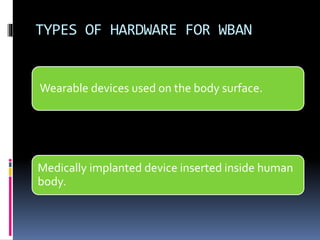
TYPES OF HARDWARE FOR WBAN
Wearable devices used on the body surface.
Medically implanted device inserted inside human
body.
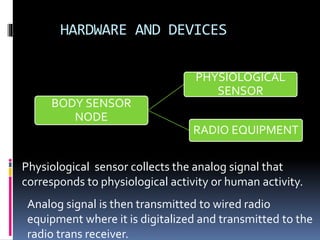
HARDWARE AND DEVICES
BODY SENSOR
NODE
PHYSIOLOGICAL
SENSOR
RADIO EQUIPMENT
Physiological sensor collects the analog signal that
corresponds to physiological activity or human activity.
Analog signal is then transmitted to wired radio
equipment where it is digitalized and transmitted to the
radio trans receiver.
TOPOLOGYUSEDBYSENSORS
SENSORS TOPOLOGY DATA RATE
Accelerometer/gyro
scope
star high
Blood glucose star high
Blood pressure star low
CO2 gas sensors star Very low
ECG star high
EEG star high
EMG star Very high
Temperature star Very low
Video/image p2p Very high
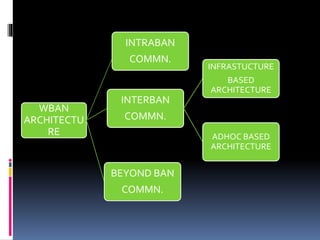
WBANN/W ARCHITECTURE
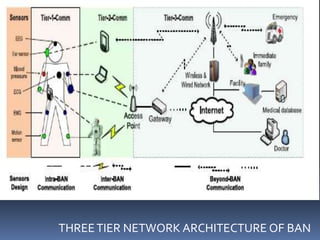
 WBAN architecture is divided into 3
components
1)Tier 1 communication design (intra BAN
communication).
2)Tier 2 communication design(inter BAN
communication.
3)Tier 3 communication design (beyond BAN
communication)
WBAN
ARCHITECTU
RE
INTERBAN
COMMN.
INFRASTUCTURE
BASED
ARCHITECTURE
ADHOC BASED
ARCHITECTURE
BEYOND BAN
COMMN.
INTRABAN
COMMN.
INTRABAN COMMUNICATION
 It refers to the radio communication of
around 2m around human body, which is
further sub categorized into
1) Communication between body sensors
2) Communication between body sensors and
portable personal servers.
 Earlier data was transmitted from sensors to
personal server through wires
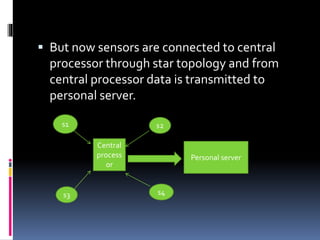
 But now sensors are connected to central
processor through star topology and from
central processor data is transmitted to
personal server.
s1 s2
s3 s4
Central
process
or
Personal server
INTERBAN COMMUNICATION
 It is a 2nd tier communication design .In inter
BAN communication is from personal severs
to one or more access point.
 Inter BAN communication is used to
interconnect BANS with various network.
 Inter BAN communication is divided into 2
categories
1)Infrastructure based architecture
2)Ad hoc based architecture
1) Infrastructure based architecture
In infrastructure based communication
environment is assumed with in limited space .
Example- waiting room in hospital, home or office
 This architecture use larger bandwidth and use
centralized structure and due to this access paint also
works as data base server.
2) Ad hoc based architecture
It consist of multiple access points which
helps the body sensor to transmit
information to different medical centers.
2 category of node exist in ad hoc based
architecture
1)Sensor node-It is around human body
2) Routing node- it is aroundWBAN.
BEYOND-BAN COMMUNICATION
 Tier 3 communication design is used in
metro-polition areas.
 To bridge inter-BAN and beyond BAN
communication gateway is used and wireless
link is created between two networks.
 Database is an important component in
beyond BAN tier.
 Database maintains users profile and medical
history.
 Through database doctor may access user
information as needed.
 Beyond BAN communication is application
specific and can also be user specific.
 If any abnormalities are found in based upon up
to date transmitted signal to database an alarm
is notified to patient or to the doctor via an
email or short message service.
 Doctor or other caretaker can contact to the
person through videoconferencing /internet and
can diagnose the problem.
 When an ambulatory person is taken out of
hometown might experience critical situation
and the emergency personal can retrieve all the
necessary information to treat the patient.
THREETIER NETWORK ARCHITECTURE OF BAN
RADIO TECHNOLOGY
 The radio technology used inWBAN are-
1) Bluetooth(802.15.1)
2) ZIGBEE (802.15.4)
BLUETOOTH-It is used for short range wireless
Communication network .It provides data rate
upto 1Mbps.
DRAWBACK-larger power consumption.
2)ZIGBEE-It is low power consumption
technology. It has lower data rate from 20kbps
To 250kbps.Zig bee operates in two mode:
a) Beacon enable mode
b) Non beacon enable mode
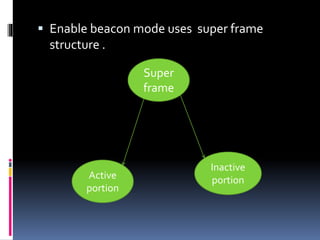
 Enable beacon mode uses super frame
structure .
Super
frame
Active
portion
Inactive
portion
 During inactive mode device may enter a
low power mode according to the required
application.
 Active mode consist of contention access
period and contention free period.
 Device is communicated during CAP period
and CFP defines time slot where no
contention takes place.
IMPLEMENTATION OF WBAN HARDWARE
 WBAN which are used for medical purpose
uses one of the MICS (medically implanted
communication services ) ism band orWMTS
(wireless medical telemetry services) or
433MHZ ism bands.
 This ism bands is used between central
control units and sensor nodes.
 Central control unit interfaces with personal
server using Bluetooth or Zig bee radio
technologies.
 SENSOR NODE DESIGN-sensor nodes is
designed to collect raw signals of human
body. it digitized the signal and transmit
through radio trans receiver.
 Sensor node consist of A/D convertors ,
microcontroller ,radio trans receiver and
battery. Micro controller is used for data
acquisition ,data processing ,power
management.
 Microcontroller is programmed to turn off the
battery connection when it is not functioning
i.e in sleep mode.
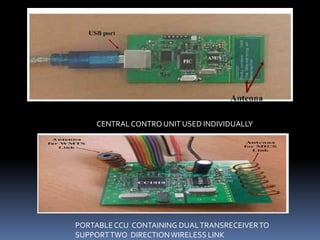
 CCU DESIGN-The primary function of CCU is
to collect data from sensor node via wireless
MICS band link and forward this data to local
or remote personal server.
 CCU and sensor node consist of AMI52100IC
From AMI semiconductor for 433MHZ MICS
and WMTS band generation .
 MICS and WMTS band can also be generated
by using CC1010.
CENTRAL CONTRO UNIT USED INDIVIDUALLY
PORTABLECCU CONTAINING DUALTRANSRECEIVERTO
SUPPORTTWO DIRECTIONWIRELESS LINK
MAC PROTOCOL
SCHEDULEDTDMA MAC PROTOCOL
 A scheduled MAC protocol provide
deterministic delay and no packet loss due to
the absence of any transmission channel
contention.
 TDMA is scheduled multiple access technique
where transmission of packet is done in the
form of time slot and frames.
 CCU allot time slot to each node to transmit
data
 TDMA based MAC protocol is suitable for
small WBAN network with limit number of
sensors generating data at fixed rate.
POLLING BASED MAC PROTOCOL
 It is based on scheduled transmission technique.
 In this data can be transferred with different
rate.
 CCU send polling message to all node which in
response send either message or NAC indicating
no message to send.
 An acknowledgement in previous transmission
may include pooling message to improve
reliability.
 New node can be joined by simply sending
message to central controller
Polling MAC based transmission sequence
RANDOM ACCESS MAC PROTOCOL
 It is also called on demand access protocol
used for short range communication.
 CSMA/CA is a random access protocol
used for short range communication.
 CSMA/CA protocol based sensor access
transmission channel only when it has data in its
transmission buffer. If it find channel free then it
transmit packets using contention based
procedure.
SECURITY REQUIREMENT IN WBAN
SECURITY MECHANISM
 TRUST BASED SCHEDULER
 KEY MANAGEMENT
 SECURED ROUTING PROTOCOL
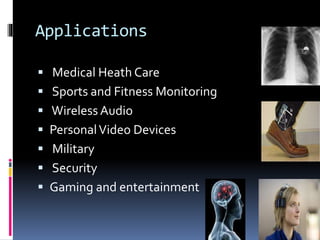
Applications
 Medical Heath Care
 Sports and Fitness Monitoring
 Wireless Audio
 PersonalVideo Devices
 Military
 Security
 Gaming and entertainment
35
Conclusion
 Benefits to patients,medical personnel and society
 Continuous monitoring is possible
 Early detection of possible problems.
 Improving the Quality of Life
 Collected the pulse rate, temperature and the
location of the patients
36
Reference
[1] Samaneh Movassaghi, MehranAbolhasan, Justin Lipman,David Smith, and
Abbas Jamalipour, “Wireless Body Area Networks:A Survey” , IEEE
Communications surveys & tutorials,vol.16, No.3,Third Quarter,2014
[2] AashimaArya Naveen Bilandi, “A Review:Wireless Body Area Networks for
Health Care”, International Journal of Innovative Research in Computer and
Communication Engineering, Vol.2, Issue 4, April 2014
[3] Prathamesh Dinkar,Abhishek Gulavani, Sourabh Ketkale, Pratik Kadam,and
Sheetal Dabhade, “Remote Health Monitoring usingWireless Body Area
Network ”, International Journal of Engineering and AdvancedTechnology
(IJEAT) ISSN: 2249 – 8958,Vol.2, Issue-4,April 2013
[ 4] GarthV. Crosby,Tirthankar Ghosh, Renita Murimi and CraigA. Chin, “Wireless
Body Area Networks for Healthcare: A Survey ”, International Journal of Ad hoc,
Sensor & Ubiquitous Computing (IJASUC) ,Vol.3,No.3 June 2012
37
[5] Changhong Wang, QiangWang, and Shunzhong Shi, “A DistributedWireless
Body Area Network for Medical Supervision”, IEEE International, May 2012
[6] Javed Ahmadand Fareeha Zafar,”Review of Body Area NetworkTechnology
& Wireless Medical Monitoring”,International Journal of Information and
CommunicationTechnology Research ,Volume 2 No. 2, February 2012
[7] Latre, Benoit, Bart Braem, Ingrid Moerman, Chris Blondia, and Piet
Demeester. “A survey on wireless body area networks,” Wireless Networks, vol.
17, 2010
[8] Sana ULLAH,Pervez KHAN,Niamat ULLAH,Shahnaz SALEE and Henry
HIGGINSandKyung Sup KWAK, “A Review ofWireless Body Area Networks for
Medical Applications ”, Int. J. Communications, Network and System
Sciences,Vol.2,november 2009
[9] Pervez Khan, Md.Asdaque Hussain and Kyung Sup Kwak “Medical Applications
ofWireless Body Area Networks ”, International Journal of DigitalContent
Technology and its Applications Vol.3, September 2009
38
Thank you
39

Wban

  • 1.
    Presented by:- ANKIT KUMARVERMA M.TECH(1STYEAR) REG.NO-14304003 Department of Electronics engineering School of Engineering andTechnology
  • 2.
    CONTENT  INTRODUCTION  HISTORY HARDWARE  BODY SENSOR  WBAN COMMUNICATION N/W ARCHITECTURE  RADIOTECHNOLOGY  IMPLEMENTATION OF HARDWARE  MAC PROTOCOL  SECURITY REQUIREMENT  APPLICATION  CONCLUSION  REFERENCES
  • 3.
    INTRODUCTION  Wireless bodyarea network is an emerging technology in today world ,it plays an very important role in the field of health services.  Now a days person data monitoring is a leading issue for health and disease management.  Wireless body area network consist of light- weight ,ultra low power wearable sensors.  This wearable sensors monitors human physiological activity such as health status.
  • 4.
    HISTORY  Wireless bodyarea network was firstly introduced byT. G. Zimmerman in 1996.  Such network was defined as wireless personal area network.  The name body area network was refined as WBAN by increasing its range more than 3m.
  • 5.
    TYPES OF HARDWAREFOR WBAN Wearable devices used on the body surface. Medically implanted device inserted inside human body.
  • 7.
    HARDWARE AND DEVICES BODYSENSOR NODE PHYSIOLOGICAL SENSOR RADIO EQUIPMENT Physiological sensor collects the analog signal that corresponds to physiological activity or human activity. Analog signal is then transmitted to wired radio equipment where it is digitalized and transmitted to the radio trans receiver.
  • 8.
    TOPOLOGYUSEDBYSENSORS SENSORS TOPOLOGY DATARATE Accelerometer/gyro scope star high Blood glucose star high Blood pressure star low CO2 gas sensors star Very low ECG star high EEG star high EMG star Very high Temperature star Very low Video/image p2p Very high
  • 9.
    WBANN/W ARCHITECTURE  WBANarchitecture is divided into 3 components 1)Tier 1 communication design (intra BAN communication). 2)Tier 2 communication design(inter BAN communication. 3)Tier 3 communication design (beyond BAN communication)
  • 10.
  • 11.
    INTRABAN COMMUNICATION  Itrefers to the radio communication of around 2m around human body, which is further sub categorized into 1) Communication between body sensors 2) Communication between body sensors and portable personal servers.  Earlier data was transmitted from sensors to personal server through wires
  • 12.
     But nowsensors are connected to central processor through star topology and from central processor data is transmitted to personal server. s1 s2 s3 s4 Central process or Personal server
  • 13.
    INTERBAN COMMUNICATION  Itis a 2nd tier communication design .In inter BAN communication is from personal severs to one or more access point.  Inter BAN communication is used to interconnect BANS with various network.  Inter BAN communication is divided into 2 categories 1)Infrastructure based architecture 2)Ad hoc based architecture
  • 14.
    1) Infrastructure basedarchitecture In infrastructure based communication environment is assumed with in limited space . Example- waiting room in hospital, home or office  This architecture use larger bandwidth and use centralized structure and due to this access paint also works as data base server.
  • 15.
    2) Ad hocbased architecture It consist of multiple access points which helps the body sensor to transmit information to different medical centers. 2 category of node exist in ad hoc based architecture 1)Sensor node-It is around human body 2) Routing node- it is aroundWBAN.
  • 16.
    BEYOND-BAN COMMUNICATION  Tier3 communication design is used in metro-polition areas.  To bridge inter-BAN and beyond BAN communication gateway is used and wireless link is created between two networks.  Database is an important component in beyond BAN tier.  Database maintains users profile and medical history.  Through database doctor may access user information as needed.
  • 17.
     Beyond BANcommunication is application specific and can also be user specific.  If any abnormalities are found in based upon up to date transmitted signal to database an alarm is notified to patient or to the doctor via an email or short message service.  Doctor or other caretaker can contact to the person through videoconferencing /internet and can diagnose the problem.  When an ambulatory person is taken out of hometown might experience critical situation and the emergency personal can retrieve all the necessary information to treat the patient.
  • 18.
  • 19.
    RADIO TECHNOLOGY  Theradio technology used inWBAN are- 1) Bluetooth(802.15.1) 2) ZIGBEE (802.15.4) BLUETOOTH-It is used for short range wireless Communication network .It provides data rate upto 1Mbps. DRAWBACK-larger power consumption.
  • 20.
    2)ZIGBEE-It is lowpower consumption technology. It has lower data rate from 20kbps To 250kbps.Zig bee operates in two mode: a) Beacon enable mode b) Non beacon enable mode
  • 21.
     Enable beaconmode uses super frame structure . Super frame Active portion Inactive portion
  • 22.
     During inactivemode device may enter a low power mode according to the required application.  Active mode consist of contention access period and contention free period.  Device is communicated during CAP period and CFP defines time slot where no contention takes place.
  • 23.
    IMPLEMENTATION OF WBANHARDWARE  WBAN which are used for medical purpose uses one of the MICS (medically implanted communication services ) ism band orWMTS (wireless medical telemetry services) or 433MHZ ism bands.  This ism bands is used between central control units and sensor nodes.  Central control unit interfaces with personal server using Bluetooth or Zig bee radio technologies.
  • 24.
     SENSOR NODEDESIGN-sensor nodes is designed to collect raw signals of human body. it digitized the signal and transmit through radio trans receiver.  Sensor node consist of A/D convertors , microcontroller ,radio trans receiver and battery. Micro controller is used for data acquisition ,data processing ,power management.  Microcontroller is programmed to turn off the battery connection when it is not functioning i.e in sleep mode.
  • 26.
     CCU DESIGN-Theprimary function of CCU is to collect data from sensor node via wireless MICS band link and forward this data to local or remote personal server.  CCU and sensor node consist of AMI52100IC From AMI semiconductor for 433MHZ MICS and WMTS band generation .  MICS and WMTS band can also be generated by using CC1010.
  • 27.
    CENTRAL CONTRO UNITUSED INDIVIDUALLY PORTABLECCU CONTAINING DUALTRANSRECEIVERTO SUPPORTTWO DIRECTIONWIRELESS LINK
  • 28.
    MAC PROTOCOL SCHEDULEDTDMA MACPROTOCOL  A scheduled MAC protocol provide deterministic delay and no packet loss due to the absence of any transmission channel contention.  TDMA is scheduled multiple access technique where transmission of packet is done in the form of time slot and frames.  CCU allot time slot to each node to transmit data
  • 29.
     TDMA basedMAC protocol is suitable for small WBAN network with limit number of sensors generating data at fixed rate.
  • 30.
    POLLING BASED MACPROTOCOL  It is based on scheduled transmission technique.  In this data can be transferred with different rate.  CCU send polling message to all node which in response send either message or NAC indicating no message to send.  An acknowledgement in previous transmission may include pooling message to improve reliability.  New node can be joined by simply sending message to central controller
  • 31.
    Polling MAC basedtransmission sequence
  • 32.
    RANDOM ACCESS MACPROTOCOL  It is also called on demand access protocol used for short range communication.  CSMA/CA is a random access protocol used for short range communication.  CSMA/CA protocol based sensor access transmission channel only when it has data in its transmission buffer. If it find channel free then it transmit packets using contention based procedure.
  • 33.
  • 34.
    SECURITY MECHANISM  TRUSTBASED SCHEDULER  KEY MANAGEMENT  SECURED ROUTING PROTOCOL
  • 35.
    Applications  Medical HeathCare  Sports and Fitness Monitoring  Wireless Audio  PersonalVideo Devices  Military  Security  Gaming and entertainment 35
  • 36.
    Conclusion  Benefits topatients,medical personnel and society  Continuous monitoring is possible  Early detection of possible problems.  Improving the Quality of Life  Collected the pulse rate, temperature and the location of the patients 36
  • 37.
    Reference [1] Samaneh Movassaghi,MehranAbolhasan, Justin Lipman,David Smith, and Abbas Jamalipour, “Wireless Body Area Networks:A Survey” , IEEE Communications surveys & tutorials,vol.16, No.3,Third Quarter,2014 [2] AashimaArya Naveen Bilandi, “A Review:Wireless Body Area Networks for Health Care”, International Journal of Innovative Research in Computer and Communication Engineering, Vol.2, Issue 4, April 2014 [3] Prathamesh Dinkar,Abhishek Gulavani, Sourabh Ketkale, Pratik Kadam,and Sheetal Dabhade, “Remote Health Monitoring usingWireless Body Area Network ”, International Journal of Engineering and AdvancedTechnology (IJEAT) ISSN: 2249 – 8958,Vol.2, Issue-4,April 2013 [ 4] GarthV. Crosby,Tirthankar Ghosh, Renita Murimi and CraigA. Chin, “Wireless Body Area Networks for Healthcare: A Survey ”, International Journal of Ad hoc, Sensor & Ubiquitous Computing (IJASUC) ,Vol.3,No.3 June 2012 37
  • 38.
    [5] Changhong Wang,QiangWang, and Shunzhong Shi, “A DistributedWireless Body Area Network for Medical Supervision”, IEEE International, May 2012 [6] Javed Ahmadand Fareeha Zafar,”Review of Body Area NetworkTechnology & Wireless Medical Monitoring”,International Journal of Information and CommunicationTechnology Research ,Volume 2 No. 2, February 2012 [7] Latre, Benoit, Bart Braem, Ingrid Moerman, Chris Blondia, and Piet Demeester. “A survey on wireless body area networks,” Wireless Networks, vol. 17, 2010 [8] Sana ULLAH,Pervez KHAN,Niamat ULLAH,Shahnaz SALEE and Henry HIGGINSandKyung Sup KWAK, “A Review ofWireless Body Area Networks for Medical Applications ”, Int. J. Communications, Network and System Sciences,Vol.2,november 2009 [9] Pervez Khan, Md.Asdaque Hussain and Kyung Sup Kwak “Medical Applications ofWireless Body Area Networks ”, International Journal of DigitalContent Technology and its Applications Vol.3, September 2009 38
  • 39.