Wireless Sensor
Networks
CS4492 Wireless and Broadband Networking
Dilum Bandara
Dilum.Bandara@uom.lk
Slides extracted from Prof. Anura Jayasumana, Colorado State University
Outline
 Platforms
 Transducers/Sensors & Standards
 Protocols
 MAC, routing, & transport
 Powering nodes
 Other issues
2
Emerging World of Sensor Networks
 Emerging information infrastructure that extends reach of
networks to physical world
 Dense collections of smart sensors, actuators, &
processors that self-configure to network & process
 Now comes under the umbrella of IoT
 May be viewed as the next step in evolution of networking,
following WWW & Internet
 “sensor-network”  describe “wireless-sensor networks”
 Consist tiny computing & sensing devices equipped with wireless
communication capability
 It has a much bigger scope & reach
 Sensor-actuator networks, wireless sensor networks, distributed
sensing networks, high & low speed collaborative adaptive systems, …
3
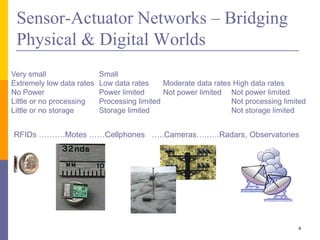
Sensor-Actuator Networks – Bridging
Physical & Digital Worlds
RFIDs ……….Motes ……Cellphones …..Cameras…..….Radars, Observatories
Small
Low data rates Moderate data rates High data rates
Power limited Not power limited Not power limited
Processing limited Not processing limited
Storage limited Not storage limited
Very small
Extremely low data rates
No Power
Little or no processing
Little or no storage
4
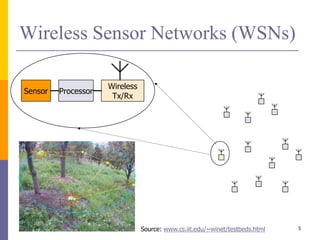
Wireless Sensor Networks (WSNs)
Processor
Sensor
Wireless
Tx/Rx
5
Source: www.cs.iit.edu/~winet/testbeds.html
Wireless Sensor Networks (Cont.)
 Wireless
 Small, cheap
 Can deploy in Tens, hundreds, & thousands
 Fine grained picture of phenomena (e.g., climate)
 Unattended operation
 Ad-hoc deployment
 Self powered
 Self organizing
 Spontaneously create impromptu network
 Dynamically adapt to device failure, degradation, movement
 Act cooperatively
 Organize themselves & sharing computations
 Provide usable chunks of predigested information than a bunch of
numbers
6
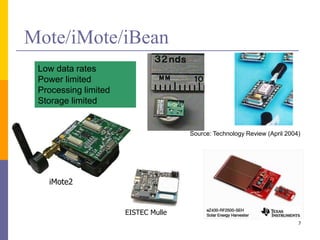
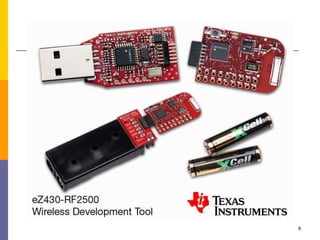
Mote/iMote/iBean
7
Low data rates
Power limited
Processing limited
Storage limited
Source: Technology Review (April 2004)
EISTEC Mulle
iMote2
8
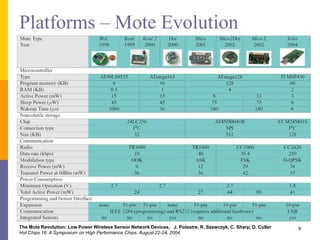
Platforms – Mote Evolution
9
The Mote Revolution: Low Power Wireless Sensor Network Devices, J. Polastre, R. Szewczyk, C. Sharp, D. Culler
Hot Chips 16: A Symposium on High Performance Chips. August 22-24, 2004.
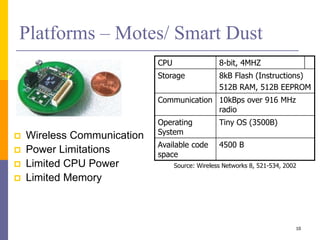
Platforms – Motes/ Smart Dust
 Wireless Communication
 Power Limitations
 Limited CPU Power
 Limited Memory
10
CPU 8-bit, 4MHZ
Storage 8kB Flash (Instructions)
512B RAM, 512B EEPROM
Communication 10kBps over 916 MHz
radio
Operating
System
Tiny OS (3500B)
Available code
space
4500 B
Source: Wireless Networks 8, 521-534, 2002
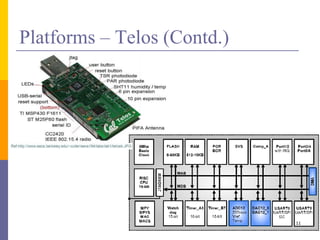
Platforms – Telos (Contd.)
11
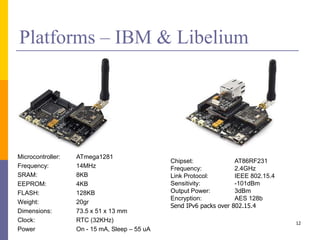
Platforms – IBM & Libelium
Microcontroller: ATmega1281
Frequency: 14MHz
SRAM: 8KB
EEPROM: 4KB
FLASH: 128KB
Weight: 20gr
Dimensions: 73.5 x 51 x 13 mm
Clock: RTC (32KHz)
Power On - 15 mA, Sleep – 55 uA
12
Chipset: AT86RF231
Frequency: 2.4GHz
Link Protocol: IEEE 802.15.4
Sensitivity: -101dBm
Output Power: 3dBm
Encryption: AES 128b
Send IPv6 packs over 802.15.4
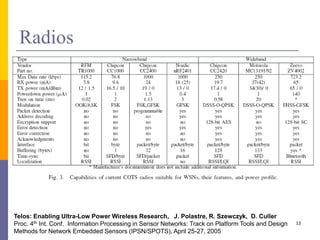
Radios
Telos: Enabling Ultra-Low Power Wireless Research, J. Polastre, R. Szewczyk, D. Culler
Proc. 4th Int. Conf. Information Processing in Sensor Networks: Track on Platform Tools and Design
Methods for Network Embedded Sensors (IPSN/SPOTS), April 25-27, 2005
13
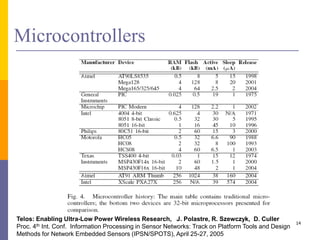
Microcontrollers
Telos: Enabling Ultra-Low Power Wireless Research, J. Polastre, R. Szewczyk, D. Culler
Proc. 4th Int. Conf. Information Processing in Sensor Networks: Track on Platform Tools and Design
Methods for Network Embedded Sensors (IPSN/SPOTS), April 25-27, 2005
14
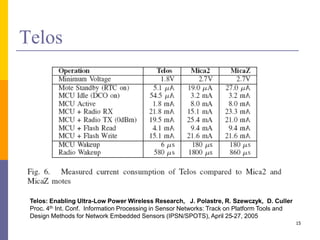
Telos
Telos: Enabling Ultra-Low Power Wireless Research, J. Polastre, R. Szewczyk, D. Culler
Proc. 4th Int. Conf. Information Processing in Sensor Networks: Track on Platform Tools and
Design Methods for Network Embedded Sensors (IPSN/SPOTS), April 25-27, 2005
15
Telos
Telos: Enabling Ultra-Low Power Wireless Research, J. Polastre, R. Szewczyk, D. Culler
Proc. 4th Int. Conf. Information Processing in Sensor Networks: Track on Platform Tools and
Design Methods for Network Embedded Sensors (IPSN/SPOTS), April 25-27, 2005
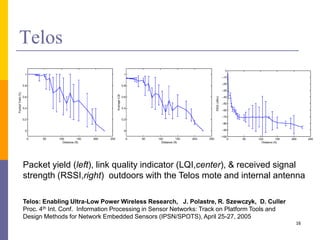
Packet yield (left), link quality indicator (LQI,center), & received signal
strength (RSSI,right) outdoors with the Telos mote and internal antenna
16
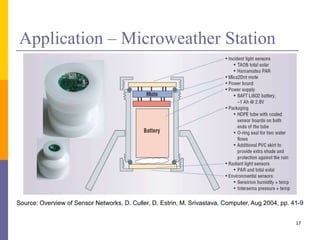
Application – Microweather Station
17
Source: Overview of Sensor Networks, D. Culler, D. Estrin, M. Srivastava, Computer, Aug 2004, pp. 41-9
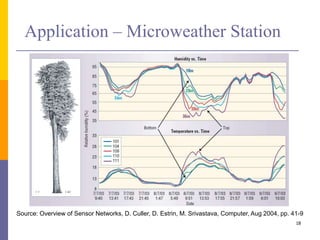
Application – Microweather Station
18
Source: Overview of Sensor Networks, D. Culler, D. Estrin, M. Srivastava, Computer, Aug 2004, pp. 41-9
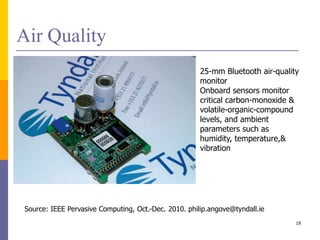
Air Quality
25-mm Bluetooth air-quality
monitor
Onboard sensors monitor
critical carbon-monoxide &
volatile-organic-compound
levels, and ambient
parameters such as
humidity, temperature,&
vibration
Source: IEEE Pervasive Computing, Oct.-Dec. 2010. philip.angove@tyndall.ie
19
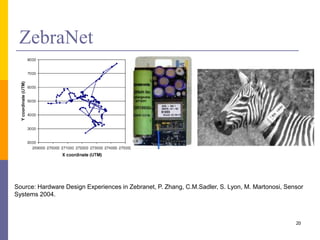
ZebraNet
Source: Hardware Design Experiences in Zebranet, P. Zhang, C.M.Sadler, S. Lyon, M. Martonosi, Sensor
Systems 2004.
20
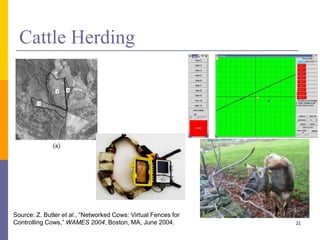
Cattle Herding
Source: Z. Butler et al., “Networked Cows: Virtual Fences for
Controlling Cows,” WAMES 2004, Boston, MA, June 2004. 21
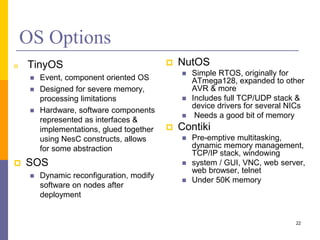
OS Options
 TinyOS
 Event, component oriented OS
 Designed for severe memory,
processing limitations
 Hardware, software components
represented as interfaces &
implementations, glued together
using NesC constructs, allows
for some abstraction
 SOS
 Dynamic reconfiguration, modify
software on nodes after
deployment
 NutOS
 Simple RTOS, originally for
ATmega128, expanded to other
AVR & more
 Includes full TCP/UDP stack &
device drivers for several NICs
 Needs a good bit of memory
 Contiki
 Pre-emptive multitasking,
dynamic memory management,
TCP/IP stack, windowing
 system / GUI, VNC, web server,
web browser, telnet
 Under 50K memory
22
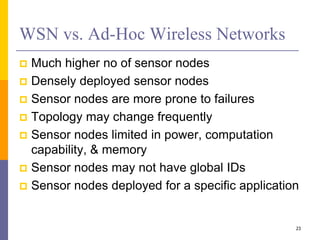
WSN vs. Ad-Hoc Wireless Networks
 Much higher no of sensor nodes
 Densely deployed sensor nodes
 Sensor nodes are more prone to failures
 Topology may change frequently
 Sensor nodes limited in power, computation
capability, & memory
 Sensor nodes may not have global IDs
 Sensor nodes deployed for a specific application
23
Physical Layer
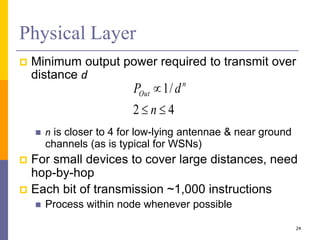
 Minimum output power required to transmit over
distance d
 n is closer to 4 for low-lying antennae & near ground
channels (as is typical for WSNs)
 For small devices to cover large distances, need
hop-by-hop
 Each bit of transmission ~1,000 instructions
 Process within node whenever possible
24
4
2
/
1



n
d
P n
Out
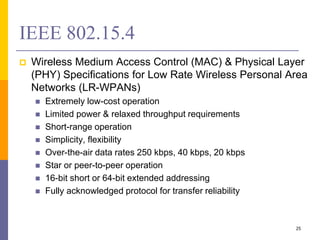
IEEE 802.15.4
 Wireless Medium Access Control (MAC) & Physical Layer
(PHY) Specifications for Low Rate Wireless Personal Area
Networks (LR-WPANs)
 Extremely low-cost operation
 Limited power & relaxed throughput requirements
 Short-range operation
 Simplicity, flexibility
 Over-the-air data rates 250 kbps, 40 kbps, 20 kbps
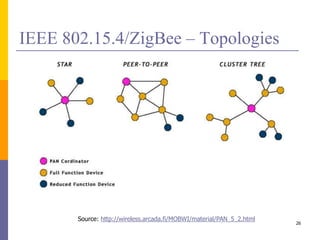
 Star or peer-to-peer operation
 16-bit short or 64-bit extended addressing
 Fully acknowledged protocol for transfer reliability
25
IEEE 802.15.4/ZigBee – Topologies
26
Source: http://wireless.arcada.fi/MOBWI/material/PAN_5_2.html
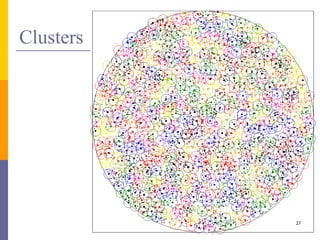
Clusters
27
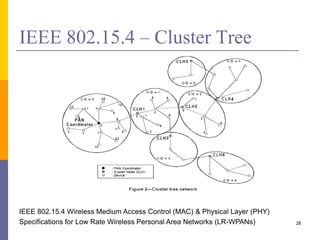
IEEE 802.15.4 – Cluster Tree
28
IEEE 802.15.4 Wireless Medium Access Control (MAC) & Physical Layer (PHY)
Specifications for Low Rate Wireless Personal Area Networks (LR-WPANs)
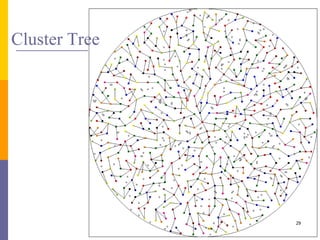
Cluster Tree
29
Power Consumption
 Microcontroller
 Examples
 StrongArm ~400mW/50mW/0.16mW
 ATmega103L 16.5mW
 Modes – Active, Idle, & Sleep
 Radio
 Modulation scheme
 Data rate
 Transmit power (distance)
 Duty cycle
 Modes – Transmit, Receive, Idle, & Sleep
30
Conserving Power
 Process locally, communicate only when necessary
 Compress data
 Avoid explicit protocol messages
 Piggy back on data
 Overhear packets destined to others
 Schedule transmissions to avoid contentions & time radio
has to remain alive
 Assign specific responsibilities to certain nodes
 E.g., retransmission, aggregation
 Reject uninteresting packets by turning off radio after
receiving only a fraction
31
Conserving Power (Cont.)
 Minimize waste due to
 Idle listening
 Over transmissions
 Overhearing
 Collisions
 Parameters
 Power consumption in Rx, Tx, & sleep modes
 Wake-up time
 Bit & frame synchronization time
 Receive strength indicator (RSSI)
 Message filtering
 Switching time between Tx & Rx
 Receive sensitivity & maximum Tx power
32
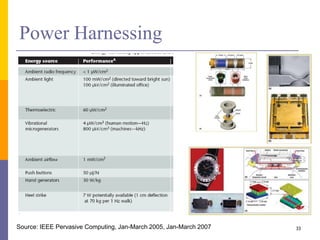
Power Harnessing
Source: IEEE Pervasive Computing, Jan-March 2005, Jan-March 2007 33
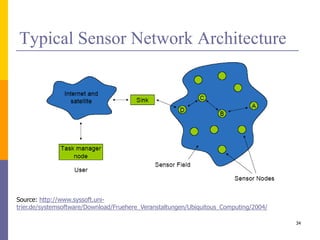
Typical Sensor Network Architecture
34
Source: http://www.syssoft.uni-
trier.de/systemsoftware/Download/Fruehere_Veranstaltungen/Ubiquitous_Computing/2004/
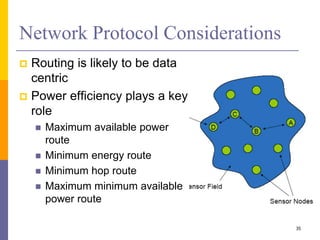
Network Protocol Considerations
 Routing is likely to be data
centric
 Power efficiency plays a key
role
 Maximum available power
route
 Minimum energy route
 Minimum hop route
 Maximum minimum available
power route
35
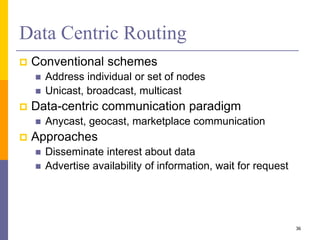
Data Centric Routing
 Conventional schemes
 Address individual or set of nodes
 Unicast, broadcast, multicast
 Data-centric communication paradigm
 Anycast, geocast, marketplace communication
 Approaches
 Disseminate interest about data
 Advertise availability of information, wait for request
36
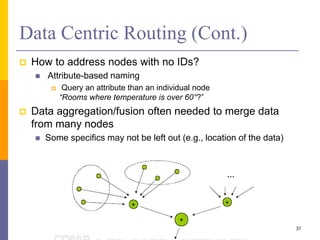
Data Centric Routing (Cont.)
 How to address nodes with no IDs?
 Attribute-based naming
 Query an attribute than an individual node
“Rooms where temperature is over 60°?”
 Data aggregation/fusion often needed to merge data
from many nodes
 Some specifics may not be left out (e.g., location of the data)
37
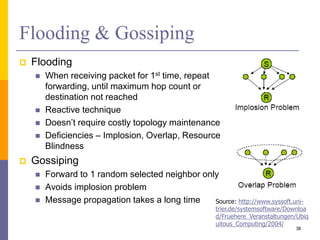
Flooding & Gossiping
 Flooding
 When receiving packet for 1st time, repeat
forwarding, until maximum hop count or
destination not reached
 Reactive technique
 Doesn’t require costly topology maintenance
 Deficiencies – Implosion, Overlap, Resource
Blindness
 Gossiping
 Forward to 1 random selected neighbor only
 Avoids implosion problem
 Message propagation takes a long time
38
Source: http://www.syssoft.uni-
trier.de/systemsoftware/Downloa
d/Fruehere_Veranstaltungen/Ubiq
uitous_Computing/2004/
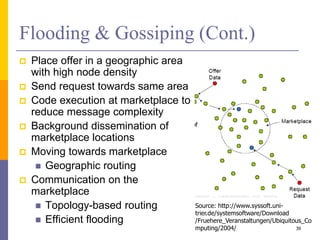
Flooding & Gossiping (Cont.)
 Place offer in a geographic area
with high node density
 Send request towards same area
 Code execution at marketplace to
reduce message complexity
 Background dissemination of
marketplace locations
 Moving towards marketplace
 Geographic routing
 Communication on the
marketplace
 Topology-based routing
 Efficient flooding
39
Source: http://www.syssoft.uni-
trier.de/systemsoftware/Download
/Fruehere_Veranstaltungen/Ubiquitous_Co
mputing/2004/
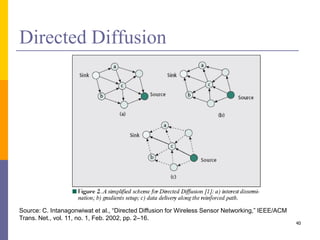
Directed Diffusion
40
Source: C. Intanagonwiwat et al., “Directed Diffusion for Wireless Sensor Networking,” IEEE/ACM
Trans. Net., vol. 11, no. 1, Feb. 2002, pp. 2–16.
Topology Control
 Topology – Which node is able to/allowed to
communicate with which node
 Networks can be too dense for efficient operation
 Too many collisions, high complexity (MAC)
 Too many paths to choose from (Routing)
 Topology Control
 Make topology less complex subject to restrictions (e.g.,
maintain connectivity)
 Control node activity (turn on/off nodes)
 Control link activity (turn on/off links)
 Flat networks (all nodes have same role)
 Hierarchical networks – Backbones, clustering
 Control power
41
0
1
2
3
4
5
6
0
1
2
3
4
5
0
0.5
1
1.5
2
2.5
7
8
9
6
27
10
5
28
12
X coordinate
42
33
4
30
35
29
11
13
14
3
34
32
37
36
17
31
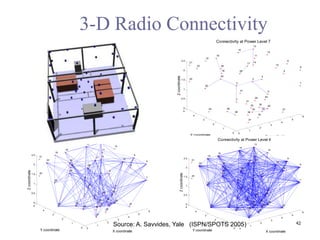
Connectivity at Power Level 7
41
25
15
1
2
38
39
18
26
24
16
Y coordinate
40
19
22
23
20
21
Z
coordinate
3-D Radio Connectivity
0
1
2
3
4
5
6
0
1
2
3
4
5
0
0.5
1
1.5
2
2.5
7
8
9
6
27
10
5
28
12
X coordinate
42
33
4
30
35
29
11
13
14
3
34
32
37
36
17
31
Connectivity at Power Level 6
41
25
15
1
2
38
39
18
26
24
16
Y coordinate
40
19
22
23
20
21
Z
coordinate
0
1
2
3
4
5
6
0
1
2
3
4
5
0
0.5
1
1.5
2
2.5
7
8
9
6
27
10
5
28
12
X coordinate
42
33
4
30
35
29
11
13
14
3
34
32
37
36
17
31
Connectivity at Power Level 4
41
25
15
1
2
38
39
18
26
24
16
Y coordinate
40
19
22
23
20
21
Z
coordinate
Source: A. Savvides, Yale (ISPN/SPOTS 2005) 42
Challenges
 Limited computation & data storage
 Low-power consumption
 Wireless communication
 Medium, ad hoc vs. infrastructure, topology & routing
 Data/sensor-related issues, e.g., calibration
 Continuous operation
 Inaccessibility – network adjustment & retasking
 Robustness & fault tolerance
 Wireless Sensor/Actuator networks (WSANs)
43
WSN – Options
 Deployment – Random vs. manual, One-time vs. iterative
 Mobility – Immobile, some mobile, all mobile
 Size – brick, matchbox, grain, dust
 Heterogeneity – Homogeneous vs. Heterogeneous
 Communication – Radio vs. light vs. inductive vs.
capacitive vs. sound
 Infrastructure vs. ad hoc
 Topology – Flat vs. hierarchical, single hop, multi-hop,
clusters, trees, graphs, etc.
 Coverage – Sparse vs. dense vs. redundant
 Connectivity – connected vs. intermittent vs. sporadic
44
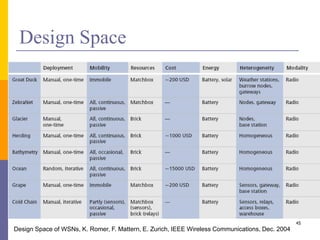
Design Space
45
Design Space of WSNs, K. Romer, F. Mattern, E. Zurich, IEEE Wireless Communications, Dec. 2004
Security of Sensor Networks
 Application
Requirements
 Data Confidentiality
 Data Authenticity
 Data Integrity
 Data Freshness
 . . .
 Vulnerabilities
 Physical attacks
 Eavesdropping
 Inject bits into the channel
 Replay previous packets
 Introduction of malicious
hardware
 Outsider attacks
 Insider attacks
 Hello floods
 Sink holes & wormholes
 . . .
46
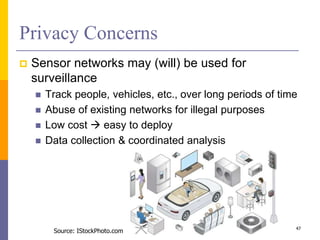
Privacy Concerns
 Sensor networks may (will) be used for
surveillance
 Track people, vehicles, etc., over long periods of time
 Abuse of existing networks for illegal purposes
 Low cost  easy to deploy
 Data collection & coordinated analysis
47
Source: IStockPhoto.com

Wireless sensor networks

  • 1.
    Wireless Sensor Networks CS4492 Wirelessand Broadband Networking Dilum Bandara Dilum.Bandara@uom.lk Slides extracted from Prof. Anura Jayasumana, Colorado State University
  • 2.
    Outline  Platforms  Transducers/Sensors& Standards  Protocols  MAC, routing, & transport  Powering nodes  Other issues 2
  • 3.
    Emerging World ofSensor Networks  Emerging information infrastructure that extends reach of networks to physical world  Dense collections of smart sensors, actuators, & processors that self-configure to network & process  Now comes under the umbrella of IoT  May be viewed as the next step in evolution of networking, following WWW & Internet  “sensor-network”  describe “wireless-sensor networks”  Consist tiny computing & sensing devices equipped with wireless communication capability  It has a much bigger scope & reach  Sensor-actuator networks, wireless sensor networks, distributed sensing networks, high & low speed collaborative adaptive systems, … 3
  • 4.
    Sensor-Actuator Networks –Bridging Physical & Digital Worlds RFIDs ……….Motes ……Cellphones …..Cameras…..….Radars, Observatories Small Low data rates Moderate data rates High data rates Power limited Not power limited Not power limited Processing limited Not processing limited Storage limited Not storage limited Very small Extremely low data rates No Power Little or no processing Little or no storage 4
  • 5.
    Wireless Sensor Networks(WSNs) Processor Sensor Wireless Tx/Rx 5 Source: www.cs.iit.edu/~winet/testbeds.html
  • 6.
    Wireless Sensor Networks(Cont.)  Wireless  Small, cheap  Can deploy in Tens, hundreds, & thousands  Fine grained picture of phenomena (e.g., climate)  Unattended operation  Ad-hoc deployment  Self powered  Self organizing  Spontaneously create impromptu network  Dynamically adapt to device failure, degradation, movement  Act cooperatively  Organize themselves & sharing computations  Provide usable chunks of predigested information than a bunch of numbers 6
  • 7.
    Mote/iMote/iBean 7 Low data rates Powerlimited Processing limited Storage limited Source: Technology Review (April 2004) EISTEC Mulle iMote2
  • 8.
  • 9.
    Platforms – MoteEvolution 9 The Mote Revolution: Low Power Wireless Sensor Network Devices, J. Polastre, R. Szewczyk, C. Sharp, D. Culler Hot Chips 16: A Symposium on High Performance Chips. August 22-24, 2004.
  • 10.
    Platforms – Motes/Smart Dust  Wireless Communication  Power Limitations  Limited CPU Power  Limited Memory 10 CPU 8-bit, 4MHZ Storage 8kB Flash (Instructions) 512B RAM, 512B EEPROM Communication 10kBps over 916 MHz radio Operating System Tiny OS (3500B) Available code space 4500 B Source: Wireless Networks 8, 521-534, 2002
  • 11.
  • 12.
    Platforms – IBM& Libelium Microcontroller: ATmega1281 Frequency: 14MHz SRAM: 8KB EEPROM: 4KB FLASH: 128KB Weight: 20gr Dimensions: 73.5 x 51 x 13 mm Clock: RTC (32KHz) Power On - 15 mA, Sleep – 55 uA 12 Chipset: AT86RF231 Frequency: 2.4GHz Link Protocol: IEEE 802.15.4 Sensitivity: -101dBm Output Power: 3dBm Encryption: AES 128b Send IPv6 packs over 802.15.4
  • 13.
    Radios Telos: Enabling Ultra-LowPower Wireless Research, J. Polastre, R. Szewczyk, D. Culler Proc. 4th Int. Conf. Information Processing in Sensor Networks: Track on Platform Tools and Design Methods for Network Embedded Sensors (IPSN/SPOTS), April 25-27, 2005 13
  • 14.
    Microcontrollers Telos: Enabling Ultra-LowPower Wireless Research, J. Polastre, R. Szewczyk, D. Culler Proc. 4th Int. Conf. Information Processing in Sensor Networks: Track on Platform Tools and Design Methods for Network Embedded Sensors (IPSN/SPOTS), April 25-27, 2005 14
  • 15.
    Telos Telos: Enabling Ultra-LowPower Wireless Research, J. Polastre, R. Szewczyk, D. Culler Proc. 4th Int. Conf. Information Processing in Sensor Networks: Track on Platform Tools and Design Methods for Network Embedded Sensors (IPSN/SPOTS), April 25-27, 2005 15
  • 16.
    Telos Telos: Enabling Ultra-LowPower Wireless Research, J. Polastre, R. Szewczyk, D. Culler Proc. 4th Int. Conf. Information Processing in Sensor Networks: Track on Platform Tools and Design Methods for Network Embedded Sensors (IPSN/SPOTS), April 25-27, 2005 Packet yield (left), link quality indicator (LQI,center), & received signal strength (RSSI,right) outdoors with the Telos mote and internal antenna 16
  • 17.
    Application – MicroweatherStation 17 Source: Overview of Sensor Networks, D. Culler, D. Estrin, M. Srivastava, Computer, Aug 2004, pp. 41-9
  • 18.
    Application – MicroweatherStation 18 Source: Overview of Sensor Networks, D. Culler, D. Estrin, M. Srivastava, Computer, Aug 2004, pp. 41-9
  • 19.
    Air Quality 25-mm Bluetoothair-quality monitor Onboard sensors monitor critical carbon-monoxide & volatile-organic-compound levels, and ambient parameters such as humidity, temperature,& vibration Source: IEEE Pervasive Computing, Oct.-Dec. 2010. philip.angove@tyndall.ie 19
  • 20.
    ZebraNet Source: Hardware DesignExperiences in Zebranet, P. Zhang, C.M.Sadler, S. Lyon, M. Martonosi, Sensor Systems 2004. 20
  • 21.
    Cattle Herding Source: Z.Butler et al., “Networked Cows: Virtual Fences for Controlling Cows,” WAMES 2004, Boston, MA, June 2004. 21
  • 22.
    OS Options  TinyOS Event, component oriented OS  Designed for severe memory, processing limitations  Hardware, software components represented as interfaces & implementations, glued together using NesC constructs, allows for some abstraction  SOS  Dynamic reconfiguration, modify software on nodes after deployment  NutOS  Simple RTOS, originally for ATmega128, expanded to other AVR & more  Includes full TCP/UDP stack & device drivers for several NICs  Needs a good bit of memory  Contiki  Pre-emptive multitasking, dynamic memory management, TCP/IP stack, windowing  system / GUI, VNC, web server, web browser, telnet  Under 50K memory 22
  • 23.
    WSN vs. Ad-HocWireless Networks  Much higher no of sensor nodes  Densely deployed sensor nodes  Sensor nodes are more prone to failures  Topology may change frequently  Sensor nodes limited in power, computation capability, & memory  Sensor nodes may not have global IDs  Sensor nodes deployed for a specific application 23
  • 24.
    Physical Layer  Minimumoutput power required to transmit over distance d  n is closer to 4 for low-lying antennae & near ground channels (as is typical for WSNs)  For small devices to cover large distances, need hop-by-hop  Each bit of transmission ~1,000 instructions  Process within node whenever possible 24 4 2 / 1    n d P n Out
  • 25.
    IEEE 802.15.4  WirelessMedium Access Control (MAC) & Physical Layer (PHY) Specifications for Low Rate Wireless Personal Area Networks (LR-WPANs)  Extremely low-cost operation  Limited power & relaxed throughput requirements  Short-range operation  Simplicity, flexibility  Over-the-air data rates 250 kbps, 40 kbps, 20 kbps  Star or peer-to-peer operation  16-bit short or 64-bit extended addressing  Fully acknowledged protocol for transfer reliability 25
  • 26.
    IEEE 802.15.4/ZigBee –Topologies 26 Source: http://wireless.arcada.fi/MOBWI/material/PAN_5_2.html
  • 27.
  • 28.
    IEEE 802.15.4 –Cluster Tree 28 IEEE 802.15.4 Wireless Medium Access Control (MAC) & Physical Layer (PHY) Specifications for Low Rate Wireless Personal Area Networks (LR-WPANs)
  • 29.
  • 30.
    Power Consumption  Microcontroller Examples  StrongArm ~400mW/50mW/0.16mW  ATmega103L 16.5mW  Modes – Active, Idle, & Sleep  Radio  Modulation scheme  Data rate  Transmit power (distance)  Duty cycle  Modes – Transmit, Receive, Idle, & Sleep 30
  • 31.
    Conserving Power  Processlocally, communicate only when necessary  Compress data  Avoid explicit protocol messages  Piggy back on data  Overhear packets destined to others  Schedule transmissions to avoid contentions & time radio has to remain alive  Assign specific responsibilities to certain nodes  E.g., retransmission, aggregation  Reject uninteresting packets by turning off radio after receiving only a fraction 31
  • 32.
    Conserving Power (Cont.) Minimize waste due to  Idle listening  Over transmissions  Overhearing  Collisions  Parameters  Power consumption in Rx, Tx, & sleep modes  Wake-up time  Bit & frame synchronization time  Receive strength indicator (RSSI)  Message filtering  Switching time between Tx & Rx  Receive sensitivity & maximum Tx power 32
  • 33.
    Power Harnessing Source: IEEEPervasive Computing, Jan-March 2005, Jan-March 2007 33
  • 34.
    Typical Sensor NetworkArchitecture 34 Source: http://www.syssoft.uni- trier.de/systemsoftware/Download/Fruehere_Veranstaltungen/Ubiquitous_Computing/2004/
  • 35.
    Network Protocol Considerations Routing is likely to be data centric  Power efficiency plays a key role  Maximum available power route  Minimum energy route  Minimum hop route  Maximum minimum available power route 35
  • 36.
    Data Centric Routing Conventional schemes  Address individual or set of nodes  Unicast, broadcast, multicast  Data-centric communication paradigm  Anycast, geocast, marketplace communication  Approaches  Disseminate interest about data  Advertise availability of information, wait for request 36
  • 37.
    Data Centric Routing(Cont.)  How to address nodes with no IDs?  Attribute-based naming  Query an attribute than an individual node “Rooms where temperature is over 60°?”  Data aggregation/fusion often needed to merge data from many nodes  Some specifics may not be left out (e.g., location of the data) 37
  • 38.
    Flooding & Gossiping Flooding  When receiving packet for 1st time, repeat forwarding, until maximum hop count or destination not reached  Reactive technique  Doesn’t require costly topology maintenance  Deficiencies – Implosion, Overlap, Resource Blindness  Gossiping  Forward to 1 random selected neighbor only  Avoids implosion problem  Message propagation takes a long time 38 Source: http://www.syssoft.uni- trier.de/systemsoftware/Downloa d/Fruehere_Veranstaltungen/Ubiq uitous_Computing/2004/
  • 39.
    Flooding & Gossiping(Cont.)  Place offer in a geographic area with high node density  Send request towards same area  Code execution at marketplace to reduce message complexity  Background dissemination of marketplace locations  Moving towards marketplace  Geographic routing  Communication on the marketplace  Topology-based routing  Efficient flooding 39 Source: http://www.syssoft.uni- trier.de/systemsoftware/Download /Fruehere_Veranstaltungen/Ubiquitous_Co mputing/2004/
  • 40.
    Directed Diffusion 40 Source: C.Intanagonwiwat et al., “Directed Diffusion for Wireless Sensor Networking,” IEEE/ACM Trans. Net., vol. 11, no. 1, Feb. 2002, pp. 2–16.
  • 41.
    Topology Control  Topology– Which node is able to/allowed to communicate with which node  Networks can be too dense for efficient operation  Too many collisions, high complexity (MAC)  Too many paths to choose from (Routing)  Topology Control  Make topology less complex subject to restrictions (e.g., maintain connectivity)  Control node activity (turn on/off nodes)  Control link activity (turn on/off links)  Flat networks (all nodes have same role)  Hierarchical networks – Backbones, clustering  Control power 41
  • 42.
    0 1 2 3 4 5 6 0 1 2 3 4 5 0 0.5 1 1.5 2 2.5 7 8 9 6 27 10 5 28 12 X coordinate 42 33 4 30 35 29 11 13 14 3 34 32 37 36 17 31 Connectivity atPower Level 7 41 25 15 1 2 38 39 18 26 24 16 Y coordinate 40 19 22 23 20 21 Z coordinate 3-D Radio Connectivity 0 1 2 3 4 5 6 0 1 2 3 4 5 0 0.5 1 1.5 2 2.5 7 8 9 6 27 10 5 28 12 X coordinate 42 33 4 30 35 29 11 13 14 3 34 32 37 36 17 31 Connectivity at Power Level 6 41 25 15 1 2 38 39 18 26 24 16 Y coordinate 40 19 22 23 20 21 Z coordinate 0 1 2 3 4 5 6 0 1 2 3 4 5 0 0.5 1 1.5 2 2.5 7 8 9 6 27 10 5 28 12 X coordinate 42 33 4 30 35 29 11 13 14 3 34 32 37 36 17 31 Connectivity at Power Level 4 41 25 15 1 2 38 39 18 26 24 16 Y coordinate 40 19 22 23 20 21 Z coordinate Source: A. Savvides, Yale (ISPN/SPOTS 2005) 42
  • 43.
    Challenges  Limited computation& data storage  Low-power consumption  Wireless communication  Medium, ad hoc vs. infrastructure, topology & routing  Data/sensor-related issues, e.g., calibration  Continuous operation  Inaccessibility – network adjustment & retasking  Robustness & fault tolerance  Wireless Sensor/Actuator networks (WSANs) 43
  • 44.
    WSN – Options Deployment – Random vs. manual, One-time vs. iterative  Mobility – Immobile, some mobile, all mobile  Size – brick, matchbox, grain, dust  Heterogeneity – Homogeneous vs. Heterogeneous  Communication – Radio vs. light vs. inductive vs. capacitive vs. sound  Infrastructure vs. ad hoc  Topology – Flat vs. hierarchical, single hop, multi-hop, clusters, trees, graphs, etc.  Coverage – Sparse vs. dense vs. redundant  Connectivity – connected vs. intermittent vs. sporadic 44
  • 45.
    Design Space 45 Design Spaceof WSNs, K. Romer, F. Mattern, E. Zurich, IEEE Wireless Communications, Dec. 2004
  • 46.
    Security of SensorNetworks  Application Requirements  Data Confidentiality  Data Authenticity  Data Integrity  Data Freshness  . . .  Vulnerabilities  Physical attacks  Eavesdropping  Inject bits into the channel  Replay previous packets  Introduction of malicious hardware  Outsider attacks  Insider attacks  Hello floods  Sink holes & wormholes  . . . 46
  • 47.
    Privacy Concerns  Sensornetworks may (will) be used for surveillance  Track people, vehicles, etc., over long periods of time  Abuse of existing networks for illegal purposes  Low cost  easy to deploy  Data collection & coordinated analysis 47 Source: IStockPhoto.com