Wireless Body Area Networks
for healthcare
Outline :
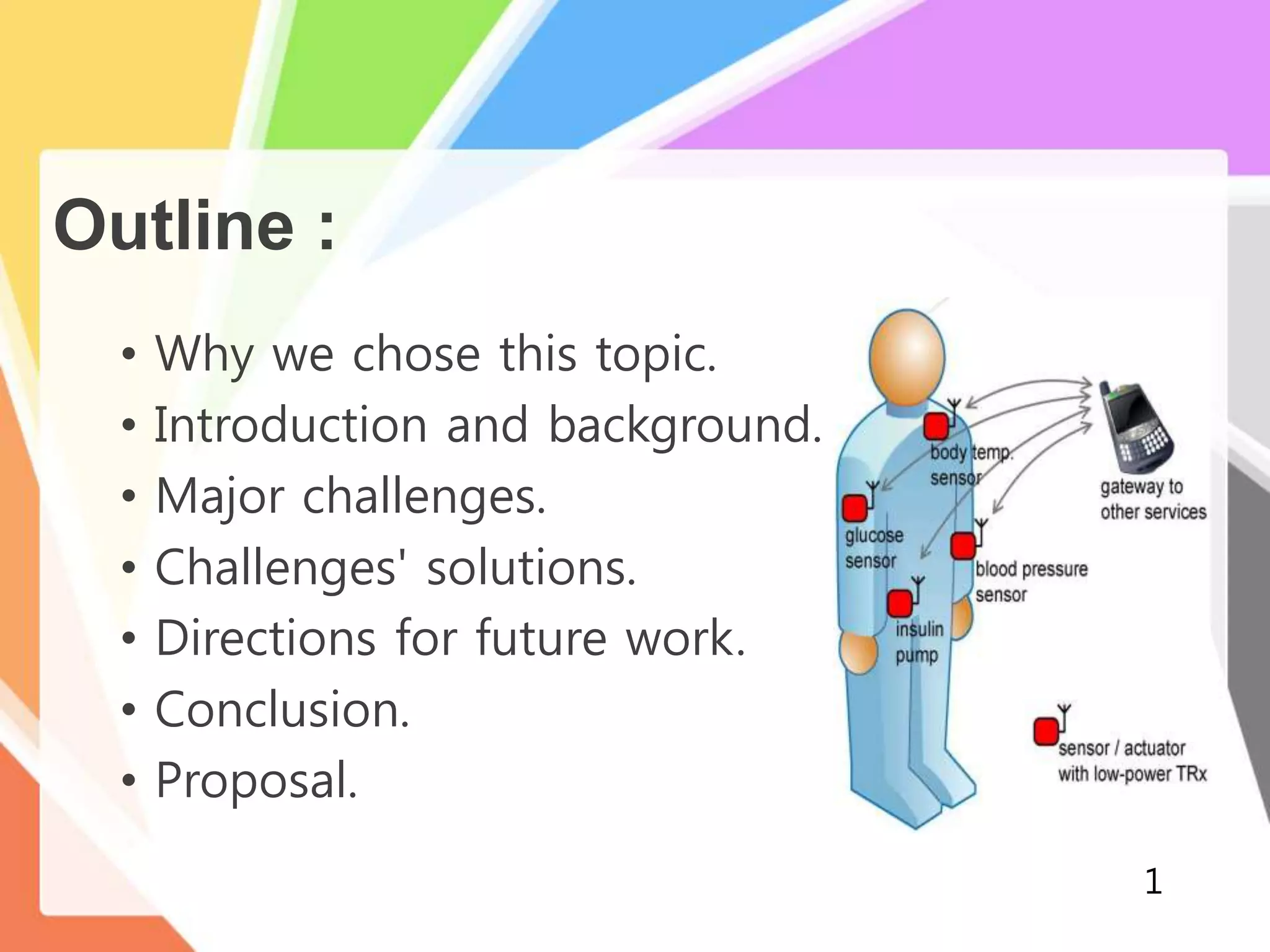
• Why we chose this topic.
• Introduction and background.
• Major challenges.
• Challenges' solutions.
• Directions for future work.
• Conclusion.
• Proposal.
1
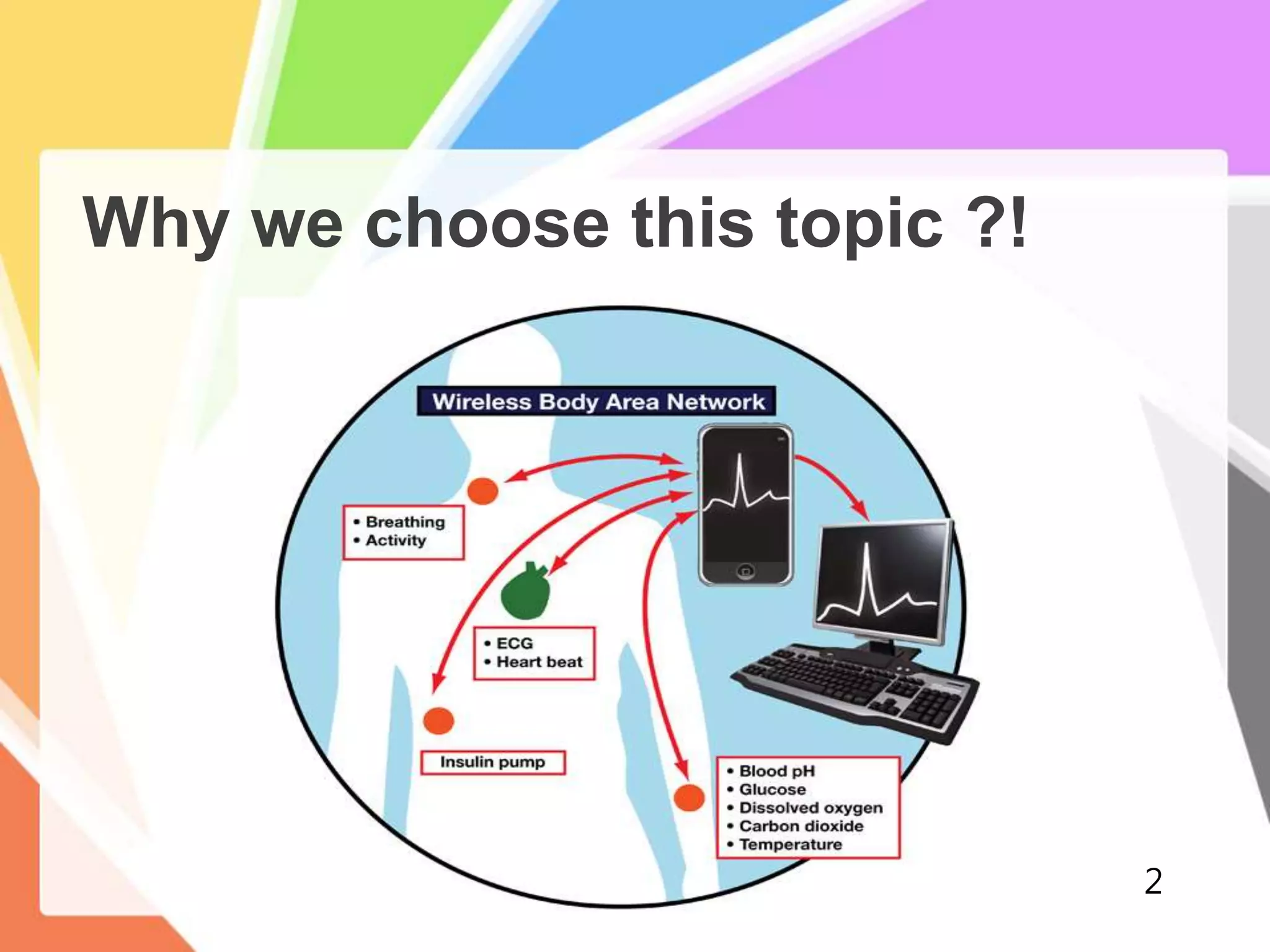
Why we choose this topic ?!
2
Introduction and Background :
What is the problem?
Elderly people, chronic diseases, and health consciousness
of community, etc.
So..
There is a need for providing a health service that
facilitates and improves the human health.
3
Introduction and Background :
How they addressed the need?
A wireless body area network (WBAN) is a collection of
wireless sensor nodes that are situated either inside or
outside the human body for monitoring the outside
environment and functions of the body.
4
Introduction and Background :
What are the advantages of WBAN?
• WBAN allows the patients to get their health
conditions monitored wherever they are without
restricting their mobility.
• Doctors can still access the data and give their
patients advices based on these data.
5
Major challenges
WBAN is the
network around
the human body
Reliability
Energy
Efficiency
Security
and
privacy Network
coexistence
Scalability
Quality-
of-service
Low cost
6
Major challenges
Physical layer challenges Energy consumption
• Medical sensors have a requirement of being
always activated to continually collect and transmit
patient’s data to care givers and hospitals.
• Energy consumption is a very sensitive issue, especially
in the implantable body sensors; it needs a body surgery
in order to replace the batteries
7
Major challenges
Physical layer challenges Energy consumption
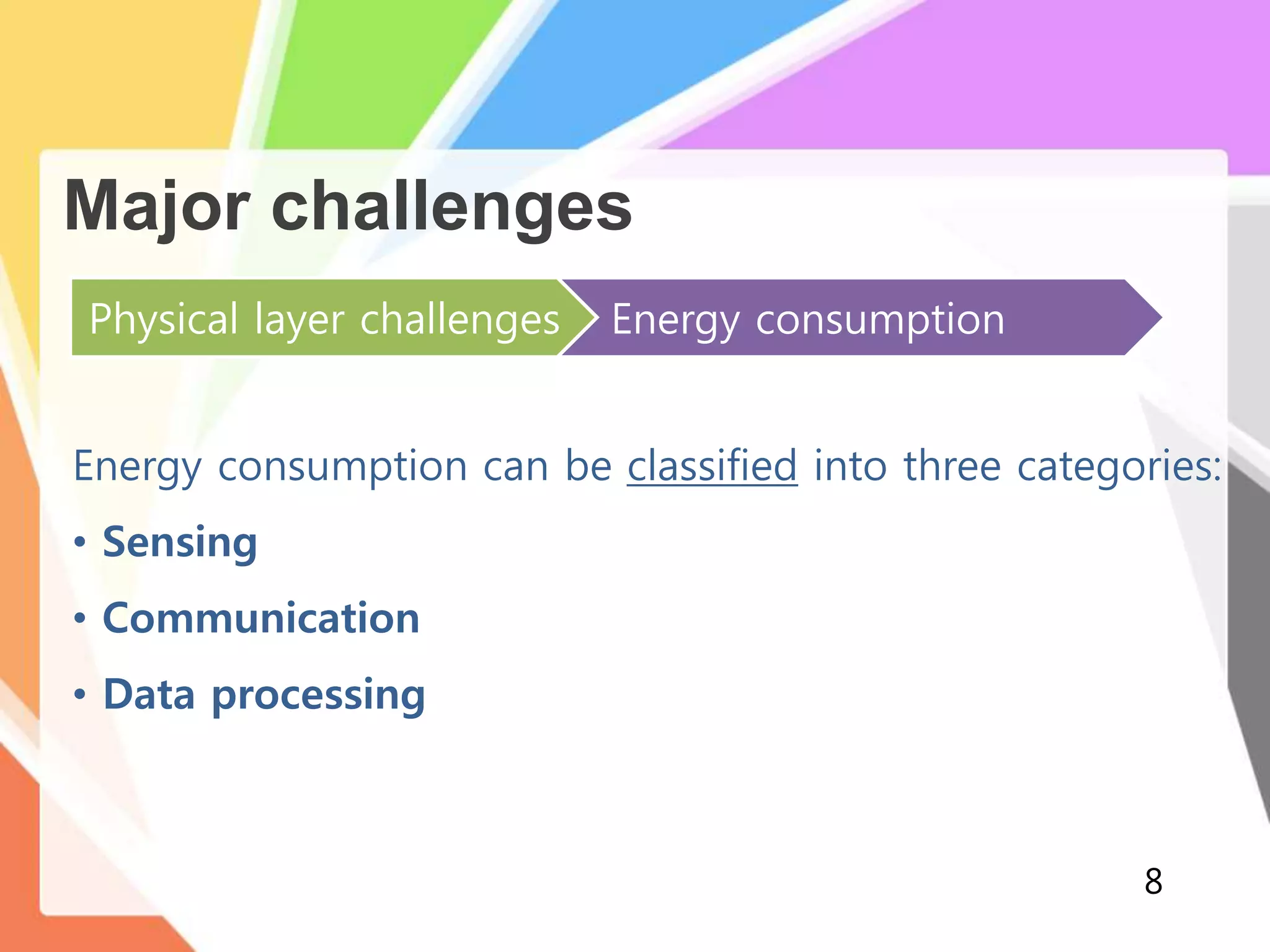
Energy consumption can be classified into three categories:
• Sensing
• Communication
• Data processing
8
Major challenges
Physical layer challenges Energy consumption
The communication between the body sensors and body
sensors with the personal device (PD) is consuming more
energy than the computational process ??!
8
Major challenges
Physical layer challenges Energy consumption
Because of:
• Idle listening and over hearing of packets.
• The cryptographic operation, which needed for the high
security requirement.
10
Challenges' Solutions:
TMAC (Time-Out Mac) protocol, which is one of the
most energy efficient protocol used in WBAN.
Based on “Duty-Cycling”
It suffers from “Early Sleeping Mode”
Physical layer challenges Energy consumption
11
Major challenges
Transport layer challenges Reliable transfer of data
Some reasons
lead to
unreliable data
transmission
Corrupted
sensors
Disrupted
connectivity
Patient
with
sweating
Health state
degradation
False
treatment
Heart
attack
12
Major challenges
Transport layer challenges Reliable transfer of data
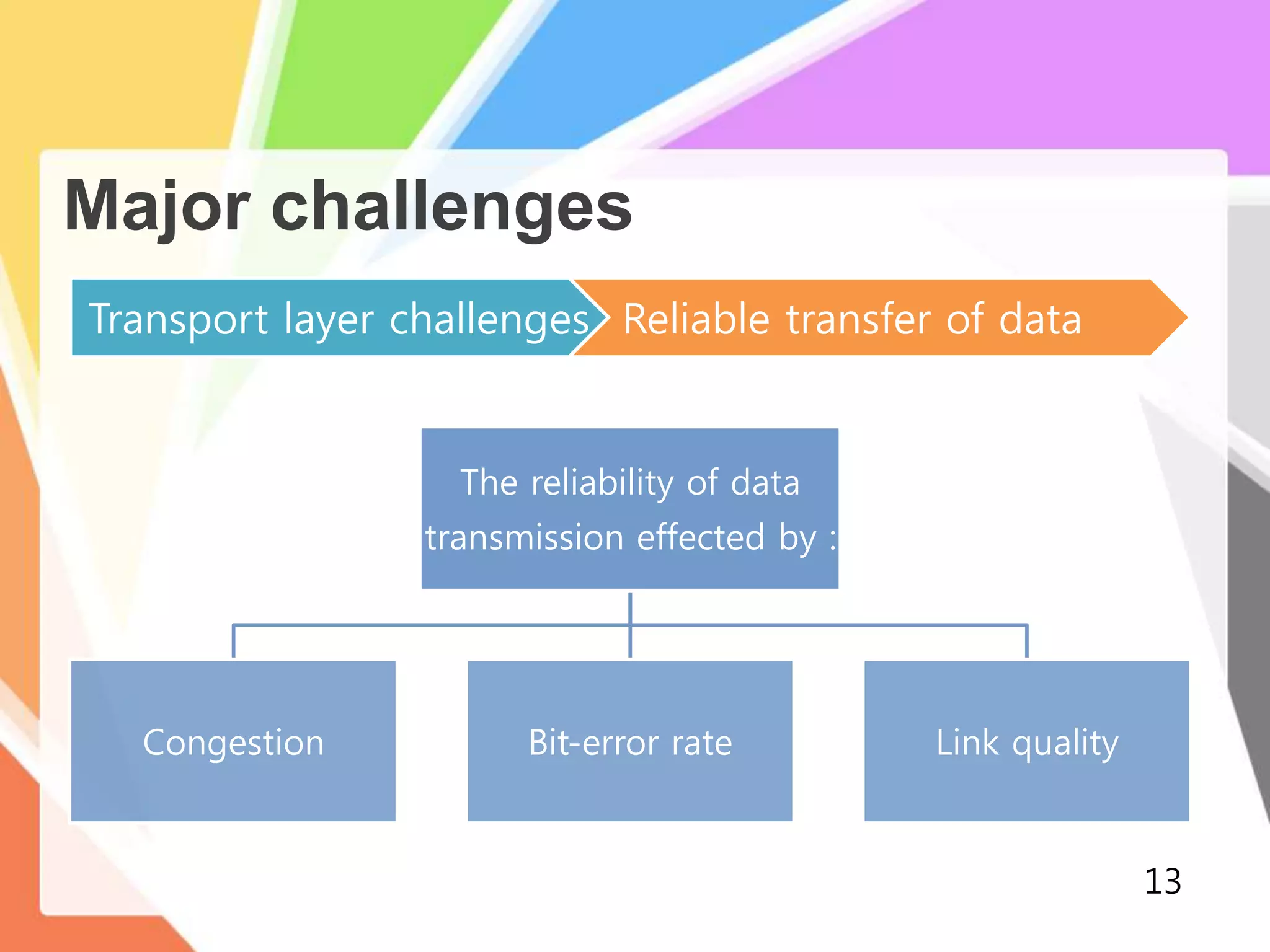
The reliability of data
transmission effected by :
Congestion Bit-error rate Link quality
13
Major challenges
Transport layer challenges Reliable transfer of data
• The error rate for medical data transfer must be
decreased to improve network reliability.
• The reliable data transmission should be investigated
for low power body sensor networks
14
Challenges' Solutions:
Approach to creating reliable WBANS called
Cooperative Network Coding (CNC).
Transport layer challenges Reliable transfer of data
15
Challenges' Solutions:
CNC increase the reliability :
Because, if any of the nodes fail, the packets can
still be transmitted by the other nodes to the desti
nation. Also, if any of the links fail, the data con
go through other paths without the need of retran
smissions.
Transport layer challenges Reliable transfer of data
16
Major challenges
Independent challenges Security and privacy
• The challenges are come from the resource constraints
of WBAN devices and the high demand of both security
and privacy with practicality and usability.
17
Major challenges
Independent challenges Security and privacy
The requirement of security and privacy :
• The privacy of patients may be
violated if the data gathered from a
monitored patient is accessible by
unauthorized users, whether the
data accessed while it is stored
inside the WBAN or during their
transmission outside the WBAN.
Data
confidentiality
18
Major challenges
Independent challenges Security and privacy
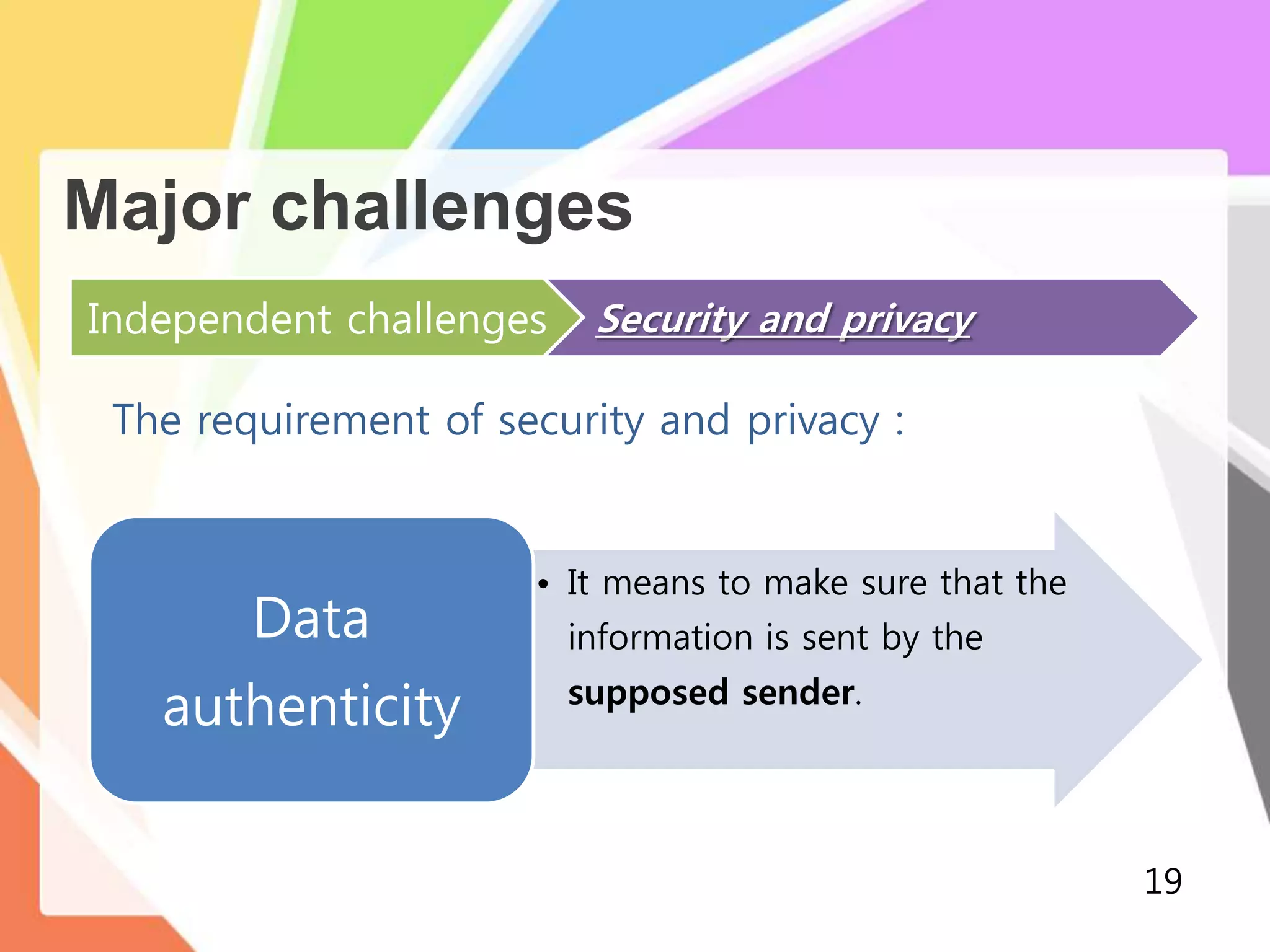
The requirement of security and privacy :
• It means to make sure that the
information is sent by the
supposed sender.
Data
authenticity
19
Major challenges
Independent challenges Security and privacy
The requirement of security and privacy :
• It means to make sure that the
received information has not
been manipulated.
Data integrity
20
Major challenges
Independent challenges Security and privacy
•The data must be encrypted and should be available
to healthcare providers even with the denial-of-service
(DoS) attacks and should be recoverable even if the
data fail.
• The traffic has to be always encrypted, authenticated
and impossible to be modified in the way to the
destination.
21
Major challenges
Independent challenges Security and privacy
• The sensors must know what network they belong to
them because the communications between sensors in
different WBANs can easily cross over when people get
in close.
22
Challenges' Solutions:
 Security and privacy:
data
confidentiality
The doctor must encrypt the Information
before sending it using a secret key either
Symmetrically or asymmetrically
data
authenticity
Message Authentication Code (MAC3) is
calculated using a shared secret key
data integrity
Need to verify the MAC to guarantee that
the received data is the last message and not
replayed a tampered message
23
Challenges' Solutions:
 Security and privacy:
-Another security solution by using TinySec an
d ZigBee network layer(NWK)
24
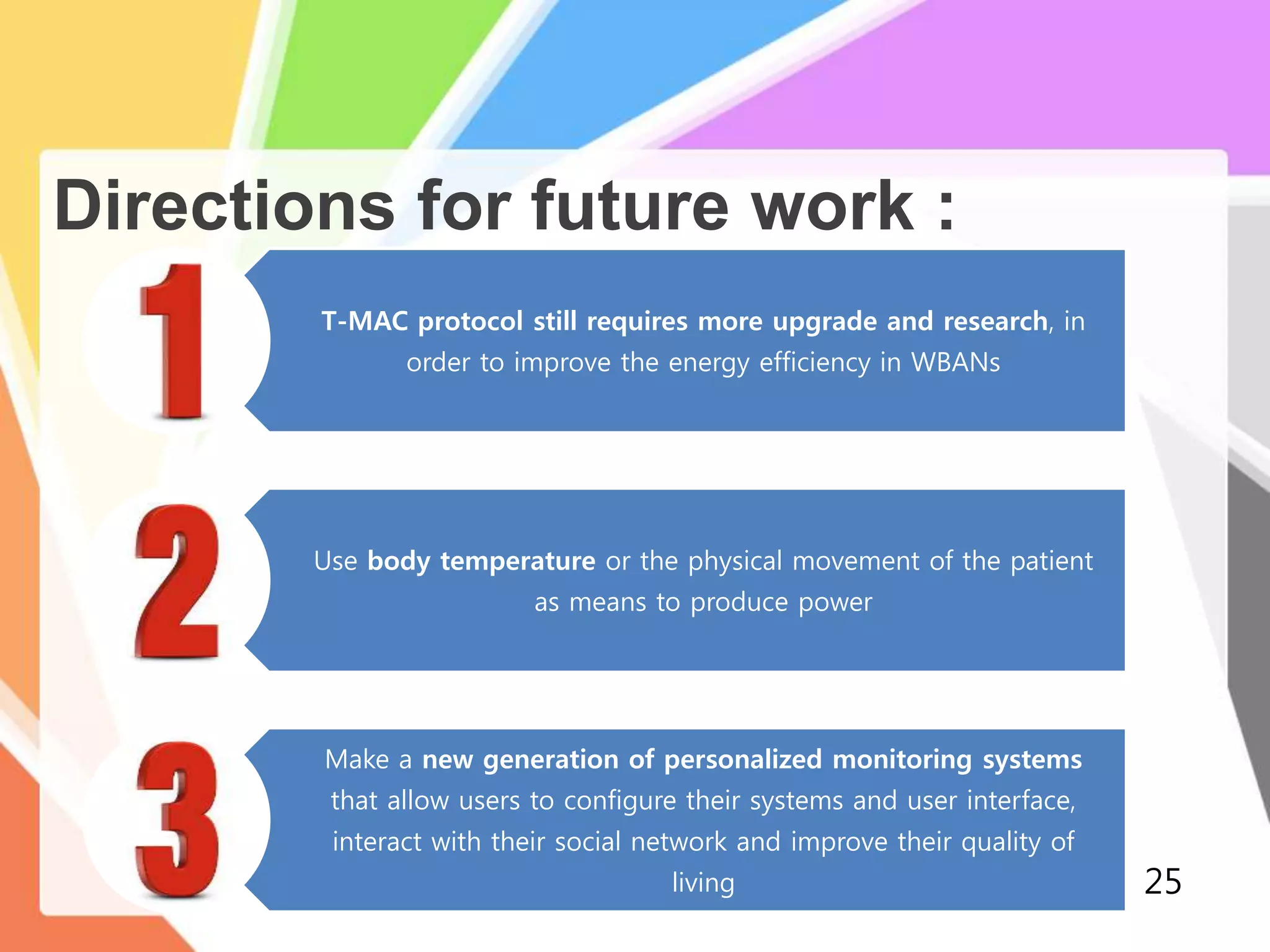
Directions for future work :
T-MAC protocol still requires more upgrade and research, in
order to improve the energy efficiency in WBANs
Use body temperature or the physical movement of the patient
as means to produce power
Make a new generation of personalized monitoring systems
that allow users to configure their systems and user interface,
interact with their social network and improve their quality of
living 25
Directions for future work :
26
Make the data available and retrieve it easily;
by stored in Cloud Servers
Google Cloud Messaging (GCM) can be used for better
message delivery and for improving the battery
performance
Conclusion
Since the energy is the most critical and challenge
issue in WBAN, we decided to complete our
research on “Energy Consumption” and propose
a solution to it.
28
Done By :
32
References :
[1] B. Yu, 'Wireless Body Area Networks for Healthcare: A Feasibility Study', 2009.
[2] A. Arya and N. Bilandi, 'A Review: Wireless Body Area Networks for Health Care'
, International Journal of Innovative Research in Computer and Communication En
gineering, vol. 2, no. 4, 2014.
[3] L. Filipe, F. Fdez-Riverola, N. Costa and A. Pereira, 'Wireless Body Area Networks
for Healthcare Applications: Protocol Stack Review', International Journal of Distrib
uted Sensor Networks, vol. 2015, pp. 1-23, 2015.
[4] H. Yoo, 'Wireless Body Area Network and its Healthcare Applications', 2013.
[5] S. Song, N. Cho and H. Yoo, 'A 0.2-mW 2-Mb/s Digital Transceiver Based on Wi
deband Signaling for Human Body Communications', IEEE J. Solid-State Circuits, vo
l. 42, no. 9, pp. 2021-2033, 2007.
32
Thank you for listening …
34

Wireless Body Area Networks for healthcare (Wban)

  • 1.
    Wireless Body AreaNetworks for healthcare
  • 2.
    Outline : • Whywe chose this topic. • Introduction and background. • Major challenges. • Challenges' solutions. • Directions for future work. • Conclusion. • Proposal. 1
  • 3.
    Why we choosethis topic ?! 2
  • 4.
    Introduction and Background: What is the problem? Elderly people, chronic diseases, and health consciousness of community, etc. So.. There is a need for providing a health service that facilitates and improves the human health. 3
  • 5.
    Introduction and Background: How they addressed the need? A wireless body area network (WBAN) is a collection of wireless sensor nodes that are situated either inside or outside the human body for monitoring the outside environment and functions of the body. 4
  • 6.
    Introduction and Background: What are the advantages of WBAN? • WBAN allows the patients to get their health conditions monitored wherever they are without restricting their mobility. • Doctors can still access the data and give their patients advices based on these data. 5
  • 7.
    Major challenges WBAN isthe network around the human body Reliability Energy Efficiency Security and privacy Network coexistence Scalability Quality- of-service Low cost 6
  • 8.
    Major challenges Physical layerchallenges Energy consumption • Medical sensors have a requirement of being always activated to continually collect and transmit patient’s data to care givers and hospitals. • Energy consumption is a very sensitive issue, especially in the implantable body sensors; it needs a body surgery in order to replace the batteries 7
  • 9.
    Major challenges Physical layerchallenges Energy consumption Energy consumption can be classified into three categories: • Sensing • Communication • Data processing 8
  • 10.
    Major challenges Physical layerchallenges Energy consumption The communication between the body sensors and body sensors with the personal device (PD) is consuming more energy than the computational process ??! 8
  • 11.
    Major challenges Physical layerchallenges Energy consumption Because of: • Idle listening and over hearing of packets. • The cryptographic operation, which needed for the high security requirement. 10
  • 12.
    Challenges' Solutions: TMAC (Time-OutMac) protocol, which is one of the most energy efficient protocol used in WBAN. Based on “Duty-Cycling” It suffers from “Early Sleeping Mode” Physical layer challenges Energy consumption 11
  • 13.
    Major challenges Transport layerchallenges Reliable transfer of data Some reasons lead to unreliable data transmission Corrupted sensors Disrupted connectivity Patient with sweating Health state degradation False treatment Heart attack 12
  • 14.
    Major challenges Transport layerchallenges Reliable transfer of data The reliability of data transmission effected by : Congestion Bit-error rate Link quality 13
  • 15.
    Major challenges Transport layerchallenges Reliable transfer of data • The error rate for medical data transfer must be decreased to improve network reliability. • The reliable data transmission should be investigated for low power body sensor networks 14
  • 16.
    Challenges' Solutions: Approach tocreating reliable WBANS called Cooperative Network Coding (CNC). Transport layer challenges Reliable transfer of data 15
  • 17.
    Challenges' Solutions: CNC increasethe reliability : Because, if any of the nodes fail, the packets can still be transmitted by the other nodes to the desti nation. Also, if any of the links fail, the data con go through other paths without the need of retran smissions. Transport layer challenges Reliable transfer of data 16
  • 18.
    Major challenges Independent challengesSecurity and privacy • The challenges are come from the resource constraints of WBAN devices and the high demand of both security and privacy with practicality and usability. 17
  • 19.
    Major challenges Independent challengesSecurity and privacy The requirement of security and privacy : • The privacy of patients may be violated if the data gathered from a monitored patient is accessible by unauthorized users, whether the data accessed while it is stored inside the WBAN or during their transmission outside the WBAN. Data confidentiality 18
  • 20.
    Major challenges Independent challengesSecurity and privacy The requirement of security and privacy : • It means to make sure that the information is sent by the supposed sender. Data authenticity 19
  • 21.
    Major challenges Independent challengesSecurity and privacy The requirement of security and privacy : • It means to make sure that the received information has not been manipulated. Data integrity 20
  • 22.
    Major challenges Independent challengesSecurity and privacy •The data must be encrypted and should be available to healthcare providers even with the denial-of-service (DoS) attacks and should be recoverable even if the data fail. • The traffic has to be always encrypted, authenticated and impossible to be modified in the way to the destination. 21
  • 23.
    Major challenges Independent challengesSecurity and privacy • The sensors must know what network they belong to them because the communications between sensors in different WBANs can easily cross over when people get in close. 22
  • 24.
    Challenges' Solutions:  Securityand privacy: data confidentiality The doctor must encrypt the Information before sending it using a secret key either Symmetrically or asymmetrically data authenticity Message Authentication Code (MAC3) is calculated using a shared secret key data integrity Need to verify the MAC to guarantee that the received data is the last message and not replayed a tampered message 23
  • 25.
    Challenges' Solutions:  Securityand privacy: -Another security solution by using TinySec an d ZigBee network layer(NWK) 24
  • 26.
    Directions for futurework : T-MAC protocol still requires more upgrade and research, in order to improve the energy efficiency in WBANs Use body temperature or the physical movement of the patient as means to produce power Make a new generation of personalized monitoring systems that allow users to configure their systems and user interface, interact with their social network and improve their quality of living 25
  • 27.
    Directions for futurework : 26 Make the data available and retrieve it easily; by stored in Cloud Servers Google Cloud Messaging (GCM) can be used for better message delivery and for improving the battery performance
  • 28.
    Conclusion Since the energyis the most critical and challenge issue in WBAN, we decided to complete our research on “Energy Consumption” and propose a solution to it. 28
  • 29.
  • 30.
    References : [1] B.Yu, 'Wireless Body Area Networks for Healthcare: A Feasibility Study', 2009. [2] A. Arya and N. Bilandi, 'A Review: Wireless Body Area Networks for Health Care' , International Journal of Innovative Research in Computer and Communication En gineering, vol. 2, no. 4, 2014. [3] L. Filipe, F. Fdez-Riverola, N. Costa and A. Pereira, 'Wireless Body Area Networks for Healthcare Applications: Protocol Stack Review', International Journal of Distrib uted Sensor Networks, vol. 2015, pp. 1-23, 2015. [4] H. Yoo, 'Wireless Body Area Network and its Healthcare Applications', 2013. [5] S. Song, N. Cho and H. Yoo, 'A 0.2-mW 2-Mb/s Digital Transceiver Based on Wi deband Signaling for Human Body Communications', IEEE J. Solid-State Circuits, vo l. 42, no. 9, pp. 2021-2033, 2007. 32
  • 31.
    Thank you forlistening … 34