WIRELESS DRIVEN LED
SEMICONDUCTOR
LIGHTNING SYSTEM
MALAVIKA S
S7 F
ROLL NO-33
1
CONTENTS
• Introduction
• History of power transfer
• Tesla coil
• General principle and classification of wireless
power transfer
• Electromagnetic induction
• Capacitive coupling
• Types of capacitive coupling
• Resonant inductive coupling
• Microwave transmission
• LED
• Application
• Conclusion
• Reference 2
INTRODUCTION
• Transmission of electrical energy from a power source to an electrical load
without man-made conductors.
• The wireless-driven led (wd-led) -combine the advantages of wireless
electrical power transfer and led semiconductor lighting technology
• Traditional led lighting system sensitive to rigid environment such as
humidity, corrosive and flammable
• The wireless-driven LED lighting system should contain LED lighting
module, wireless electrical power transfer system, LED driving circuit and
electrical energy storage system.
3
HISTORY OF POWER TRANSFER
Tesla coil
 A Tesla coil is an electrical resonant transformer circuit invented by
Nikola Tesla around 1891
 It is used to produce high-voltage, low-current,
high frequency alternating-current
 Tesla used his Tesla coil circuits to perform the first experiments
in wireless power transmission at the turn of the 20th century 4
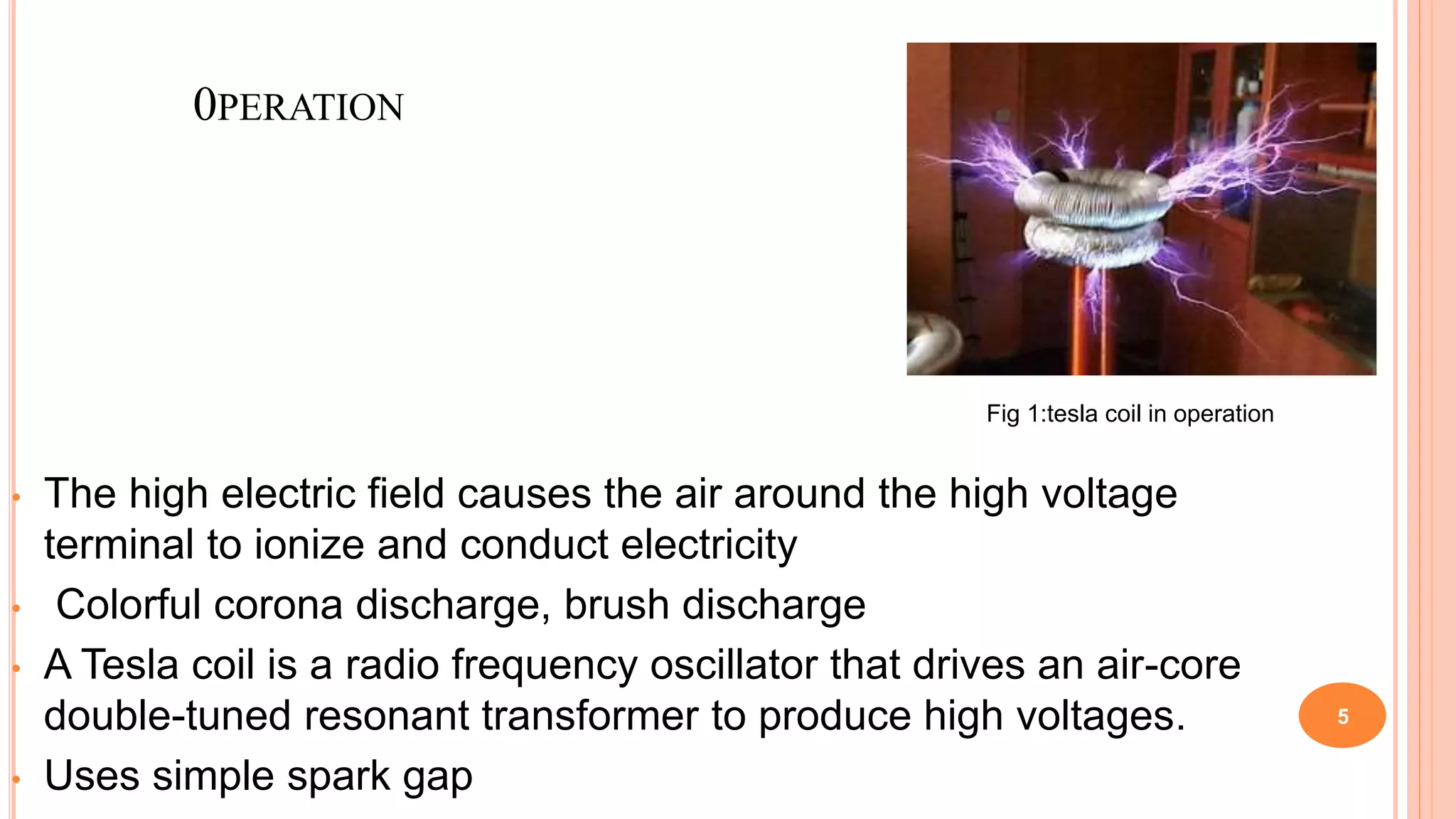
0PERATION
• The high electric field causes the air around the high voltage
terminal to ionize and conduct electricity
• Colorful corona discharge, brush discharge
• A Tesla coil is a radio frequency oscillator that drives an air-core
double-tuned resonant transformer to produce high voltages.
• Uses simple spark gap
5
Fig 1:tesla coil in operation
CONT..
6
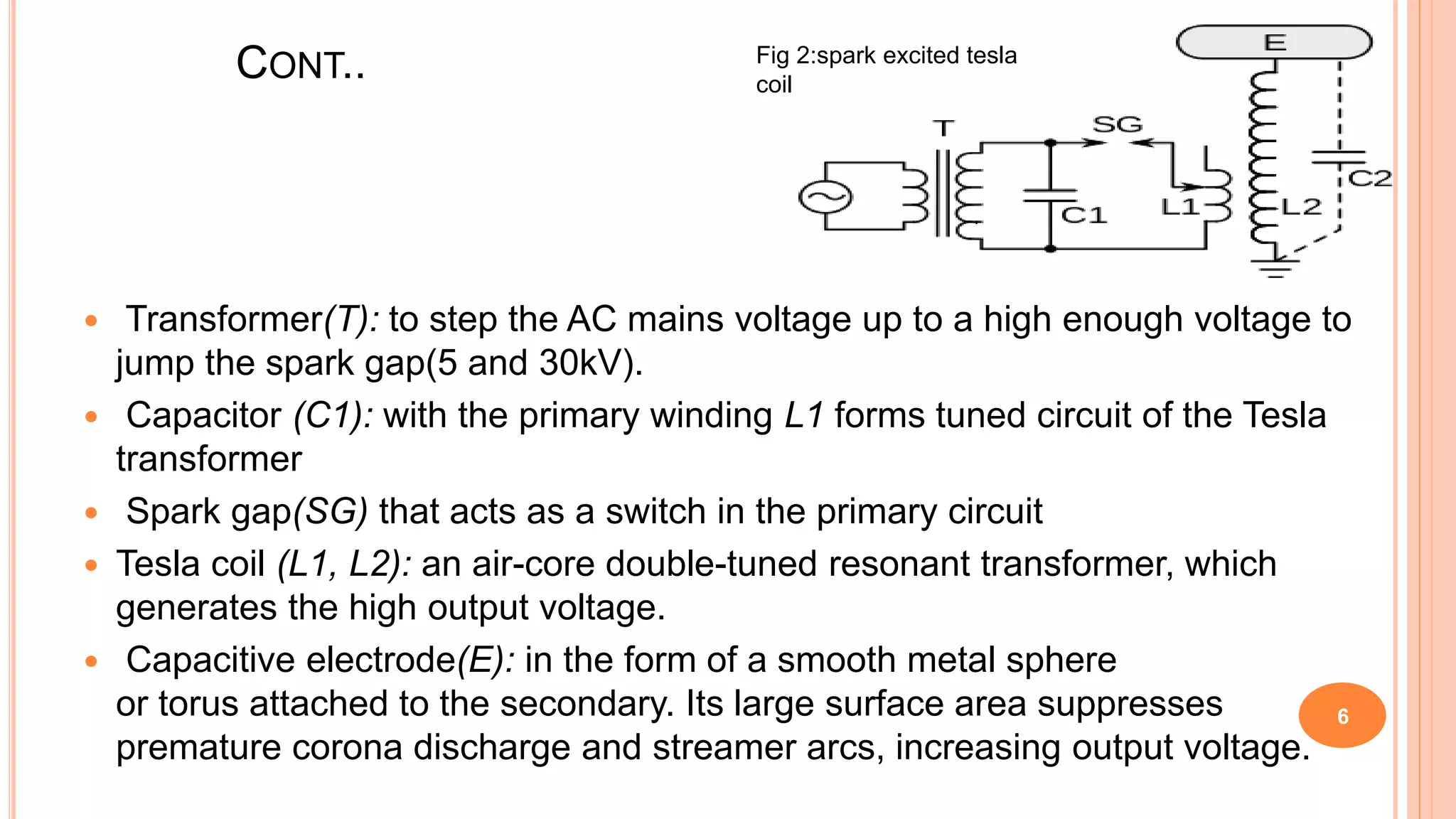
 Transformer(T): to step the AC mains voltage up to a high enough voltage to
jump the spark gap(5 and 30kV).
 Capacitor (C1): with the primary winding L1 forms tuned circuit of the Tesla
transformer
 Spark gap(SG) that acts as a switch in the primary circuit
 Tesla coil (L1, L2): an air-core double-tuned resonant transformer, which
generates the high output voltage.
 Capacitive electrode(E): in the form of a smooth metal sphere
or torus attached to the secondary. Its large surface area suppresses
premature corona discharge and streamer arcs, increasing output voltage.
Fig 2:spark excited tesla
coil
GENERAL PRINCIPLE & CLASSIFICATION OF
WPT
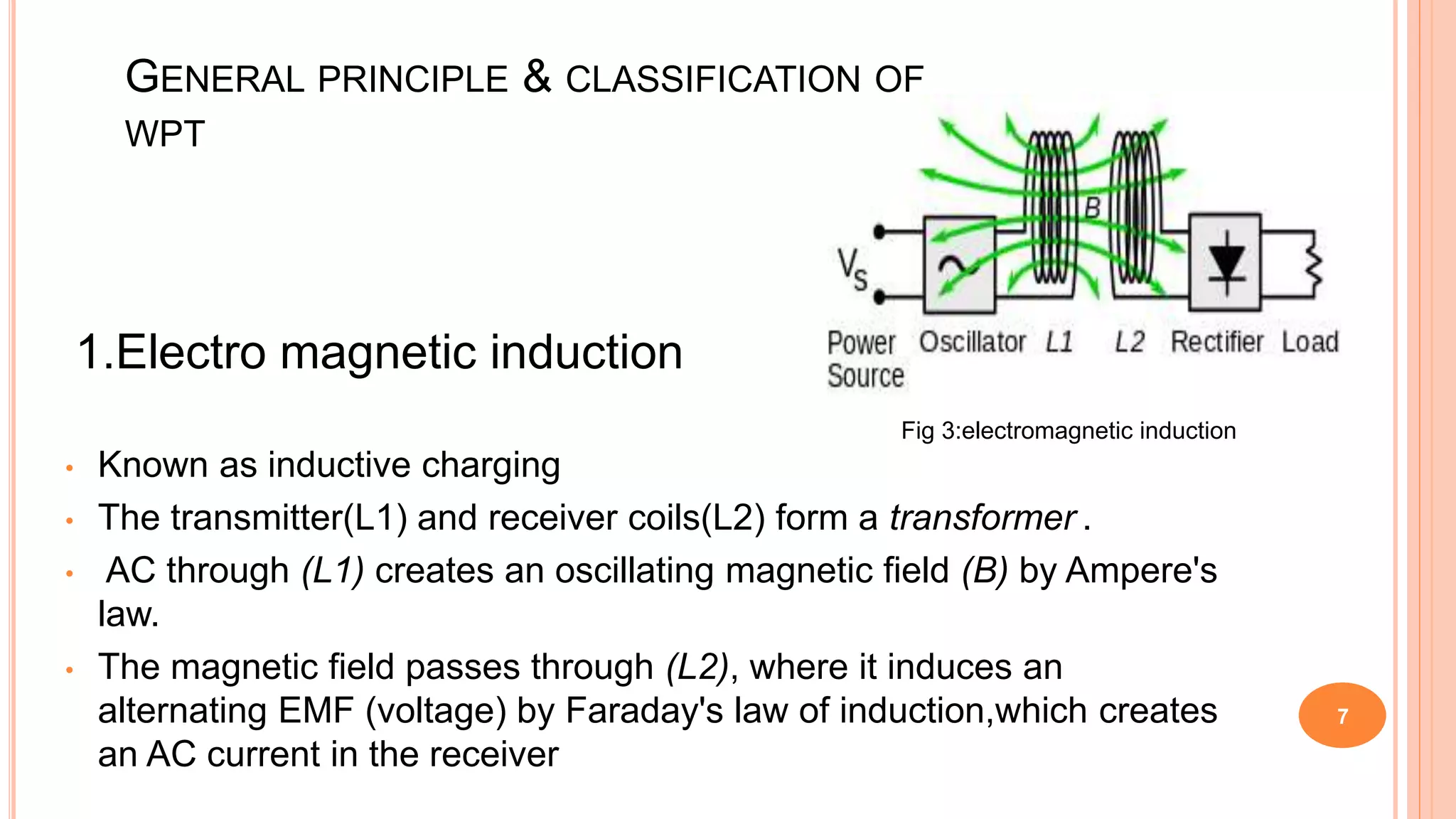
1.Electro magnetic induction
• Known as inductive charging
• The transmitter(L1) and receiver coils(L2) form a transformer .
• AC through (L1) creates an oscillating magnetic field (B) by Ampere's
law.
• The magnetic field passes through (L2), where it induces an
alternating EMF (voltage) by Faraday's law of induction,which creates
an AC current in the receiver
7
Fig 3:electromagnetic induction
CONT..
• The power transferred increases with frequency and the mutual
inductance M, which depends on the distance D between them
• A widely-used figure of merit is the coupling coefficient(K) ,equal to the
fraction of magnetic flux through L1 that passes through L2.
• Safe way of connection, the products can be enclosed from air, water
or plastic in the atmosphere.
• The transmission power and efficiency will change if the distance
between the two coils become closer or farther
8
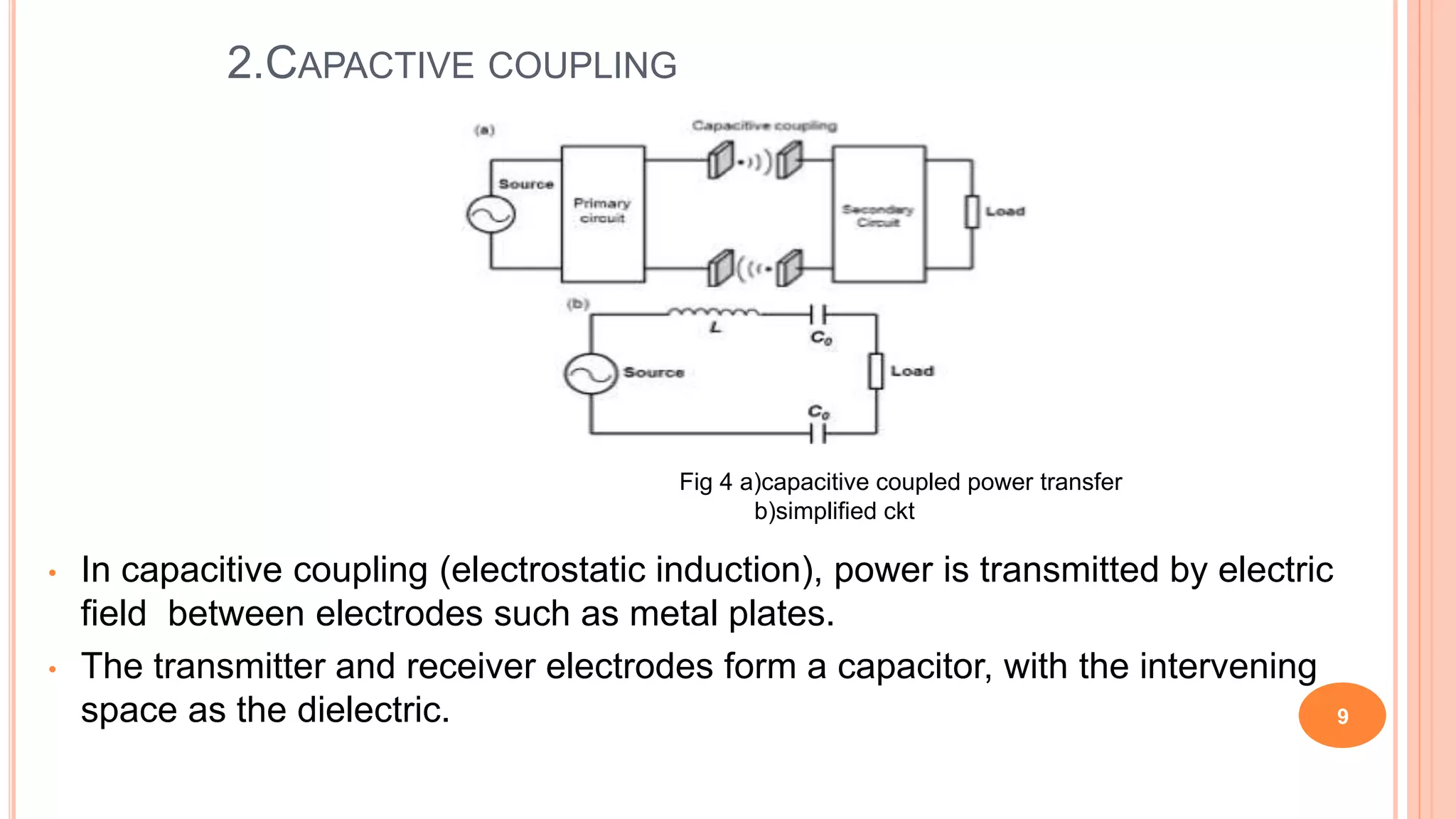
2.CAPACTIVE COUPLING
• In capacitive coupling (electrostatic induction), power is transmitted by electric
field between electrodes such as metal plates.
• The transmitter and receiver electrodes form a capacitor, with the intervening
space as the dielectric. 9
Fig 4 a)capacitive coupled power transfer
b)simplified ckt
CONT..
• Voltage is applied to the transmitting plate, and the oscillating electric
field induces an alternating potential on the receiver plate by electrostatic
induction
• Causes an alternating current to flow in the load circuit
• The amount of power transferred increases with
the frequency, capacitance between the plates, proportional to the area
of the smaller plate and inversely proportional to the separation
10
CONT..
• Used for low power applications, because the very high voltages required to
transmit significant power can be hazardous,cause side effects such
as ozone production.
• Electric fields interact strongly with most materials, including the human body,
due to dielectric polarisation.
• The field is largely confined between the capacitor plates ,reduces interferences
• Alignment requirements between the transmitter and receiver are less critical
11
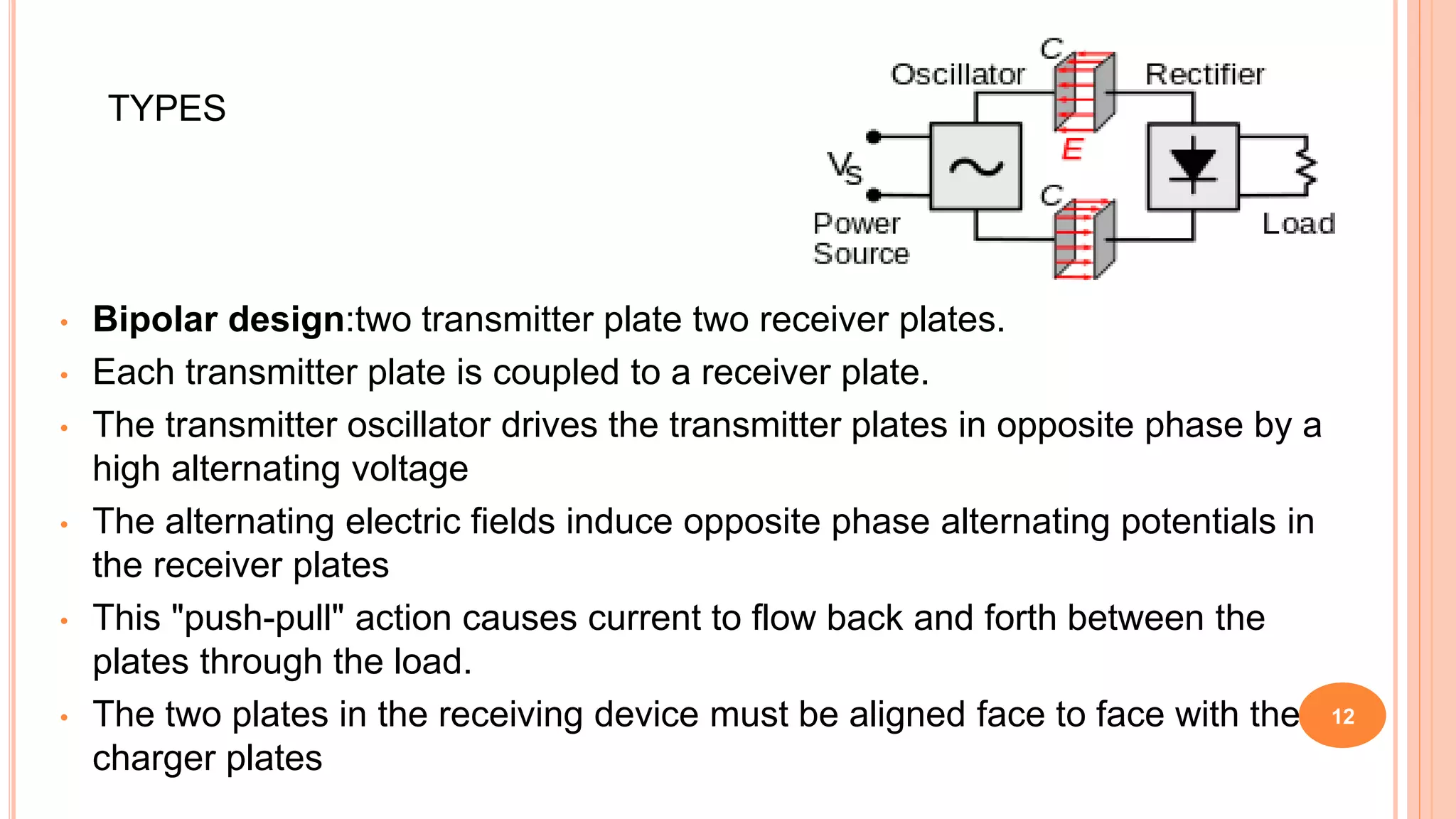
TYPES
• Bipolar design:two transmitter plate two receiver plates.
• Each transmitter plate is coupled to a receiver plate.
• The transmitter oscillator drives the transmitter plates in opposite phase by a
high alternating voltage
• The alternating electric fields induce opposite phase alternating potentials in
the receiver plates
• This "push-pull" action causes current to flow back and forth between the
plates through the load.
• The two plates in the receiving device must be aligned face to face with the
charger plates
12
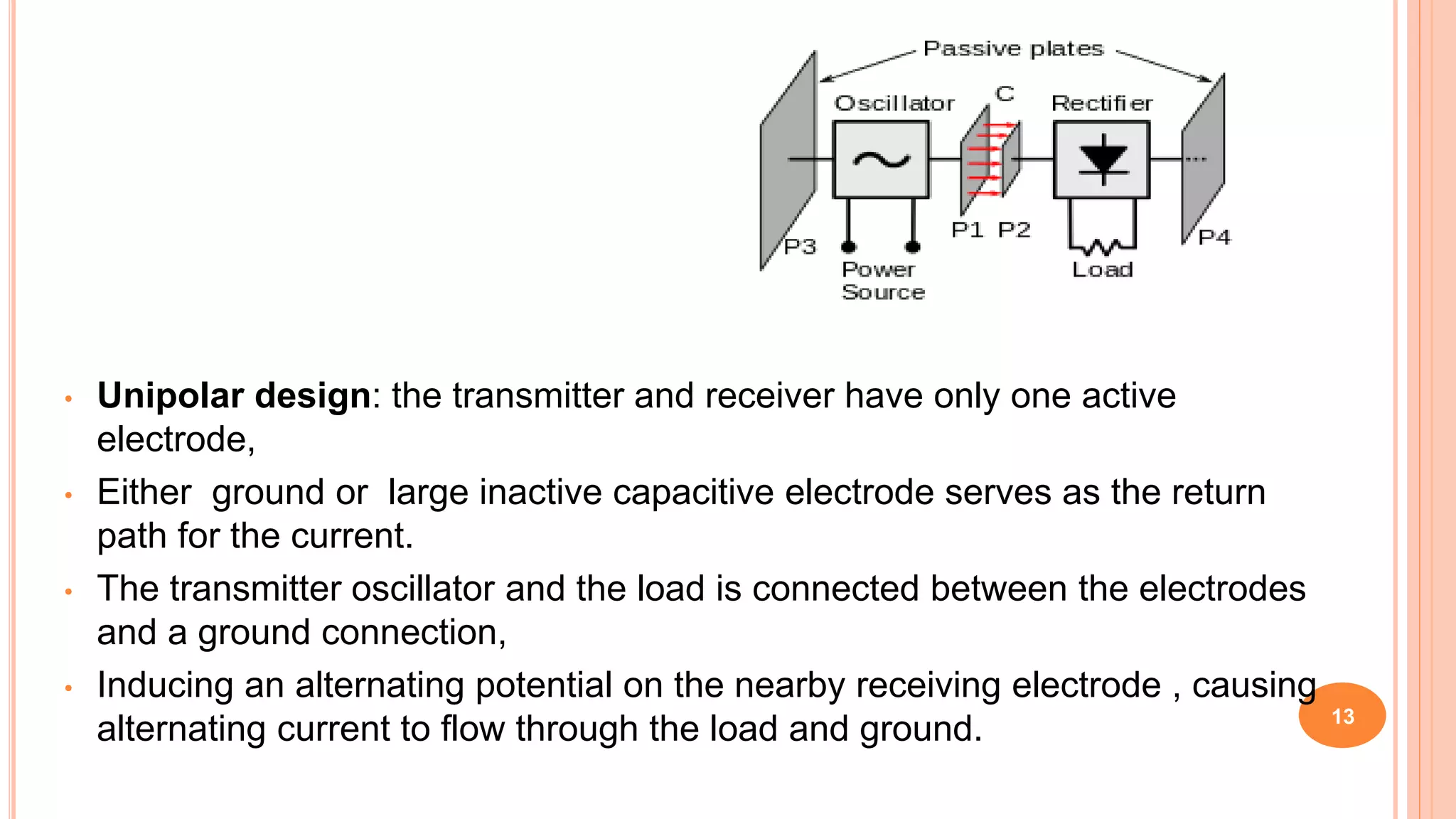
• Unipolar design: the transmitter and receiver have only one active
electrode,
• Either ground or large inactive capacitive electrode serves as the return
path for the current.
• The transmitter oscillator and the load is connected between the electrodes
and a ground connection,
• Inducing an alternating potential on the nearby receiving electrode , causing
alternating current to flow through the load and ground. 13
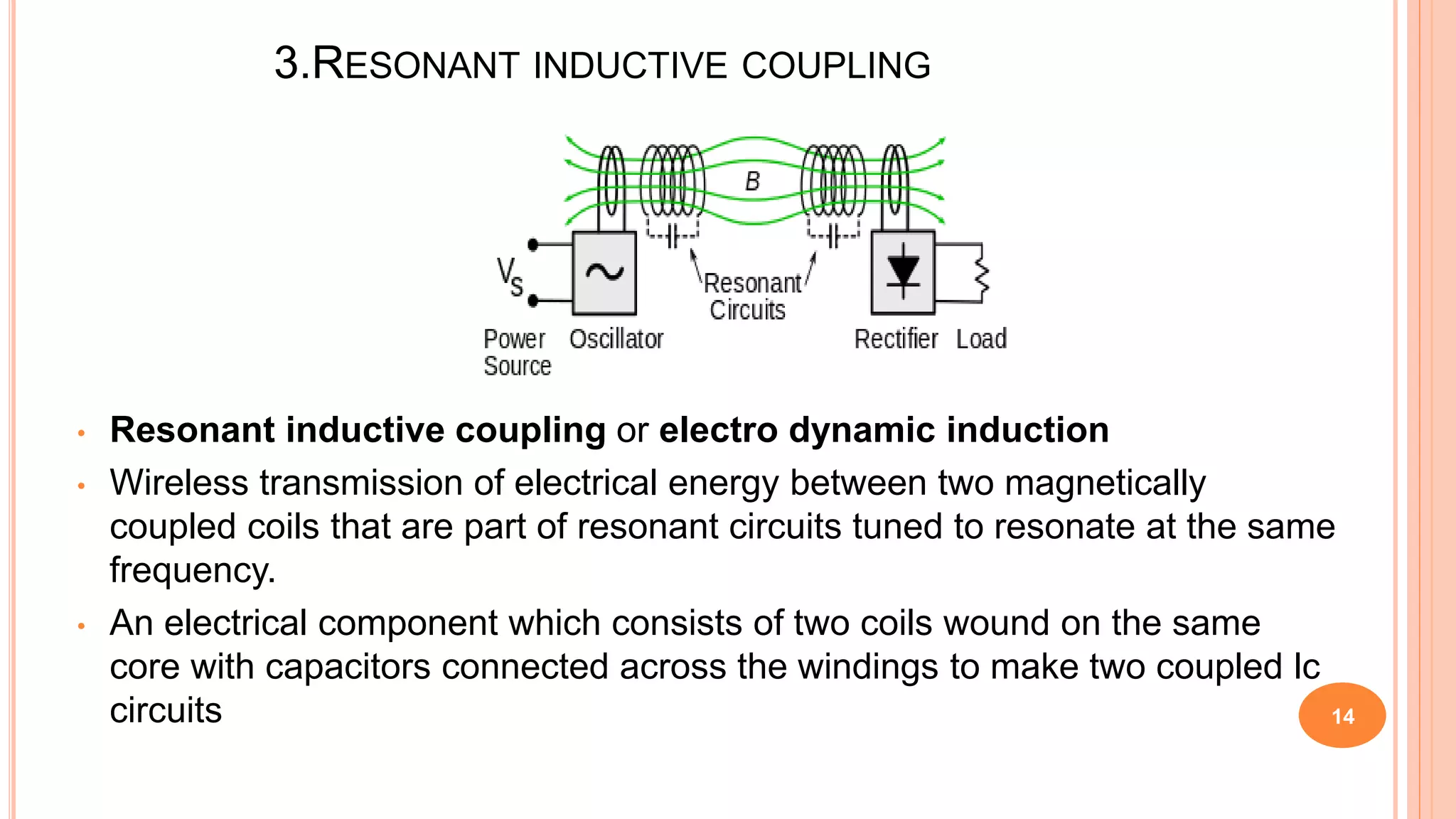
3.RESONANT INDUCTIVE COUPLING
• Resonant inductive coupling or electro dynamic induction
• Wireless transmission of electrical energy between two magnetically
coupled coils that are part of resonant circuits tuned to resonate at the same
frequency.
• An electrical component which consists of two coils wound on the same
core with capacitors connected across the windings to make two coupled lc
circuits 14
CONT..
• The two LC circuits are in different devices;
• A transmitter coil in one device transmits electric power across an intervening
space to a resonant receiver coil in another device
• Because the coil is highly resonant,energy placed in the coil dies away
relatively slowly , if a second coil is brought near it, the coil can pick up most of
the energy before it is lost
• The fields used are predominately non-radiative , near field hardware is kept
well within the 1/4 wavelength distance they radiate little energy from the
transmitter to infinity.
• If two coils resonate with the same frequency, a lot of energy moves from the
transmitting coil to the receiving coils
15
4. MICROWAVE TRANSMISSION
• Transmitting energy by the use of electromagnetic waves called
microwaves
• Frequency range (1ghz to 300ghz)
• Wavelength (30cm down to 1cm)
• Distance covered by microwave signal depends on antenna height.
• To increase coverage each antenna has a built in repeater that
regenerates that signal before passing it on to the next antenna
• Antennas are placed for each 25miles
• Microwave power transmission belongs to a long-distance power
transmission technology.
16
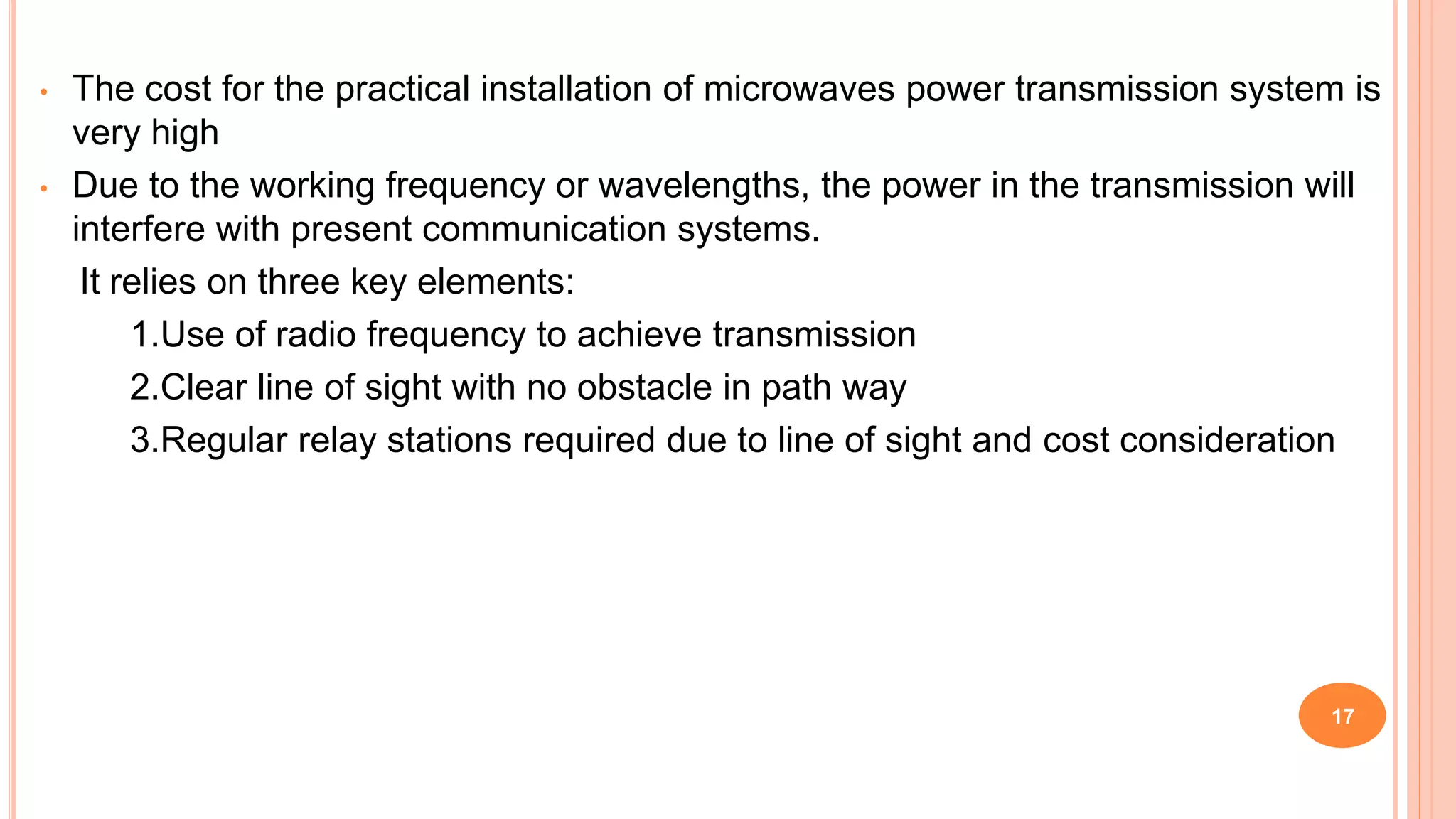
• The cost for the practical installation of microwaves power transmission system is
very high
• Due to the working frequency or wavelengths, the power in the transmission will
interfere with present communication systems.
It relies on three key elements:
1.Use of radio frequency to achieve transmission
2.Clear line of sight with no obstacle in path way
3.Regular relay stations required due to line of sight and cost consideration
17
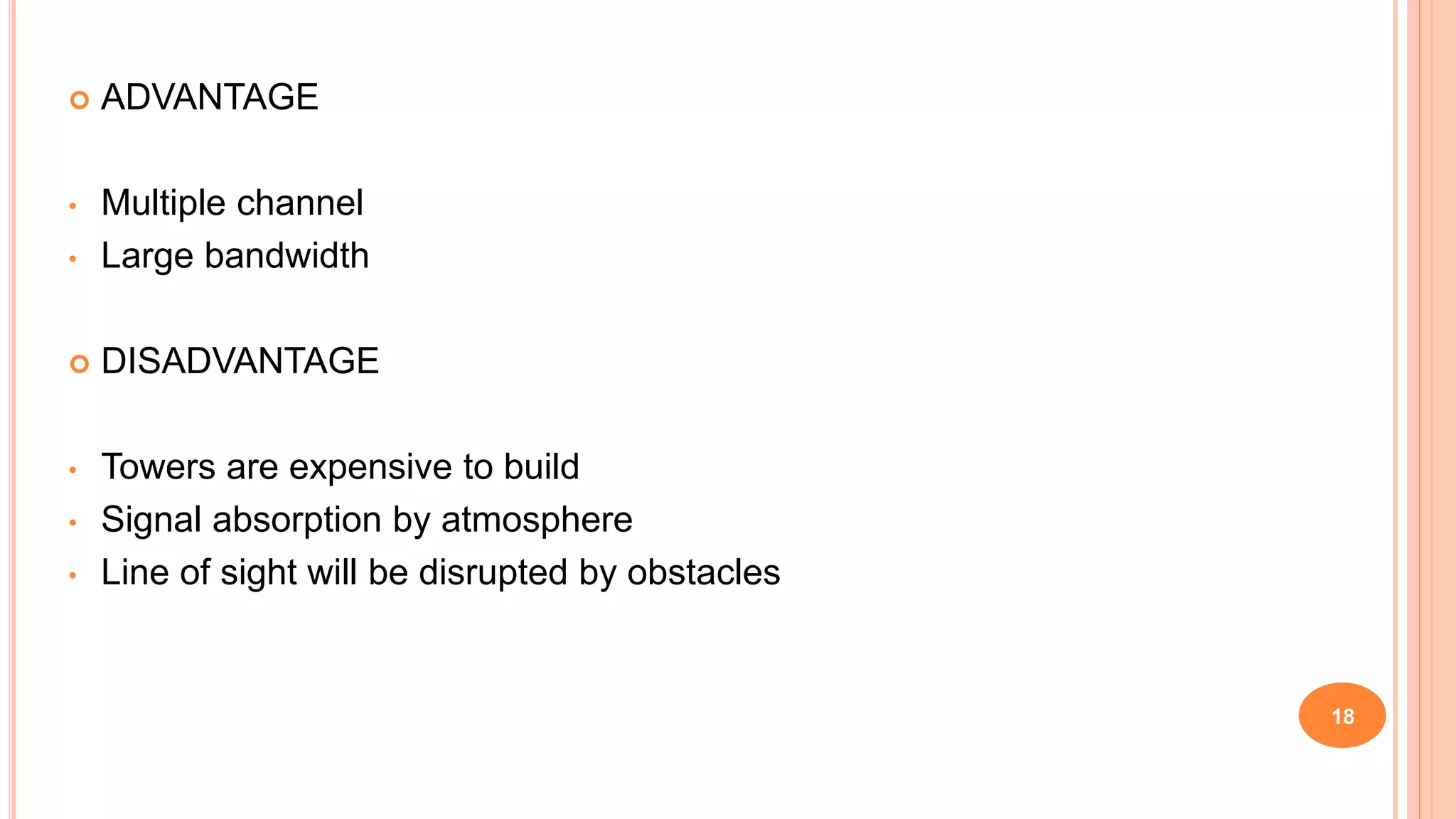
 ADVANTAGE
• Multiple channel
• Large bandwidth
 DISADVANTAGE
• Towers are expensive to build
• Signal absorption by atmosphere
• Line of sight will be disrupted by obstacles
18
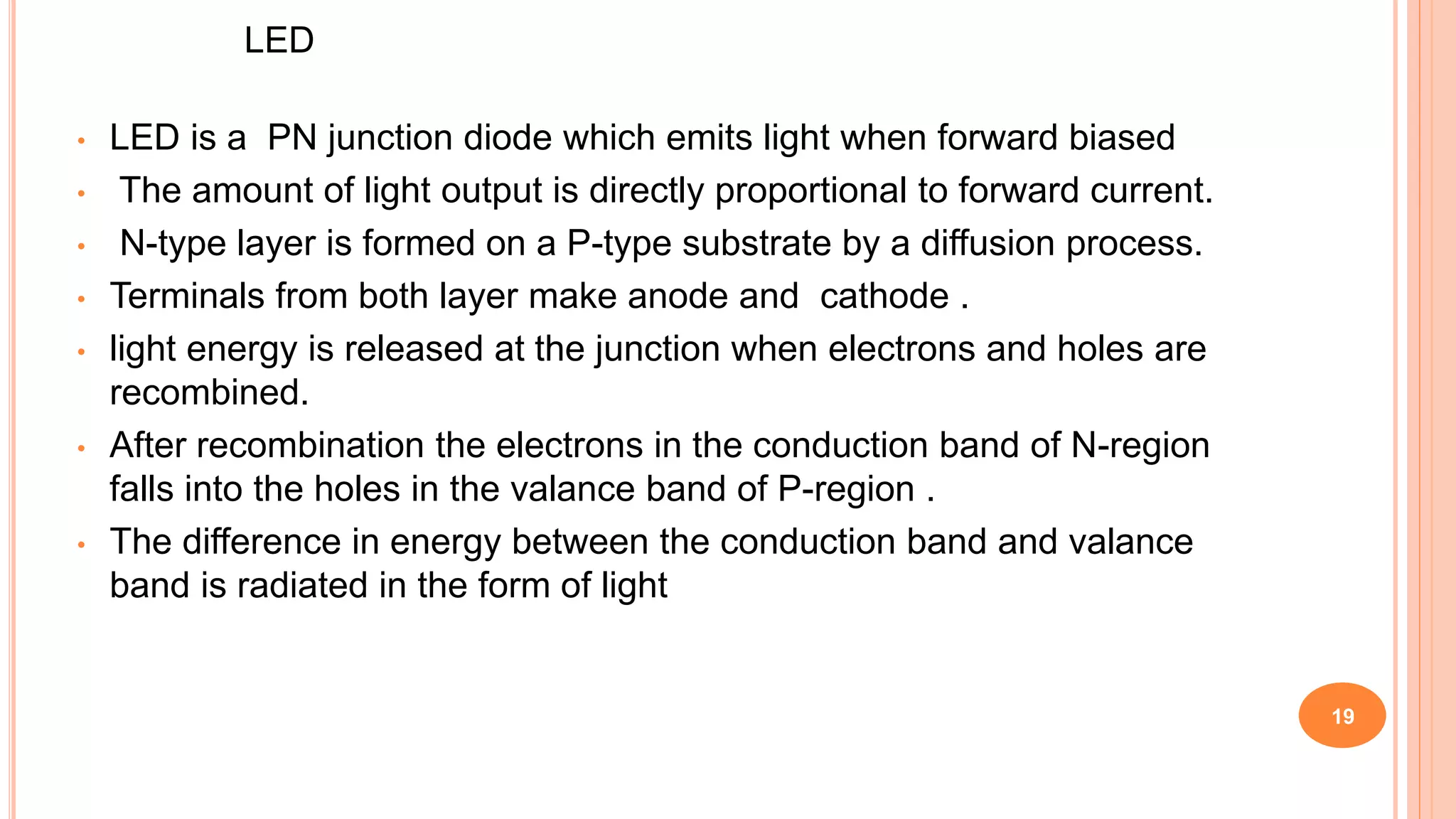
LED
• LED is a PN junction diode which emits light when forward biased
• The amount of light output is directly proportional to forward current.
• N-type layer is formed on a P-type substrate by a diffusion process.
• Terminals from both layer make anode and cathode .
• light energy is released at the junction when electrons and holes are
recombined.
• After recombination the electrons in the conduction band of N-region
falls into the holes in the valance band of P-region .
• The difference in energy between the conduction band and valance
band is radiated in the form of light
19
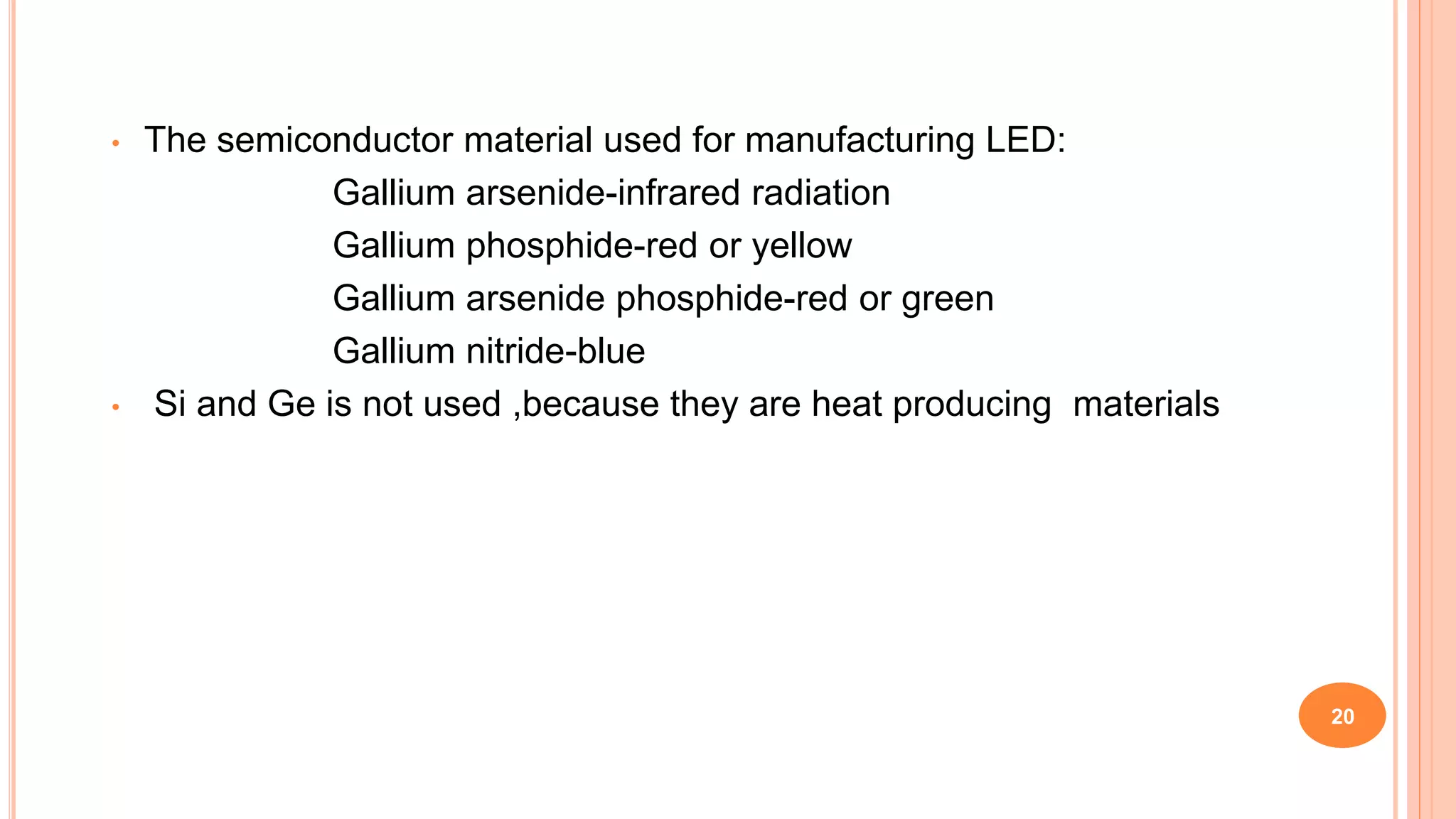
• The semiconductor material used for manufacturing LED:
Gallium arsenide-infrared radiation
Gallium phosphide-red or yellow
Gallium arsenide phosphide-red or green
Gallium nitride-blue
• Si and Ge is not used ,because they are heat producing materials
20
ADVANTAGE
• Products are more convenient by eliminating the wires in the lighting
system.
• Safer and more reliable by eliminating the fire hazard and risk of short
circuit with conductive interconnections,
• Waterproof and explosion proof by removing the electric contacts and
wires that connect led lighting module
• More flexible by transferring electric power to LED lighting module
through air, water, glass and plastic without any electric connection.
• Improve the reliability
• Electrical shock protection,
• Portable and environmentally sound
21
CONCLUSION
• Opportunities and challenges always go alone with the new
technologies.
• In many areas, the wireless power technique can be integrated with
led lighting or display system, which can make led products more
convenient or reliable compared to the traditional system
• And with the commercialization of wireless-driven LED products,
more and more related applications will be found.
22
REFERENCE
[1] http://en.wikipedia.org/wiki/Tesla coil
[2] Liang Huang and Aiguo Patrick Hu, “An overview of capacitively
coupled power transfer—a new contactless power transfer solution”,
2013 IEEE 8th Conference on Industrial Electronics and
Applications(ICIEA), pp 461- 464.
[3] http://en.wikipedia.org/wiki/Microwave_transmission
[4] Vikash Choudhary and Satendar Pal Singh, “Wireless Power
Transmission: An Innovative Idea”, International Journal of
Educational Planning & Administration. ISSN 2249-3093 Volume 1,
Number 3 (2011), pp. 203-210 23
24

Wireless driven led semiconductor lightning system

  • 1.
    WIRELESS DRIVEN LED SEMICONDUCTOR LIGHTNINGSYSTEM MALAVIKA S S7 F ROLL NO-33 1
  • 2.
    CONTENTS • Introduction • Historyof power transfer • Tesla coil • General principle and classification of wireless power transfer • Electromagnetic induction • Capacitive coupling • Types of capacitive coupling • Resonant inductive coupling • Microwave transmission • LED • Application • Conclusion • Reference 2
  • 3.
    INTRODUCTION • Transmission ofelectrical energy from a power source to an electrical load without man-made conductors. • The wireless-driven led (wd-led) -combine the advantages of wireless electrical power transfer and led semiconductor lighting technology • Traditional led lighting system sensitive to rigid environment such as humidity, corrosive and flammable • The wireless-driven LED lighting system should contain LED lighting module, wireless electrical power transfer system, LED driving circuit and electrical energy storage system. 3
  • 4.
    HISTORY OF POWERTRANSFER Tesla coil  A Tesla coil is an electrical resonant transformer circuit invented by Nikola Tesla around 1891  It is used to produce high-voltage, low-current, high frequency alternating-current  Tesla used his Tesla coil circuits to perform the first experiments in wireless power transmission at the turn of the 20th century 4
  • 5.
    0PERATION • The highelectric field causes the air around the high voltage terminal to ionize and conduct electricity • Colorful corona discharge, brush discharge • A Tesla coil is a radio frequency oscillator that drives an air-core double-tuned resonant transformer to produce high voltages. • Uses simple spark gap 5 Fig 1:tesla coil in operation
  • 6.
    CONT.. 6  Transformer(T): tostep the AC mains voltage up to a high enough voltage to jump the spark gap(5 and 30kV).  Capacitor (C1): with the primary winding L1 forms tuned circuit of the Tesla transformer  Spark gap(SG) that acts as a switch in the primary circuit  Tesla coil (L1, L2): an air-core double-tuned resonant transformer, which generates the high output voltage.  Capacitive electrode(E): in the form of a smooth metal sphere or torus attached to the secondary. Its large surface area suppresses premature corona discharge and streamer arcs, increasing output voltage. Fig 2:spark excited tesla coil
  • 7.
    GENERAL PRINCIPLE &CLASSIFICATION OF WPT 1.Electro magnetic induction • Known as inductive charging • The transmitter(L1) and receiver coils(L2) form a transformer . • AC through (L1) creates an oscillating magnetic field (B) by Ampere's law. • The magnetic field passes through (L2), where it induces an alternating EMF (voltage) by Faraday's law of induction,which creates an AC current in the receiver 7 Fig 3:electromagnetic induction
  • 8.
    CONT.. • The powertransferred increases with frequency and the mutual inductance M, which depends on the distance D between them • A widely-used figure of merit is the coupling coefficient(K) ,equal to the fraction of magnetic flux through L1 that passes through L2. • Safe way of connection, the products can be enclosed from air, water or plastic in the atmosphere. • The transmission power and efficiency will change if the distance between the two coils become closer or farther 8
  • 9.
    2.CAPACTIVE COUPLING • Incapacitive coupling (electrostatic induction), power is transmitted by electric field between electrodes such as metal plates. • The transmitter and receiver electrodes form a capacitor, with the intervening space as the dielectric. 9 Fig 4 a)capacitive coupled power transfer b)simplified ckt
  • 10.
    CONT.. • Voltage isapplied to the transmitting plate, and the oscillating electric field induces an alternating potential on the receiver plate by electrostatic induction • Causes an alternating current to flow in the load circuit • The amount of power transferred increases with the frequency, capacitance between the plates, proportional to the area of the smaller plate and inversely proportional to the separation 10
  • 11.
    CONT.. • Used forlow power applications, because the very high voltages required to transmit significant power can be hazardous,cause side effects such as ozone production. • Electric fields interact strongly with most materials, including the human body, due to dielectric polarisation. • The field is largely confined between the capacitor plates ,reduces interferences • Alignment requirements between the transmitter and receiver are less critical 11
  • 12.
    TYPES • Bipolar design:twotransmitter plate two receiver plates. • Each transmitter plate is coupled to a receiver plate. • The transmitter oscillator drives the transmitter plates in opposite phase by a high alternating voltage • The alternating electric fields induce opposite phase alternating potentials in the receiver plates • This "push-pull" action causes current to flow back and forth between the plates through the load. • The two plates in the receiving device must be aligned face to face with the charger plates 12
  • 13.
    • Unipolar design:the transmitter and receiver have only one active electrode, • Either ground or large inactive capacitive electrode serves as the return path for the current. • The transmitter oscillator and the load is connected between the electrodes and a ground connection, • Inducing an alternating potential on the nearby receiving electrode , causing alternating current to flow through the load and ground. 13
  • 14.
    3.RESONANT INDUCTIVE COUPLING •Resonant inductive coupling or electro dynamic induction • Wireless transmission of electrical energy between two magnetically coupled coils that are part of resonant circuits tuned to resonate at the same frequency. • An electrical component which consists of two coils wound on the same core with capacitors connected across the windings to make two coupled lc circuits 14
  • 15.
    CONT.. • The twoLC circuits are in different devices; • A transmitter coil in one device transmits electric power across an intervening space to a resonant receiver coil in another device • Because the coil is highly resonant,energy placed in the coil dies away relatively slowly , if a second coil is brought near it, the coil can pick up most of the energy before it is lost • The fields used are predominately non-radiative , near field hardware is kept well within the 1/4 wavelength distance they radiate little energy from the transmitter to infinity. • If two coils resonate with the same frequency, a lot of energy moves from the transmitting coil to the receiving coils 15
  • 16.
    4. MICROWAVE TRANSMISSION •Transmitting energy by the use of electromagnetic waves called microwaves • Frequency range (1ghz to 300ghz) • Wavelength (30cm down to 1cm) • Distance covered by microwave signal depends on antenna height. • To increase coverage each antenna has a built in repeater that regenerates that signal before passing it on to the next antenna • Antennas are placed for each 25miles • Microwave power transmission belongs to a long-distance power transmission technology. 16
  • 17.
    • The costfor the practical installation of microwaves power transmission system is very high • Due to the working frequency or wavelengths, the power in the transmission will interfere with present communication systems. It relies on three key elements: 1.Use of radio frequency to achieve transmission 2.Clear line of sight with no obstacle in path way 3.Regular relay stations required due to line of sight and cost consideration 17
  • 18.
     ADVANTAGE • Multiplechannel • Large bandwidth  DISADVANTAGE • Towers are expensive to build • Signal absorption by atmosphere • Line of sight will be disrupted by obstacles 18
  • 19.
    LED • LED isa PN junction diode which emits light when forward biased • The amount of light output is directly proportional to forward current. • N-type layer is formed on a P-type substrate by a diffusion process. • Terminals from both layer make anode and cathode . • light energy is released at the junction when electrons and holes are recombined. • After recombination the electrons in the conduction band of N-region falls into the holes in the valance band of P-region . • The difference in energy between the conduction band and valance band is radiated in the form of light 19
  • 20.
    • The semiconductormaterial used for manufacturing LED: Gallium arsenide-infrared radiation Gallium phosphide-red or yellow Gallium arsenide phosphide-red or green Gallium nitride-blue • Si and Ge is not used ,because they are heat producing materials 20
  • 21.
    ADVANTAGE • Products aremore convenient by eliminating the wires in the lighting system. • Safer and more reliable by eliminating the fire hazard and risk of short circuit with conductive interconnections, • Waterproof and explosion proof by removing the electric contacts and wires that connect led lighting module • More flexible by transferring electric power to LED lighting module through air, water, glass and plastic without any electric connection. • Improve the reliability • Electrical shock protection, • Portable and environmentally sound 21
  • 22.
    CONCLUSION • Opportunities andchallenges always go alone with the new technologies. • In many areas, the wireless power technique can be integrated with led lighting or display system, which can make led products more convenient or reliable compared to the traditional system • And with the commercialization of wireless-driven LED products, more and more related applications will be found. 22
  • 23.
    REFERENCE [1] http://en.wikipedia.org/wiki/Tesla coil [2]Liang Huang and Aiguo Patrick Hu, “An overview of capacitively coupled power transfer—a new contactless power transfer solution”, 2013 IEEE 8th Conference on Industrial Electronics and Applications(ICIEA), pp 461- 464. [3] http://en.wikipedia.org/wiki/Microwave_transmission [4] Vikash Choudhary and Satendar Pal Singh, “Wireless Power Transmission: An Innovative Idea”, International Journal of Educational Planning & Administration. ISSN 2249-3093 Volume 1, Number 3 (2011), pp. 203-210 23
  • 24.