WIRELESS DRIVEN LED
SEMICONDUCTOR LIGHTING
SYSTEM
PRESENTED BY,
V M RAHUL
OVERVIEW
• INTRODUCTION
• WIRELESS POWER TRANSFER
• TYPES OF WIRELESS POWER TRANSFER
• WD-LED LIGHTING SYSTEM
• APPLICATIONS
• FUTURE SCOPE
• CONCLUSION
2
INTRODUCTION
• LED Lighting system.
• Wireless power transfer.
• Wireless driven led.
3
WIRELESS POWER TRANSFER
6
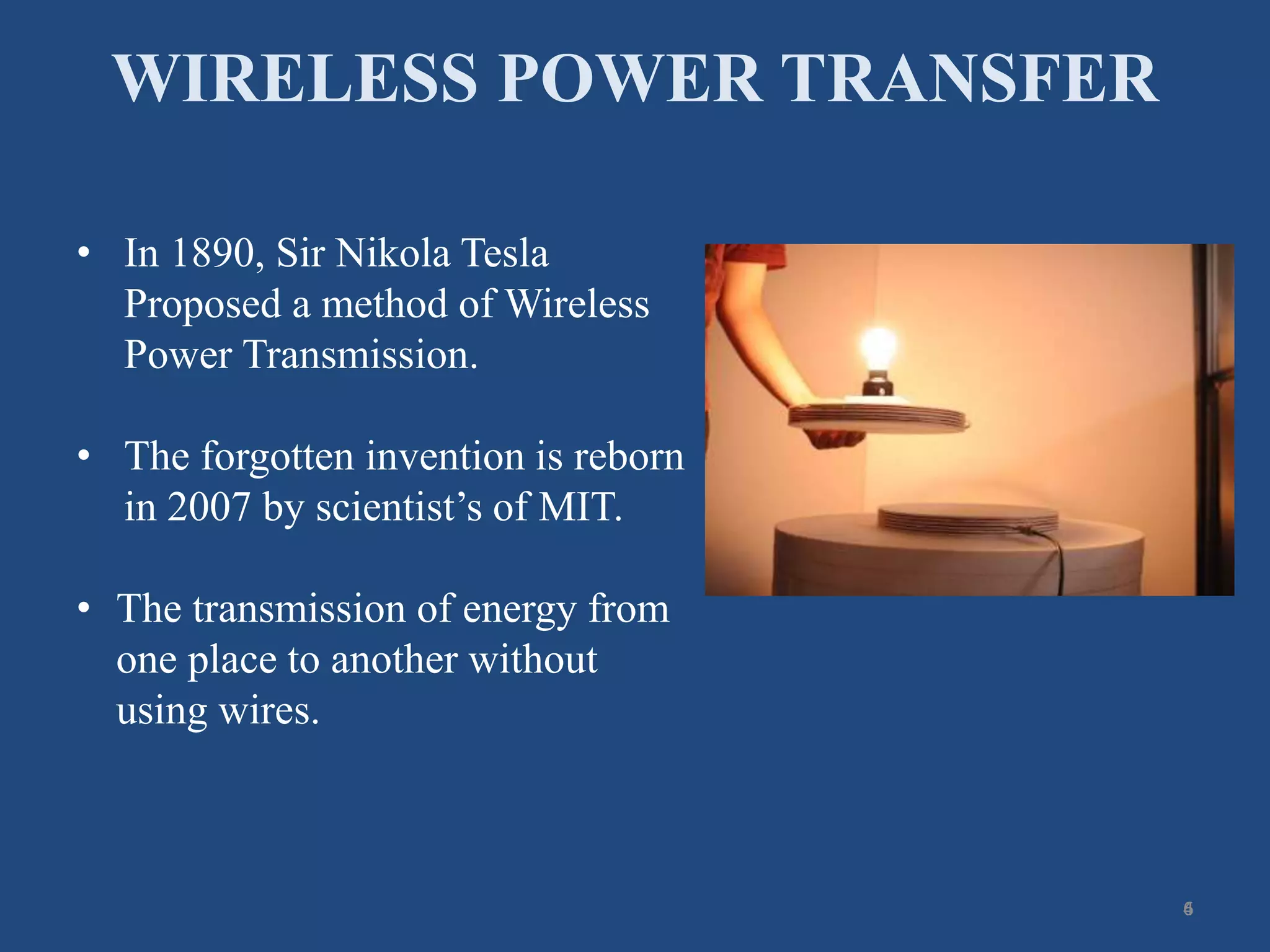
• In 1890, Sir Nikola Tesla
Proposed a method of Wireless
Power Transmission.
• The forgotten invention is reborn
in 2007 by scientist’s of MIT.
• The transmission of energy from
one place to another without
using wires.
4
ADVANTAGES
• WPT system would completely eliminates the
existing high- tension power transmission line cable.
• Can reach the places which are remote.
• High Efficiency and Low cost maintenance.
• Power Theft will be negligible.
5
CLASSIFICATION OF THE WIRELESS
POWER TRANSMISSION SYSTEM
• Electromagnetism induction / Inductive charging.
• Capacitive coupling .
• Resonant inductive coupling .
• Microwave power transmission.
6
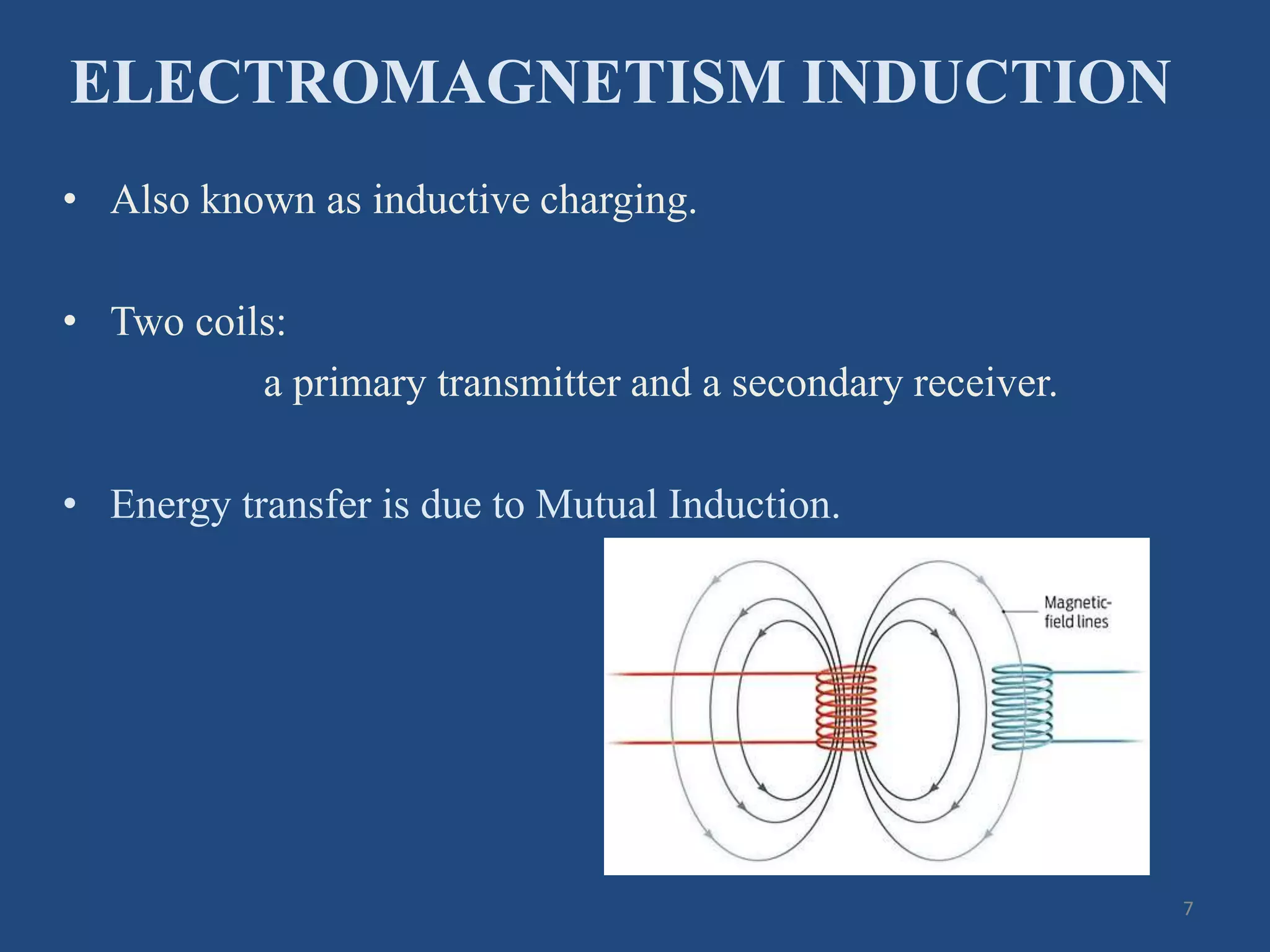
ELECTROMAGNETISM INDUCTION
• Also known as inductive charging.
• Two coils:
a primary transmitter and a secondary receiver.
• Energy transfer is due to Mutual Induction.
7
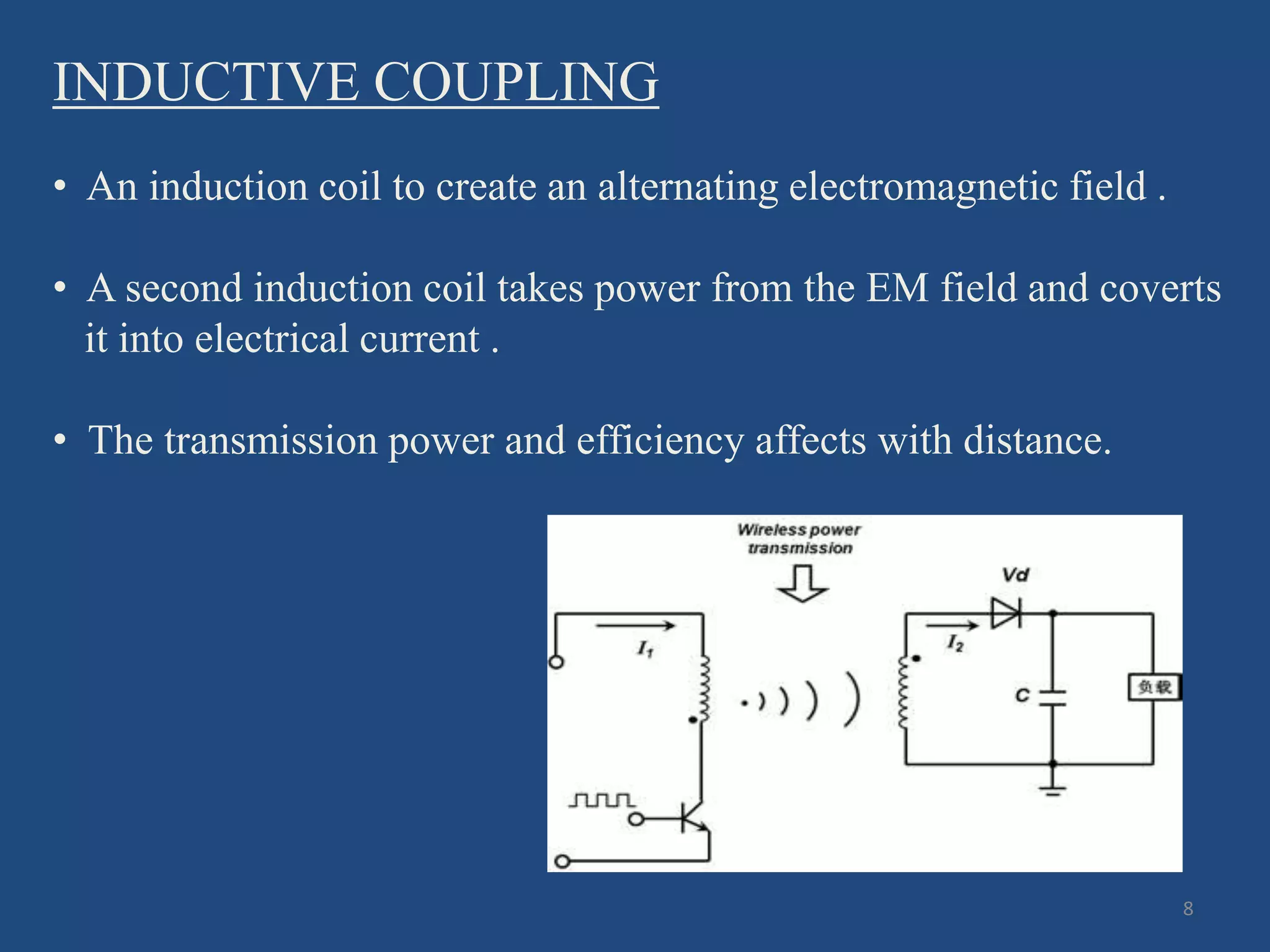
INDUCTIVE COUPLING
8
• An induction coil to create an alternating electromagnetic field .
• A second induction coil takes power from the EM field and coverts
it into electrical current .
• The transmission power and efficiency affects with distance.
Advantage:
- It provides a safe way of connection.
- the products can be all enclosed and away
from air, water or plastic in the atmosphere
Disadvantage
- require more electronics and coils
- complex .
- high cost.
9
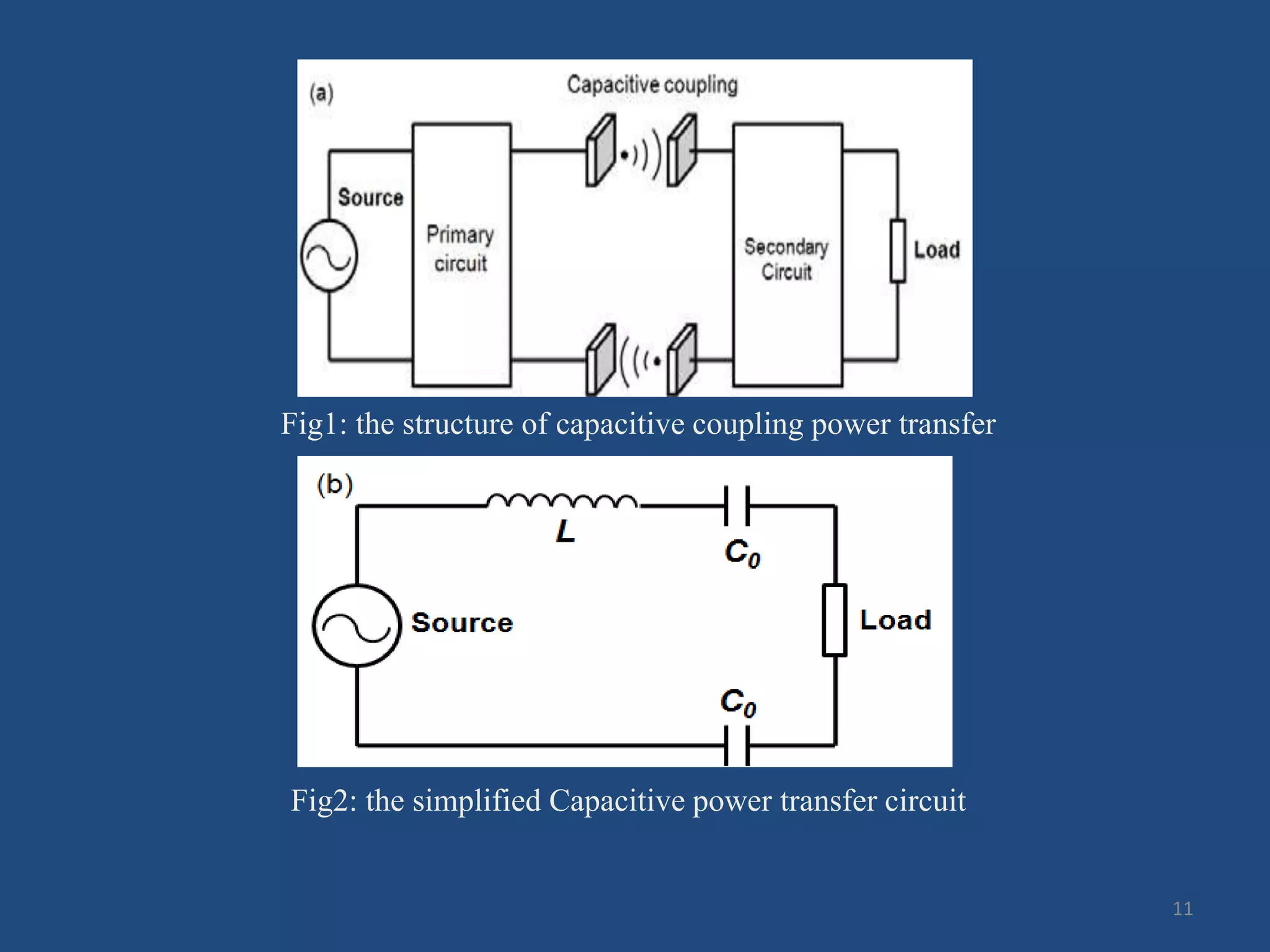
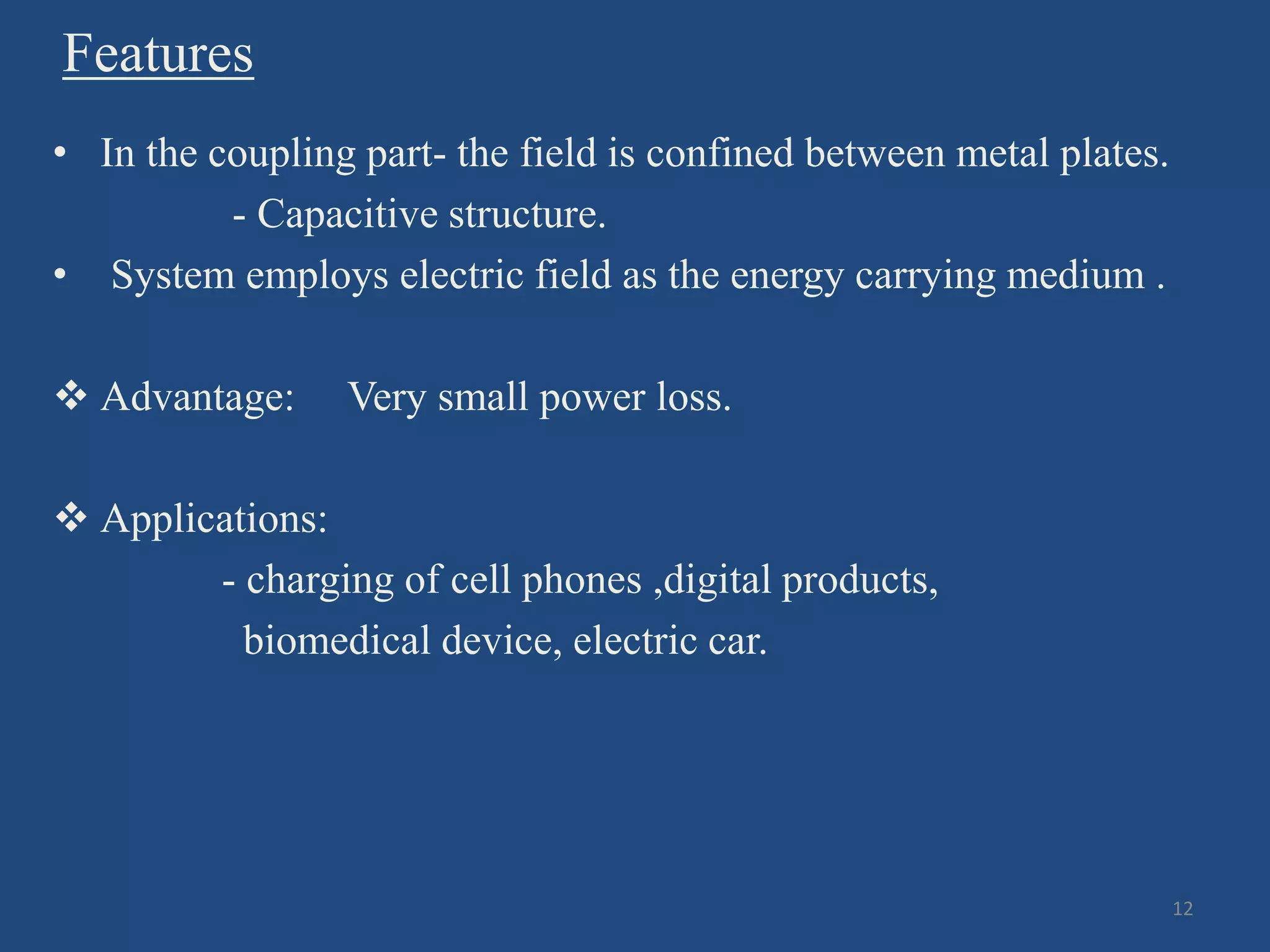
CAPACITIVE COUPLING
• Consists of,
 primary power transmitter
- acting as a high frequency voltage source.
 capacitive structure
- functioning as the electric energy transfer
channel.
 power receiver
- acting as the secondary power conditioner, and
supply the electric power to the load.
10
11
Fig1: the structure of capacitive coupling power transfer
Fig2: the simplified Capacitive power transfer circuit
Features
• In the coupling part- the field is confined between metal plates.
- Capacitive structure.
• System employs electric field as the energy carrying medium .
 Advantage: Very small power loss.
 Applications:
- charging of cell phones ,digital products,
biomedical device, electric car.
12
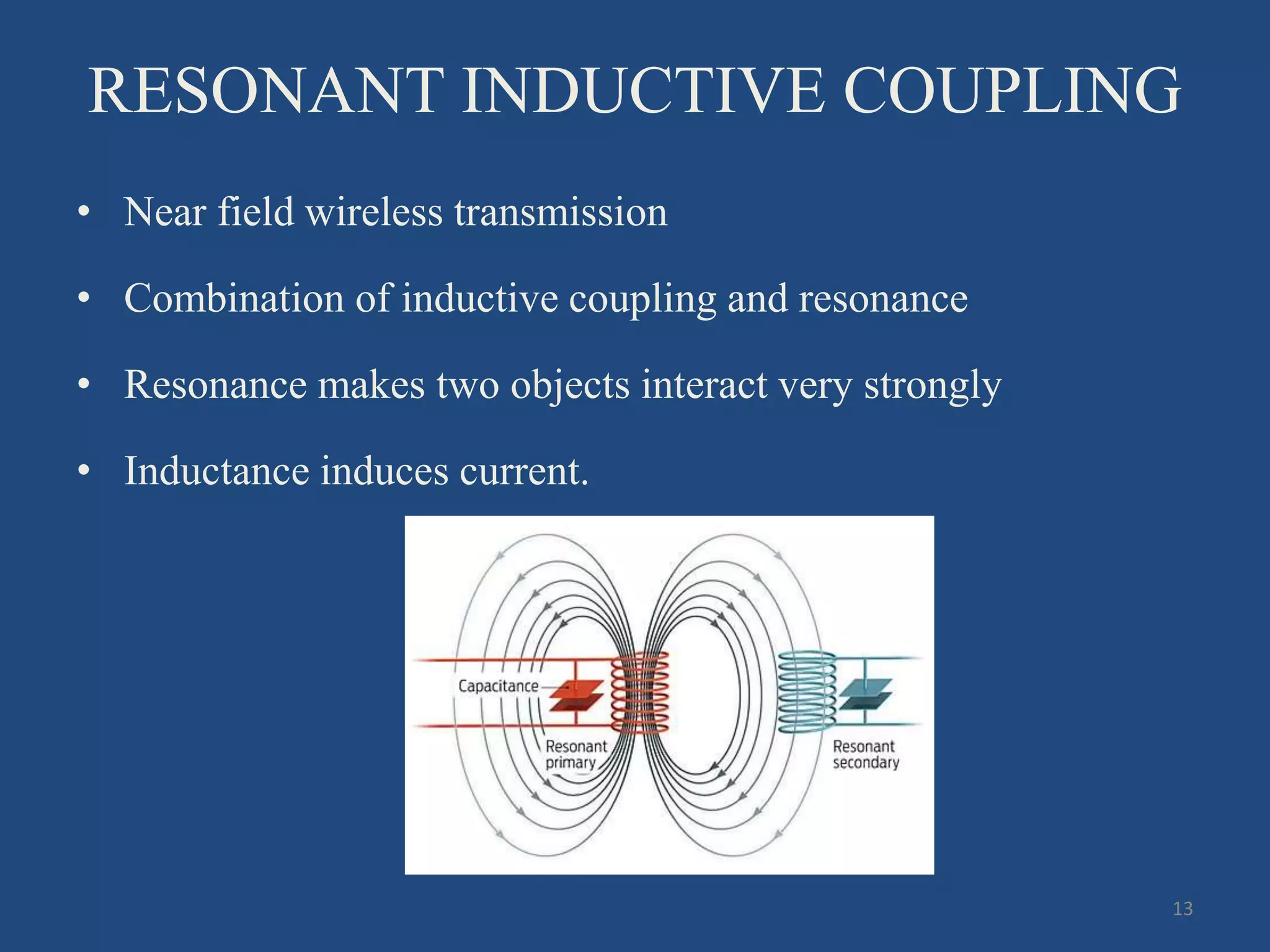
RESONANT INDUCTIVE COUPLING
• Near field wireless transmission
• Combination of inductive coupling and resonance
• Resonance makes two objects interact very strongly
• Inductance induces current.
13
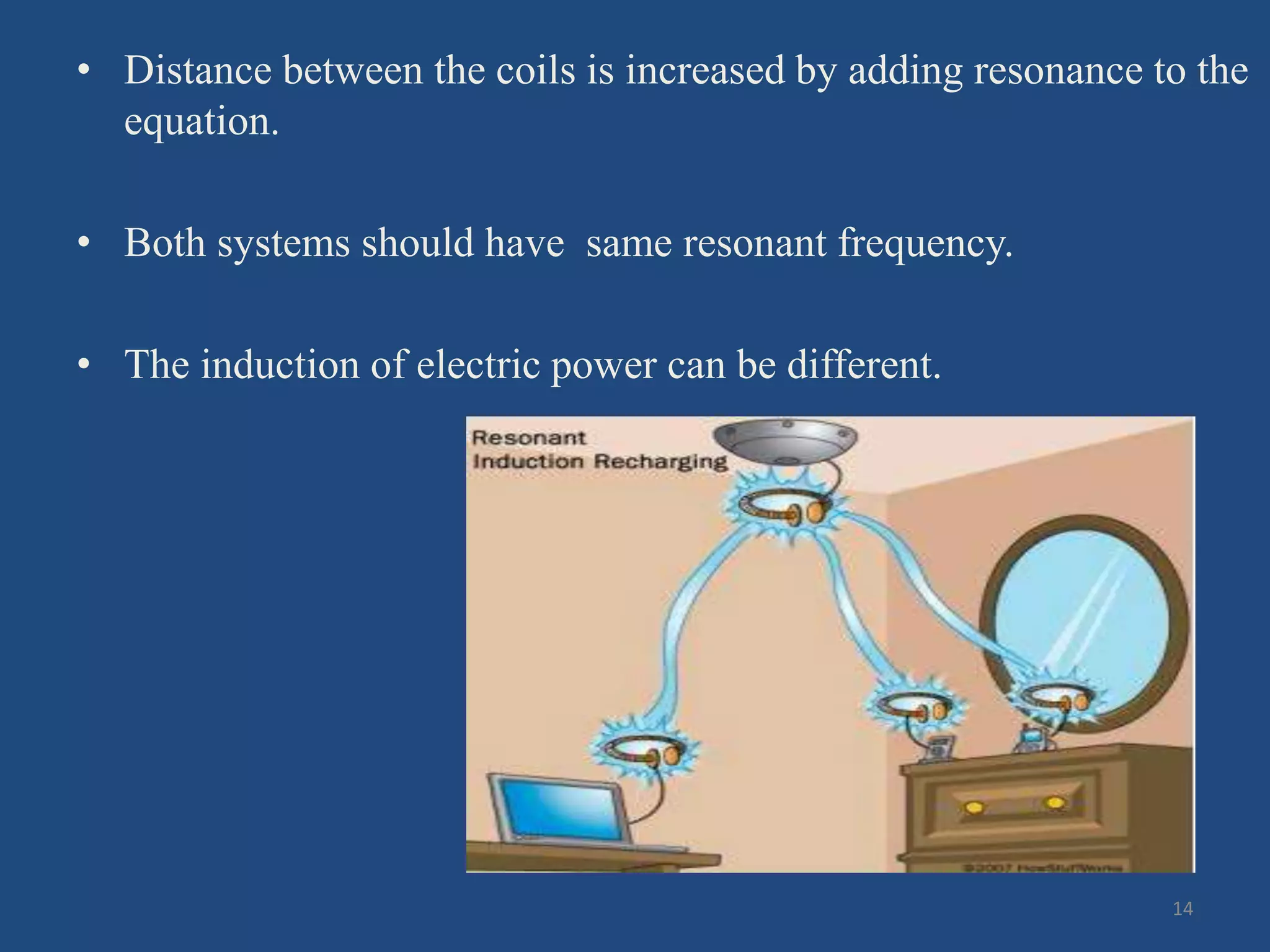
• Distance between the coils is increased by adding resonance to the
equation.
• Both systems should have same resonant frequency.
• The induction of electric power can be different.
14
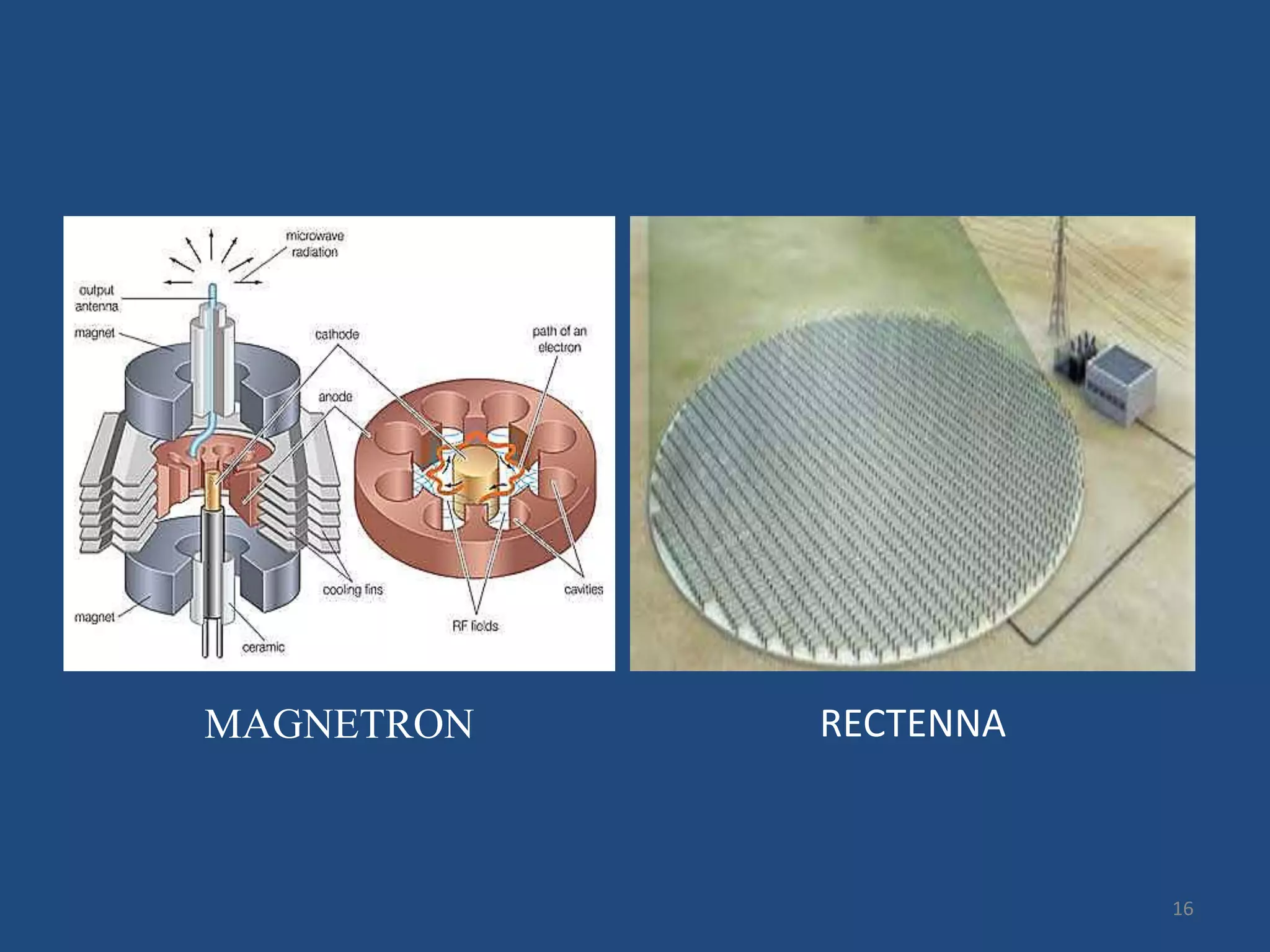
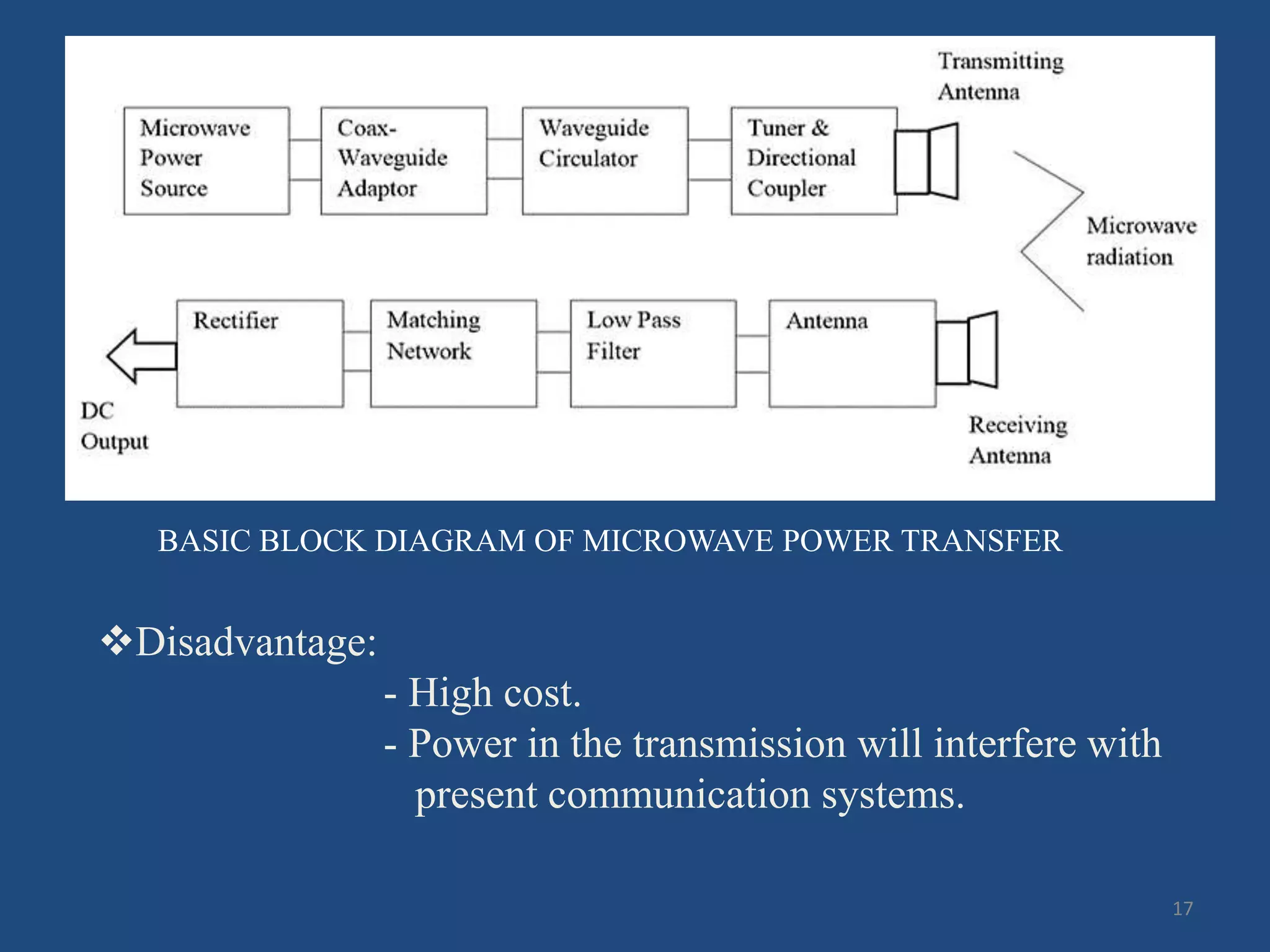
MICROWAVES POWER TRANSMISSION
• Belongs to far field technique.
• Transmitting energy by use of microwaves.
• Method for transferring energy to the surface of the
earth from solar power satellites.
• Steps:
• Electrical energy to microwave energy
• Capturing microwaves using rectenna.
• Microwave energy to electrical energy
15
16
MAGNETRON RECTENNA
17
Disadvantage:
- High cost.
- Power in the transmission will interfere with
present communication systems.
BASIC BLOCK DIAGRAM OF MICROWAVE POWER TRANSFER
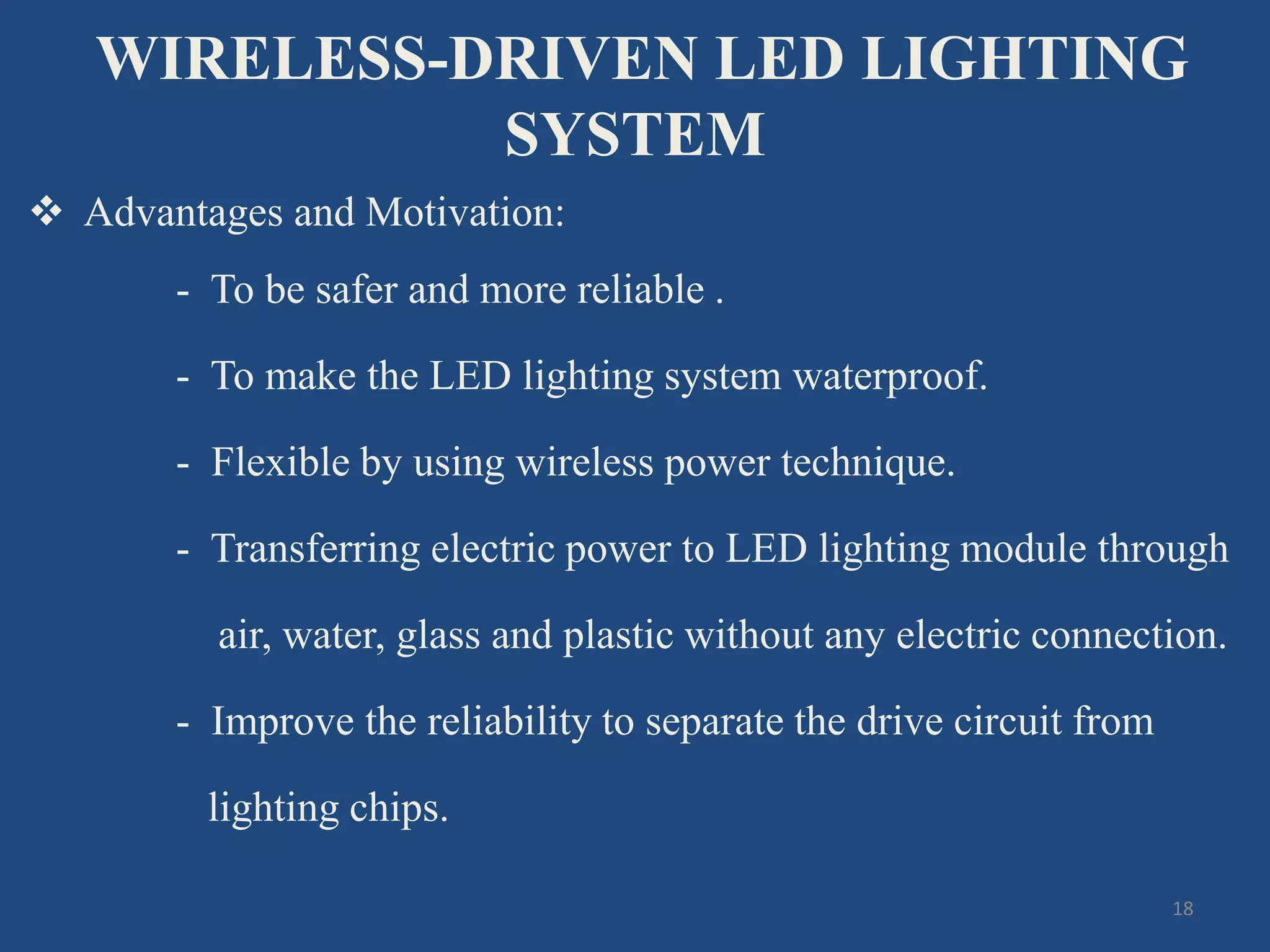
WIRELESS-DRIVEN LED LIGHTING
SYSTEM
 Advantages and Motivation:
- To be safer and more reliable .
- To make the LED lighting system waterproof.
- Flexible by using wireless power technique.
- Transferring electric power to LED lighting module through
air, water, glass and plastic without any electric connection.
- Improve the reliability to separate the drive circuit from
lighting chips.
18
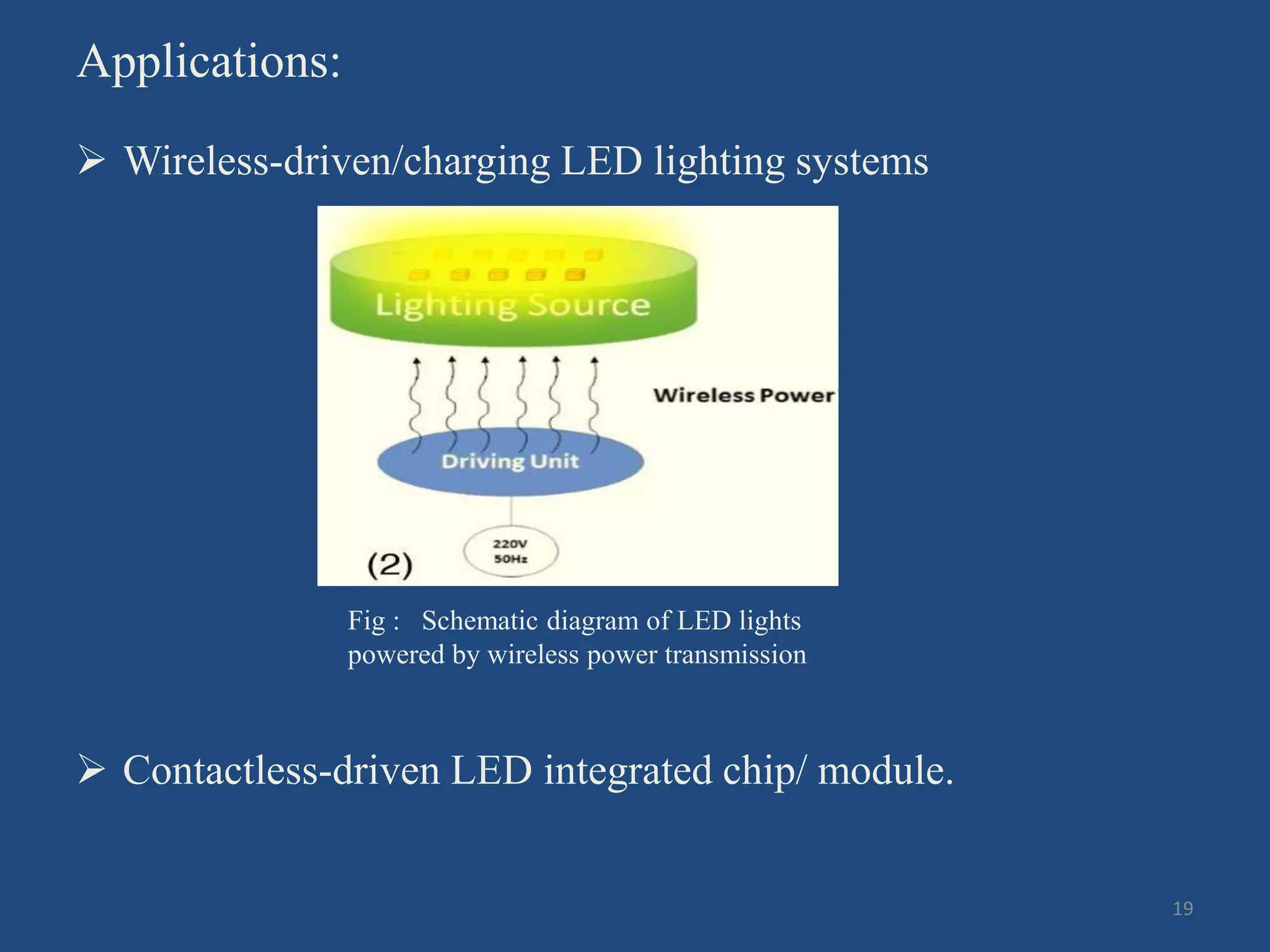
Applications:
 Wireless-driven/charging LED lighting systems
 Contactless-driven LED integrated chip/ module.
19
Fig : Schematic diagram of LED lights
powered by wireless power transmission
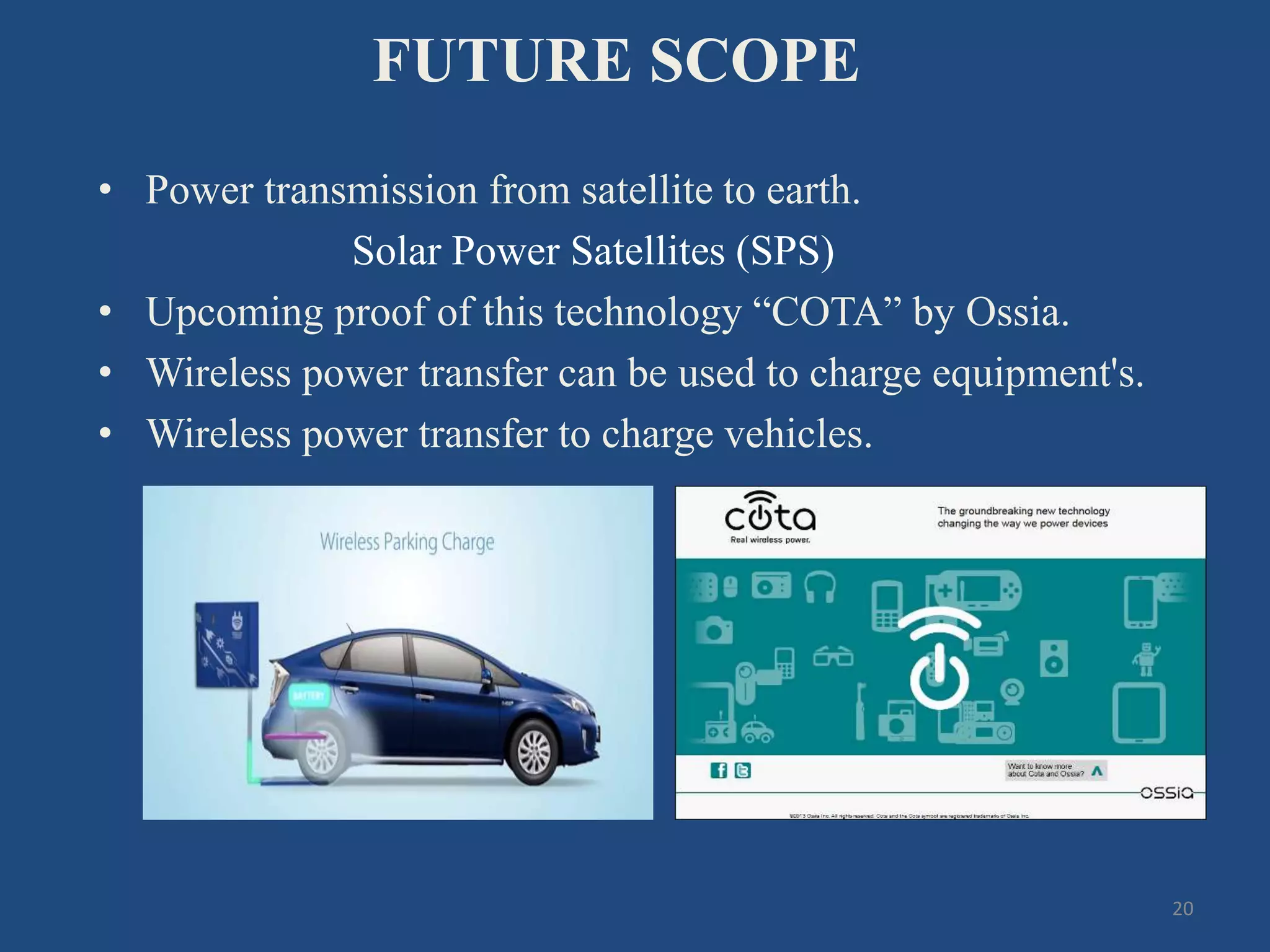
FUTURE SCOPE
• Power transmission from satellite to earth.
Solar Power Satellites (SPS)
• Upcoming proof of this technology “COTA” by Ossia.
• Wireless power transfer can be used to charge equipment's.
• Wireless power transfer to charge vehicles.
20
CONCLUSION
• Transmission without wires- a reality
• Efficient.
• Low maintenance cost. But, high initial cost
• Better than conventional wired transfer
• Energy crisis can be decreased
• In near future, world will be completely wireless
• The wireless power technique can be integrated with LED.
- LED products more convenient or reliable
-Lighting field can be more enhanced.
21
REFERENCE
• 1.“Nobel Prize and Laureates”,
http://www.nobelprize.org/nobel_prizes/physics/laureates/2014/press.html
• 2. Wikipedia. (2012, August 7). Tesla coil [Online].
Avaliable:http://en.wikipedia.org/wiki/Tesla coil
• 3. Liang Huang and Aiguo Patrick Hu, “An overview of capacitively coupled power
transfer—a new contactless power transfer solution”, 2013 IEEE 8th Conference on
Industrial Electronics and Applications(ICIEA), pp 461 -464.
• http://ieeexplore.ieee.org/xpl/articleDetails.jsp?arnumber=7127224&newsearch=true&qu
eryText=WIRELESS%20DRIVEN%20LED%20%20%20SEMICONDUCTOR%20LIG
HTING%20%20%20%20SYSTEM%20%0B&fname=&mname=&lname=&title=&volu
me=&issue=&spage=
22
QUERIES
23
THANK YOU
24

WIRELESS DRIVEN LED SEMICONDUCTOR LIGHTING SYSTEM

  • 1.
    WIRELESS DRIVEN LED SEMICONDUCTORLIGHTING SYSTEM PRESENTED BY, V M RAHUL
  • 2.
    OVERVIEW • INTRODUCTION • WIRELESSPOWER TRANSFER • TYPES OF WIRELESS POWER TRANSFER • WD-LED LIGHTING SYSTEM • APPLICATIONS • FUTURE SCOPE • CONCLUSION 2
  • 3.
    INTRODUCTION • LED Lightingsystem. • Wireless power transfer. • Wireless driven led. 3
  • 4.
    WIRELESS POWER TRANSFER 6 •In 1890, Sir Nikola Tesla Proposed a method of Wireless Power Transmission. • The forgotten invention is reborn in 2007 by scientist’s of MIT. • The transmission of energy from one place to another without using wires. 4
  • 5.
    ADVANTAGES • WPT systemwould completely eliminates the existing high- tension power transmission line cable. • Can reach the places which are remote. • High Efficiency and Low cost maintenance. • Power Theft will be negligible. 5
  • 6.
    CLASSIFICATION OF THEWIRELESS POWER TRANSMISSION SYSTEM • Electromagnetism induction / Inductive charging. • Capacitive coupling . • Resonant inductive coupling . • Microwave power transmission. 6
  • 7.
    ELECTROMAGNETISM INDUCTION • Alsoknown as inductive charging. • Two coils: a primary transmitter and a secondary receiver. • Energy transfer is due to Mutual Induction. 7
  • 8.
    INDUCTIVE COUPLING 8 • Aninduction coil to create an alternating electromagnetic field . • A second induction coil takes power from the EM field and coverts it into electrical current . • The transmission power and efficiency affects with distance.
  • 9.
    Advantage: - It providesa safe way of connection. - the products can be all enclosed and away from air, water or plastic in the atmosphere Disadvantage - require more electronics and coils - complex . - high cost. 9
  • 10.
    CAPACITIVE COUPLING • Consistsof,  primary power transmitter - acting as a high frequency voltage source.  capacitive structure - functioning as the electric energy transfer channel.  power receiver - acting as the secondary power conditioner, and supply the electric power to the load. 10
  • 11.
    11 Fig1: the structureof capacitive coupling power transfer Fig2: the simplified Capacitive power transfer circuit
  • 12.
    Features • In thecoupling part- the field is confined between metal plates. - Capacitive structure. • System employs electric field as the energy carrying medium .  Advantage: Very small power loss.  Applications: - charging of cell phones ,digital products, biomedical device, electric car. 12
  • 13.
    RESONANT INDUCTIVE COUPLING •Near field wireless transmission • Combination of inductive coupling and resonance • Resonance makes two objects interact very strongly • Inductance induces current. 13
  • 14.
    • Distance betweenthe coils is increased by adding resonance to the equation. • Both systems should have same resonant frequency. • The induction of electric power can be different. 14
  • 15.
    MICROWAVES POWER TRANSMISSION •Belongs to far field technique. • Transmitting energy by use of microwaves. • Method for transferring energy to the surface of the earth from solar power satellites. • Steps: • Electrical energy to microwave energy • Capturing microwaves using rectenna. • Microwave energy to electrical energy 15
  • 16.
  • 17.
    17 Disadvantage: - High cost. -Power in the transmission will interfere with present communication systems. BASIC BLOCK DIAGRAM OF MICROWAVE POWER TRANSFER
  • 18.
    WIRELESS-DRIVEN LED LIGHTING SYSTEM Advantages and Motivation: - To be safer and more reliable . - To make the LED lighting system waterproof. - Flexible by using wireless power technique. - Transferring electric power to LED lighting module through air, water, glass and plastic without any electric connection. - Improve the reliability to separate the drive circuit from lighting chips. 18
  • 19.
    Applications:  Wireless-driven/charging LEDlighting systems  Contactless-driven LED integrated chip/ module. 19 Fig : Schematic diagram of LED lights powered by wireless power transmission
  • 20.
    FUTURE SCOPE • Powertransmission from satellite to earth. Solar Power Satellites (SPS) • Upcoming proof of this technology “COTA” by Ossia. • Wireless power transfer can be used to charge equipment's. • Wireless power transfer to charge vehicles. 20
  • 21.
    CONCLUSION • Transmission withoutwires- a reality • Efficient. • Low maintenance cost. But, high initial cost • Better than conventional wired transfer • Energy crisis can be decreased • In near future, world will be completely wireless • The wireless power technique can be integrated with LED. - LED products more convenient or reliable -Lighting field can be more enhanced. 21
  • 22.
    REFERENCE • 1.“Nobel Prizeand Laureates”, http://www.nobelprize.org/nobel_prizes/physics/laureates/2014/press.html • 2. Wikipedia. (2012, August 7). Tesla coil [Online]. Avaliable:http://en.wikipedia.org/wiki/Tesla coil • 3. Liang Huang and Aiguo Patrick Hu, “An overview of capacitively coupled power transfer—a new contactless power transfer solution”, 2013 IEEE 8th Conference on Industrial Electronics and Applications(ICIEA), pp 461 -464. • http://ieeexplore.ieee.org/xpl/articleDetails.jsp?arnumber=7127224&newsearch=true&qu eryText=WIRELESS%20DRIVEN%20LED%20%20%20SEMICONDUCTOR%20LIG HTING%20%20%20%20SYSTEM%20%0B&fname=&mname=&lname=&title=&volu me=&issue=&spage= 22
  • 23.
  • 24.