Photovoltaic Cells:
Solar Cells

    EBB 424

    Dr. Sabar D. Hutagalung
    USM
Efficiency
 Efficiency = Fraction of incident light energy converted to electrical
  energy.
 Efficiency is the most important characteristic because it allows the
  device to be assessed economically in comparison to other energy
  devices.
 For a given solar spectrum, the efficiency depends on:
       Semiconductor material
       Device structure
       Ambient conditions (temperature)
       High radiation damage
       Sun spectrum
 Efficiency alone is not enough, the cost of the cell is also important
   and the life time.
I-V characteristics & Efficiency
                                     in dark (diode)


                                           under illumination


        Typical I-V characteristic of solar cells
I-V characteristics & Efficiency

                                                       As the intensity
                                                       increases, the short-
                                                       circuit current ISC
                                                       increases linearly,
                                                       but the open circuit
                                                       voltage VOC increases
                                                       sublinearly.


The I-V characteristics of a solar cell with varying
illumination as a parameter.
I-V characteristics & Efficiency
(II)                      (I)


(III)                     (IV)


        The I-Va characteristic of a solar cell.
        The maximum power is obtained at Pm = ImVm
I-V characteristics & Efficiency


    The I-V characteristics of a solar cell with varying illumination
I-V characteristics & Efficiency
Calculation, η
Consider a solar cell driving a 30Ω resistive load. The cell has area = 1
cm x 1 cm and is illuminated with light of intensity = 600Wm-2 and has I-V
characteristic as shown below.
                                            0.425V


     14.2mA


Q: What are the current and voltage in the circuit?
A: I’ = 14.2mA , V’ = 0.425V
Q: Calculate the power delivered to the load (Pout)
A: Area under the I’, V’ rectangular = P
       P= 14.2 x 10-3A x 0.425V = 6.035mW
Calculation, η
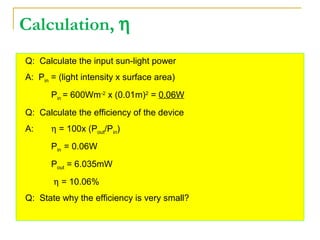
Q: Calculate the input sun-light power
A: Pin = (light intensity x surface area)
       Pin = 600Wm-2 x (0.01m)2 = 0.06W
Q: Calculate the efficiency of the device
A:     η = 100x (Pout/Pin)
       Pin = 0.06W
       Pout = 6.035mW
       η = 10.06%
Q: State why the efficiency is very small?
Solar Spectrum
Conversion Efficiency
   The most efficient PV modules usually
    employ single-crystal Si cells, with
    efficiencies up to 15%.
   Poly-crystalline cells are less expensive to
    manufacture but yield module efficiencies of
    about 11%.
   Thin-film cells are less expensive still, but
    give efficiencies to about 8% and suffer
    greater losses from deterioration.
Solar Photovoltaic Plants
How PV Cells Work


                                        Photovoltaic cells, modules, panels and
                                        arrays
Diagram of a photovoltaic cell


Major photovoltaic system components.
Problem
   Suppose that a particular family house in a sunny
    geographic location consumes a daily average electrical
    power of 1500 W supply by an 50 m2 are of solar panel. The
    average solar intensity incident per day is about 6 kWh m-2.
    What is the efficiency of solar cell?


                                                              18
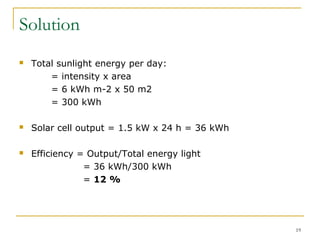
Solution
   Total sunlight energy per day:
        = intensity x area
        = 6 kWh m-2 x 50 m2
        = 300 kWh

   Solar cell output = 1.5 kW x 24 h = 36 kWh

   Efficiency = Output/Total energy light
                = 36 kWh/300 kWh
                = 12 %


                                                 19
Solar Cells
Efisiensi solar cells

Efisiensi solar cells

  • 1.
    Photovoltaic Cells: Solar Cells EBB 424 Dr. Sabar D. Hutagalung USM
  • 2.
    Efficiency  Efficiency =Fraction of incident light energy converted to electrical energy.  Efficiency is the most important characteristic because it allows the device to be assessed economically in comparison to other energy devices.  For a given solar spectrum, the efficiency depends on:  Semiconductor material  Device structure  Ambient conditions (temperature)  High radiation damage  Sun spectrum  Efficiency alone is not enough, the cost of the cell is also important and the life time.
  • 3.
    I-V characteristics &Efficiency in dark (diode) under illumination Typical I-V characteristic of solar cells
  • 4.
    I-V characteristics &Efficiency As the intensity increases, the short- circuit current ISC increases linearly, but the open circuit voltage VOC increases sublinearly. The I-V characteristics of a solar cell with varying illumination as a parameter.
  • 5.
  • 6.
    I-V characteristics &Efficiency (II) (I) (III) (IV) The I-Va characteristic of a solar cell. The maximum power is obtained at Pm = ImVm
  • 7.
  • 8.
  • 9.
    I-V characteristics &Efficiency The I-V characteristics of a solar cell with varying illumination
  • 10.
  • 11.
    Calculation, η Consider asolar cell driving a 30Ω resistive load. The cell has area = 1 cm x 1 cm and is illuminated with light of intensity = 600Wm-2 and has I-V characteristic as shown below. 0.425V 14.2mA Q: What are the current and voltage in the circuit? A: I’ = 14.2mA , V’ = 0.425V Q: Calculate the power delivered to the load (Pout) A: Area under the I’, V’ rectangular = P P= 14.2 x 10-3A x 0.425V = 6.035mW
  • 12.
    Calculation, η Q: Calculatethe input sun-light power A: Pin = (light intensity x surface area) Pin = 600Wm-2 x (0.01m)2 = 0.06W Q: Calculate the efficiency of the device A: η = 100x (Pout/Pin) Pin = 0.06W Pout = 6.035mW η = 10.06% Q: State why the efficiency is very small?
  • 14.
  • 15.
    Conversion Efficiency  The most efficient PV modules usually employ single-crystal Si cells, with efficiencies up to 15%.  Poly-crystalline cells are less expensive to manufacture but yield module efficiencies of about 11%.  Thin-film cells are less expensive still, but give efficiencies to about 8% and suffer greater losses from deterioration.
  • 16.
  • 17.
    How PV CellsWork Photovoltaic cells, modules, panels and arrays Diagram of a photovoltaic cell Major photovoltaic system components.
  • 18.
    Problem  Suppose that a particular family house in a sunny geographic location consumes a daily average electrical power of 1500 W supply by an 50 m2 are of solar panel. The average solar intensity incident per day is about 6 kWh m-2. What is the efficiency of solar cell? 18
  • 19.
    Solution  Total sunlight energy per day: = intensity x area = 6 kWh m-2 x 50 m2 = 300 kWh  Solar cell output = 1.5 kW x 24 h = 36 kWh  Efficiency = Output/Total energy light = 36 kWh/300 kWh = 12 % 19
  • 20.