ENGINEERING INSTITUTE FOR JUNIOR EXECUTIVES
M.B. ROAD, DALALPUKUR, HOWRAH-711104
GOVT. OF WEST BENGAL
ELECTRICAL ENGINEERING DEPARTMENT
ELECTRIC POWER TRANSMISSION AND DISTRIBUTION
LABORATORY
COURSE OUTCOMES :- Wireless Transmission Of Electrical Power
ACTIVITY NO:- A-14:3D DATE:-21/02/2025
Page No:1
WIRELESS POWER
TRANSMISSION
EPTD LABORATORY
PRESENTED BY: SUBHAMOY DAS
TRADE: DEE REG.NO:- D242500677
SESSION: 2024-2026
Page No:3
CONTENT
 Introduction
 Why is WPT?
 History of WPT
 Types of WPT
 Techniques to transfer energy wirelessly
 Advantages and Disadvantages
 Applications
 OUR PROJECT
 Conclusion
Page No:4
INTRODUCTION
 The transmission of energy from one place to another without using wires
 Conventional energy transfer is using wires
 But, the wireless transmission is made possible by using various technologies
 As per studies, most electrical energy transfer is through wires. Most of the
energy loss is during transmission
 On an average, more than 30%
 In India, it exceeds 40%
Page No:5
Why is WPT?
 Reliable
 Efficient
 Fast
 Low maintenance cost
 Can be used for short-range or long range.
Page No:6
History:
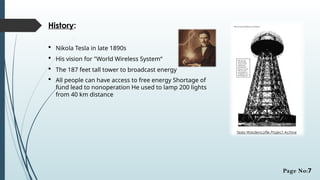
 Nikola Tesla in late 1890s
 His vision for "World Wireless System“
 The 187 feet tall tower to broadcast energy
 All people can have access to free energy Shortage of
fund lead to nonoperation He used to lamp 200 lights
from 40 km distance
Tesla Wardencyffe Project Achive
Page No:7
Types and Technologies of WPT:
 Near-field techniques
 Inductive Coupling
 Resonant Inductive Coupling
 Air lonization
 Far-field techniques:
 Microwave Power Transmission (MPT)
 LASER power transmission
Page No:8
Energy Coupling:
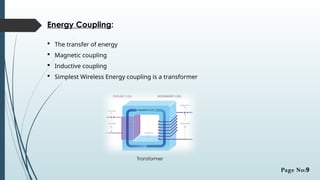
 The transfer of energy
 Magnetic coupling
 Inductive coupling
 Simplest Wireless Energy coupling is a transformer
Transformer
Page No:9
Inductive Coupling:
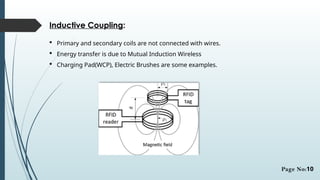
 Primary and secondary coils are not connected with wires.
 Energy transfer is due to Mutual Induction Wireless
 Charging Pad(WCP), Electric Brushes are some examples.
Page No:10
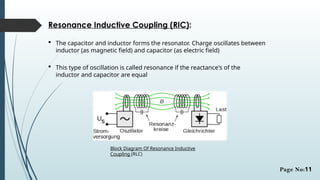
Resonance Inductive Coupling (RIC):
 The capacitor and inductor forms the resonator. Charge oscillates between
inductor (as magnetic field) and capacitor (as electric field)
 This type of oscillation is called resonance if the reactance's of the
inductor and capacitor are equal
Block Diagram Of Resonance Inductive
Coupling (RLC)
Page No:11
How Resonance In RIC:
 Coil provides the inductance
 Capacitor is connected parallel to the coil
 Radiation loss will be negligeibe
 Energy will be shifting back and forth between magnetic field
surrounding the coil and electric field around the capacitor
Page No:12
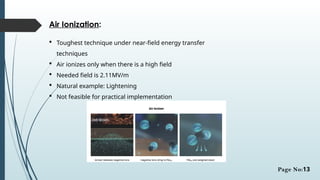
Air Ionization:
 Toughest technique under near-field energy transfer
techniques
 Air ionizes only when there is a high field
 Needed field is 2.11MV/m
 Natural example: Lightening
 Not feasible for practical implementation
Page No:13
Microwave Power Transfer(MPT):
 Transfers high power from one place to another. Two places being in
line of sight usually
 Electrical energy to microwave energy
 Capturing microwaves using rectenna
 Microwave energy to electrical energy
 AC is converted to DC first
 DC is converted to microwaves using magnetron
 Transmitted waves are received at rectenna which rectifies,
gives
 DC as the outputDC is converted back to AC
Page No:14
LASER Transmission:
 LASER is highly directional, coherent
 Not dispersed for very long
 But, gets attenuated when it propagates through
atmosphere
 Simple receiver
 Photovoltaic cell
 Cost-efficient
Page No:15
Solar Power Satellites (SPS):
 To provide energy to earth's increasing energy need
 To efficiently make use of renewable energy i.e., solar energy
 SPS are placed in geostationary orbits
 Each SPS may have 400 million photocells
 Efficiency exceeds 95%, if microwave is used
Page No:16
Advantages:
 No wires
 No Energy-waste as compared to dumped used batteries
 Need for battery is eliminated
 Maintenance cost is less
Page No:17
Disadvantages:
 Initial cost is high
 In RIC, tuning is difficult(L & C Values for Resonance)
 Air ionization technique is not feasible(small distance, High voltage,)
 Distance constraint
Page No:18
The Qi Standard:
 Qi(Chee) is a interface standard Developed by Wireless Power
Consortium
 It works for a distance up to 40mm(1.6inches)
 Comprises a transmission
 Pad & a compatible receive
Page No:19
Applications:
 Near-field energy transfer
 Electric automobile charging
 Static and moving
 Consumer electronics
 Industrial purposes
 Harsh environment
 Far-field energy transfer
 Solar Power Satellites
 Energy to remote areas
 Can broadcast energy globally (in future)
Page No:20
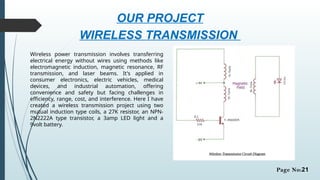
OUR PROJECT
WIRELESS TRANSMISSION
Wireless power transmission involves transferring
electrical energy without wires using methods like
electromagnetic induction, magnetic resonance, RF
transmission, and laser beams. It's applied in
consumer electronics, electric vehicles, medical
devices, and industrial automation, offering
convenience and safety but facing challenges in
efficiency, range, cost, and interference. Here I have
created a wireless transmission project using two
mutual induction type coils, a 27K resistor, an NPN-
2N2222A type transistor, a 3amp LED light and a
9volt battery.
Page No:21
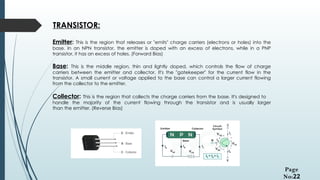
TRANSISTOR:
Emitter: This is the region that releases or "emits" charge carriers (electrons or holes) into the
base. In an NPN transistor, the emitter is doped with an excess of electrons, while in a PNP
transistor, it has an excess of holes. (Forward Bias)
Base: This is the middle region, thin and lightly doped, which controls the flow of charge
carriers between the emitter and collector. It's the "gatekeeper" for the current flow in the
transistor. A small current or voltage applied to the base can control a larger current flowing
from the collector to the emitter.
Collector: This is the region that collects the charge carriers from the base. It's designed to
handle the majority of the current flowing through the transistor and is usually larger
than the emitter. (Reverse Bias)
Page
No:22
WORKING PRINCIPLE OF WIRELESS TRANSMISSION:
Wireless transmission works by converting electrical energy into electromagnetic
waves, which then travel through the air to a receiver that converts the waves
back into usable electricity, essentially transferring power without the need for
physical wires; this principle is primarily based on electromagnetic induction,
where a changing magnetic field induces a current in a nearby conductor, like a
coil of wire, allowing for energy transfer between two coils positioned close
together.
 Electromagnetic fields:
The core principle involves creating a time-varying electromagnetic field using a
transmitter coil that generates a magnetic field when current flows through it.
 Receiver coil:
A nearby receiver coil, properly aligned with the transmitter coil, picks up the
magnetic field and induces a current within it, allowing for power transfer.
Page No:23
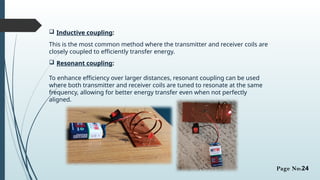
 Inductive coupling:
This is the most common method where the transmitter and receiver coils are
closely coupled to efficiently transfer energy.
 Resonant coupling:
To enhance efficiency over larger distances, resonant coupling can be used
where both transmitter and receiver coils are tuned to resonate at the same
frequency, allowing for better energy transfer even when not perfectly
aligned.
Page No:24
Conclusion:
 Transmission without wires- a reality
 Efficient Low maintenance cost
 But, high initial cost Better than conventional wired transfer
 Energy crisis can be decreased Low loss
 In near future, world will be completely wireless
Page No:25
Wireless Transmission line(Subhamoy Das).pptx

Wireless Transmission line(Subhamoy Das).pptx

  • 1.
    ENGINEERING INSTITUTE FORJUNIOR EXECUTIVES M.B. ROAD, DALALPUKUR, HOWRAH-711104 GOVT. OF WEST BENGAL ELECTRICAL ENGINEERING DEPARTMENT ELECTRIC POWER TRANSMISSION AND DISTRIBUTION LABORATORY COURSE OUTCOMES :- Wireless Transmission Of Electrical Power ACTIVITY NO:- A-14:3D DATE:-21/02/2025 Page No:1
  • 2.
    WIRELESS POWER TRANSMISSION EPTD LABORATORY PRESENTEDBY: SUBHAMOY DAS TRADE: DEE REG.NO:- D242500677 SESSION: 2024-2026 Page No:3
  • 3.
    CONTENT  Introduction  Whyis WPT?  History of WPT  Types of WPT  Techniques to transfer energy wirelessly  Advantages and Disadvantages  Applications  OUR PROJECT  Conclusion Page No:4
  • 4.
    INTRODUCTION  The transmissionof energy from one place to another without using wires  Conventional energy transfer is using wires  But, the wireless transmission is made possible by using various technologies  As per studies, most electrical energy transfer is through wires. Most of the energy loss is during transmission  On an average, more than 30%  In India, it exceeds 40% Page No:5
  • 5.
    Why is WPT? Reliable  Efficient  Fast  Low maintenance cost  Can be used for short-range or long range. Page No:6
  • 6.
    History:  Nikola Teslain late 1890s  His vision for "World Wireless System“  The 187 feet tall tower to broadcast energy  All people can have access to free energy Shortage of fund lead to nonoperation He used to lamp 200 lights from 40 km distance Tesla Wardencyffe Project Achive Page No:7
  • 7.
    Types and Technologiesof WPT:  Near-field techniques  Inductive Coupling  Resonant Inductive Coupling  Air lonization  Far-field techniques:  Microwave Power Transmission (MPT)  LASER power transmission Page No:8
  • 8.
    Energy Coupling:  Thetransfer of energy  Magnetic coupling  Inductive coupling  Simplest Wireless Energy coupling is a transformer Transformer Page No:9
  • 9.
    Inductive Coupling:  Primaryand secondary coils are not connected with wires.  Energy transfer is due to Mutual Induction Wireless  Charging Pad(WCP), Electric Brushes are some examples. Page No:10
  • 10.
    Resonance Inductive Coupling(RIC):  The capacitor and inductor forms the resonator. Charge oscillates between inductor (as magnetic field) and capacitor (as electric field)  This type of oscillation is called resonance if the reactance's of the inductor and capacitor are equal Block Diagram Of Resonance Inductive Coupling (RLC) Page No:11
  • 11.
    How Resonance InRIC:  Coil provides the inductance  Capacitor is connected parallel to the coil  Radiation loss will be negligeibe  Energy will be shifting back and forth between magnetic field surrounding the coil and electric field around the capacitor Page No:12
  • 12.
    Air Ionization:  Toughesttechnique under near-field energy transfer techniques  Air ionizes only when there is a high field  Needed field is 2.11MV/m  Natural example: Lightening  Not feasible for practical implementation Page No:13
  • 13.
    Microwave Power Transfer(MPT): Transfers high power from one place to another. Two places being in line of sight usually  Electrical energy to microwave energy  Capturing microwaves using rectenna  Microwave energy to electrical energy  AC is converted to DC first  DC is converted to microwaves using magnetron  Transmitted waves are received at rectenna which rectifies, gives  DC as the outputDC is converted back to AC Page No:14
  • 14.
    LASER Transmission:  LASERis highly directional, coherent  Not dispersed for very long  But, gets attenuated when it propagates through atmosphere  Simple receiver  Photovoltaic cell  Cost-efficient Page No:15
  • 15.
    Solar Power Satellites(SPS):  To provide energy to earth's increasing energy need  To efficiently make use of renewable energy i.e., solar energy  SPS are placed in geostationary orbits  Each SPS may have 400 million photocells  Efficiency exceeds 95%, if microwave is used Page No:16
  • 16.
    Advantages:  No wires No Energy-waste as compared to dumped used batteries  Need for battery is eliminated  Maintenance cost is less Page No:17
  • 17.
    Disadvantages:  Initial costis high  In RIC, tuning is difficult(L & C Values for Resonance)  Air ionization technique is not feasible(small distance, High voltage,)  Distance constraint Page No:18
  • 18.
    The Qi Standard: Qi(Chee) is a interface standard Developed by Wireless Power Consortium  It works for a distance up to 40mm(1.6inches)  Comprises a transmission  Pad & a compatible receive Page No:19
  • 19.
    Applications:  Near-field energytransfer  Electric automobile charging  Static and moving  Consumer electronics  Industrial purposes  Harsh environment  Far-field energy transfer  Solar Power Satellites  Energy to remote areas  Can broadcast energy globally (in future) Page No:20
  • 20.
    OUR PROJECT WIRELESS TRANSMISSION Wirelesspower transmission involves transferring electrical energy without wires using methods like electromagnetic induction, magnetic resonance, RF transmission, and laser beams. It's applied in consumer electronics, electric vehicles, medical devices, and industrial automation, offering convenience and safety but facing challenges in efficiency, range, cost, and interference. Here I have created a wireless transmission project using two mutual induction type coils, a 27K resistor, an NPN- 2N2222A type transistor, a 3amp LED light and a 9volt battery. Page No:21
  • 21.
    TRANSISTOR: Emitter: This isthe region that releases or "emits" charge carriers (electrons or holes) into the base. In an NPN transistor, the emitter is doped with an excess of electrons, while in a PNP transistor, it has an excess of holes. (Forward Bias) Base: This is the middle region, thin and lightly doped, which controls the flow of charge carriers between the emitter and collector. It's the "gatekeeper" for the current flow in the transistor. A small current or voltage applied to the base can control a larger current flowing from the collector to the emitter. Collector: This is the region that collects the charge carriers from the base. It's designed to handle the majority of the current flowing through the transistor and is usually larger than the emitter. (Reverse Bias) Page No:22
  • 22.
    WORKING PRINCIPLE OFWIRELESS TRANSMISSION: Wireless transmission works by converting electrical energy into electromagnetic waves, which then travel through the air to a receiver that converts the waves back into usable electricity, essentially transferring power without the need for physical wires; this principle is primarily based on electromagnetic induction, where a changing magnetic field induces a current in a nearby conductor, like a coil of wire, allowing for energy transfer between two coils positioned close together.  Electromagnetic fields: The core principle involves creating a time-varying electromagnetic field using a transmitter coil that generates a magnetic field when current flows through it.  Receiver coil: A nearby receiver coil, properly aligned with the transmitter coil, picks up the magnetic field and induces a current within it, allowing for power transfer. Page No:23
  • 23.
     Inductive coupling: Thisis the most common method where the transmitter and receiver coils are closely coupled to efficiently transfer energy.  Resonant coupling: To enhance efficiency over larger distances, resonant coupling can be used where both transmitter and receiver coils are tuned to resonate at the same frequency, allowing for better energy transfer even when not perfectly aligned. Page No:24
  • 24.
    Conclusion:  Transmission withoutwires- a reality  Efficient Low maintenance cost  But, high initial cost Better than conventional wired transfer  Energy crisis can be decreased Low loss  In near future, world will be completely wireless Page No:25