SEMINAR
WIRELESS ELECTRICITY
Presented by:
K.SRI HARSHA
B110874EE
CONTENTS
What is Wireless Electricity ?
History
Block diagram
Physics behind Wireless electricity
Witricity
Challenges faced
Conclusion
Reference
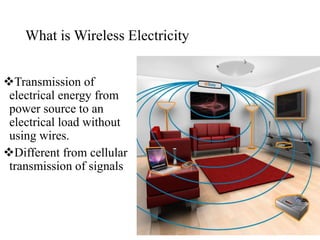
What is Wireless Electricity
Transmission of
electrical energy from
power source to an
electrical load without
using wires.
Different from cellular
transmission of signals
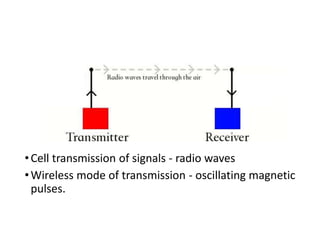
•Cell transmission of signals - radio waves
•Wireless mode of transmission - oscillating magnetic
pulses.
• Nikola Tesla - performed
the first experiments on
wireless electricity.
• He had put a great effort
in popularizing the idea.
•Spark-excited radio frequency
resonant transformers - Tesla coils
•Generated high AC voltages on
elevated capacitive terminals.
•Transmitted power over short
distance without wires.
Water – Current Analogy
•Pumping of water through a host
•The flow of water- current
•Pressure – Voltage
•Nozzle –Capacitive terminals
Tesla Coil
Tesla Coil
•Similary, when current is passed through a small
primary coil to a larger secondary coil
•As a result, the voltage steps up tremendously.
•This makes the Tesla Coil a Transformer.
Tesla Coil
• The transmission distance was increased by using a
receiving LC circuit ,tuned to resonance with the
transmitter's LC circuit.
• Using voltages of the order of 20 megavolts generated by an
enormous coil,
He was able to light three incandescent lamps by resonant
inductive coupling
Distance -100 feet (30 m).
Wardenclyffe Tower
• Tesla began construction of a
large high-voltage coil facility, the
Wardenclyffe Tower
• A prototype transmitter for a
"World Wireless System"
• To transmit power worldwide.
• The facility was never
completed, due to lack of funding
• Now-a-days there is a rapid increase of electronic goods like cell
phones ,laptops ,I-pods etc., which rely on the chemical storage
of energy by the battery which need to be recharged frequently
As these are becoming daily needs to the present generation
wireless energy transfer i.e, witricity would be useful for many
applications as these things need mid range energy.
Wireless Electricity
How it Works
Wireless Electricity uses the principle which
involves the usage of inductively coupled objects
with same resonant frequency.
 The principle Electromagnetic Induction states
that a coil generating magnetic field induces a
current in another coil as it is being placed in the
field of the former coil.
On the usage of resonance, the energy is well
transferred between coils having same resonant
frequency without any interruption.
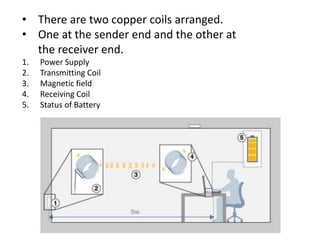
• There are two copper coils arranged.
• One at the sender end and the other at
the receiver end.
1. Power Supply
2. Transmitting Coil
3. Magnetic field
4. Receiving Coil
5. Status of Battery
Primary Coil
When the power is
switched on the first
coil converts the
electricity into
magnetic field, which
is oscillating at a
particular frequency.
Secondary Coil
The second coil at the
receiving end converts
the oscillating magnetic
field into electricity.
The surrounding
environment remains
unaffected.
Magnetic coupling
PHYSICS BEHIND WIRELESS TECHNOLOGY
Resonance:
• Resonance involves energy
oscillating between two
modes.
• The resonant factor for this
resonator:
𝜔 =
1
𝐿𝐶
PHYSICS BEHIND WIRELESS TECHNOLOGY
Two objects having similar resonance tend to
exchange energy without causing any effects on
the surrounding objects.
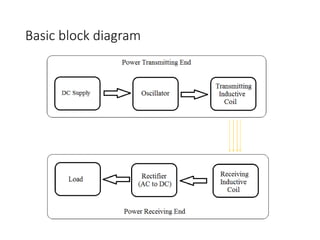
Basic block diagram
Wireless supply to a DC Fan
Sequence of flow of Power
Step 1
A circuit [A] attached to the wall socket converts the
DC current to 2 megahertz and feeds it to the
transmitting coil [B].
 The oscillating current inside the transmitting coil
causes the coil to emit a 2 -megahertz magnetic field
Continued…
Step 2
The receiving coil [C] is designed to resonate at the
same frequency
Magnetic induction takes place.
Receiving coil picks up the energy of the first coil's
magnetic field.
Continued…
Step 3
The energy of the oscillating magnetic field
induces an electrical current in the receiving coil,
lighting the bulb [D].
Experiment conducted by MIT Researchers
• At MIT, 2007,Project
‘Witricity’
• Powered a 60 watt
light bulb wirelessly,
using two 5-turn
copper coils.
• Diameter: 60 cm (24
in)
• Distance :2 m (7 ft)
• Efficiency : 45%
Experiment conducted by MIT Researchers
• Resonating frequency : 9.9 MHz
(≈ wavelength 30 m)
• Primary coil - connected
inductively to a power source
• Secondary Coil - to a bulb (load).
• The setup powered the bulb on,
even when the direct line of sight
was blocked using a wooden
panel.
• Researchers were able to power a
60 watt light bulb at roughly 90%
efficiency at a distance of 1 m.
• The research project at MIT was spun off into a private company, called
by the same name, WiTricity.
• It is an American engineering company
• Manufactures devices for wireless energy transmission using resonant
energy transfer based on oscillating magnetic fields.
CHALLENGES
•Design of high frequency stable oscillators.
•Reducing the size of the coils used.
•Cost of production.
Applications
•Totally replaces the wires
•Electronic gadgets like laptops, mobiles,
iPod etc. can be charged wirelessly
•Charging is automatic, without human
intervention
• The entire lighting system can
be powered wirelessly.
• The car can be charged
automatically.
Medical Field
Wireless charging of
• Ventricular assist devices
• Pacemakers
• Defibrilators
Future of Wireless Electricity
Conclusion
Non-radioactive mode of energy transfer.
Magnetic fields interact very weakly with biological organisms—people
and animals and are scientifically regarded to be safe.
It can transfer the power through walls and any metal obstacles.
Transmission efficiency is maximum over short range of distance (mm).
Wireless Electricity technology is based on sharply resonant strong
coupling.
It is able to transfer power efficiently even when the distances
between the power source and capture device are several times the
size of the devices themselves
REFERENCES
• Basharat Nizam, “Inductive Charging Technique,”
International Journal of Engineering Trends and
Technology (IJETT), Volume4, Issue4- April 2013
• A.K. RamRakhyani, S. Mirabbasi, and M. Chiao,
“Design and Optimization of Resonance Based
Efficient Wireless Power Delivery Systems for
Biomedical Implants,” IEEE Transactions on, Volume5,
No1:48–63,February 2011.
• David W Baarman, “Understanding wireless power”,
Director of Advanced Technologies, Fulton Innovation
Joshua Schwannecke, Research Scientist, Fulton
Innovation December 2009
• Shawon Senjuti, “Design and optimization of efficient
wireless power transfer links for implantable
biotelemetry systems,” A thesis submitted in partial
fulfillment of the requirements for the degree of
Master of Engineering Science
• Dr. Morris Kesler, “Highly resonant wireless power
transfer”.
Any Questions ?

WIRELESS ELECTRICITY

  • 1.
  • 2.
    CONTENTS What is WirelessElectricity ? History Block diagram Physics behind Wireless electricity Witricity Challenges faced Conclusion Reference
  • 3.
    What is WirelessElectricity Transmission of electrical energy from power source to an electrical load without using wires. Different from cellular transmission of signals
  • 4.
    •Cell transmission ofsignals - radio waves •Wireless mode of transmission - oscillating magnetic pulses.
  • 5.
    • Nikola Tesla- performed the first experiments on wireless electricity. • He had put a great effort in popularizing the idea.
  • 6.
    •Spark-excited radio frequency resonanttransformers - Tesla coils •Generated high AC voltages on elevated capacitive terminals. •Transmitted power over short distance without wires.
  • 7.
  • 8.
    Water – CurrentAnalogy •Pumping of water through a host •The flow of water- current •Pressure – Voltage •Nozzle –Capacitive terminals
  • 9.
  • 10.
    Tesla Coil •Similary, whencurrent is passed through a small primary coil to a larger secondary coil •As a result, the voltage steps up tremendously. •This makes the Tesla Coil a Transformer.
  • 11.
    Tesla Coil • Thetransmission distance was increased by using a receiving LC circuit ,tuned to resonance with the transmitter's LC circuit. • Using voltages of the order of 20 megavolts generated by an enormous coil, He was able to light three incandescent lamps by resonant inductive coupling Distance -100 feet (30 m).
  • 12.
    Wardenclyffe Tower • Teslabegan construction of a large high-voltage coil facility, the Wardenclyffe Tower • A prototype transmitter for a "World Wireless System" • To transmit power worldwide. • The facility was never completed, due to lack of funding
  • 13.
    • Now-a-days thereis a rapid increase of electronic goods like cell phones ,laptops ,I-pods etc., which rely on the chemical storage of energy by the battery which need to be recharged frequently As these are becoming daily needs to the present generation wireless energy transfer i.e, witricity would be useful for many applications as these things need mid range energy. Wireless Electricity
  • 14.
    How it Works WirelessElectricity uses the principle which involves the usage of inductively coupled objects with same resonant frequency.  The principle Electromagnetic Induction states that a coil generating magnetic field induces a current in another coil as it is being placed in the field of the former coil. On the usage of resonance, the energy is well transferred between coils having same resonant frequency without any interruption.
  • 15.
    • There aretwo copper coils arranged. • One at the sender end and the other at the receiver end. 1. Power Supply 2. Transmitting Coil 3. Magnetic field 4. Receiving Coil 5. Status of Battery
  • 16.
    Primary Coil When thepower is switched on the first coil converts the electricity into magnetic field, which is oscillating at a particular frequency.
  • 17.
    Secondary Coil The secondcoil at the receiving end converts the oscillating magnetic field into electricity. The surrounding environment remains unaffected.
  • 18.
  • 19.
    PHYSICS BEHIND WIRELESSTECHNOLOGY Resonance: • Resonance involves energy oscillating between two modes. • The resonant factor for this resonator: 𝜔 = 1 𝐿𝐶
  • 20.
    PHYSICS BEHIND WIRELESSTECHNOLOGY Two objects having similar resonance tend to exchange energy without causing any effects on the surrounding objects.
  • 21.
  • 22.
  • 23.
    Sequence of flowof Power Step 1 A circuit [A] attached to the wall socket converts the DC current to 2 megahertz and feeds it to the transmitting coil [B].  The oscillating current inside the transmitting coil causes the coil to emit a 2 -megahertz magnetic field
  • 24.
    Continued… Step 2 The receivingcoil [C] is designed to resonate at the same frequency Magnetic induction takes place. Receiving coil picks up the energy of the first coil's magnetic field.
  • 25.
    Continued… Step 3 The energyof the oscillating magnetic field induces an electrical current in the receiving coil, lighting the bulb [D].
  • 26.
    Experiment conducted byMIT Researchers • At MIT, 2007,Project ‘Witricity’ • Powered a 60 watt light bulb wirelessly, using two 5-turn copper coils. • Diameter: 60 cm (24 in) • Distance :2 m (7 ft) • Efficiency : 45%
  • 27.
    Experiment conducted byMIT Researchers • Resonating frequency : 9.9 MHz (≈ wavelength 30 m) • Primary coil - connected inductively to a power source • Secondary Coil - to a bulb (load). • The setup powered the bulb on, even when the direct line of sight was blocked using a wooden panel. • Researchers were able to power a 60 watt light bulb at roughly 90% efficiency at a distance of 1 m.
  • 28.
    • The researchproject at MIT was spun off into a private company, called by the same name, WiTricity. • It is an American engineering company • Manufactures devices for wireless energy transmission using resonant energy transfer based on oscillating magnetic fields.
  • 29.
    CHALLENGES •Design of highfrequency stable oscillators. •Reducing the size of the coils used. •Cost of production.
  • 30.
    Applications •Totally replaces thewires •Electronic gadgets like laptops, mobiles, iPod etc. can be charged wirelessly •Charging is automatic, without human intervention
  • 31.
    • The entirelighting system can be powered wirelessly. • The car can be charged automatically.
  • 32.
    Medical Field Wireless chargingof • Ventricular assist devices • Pacemakers • Defibrilators
  • 33.
    Future of WirelessElectricity
  • 34.
    Conclusion Non-radioactive mode ofenergy transfer. Magnetic fields interact very weakly with biological organisms—people and animals and are scientifically regarded to be safe. It can transfer the power through walls and any metal obstacles. Transmission efficiency is maximum over short range of distance (mm). Wireless Electricity technology is based on sharply resonant strong coupling. It is able to transfer power efficiently even when the distances between the power source and capture device are several times the size of the devices themselves
  • 35.
    REFERENCES • Basharat Nizam,“Inductive Charging Technique,” International Journal of Engineering Trends and Technology (IJETT), Volume4, Issue4- April 2013 • A.K. RamRakhyani, S. Mirabbasi, and M. Chiao, “Design and Optimization of Resonance Based Efficient Wireless Power Delivery Systems for Biomedical Implants,” IEEE Transactions on, Volume5, No1:48–63,February 2011. • David W Baarman, “Understanding wireless power”, Director of Advanced Technologies, Fulton Innovation Joshua Schwannecke, Research Scientist, Fulton Innovation December 2009 • Shawon Senjuti, “Design and optimization of efficient wireless power transfer links for implantable biotelemetry systems,” A thesis submitted in partial fulfillment of the requirements for the degree of Master of Engineering Science • Dr. Morris Kesler, “Highly resonant wireless power transfer”.
  • 37.

Editor's Notes

  • #3 Beginning course details and/or books/materials needed for a class/project.
  • #4 A schedule design for optional periods of time/objectives.
  • #15 Relative vocabulary list.
  • #21 A list of procedures and steps, or a lecture slide with media.
  • #35 Example graph/chart.