The document presents a temperature-based fan speed controller designed to adjust the speed of a fan according to ambient temperature using a microcontroller. It includes a literature review highlighting energy savings, a detailed methodology outlining components and operation, and discusses results, applications, advantages, and disadvantages of the system. The conclusion emphasizes successful implementation and recommends further enhancements such as monitoring additional parameters and remote data transmission.
CONTENTS
• Chapter1: Introduction
• Chapter 2: Literature Review
• Chapter 3: Methodology
• Chapter 4: Result and Discussion
• Chapter 5: Conclusion and Recommendation
3.
INTRODUCTION
CHAPTER ONE
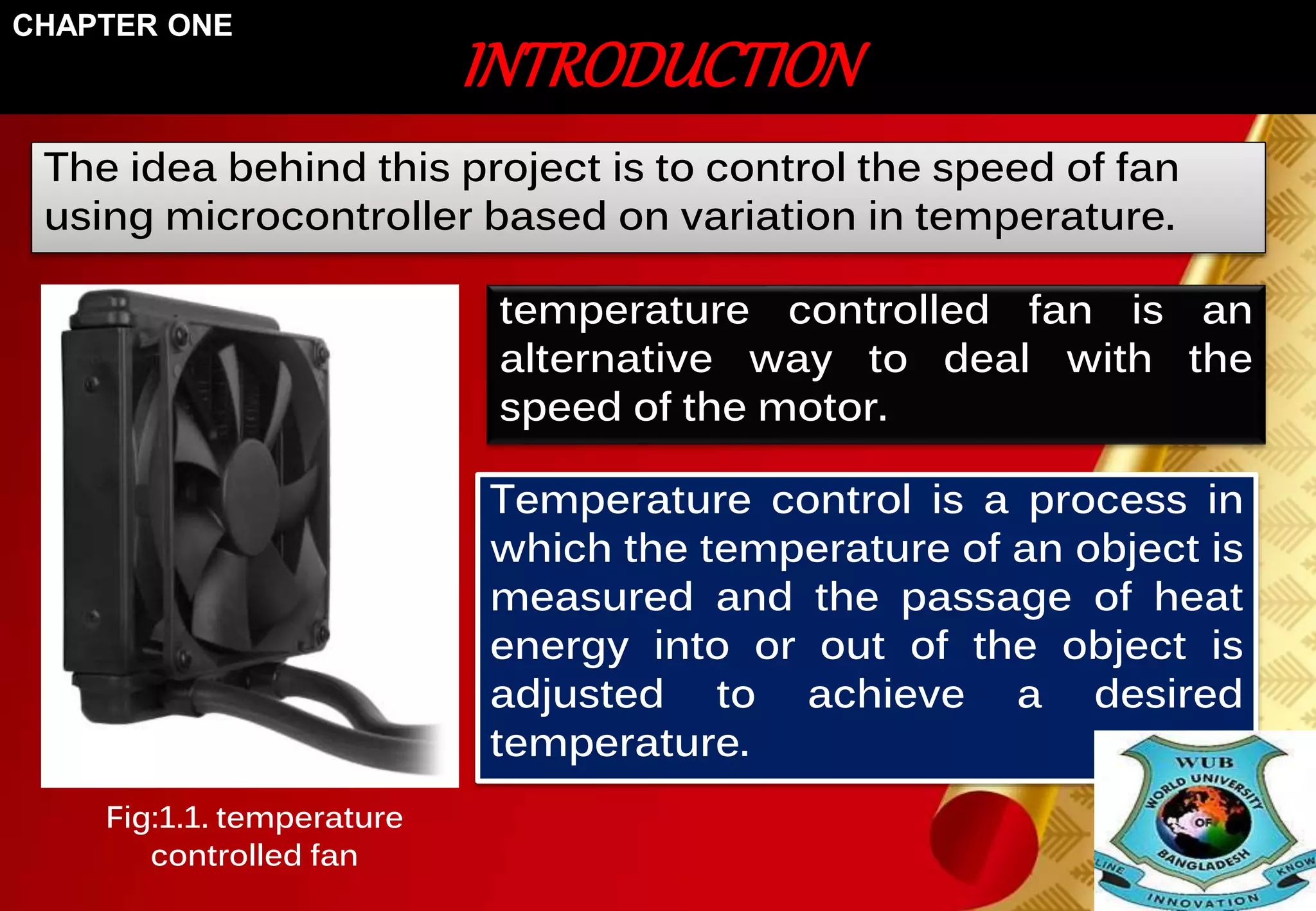
The idea behind this project is to control the speed of fan
using microcontroller based on variation in temperature.
temperature controlled fan is an
alternative way to deal with the
speed of the motor.
Temperature control is a process in
which the temperature of an object is
measured and the passage of heat
energy into or out of the object is
adjusted to achieve a desired
temperature.
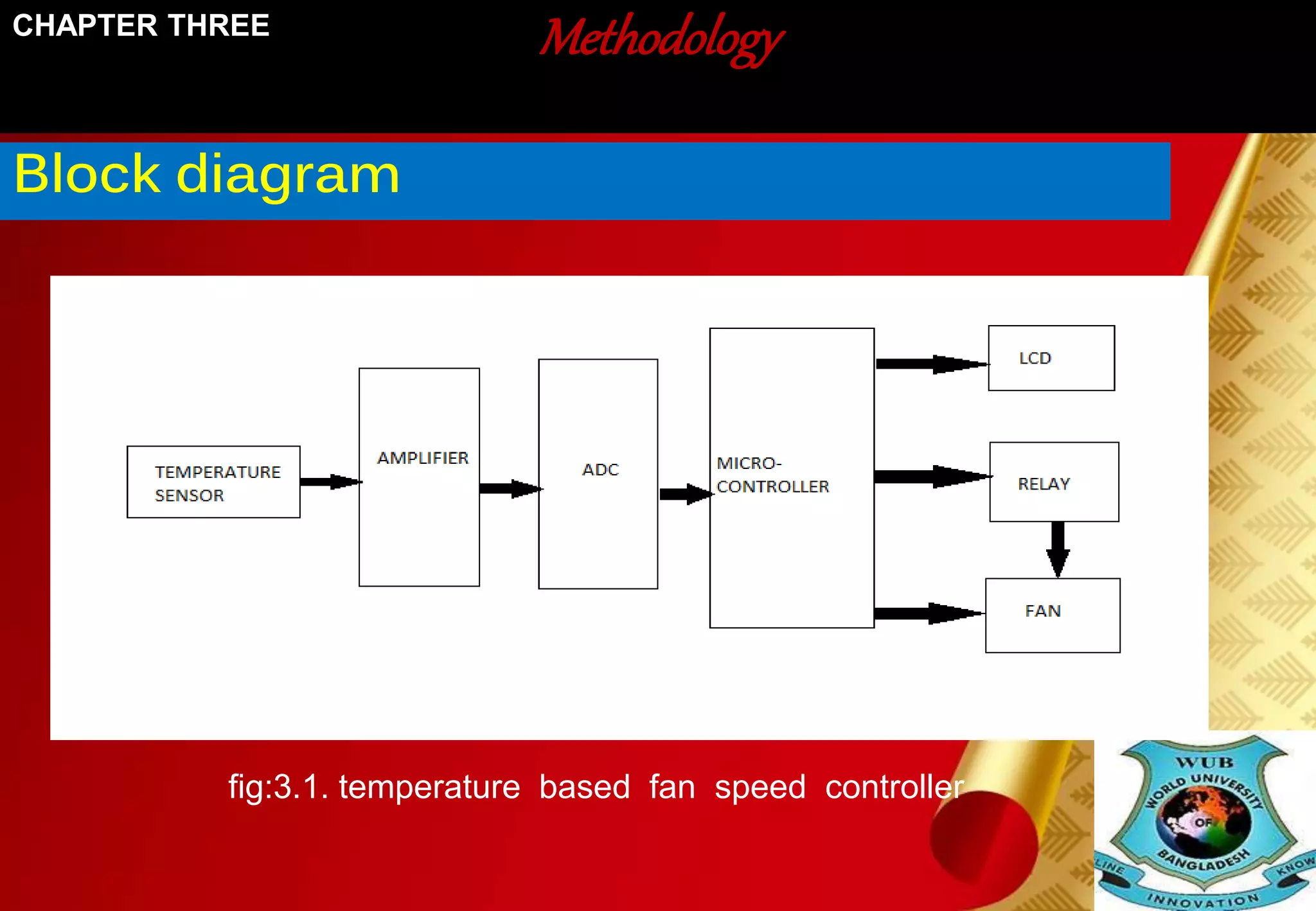
Fig:1.1. temperature
controlled fan
4.
INTRODUCTION CHAPTER ONE
Objectives
Measure the room temperature
Display the current temperature in the LCD
Vary the speed of fan accordingly
Reducing the power consumption
5.
Literature Review
Accordingto Tito Smailagich, given the high
cost of electrical power, replacing a
conventional on/off temperature control with a
proportional controller can often save energy
and money.
Lawrence Berkeley National
Laboratory in their articles mentioned
that in the manufacturing sector, fans
use about 78.7 billion kilowatt-hours
of energy each year. This
consumption represents 15 percent of
the electricity used by motors.
CHAPTER TWO
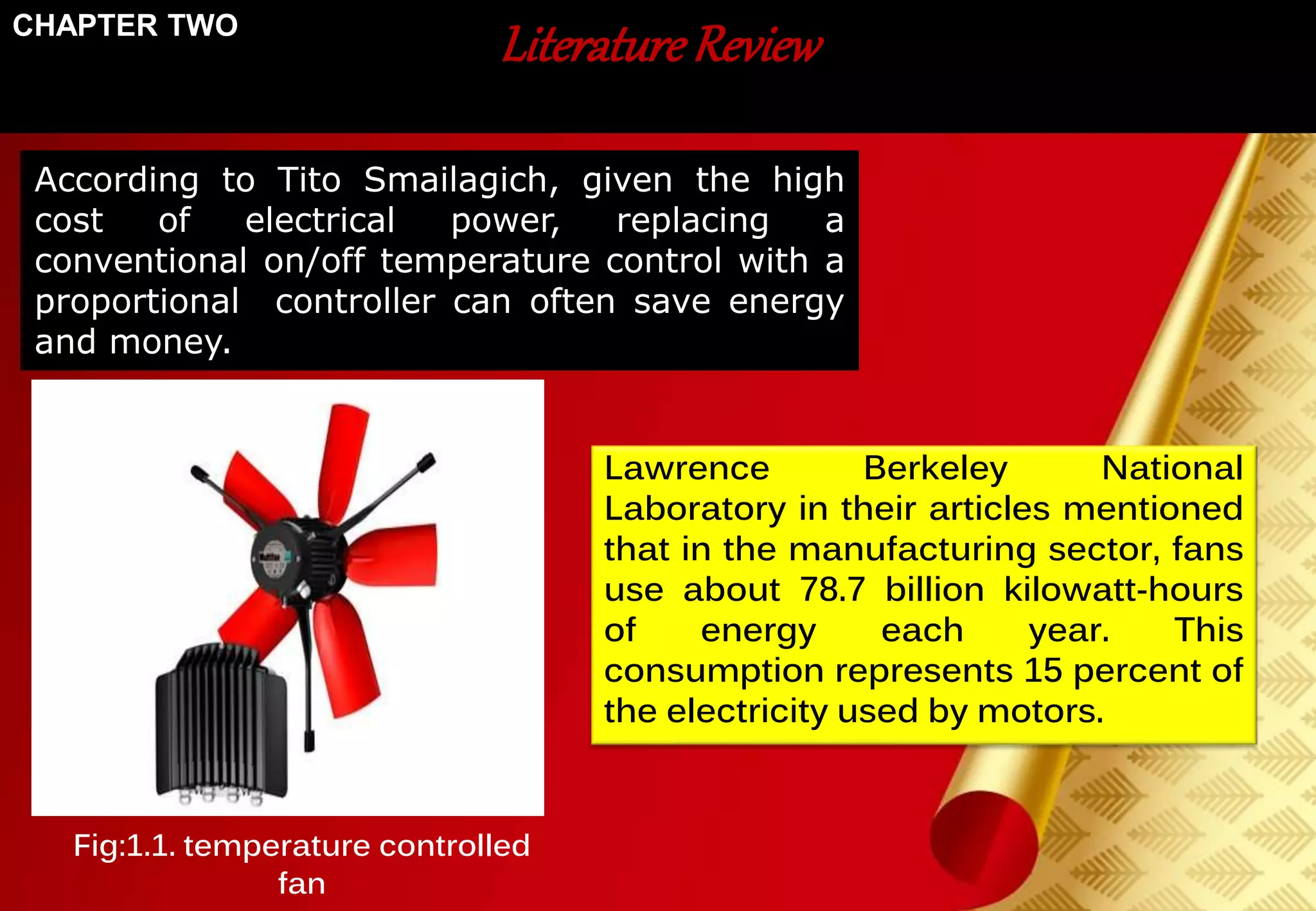
Fig:1.1. temperature controlled
fan
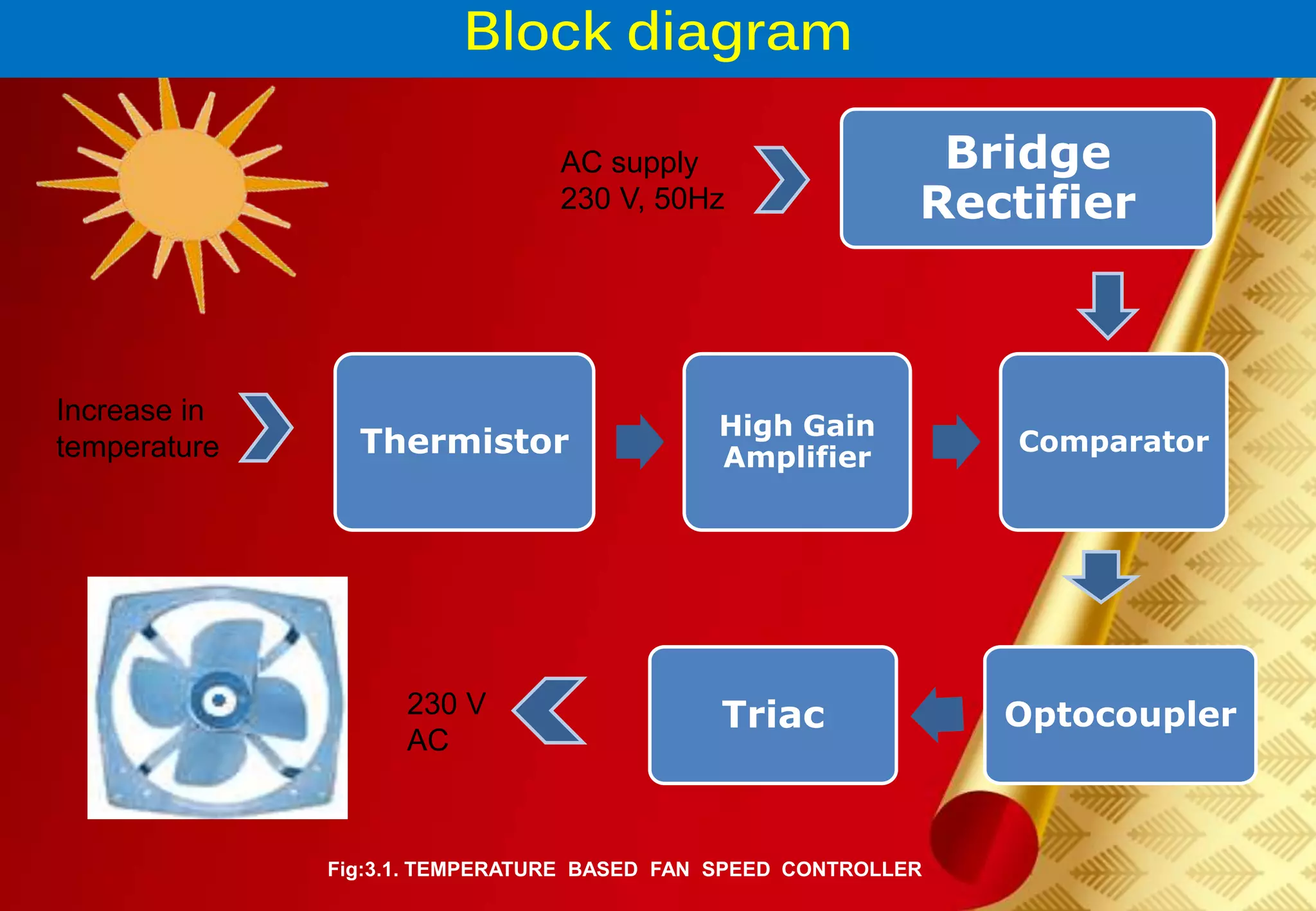
Block diagram
ThermistorHigh Gain
Amplifier
Bridge
Rectifier
Comparator
Triac Optocoupler
Increase in
temperature
AC supply
230 V, 50Hz
230 V
AC
Fig:3.1. TEMPERATURE BASED FAN SPEED CONTROLLER
METHODOLOGY
CHAPTER THREE
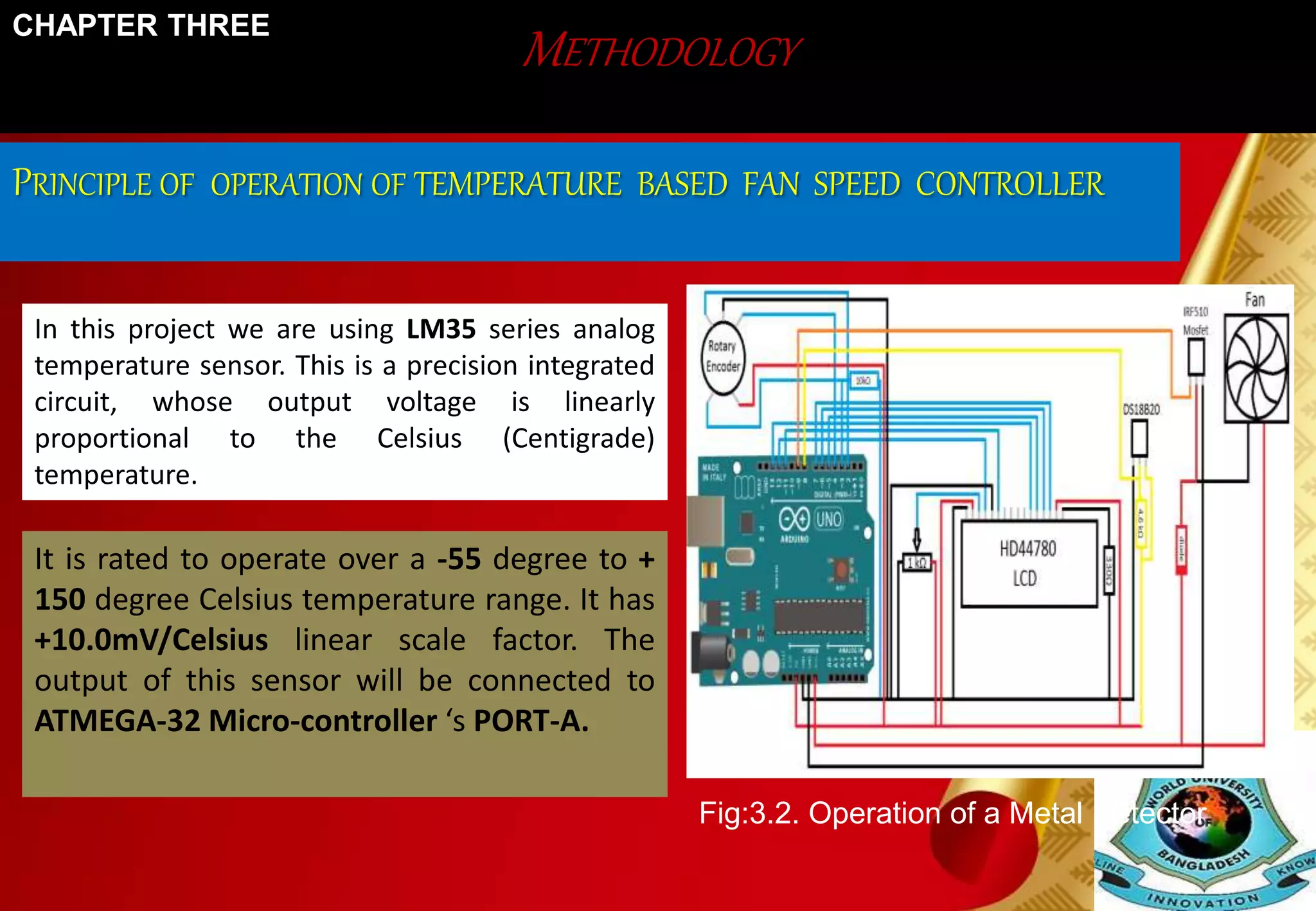
PRINCIPLE OF OPERATION OF TEMPERATURE BASED FAN SPEED CONTROLLER
In this project we are using LM35 series analog
temperature sensor. This is a precision integrated
circuit, whose output voltage is linearly
proportional to the Celsius (Centigrade)
temperature.
It is rated to operate over a -55 degree to +
150 degree Celsius temperature range. It has
+10.0mV/Celsius linear scale factor. The
output of this sensor will be connected to
ATMEGA-32 Micro-controller ‘s PORT-A.
Fig:3.2. Operation of a Metal Detector
10.
CIRCUIT DIAGRAM
METHODOLOGY
CHAPTER THREE
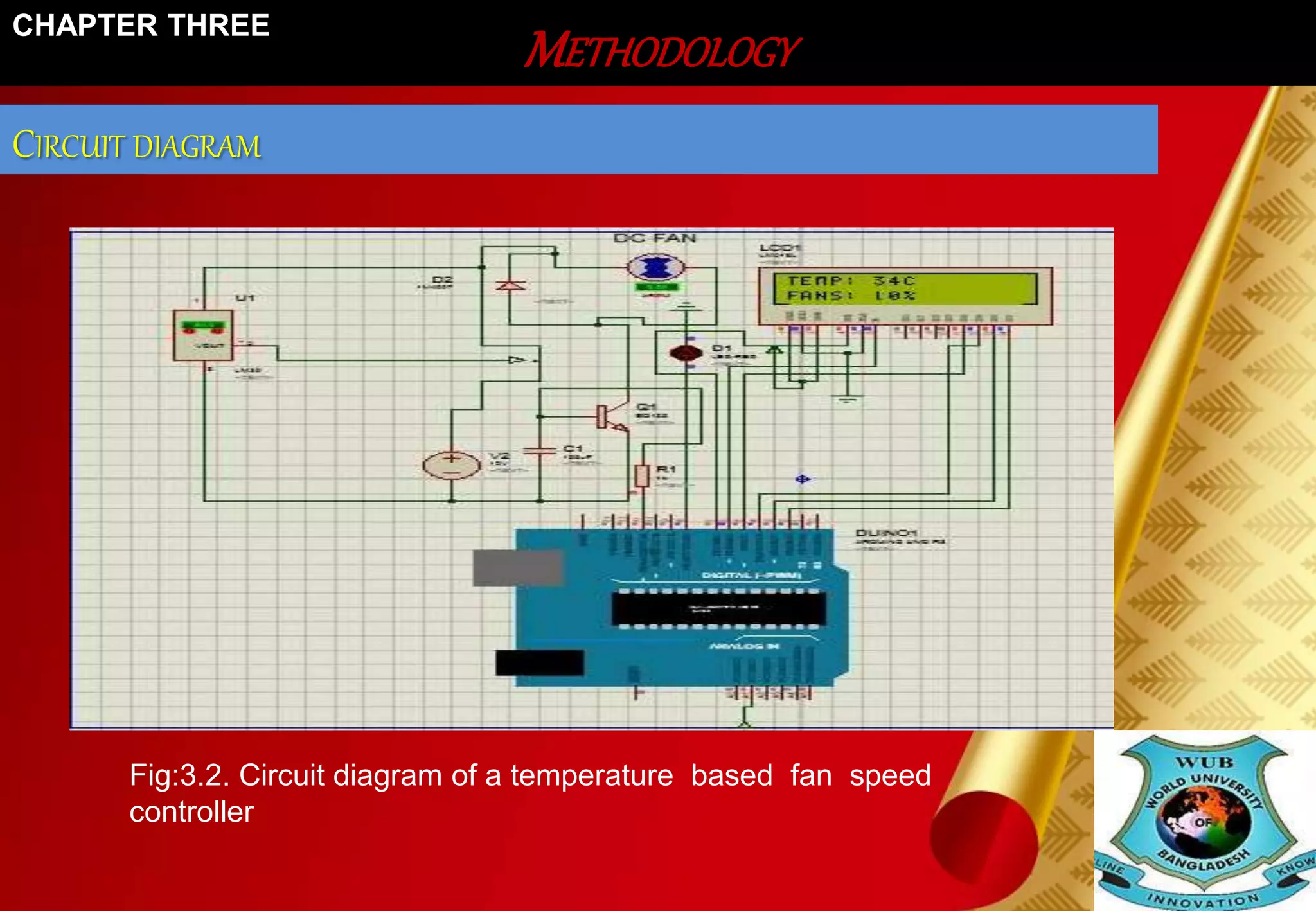
Fig:3.2. Circuit diagram of a temperature based fan speed
controller
11.
CIRCUIT DIAGRAM
METHODOLOGY
CHAPTER THREE
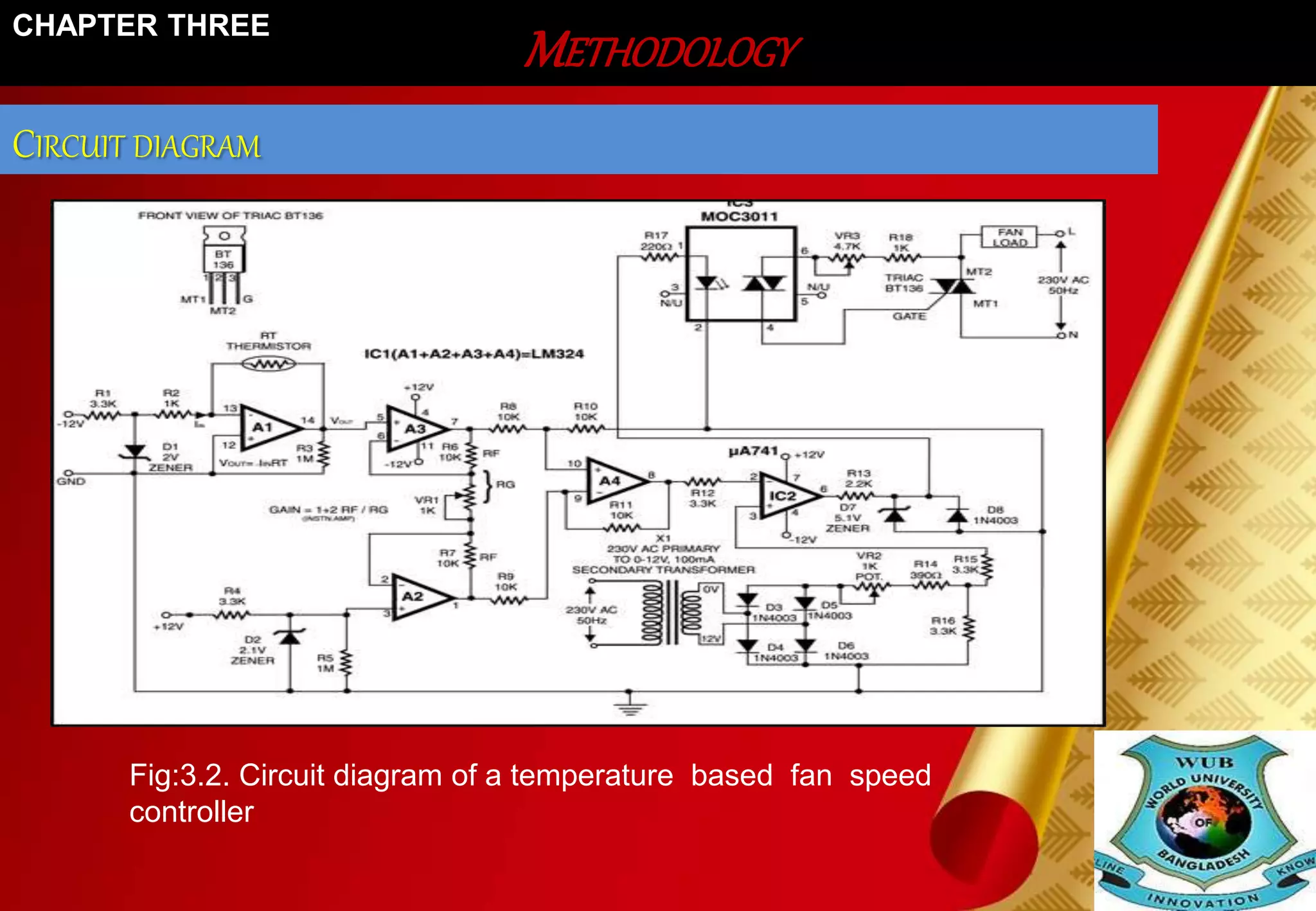
Fig:3.2. Circuit diagram of a temperature based fan speed
controller
12.
CHAPTER THREE
COMPONENTS
METHODOLOGY
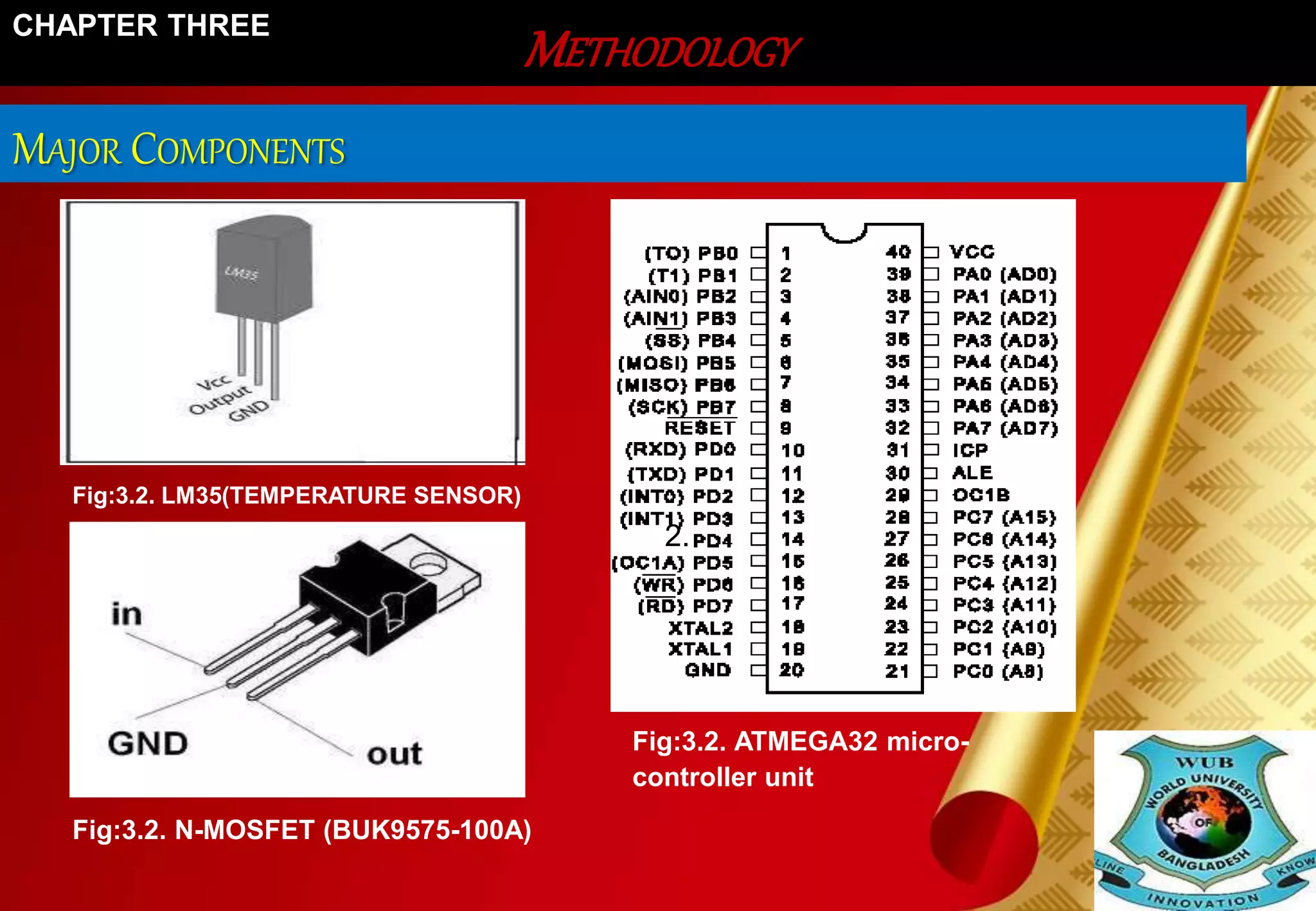
1. LM35(TEMPERATURE SENSOR)
2. ATMEGA32 micro-controller unit
3. Brushless variable speed DC Motor [DR-6634-514]
4. N-MOSFET (BUK9575-100A)
5. Resistors (10k ohm, 1k ohm)
6. LM7805 Voltage regulator IC
13.
MAJOR COMPONENTS
METHODOLOGY
CHAPTER THREE
Fig:3.2. ATMEGA32 micro-controller
unit
Fig:3.2. LM35(TEMPERATURE SENSOR)
2.
Fig:3.2. N-MOSFET (BUK9575-100A)
Result and discussion
CHAPTER FOUR
Results
After designing, simulating, assembling, soldering
and testing the circuit, we came to the conclusion
that our circuit of the temperature based fan speed
controller is working satisfactorily.
The construction hardware perfect.
The total project work perfectly and has negligible
amount of unexpected functioning.
16.
Result and discussionCHAPTER FOUR
APPLICATION
Personal computers
Exhaust fans in large hotels
Washing machines
CD and DVD players
17.
Result and discussionCHAPTER FOUR
Advantages and disadvantages
Advantages-
(1) Since it is an automated system ,it is programmed effectively so
that no interruptions would stop its functionality.
(2)To monitor the environment, that is not comfortable or possible
to monitor for humans(especially for extended periods of time)
(3) Prevents waste of energy.
Disadvantages-
(1) It can only be maintained by technical person .
(2) Due to temperature variation, after sometimes it’s efficiency
may be decreased .
18.
Conclusion and RecommendationCHAPTER FIVE
Conclusion
The problem statement is implemented.
Hardware part is halfway implemented.
Through simulations and after running the code in IDE abstract is
verified
As the technology is going on developing day by day, we prefer
things to be done automatically and in the same way our projects
reduces the work to mankind.
19.
Conclusion and RecommendationCHAPTER FIVE
Recommendation
• We can monitor more parameters like humidity, light and at the same
time control them.
•We can send this data to a remote location using mobile or internet.
We can draw graphs of variations in these parameters using computer.
•When temperature exceeds the limit, a call will be dialed to the
respective given number by an automatic Dialer system.