ENERGY EFFICIENT INTELLIGENT
LED LIGHTING SYSTEM
PRIYA JOHNSON
S7 F
ROLL NO : 44
CONTENTS
• Introduction
• Existing Systems
• Proposed System
• LED
• Operating principle of proposed system
• Overview of proposed system
• Minimum Light Intensity Control Algorithm
• Hardware Block diagram
• PCB layout of proposed system
• Case study
• Experiment result
• Disadvantages
• Conclusion
• Reference
1
INTRODUCTION
• Light accounts for approx. 20% of total energy
consumption
• Invention of LED reduces energy consumption of a
light
• The intelligent light control system can reduce
energy consumption
• Automatically control the intensity of illumination
through situation awareness
• About 15% of total energy consumption can be
reduced through light control according to user’s
living pattern
2
EXISTING SYSTEMS
• Can support ON-OFF / dimming control after
detecting object, intensity of illumination or
controlling with time setting
• It is hard to apply to complex environments
because of presence of variety of users
• Mostly installed in places such as front door or
hallway
3
PROPOSED SYSTEM
• The new intelligent light control system should be
designed :
 to maximize the utilization of an LED
 to have communication capability
 to control based on the situation awareness
 to enhance both energy efficiency & user
satisfaction
• The system uses multi-sensors & wireless
communication technology
• Control LED light according to user’s state &
surroundings
• Autonomously adjust the min light intensity
4
LED
• Two lead semiconductor light source
• A PN junction diode which emits light when
forward biased
• The amount of light output is directly
proportional to forward current
• Light energy is released at the junction when
electrons and holes are recombined
• After recombination the electrons in the
conduction band of N-region falls into the holes
in the valance band of P-region
5
CONTD…
• The difference in energy between the conduction
band and valance band is radiated in the form of
light
• The semiconductor material used for manufacturing
LED:
Gallium arsenide-infrared radiation
Gallium phosphide-red or yellow
Gallium arsenide phosphide-red or green
Gallium nitride-blue
6
OPERATING PRINCIPLE OF
PROPOSED SYSTEM
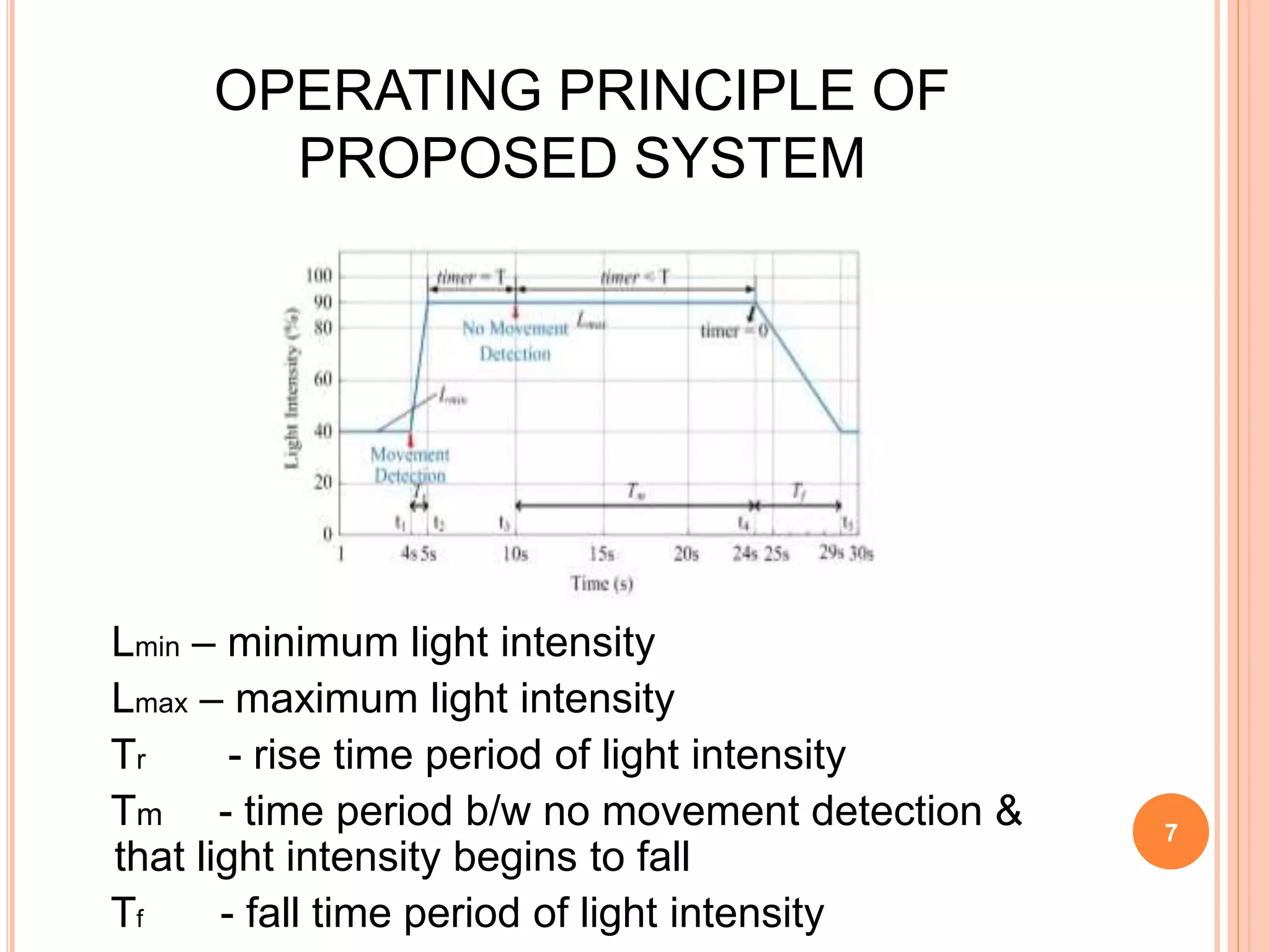
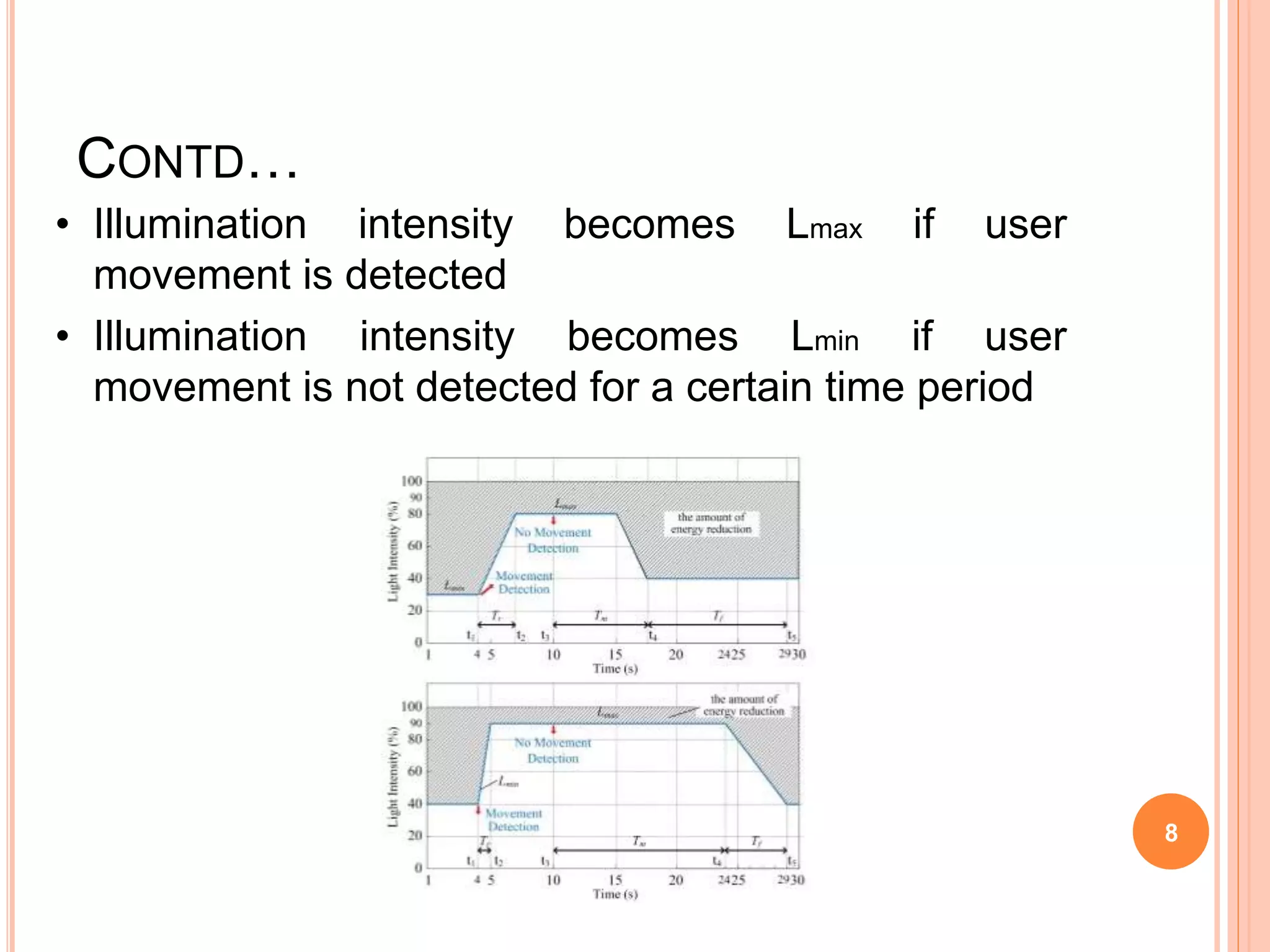
Lmin – minimum light intensity
Lmax – maximum light intensity
Tr - rise time period of light intensity
Tm - time period b/w no movement detection &
that light intensity begins to fall
Tf - fall time period of light intensity
7
CONTD…
8
• Illumination intensity becomes Lmax if user
movement is detected
• Illumination intensity becomes Lmin if user
movement is not detected for a certain time period
CONTD…
• As Tr is longer, Tm & Tf are smaller and Lmax & Lmin
are smaller, energy saving effects becomes larger
• Inconvenience of users can be bigger
• Necessary to properly set the value to space
environmental characteristics
9
OVERVIEW OF PROPOSED SYSTEM
10
CONTD…
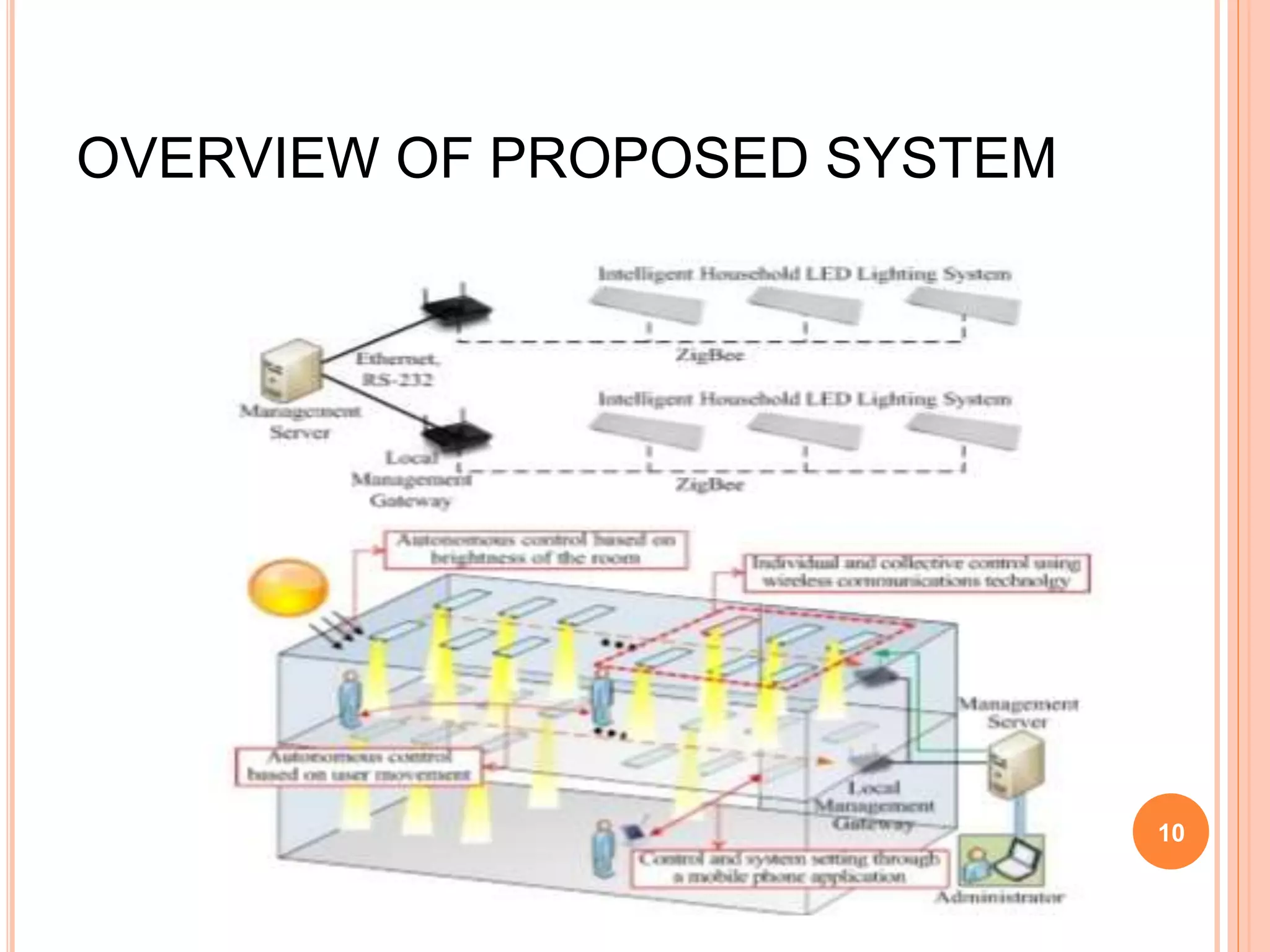
• Autonomous control based on user movement
• Autonomous control based on brightness of room
• Autonomous optimization of system control & state
variables
• Collective control using a wireless technology
• Control & system setting through a wireless controller &
a mobile phone application
 Reduce energy consumption via interaction with
information about user’s state
 Autonomous control could lead to disturbance to
residents
 It automatically optimizes the system control & state
variables 11
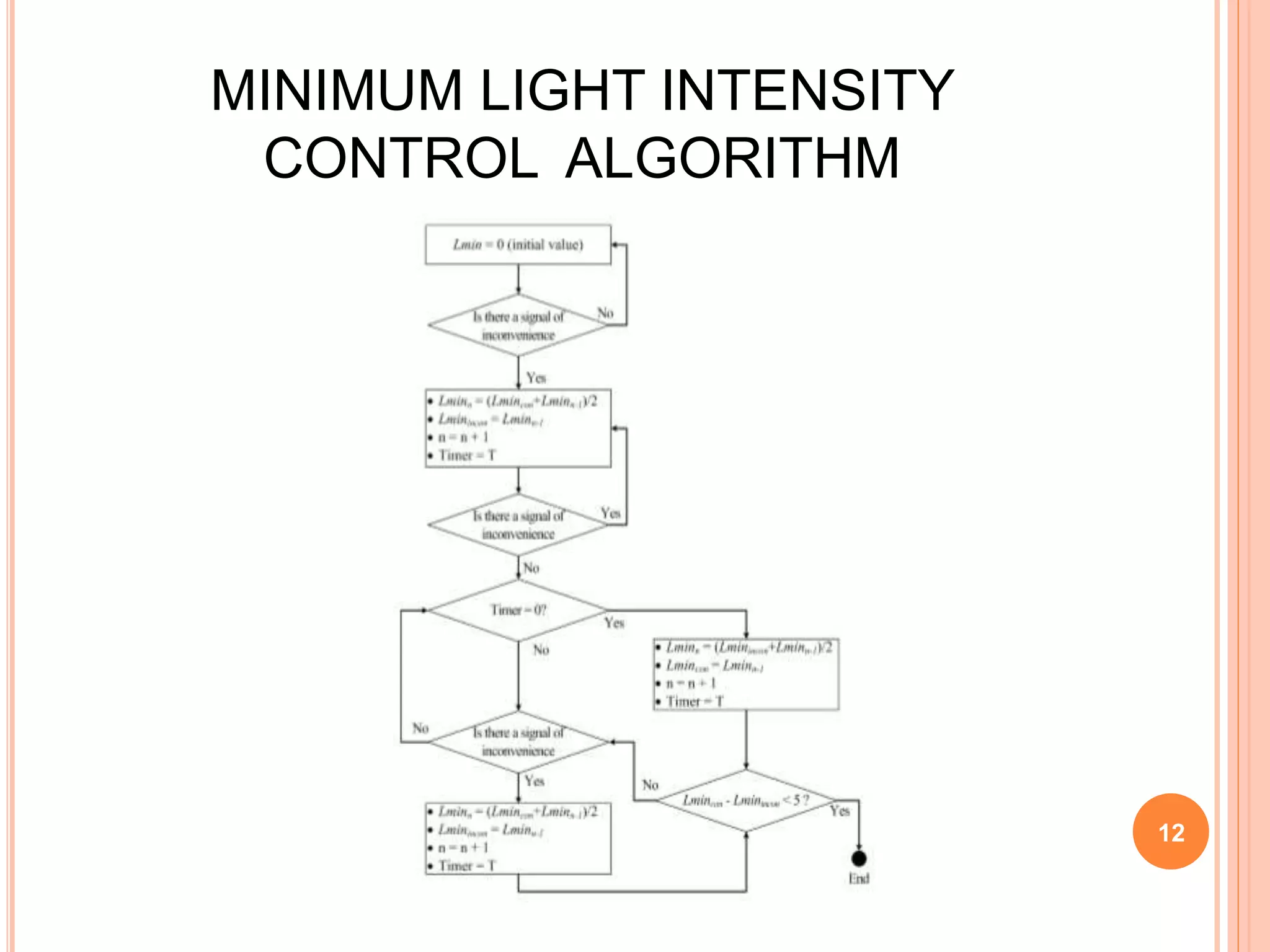
MINIMUM LIGHT INTENSITY
CONTROL ALGORITHM
12
CONTD…
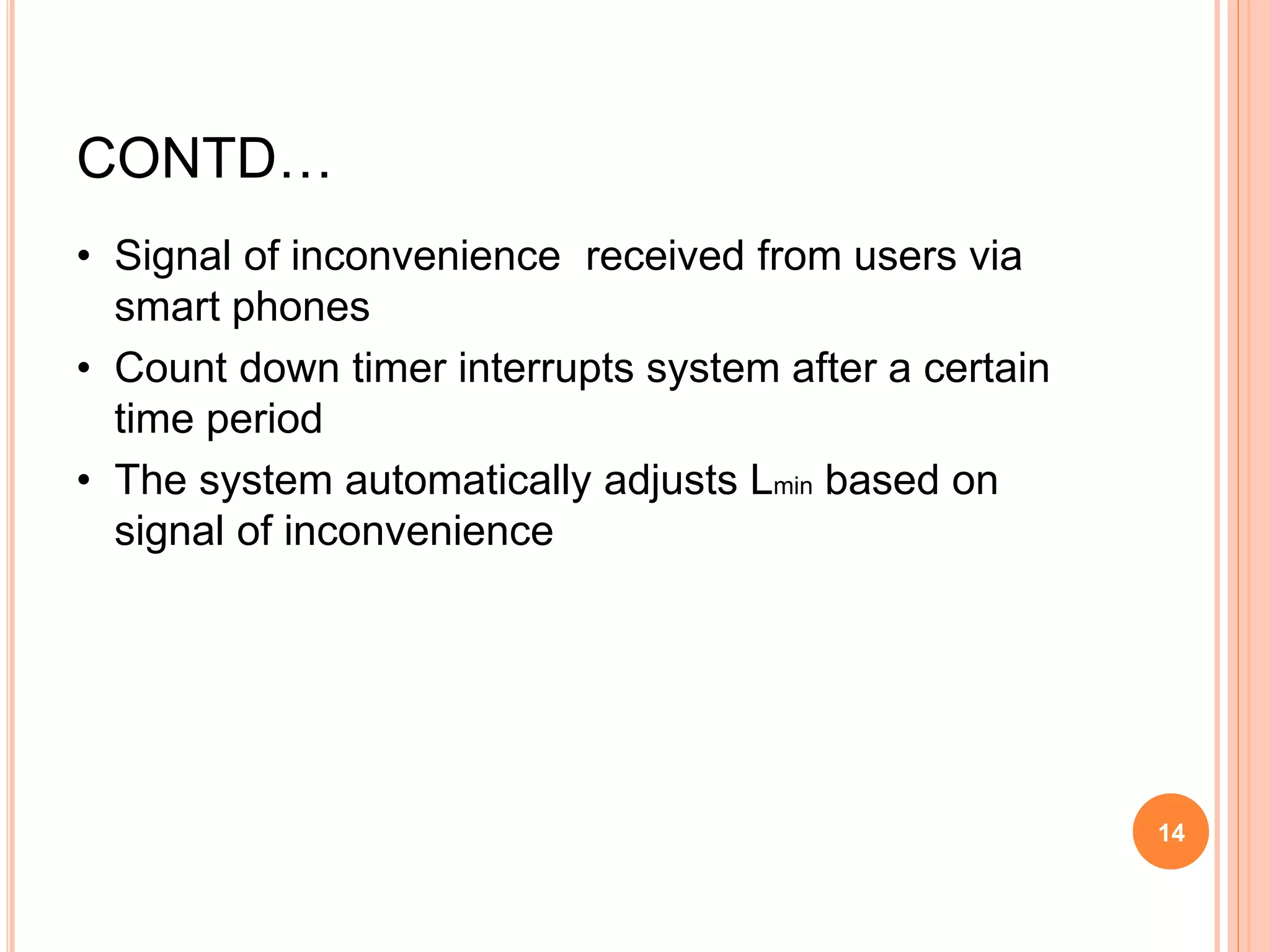
• Signal of inconvenience received from users via
smart phones
• Count down timer interrupts system after a certain
time period
• The system automatically adjusts Lmin based on
signal of inconvenience
14
CONTD…
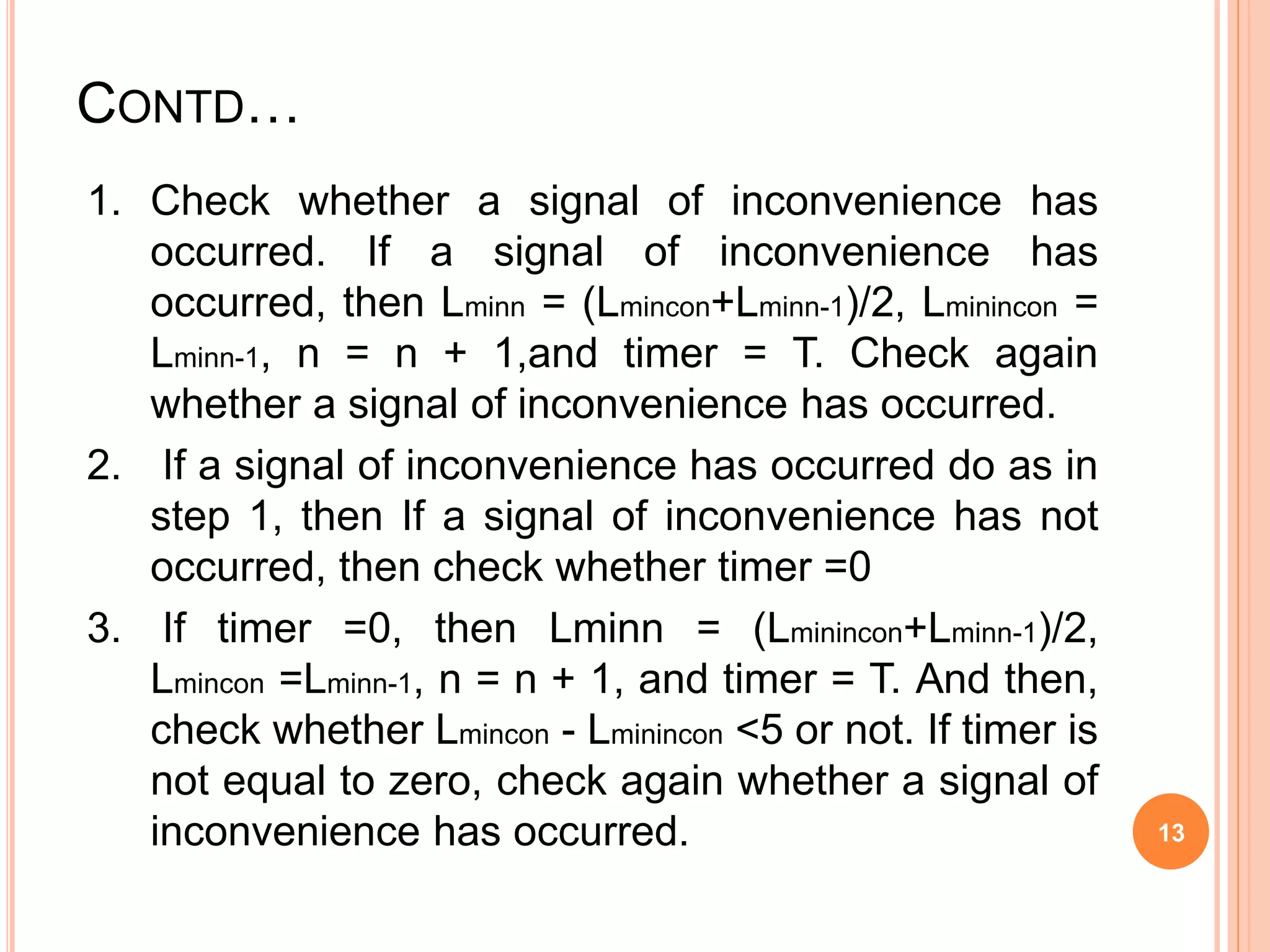
1. Check whether a signal of inconvenience has
occurred. If a signal of inconvenience has
occurred, then Lminn = (Lmincon+Lminn-1)/2, Lminincon =
Lminn-1, n = n + 1,and timer = T. Check again
whether a signal of inconvenience has occurred.
2. If a signal of inconvenience has occurred do as in
step 1, then If a signal of inconvenience has not
occurred, then check whether timer =0
3. If timer =0, then Lminn = (Lminincon+Lminn-1)/2,
Lmincon =Lminn-1, n = n + 1, and timer = T. And then,
check whether Lmincon - Lminincon <5 or not. If timer is
not equal to zero, check again whether a signal of
inconvenience has occurred. 13
CONTD…
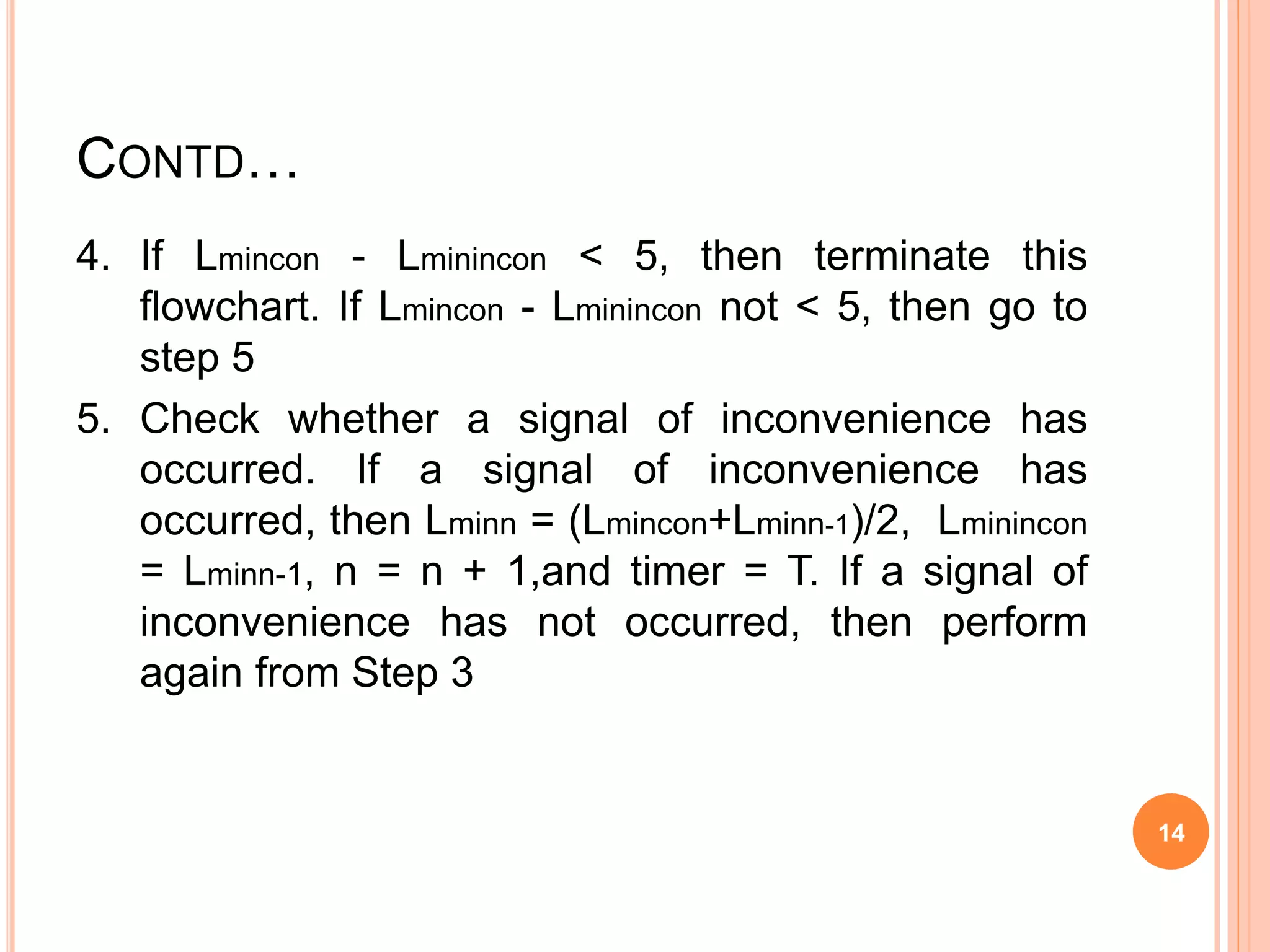
4. If Lmincon - Lminincon < 5, then terminate this
flowchart. If Lmincon - Lminincon not < 5, then go to
step 5
5. Check whether a signal of inconvenience has
occurred. If a signal of inconvenience has
occurred, then Lminn = (Lmincon+Lminn-1)/2, Lminincon
= Lminn-1, n = n + 1,and timer = T. If a signal of
inconvenience has not occurred, then perform
again from Step 3
14
HARDWARE BLOCK DIAGRAM
15
• 8 bit microcontroller : Role in situation analysis,
event processing, and learning. This part optimizes
the control and state variables to adapt itself to the
various environments.
• Motion detection sensor : detects moving objects
• CDS sensor :Cadmium sulphide – photo resistive
sensors
CONTD…
• ZigBee module : Used for communication with other
LED lighting system and networked devices
• LED driver part : Consists of current controller
modules for driving LEDs
• There are two ports that are controllable and are
able to control for 255 levels of brightness
• The power part is composed of a power regulator
& SMPS
16
PCB LAYOUT OF PROPOSED
SYSTEM
• When switch g is On & h is On ; switch a, b and c
are used to adjust Lmax ; switch d, e, and f are used
to adjust Lmin
• When switch g is On & h is Off ; switch a, b, and c
are used to adjust Tr ; switch d, e and f are used to
adjust Tf 17
CONTD…
• When switch g is Off & h is On ; switch a, b, and c
are used to adjust countdown timer(Tm)
• If switch g is Off & the h is Off ; the proposed
system operates as a general LED lighting without
intelligent lighting control.
18
CASE STUDY
• Home and office building : User satisfaction is an
important factor ; Lmin is set to the high value
• Warehouse : User satisfaction is a less important
factor ; Lmin is set to low value ; a significant amount
of energy consumption can be reduced
• Parking lot : User satisfaction is an less important
factor ; Lmin is set to the high value only from the
entrance of the parking lot to a vacant parking
space ; when a user gets out of a car, Lmin is set to
the high value only from user's current position to
the entrance of the building
19
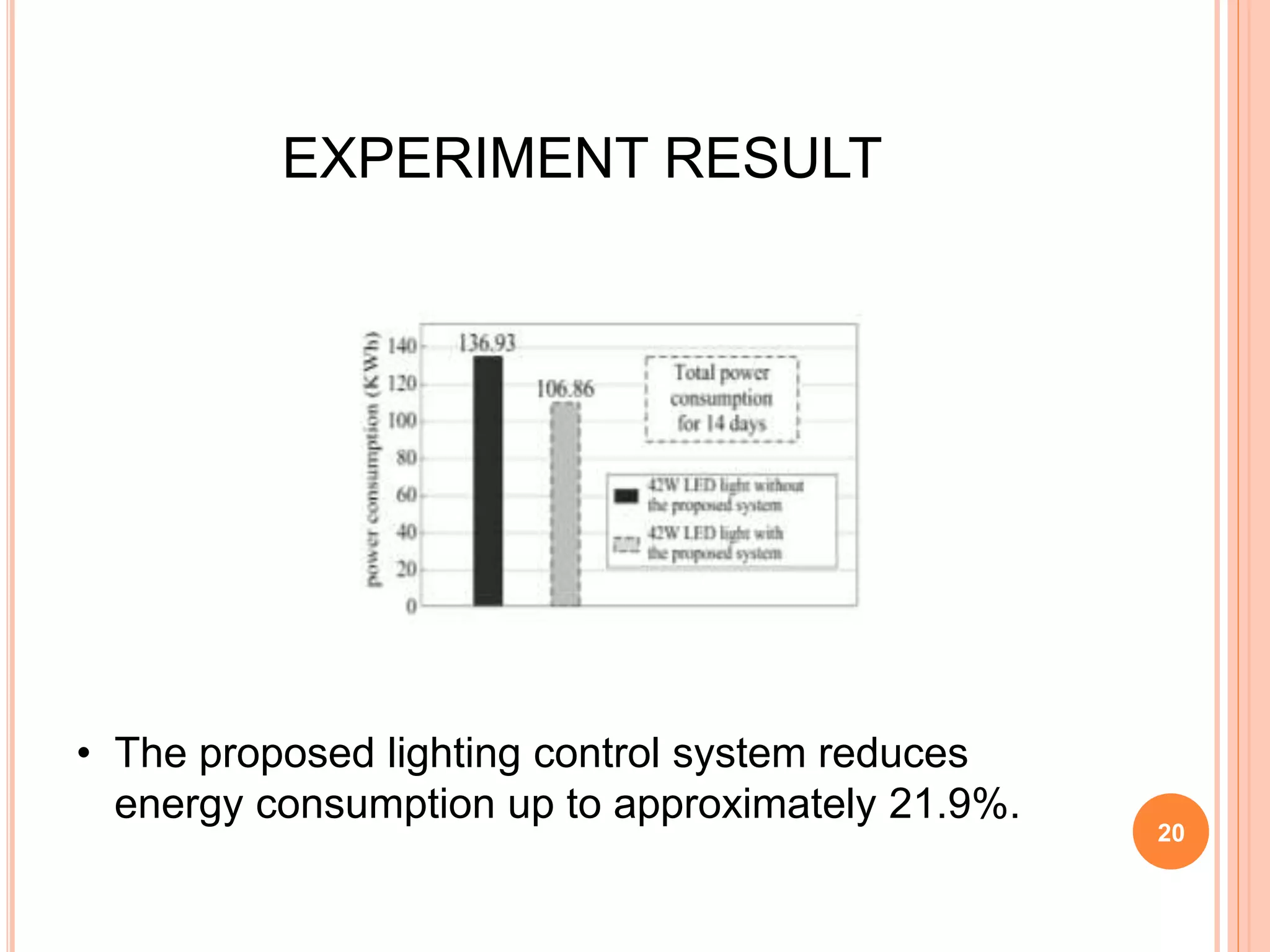
EXPERIMENT RESULT
• The proposed lighting control system reduces
energy consumption up to approximately 21.9%.
20
DISADVANTAGES
• Initial cost of LED system is high, but it can be
overcome in the long run
• Implementation of proposed system to the existing
system is difficult because it requires
implementation of additional components to each
and every building
21
CONCLUSION
• Utilizes multi sensors and wireless communication
technology in order to control an LED light
according to the user’s state and the surroundings
• Can autonomously adjust the minimum light
intensity value to enhance both energy efficiency
and user satisfaction
• Reduces total power consumption up to 21.9%.
22
REFERENCES
[1]Jinsung Byun,Insung Hong,Byoungjoo Lee,Sehyun
Park, "Intelligent Household LED Lighting System
Considering Energy Efficiency and User
Satisfaction,” IEEE Trans. on Consumer
Electron.,Vol .59 , No.1, Feb.2013
[2] S. Matta and S. M. Mahmud, "An intelligent light
control system for power saving," in Proceedings of
the Annual Conference of the IEEE Industrial
Electronics Society, pp. 3316-3321, 2010
23
24
THANK YOU…
QUESTIONS???
25

Energy Efficient Intelligent LED Lighting System

  • 1.
    ENERGY EFFICIENT INTELLIGENT LEDLIGHTING SYSTEM PRIYA JOHNSON S7 F ROLL NO : 44
  • 2.
    CONTENTS • Introduction • ExistingSystems • Proposed System • LED • Operating principle of proposed system • Overview of proposed system • Minimum Light Intensity Control Algorithm • Hardware Block diagram • PCB layout of proposed system • Case study • Experiment result • Disadvantages • Conclusion • Reference 1
  • 3.
    INTRODUCTION • Light accountsfor approx. 20% of total energy consumption • Invention of LED reduces energy consumption of a light • The intelligent light control system can reduce energy consumption • Automatically control the intensity of illumination through situation awareness • About 15% of total energy consumption can be reduced through light control according to user’s living pattern 2
  • 4.
    EXISTING SYSTEMS • Cansupport ON-OFF / dimming control after detecting object, intensity of illumination or controlling with time setting • It is hard to apply to complex environments because of presence of variety of users • Mostly installed in places such as front door or hallway 3
  • 5.
    PROPOSED SYSTEM • Thenew intelligent light control system should be designed :  to maximize the utilization of an LED  to have communication capability  to control based on the situation awareness  to enhance both energy efficiency & user satisfaction • The system uses multi-sensors & wireless communication technology • Control LED light according to user’s state & surroundings • Autonomously adjust the min light intensity 4
  • 6.
    LED • Two leadsemiconductor light source • A PN junction diode which emits light when forward biased • The amount of light output is directly proportional to forward current • Light energy is released at the junction when electrons and holes are recombined • After recombination the electrons in the conduction band of N-region falls into the holes in the valance band of P-region 5
  • 7.
    CONTD… • The differencein energy between the conduction band and valance band is radiated in the form of light • The semiconductor material used for manufacturing LED: Gallium arsenide-infrared radiation Gallium phosphide-red or yellow Gallium arsenide phosphide-red or green Gallium nitride-blue 6
  • 8.
    OPERATING PRINCIPLE OF PROPOSEDSYSTEM Lmin – minimum light intensity Lmax – maximum light intensity Tr - rise time period of light intensity Tm - time period b/w no movement detection & that light intensity begins to fall Tf - fall time period of light intensity 7
  • 9.
    CONTD… 8 • Illumination intensitybecomes Lmax if user movement is detected • Illumination intensity becomes Lmin if user movement is not detected for a certain time period
  • 10.
    CONTD… • As Tris longer, Tm & Tf are smaller and Lmax & Lmin are smaller, energy saving effects becomes larger • Inconvenience of users can be bigger • Necessary to properly set the value to space environmental characteristics 9
  • 11.
  • 12.
    CONTD… • Autonomous controlbased on user movement • Autonomous control based on brightness of room • Autonomous optimization of system control & state variables • Collective control using a wireless technology • Control & system setting through a wireless controller & a mobile phone application  Reduce energy consumption via interaction with information about user’s state  Autonomous control could lead to disturbance to residents  It automatically optimizes the system control & state variables 11
  • 13.
  • 14.
    CONTD… • Signal ofinconvenience received from users via smart phones • Count down timer interrupts system after a certain time period • The system automatically adjusts Lmin based on signal of inconvenience 14
  • 15.
    CONTD… 1. Check whethera signal of inconvenience has occurred. If a signal of inconvenience has occurred, then Lminn = (Lmincon+Lminn-1)/2, Lminincon = Lminn-1, n = n + 1,and timer = T. Check again whether a signal of inconvenience has occurred. 2. If a signal of inconvenience has occurred do as in step 1, then If a signal of inconvenience has not occurred, then check whether timer =0 3. If timer =0, then Lminn = (Lminincon+Lminn-1)/2, Lmincon =Lminn-1, n = n + 1, and timer = T. And then, check whether Lmincon - Lminincon <5 or not. If timer is not equal to zero, check again whether a signal of inconvenience has occurred. 13
  • 16.
    CONTD… 4. If Lmincon- Lminincon < 5, then terminate this flowchart. If Lmincon - Lminincon not < 5, then go to step 5 5. Check whether a signal of inconvenience has occurred. If a signal of inconvenience has occurred, then Lminn = (Lmincon+Lminn-1)/2, Lminincon = Lminn-1, n = n + 1,and timer = T. If a signal of inconvenience has not occurred, then perform again from Step 3 14
  • 17.
    HARDWARE BLOCK DIAGRAM 15 •8 bit microcontroller : Role in situation analysis, event processing, and learning. This part optimizes the control and state variables to adapt itself to the various environments. • Motion detection sensor : detects moving objects • CDS sensor :Cadmium sulphide – photo resistive sensors
  • 18.
    CONTD… • ZigBee module: Used for communication with other LED lighting system and networked devices • LED driver part : Consists of current controller modules for driving LEDs • There are two ports that are controllable and are able to control for 255 levels of brightness • The power part is composed of a power regulator & SMPS 16
  • 19.
    PCB LAYOUT OFPROPOSED SYSTEM • When switch g is On & h is On ; switch a, b and c are used to adjust Lmax ; switch d, e, and f are used to adjust Lmin • When switch g is On & h is Off ; switch a, b, and c are used to adjust Tr ; switch d, e and f are used to adjust Tf 17
  • 20.
    CONTD… • When switchg is Off & h is On ; switch a, b, and c are used to adjust countdown timer(Tm) • If switch g is Off & the h is Off ; the proposed system operates as a general LED lighting without intelligent lighting control. 18
  • 21.
    CASE STUDY • Homeand office building : User satisfaction is an important factor ; Lmin is set to the high value • Warehouse : User satisfaction is a less important factor ; Lmin is set to low value ; a significant amount of energy consumption can be reduced • Parking lot : User satisfaction is an less important factor ; Lmin is set to the high value only from the entrance of the parking lot to a vacant parking space ; when a user gets out of a car, Lmin is set to the high value only from user's current position to the entrance of the building 19
  • 22.
    EXPERIMENT RESULT • Theproposed lighting control system reduces energy consumption up to approximately 21.9%. 20
  • 23.
    DISADVANTAGES • Initial costof LED system is high, but it can be overcome in the long run • Implementation of proposed system to the existing system is difficult because it requires implementation of additional components to each and every building 21
  • 24.
    CONCLUSION • Utilizes multisensors and wireless communication technology in order to control an LED light according to the user’s state and the surroundings • Can autonomously adjust the minimum light intensity value to enhance both energy efficiency and user satisfaction • Reduces total power consumption up to 21.9%. 22
  • 25.
    REFERENCES [1]Jinsung Byun,Insung Hong,ByoungjooLee,Sehyun Park, "Intelligent Household LED Lighting System Considering Energy Efficiency and User Satisfaction,” IEEE Trans. on Consumer Electron.,Vol .59 , No.1, Feb.2013 [2] S. Matta and S. M. Mahmud, "An intelligent light control system for power saving," in Proceedings of the Annual Conference of the IEEE Industrial Electronics Society, pp. 3316-3321, 2010 23
  • 26.
  • 27.