ELECTRICITY THROUGH
WIRELESS
TRANSMISSION-
WITRICITY


by
Apoorva
Introduction
   In our present electricity generation system
    we waste more than half of its resources.
    Especially transmission and distribution
    losses are main concern of the present
    power technology.

   The transmission and distribution system
    causes a loss of 26% to 30% of energy
    generated.

   The transmission of power without wires is
History of Wireless Power
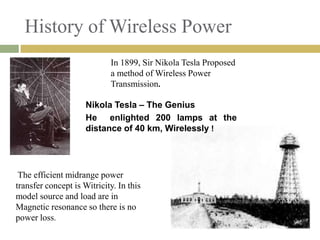
                            In 1899, Sir Nikola Tesla Proposed
                            a method of Wireless Power
                            Transmission.

                     Nikola Tesla – The Genius
                     He enlighted 200 lamps at the
                     distance of 40 km, Wirelessly !


 The efficient midrange power
transfer concept is Witricity. In this
model source and load are in
Magnetic resonance so there is no
power loss.
Research at MIT

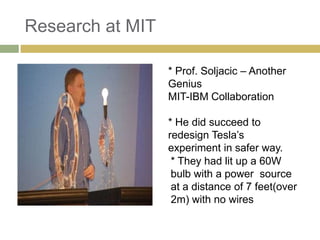
                  * Prof. Soljacic – Another
                  Genius
                  MIT-IBM Collaboration

                  * He did succeed to
                  redesign Tesla’s
                  experiment in safer way.
                   * They had lit up a 60W
                   bulb with a power source
                   at a distance of 7 feet(over
                   2m) with no wires
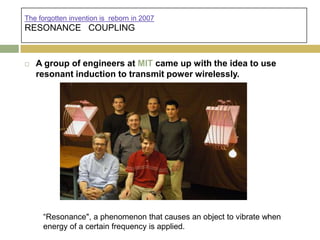
The forgotten invention is reborn in 2007
RESONANCE COUPLING


   A group of engineers at MIT came up with the idea to use
    resonant induction to transmit power wirelessly.


     “Resonance", a phenomenon that causes an object to vibrate when
     energy of a certain frequency is applied.
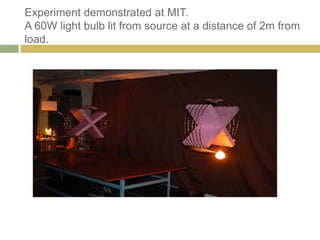
Experiment demonstrated at MIT.
A 60W light bulb lit from source at a distance of 2m from
load.
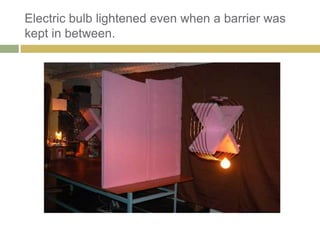
Electric bulb lightened even when a barrier was
kept in between.
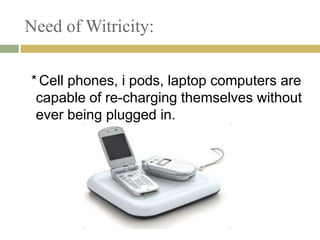
Need of Witricity:


* Cell phones, i pods, laptop computers are
 capable of re-charging themselves without
 ever being plugged in.
What is WiTricity ?
definition is :
* “Transmission of energy through the air”.
* A system of two electromagnetic
resonators       coupled mostly through
their magnetic fields.

** Cables are going to replaced by WiTricity.
    Efficient power transfer
Types and Technologies
   Near-field techniques
     Inductive Coupling
     Resonant Inductive Coupling

     Air Ionization


   Far-field techniques
     MicrowavePower Transmission (MPT)
     LASER power transmission
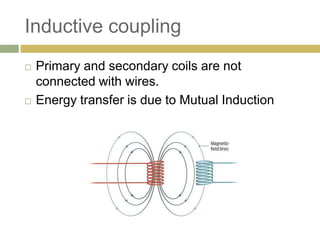
Inductive coupling
   Primary and secondary coils are not
    connected with wires.
   Energy transfer is due to Mutual Induction
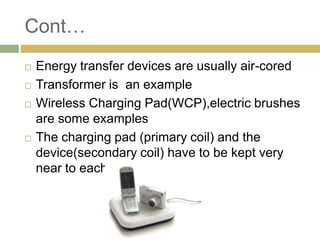
Cont…
   Energy transfer devices are usually air-cored
   Transformer is an example
   Wireless Charging Pad(WCP),electric brushes
    are some examples
   The charging pad (primary coil) and the
    device(secondary coil) have to be kept very
    near to each other
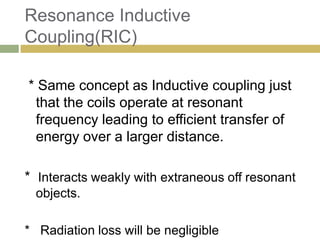
Resonance Inductive
Coupling(RIC)

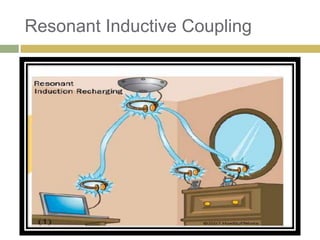
* Same concept as Inductive coupling just
 that the coils operate at resonant
 frequency leading to efficient transfer of
 energy over a larger distance.

* Interacts weakly with extraneous off resonant
  objects.

* Radiation loss will be negligible
Resonant Inductive Coupling
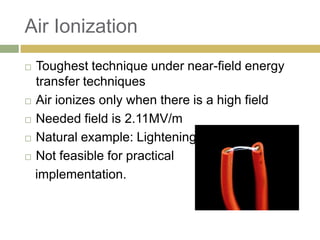
Air Ionization
 Toughest technique under near-field energy
  transfer techniques
 Air ionizes only when there is a high field

 Needed field is 2.11MV/m

 Natural example: Lightening

 Not feasible for practical

  implementation.
Far-field energy transfer
   Microwave Power Transfer(MPT)
   Transfers high power from one place to another.
   Steps:
     Electrical energy to microwave energy
     Capturing microwaves using rectenna
     Microwave energy to electrical energy
   AC can not be directly converted to microwave
    energy
   AC is converted to DC first
   DC is converted to microwaves using magnetron
   Transmitted waves are received at rectenna
    which rectifies, gives DC as the output
   DC is converted back to AC
LASER transmission
   LASER is highly directional, coherent
   Not dispersed for very long
   But, gets attenuated when it propagates
    through atmosphere
   Simple receiver
     Photovoltaic   cell
   Cost-efficient
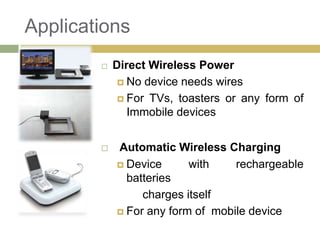
Applications
           Direct Wireless Power
              No device needs wires

              For TVs, toasters or any form of
               Immobile devices


           Automatic Wireless Charging
             Device      with    rechargeable
              batteries
                 charges itself
             For any form of mobile device
Some more Applications…


 * Consumer electronics.

     *Industrial
    would be free of heavy installation of wires and devoid
     of any hazardous electric shock incidents.
     *Transportation
    Could charge an electric car or automobile.
Wireless power transmission is
safe
   Human beings or other objects placed
    between the transmitter and receiver do
    not hinder the transmission of power.

   magnetic fields tend to interact very
    weakly with the biological tissues of the
    body, and so are not prone to cause any
    damage to any living beings.
Advantages

   Efficient and reliable power.
    Creation of a shock free environment devoid of
    any chances of power thefts.
    Provides solution to the ever increasing demand
    for power.
    A solution to reduce e-waste- a more safe
    environment.
    A more cost effective methodology for getting
    electricity to your houses which includes paying
    less for use of power.
    Not affected by the day and night cycle, leads to
    lesser limitations on power harvesting.
Disadvantages.
 For short and mid range transfer system
  has to be set at the right frequency or
  there would be no power transfer.
 For long range the installation cost is high.
CONCLUSION

 Transmission without wires- a reality
 Efficient

 Low maintenance cost. But, high initial
  cost
 Better than conventional wired transfer

 Energy crisis can be decreased

 Low loss

 In near future, world will be completely
  wireless
Electricity through wireless transmission witricity

Electricity through wireless transmission witricity

  • 1.
  • 2.
    Introduction  In our present electricity generation system we waste more than half of its resources. Especially transmission and distribution losses are main concern of the present power technology.  The transmission and distribution system causes a loss of 26% to 30% of energy generated.  The transmission of power without wires is
  • 3.
    History of WirelessPower In 1899, Sir Nikola Tesla Proposed a method of Wireless Power Transmission. Nikola Tesla – The Genius He enlighted 200 lamps at the distance of 40 km, Wirelessly ! The efficient midrange power transfer concept is Witricity. In this model source and load are in Magnetic resonance so there is no power loss.
  • 4.
    Research at MIT * Prof. Soljacic – Another Genius MIT-IBM Collaboration * He did succeed to redesign Tesla’s experiment in safer way. * They had lit up a 60W bulb with a power source at a distance of 7 feet(over 2m) with no wires
  • 5.
    The forgotten inventionis reborn in 2007 RESONANCE COUPLING  A group of engineers at MIT came up with the idea to use resonant induction to transmit power wirelessly. “Resonance", a phenomenon that causes an object to vibrate when energy of a certain frequency is applied.
  • 6.
    Experiment demonstrated atMIT. A 60W light bulb lit from source at a distance of 2m from load.
  • 7.
    Electric bulb lightenedeven when a barrier was kept in between.
  • 8.
    Need of Witricity: *Cell phones, i pods, laptop computers are capable of re-charging themselves without ever being plugged in.
  • 9.
    What is WiTricity? definition is : * “Transmission of energy through the air”. * A system of two electromagnetic resonators coupled mostly through their magnetic fields. ** Cables are going to replaced by WiTricity. Efficient power transfer
  • 10.
    Types and Technologies  Near-field techniques  Inductive Coupling  Resonant Inductive Coupling  Air Ionization  Far-field techniques  MicrowavePower Transmission (MPT)  LASER power transmission
  • 11.
    Inductive coupling  Primary and secondary coils are not connected with wires.  Energy transfer is due to Mutual Induction
  • 12.
    Cont…  Energy transfer devices are usually air-cored  Transformer is an example  Wireless Charging Pad(WCP),electric brushes are some examples  The charging pad (primary coil) and the device(secondary coil) have to be kept very near to each other
  • 13.
    Resonance Inductive Coupling(RIC) * Sameconcept as Inductive coupling just that the coils operate at resonant frequency leading to efficient transfer of energy over a larger distance. * Interacts weakly with extraneous off resonant objects. * Radiation loss will be negligible
  • 14.
  • 15.
    Air Ionization  Toughesttechnique under near-field energy transfer techniques  Air ionizes only when there is a high field  Needed field is 2.11MV/m  Natural example: Lightening  Not feasible for practical implementation.
  • 16.
    Far-field energy transfer  Microwave Power Transfer(MPT)  Transfers high power from one place to another.  Steps:  Electrical energy to microwave energy  Capturing microwaves using rectenna  Microwave energy to electrical energy  AC can not be directly converted to microwave energy  AC is converted to DC first  DC is converted to microwaves using magnetron  Transmitted waves are received at rectenna which rectifies, gives DC as the output  DC is converted back to AC
  • 17.
    LASER transmission  LASER is highly directional, coherent  Not dispersed for very long  But, gets attenuated when it propagates through atmosphere  Simple receiver  Photovoltaic cell  Cost-efficient
  • 18.
    Applications  Direct Wireless Power  No device needs wires  For TVs, toasters or any form of Immobile devices  Automatic Wireless Charging  Device with rechargeable batteries charges itself  For any form of mobile device
  • 19.
    Some more Applications… * Consumer electronics. *Industrial  would be free of heavy installation of wires and devoid of any hazardous electric shock incidents. *Transportation  Could charge an electric car or automobile.
  • 20.
    Wireless power transmissionis safe  Human beings or other objects placed between the transmitter and receiver do not hinder the transmission of power.  magnetic fields tend to interact very weakly with the biological tissues of the body, and so are not prone to cause any damage to any living beings.
  • 21.
    Advantages  Efficient and reliable power.  Creation of a shock free environment devoid of any chances of power thefts.  Provides solution to the ever increasing demand for power.  A solution to reduce e-waste- a more safe environment.  A more cost effective methodology for getting electricity to your houses which includes paying less for use of power.  Not affected by the day and night cycle, leads to lesser limitations on power harvesting.
  • 22.
    Disadvantages.  For shortand mid range transfer system has to be set at the right frequency or there would be no power transfer.  For long range the installation cost is high.
  • 23.
    CONCLUSION  Transmission withoutwires- a reality  Efficient  Low maintenance cost. But, high initial cost  Better than conventional wired transfer  Energy crisis can be decreased  Low loss  In near future, world will be completely wireless