SEMINAR ON
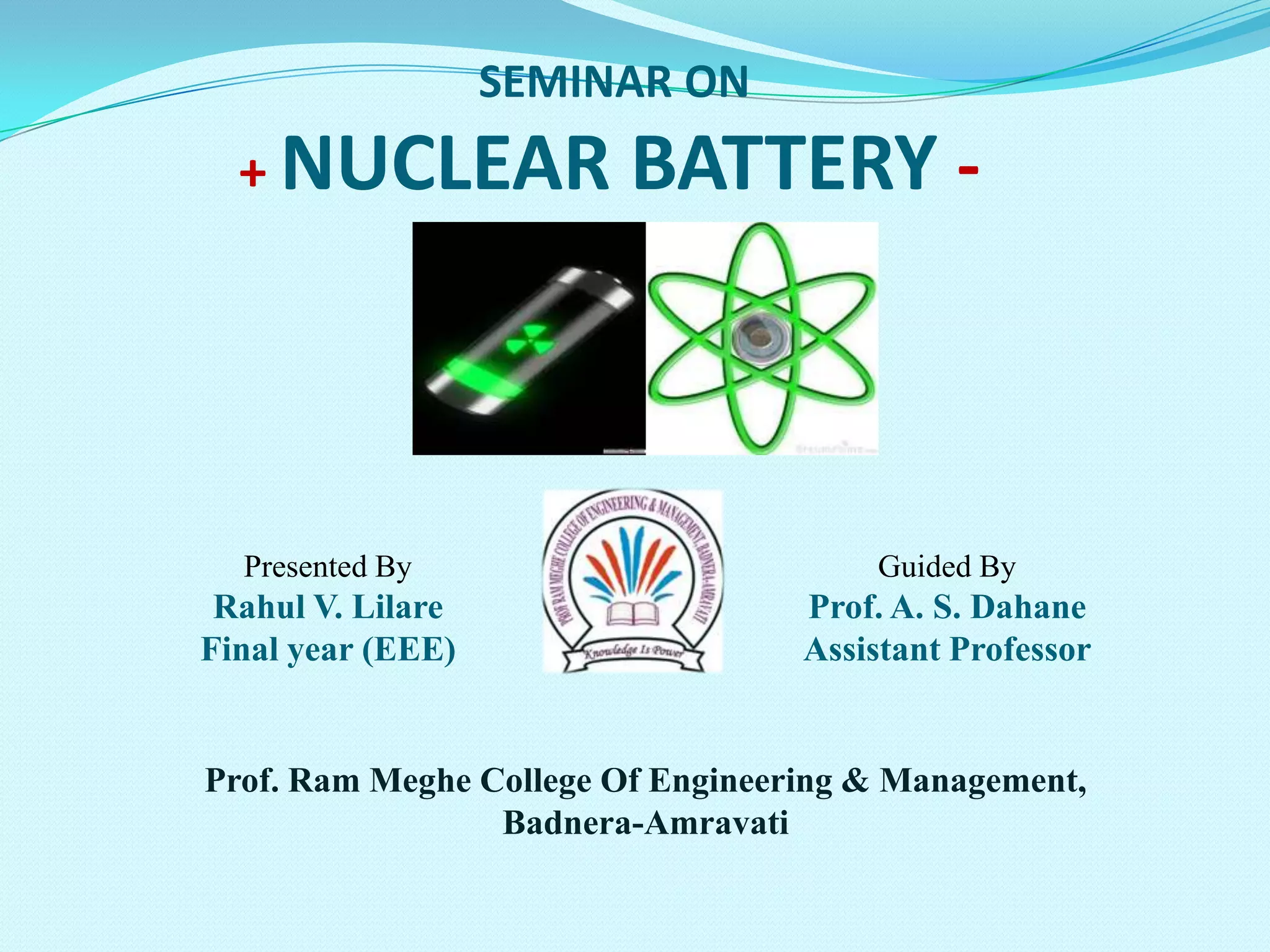
+ NUCLEAR BATTERY -
Presented By
Rahul V. Lilare
Final year (EEE)
Guided By
Prof. A. S. Dahane
Assistant Professor
Prof. Ram Meghe College Of Engineering & Management,
Badnera-Amravati
CONTENTS
 Why Nuclear Battery ???
 Historical Developments
 Energy Production Mechanism
 Fuel Considerations
 Advantages
 Disadvantages
 Applications
 Conclusion
ANSWERS :
 Need for compact reliable light weight and self-
contained power supplies.
 Chemical batteries require frequent replacements and
are bulky.
 Fuel and Solar cells are expensive and requires sunlight
respectively.
 Can be used in inaccessible and extreme conditions.
 Nuclear batteries have lifespan upto decades and
nearly 200 times more efficient.
 Do not rely on nuclear reaction , so no radioactive
wastes.
 Uses emissions from radioactive isotope to
generate electricity.
HISTORICAL DEVELOPMENTS
 Idea was introduced in 1950 and patented to Tracer Lab.
 Radioisotope electric power system developed by Paul
Brown.
 He organized an approach to harness energy from the
magnetic field of alpha and beta particles using Radium-
226.
 Low efficiency due to loss of electrons.
ENERGY PRODUCTION MECHANISMS
Betavoltaics :
 Uses energy from beta particles.
 Provides extended battery life and power density.
 Beta particles from radioactive gas captured in Si
wafer coated with diode material.
 Absorbed radiation creates electron-hole pair.
 Results in the generation of electric current
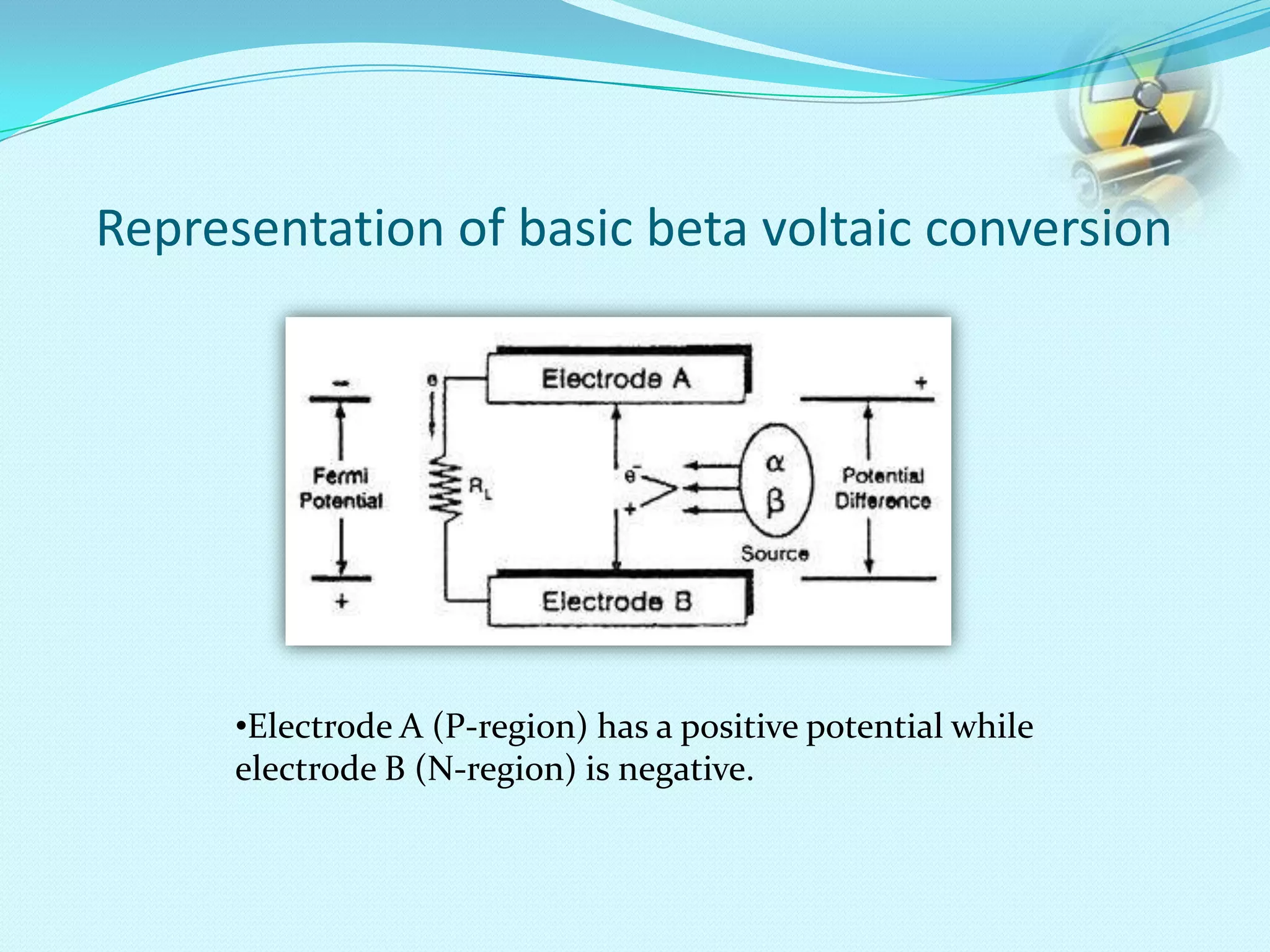
Representation of basic beta voltaic conversion
•Electrode A (P-region) has a positive potential while
electrode B (N-region) is negative.
 Before the radioactive source is introduced , no current
flows as the electrical forces are in equilibrium.
 As a beta emitter is introduced , electrons are knocked
out by its energy.
 Generates electron-hole pairs in the junction.
 When beta particle imparts more than ionization
potential the electron rises to a higher level.
 Potential difference drives electrons from electrode A
through the load where they give up the energy.
Direct Charging Generators:
• This method makes use of kinetic energy as well as
the magnetic property of Alpha particles to generate
current.
• It consists of a core composed of radioactive elements.
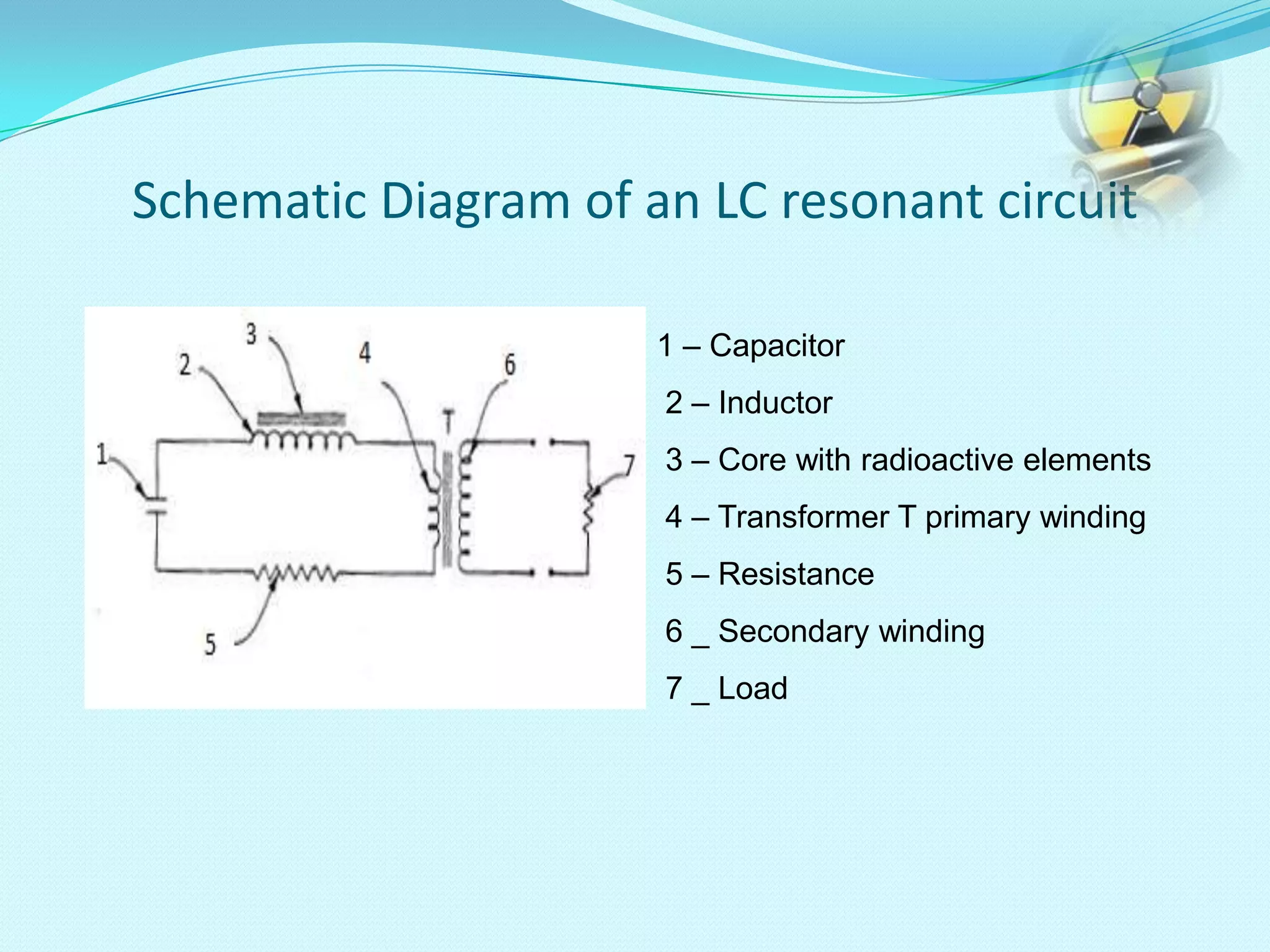
• Primary generator consists of a LC tank circuit.
• LC circuit produces the oscillations required for
transformer operation.
Schematic Diagram of an LC resonant circuit
1 – Capacitor
2 – Inductor
3 – Core with radioactive elements
4 – Transformer T primary winding
5 – Resistance
6 _ Secondary winding
7 _ Load
WORKING
 Oscillations induced in LCR circuit damp out due to loss of
energy.
 Here energy is imparted to the alpha particles during the
decay of elements in the core.
 This energy is introduced to circuit when alpha particles are
absorbed by the inductor.
 Oscillations sustain until amount of energy
absorbed=amount of energy dissipated in ohmic resistance.
 This excess energy is delivered to the load connected across
transformer T secondary winding.
FUEL CONSIDERATIONS
 The major criterions considered in the selection of
fuels are:
 Avoidance of gamma in the decay chain
 Half life( Should be more)
 Cost should be less.
 Any radioisotope in the form of a solid that gives
off alpha or beta particles can be utilized in the
nuclear battery.
 The most powerful source of energy known is
radium-226.
 However Strontium-90 may also be used in this
Battery
ADVANTAGES
 Life span- minimum of 10 years.
 Reliable electricity.
 Amount of energy highest.
 Lighter with high energy density.
 Efficient
 Reduces green house and associated effects.
 Fuel used is the nuclear waste from nuclear fission.
DISADVANTAGES
 High initial cost of production
 Energy conversion methodologies are not much
advanced.
 Regional and country-specific laws regarding use and
disposal of radioactive fuels.
 To gain social acceptance.
APPLICATIONS
• Space applications:
 Unaffected by long period of darkness and radiation
 Compact and lighter in weight.
 Can avoid heating equipments required for storage batteries.
 High power for long time independent of atmospheric
conditions.
 NASA is trying to harness this technology in space
applications.
 Medical applications:
 In Cardiac pacemakers
 Batteries should have reliability and longevity to
avoid frequent replacements.
• Mobile devices:
 Nuclear powered laptop battery Xcell-N has 7000 - 8000 times more
life.
 No need for charging, battery replacing.
 Automobiles:
 No need for frequent recharging as in case of present
electric vehicles.
• Military applications
 Safe, longer life
• Under-water sea probes and sea sensors:
 In sensors working for long time.
 At inaccessible and extreme conditions.
 Use in coal mines and polar sensor applications too.
CONCLUSION
 Small compact devices of future require small
batteries.
 Nuclear batteries increase functionality, reliability and
longevity.
 Batteries of the near future.
 With several features being added to this, nuclear cells
are going to be next best thing ever invented in the
human history.
THANK YOU
REFERENCES
 Brown Paul: "Resonant Nuclear Battery Supply", Raum
& Zeit, 1(3) (August-September, 1989)
 Galina N. Yakubova, Ph.D. Department of Nuclear,
Plasma and Radiological Engineering University of
Illinois at Urbana-Champaign, 2010 J. F. Stubbins,
Advisor, “NUCLEAR BATTERIES”
 www.ieeeexplorer.com
 www.technologyreview.com
 www.wikipedia.com/atomic_battery

Rahul lilare ppt

  • 1.
    SEMINAR ON + NUCLEARBATTERY - Presented By Rahul V. Lilare Final year (EEE) Guided By Prof. A. S. Dahane Assistant Professor Prof. Ram Meghe College Of Engineering & Management, Badnera-Amravati
  • 2.
    CONTENTS  Why NuclearBattery ???  Historical Developments  Energy Production Mechanism  Fuel Considerations  Advantages  Disadvantages  Applications  Conclusion
  • 4.
    ANSWERS :  Needfor compact reliable light weight and self- contained power supplies.  Chemical batteries require frequent replacements and are bulky.  Fuel and Solar cells are expensive and requires sunlight respectively.  Can be used in inaccessible and extreme conditions.
  • 5.
     Nuclear batterieshave lifespan upto decades and nearly 200 times more efficient.  Do not rely on nuclear reaction , so no radioactive wastes.  Uses emissions from radioactive isotope to generate electricity.
  • 6.
    HISTORICAL DEVELOPMENTS  Ideawas introduced in 1950 and patented to Tracer Lab.  Radioisotope electric power system developed by Paul Brown.  He organized an approach to harness energy from the magnetic field of alpha and beta particles using Radium- 226.  Low efficiency due to loss of electrons.
  • 7.
    ENERGY PRODUCTION MECHANISMS Betavoltaics:  Uses energy from beta particles.  Provides extended battery life and power density.  Beta particles from radioactive gas captured in Si wafer coated with diode material.  Absorbed radiation creates electron-hole pair.  Results in the generation of electric current
  • 8.
    Representation of basicbeta voltaic conversion •Electrode A (P-region) has a positive potential while electrode B (N-region) is negative.
  • 9.
     Before theradioactive source is introduced , no current flows as the electrical forces are in equilibrium.  As a beta emitter is introduced , electrons are knocked out by its energy.  Generates electron-hole pairs in the junction.  When beta particle imparts more than ionization potential the electron rises to a higher level.  Potential difference drives electrons from electrode A through the load where they give up the energy.
  • 10.
    Direct Charging Generators: •This method makes use of kinetic energy as well as the magnetic property of Alpha particles to generate current. • It consists of a core composed of radioactive elements. • Primary generator consists of a LC tank circuit. • LC circuit produces the oscillations required for transformer operation.
  • 11.
    Schematic Diagram ofan LC resonant circuit 1 – Capacitor 2 – Inductor 3 – Core with radioactive elements 4 – Transformer T primary winding 5 – Resistance 6 _ Secondary winding 7 _ Load
  • 12.
    WORKING  Oscillations inducedin LCR circuit damp out due to loss of energy.  Here energy is imparted to the alpha particles during the decay of elements in the core.  This energy is introduced to circuit when alpha particles are absorbed by the inductor.  Oscillations sustain until amount of energy absorbed=amount of energy dissipated in ohmic resistance.  This excess energy is delivered to the load connected across transformer T secondary winding.
  • 13.
    FUEL CONSIDERATIONS  Themajor criterions considered in the selection of fuels are:  Avoidance of gamma in the decay chain  Half life( Should be more)  Cost should be less.  Any radioisotope in the form of a solid that gives off alpha or beta particles can be utilized in the nuclear battery.  The most powerful source of energy known is radium-226.  However Strontium-90 may also be used in this Battery
  • 14.
    ADVANTAGES  Life span-minimum of 10 years.  Reliable electricity.  Amount of energy highest.  Lighter with high energy density.  Efficient  Reduces green house and associated effects.  Fuel used is the nuclear waste from nuclear fission.
  • 15.
    DISADVANTAGES  High initialcost of production  Energy conversion methodologies are not much advanced.  Regional and country-specific laws regarding use and disposal of radioactive fuels.  To gain social acceptance.
  • 16.
    APPLICATIONS • Space applications: Unaffected by long period of darkness and radiation  Compact and lighter in weight.  Can avoid heating equipments required for storage batteries.  High power for long time independent of atmospheric conditions.  NASA is trying to harness this technology in space applications.
  • 17.
     Medical applications: In Cardiac pacemakers  Batteries should have reliability and longevity to avoid frequent replacements. • Mobile devices:  Nuclear powered laptop battery Xcell-N has 7000 - 8000 times more life.  No need for charging, battery replacing.
  • 18.
     Automobiles:  Noneed for frequent recharging as in case of present electric vehicles. • Military applications  Safe, longer life • Under-water sea probes and sea sensors:  In sensors working for long time.  At inaccessible and extreme conditions.  Use in coal mines and polar sensor applications too.
  • 19.
    CONCLUSION  Small compactdevices of future require small batteries.  Nuclear batteries increase functionality, reliability and longevity.  Batteries of the near future.  With several features being added to this, nuclear cells are going to be next best thing ever invented in the human history.
  • 20.
  • 21.
    REFERENCES  Brown Paul:"Resonant Nuclear Battery Supply", Raum & Zeit, 1(3) (August-September, 1989)  Galina N. Yakubova, Ph.D. Department of Nuclear, Plasma and Radiological Engineering University of Illinois at Urbana-Champaign, 2010 J. F. Stubbins, Advisor, “NUCLEAR BATTERIES”  www.ieeeexplorer.com  www.technologyreview.com  www.wikipedia.com/atomic_battery