Body Area Network- Communication Establishment.pptx
1.
Department of Electronics& Communication Engineering, MIT, Manipal
Body Area Networks:
A Case Study on how communication is
established from body chip to the device
and signals are transmitted from
Transmitter to Receiver.
by
Krishnananda K R
240938006 M.Tech DECE
AMCT SEMINAR
2.
Department of Electronics& Communication Engineering, MIT, Manipal
INTRODUCTION
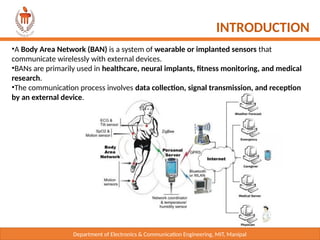
•A Body Area Network (BAN) is a system of wearable or implanted sensors that
communicate wirelessly with external devices.
•BANs are primarily used in healthcare, neural implants, fitness monitoring, and medical
research.
•The communication process involves data collection, signal transmission, and reception
by an external device.
3.
Department of Electronics& Communication Engineering, MIT, Manipal
COMPONENTS OF BAN COMMUNICATION
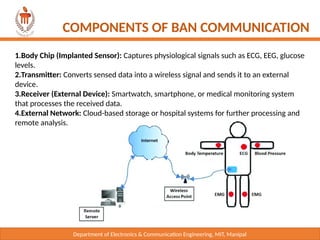
1.Body Chip (Implanted Sensor): Captures physiological signals such as ECG, EEG, glucose
levels.
2.Transmitter: Converts sensed data into a wireless signal and sends it to an external
device.
3.Receiver (External Device): Smartwatch, smartphone, or medical monitoring system
that processes the received data.
4.External Network: Cloud-based storage or hospital systems for further processing and
remote analysis.
4.
Department of Electronics& Communication Engineering, MIT, Manipal
COMMUNICATION PROCESS FROM
BODY CHIP TO EXTERNAL DEVICES
Step 1: Data Collection from Body Chip
•Sensors detect and measure physiological parameters such as heart rate(ECG), neural
signals(EEG), glucose levels(Blood sugar monitoring), Oxygen levels(Sp02) or BP. [2]
•The biological signals are converted into electrical signals for processing.
Working:
1.Biological signals (heartbeats, neural impulses, glucose levels) are weak analog signals.
2.Sensors convert these biological signals into electrical signals.
3.The electrical signals are amplified for further processing.
Frequency Ranges for Sensor Operation:
•MICS(Medical Implant Communication Service) Band (402-405 MHz) – Used for implanted
medical devices (ex: pacemakers, glucose monitors). [1]
•ISM(Industrial, Scientific, and Medical) Band (2.4 GHz, 5 GHz) – Used for wearables and
non-invasive sensors (ex: smartwatches, ECG sensors).
5.
Department of Electronics& Communication Engineering, MIT, Manipal
COMMUNICATION PROCESS FROM
BODY CHIP TO EXTERNAL DEVICES
Step 2: Signal Processing and Conversion
•The electrical signals are converted into digital form using an Analog-to-Digital Converter
(ADC). The data is compressed and encoded for transmission.
Working:
1.Analog-to-Digital Conversion (ADC):
Biological signals are analog (continuous values).
ADC converts them into digital signals (0s and 1s) for processing.
2.Data Compression:
The digital data is compressed to reduce transmission power and bandwidth.
3.Encoding for Transmission:
The data is encoded using standard communication protocols such as:
IEEE 802.15.6 (WBAN Standard) [1]
Bluetooth Low Energy (BLE) - It is a wireless communication protocol designed
for low power consumption, enabling efficient data transfer over short
distances. It is part of the Bluetooth 4.0, 4.1, 4.2, 5.0, and later versions,
optimized for applications where low energy usage is critical, such as wearable
devices, IoT, and medical sensors. [1]
ZigBee [1]
6.
Department of Electronics& Communication Engineering, MIT, Manipal
COMMUNICATION PROCESS FROM
BODY CHIP TO EXTERNAL DEVICES
Step 3: Signal Transmission from Transmitter to Receiver
• The digital data is modulated and transmitted wirelessly to an external receiver.
Different transmission methods are used based on the application.
Transmission Methods and Frequency Ranges:
Transmission
Method
Technology Frequency Range Use Case Example
Radio Frequency
(RF)
Bluetooth, ZigBee, Wi-Fi 402-405 MHz (MICS),
2.4 GHz, 5 GHz
Smartwatches, ECG
monitors
Optical
Communication
Infrared, Visible Light 30 THz - 300 THz Optical heart rate
sensors in
smartwatches
Acoustic
Communication
Ultrasound waves 20 kHz - 10 MHz Implant-to-implant
communication
[4]
Human Body
Communication
(HBC)
Electrostatic coupling 10 kHz - 100 MHz Uses the body itself
for data transmission
7.
Department of Electronics& Communication Engineering, MIT, Manipal
COMMUNICATION PROCESS FROM
BODY CHIP TO EXTERNAL DEVICES
Step 4: Signal Reception and Processing
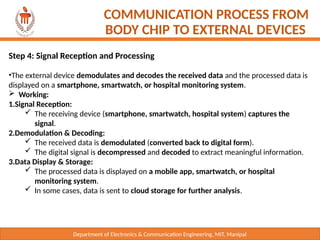
•The external device demodulates and decodes the received data and the processed data is
displayed on a smartphone, smartwatch, or hospital monitoring system.
Working:
1.Signal Reception:
The receiving device (smartphone, smartwatch, hospital system) captures the
signal.
2.Demodulation & Decoding:
The received data is demodulated (converted back to digital form).
The digital signal is decompressed and decoded to extract meaningful information.
3.Data Display & Storage:
The processed data is displayed on a mobile app, smartwatch, or hospital
monitoring system.
In some cases, data is sent to cloud storage for further analysis.
8.
Department of Electronics& Communication Engineering, MIT, Manipal
SIGNAL TRANSMISSION TECHNOLOGIES
IN WBAN
Technology Application Advantages Challenges
RF-Based
(Bluetooth, ZigBee,
Wi-Fi)
Smartwatches,
Wearables
High speed, Low
latency
Signal attenuation in
body
Optical (Infrared,
Visible Light)
In-body sensors No RF interference
Requires Line-of-
Sight
Acoustic
(Ultrasound)
Deep-Tissue
Implants Works well in tissues Low data rate
Human Body
Communication
(HBC) [3]
Medical Implants Secure, Low Power Limited Range
Electro-Quasistatic
HBC (EQS-HBC) [5]
Neural & Cardiac
Implants
Secure, Low Power
Limited intra-body
applications
9.
Department of Electronics& Communication Engineering, MIT, Manipal
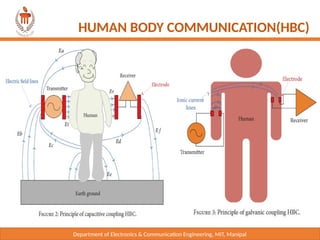
HUMAN BODY COMMUNICATION(HBC)
• Human Body Communication (HBC) is a novel, non-RF-based technique where the
human body itself acts as a transmission medium for electrical signals. [3]
Advantages of HBC over RF-based techniques (Bluetooth, Zigbee, UWB):
i. Lower power consumption
ii. Reduced signal leakage and interference (Since HBC signals stay within the body)
iii. Higher security against eavesdropping/hacking (Preventing unauthorized access)
iv. More efficient for miniaturized medical devices (As HBC does not need bulky
antennas or high-power transmitters)
10.
Department of Electronics& Communication Engineering, MIT, Manipal
HUMAN BODY COMMUNICATION(HBC)
HBC Signal Transmission Methods: [3]
HBC is categorized into two types based on how the signal propagates through the
human body:
1. Capacitive Coupling HBC: Uses electrodes placed on the skin to generate an electric
field that travels through the body.
Return path: Air or an external ground (environment-dependent).
Higher transmission range (up to 2 meters) but more prone to environmental
interference.
Best suited for on-body applications (ex: smartwatches, fitness trackers).
2. Galvanic Coupling HBC: Uses a pair of electrodes to inject a low-power electrical
current directly into the body.
Return path: Conductive human tissue.
More stable and secure than capacitive coupling.
Lower transmission range (5–40 cm) but better signal quality.
Best suited for implantable medical devices (ex: pacemakers, neural implants).
Department of Electronics& Communication Engineering, MIT, Manipal
Comparison of EQS-HBC and Traditional HBC
Feature EQS-HBC (Electro-Quasistatic
HBC)
Traditional HBC
(Capacitive/Galvanic Coupling)
Definition Uses electro-quasistatic fields
to transmit signals within the
human body with minimal
radiation.
Uses electric fields (Capacitive)
or weak electrical currents
(Galvanic) for body-based
communication.
Signal Leakage
[5]
Extremely low (~0.15m)
Signals stay inside the body,
preventing interception.
Moderate to high (~1–2m)
Signals can leak outside the
body and be intercepted.
Security Highly secure – Only devices
physically touching the body
can receive signals.
Less secure – Signals can be
wirelessly intercepted from a
short distance.
Transmission
Range
~0.15 meters (short range,
prevents eavesdropping).
1–2 meters (longer range but
increases security risks).
Ideal Use Case Highly sensitive data transfer
(e.g., pacemakers, brain
implants).
Standard health monitoring
(e.g., ECG sensors,
smartwatches).
13.
Department of Electronics& Communication Engineering, MIT, Manipal
REFERENCES
[1] S. Movassaghi, M. Abolhasan, J. Lipman, D. Smith, and A. Jamalipour, "Wireless Body Area
Networks: A Survey," IEEE Communications Surveys & Tutorials, vol. 16, no. 3, pp. 1658-1686, Jan.
2014.
[2] A. Darwish and A. E. Hassanien, "Wearable and Implantable Wireless Sensor Network Solutions for
Healthcare Monitoring," Sensors, vol. 11, no. 6, pp. 5561-5595, May 2011.
[3] J. F. Zhao, X. M. Chen, B. D. Liang, and Q. X. Chen, "A Review on Human Body Communication:
Signal Propagation Model, Communication Performance, and Experimental Issues," Wireless
Communications and Mobile Computing, vol. 2017, Article ID 5842310, pp. 1-15, Oct. 2017.
[4] J. E. Ferguson and A. D. Redish, "Wireless Communication with Implanted Medical Devices Using
the Conductive Properties of the Body," Expert Review of Medical Devices, vol. 8, no. 4, pp. 427-433,
Jul. 2011.
[5] D. Das, S. Maity, B. Chatterjee, and S. Sen, "Enabling Covert Body Area Network Using Electro-
Quasistatic Human Body Communication," Scientific Reports, vol. 9, Article 4160, pp. 1-13, Mar. 2019.
![Department of Electronics & Communication Engineering, MIT, Manipal
COMMUNICATION PROCESS FROM
BODY CHIP TO EXTERNAL DEVICES
Step 1: Data Collection from Body Chip
•Sensors detect and measure physiological parameters such as heart rate(ECG), neural
signals(EEG), glucose levels(Blood sugar monitoring), Oxygen levels(Sp02) or BP. [2]
•The biological signals are converted into electrical signals for processing.
Working:
1.Biological signals (heartbeats, neural impulses, glucose levels) are weak analog signals.
2.Sensors convert these biological signals into electrical signals.
3.The electrical signals are amplified for further processing.
Frequency Ranges for Sensor Operation:
•MICS(Medical Implant Communication Service) Band (402-405 MHz) – Used for implanted
medical devices (ex: pacemakers, glucose monitors). [1]
•ISM(Industrial, Scientific, and Medical) Band (2.4 GHz, 5 GHz) – Used for wearables and
non-invasive sensors (ex: smartwatches, ECG sensors).](https://image.slidesharecdn.com/amct-bodyareanetwork-250227173708-a128420b/85/Body-Area-Network-Communication-Establishment-pptx-4-320.jpg)
![Department of Electronics & Communication Engineering, MIT, Manipal
COMMUNICATION PROCESS FROM
BODY CHIP TO EXTERNAL DEVICES
Step 2: Signal Processing and Conversion
•The electrical signals are converted into digital form using an Analog-to-Digital Converter
(ADC). The data is compressed and encoded for transmission.
Working:
1.Analog-to-Digital Conversion (ADC):
Biological signals are analog (continuous values).
ADC converts them into digital signals (0s and 1s) for processing.
2.Data Compression:
The digital data is compressed to reduce transmission power and bandwidth.
3.Encoding for Transmission:
The data is encoded using standard communication protocols such as:
IEEE 802.15.6 (WBAN Standard) [1]
Bluetooth Low Energy (BLE) - It is a wireless communication protocol designed
for low power consumption, enabling efficient data transfer over short
distances. It is part of the Bluetooth 4.0, 4.1, 4.2, 5.0, and later versions,
optimized for applications where low energy usage is critical, such as wearable
devices, IoT, and medical sensors. [1]
ZigBee [1]](https://image.slidesharecdn.com/amct-bodyareanetwork-250227173708-a128420b/85/Body-Area-Network-Communication-Establishment-pptx-5-320.jpg)
![Department of Electronics & Communication Engineering, MIT, Manipal
COMMUNICATION PROCESS FROM
BODY CHIP TO EXTERNAL DEVICES
Step 3: Signal Transmission from Transmitter to Receiver
• The digital data is modulated and transmitted wirelessly to an external receiver.
Different transmission methods are used based on the application.
Transmission Methods and Frequency Ranges:
Transmission
Method
Technology Frequency Range Use Case Example
Radio Frequency
(RF)
Bluetooth, ZigBee, Wi-Fi 402-405 MHz (MICS),
2.4 GHz, 5 GHz
Smartwatches, ECG
monitors
Optical
Communication
Infrared, Visible Light 30 THz - 300 THz Optical heart rate
sensors in
smartwatches
Acoustic
Communication
Ultrasound waves 20 kHz - 10 MHz Implant-to-implant
communication
[4]
Human Body
Communication
(HBC)
Electrostatic coupling 10 kHz - 100 MHz Uses the body itself
for data transmission](https://image.slidesharecdn.com/amct-bodyareanetwork-250227173708-a128420b/85/Body-Area-Network-Communication-Establishment-pptx-6-320.jpg)
![Department of Electronics & Communication Engineering, MIT, Manipal
SIGNAL TRANSMISSION TECHNOLOGIES
IN WBAN
Technology Application Advantages Challenges
RF-Based
(Bluetooth, ZigBee,
Wi-Fi)
Smartwatches,
Wearables
High speed, Low
latency
Signal attenuation in
body
Optical (Infrared,
Visible Light)
In-body sensors No RF interference
Requires Line-of-
Sight
Acoustic
(Ultrasound)
Deep-Tissue
Implants Works well in tissues Low data rate
Human Body
Communication
(HBC) [3]
Medical Implants Secure, Low Power Limited Range
Electro-Quasistatic
HBC (EQS-HBC) [5]
Neural & Cardiac
Implants
Secure, Low Power
Limited intra-body
applications](https://image.slidesharecdn.com/amct-bodyareanetwork-250227173708-a128420b/85/Body-Area-Network-Communication-Establishment-pptx-8-320.jpg)
![Department of Electronics & Communication Engineering, MIT, Manipal
HUMAN BODY COMMUNICATION(HBC)
• Human Body Communication (HBC) is a novel, non-RF-based technique where the
human body itself acts as a transmission medium for electrical signals. [3]
Advantages of HBC over RF-based techniques (Bluetooth, Zigbee, UWB):
i. Lower power consumption
ii. Reduced signal leakage and interference (Since HBC signals stay within the body)
iii. Higher security against eavesdropping/hacking (Preventing unauthorized access)
iv. More efficient for miniaturized medical devices (As HBC does not need bulky
antennas or high-power transmitters)](https://image.slidesharecdn.com/amct-bodyareanetwork-250227173708-a128420b/85/Body-Area-Network-Communication-Establishment-pptx-9-320.jpg)
![Department of Electronics & Communication Engineering, MIT, Manipal
HUMAN BODY COMMUNICATION(HBC)
HBC Signal Transmission Methods: [3]
HBC is categorized into two types based on how the signal propagates through the
human body:
1. Capacitive Coupling HBC: Uses electrodes placed on the skin to generate an electric
field that travels through the body.
Return path: Air or an external ground (environment-dependent).
Higher transmission range (up to 2 meters) but more prone to environmental
interference.
Best suited for on-body applications (ex: smartwatches, fitness trackers).
2. Galvanic Coupling HBC: Uses a pair of electrodes to inject a low-power electrical
current directly into the body.
Return path: Conductive human tissue.
More stable and secure than capacitive coupling.
Lower transmission range (5–40 cm) but better signal quality.
Best suited for implantable medical devices (ex: pacemakers, neural implants).](https://image.slidesharecdn.com/amct-bodyareanetwork-250227173708-a128420b/85/Body-Area-Network-Communication-Establishment-pptx-10-320.jpg)
![Department of Electronics & Communication Engineering, MIT, Manipal
Comparison of EQS-HBC and Traditional HBC
Feature EQS-HBC (Electro-Quasistatic
HBC)
Traditional HBC
(Capacitive/Galvanic Coupling)
Definition Uses electro-quasistatic fields
to transmit signals within the
human body with minimal
radiation.
Uses electric fields (Capacitive)
or weak electrical currents
(Galvanic) for body-based
communication.
Signal Leakage
[5]
Extremely low (~0.15m)
Signals stay inside the body,
preventing interception.
Moderate to high (~1–2m)
Signals can leak outside the
body and be intercepted.
Security Highly secure – Only devices
physically touching the body
can receive signals.
Less secure – Signals can be
wirelessly intercepted from a
short distance.
Transmission
Range
~0.15 meters (short range,
prevents eavesdropping).
1–2 meters (longer range but
increases security risks).
Ideal Use Case Highly sensitive data transfer
(e.g., pacemakers, brain
implants).
Standard health monitoring
(e.g., ECG sensors,
smartwatches).](https://image.slidesharecdn.com/amct-bodyareanetwork-250227173708-a128420b/85/Body-Area-Network-Communication-Establishment-pptx-12-320.jpg)
![Department of Electronics & Communication Engineering, MIT, Manipal
REFERENCES
[1] S. Movassaghi, M. Abolhasan, J. Lipman, D. Smith, and A. Jamalipour, "Wireless Body Area
Networks: A Survey," IEEE Communications Surveys & Tutorials, vol. 16, no. 3, pp. 1658-1686, Jan.
2014.
[2] A. Darwish and A. E. Hassanien, "Wearable and Implantable Wireless Sensor Network Solutions for
Healthcare Monitoring," Sensors, vol. 11, no. 6, pp. 5561-5595, May 2011.
[3] J. F. Zhao, X. M. Chen, B. D. Liang, and Q. X. Chen, "A Review on Human Body Communication:
Signal Propagation Model, Communication Performance, and Experimental Issues," Wireless
Communications and Mobile Computing, vol. 2017, Article ID 5842310, pp. 1-15, Oct. 2017.
[4] J. E. Ferguson and A. D. Redish, "Wireless Communication with Implanted Medical Devices Using
the Conductive Properties of the Body," Expert Review of Medical Devices, vol. 8, no. 4, pp. 427-433,
Jul. 2011.
[5] D. Das, S. Maity, B. Chatterjee, and S. Sen, "Enabling Covert Body Area Network Using Electro-
Quasistatic Human Body Communication," Scientific Reports, vol. 9, Article 4160, pp. 1-13, Mar. 2019.](https://image.slidesharecdn.com/amct-bodyareanetwork-250227173708-a128420b/85/Body-Area-Network-Communication-Establishment-pptx-13-320.jpg)