Evolution of the generations of mobile Communication system.
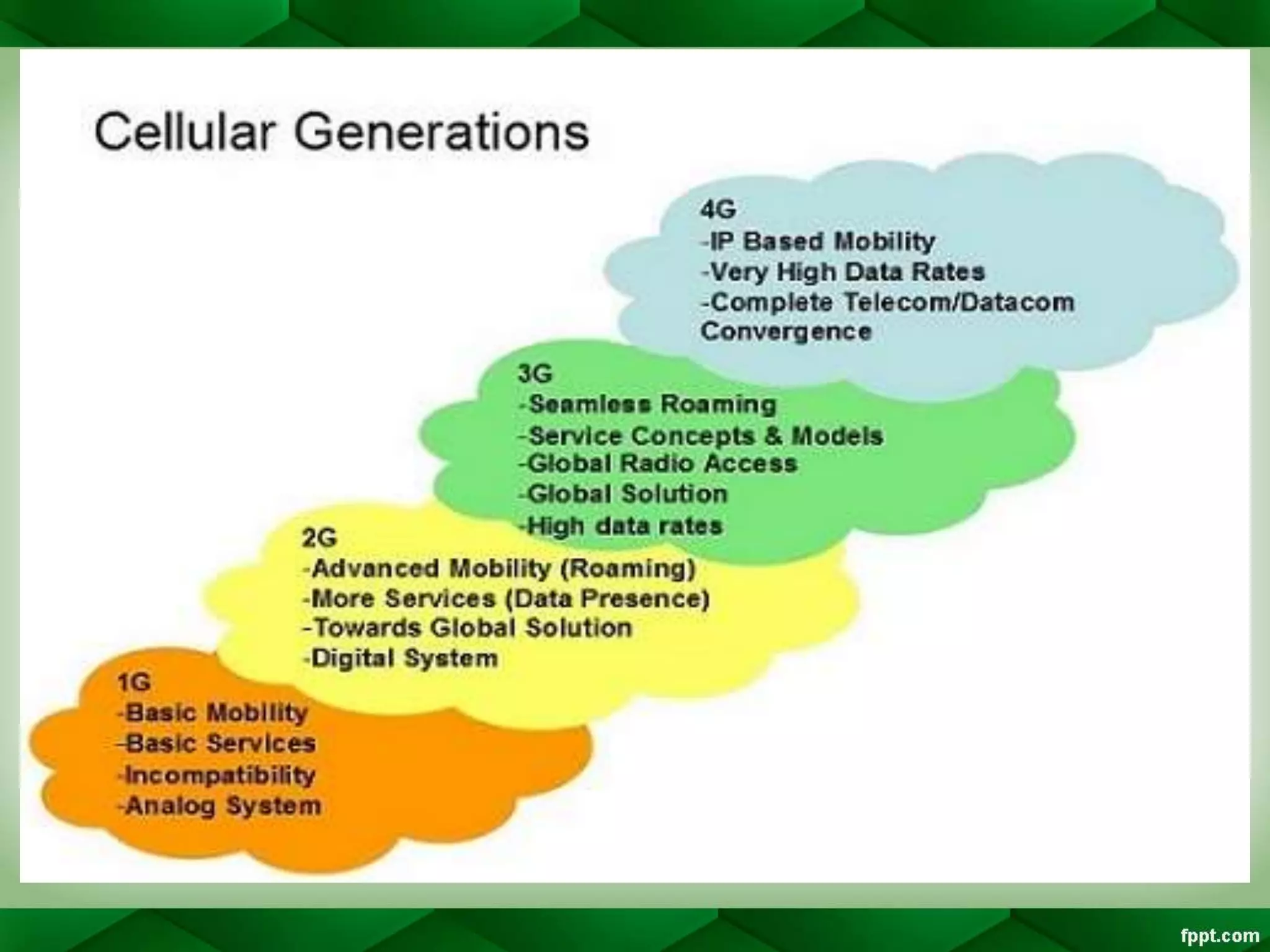
The document outlines the evolution of mobile communication systems from 0G to 4G. It discusses the key technologies and concepts behind each generation including:
- 0G systems used analog radio telephones in cars and early mobile telephone systems.
- 1G systems launched the first commercial cellular networks using analog technology like AMPS.
- 2G introduced digital networks and SMS, using technologies like GSM.
- 3G brought faster data speeds up to 2Mbps using WCDMA, and new applications like video calling and mobile internet.
- 4G aims to provide ultra-broadband speeds from 100Mbps to 1Gbps using LTE and WiMax, competing with home internet speeds
Evolution of the generations of mobile Communication system.
1.
Evolution of thegenerations of mobile
Communication system.
MUSFIQUR RAHMAN
Department of Electronic and Telecommunication Engineering
University of Liberal Arts Bangladesh (ULAB)
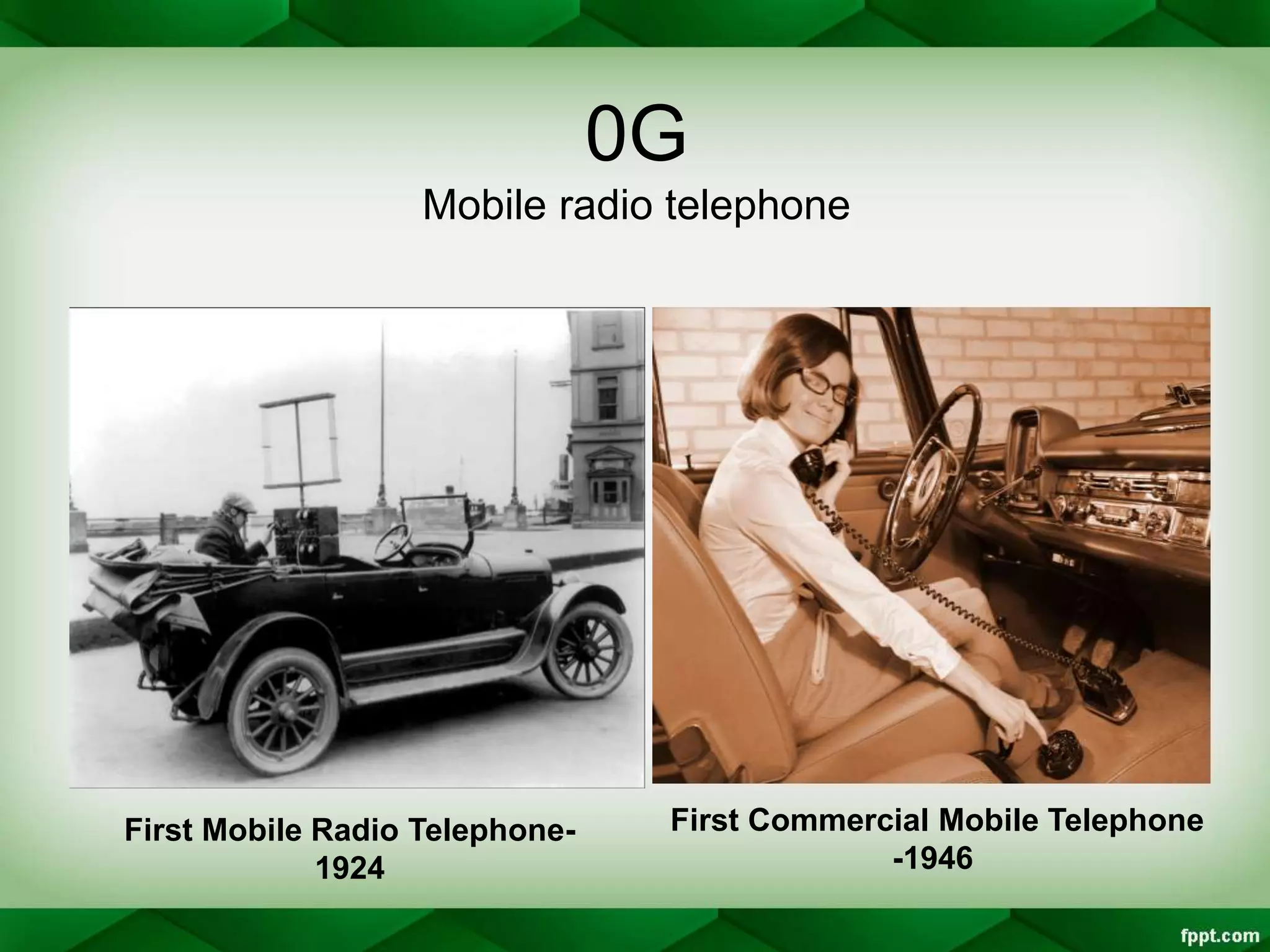
0G
Mobile radio telephone
Pre-cellphone mobile technology, such as radio telephones that some had in cars before the
arrival of cell Phones.
Motorola in conjunction with the Bell System operated the first commercial mobile telephone
service Mobile Telephone System (MTS) in the US in 1946
First automatic system was the Bell System's IMTS which became available in 1962, offering
automatic dialing to and from the mobile.
Technologies:
* PTT (Push to Talk)
* MTS ( Mobile Telephone System)
* IMTS (Improved MTS)
Radio Common Carrier:
paired UHF 454/459 MHz and VHF 152/158 MHz
5.
Cellular concepts
• 1947:Douglas H. Ring and W. Rae Young, Bell Labs engineers, proposed
hexagonal cells for mobile phones in vehicles
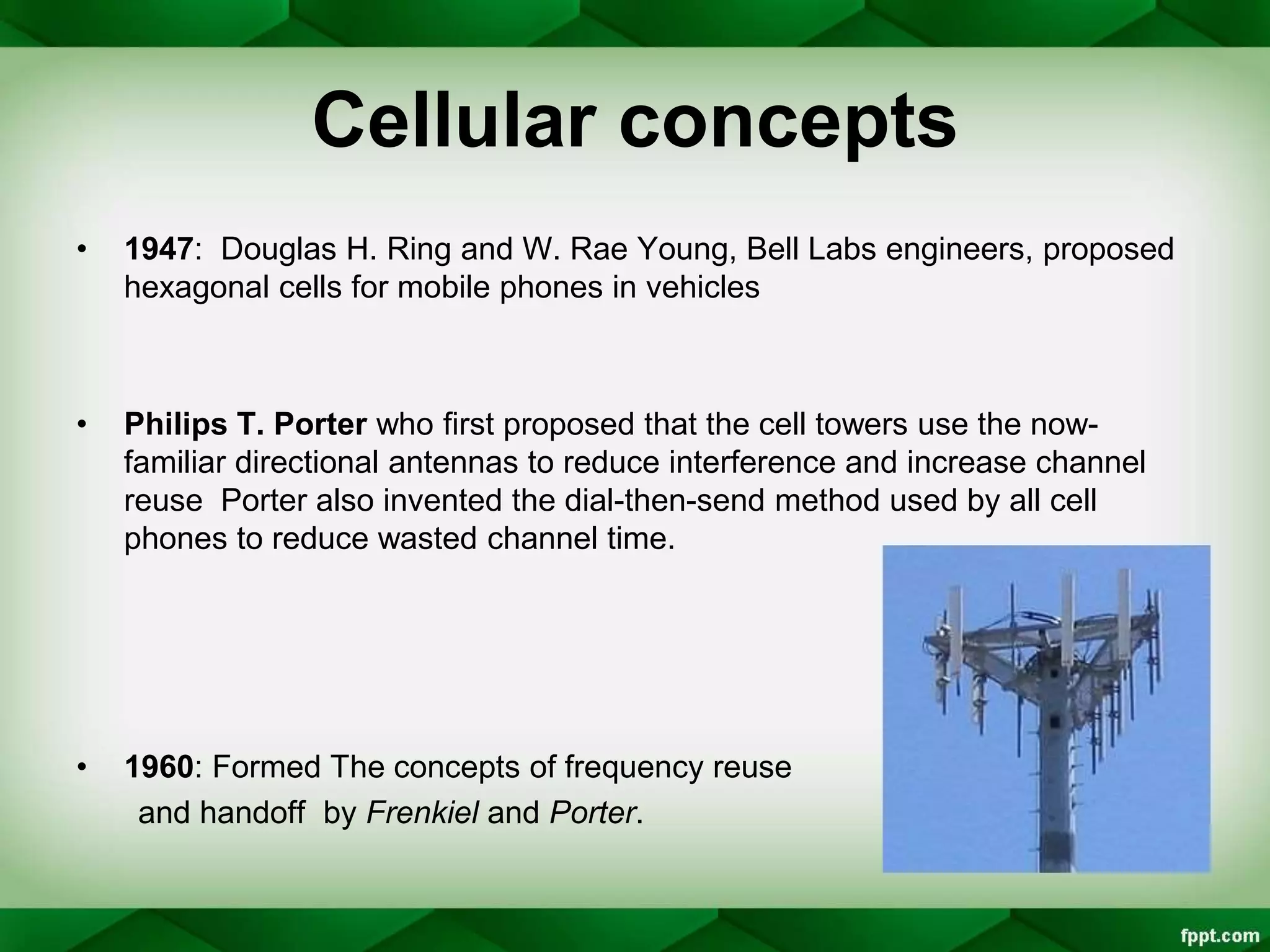
• Philips T. Porter who first proposed that the cell towers use the now-
familiar directional antennas to reduce interference and increase channel
reuse Porter also invented the dial-then-send method used by all cell
phones to reduce wasted channel time.
• 1960: Formed The concepts of frequency reuse
and handoff by Frenkiel and Porter.
6.
Cellular concepts
• 1970:Amos E. Joel, Jr., a Bell Labs engineer, invented a "three-sided trunk
circuit" to aid in the "call handoff" process from one cell to another. His
patent contained an early description of the Bell Labs cellular concept, but
as switching systems became faster, such a circuit became unnecessary
and was never implemented in a system.
• 1973: A cellular telephone switching plan was described by Fluhr and
Nussbaum.
• 1977: cellular telephone data signaling system was described by
Hachenburg et al.
7.
Handheld mobile phone
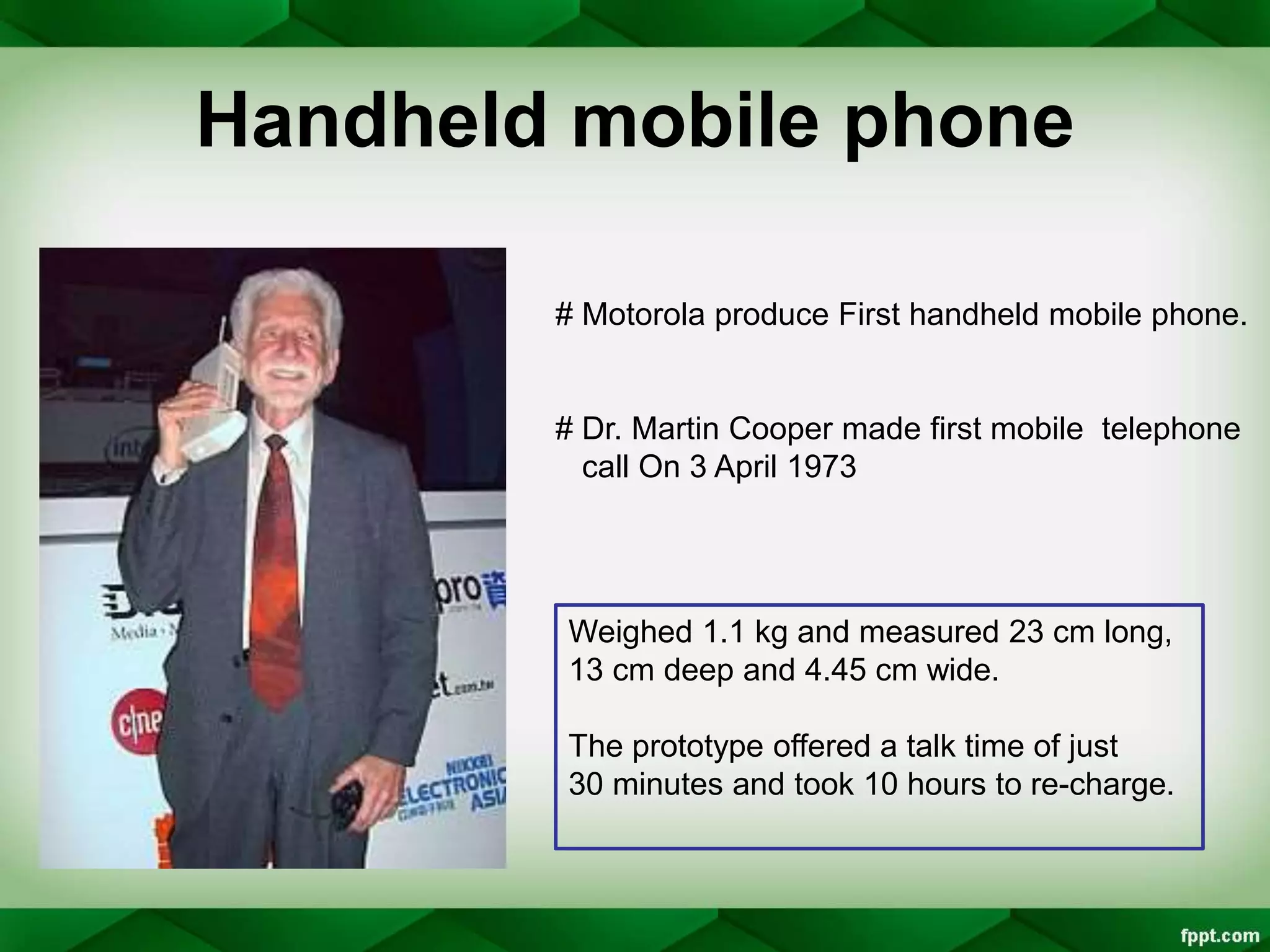
#Motorola produce First handheld mobile phone.
# Dr. Martin Cooper made first mobile telephone
call On 3 April 1973
Weighed 1.1 kg and measured 23 cm long,
13 cm deep and 4.45 cm wide.
The prototype offered a talk time of just
30 minutes and took 10 hours to re-charge.
8.
1G
# In 1979:The first commercially automated cellular network (the 1G
generation) was launched in Japan by NTT (Nippon Telegraph and
Telephone) initially in the metropolitan area of Tokyo.
# In 1981: the Nordic Mobile Telephone (NMT) system simultaneously
launched in Denmark, Finland, Norway and Sweden. NMT was the first
mobile phone network to feature international roaming
# In 1983: the first 1G network launched in the USA was Chicago-based
Ameritech using the Motorola DynaTAC mobile phone. Several countries
then followed in the early to mid-1980s including the UK, Mexico and
Canada.
History:
9.
1G
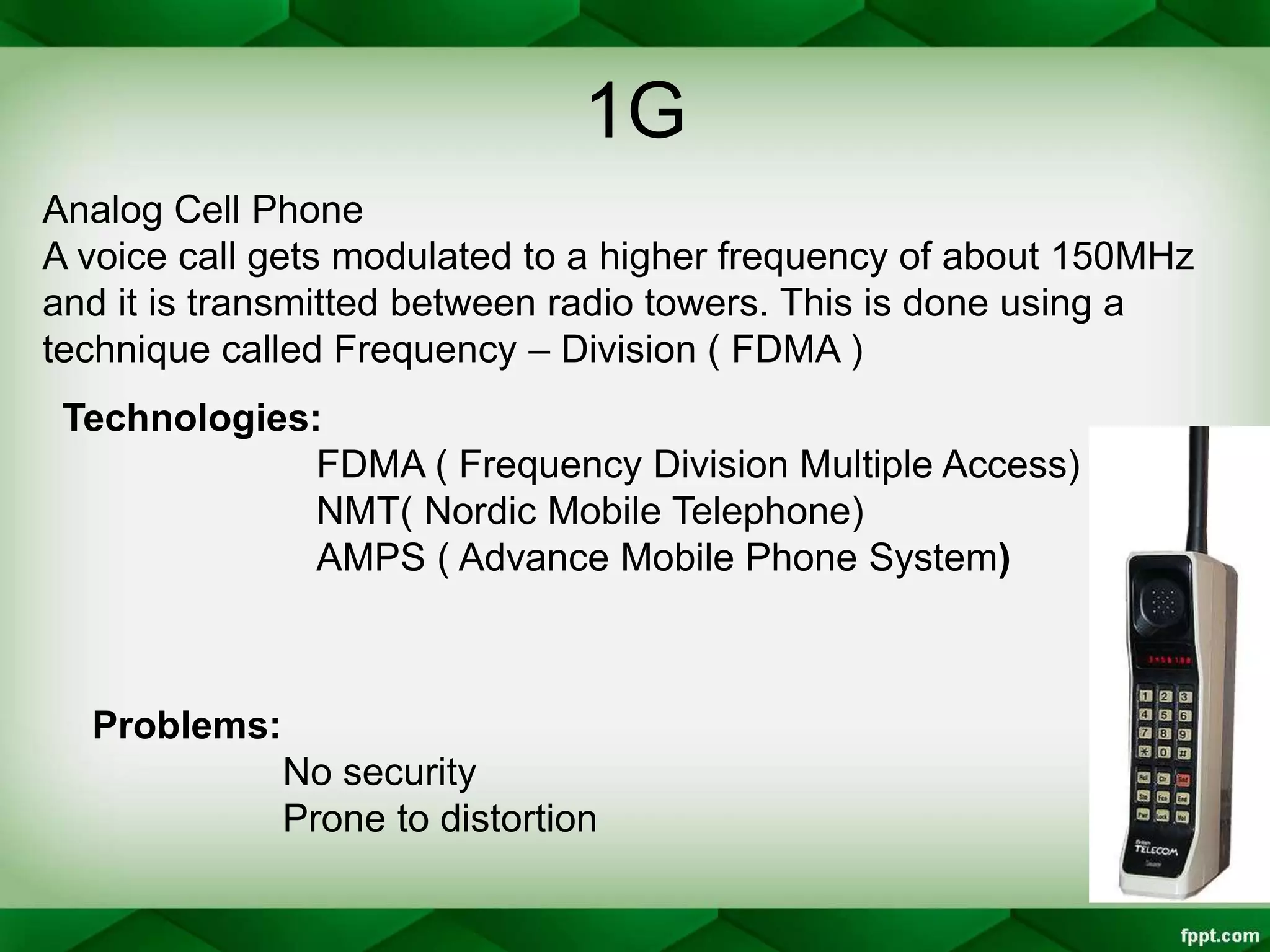
Analog Cell Phone
Avoice call gets modulated to a higher frequency of about 150MHz
and it is transmitted between radio towers. This is done using a
technique called Frequency – Division ( FDMA )
Technologies:
FDMA ( Frequency Division Multiple Access)
NMT( Nordic Mobile Telephone)
AMPS ( Advance Mobile Phone System)
Problems:
No security
Prone to distortion
10.
2G
Digital Cell Phone
Speed: 10kbits/sec
Different Services:
Digital Voice Calling
Short message service (sms)
Technology :
CDMA
TDMA
Benefits:
Improves the voice clarity
Reduces noise in the line
Secrecy and safety to the data and voice calls
Evolution:
2.5G (GPRS) : Implemented a packet-switch
2.75G (EDGE) : introduction of 8PSK encoding.
[ Developed in 2003 by AT&T USA]450 MHz frequency band
Stander:
GSM
11.
3G
First 3G waslaunched by NTT DoCoMo in Japan in the Tokyo region in May 2001
Using WCDMA
In 2002 the first 3G networks on the rival CDMA2000 1xEV-DO technology were
launched by SK Telecom and KTF in South Korea, and Monet in the USA.
The communication spectrum between 400 MHz to 3 GHz was allocated for 3G.
Technology :
# Wideband Code Division Multiple Access (W-CDMA) : Data rate upto 2 mbps
# Time Division Synchronous Code Division Multiple Access (TD-SCDMA)
# UWC-136
# Digital enhanced cordless telecommunications (DECT)
12.
3G
Application:
Internet, e-mail, fax,e-commerce, music,
Video clips, video conferencing
Combination a mobile phone, laptop PC and TV
Features includes:
-Phone calls
-Global roaming
-send/receive large email messages
-High-speed web
- Navigation/maps
-Videoconferencing
-TV streaming
-GPS
13.
4G
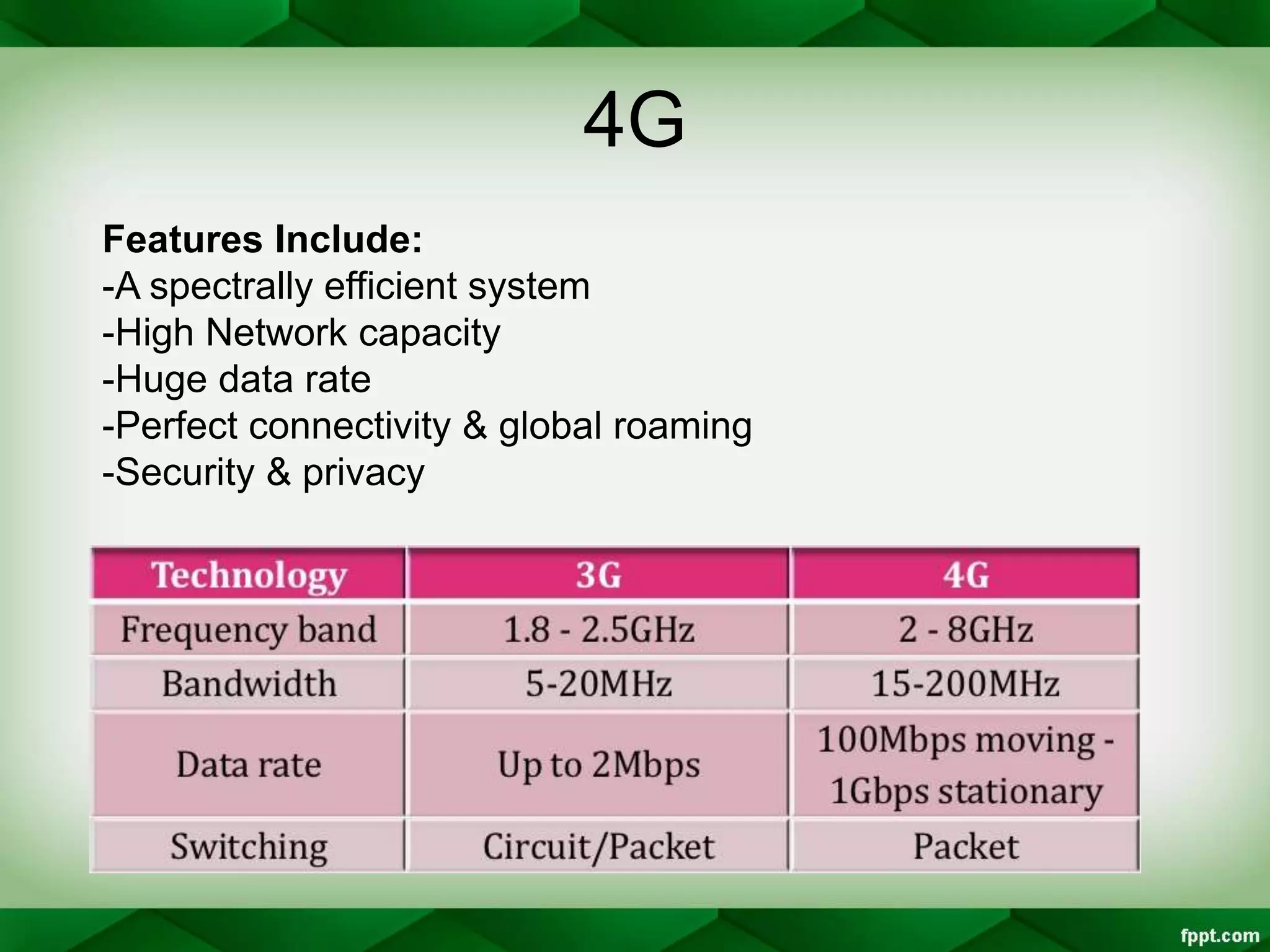
4G development focusesaround achieving ultra broadband speeds,
competing with and in some cases outstripping the speeds provided
by home internet connection.
4G average speeds are targeted to be in the 100Mbps to 1Gbps
range, roughly 10 to 100 times ( dependent on location) faster
Than 3G networks.
There are two major systems in U.S, which are using the 4G
mobile technology – WiMax, LTE ( Long Term Evolution)
WiMax’s majority owner id Sprint Nextel which currently has two
Mobile phones, HTC Evo and Samsung Epic
14.
4G
Features Include:
-A spectrallyefficient system
-High Network capacity
-Huge data rate
-Perfect connectivity & global roaming
-Security & privacy