Partition Walls
Presented By
Akshay Shetty
Contents
Introduction
Types of Partition wall
• Wooden partitions.
• Brick Partitions.
• Glass Partitions.
• Aluminium partitions.
Advantages.
Disadvantages.
Introduction
• Partition wall may be defined as a wall or division
provided for the purpose of dividing one room or portion
from another.
• Partition walls are designed as non-load or load bearing
walls.
• Based on the material used some of the partition wall may
be classified as follows
1. Wooden partition wall
2. Brick partition wall.
3. Glass partition wall.
4. Aluminium partition wall.
Wooden Partition
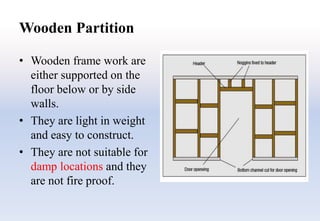
• Wooden frame work are
either supported on the
floor below or by side
walls.
• They are light in weight
and easy to construct.
• They are not suitable for
damp locations and they
are not fire proof.
Brick Partition
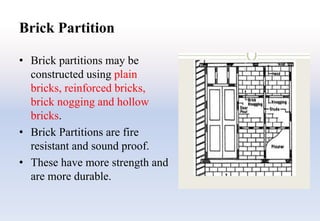
• Brick partitions may be
constructed using plain
bricks, reinforced bricks,
brick nogging and hollow
bricks.
• Brick Partitions are fire
resistant and sound proof.
• These have more strength and
are more durable.
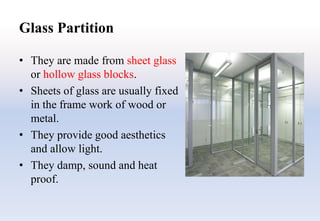
Glass Partition
• They are made from sheet glass
or hollow glass blocks.
• Sheets of glass are usually fixed
in the frame work of wood or
metal.
• They provide good aesthetics
and allow light.
• They damp, sound and heat
proof.
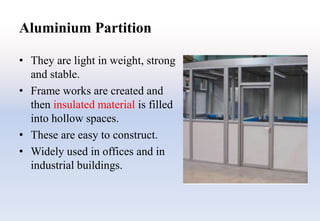
Aluminium Partition
• They are light in weight, strong
and stable.
• Frame works are created and
then insulated material is filled
into hollow spaces.
• These are easy to construct.
• Widely used in offices and in
industrial buildings.
Advantages
• Provide Privacy from sight and sound.
• Divide the whole area into number of rooms.
• Easy construction and occupy less space.
• Light in weight an cost effective.
Disadvantages
• Traditional partition wall, is that it is often detrimental to
the environment. It is usually not made up of
environmentally friendly materials, but rather made of non
sustainable and non recyclable materials.
• By placing it in the wrong position/place, you can quickly
darken the area and even break the volume and decrease
the living space.
THANK YOU

Partition walls

  • 1.
  • 2.
    Contents Introduction Types of Partitionwall • Wooden partitions. • Brick Partitions. • Glass Partitions. • Aluminium partitions. Advantages. Disadvantages.
  • 3.
    Introduction • Partition wallmay be defined as a wall or division provided for the purpose of dividing one room or portion from another. • Partition walls are designed as non-load or load bearing walls. • Based on the material used some of the partition wall may be classified as follows 1. Wooden partition wall 2. Brick partition wall. 3. Glass partition wall. 4. Aluminium partition wall.
  • 4.
    Wooden Partition • Woodenframe work are either supported on the floor below or by side walls. • They are light in weight and easy to construct. • They are not suitable for damp locations and they are not fire proof.
  • 5.
    Brick Partition • Brickpartitions may be constructed using plain bricks, reinforced bricks, brick nogging and hollow bricks. • Brick Partitions are fire resistant and sound proof. • These have more strength and are more durable.
  • 6.
    Glass Partition • Theyare made from sheet glass or hollow glass blocks. • Sheets of glass are usually fixed in the frame work of wood or metal. • They provide good aesthetics and allow light. • They damp, sound and heat proof.
  • 7.
    Aluminium Partition • Theyare light in weight, strong and stable. • Frame works are created and then insulated material is filled into hollow spaces. • These are easy to construct. • Widely used in offices and in industrial buildings.
  • 8.
    Advantages • Provide Privacyfrom sight and sound. • Divide the whole area into number of rooms. • Easy construction and occupy less space. • Light in weight an cost effective.
  • 9.
    Disadvantages • Traditional partitionwall, is that it is often detrimental to the environment. It is usually not made up of environmentally friendly materials, but rather made of non sustainable and non recyclable materials. • By placing it in the wrong position/place, you can quickly darken the area and even break the volume and decrease the living space.
  • 10.