False Ceiling
Materials
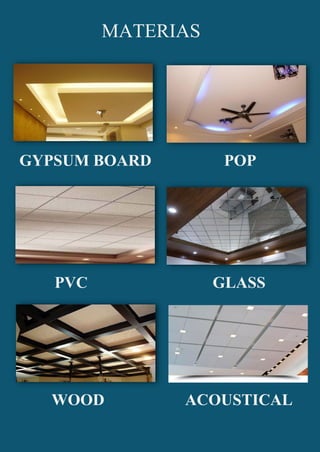
MATERIAS
GYPSUM BOARD POP
PVC GLASS
WOOD ACOUSTICAL
GYPSUM BOARD
 Gypsum items possess the following important Properties
1.They are in combustible.
2.They possess relatively small bulk density.
3.They serve as good sound absorbers
 The main reason for gypsum board being a popular material for
false ceiling are
a) Ease of Installation
b) Fire Resistance
c) Sound Insulation
d) Durability, Economy & Versatility
 It is a Panel made of gypsum plaster.
 It is pressed between two sheets of paper.
 It is used to make interior walls and ceilings.
Sizes of Gypsum Board
 4’x4’
 6’x6’
 6’x4’
Thickness of Gypsum Board
 8mm
 10mm(mostly use for large ceiling)
 12mm
 Upto 20mm
PLASTER OF PARIS (P.O.P)
Advantages
 A smooth, uniform finish.
 The surface can be recovered or painted.
 Easy to construct and maintain.
 The ceiling are really light.
Facts about POP
 Plaster of Paris is a type of ceiling that originally originated
from France
 It is a mixture of calcined gypsum, sand & water.
 When these ingredients are mixed together and the
subsequent paste is allowed to dry, it hardens and forms a
tough coating.
Installation
 Fixing the framework directly on the beam and structural
ceiling.
 Fixing the wall supports and angles supports
 Fixing the suspended framework on the supporting members.
 Fixing of POP boards.
 Applying insulation.
 Finishing the joints.
 Edging profile.
 Fixing the moldings and decorative motifs.
 Final finishing with paints for desired effects.
GLASS
 Usual transparent glass is never used, as it contradicts the very
idea of false ceiling-to hide from the viewer’s eye and defects
and irregularities and other services wiring , plumbing, air
conditioning systems etc
 Frosted glass is mostly used other than back painted, stained
glass, mirrors etc
Advantages
 Creates the illusion of depth, it makes the room visually higher.
 Resist moisture and temperature fluctuations.
 Easy to clean and maintain.
 Suspended glass ceiling with stained glass panels can be
decorated with the image or using the in jet printing on
special equipment, or a sticker on top of the glass transparent
film with a pattern.
Disadvantages
 Hard and brittle to cut, drill and work with.
 Suspended glass ceiling are quite heavy compared to other
materials.
 Most dangerous if any glass tile breaks during repair works.
 Not advisable in earthquake prone areas.
WOOD
Advantages
 Very economical.
 Natural acoustical properties.
 Esthetic appeal gives richness to the space.
 Effective for creating rustic look.
 Give warmth to the space.
Disadvantages
 Comparatively heavier than other materials.
 Lessens the visual height of the room.
 Cannot withstand attack of pest like termites for long period.
 Not recommended for damp spaces or leakage prone areas.
Basic Materials
 The material used in false ceiling is made up of either hard or
MDF or particle board.
 In MDF mica is used to glue the either sides of the board.
 Using solid wood is not recommended because it is heavy.
 The one on the inner side of the board is known as “Balanced
surface”
 The one on the external side i.e. the visible surface is known as
the “finished surface”.
 Where as the wood gives the natural finish when polished.
Installation
 Grid system is formed with the help of wooden joists.
 Modular grid size 400x600mm
 Grid system is supported by hanger wire & wooden screws.
 Each cell is filled with lightweight “wooden panels”.
ACOUSTIC BOARD
 Board made of sound absorbing materials.
 Its job is to provide sound insulation.
 Ceiling is porous.
 When sound passes through an acoustic board the intensity of sound is
decreased.
 The loss of sound energy is balanced by producing heat energy.
 Used in auditoriums, halls, seminar rooms, libraries etc.
Installation Method
M. Kamran
15-101
DAT-2
ARCH-353
False Ceiling  Materials

False Ceiling Materials

  • 1.
  • 2.
    MATERIAS GYPSUM BOARD POP PVCGLASS WOOD ACOUSTICAL
  • 3.
    GYPSUM BOARD  Gypsumitems possess the following important Properties 1.They are in combustible. 2.They possess relatively small bulk density. 3.They serve as good sound absorbers  The main reason for gypsum board being a popular material for false ceiling are a) Ease of Installation b) Fire Resistance c) Sound Insulation d) Durability, Economy & Versatility  It is a Panel made of gypsum plaster.  It is pressed between two sheets of paper.  It is used to make interior walls and ceilings. Sizes of Gypsum Board  4’x4’  6’x6’  6’x4’ Thickness of Gypsum Board  8mm  10mm(mostly use for large ceiling)  12mm  Upto 20mm
  • 4.
    PLASTER OF PARIS(P.O.P) Advantages  A smooth, uniform finish.  The surface can be recovered or painted.  Easy to construct and maintain.  The ceiling are really light. Facts about POP  Plaster of Paris is a type of ceiling that originally originated from France  It is a mixture of calcined gypsum, sand & water.  When these ingredients are mixed together and the subsequent paste is allowed to dry, it hardens and forms a tough coating. Installation  Fixing the framework directly on the beam and structural ceiling.  Fixing the wall supports and angles supports  Fixing the suspended framework on the supporting members.  Fixing of POP boards.  Applying insulation.  Finishing the joints.  Edging profile.  Fixing the moldings and decorative motifs.  Final finishing with paints for desired effects.
  • 5.
    GLASS  Usual transparentglass is never used, as it contradicts the very idea of false ceiling-to hide from the viewer’s eye and defects and irregularities and other services wiring , plumbing, air conditioning systems etc  Frosted glass is mostly used other than back painted, stained glass, mirrors etc Advantages  Creates the illusion of depth, it makes the room visually higher.  Resist moisture and temperature fluctuations.  Easy to clean and maintain.  Suspended glass ceiling with stained glass panels can be decorated with the image or using the in jet printing on special equipment, or a sticker on top of the glass transparent film with a pattern. Disadvantages  Hard and brittle to cut, drill and work with.  Suspended glass ceiling are quite heavy compared to other materials.  Most dangerous if any glass tile breaks during repair works.  Not advisable in earthquake prone areas.
  • 6.
    WOOD Advantages  Very economical. Natural acoustical properties.  Esthetic appeal gives richness to the space.  Effective for creating rustic look.  Give warmth to the space. Disadvantages  Comparatively heavier than other materials.  Lessens the visual height of the room.  Cannot withstand attack of pest like termites for long period.  Not recommended for damp spaces or leakage prone areas. Basic Materials  The material used in false ceiling is made up of either hard or MDF or particle board.  In MDF mica is used to glue the either sides of the board.  Using solid wood is not recommended because it is heavy.  The one on the inner side of the board is known as “Balanced surface”  The one on the external side i.e. the visible surface is known as the “finished surface”.  Where as the wood gives the natural finish when polished. Installation  Grid system is formed with the help of wooden joists.  Modular grid size 400x600mm  Grid system is supported by hanger wire & wooden screws.  Each cell is filled with lightweight “wooden panels”.
  • 7.
    ACOUSTIC BOARD  Boardmade of sound absorbing materials.  Its job is to provide sound insulation.  Ceiling is porous.  When sound passes through an acoustic board the intensity of sound is decreased.  The loss of sound energy is balanced by producing heat energy.  Used in auditoriums, halls, seminar rooms, libraries etc. Installation Method
  • 8.