This page
intentionally left
blank
Copyright © 2007, New Age International (P) Ltd., Publishers
Published by New Age International (P) Ltd., Publishers
All rights reserved.
No part of this ebook may be reproduced in any form, by photostat, microfilm,
xerography, or any other means, or incorporated into any information retrieval
system, electronic or mechanical, without the written permission of the publisher.
All inquiries should be emailed to rights@newagepublishers.com

ISBN (13) : 978-81-224-2635-9

PUBLISHING FOR ONE WORLD

NEW AGE INTERNATIONAL (P) LIMITED, PUBLISHERS
4835/24, Ansari Road, Daryaganj, New Delhi - 110002
Visit us at www.newagepublishers.com
Dedicated to
Central Building Research Institute, Roorkee

my mother organization which nurtured me for 35 years and provided
me opportunities to work over a wide spectrum of projects including
Use of Glass in Buildings
— Dr. N. K. Garg
This page
intentionally left
blank
Foreword
Glass has always been associated with notable advances in construction. The
monumental edifice of Crystal Palace, built in London by Paxton in 1851, was
erected in record time using revolutionary assembly techniques. With its fully
glazed roof, the “glass ceiling” concept received its seal of approval by architects.
This initial and tentative use of glass on such a spectacular and large scale was
contemporary to the extraordinary contribution engineering, supplemented by
the industrial revolution. It was to engender the unprecedented development of
construction allying glass with steel, cast iron and, in due course, concrete.
Beyond its architectural aspect & structural capabilities, glass has come up with
new properties to meet the modern demands of comfort as well as safety & security. It is a rare
construction material, which is traditional, multifunctional & constantly evolving.
The 20th century has witnessed increasingly complex performance demands on glass. It has lost its
image for fragility and earned the status of a multi-purpose building material. More than ever, glass
has become a symbol of modernity.
The glass industry in India has kept pace with the emerging performance requirements of glass. It is
capable of producing world-class glass in the country. Newer performance characteristic needed
guidelines for use of glass most scientifically and judiciously in buildings. I am happy to note that
Central Building Research Institute has undertaken the enabling role and prepared guidelines for use
of glass in buildings.
The guidelines covering general as well as optical, acoustical & structural properties of commonly
used glass types will enable the designer to select the right type of glass for his building. Tools to
arrive at the appropriate thickness of glass, innovative glazing systems along with do’s & don’ts are
also covered. The document with its holistic approach will surely promote right and safe use of glass
in buildings as a symbol of modernity through the 21st century.

V.K.Mathur
Former Director, CBRI
This page
intentionally left
blank
Preface
Glass is a “high-tech” material appreciated for its visual appeal. The fascination
which glass inspires in designers is explained by its aesthetics and functions. Its
transparency, affording both light and vision yet imposing separation and even
isolation worth appreciating. It can, do the very opposite as well. Glass can form
building’s envelope as opaque as stone, reflecting images and allowing light to
reach the interior, without compromising vision through to the exterior. Glass can
also provide a delicate covering that softens a building’s mass, or indeed accentuate
it, by simply reflecting both light and the surrounding environment.
The innovative installation techniques e.g. structural glazing or bolted glass assemblies and developments
in glass coating technology for solar control performance has extended its capacity to constitute
entire facades, forming a skin which can be totally smooth, transparent or opaque, reflective or
coloured as per the perception of the designer.
India is producing world class glass with a range of strength & optical properties. To facilitate its use
as an emerging building material adding excellence in building performance, guidelines have been
formulated. National & international codes, experiences of the glass industry including the
manufactures, the fabricators & the installers form the basis of these guidelines. It is my endeavor to
provide technical information accurately. However variations are possible and CBRI shall not be
liable for the same. The role of All India Flat Glass Manufacturers’ Association (AIFGMA) for
sponsoring this study at CBRI & providing necessary assistance is commendable.
It has been a pleasant experience for me to edit this volume. Sh. V. K. Mathur, Former Director,
CBRI has very kindly written the foreword. I am indebted to him. I appreciate the dedication of my
colleagues: Sh. Ashok Kumar, Sh. S.K.Negi, Sh. Navjeev Saxena, Dr. Rajesh Deoliya and Sh. V.
Srinivasan at CBRI in completing the project entitled, ‘Use of Glass in Buildings’ which forms the
basis of this work.

(Dr. N. K. Garg)
This page
intentionally left
blank
Acknowledgements
Eminent industrialists, manufacturers, fabricators, installers, administrators, scholars & users of
glass have provided their inputs related to their fields of expertise. Special recognition is due to the
following for facilitating the preparation of guidelines, ‘use of glass in buildings’.
Shri K. K. Trivedi
Secretary General
All India Flat Glass Manufacturers Association
(AIFGMA)
New Delhi

Shri S. K. Mehrotra
V. P. (Works)
Gujarat Borosil Limited
Bharuch
(Gujarat)

Mr. Alok Modi
Jt. M. Director
Gujarat Guardian Limited
New Delhi

Shri Phiroze J. Masters
General Manager (Mktg.)
Gujarat Borosil Limited
Mahalakshmi, Mumbai

Shri P. K. Kheruka
Director
Borosil Glass Works Limited
Mumbai

Sh. R. K. Bhatt
Chief Engineer
DLF Constructions
Gurgoan

Shri Sharan Jeet Singh
Managing Director
GSC Toughened Glass Pvt. Ltd.
Noida

Shri Gopal C. Panigrahi
Head Manufacturing
Float Glass India Limited
Maharashtra

Sh. Deepak Ghalowt
Architect
Editor
Construction Journal of India
New Delhi

Shri R. M. Kunzru
Executive Director (Technical &
Operations)
Float Glass India Limited
Taloja, Maharashtra
(xii)
Mr. Farhaat Kamil
Kaenat Glass Agencies
New Delhi

Sh. Sandeep Chaudri
Partner, A L Karma
New Delhi

Shri A. L. Kelkar
Joint General Manager
ICICI Bank Limited
Mumbai

Sh. Anshu Gupta
Territory Head-Arch Division
Gujarat Guardian Limited
New Delhi

Shri R. Madhukar
Chief Manager
ICICI Bank Limited
Mumbai

Sh. Subash Chandra
Raw Line Manager
Gujarat Guardian Limited
Ankleshwar
Gujrat

Shri Oswald Lobo
Proprietor
Professional Glass Façade Cleaners
Kandivali (E)
Mumbai

Shri Anand R. Jain
Saint – Gobain Glass India Ltd.
Sriperumbudur – 602 105
Kanchipuram Distt.
Tamil Nadu
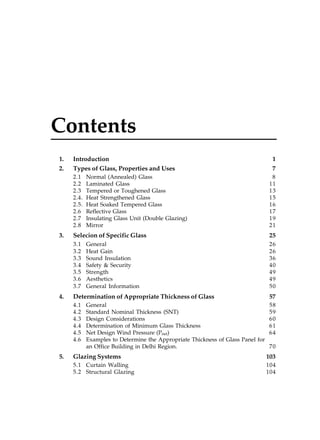
Contents
1.
2.

Introduction
Types of Glass, Properties and Uses
2.1
2.2
2.3
2.4.
2.5.
2.6
2.7
2.8

3.

Normal (Annealed) Glass
Laminated Glass
Tempered or Toughened Glass
Heat Strengthened Glass
Heat Soaked Tempered Glass
Reflective Glass
Insulating Glass Unit (Double Glazing)
Mirror

1
7
8
11
13
15
16
17
19
21

25

3.1
3.2
3.3
3.4
3.5
3.6
3.7

4.

Selecion of Specific Glass

26
26
36
40
49
49
50

Determination of Appropriate Thickness of Glass
4.1
4.2
4.3
4.4
4.5
4.6

5.

General
Heat Gain
Sound Insulation
Safety & Security
Strength
Aesthetics
General Information

57

General
58
Standard Nominal Thickness (SNT)
59
Design Considerations
60
Determination of Minimum Glass Thickness
61
Net Design Wind Pressure (Pnet)
64
Examples to Determine the Appropriate Thickness of Glass Panel for
an Office Building in Delhi Region.
70

Glazing Systems

103

5.1 Curtain Walling
5.2 Structural Glazing

104
104
(xvi)
5.3
5.4
5.5
5.6
5.7
5.8

6.

Bolted Glazing
Fin Supported Glazing
Cable Stayed Glazing
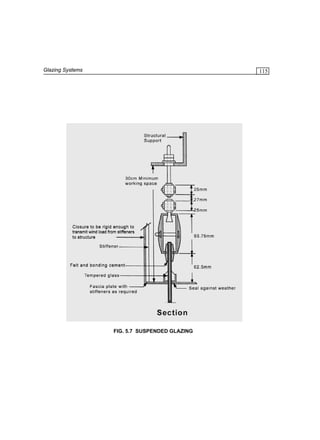
Suspended Glazing
Mirror Installation
Accessories for Glazing Systems

105
106
106
107
108
109

General Guidelines

117

6.1
6.2
6.3
6.4
6.5
6.6
6.7
6.8
6.9

General
Normal (Annealed) Glass
Laminated Glass
Tempered Glass
Reflective Glass
Insulating Glass
Mirror
Aluminium Framings
Safety from Earthquakes

118
118
119
119
119
121
121
123
124

Reference Material
Definitions

125
131
1
Introduction
Use of Glass in Buildings

2

1.0 INTRODUCTION
Glass is one of the commonest man-made materials
that has been in use for a number of years. From the
stained glass windows of medieval churches, glass
has brought us protection from our environment, while
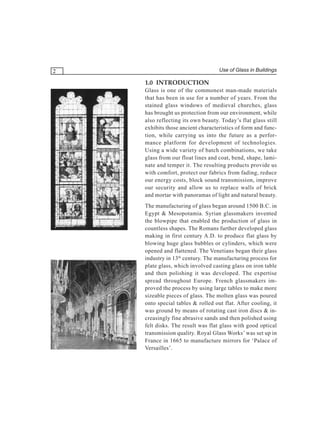
also reflecting its own beauty. Today’s flat glass still
exhibits those ancient characteristics of form and function, while carrying us into the future as a performance platform for development of technologies.
Using a wide variety of batch combinations, we take
glass from our float lines and coat, bend, shape, laminate and temper it. The resulting products provide us
with comfort, protect our fabrics from fading, reduce
our energy costs, block sound transmission, improve
our security and allow us to replace walls of brick
and mortar with panoramas of light and natural beauty.
The manufacturing of glass began around 1500 B.C. in
Egypt & Mesopotamia. Syrian glassmakers invented
the blowpipe that enabled the production of glass in
countless shapes. The Romans further developed glass
making in first century A.D. to produce flat glass by
blowing huge glass bubbles or cylinders, which were
opened and flattened. The Venetians began their glass
industry in 13th century. The manufacturing process for
plate glass, which involved casting glass on iron table
and then polishing it was developed. The expertise
spread throughout Europe. French glassmakers improved the process by using large tables to make more
sizeable pieces of glass. The molten glass was poured
onto special tables & rolled out flat. After cooling, it
was ground by means of rotating cast iron discs & increasingly fine abrasive sands and then polished using
felt disks. The result was flat glass with good optical
transmission quality. Royal Glass Works’ was set up in
France in 1665 to manufacture mirrors for ‘Palace of
Versailles’.
Introduction

3
England became the world’s center for quality plate glass
for windows in 1773. This period marked for the first time
in the history of glassmaking that glazed window glass was
widely available and affordable for most homeowners.
Industrial revolution brought a number of innovations to
glassmaking. William Pilkington invented a machine,
which automated the production of glass. Around the turn
of the century, glassmakers discovered that glass could be
“tempered” by reheating it and then cooling it again
quickly.
The American Irwing Colburn and the Belgian Emile
Fourcault simultaneously developed a new automated
glassmaking process, which drew molten glass from
the furnace in a thin stream, then flattened and cooled
it by pulling it between asbestos rollers as a sheet.
Though the sheet glass produced by this “draw” process was still not distortion free, it was the highest
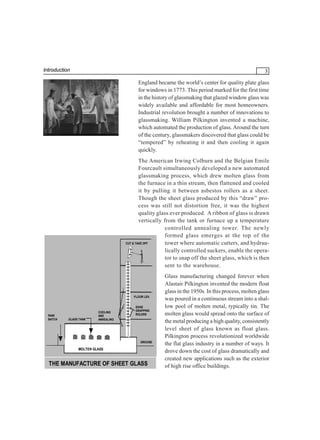
quality glass ever produced. A ribbon of glass is drawn
vertically from the tank or furnace up a temperature
controlled annealing tower. The newly
formed glass emerges at the top of the
CUT & TAKE OFF
tower where automatic cutters, and hydraulically controlled suckers, enable the operator to snap off the sheet glass, which is then
sent to the warehouse.

FLOOR LEV.

RAW
BATCH

GLASS TANK

COOLING
AND
ANNEALING

EDGE
GRAPPING
ROLERS

GROUND

MOLTEN GLASS

THE MANUFACTURE OF SHEET GLASS

Glass manufacturing changed forever when
Alastair Pilkington invented the modern float
glass in the 1950s. In this process, molten glass
was poured in a continuous stream into a shallow pool of molten metal, typically tin. The
molten glass would spread onto the surface of
the metal producing a high quality, consistently
level sheet of glass known as float glass.
Pilkington process revolutionized worldwide
the flat glass industry in a number of ways. It
drove down the cost of glass dramatically and
created new applications such as the exterior
of high rise office buildings.
Use of Glass in Buildings

4

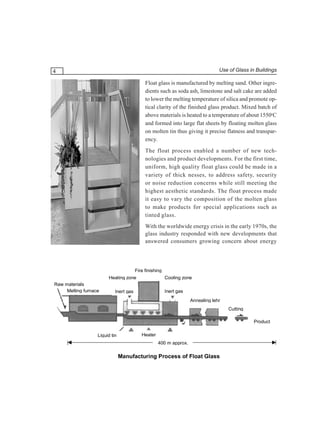
Float glass is manufactured by melting sand. Other ingredients such as soda ash, limestone and salt cake are added
to lower the melting temperature of silica and promote optical clarity of the finished glass product. Mixed batch of
above materials is heated to a temperature of about 1550oC
and formed into large flat sheets by floating molten glass
on molten tin thus giving it precise flatness and transparency.
The float process enabled a number of new technologies and product developments. For the first time,
uniform, high quality float glass could be made in a
variety of thick nesses, to address safety, security
or noise reduction concerns while still meeting the
highest aesthetic standards. The float process made
it easy to vary the composition of the molten glass
to make products for special applications such as
tinted glass.
With the worldwide energy crisis in the early 1970s, the
glass industry responded with new developments that
answered consumers growing concern about energy

Fire finishing
Heating zone
Raw materials
Melting furnace

Cooling zone
Inert gas

Inert gas

Annealing lehr
Cutting
Product
Liquid tin

Heater
400 m approx.

Manufacturing Process of Float Glass
6

Use of Glass in Buildings

The guidelines consist of Six Chapters
Chapter 2 describes general properties and uses of glass
types with a view that the user makes a preliminary selection of the type(s) of glass suitable for his application.
Chapter 3 assists the user to select specific type of glass with
respect to heat gain (solar incidence), sound insulation, safety
& security with respect to thermal breakage, human impact,
fire resistance and aesthetics.
Chapter 4 provides tools to workout safe thickness for the
specific type of glass selected in previous chapter. Wind
pressure varies as per location as well as height of the building. Accordingly appropriate wind pressure is estimated
and required thickness of glass is arrived at.
Chapter 5 discusses some of the prevalent glazing systems
to fix the glass in buildings.
Chapter 6 gives general guidelines including dos and
don’ts for use of glass in buildings. It is followed by
references materials and definitions.
Introduction

7

2
Types of
Glass,
Properties
and Uses
Use of Glass in Buildings

8

2.0 TYPES OF GLASS, PROPERTIES AND
USES
Glass is an inorganic product of fusion that has cooled to a
rigid solid without undergoing crystallization. It may be
transparent, translucent or shiny depending upon the
quantities of its basic constituents such as sand, soda &
lime. By varying their quantities & using certain special
additives, the properties and characteristics of glass are
modulated to obtain a large variety. The important ones
used in buildings are discussed in following paragraphs:

2.1 NORMAL (ANNEALED) GLASS
Normal glass is synonymous with flat glass irrespective of
the process of manufacture. Float glass has a perfectly
flat, brilliant surface, whereas sheet glass has slight
distortions. Both are referred as annealed glass and can be
processed to obtain many different varieties of glass for
use in buildings.
2.1.1 Properties
The properties of normal glass are:
•

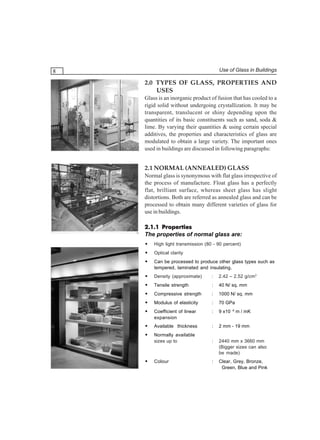
High light transmission (80 - 90 percent)

•

Optical clarity

•

Can be processed to produce other glass types such as
tempered, laminated and insulating.

•

Density (approximate)

:

2.42 – 2.52 g/cm3

•

Tensile strength

:

40 N/ sq. mm

•

Compressive strength

:

1000 N/ sq. mm

•

Modulus of elasticity

:

70 GPa

•

Coefficient of linear
expansion

:

9 x10 -6 m / mK

•

Available thickness

:

2 mm - 19 mm

•

Normally available
sizes up to

:

2440 mm x 3660 mm
(Bigger sizes can also
be made)

Colour

:

Clear, Grey, Bronze,
Green, Blue and Pink

•
Types of Glass, Properties and Uses

9
2.1.2 Use of Normal (Annealed) Glass
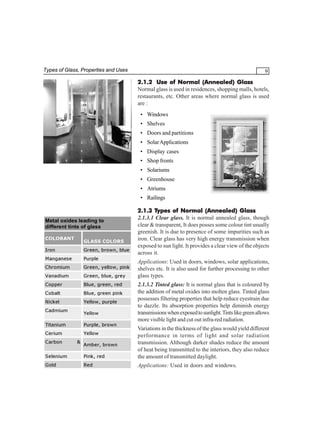
Normal glass is used in residences, shopping malls, hotels,
restaurants, etc. Other areas where normal glass is used
are :
• Windows
• Shelves
• Doors and partitions
• Solar Applications
• Display cases
• Shop fronts
• Solariums
• Greenhouse
• Atriums
• Railings

Metal oxides leading to
different tints of glass
COLORANT

GLASS COLORS

Iron

Green, brown, blue

Manganese

Purple

Chromium

Green, yellow, pink

Vanadium

Green, blue, grey

Copper

Blue, green, red

Cobalt

Blue, green pink

Nickel

Yellow, purple

Cadmium

Yellow

Titanium

Purple, brown

Cerium

Yellow

Types
2.1.3 Types of Normal (Annealed) Glass
2.1.3.1 Clear glass. It is normal annealed glass, though
clear & transparent, It does posses some colour tint usually
greenish. It is due to presence of some impurities such as
iron. Clear glass has very high energy transmission when
exposed to sun light. It provides a clear view of the objects
across it.
Applications: Used in doors, windows, solar applications,
shelves etc. It is also used for further processing to other
glass types.
2.1.3.2 Tinted glass: It is normal glass that is coloured by
the addition of metal oxides into molten glass. Tinted glass
possesses filtering properties that help reduce eyestrain due
to dazzle. Its absorption properties help diminish energy
transmissions when exposed to sunlight. Tints like green allows
more visible light and cut out infra-red radiation.

Selenium

Pink, red

Variations in the thickness of the glass would yield different
performance in terms of light and solar radiation
transmission. Although darker shades reduce the amount
of heat being transmitted to the interiors, they also reduce
the amount of transmitted daylight.

Gold

Red

Applications: Used in doors and windows.

Carbon

&

Amber, brown
10

Use of Glass in Buildings

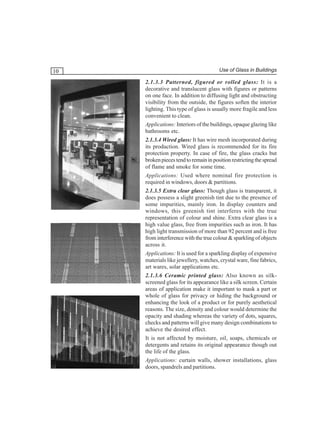
2.1.3.3 Patterned, figured or rolled glass: It is a
decorative and translucent glass with figures or patterns
on one face. In addition to diffusing light and obstructing
visibility from the outside, the figures soften the interior
lighting. This type of glass is usually more fragile and less
convenient to clean.
Applications: Interiors of the buildings, opaque glazing like
bathrooms etc.
2.1.3.4 Wired glass: It has wire mesh incorporated during
its production. Wired glass is recommended for its fire
protection property. In case of fire, the glass cracks but
broken pieces tend to remain in position restricting the spread
of flame and smoke for some time.
Applications: Used where nominal fire protection is
required in windows, doors & partitions.
2.1.3.5 Extra clear glass: Though glass is transparent, it
does possess a slight greenish tint due to the presence of
some impurities, mainly iron. In display counters and
windows, this greenish tint interferes with the true
representation of colour and shine. Extra clear glass is a
high value glass, free from impurities such as iron. It has
high light transmission of more than 92 percent and is free
from interference with the true colour & sparkling of objects
across it.
Applications: It is used for a sparkling display of expensive
materials like jewellery, watches, crystal ware, fine fabrics,
art wares, solar applications etc.
2.1.3.6 Ceramic printed glass: Also known as silkscreened glass for its appearance like a silk screen. Certain
areas of application make it important to mask a part or
whole of glass for privacy or hiding the background or
enhancing the look of a product or for purely aesthetical
reasons. The size, density and colour would determine the
opacity and shading whereas the variety of dots, squares,
checks and patterns will give many design combinations to
achieve the desired effect.
It is not affected by moisture, oil, soaps, chemicals or
detergents and retains its original appearance though out
the life of the glass.
Applications: curtain walls, shower installations, glass
doors, spandrels and partitions.
Types of Glass, Properties and Uses

11

2.2 LAMINATED GLASS
Laminated glass is composed of two or more layers of
glass with one or more layers of a transparent/ pigmented
and specially treated plastic Polyvinyl Butyral [PVB]
sandwiched between the glass layers. The glass panes
(layers) can be either normal glass or tempered glass. When
the glass is broken, fragments tend to adhere to the plastic
[PVB] interlayer thereby reducing the risk of injury and
helping to resist further damage by weather.
2.2.1 Properties
The properties of laminated glass are:
• Laminated glass does not shatter like ordinary glass. It
absorbs impact, resists penetration, and remains intact
even if broken, holding glass fragments in place and
lowering the risk of injury. Global building standards
increasingly specify stricter safety requirements where
any breakage could mean a major hazard from falling
glass and glass floors.
• Laminated glass resists intrusion because the interlayer
continues to safeguard the building even after the glass
itself is broken. It cannot be cut from only one sides,
so ordinary glasscutters are useless as break-in tools.
Laminated glass tends to resist impact. In multi-ply
configurations, it can even resist bullets, heavy objects,
or small explosions. In most cases, it takes many blows,
all in the same spot, to penetrate the glass. The rise in
urban crime and terrorism also points to laminated glass
as increasingly desirable material.
Laminated glass is capable to stop flying debris and
limit or avoid splintering on opposite side of the impact.
• Laminated glass is an excellent barrier to noise. The
sheer damping performance of the plastic interlayer
makes laminated glass an effective sound control
product. This makes it ideal for airports, hotels, dataprocessing centers, recording studios, and any building
near airports, highways, or train lines.
• Ultraviolet light is the leading cause of deterioration
and fading of furnishings, pictures, and fabrics.
Use of Glass in Buildings

12

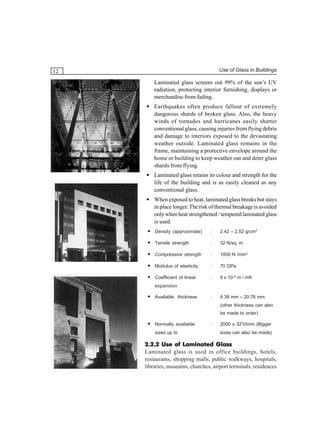
Laminated glass screens out 99% of the sun’s UV
radiation, protecting interior furnishing, displays or
merchandise from fading.
• Earthquakes often produce fallout of extremely
dangerous shards of broken glass. Also, the heavy
winds of tornados and hurricanes easily shatter
conventional glass, causing injuries from flying debris
and damage to interiors exposed to the devastating
weather outside. Laminated glass remains in the
frame, maintaining a protective envelope around the
home or building to keep weather out and deter glass
shards from flying.
• Laminated glass retains its colour and strength for the
life of the building and is as easily cleaned as any
conventional glass.
• When exposed to heat, laminated glass breaks but stays
in place longer. The risk of thermal breakage is avoided
only when heat strengthened / tempered laminated glass
is used.
• Density (approximate)

:

2.42 – 2.52 g/cm3

• Tensile strength

:

32 N/sq. m

• Compressive strength

:

1000 N /mm2

• Modulus of elasticity

:

70 GPa

• Coefficient of linear

:

9 x 10⁻⁶ m / mK

:

4.38 mm – 20.76 mm

expansion

• Available thickness

(other thickness can also
be made to order)

• Normally available
sizes up to

:

2000 x 3210mm (Bigger
sizes can also be made)

2.2.2 Use of Laminated Glass
Laminated glass is used in office buildings, hotels,
restaurants, shopping malls, public walkways, hospitals,
libraries, museums, churches, airport terminals, residences
Types of Glass, Properties and Uses

13
& apartment buildings, noise control applications, embassies,
computer centers.
High security places, for example, banks, teller, and drivethrough windows, ticket windows, gas stations, currency
exchanges, armoured vehicles, jewellery shops and burglar
resistant showcases. Other areas where laminated glass
is used are:
•
•
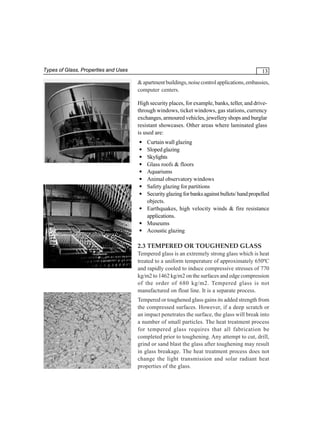
•
•
•
•
•
•

Curtain wall glazing
Sloped glazing
Skylights
Glass roofs & floors
Aquariums
Animal observatory windows
Safety glazing for partitions
Security glazing for banks against bullets/ hand propelled
objects.
• Earthquakes, high velocity winds & fire resistance
applications.
• Museums
• Acoustic glazing

2.3 TEMPERED OR TOUGHENED GLASS
Tempered glass is an extremely strong glass which is heat
treated to a uniform temperature of approximately 650ºC
and rapidly cooled to induce compressive stresses of 770
kg/m2 to 1462 kg/m2 on the surfaces and edge compression
of the order of 680 kg/m2. Tempered glass is not
manufactured on float line. It is a separate process.
Tempered or toughened glass gains its added strength from
the compressed surfaces. However, if a deep scratch or
an impact penetrates the surface, the glass will break into
a number of small particles. The heat treatment process
for tempered glass requires that all fabrication be
completed prior to toughening. Any attempt to cut, drill,
grind or sand blast the glass after toughening may result
in glass breakage. The heat treatment process does not
change the light transmission and solar radiant heat
properties of the glass.
Use of Glass in Buildings

14

2.3.1 Properties
• Tempered Glass is four to five times stronger than
normal glass of equivalent thickness. It is mainly used
for safety & strength.
• Tempered Glass provides greater thermal strength. It
offers increased resistance to both sudden temperature
changes and temperature differentials up to 250°C
compared with normal glass, which can withstand
temperature differentials up to 40°C only.
• Tempered Glass is difficult to break and when on
breakage it will break into small, relatively harmless
fragments. This substantially reduces the likelihood of
injury to people, as there are no jagged edges or sharp
corners like normal glass.
Due to the inherent superior features of tempered glass
like more strength, ability to withstand sudden impacts
and breaking safely into small pieces, it is used as a safety
glazing
• Density (approximate) :

2.42 – 2.52 g/cm3

• Tensile strength

120 to 200 N/sq. mm

:

• Compressive strength :

1000 N /sq. mm

• Modulus of elasticity

:

70 GPa

• Coefficient of linear

:

9 x 10⁻⁶ m / mK

:

3 mm - 19 mm

:

2440 mm x 3660mm

expansion

• Available thickness
• Normally available
sizes up to

(Bigger sizes can also
be made)

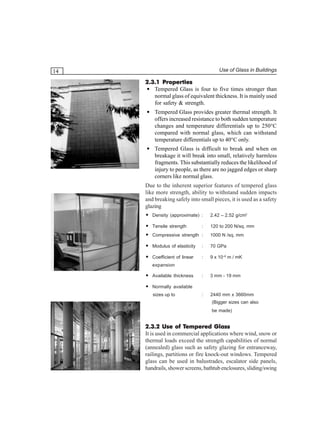
Tempered
2.3.2 Use of Tempered Glass
It is used in commercial applications where wind, snow or
thermal loads exceed the strength capabilities of normal
(annealed) glass such as safety glazing for entranceway,
railings, partitions or fire knock-out windows. Tempered
glass can be used in balustrades, escalator side panels,
handrails, shower screens, bathtub enclosures, sliding/swing
Types of Glass, Properties and Uses

15
doors, squash, racquetball wall, showcases, partitions etc.
Other areas where tempered glass should be used are:
• Mainly used for safety and strength
• Curtain walls of high-rise buildings
• Exterior and interior of buildings where strength is
important
• Spandrels for walls and decorative panelling
• Door openings, showroom and lobby facades, escalator
side plates, and staircase handrails
• Viewing partitions of sports complexes, resorts and airports.

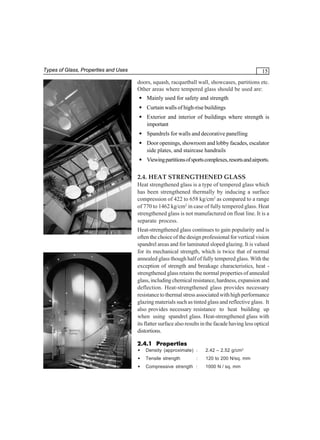
2.4. HEAT STRENGTHENED GLASS
Heat strengthened glass is a type of tempered glass which
has been strengthened thermally by inducing a surface
compression of 422 to 658 kg/cm2 as compared to a range
of 770 to 1462 kg/cm2 in case of fully tempered glass. Heat
strengthened glass is not manufactured on float line. It is a
separate process.
Heat-strengthened glass continues to gain popularity and is
often the choice of the design professional for vertical vision
spandrel areas and for laminated sloped glazing. It is valued
for its mechanical strength, which is twice that of normal
annealed glass though half of fully tempered glass. With the
exception of strength and breakage characteristics, heat strengthened glass retains the normal properties of annealed
glass, including chemical resistance, hardness, expansion and
deflection. Heat-strengthened glass provides necessary
resistance to thermal stress associated with high performance
glazing materials such as tinted glass and reflective glass. It
also provides necessary resistance to heat building up
when using spandrel glass. Heat-strengthened glass with
its flatter surface also results in the facade having less optical
distortions.
2.4.1 Properties
•

Density (approximate) :

2.42 – 2.52 g/cm3

•

Tensile strength

120 to 200 N/sq. mm

•

Compressive strength :

:

1000 N / sq. mm
Use of Glass in Buildings

16
•

Modulus of elasticity

:

70 GPa

•

Coefficient of linear
expansion

:

9 x 10⁻⁶ m / mK

•

Available thickness

:

3 mm - 19 mm

•

Normally available
sizes up to

:

2440 mm x 3660mm
(Bigger sizes can also
be made)

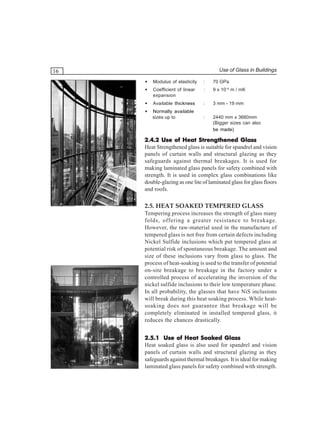
2.4.2 Use of Heat Strengthened Glass
Heat Strengthened glass is suitable for spandrel and vision
panels of curtain walls and structural glazing as they
safeguards against thermal breakages. It is used for
making laminated glass panels for safety combined with
strength. It is used in complex glass combinations like
double-glazing as one lite of laminated glass for glass floors
and roofs.

2.5. HEAT SOAKED TEMPERED GLASS
Tempering process increases the strength of glass many
folds, offering a greater resistance to breakage.
However, the raw-material used in the manufacture of
tempered glass is not free from certain defects including
Nickel Sulfide inclusions which put tempered glass at
potential risk of spontaneous breakage. The amount and
size of these inclusions vary from glass to glass. The
process of heat-soaking is used to the transfer of potential
on-site breakage to breakage in the factory under a
controlled process of accelerating the inversion of the
nickel sulfide inclusions to their low temperature phase.
In all probability, the glasses that have NiS inclusions
will break during this heat soaking process. While heatsoaking does not guarantee that breakage will be
completely eliminated in installed tempered glass, it
reduces the chances drastically.
Soaked
2.5.1 Use of Heat Soaked Glass
Heat soaked glass is also used for spandrel and vision
panels of curtain walls and structural glazing as they
safeguards against thermal breakages. It is ideal for making
laminated glass panels for safety combined with strength.
Types of Glass, Properties and Uses

17
It is also used in complex glass combinations like doubleglazing as one lite of laminated glass for poolsides, pool
bottoms & aquariums etc. It s an essential requirement to
use heat soaked glass for all bolted systems.

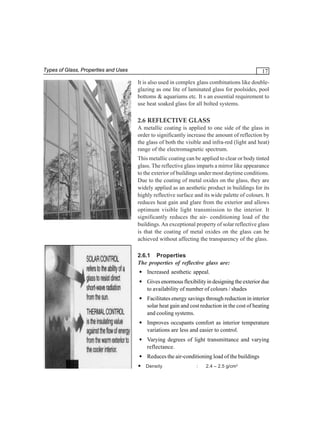
2.6 REFLECTIVE GLASS
A metallic coating is applied to one side of the glass in
order to significantly increase the amount of reflection by
the glass of both the visible and infra-red (light and heat)
range of the electromagnetic spectrum.
This metallic coating can be applied to clear or body tinted
glass. The reflective glass imparts a mirror like appearance
to the exterior of buildings under most daytime conditions.
Due to the coating of metal oxides on the glass, they are
widely applied as an aesthetic product in buildings for its
highly reflective surface and its wide palette of colours. It
reduces heat gain and glare from the exterior and allows
optimum visible light transmission to the interior. It
significantly reduces the air- conditioning load of the
buildings. An exceptional property of solar reflective glass
is that the coating of metal oxides on the glass can be
achieved without affecting the transparency of the glass.
2.6.1 Properties
The properties of reflective glass are:
• Increased aesthetic appeal.
• Gives enormous flexibility in designing the exterior due
to availability of number of colours / shades
• Facilitates energy savings through reduction in interior
solar heat gain and cost reduction in the cost of heating
and cooling systems.
• Improves occupants comfort as interior temperature
variations are less and easier to control.
• Varying degrees of light transmittance and varying
reflectance.
• Reduces the air-conditioning load of the buildings
• Density

:

2.4 – 2.5 g/cm3
Use of Glass in Buildings

18
• Available thickness

:

3 mm - 12 mm

• Normally available

:

2250 x3210 mm
(Bigger size can also be
made)

sizes up to

2.6.2 Use of Reflective Glass
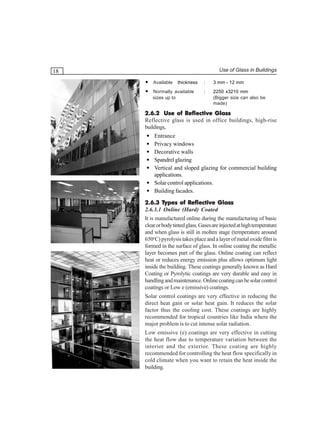
Reflective glass is used in office buildings, high-rise
buildings,
•
•
•
•
•

Entrance
Privacy windows
Decorative walls
Spandrel glazing
Vertical and sloped glazing for commercial building
applications.
• Solar control applications.
• Building facades.
Types
Reflective
2.6.3 Types of Reflective Glass
2.6.3.1 Online (Hard) Coated
It is manufactured online during the manufacturing of basic
clear or body tinted glass. Gases are injected at high temperature
and when glass is still in molten stage (temperature around
650oC) pyrolysis takes place and a layer of metal oxide film is
formed in the surface of glass. In online coating the metallic
layer becomes part of the glass. Online coating can reflect
heat or reduces energy emission plus allows optimum light
inside the building. These coatings generally known as Hard
Coating or Pyrolytic coatings are very durable and easy in
handling and maintenance. Online coating can be solar control
coatings or Low e (emissive) coatings.
Solar control coatings are very effective in reducing the
direct heat gain or solar heat gain. It reduces the solar
factor thus the cooling cost. These coatings are highly
recommended for tropical countries like India where the
major problem is to cut intense solar radiation.
Low emissive (e) coatings are very effective in cutting
the heat flow due to temperature variation between the
interior and the exterior. These coating are highly
recommended for controlling the heat flow specifically in
cold climate when you want to retain the heat inside the
building.
Types of Glass, Properties and Uses

19
Applications: Suitable for further processing to tempered,
laminated & insulating glass and also for windows.
2.6.3.2 Offline (Soft) Coating
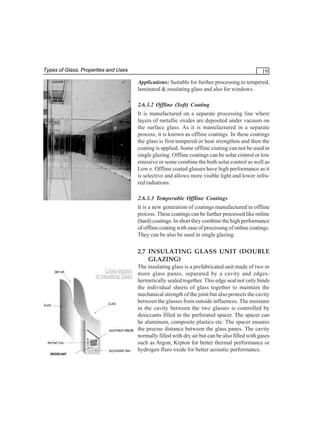
It is manufactured on a separate processing line where
layers of metallic oxides are deposited under vacuum on
the surface glass. As it is manufactured in a separate
process, it is known as offline coatings. In these coatings
the glass is first tempered or heat strengthen and then the
coating is applied. Some offline coating can not be used in
single glazing. Offline coatings can be solar control or low
emissive or some combine the both solar control as well as
Low e. Offline coated glasses have high performance as it
is selective and allows more visible light and lower infrared radiations.
2.6.3.3 Temperable Offline Coatings
It is a new generation of coatings manufactured in offline
process. These coatings can be further processed like online
(hard) coatings. In short they combine the high performance
of offline coating with ease of processing of online coatings.
They can be also be used in single glazing.

2.7 INSULATING GLASS UNIT (DOUBLE
GLAZING)
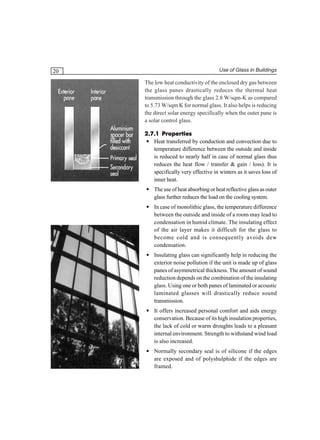
The insulating glass is a prefabricated unit made of two or
more glass panes, separated by a cavity and edgeshermetically sealed together. This edge seal not only binds
the individual sheets of glass together to maintain the
mechanical strength of the joint but also protects the cavity
between the glasses from outside influences. The moisture
in the cavity between the two glasses is controlled by
desiccants filled in the perforated spacer. The spacer can
be aluminum, composite plastics etc. The spacer ensures
the precise distance between the glass panes. The cavity
normally filled with dry air but can be also filled with gases
such as Argon, Krpton for better thermal performance or
hydrogen fluro oxide for better acoustic performance.
DESSICANT
20

Use of Glass in Buildings

The low heat conductivity of the enclosed dry gas between
the glass panes drastically reduces the thermal heat
transmission through the glass 2.8 W/sqm-K as compared
to 5.73 W/sqm K for normal glass. It also helps is reducing
the direct solar energy specifically when the outer pane is
a solar control glass.
2.7.1 Properties
• Heat transferred by conduction and convection due to
temperature difference between the outside and inside
is reduced to nearly half in case of normal glass thus
reduces the heat flow / transfer & gain / loss). It is
specifically very effective in winters as it saves loss of
inner heat.
• The use of heat absorbing or heat reflective glass as outer
glass further reduces the load on the cooling system.
• In case of monolithic glass, the temperature difference
between the outside and inside of a room may lead to
condensation in humid climate. The insulating effect
of the air layer makes it difficult for the glass to
become cold and is consequently avoids dew
condensation.
• Insulating glass can significantly help in reducing the
exterior noise pollution if the unit is made up of glass
panes of asymmetrical thickness. The amount of sound
reduction depends on the combination of the insulating
glass. Using one or both panes of laminated or acoustic
laminated glasses will drastically reduce sound
transmission.
• It offers increased personal comfort and aids energy
conservation. Because of its high insulation properties,
the lack of cold or warm droughts leads to a pleasant
internal environment. Strength to withstand wind load
is also increased.
• Normally secondary seal is of silicone if the edges
are exposed and of polyshulphide if the edges are
framed.
Types of Glass, Properties and Uses

21
•
•

Available thickness :

Custom made

Normally available
sizes up to

Custom made

:

2.7.2 Use of Insulating Glass
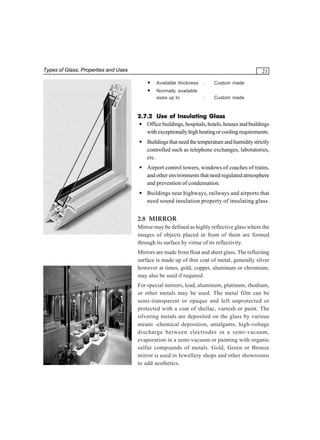
• Office buildings, hospitals, hotels, houses and buildings
with exceptionally high heating or cooling requirements.
• Buildings that need the temperature and humidity strictly
controlled such as telephone exchanges, laboratories,
etc.
• Airport control towers, windows of coaches of trains,
and other environments that need regulated atmosphere
and prevention of condensation.
• Buildings near highways, railways and airports that
need sound insulation property of insulating glass.

2.8 MIRROR
Mirror may be defined as highly reflective glass where the
images of objects placed in front of them are formed
through its surface by virtue of its reflectivity.
Mirrors are made from float and sheet glass. The reflecting
surface is made up of thin coat of metal, generally silver
however at times, gold, copper, aluminum or chromium,
may also be used if required.
For special mirrors, lead, aluminum, platinum, rhodium,
or other metals may be used. The metal film can be
semi-transparent or opaque and left unprotected or
protected with a coat of shellac, varnish or paint. The
silvering metals are deposited on the glass by various
means -chemical deposition, amalgams, high-voltage
discharge between electrodes in a semi-vacuum,
evaporation in a semi-vacuum or painting with organic
sulfur compounds of metals. Gold, Green or Bronze
mirror is used in Jewellery shops and other showrooms
to add aesthetics.
Use of Glass in Buildings

22

2.8.1 Properties
The properties of mirror are:
•
•
•

Mirrors have very high
reflectivity
Available thickness up to
Normally available
sizes up to

:
:

2 mm - 8 mm
2140 mm x 3050 mm

2.8.2 Use of Mirror
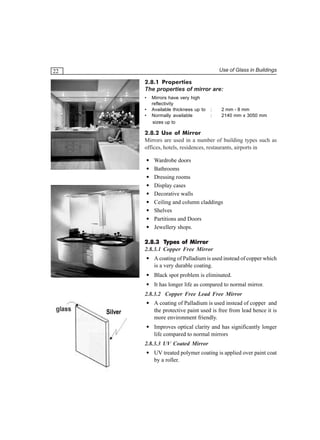
Mirrors are used in a number of building types such as
offices, hotels, residences, restaurants, airports in
•
•
•
•
•
•
•
•
•

Wardrobe doors
Bathrooms
Dressing rooms
Display cases
Decorative walls
Ceiling and column claddings
Shelves
Partitions and Doors
Jewellery shops.

2.8.3 Types of Mirror
2.8.3.1 Copper Free Mirror
• A coating of Palladium is used instead of copper which
is a very durable coating.
• Black spot problem is eliminated.
• It has longer life as compared to normal mirror.
2.8.3.2 Copper Free Lead Free Mirror

Silver

• A coating of Palladium is used instead of copper and
the protective paint used is free from lead hence it is
more environment friendly.
• Improves optical clarity and has significantly longer
life compared to normal mirrors
2.8.3.3 UV Coated Mirror
• UV treated polymer coating is applied over paint coat
by a roller.
This page
intentionally left
blank
3
Selection of
Specific
Glass
Use of Glass in Buildings

26

3.0 SELECION OF SPECIFIC GLASS
3.1 GENERAL
In the previous section, a general selection of the types of
glass has been discussed. The present section discusses
the selection of specific types of glass for particular
applications. Considering the ever-increasing options of
variety of glass products, it is essential to consider the
factors that influence the choice of a particular type of
glass to get the desired results. Selection of glass for use in
buildings on scientific lines depends upon the following
parameters:
• Heat Gain (solar incidence)
• Sound insulation
• Safety & Security:
o Thermal Breakage
o Human Impact
o Security (burglar proof, Bullet Proof, Explosion
Proof etc.)
o Fire Resistance
• Strength
• Aesthetics

3.2 HEAT GAIN
Different types of glass treat the incident solar energy in
different ways. It involves:
• Heat transfer mechanism
• Solar energy spectrum
• Factors determining the performance of glass
• Total heat gain
• Selectivity in tropical countries
Transfer
3.2.1 Heat Transfer Mechanism
Heat transfer happens in three ways - conduction,
convection and radiation:
Selection of Specific Glass

27
Conduction: Flow of heat from hotter part to cooler part
in a solid.
Convection: Heat transfer due to movement of liquid or
gas. It does not happen in vacuum.
Radiation: Heat transfer due to heat emitted by hot bodies.
Heat emitted by sun is know as solar radiation and by bodies
on earth are know as thermal radiation. There is no medium
required for heat transfer by radiation.
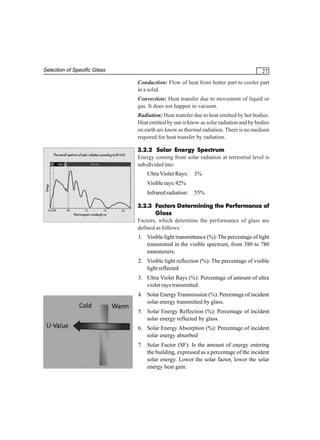
3.2.2 Solar Energy Spectrum
Energy coming from solar radiation at terrestrial level is
sub-divided into:
Ultra Violet Rays:

3%

Visible rays:42%
Infrared radiation:

55%

3.2.3 Factors Determining the Performance of
Glass
Factors, which determine the performance of glass are
defined as follows:
1. Visible light transmittance (%): The percentage of light
transmitted in the visible spectrum, from 380 to 780
nanometers.
2. Visible light reflection (%): The percentage of visible
light reflected
3. Ultra Violet Rays (%): Percentage of amount of ultra
violet rays transmitted.
4. Solar Energy Transmission (%): Percentage of incident
solar energy transmitted by glass.
5. Solar Energy Reflection (%): Percentage of incident
solar energy reflected by glass.
6. Solar Energy Absorption (%): Percentage of incident
solar energy absorbed
7. Solar Factor (SF): Is the amount of energy entering
the building, expressed as a percentage of the incident
solar energy. Lower the solar factor, lower the solar
energy heat gain.
28

Use of Glass in Buildings

8. Shading Coefficient (SC): Ratio of solar factor of glass
to solar factor of 3mm clear glass (0.87)
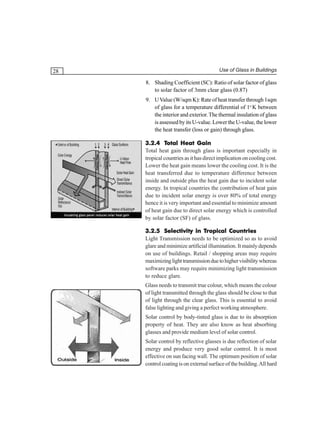
9. U Value (W/sqm K): Rate of heat transfer through 1sqm
of glass for a temperature differential of 1o K between
the interior and exterior. The thermal insulation of glass
is assessed by its U-value. Lower the U-value, the lower
the heat transfer (loss or gain) through glass.
3.2.4 Total Heat Gain
Total heat gain through glass is important especially in
tropical countries as it has direct implication on cooling cost.
Lower the heat gain means lower the cooling cost. It is the
heat transferred due to temperature difference between
inside and outside plus the heat gain due to incident solar
energy. In tropical countries the contribution of heat gain
due to incident solar energy is over 80% of total energy
hence it is very important and essential to minimize amount
of heat gain due to direct solar energy which is controlled
by solar factor (SF) of glass.
Tropical
3.2.5 Selectivity in Tropical Countries
Light Transmission needs to be optimized so as to avoid
glare and minimize artificial illumination. It mainly depends
on use of buildings. Retail / shopping areas may require
maximizing light transmission due to higher visibility whereas
software parks may require minimizing light transmission
to reduce glare.
Glass needs to transmit true colour, which means the colour
of light transmitted through the glass should be close to that
of light through the clear glass. This is essential to avoid
false lighting and giving a perfect working atmosphere.
Solar control by body-tinted glass is due to its absorption
property of heat. They are also know as heat absorbing
glasses and provide medium level of solar control.
Solar control by reflective glasses is due reflection of solar
energy and produce very good solar control. It is most
effective on sun facing wall. The optimum position of solar
control coating is on external surface of the building. All hard
Selection of Specific Glass

29
coatings are durable for this application. Soft and medium
solar coating cannot be positioned on external surfaces.
Body tinted glasses with reflective coatings achieve solar
control by absorbing as well as reflecting solar heat energy.
They combine both the functions. Reflective glass is best
for reducing peak air-conditioning load requirements.
Double glazed or insulating glass unit helps in further
reducing the operating costs. Saving in capital and operating
costs of AC is best achieved by using a double glazing with
solar control coated glass on the outside with clear or low
e glass on the inside.
Any solar control product, however selective in its
absorption or reflection of solar radiation, will reduce
the light transmission. Though ultraviolet constitutes
only 3% of the solar spectrum, it is the major cause
of fading curtains, carpets and upholstery inside a
building. Laminated glass cuts down almost 99% of
all ultraviolet radiation and drastically reduces fading.
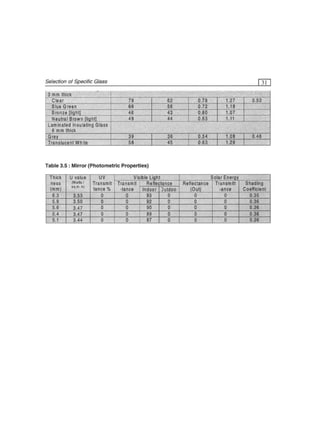
Indicative values of the factors determining the
performance of glass (photometric properties) with respect
to the glass type covered in the study are annexed in table
3.1 to 3.9.

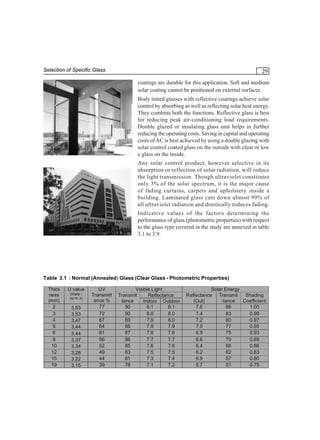
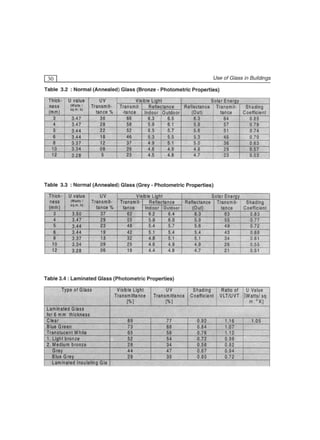
Table 3.1 : Normal (Annealed) Glass (Clear Glass - Photometric Properties)
Thick
ness
(mm)
2
3
4
5
6
8
10
12
15
19

U value
(Watts /
sq.m. k)

3.53
3.53
3.47
3.44
3.44
3.37
3.34
3.28
3.22
3.15

UV
Transmitt
ance %
77
72
67
64
61
56
52
49
44
39

Visible Light
Transmit
Reflectance
tance
Indoor Outdoor
90
8.1
8.1
90
8.0
8.0
89
7.9
8.0
88
7.9
7.9
87
7.8
7.8
86
7.7
7.7
85
7.6
7.6
83
7.5
7.5
81
7.3
7.4
78
7.1
7.2

Solar Energy
Reflectance Transmit
Shading
(Out)
-tance
Coefficient
7.6
86
1.00
7.4
83
0.99
7.2
80
0.97
7.0
77
0.95
6.9
75
0.93
6.6
70
0.89
6.4
66
0.86
6.2
62
0.83
6.9
57
0.80
5.7
51
0.75
Use of Glass in Buildings

32

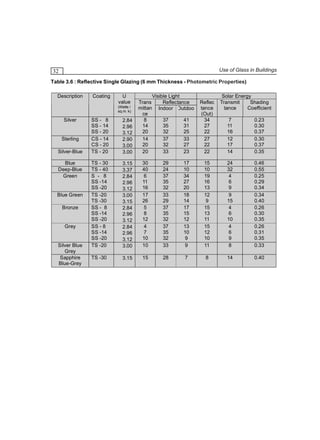
Table 3.6 : Reflective Single Glazing (6 mm Thickness - Photometric Properties)
Description

Coating

U
value

SS - 8
SS - 14
SS - 20
CS - 14
CS - 20
TS - 20

2.84
2.96
3.12
2.90
3.00
3.00

TS - 30
TS - 40
S - 8
SS -14
SS -20
TS -20
TS -30
SS - 8
SS -14
SS -20
SS - 8
SS -14
SS -20
TS -20

3.15
3.37
2.84
2.96
3.12
3.00
3.15
2.84
2.96
3.12
2.84
2.96
3.12
3.00

30
40
6
11
16
17
26
5
8
12
4
7
10
10

29
24
37
35
32
33
29
37
35
32
37
35
32
33

17
10
34
27
20
18
14
17
15
12
13
10
9
9

TS -30

3.15

15

28

7

(Watts /
sq.m. k)

Silver

Sterling
Silver-Blue
Blue
Deep-Blue
Green

Blue Green
Bronze

Grey

Silver Blue
Grey
Sapphire
Blue-Grey

Visible Light
Reflectance
Reflec
Indoor Outdoor tance
(Out)
37
41
34
35
31
27
32
25
22
37
33
27
32
27
22
33
23
22

Trans
mittan
ce
8
14
20
14
20
20

Solar Energy
Transmit
Shading
tance
Coefficient
7
11
16
12
17
14

0.23
0.30
0.37
0.30
0.37
0.35

15
10
19
16
13
12
9
15
13
11
15
12
10
11

24
32
4
6
9
9
15
4
6
10
4
6
9
8

0.46
0.55
0.25
0.29
0.34
0.34
0.40
0.26
0.30
0.35
0.26
0.31
0.35
0.33

8

14

0.40
Selection of Specific Glass

33

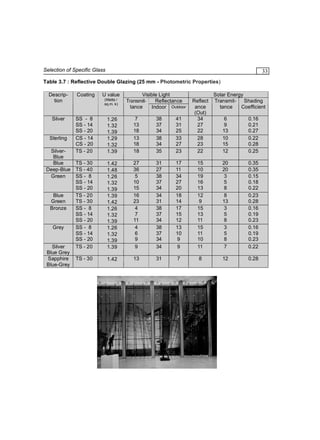
Table 3.7 : Reflective Double Glazing (25 mm - Photometric Properties)
Description

Coating

Silver

SS - 8
SS - 14
SS - 20
CS - 14
CS - 20
TS - 20

1.26
1.32
1.39
1.29
1.32
1.39

7
13
18
13
18
18

38
37
34
38
34
35

41
31
25
33
27
23

Reflect
ance
(Out)
34
27
22
28
23
22

TS - 30
TS - 40
SS - 8
SS - 14
SS - 20
TS - 20
TS - 30
SS - 8
SS - 14
SS - 20
SS - 8
SS - 14
SS - 20
TS - 20

1.42
1.48
1.26
1.32
1.39
1.39
1.42
1.26
1.32
1.39
1.26
1.32
1.39
1.39

27
36
5
10
15
16
23
4
7
11
4
6
9
9

31
27
38
37
34
34
31
38
37
34
38
37
34
34

17
11
34
27
20
18
14
17
15
12
13
10
9
9

TS - 30

1.42

13

31

7

Sterling
SilverBlue
Blue
Deep-Blue
Green

Blue
Green
Bronze

Grey

Silver
Blue Grey
Sapphire
Blue-Grey

U value
(Watts /
sq.m. k)

Visible Light
Reflectance
tance
Indoor Outdoor

Solar Energy
Transmit- Shading
tance
Coefficient
6
9
13
10
15
12

0.16
0.21
0.27
0.22
0.28
0.25

15
10
19
16
13
12
9
15
13
11
15
11
10
11

20
20
3
5
8
8
13
3
5
8
3
5
8
7

0.35
0.35
0.15
0.18
0.22
0.23
0.28
0.16
0.19
0.23
0.16
0.19
0.23
0.22

8

12

0.28
Use of Glass in Buildings

34

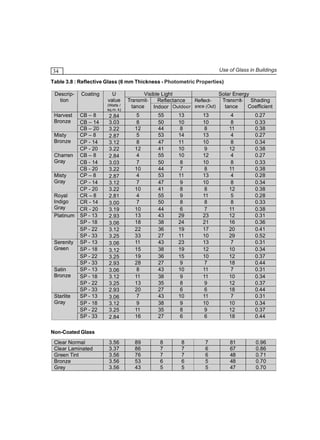
Table 3.8 : Reflective Glass (6 mm Thickness - Photometric Properties)

Description

Coating

U
value
(Watts /
sq.m. k)

Harvest
Bronze
Misty
Bronze
Charren
Gray
Misty
Gray
Royal
Indigo
Gray
Platinum

Serenity
Green

Satin
Bronze

Starlite
Gray

CB – 8
CB – 14
CB – 20
CP – 8
CP - 14
CP - 20
CB – 8
CB - 14
CB - 20
CP – 8
CP - 14
CP - 20
CR – 8
CR - 14
CR - 20
SP - 13
SP - 18
SP - 22
SP - 33
SP - 13
SP - 18
SP - 22
SP - 33
SP - 13
SP - 18
SP - 22
SP - 33
SP - 13
SP - 18
SP - 22
SP - 33

Visible Light
Reflectance
tance
Indoor

Solar Energy
tance

Shading
Coefficient

Reflect-

2.84
3.03
3.22
2.87
3.12
3.22
2.84
3.03
3.22
2.87
3.12
3.22
2.81
3.00
3.19
2.93
3.06
3.12
3.25
3.06
3.12
3.25
2.93
3.06
3.12
3.25
2.93
3.06
3.12
3.25
2.84

5
8
12
5
8
12
4
7
10
4
7
10
4
7
10
13
18
22
33
11
15
19
28
8
11
13
20
7
9
11
16

55
50
44
53
47
41
55
50
44
53
47
41
55
50
44
43
38
36
27
43
38
36
27
43
38
35
27
43
38
35
27

13
10
8
14
11
10
10
8
7
11
9
8
9
8
6
29
24
19
11
23
19
15
9
10
9
8
6
10
9
8
6

13
10
8
13
10
9
12
10
8
13
10
8
11
8
7
23
21
17
10
13
12
10
7
11
11
9
6
11
10
9
6

4
8
11
4
8
12
4
8
11
4
8
12
5
8
11
12
16
20
29
7
10
12
18
7
10
12
18
7
10
12
18

0.27
0.33
0.38
0.27
0.34
0.38
0.27
0.33
0.38
0.28
0.34
0.38
0.28
0.33
0.38
0.31
0.36
0.41
0.52
0.31
0.34
0.37
0.44
0.31
0.34
0.37
0.44
0.31
0.34
0.37
0.44

3.56
3.37
3.56
3.56
3.56

89
86
76
53
43

8
7
7
6
5

8
7
7
6
5

7
6
6
5
5

81
67
48
48
47

0.96
0.86
0.71
0.70
0.70

Non-Coated Glass

Clear Normal
Clear Laminated
Green Tint
Bronze
Grey
Selection of Specific Glass

35

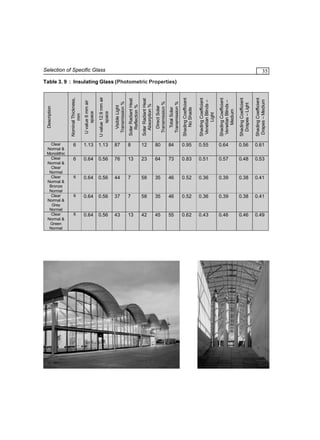
U value 6 mm air
space

U value 12.9 mm air
space

Visible Light
Transmission %

Solar Radiant Heat
Reflection %

Solar Radiant Heat
Absorption %

Direct Solar
Transmission %

Total Solar
Transmission %

Shading Coefficient
No Shade

Shading Coefficient
Venetian Blinds –
Light

Shading Coefficient
Venetian Blinds –
Medium

Shading Coefficient
Drapes – Light

Shading Coefficient
Drapes – Medium

Clear
Normal &
Monolithic
Clear
Normal &
Clear
Normal
Clear
Normal &
Bronze
Normal
Clear
Normal &
Grey
Normal
Clear
Normal &
Green
Normal

6

1.13

1.13

87

8

12

80

84

0.95

0.55

0.64

0.56

0.61

6

0.64

0.56

76

13

23

64

73

0.83

0.51

0.57

0.48

0.53

6

0.64

0.56

44

7

58

35

46

0.52

0.36

0.39

0.38

0.41

6

0.64

0.56

37

7

58

35

46

0.52

0.36

0.39

0.38

0.41

6

0.64

0.56

43

13

42

45

55

0.62

0.43

0.46

0.46

0.49

Nominal Thickness,
mm

Description

Table 3. 9 : Insulating Glass (Photometric Properties)
Use of Glass in Buildings

36

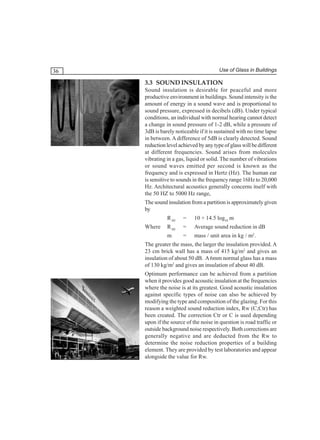
3.3 SOUND INSULATION
Sound insulation is desirable for peaceful and more
productive environment in buildings. Sound intensity is the
amount of energy in a sound wave and is proportional to
sound pressure, expressed in decibels (dB). Under typical
conditions, an individual with normal hearing cannot detect
a change in sound pressure of 1-2 dB, while a pressure of
3dB is barely noticeable if it is sustained with no time lapse
in between. A difference of 5dB is clearly detected. Sound
reduction level achieved by any type of glass will be different
at different frequencies. Sound arises from molecules
vibrating in a gas, liquid or solid. The number of vibrations
or sound waves emitted per second is known as the
frequency and is expressed in Hertz (Hz). The human ear
is sensitive to sounds in the frequency range 16Hz to 20,000
Hz. Architectural acoustics generally concerns itself with
the 50 HZ to 5000 Hz range,
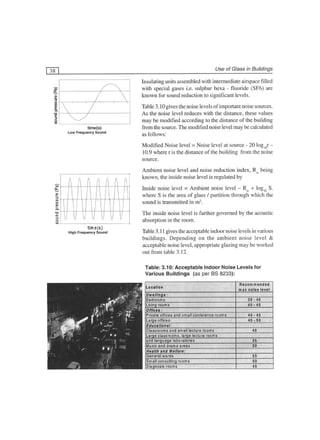
The sound insulation from a partition is approximately given
by
R AV

10 + 14.5 log10 m

R AV

=

Average sound reduction in dB

m

Where

=
=

mass / unit area in kg / m2.

The greater the mass, the larger the insulation provided. A
23 cm brick wall has a mass of 415 kg/m2 and gives an
insulation of about 50 dB. A 6mm normal glass has a mass
of 130 kg/m2 and gives an insulation of about 40 dB.
Optimum performance can be achieved from a partition
when it provides good acoustic insulation at the frequencies
where the noise is at its greatest. Good acoustic insulation
against specific types of noise can also be achieved by
modifying the type and composition of the glazing. For this
reason a weighted sound reduction index, Rw (C;Ctr) has
been created. The correction Ctr or C is used depending
upon if the source of the noise in question is road traffic or
outside background noise respectively. Both corrections are
generally negative and are deducted from the Rw to
determine the noise reduction properties of a building
element. They are provided by test laboratories and appear
alongside the value for Rw.
Selection of Specific Glass

37

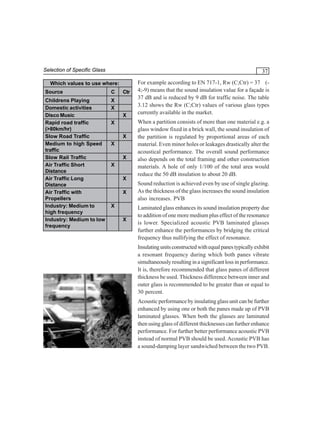
Which values to use where:
Source

C

Childrens Playing
Domestic activities
Disco Music
Rapid road traffic
(>80km/hr)
Slow Road Traffic
Medium to high Speed
traffic
Slow Rail Traffic
Air Traffic Short
Distance
Air Traffic Long
Distance
Air Traffic with
Propellers
Industry: Medium to
high frequency
Industry: Medium to low
frequency

Ctr

X
X
X
X
X
X
X
X
X
X
X
X

For example according to EN 717-1, Rw (C;Ctr) = 37 (4;-9) means that the sound insulation value for a façade is
37 dB and is reduced by 9 dB for traffic noise. The table
3.12 shows the Rw (C;Ctr) values of various glass types
currently available in the market.
When a partition consists of more than one material e.g. a
glass window fixed in a brick wall, the sound insulation of
the partition is regulated by proportional areas of each
material. Even minor holes or leakages drastically alter the
acoustical performance. The overall sound performance
also depends on the total framing and other construction
materials. A hole of only 1/100 of the total area would
reduce the 50 dB insulation to about 20 dB.
Sound reduction is achieved even by use of single glazing.
As the thickness of the glass increases the sound insulation
also increases. PVB
Laminated glass enhances its sound insulation property due
to addition of one more medium plus effect of the resonance
is lower. Specialized acoustic PVB laminated glasses
further enhance the performances by bridging the critical
frequency thus nullifying the effect of resonance.
Insulating units constructed with equal panes typically exhibit
a resonant frequency during which both panes vibrate
simultaneously resulting in a significant loss in performance.
It is, therefore recommended that glass panes of different
thickness be used. Thickness difference between inner and
outer glass is recommended to be greater than or equal to
30 percent.
Acoustic performance by insulating glass unit can be further
enhanced by using one or both the panes made up of PVB
laminated glasses. When both the glasses are laminated
then using glass of different thicknesses can further enhance
performance. For further better performance acoustic PVB
instead of normal PVB should be used. Acoustic PVB has
a sound-damping layer sandwiched between the two PVB.
Selection of Specific Glass

39

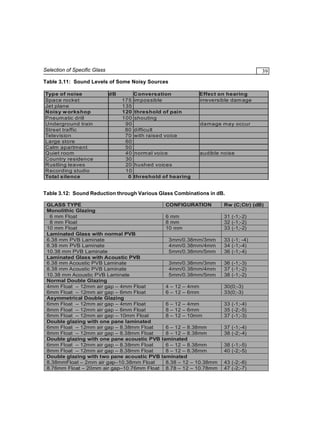
Table 3.11: Sound Levels of Some Noisy Sources
Type of noise
Space rocket
Jet plane
Noisy w orkshop
Pneumatic drill
Underground train
Street traffic
Television
Large store
Calm apartm ent
Q uiet room
Country residence
Rustling leaves
Recording studio
Total silence

dB
175
135
120
100
90
80
70
60
50
40
30
20
10
0

Conversation
im possible

Effect on hearing
irreversible dam age

threshold of pain
shouting
damage m ay occur
difficu lt
with raised voice

norm al voice

audible noise

hushed voices
threshold of hearing

Table 3.12: Sound Reduction through Various Glass Combinations in dB.
GLASS TYPE
CONFIGURATION
Monolithic Glazing
6 mm Float
6 mm
8 mm Float
8 mm
10 mm Float
10 mm
Laminated Glass with normal PVB
6.38 mm PVB Laminate
3mm/0.38mm/3mm
8.38 mm PVB Laminate
4mm/0.38mm/4mm
10.38 mm PVB Laminate
5mm/0.38mm/5mm
Laminated Glass with Acoustic PVB
6.38 mm Acoustic PVB Laminate
3mm/0.38mm/3mm
8.38 mm Acoustic PVB Laminate
4mm/0.38mm/4mm
10.38 mm Acoustic PVB Laminate
5mm/0.38mm/5mm
Normal Double Glazing
4mm Float – 12mm air gap – 4mm Float
4 – 12 – 4mm
6mm Float – 12mm air gap – 6mm Float
6 – 12 – 6mm
Asymmetrical Double Glazing
6mm Float – 12mm air gap – 4mm Float
6 – 12 – 4mm
8mm Float – 12mm air gap – 6mm Float
8 – 12 – 6mm
8mm Float – 12mm air gap – 10mm Float
8 – 12 – 10mm
Double glazing with one pane laminated
6mm Float – 12mm air gap – 8.38mm Float
6 – 12 – 8.38mm
8mm Float – 12mm air gap – 8.38mm Float
8 – 12 – 8.38mm
Double glazing with one pane acoustic PVB laminated
6mm Float – 12mm air gap – 8.38mm Float
6 – 12 – 8.38mm
8mm Float – 12mm air gap – 8.38mm Float
8 – 12 – 8.38mm
Double glazing with two pane acoustic PVB laminated
8.38mmFloat – 2mm air gap–10.38mm Float
8.38 – 12 – 10.38mm
8.76mm Float – 20mm air gap–10.76mm Float 8.78 – 12 – 10.78mm

Rw (C;Ctr) (dB)
31 (-1;-2)
32 (-1;-2)
33 (-1;-2)
33 (-1; -4)
34 (-1;-4)
36 (-1;-4)
36 (-1;-3)
37 (-1;-2)
38 (-1;-2)
30(0;-3)
33(0;-3)
33 (-1;-4)
35 (-2;-5)
37 (-1;-3)
37 (-1;-4)
38 (-2;-4)
38 (-1;-5)
40 (-2;-5)
43 (-2;-6)
47 (-2;-7)
Selection of Specific Glass

41
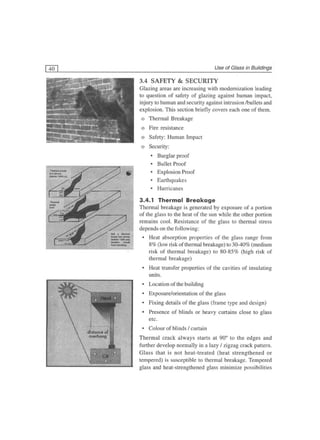
of thermal breakages while laminated and double-glazed
glass without tempering or heat strengthening have the
chances of thermal breakages. Therefore, if the risk of
thermal breakage is high, heat strengthened glass should
be used. Thermal cracks in glasses used in annealed
condition can be minimized by having clean cuts, grinding
the edges, non-chipped off edges and minimizing rebate in
the frames plus ensuring gaskets in place.
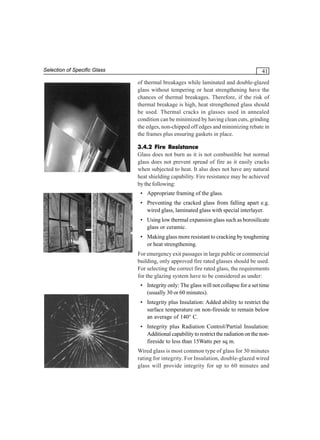
3.4.2 Fire Resistance
Glass does not burn as it is not combustible but normal
glass does not prevent spread of fire as it easily cracks
when subjected to heat. It also does not have any natural
heat shielding capability. Fire resistance may be achieved
by the following:
• Appropriate framing of the glass.
• Preventing the cracked glass from falling apart e.g.
wired glass, laminated glass with special interlayer.
• Using low thermal expansion glass such as borosilicate
glass or ceramic.
• Making glass more resistant to cracking by toughening
or heat strengthening.
For emergency exit passages in large public or commercial
building, only approved fire rated glasses should be used.
For selecting the correct fire rated glass, the requirements
for the glazing system have to be considered as under:
• Integrity only: The glass will not collapse for a set time
(usually 30 or 60 minutes).
• Integrity plus Insulation: Added ability to restrict the
surface temperature on non-fireside to remain below
an average of 140° C.
• Integrity plus Radiation Control/Partial Insulation:
Additional capability to restrict the radiation on the nonfireside to less than 15Watts per sq m.
Wired glass is most common type of glass for 30 minutes
rating for integrity. For Insulation, double-glazed wired
glass will provide integrity for up to 60 minutes and
42

Use of Glass in Buildings

Insulation for up to 30 minutes. It is not only glass, but the
total glazing system has to be fire rated. The provision of
National Building Code for fire protection should be followed.
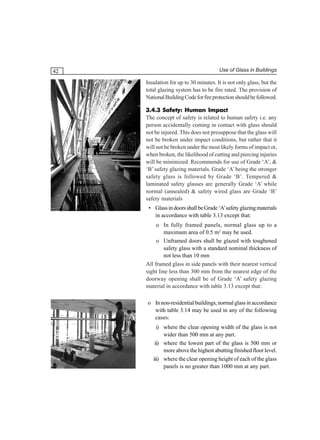
3.4.3 Safety: Human Impact
The concept of safety is related to human safety i.e. any
person accidentally coming in contact with glass should
not be injured. This does not presuppose that the glass will
not be broken under impact conditions, but rather that it
will not be broken under the most likely forms of impact or,
when broken, the likelihood of cutting and piercing injuries
will be minimized. Recommends for use of Grade ‘A’, &
‘B’ safety glazing materials. Grade ‘A’ being the stronger
safety glass is followed by Grade ‘B’. Tempered &
laminated safety glasses are generally Grade ‘A’ while
normal (annealed) & safety wired glass are Grade ‘B’
safety materials
• Glass in doors shall be Grade ‘A’ safety glazing materials
in accordance with table 3.13 except that:
o In fully framed panels, normal glass up to a
maximum area of 0.5 m2 may be used.
o Unframed doors shall be glazed with toughened
safety glass with a standard nominal thickness of
not less than 10 mm
All framed glass in side panels with their nearest vertical
sight line less than 300 mm from the nearest edge of the
doorway opening shall be of Grade ‘A’ safety glazing
material in accordance with table 3.13 except that:
o In non-residential buildings, normal glass in accordance
with table 3.14 may be used in any of the following
cases:
i) where the clear opening width of the glass is not
wider than 500 mm at any part.
ii) where the lowest part of the glass is 500 mm or
more above the highest abutting finished floor level.
iii) where the clear opening height of each of the glass
panels is no greater than 1000 mm at any part.
Selection of Specific Glass

43
iv) where the side panel is provided with a chair rail to
protect each face of the glass and located with its
upper edge not less than 700 mm or its bottom edge
not more than 1000 mm above the highest abutting
finished floor level.
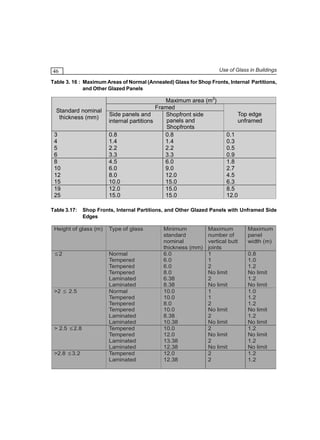
• In non-residential buildings, normal glass in accordance
with table 3.16 may be used provided that the clear
opening width of the glass is greater than 2 m and
eitheri) A stall board not less than 300 mm above the
highest abutting finished floor level is provided or
ii) ordinary normal glass not less than 10 mm standard
nominal thickness is used.
• In residential buildings, where the lowest visible sight
line is 1200 mm or greater above the highest abutting
finished floor level, normal glass in accordance with
table 3.16 may be used.
• Unframed glass in side panels without exposed edges
shall be used with Grade ‘A’ safety glazing material
in accordance Table 3.13 or Table 3.17.
• Louvres in side panels with any edge exposed shall
be glazed with a Grade ‘A’ tempered safety glazing
material in accordance of table 3.13 or 3.17 except
that a standard nominal thickness of not less than 5mm
for louvers shall be used up to 225 mm in blade width.
For blade widths in excess of this, a minimum of 10
mm glass shall be used.
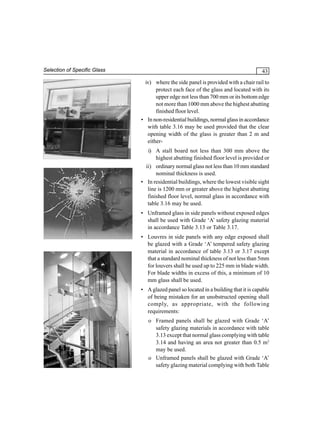
• A glazed panel so located in a building that it is capable
of being mistaken for an unobstructed opening shall
comply, as appropriate, with the following
requirements:
o Framed panels shall be glazed with Grade ‘A’
safety glazing materials in accordance with table
3.13 except that normal glass complying with table
3.14 and having an area not greater than 0.5 m2
may be used.
o Unframed panels shall be glazed with Grade ‘A’
safety glazing material complying with both Table
44

Use of Glass in Buildings

3.13 and Table 3.17 with regard to the size
requirements for the selected Grade ‘A’ safety
glazing material.
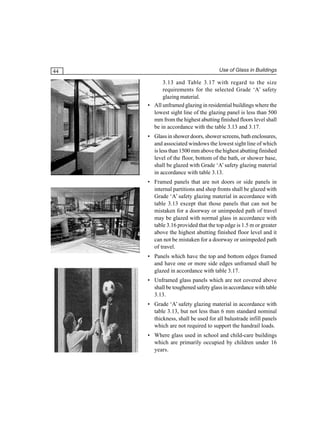
• All unframed glazing in residential buildings where the
lowest sight line of the glazing panel is less than 500
mm from the highest abutting finished floors level shall
be in accordance with the table 3.13 and 3.17.
• Glass in shower doors, shower screens, bath enclosures,
and associated windows the lowest sight line of which
is less than 1500 mm above the highest abutting finished
level of the floor, bottom of the bath, or shower base,
shall be glazed with Grade ‘A’ safety glazing material
in accordance with table 3.13.
• Framed panels that are not doors or side panels in
internal partitions and shop fronts shall be glazed with
Grade ‘A’ safety glazing material in accordance with
table 3.13 except that those panels that can not be
mistaken for a doorway or unimpeded path of travel
may be glazed with normal glass in accordance with
table 3.16 provided that the top edge is 1.5 m or greater
above the highest abutting finished floor level and it
can not be mistaken for a doorway or unimpeded path
of travel.
• Panels which have the top and bottom edges framed
and have one or more side edges unframed shall be
glazed in accordance with table 3.17.
• Unframed glass panels which are not covered above
shall be toughened safety glass in accordance with table
3.13.
• Grade ‘A’ safety glazing material in accordance with
table 3.13, but not less than 6 mm standard nominal
thickness, shall be used for all balustrade infill panels
which are not required to support the handrail loads.
• Where glass used in school and child-care buildings
which are primarily occupied by children under 16
years.
Selection of Specific Glass

45

Table 3.13 Maximum Areas of Clear or Patterned Grade ‘A’ Safety Glazing Material for Framed
Glass Doors, Framed Glass Side Panels, and Other Glazed Panels

Standard
nominal Maximum area (m2)
thickness (mm)
Tempered safety glass
3
1.0
4
2.0
5
3.0
6
4.0
8
6.0
10
8.0
12
10.0
Laminated safety glass
5.38
2.0
6.38
3.0
8.38
5.0
10.38
7.0
12.38
9.0
Where sealed insulating glass units are used the maximum areas specified in may be
multiplied by 1.5 provided that each of the component glasses of the unit otherwise
comply with the relevant requirements.
Type of glass

Table 3.14 Maximum Areas of Clear or Patterned Normal Glass for Framed Glass Doors,
Framed Glass Side Panels, and Other Framed Glass Side Panels, and Other Framed
Glazed Panels

Standard nominal thickness (mm)
3
4
5
6
8
10
12
15
19
25

Maximum area (m2)
0.1
0.3
0.5
0.9
1.8
2.7
4.5
6.3
8.5
12.0

Table 3.15 Maximum Areas of Grade ‘A’ Safety Glazing Materials for Shower Doors, Shower
Screens and Bath Enclosures

Type of glass

Standard nominal thickness (mm)

Maximum area (m2)

Safety wired glass

≥6

2.5
Use of Glass in Buildings

46

Table 3. 16 : Maximum Areas of Normal (Annealed) Glass for Shop Fronts, Internal Partitions,
and Other Glazed Panels

Standard nominal
thickness (mm)
3
4
5
6
8
10
12
15
19
25
Table 3.17:

Maximum area (m2)
Framed
Side panels and
Shopfront side
panels and
internal partitions
Shopfronts
0.8
0.8
1.4
1.4
2.2
2.2
3.3
3.3
4.5
6.0
6.0
9.0
8.0
12.0
10.0
15.0
12.0
15.0
15.0
15.0

Type of glass

≤2

Normal
Tempered
Tempered
Tempered
Laminated
Laminated
Normal
Tempered
Tempered
Tempered
Laminated
Laminated
Tempered
Tempered
Laminated
Laminated
Tempered
Laminated

> 2.5 ≤ 2.8

>2.8 ≤ 3.2

0.1
0.3
0.5
0.9
1.8
2.7
4.5
6.3
8.5
12.0

Shop Fronts, Internal Partitions, and Other Glazed Panels with Unframed Side
Edges

Height of glass (m)

>2 ≤ 2.5

Top edge
unframed

Minimum
Maximum
standard
number of
nominal
vertical butt
thickness (mm) joints
6.0
1
6.0
1
6.0
2
8.0
No limit
6.38
2
8.38
No limit
10.0
1
10.0
1
8.0
2
10.0
No limit
8.38
2
10.38
No limit
10.0
2
12.0
No limit
13.38
2
12.38
No limit
12.0
2
12.38
2

Maximum
panel
width (m)
0.8
1.0
1.2
No limit
1.2
No limit
1.0
1.2
1.2
No limit
1.2
No limit
1.2
No limit
1.2
No limit
1.2
1.2
48

Use of Glass in Buildings

• Laminated security glazing will not generally shatter
from impacts of small fragments propelled by the blast
(i.e. nails, stones, etc.) even if the fragments penetrate
the glazing.
3.4.4.3 Security from Explosions
In an explosion, glass causes most of the damage and
injuries. If the glass e.q. laminated glass is confined in frame,
there will be neither flying glass debris nor falling pieces of
glass. Moreover, given that the facade is preserved, the
interior damage will be substantially limited.
3.4.4.4 Security from Earthquakes
Laminated glass composed of one sheet of ordinary glass
and one sheet of heat-tempered glass opens the way to an
anti-earthquake glazing, particularly when used in
combination with seismically engineered systems. The glass
even if broken should stay in position.
3.4.4.5 Security from Hurricanes
During a storm, the most vulnerable parts of homes and
buildings are the doors and windows. The glazings fitted
with laminated glass resist the pressure of high winds for
several hours, the impact of windborne debris of large
dimensions, sudden gusts, changes in pressure and wind
direction.
In zones exposed to violent storms, windows equipped with
laminated glass are always recommended. Even if they
break the glass shards will adhere to the interlayer, the
glazing stays in place and the occupants remain protected.
Laminated glass can be designed to provide any specified
degree of security. The precise constituents of the laminated
glass will depend on the particular purpose and the
specification should developed after detailed discussion with
supplier, who should also be able to advise on the correct
manner of glazing.
Selection of Specific Glass

49

3.5 STRENGTH
India is divided into six zones with respect to wind velocities.
Each zone has different wind velocities at different heights
above the ground. For further details refer chapter 4. For
wind load resistance, glass needs to be designed according
to the situation, taking into account the load, the support
conditions and the type of glass. The calculations are
relatively simple and tables can be used to workout
appropriate thickness of glass for windows / glazing.
The performance of associated fittings & fixtures such as
handles, bolts etc. should also be considered along with the
strength of the glass with a view that if the human body
strikes against the glass, while operating the fitting &
fixtures, the safety of the human body is ensured.
The strongest type of glass is tempered glass (4 times
stronger) and is the only choice for doors and glass
assemblies on patch fitting and bolts. Heat strengthened
glass is next best in strength (2 times stronger); Laminated
glass strength is same as that of a single glass of total
thickness.
Normal glass is extremely dangerous in earthquakes and
other natural disasters. Only safety glass (tempered or
laminated) should be used. Certain buildings like hospitals,
fire services, police stations etc. have much greater need
to remain serviceable in such situations and should use
laminated-tempered glass only.

3.6 AESTHETICS
Aesthetics play an important decisive role in deciding a
particular glass. Aesthetic appearance of a building depends
on:
• Colour of light reflected
• Amount of light reflected
Colour of light reflected depends on:
• Surrounding conditions (sky/ buildings/ vegetation etc.)
• Position, type and colour of coating
• Colour of base glass
Use of Glass in Buildings

50

Amount of light reflected depends on:
• Amount of incident light
• Type and position of coating
While from the technical standpoint, performance
requirements and costs should narrow down the available
choices, the selection is often influenced by the visual
appeal of glass in interiors or exteriors. The selection of
glass for a particular application from aesthetic point of
view is largely a matter of designers preferences &
owners choice.

3.7 GENERAL INFORMATION
The general information contains dimensional and framing
requirements, Standard Nominal Thickness of Glass,
Design Requirements for Specific Situations and Chair
Rail.
3.7.1 Dimensional Requirements
Although some glass (particularly toughened glass) may
be adequately designed from a structural strength point
of view by the methods described in chapter 4.0, glasses
of high strength may be flexible that they are
unsatisfactory from an appearance point of view
toughening does not increase stiffness. Edge movements
associated with flexible glasses can result in excessive
strains on the sealant, leading to seal failure and water
leakage. For flexible high strength glasses, deflection
limitations must always be considered as part of the overall
design. It is recommended that the maximum deflection
for all glass should be limited to span/60.
3.7.2 Framing Requirements
Frames when completely assembled and glazed, the frame
member supporting the edge of the glass should not deflect
more than the following values at the appropriate permissible
stress design load:
(a) Span/150 for windows and sliding doors for residential
applications irrespective of height and for other buildings
less than 10 m high.
Selection of Specific Glass

51
(b) Span/240 for other than residential applications greater
than 10 m high.
A panel glazed directly into the building structure by means
of appropriate beads or stops shall be considered to be
framed provided that the assembly complies with the
deflection requirements as mentioned above. Mixed framing
- glass supported along the top and bottom edges by one
means and along the vertical edges by another means shall
be considered to be framed provided that the assembly
complies with the deflection requirements.
3.7.3 Standard Nominal Thickness of Glass
Glass specified in these guidelines refers to various glass
types having a standard nominal thickness.
Linear interpolation in determination of glass area or span
with respect to glass thickness shall be carried out using
the minimum thickness of the non-standard glass relative
to the minimum thickness of the standard nominal thickness
of the appropriate glass type.
3.7.4 Use of Glass in Specific Situations
The glass may be used as mirror, doors, side panels, shower
doors, shower screens, bath enclosures, shop fronts, and internal
partitions etc. It may strictly be required to use the toughened
and laminated safety glasses in most of situations except in case
of mirror. The relevant guidelines to use the glass in such
situations are explained in following articles.
3.7.4.1 Use as Mirror
In order to use the glass as mirror, the recommendations
with respect to thickness of glass & maximum permissible
sizes given in the table 3.18 may be followed:

Table 3.18

Nominal
Thickness (mm)
3
5
6

Maximum Size
(mm)
1318 x 2438
1829 x 3048
2140 x 3050
52

Use of Glass in Buildings

3.7.4.2 Use as Doors
Glass used as doors shall be toughened and laminated safety
glasses in accordance with table 3.13 with following exceptions:
• In fully framed panels, normal glass upto a maximum
area of 0.5 m2 may be used.
• Unframed doors shall be glazed with toughened safety
glass with a SNT of not less than 10 mm
3.7.4.3 Use as Side Panels
The side panels may be used as framed as well as
unframed. The requirements under both of these support
conditions are described in following sub articles.
3.7.4.3.1 Framed Side Panels
The framed glass used in side panels with their nearest
vertical sight line less than 300 mm from the nearest edge
of the doorway opening shall be a toughened and laminated
safety glasses in accordance with table 3.13.
3.7.4.3.2 Unframed Side Panels
Unframed glass in side panels without exposed edges shall
be glazed with toughened or laminated safety glasses in
accordance with the requirements shown in table 3.17.
3.7.5 Use as Shower Doors, Shower Screens
and Bath Enclosures
All glass in shower doors, shower screens, bath enclosures,
and associated windows the lowest sight lines of which is
less than 1500 mm above the highest abutting finished level
of the floor, bottom of the bath, or shower base, shall be
glazed with toughened and laminated safety glasses in
accordance with table 3.13.
3.7.6 Use as Shop-fronts and Internal
Partitions
The shop front and internal partition can be used framed
as well as unframed as described below:
3.7.6.1 Framed Panels
Framed panels that are not doors or side panels in internal
partition and shop-fronts shall be glazed with toughened
and laminated safety glasses in accordance with table 3.13
except that those panels that cannot be mistaken for a
doorway or unimpeded path of travel may be glazed with
annealed glass in accordance with table 3.16.
Selection of Specific Glass

53
3.7.6.2 Unframed Panels
The panels may be unframed either at top or side edges.
The requirements under these situations are as follows:
3.7.6.2.1 Top Edge Unframed
Panels that are framed on three sides but not on the top
edge shall be glazed with toughened and laminated safety
glasses in accordance with table 3.13 or with normal glass
in accordance with table 3.16, provided that the top edge is
1.5m or greater above the highest abutting finished floor
level and it cannot be mistaken for a doorway or unimpeded
path of travel.
3.7.6.2.2 Side Edges Unframed
Panels having the top and bottom edges as framed and one
or more side edges unframed shall be glazed in accordance
with table 3.17.
3.7.6.2.3 Other Unframed Panels
Unframed glass panels, which are not covered by articles
3.7.6.2.1 and 3.7.6.2.2, shall be of toughened safety glass
in accordance with table 3.13.
3.7.7 Shelves
The maximum evenly distributed safe load that a shelf can
support is dependent on glass type, thickness, width and
the span of the glass between supports. The maximum
evenly distributed safe load for a rectangular shelf can be
calculated from the following equation:
Maximum evenly distributed safe load (kg) = XLD
Where, X = maximum evenly distributed safe load
per unit area in kg/m2 from table 3.19.
L

= the unsupported span of the shelf in
metres.

D = the depth of the shelf in metres.
• Normal glass is acceptable for use as shelves only
when fully enclosed within a cabinet.
• Glass shelves that are not fully enclosed in a cabinet
shall be laminated glass / tempered glass.
• The glass shelves should overlap the support by at least
4 mm.
Use of Glass in Buildings

54

Maximum evenly distributed safe load per unit area supported by a glass shelf for
determining safe loading capacity (kg/m2) for a given unsupported length, thickness
and type of glass.

Nominal
thickness
t
of
glass(mm)

Tempered

Laminated

Normal

Type of glass

Table 3.19

300

400

500

600

700

800

900

1000

1100

1200

1300

1400

1500

4
5
6
8
10
12
4
6
8
10
12

153
244
356
627
995
1447
69
166
305
487
711

86
137
200
353
559
814
39
93
172
274
400

55
88
128
226
358
521
25
60
110
175
256

38
61
89
157
249
362
17
41
76
122
178

28
45
65
41
183
266
13
30
56
89
131

21
34
50
88
140
203
10
23
43
69
100

17
27
40
70
111
161
8
18
34
54
79

11
22
32
56
90
130
6
15
27
44
64

14
18
26
47
74
108
5
12
23
36
53

10
15
22
39
62
90
4
10
19
30
44

8
13
19
33
53
77
4
9
16
26
38

7
11
16
29
46
66
3
8
14
22
33

6
10
14
25
40
58
3
7
12
19
28

4
5
6
8
10
12

988
1991
2997
5283
8383
12197

417
840
1482
2972
4716
6861

213
430
759
1775
3018
4391

123
249
439
1027
2054
3049

78
157
276
647
1293
2240

52
105
185
433
866
1520

37
74
130
304
608
1068

27
54
95
222
444
778

20
40
71
167
333
585

15
31
55
128
257
450

12
24
43
101
202
354

10
20
35
81
162
284

8
16
28
66
131
231

X, the maximum evenly distributed safe load per unit area(kg/m2) supported by the following
lengths L of glass in mm

Guarding loads: as per BS 6180: 1995

Office
Industrial &
Stores light
traffic
Industrial &
stores heavy
traffic
Library,
museum, non
residential
Hospital,
Schools &
Colleges
Sports ground
Retail
Cinema, disco
& points of
assembly
Residential
Hotels &
Motels
Hostels &
guest houses

Line load
UDL
KN/m run
0.74
0.36

UDL
(infill)
KN/ sq m
1
0.5

Point
Load
KN
0.5
0.25

0.74

1

0.5

0.74

1

0.5

0.74

1

0.5

3
1.5
3.0

1.5
1.5
1.5

1.5
1.5
1.5

0.36
0.74

0.5
1

0.25
0.5

0.74

1

0.5

3.7.8 Glass as Guarding
When glass is used to protect a change in level whether as
part of balustrade, screen or window, it is said to be acting
as guarding. For domestic applications guarding is to be
provided to protect changes in level greater than 600 mm.
In commercial applications, guarding is to be provided were
there is a change in level of 380mm or the equivalent of
two stair risers.
In all buildings, where glazing is protecting a change of
level and the glass is within 800mm of finish floor level, it
must have sufficient strength to “provide containment”.
Where barriers are to be used in dwelling and other
buildings in which children will be present, consideration
of the design should be made to ensure that any gaps are
less than 100mm and that the barrier cannot be easily
climbed. Line load (KN/m run), infill load (KN/sq m) and
point load (KN) are used in the design of barriers
incorporating glass depending on their location within a
building and the building usage.
Selection of Specific Glass

55
The loads are to be considered separately and are not
cumulative. The design should take into account the most
unfavorable likely imposed loads without excessive
deflections or distortion.
3.7.9 Chair Rail
A glazing bar or rigid push bar in a glazed window/ door,
which provides protection from human impact, is known
as chair rail.
Chair rails shall have a width in the vertical direction of not
less than 40 mm and shall be designed for the horizontal railing
loads. Where the chair rail is installed clear of the glazing, it
shall also be designed for the vertical railing loads and the
deflection of the chair rail under the horizontal loads shall be
such that the chair rail remains clear of the glass panel under
1.5 times the specified rail loads.
3.7.10 Design Requirements for Other
Situations
Where glass is used in situations not otherwise covered in
these guidelines, the manufacturers shall be consulted for
design data. But in all cases, consideration shall be given
to the consequences of glass breakage, and the design
criteria shall be appropriately chosen to suit the application.

Detailed properties of normal glass, laminated glass,
tempered glass, reflective glass, insulating glass and
mirror along with their commonly used variants are
described in this chapter. Selection of a specific glass
type depends upon a number of building requirements
such as solar control, sound insulation, thermal
strength, fire resistance, safety, security strength &
aesthetic appeal. The chapter covers each of these
requirements to assist the reader for specific selection
of glass type.
This page
intentionally left
blank
4
Determination
of Appropriate
Glass Thickness
Determination of Appropriate Glass Thickness

59

• Applicable to rectangular panels properly fixed/ grouted.
• Design minimum thickness of the glass will be the
maximum value of the thickness arrived at under article
4.3, 4.4 and 4.5.
For any other condition with respect to wind load not covered
above, appropriate clauses of IS: 875 (Part – 3) –1987
(Reaffirmed 1997) should be referred.
The numerical examples for computation of glass thickness
for various locations and glass specifications are given in
the article 4.6.

4.2 STANDARD NOMINAL THICKNESS
(SNT)
The glass sheets may have different thickness at different
locations. Table 4.1 shows acceptable thickness limits for
different types of the glass.
Table 4.1 Thickness Limits for Standard Nominal
Thickness of Glass (mm)

Type of
glass

Nominal
thickness

Thickness limits

Normal
Reflective&
Tempered
glass

3
4
5
6
8
10
12
15
19
25

2.8
3.8
4.8
5.8
7.7
9.7
11.7
14.5
18.0
23.5

3.2
4.2
5.2
6.2
8.3
10.3
12.3
15.5
20.0
26.5

Laminated
glass

5.38
6.38
8.38
10.38
12.38
16.38

4.95
5.95
7.95
9.95
11.95
15.75

5.81
6.81
8.81
10.81
12.81
17.01

Minimum Maximum
Use of Glass in Buildings

64

4.5 NET DESIGN WIND PRESSURE (PNET)
Net design wind pressure (Pnet) is an important parameter
governing the thickness of glass to be used in the window
panels. It depends on several factors i.e. location of
building (wind zone), construction patterns around buildings
(terrain category), topography of site, building plan and
height etc.
Net design wind pressure (Pnet), may be defined using the
following equation:
P net

= Pz × Cp

…(4.7)

where, C p = Net pressure coefficient
P z = Design wind pressure at height ‘z’
(N/m2)
Important terms related to the equation 4.7 are defined in
the following sections.
4.5.1 Wind Zone
India has been divided into six wind zones. Each wind zone
has a specific basic wind speed. These basic wind speeds
have been used to compute design wind pressures. A proper
wind zone should be selected for the site of a building. For
ready reference, wind zones and basic wind speeds of some
important cities and towns are given in the table 4.5.
4.5.2 Terrain Category
Wind pressure also depends on terrain type where building
is to be located. Terrain category means the characteristics
of the surface irregularities of an area, which arise from
natural or constructed features. Wind pressures have been
computed for all the four terrain categories which are as
follows:
Category I – Exposed open terrain with few or no
obstructions and in which the average height of any object
surrounding the structure is less than 1.5m.
Determination of Appropriate Glass Thickness

65

Table 4.5: Basic Wind Speep at 10m Height for Some Important Cities/Towns

City / Town
Agra
Ahmadabad
Ajmer
Almora
Amritsar
Asansol
Aurangabad
Bahraich
Bangalore
Barauni
Bareilly
Bhatinda
Bhilai
Bhopal
Bhubaneshwar
Bhuj
Bikaner
Bokaro
Bombay
Calcutta
Calicut
Chandigarh
Coimbatore
Cuttack
Darbhanga
Darjeeling
Dehra Dun
Delhi
Durgapur
Gangtok
Gauhati
Gaya
Gorakhpur
Hyderabad
Imphal
Jabalpur
Jaipur
Jamshedpur

Wind
Zone
IV
II
IV
IV
IV
IV
II
IV
I
IV
IV
IV
II
II
V
V
IV
IV
III
V
II
IV
II
V
VI
IV
IV
IV
IV
IV
V
II
IV
III
IV
IV
IV
IV

Basic
Wind
Speed
(m/s)
47
39
47
47
47
47
39
47
33
47
47
47
39
39
50
50
47
47
44
50
39
47
39
50
55
47
47
47
47
47
50
39
47
44
47
47
47
47

City / Town

Wind
Zone

Basic Wind
Speed (m/s)

Jhansi
Jodhpur
Kanpur
Kohima
Kurnool
Lakshadweep
Lucknow
Ludhiana
Madras
Madurai
Mandi
Mangalore
Moradabad
Mysore
Nagpur
Nainital
Nasik
Nellore
Panjim
Patiala
Patna
Pondicherry
Port Blair
Pune
Raipur
Rajkot
Ranchi
Roorkee
Rourkela
Simla
Srinagar
Surat
Tiruchchirrappalli
Trivandrum
Udaipur
Vadodara
Varanasi
Vijaywada

IV
IV
IV
III
II
II
IV
IV
V
II
II
II
IV
I
III
IV
II
V
II
IV
IV
V
III
II
II
II
II
II
II
II
II
III
IV
II
IV
III
IV
V

47
47
47
44
39
39
47
47
50
39
39
39
47
33
44
47
39
50
39
47
47
50
44
39
39
39
39
39
39
39
39
44
47
39
47
44
47
50

Note: - For any city not covered in this table IS : 875 (Part 3) 1987 may be referred.
Use of Glass in Buildings

66

Category II - Open terrain with well-scattered obstructions
having heights generally between 1.5-10m.
Category III – Terrain with numerous closely spaced
obstructions having the size of building structures up to 10m
height with or without a few isolated tall structures.
Category IV – Terrain with numerous large, high and
closely spaced obstructions.
Design wind pressures have been computed and given in
tables 4.6 to 4.11.
4.5.3 Class of Structure
The buildings/structures are classified into the following
three different classes depending upon their size:
Class A – Structures and/or their components such as
cladding, glazing, roofing etc., having maximum dimension
(greatest horizontal or vertical dimension) less than 20m.

Table 4.6 Design Wind Pressure ‘PZ’ for Wind Zone-1 (Basic wind speed 33 m/sec)
Design Wind Pressure (N/m 2 )

Height
(m)

Terrain Category I

Terrain Category II

5.0

794.21

720.37

Terrain Category III
596.54

Terrain Category IV
461.04

10.0

794.21

720.37

596.54

461.04

15.0

855.88

794.21

677.80

461.04

20.0

903.64

824.76

734.85

461.04

25.0

928.00

863.75

771.68

564.21

30.0

952.69

903.64

809.41

677.80

35.0

973.52

923.92

832.48

723.98

40.0

994.57

944.43

855.88

771.68

45.0

1015.84

965.16

879.59

820.91

50.0

1037.34

986.12

903.64

871.65

60.0

1058.19

1009.86

929.64

903.64

70.0

1079.25

1033.88

956.01

936.20

80.0

1100.51

1058.19

982.75

969.33

90.0

1121.99

1082.78

1009.86

1003.05

100.0

1143.67

1107.65

1037.34

1037.34

125.0

1180.26

1143.67

1072.20

1072.20

150.0

1217.43

1180.26

1107.65

1107.65

175.0

1236.23

1198.77

1134.61

1134.61

200.0

1255.18

1217.43

1161.89

1161.89

250.0

1293.50

1255.18

1198.77

1180.26
Determination of Appropriate Glass Thickness

67

Table 4.7 Design Wind Pressure ‘PZ’ for Wind Zone- II (Basic wind speed 39 m/sec)
Height
(m)

Terrain Category I

Design Wind Pressure (N/m 2 )
Terrain Category II
Terrain Category III

Terrain Category IV

5.0
10.0

1130.50
1130.50

1025.40
1025.40

849.13
849.13

656.25
656.25

15.0
20.0

1218.28
1286.26

1130.50
1173.98

964.80
1046.01

656.25
656.25

25.0

1320.94

1229.48

1098.43

803.12

30.0
35.0

1356.09
1385.73

1286.26
1315.13

1152.14
1184.98

964.80
1030.53

40.0

1415.69

1344.32

1218.27

1098.43

45.0
50.0

1445.97
1476.57

1373.83
1403.67

1252.04
1286.26

1168.50
1240.73

60.0
70.0

1506.25
1536.23

1437.46
1471.65

1323.27
1360.81

1286.26
1332.61

80.0

1566.50

1506.25

1398.87

1379.78

90.0
100.0

1597.06
1627.92

1541.25
1576.65

1437.46
1476.57

1427.76
1476.57

125.0

1680.01

1627.92

1526.20

1526.20

150.0
175.0

1732.92
1759.68

1680.01
1706.36

1576.65
1615.03

1576.65
1615.03

200.0
250.0

1786.65
1841.20

1732.92
1786.65

1653.86
1706.36

1653.86
1680.01

Table 4.8 Design Wind Pressure ‘PZ’ for Wind Zone- III
Height
(m)
5.0
10.0
15.0
20.0
25.0
30.0
35.0
40.0

Terrain Category I
1466.23
1466.23
1580.07
1668.25
1713.23
1758.81
1797.26
1836.12

(Basic wind speed 44 m/sec)

Design Wind Pressure (N/m 2 )
Terrain Category II
Terrain Category III
1329.92
1101.30
1329.92
1101.30
1466.23
1251.32
1522.62
1356.65
1594.60
1424.64
1668.25
1494.29
1705.69
1536.88
1743.55
1580.07

Terrain Category IV
851.15
851.15
851.15
851.15
1041.62
1251.32
1336.57
1424.64

45.0
50.0
60.0
70.0
80.0
90.0
100.0
125.0
150.0
175.0
200.0

1875.39
1915.08
1953.57
1992.45
2031.71
2071.35
2111.38
2178.93
2247.56
2282.27
2317.25

1781.83
1820.52
1864.35
1908.70
1953.57
1998.97
2044.88
2111.38
2178.93
2213.11
2247.56

1623.86
1668.25
1716.25
1764.94
1814.30
1864.35
1915.08
1979.45
2044.88
2094.65
2145.02

1515.51
1609.20
1668.25
1728.36
1789.54
1851.78
1915.08
1979.45
2044.88
2094.65
2145.02

250.0

2388.00

2317.25

2213.11

2178.93
Use of Glass in Buildings

68

Table 4.9 Design Wind Pressure ‘PZ” for Wind Zone -IV (Basic wind speed 47m/sec)
Design Wind Pressure (N/m 2)

Height
(m)
5.0

Terrain Category I
1672.99

Terrain Category II
1517.45

Terrain Category III
1256.60

Terrain Category IV
971.17

10.0

1672.99

1517.45

1256.60

971.17

15.0
20.0

1802.88
1903.49

1672.99
1737.33

1427.77
1547.95

971.17
971.17

25.0

1954.82

1819.46

1625.53

1188.51

30.0
35.0

2006.83
2050.69

1903.49
1946.22

1705.01
1753.60

1427.77
1525.05

40.0
45.0

2095.03
2139.84

1989.42
2033.09

1802.88
1852.85

1625.53
1729.22

50.0

2185.13

2077.24

1903.49

1836.12

60.0
70.0

2229.05
2273.41

2127.25
2177.85

1958.26
2013.82

1903.49
1972.08

80.0

2318.20

2229.05

2070.14

2041.88

90.0
100.0

2363.44
2409.11

2280.84
2333.23

2127.25
2185.13

2112.90
2185.13

125.0
150.0

2486.19
2564.49

2409.11
2486.19

2258.57
2333.23

2258.57
2333.23

175.0

2604.10

2525.19

2390.02

2390.02

200.0
250.0

2644.01
2724.73

2564.49
2644.00

2447.50
2525.19

2447.50
2486.19

Table 4.10 Design Wind Pressure ‘PZ’ for Wind Zone- V (Basic wind speed 50 m/sec)
Height
(m)
5.0
10.0
15.0
20.0
25.0
30.0
35.0
40.0
45.0
50.0
60.0
70.0
80.0
90.0
100.0
125.0
150.0
175.0
200.0
250.0

Terrain Category I
1928.93
1928.93
2078.70
2194.70
2253.88
2313.85
2364.42
2415.54
2467.21
2519.42
2570.07
2621.21
2672.86
2725.01
2777.67
2866.55
2956.82
3002.49
3048.50
3141.58

Design Wind Pressure (N/m 2 )
Terrain Category II
Terrain Category III
1749.60
1448.84
1749.60
1448.84
1928.93
1646.20
2003.12
1784.77
2097.81
1874.22
2194.70
1965.85
2243.96
2021.88
2293.77
2078.70
2344.13
2136.31
2395.03
2194.70
2452.69
2257.85
2511.03
2321.90
2570.07
2386.85
2629.78
2452.69
2690.19
2519.42
2777.67
2604.11
2866.55
2690.19
2911.51
2755.66
2956.82
2821.93
3048.50
2911.51

Terrain Category IV
1119.74
1119.74
1119.74
1119.74
1370.33
1646.20
1758.36
1874.22
1993.77
2117.02
2194.70
2273.78
2354.26
2436.14
2519.42
2604.11
2690.19
2755.66
2821.93
2866.55
Determination of Appropriate Glass Thickness

69

Table 4.11 Design Wind Pressure ‘PZ’ for Wind Zone- VI (Basic wind speed 55 m/sec)
Height
(m)
5.0
10.0
15.0
20.0
25.0
30.0
35.0
40.0
45.0
50.0
60.0
70.0
80.0
90.0
100.0
125.0
150.0
175.0
200.0
250.0

Terrain Category I
2334.01
2334.01
2515.23
2655.59
2727.19
2799.75
2860.95
2922.81
2985.32
3048.50
3109.78
3171.66
3234.16
3297.26
3360.98
3468.52
3577.76
3633.01
3688.69
3801.32

Design Wind Pressure (N/m 2 )
Terrain Category II
Terrain Category III
2117.02
1753.10
2117.02
1753.10
2334.01
1991.90
2423.77
2159.57
2538.36
2267.80
2655.59
2378.68
2715.19
2446.48
2775.46
2515.23
2836.39
2584.93
2897.98
2655.59
2967.75
2732.00
3038.35
2809.50
3109.78
2888.08
3182.04
2967.75
3255.12
3048.50
3360.98
3150.97
3468.52
3255.12
3522.93
3334.35
3577.76
3414.54
3688.69
3522.93

Table 4.12 Net Pressure Coefficient CP for Rectangular Buildings
Permeability of Building*

Height to width ratio (h/w)

CP

1.40

h/w ≤ ½

1.50
1.70

h/w ≤ ½

1.70

½ < h/w < 6

> 20%

1.20

½ < h/w < 6

5% - 20%

h/w ≤ ½
½ < h/w <6

< 5%

1.90

* Permeability is the ratio of area of openings to the area of wall.
Here,
h = height of the building
w = width of the building (smaller plan dimension)

Terrain Category IV
1354.89
1354.89
1354.89
1354.89
1658.10
1991.90
2127.62
2267.80
2412.46
2561.59
2655.59
2751.27
2848.66
2947.73
3048.50
3150.97
3255.12
3334.35
3414.54
3468.52
Determination of Appropriate Glass Thickness

73

Design:
All the steps explained under example 1 will be followed
and some of the important calculations are being shown
below:
Design wind pressure from table 4.9 for terrain category
II is 2033 N/m2
Coefficient Cp = 1.7
Net Pressure
Pnet = Pz x Cp
= 2033 x 1.7 = 3456 N /m2
From table 4.15, it is clear that the thickness of 8 mm
tempered glass is sufficient to cater a pressure of 3456 N/
m2 for 4.5 m2 panel area.
Example 4 :
Same as in Example 1 with a change in the location of the
glass panel at a height of 20 m.
Design:
All the steps explained in example 1 will be followed and
some of the important calculations are being shown below:
From table 4.9 the value of
P z = 1737 N/ m2.
From table 4.12, Coefficient
C p = 1.7
Therefore,

P net

=
=
=

Pz x Cp
1737 x 1.7
2952.9 N /m2

From table 4.15, the maximum allowable area for 8 mm
thick tempered glass panel is 5.90m2, which is greater than
the area of 4.5m2 glass panel. Hence, 8 mm thick tempered
glass panel can be used at this height also.
Example 5:
Same as Example 1 with a change in the location of the
glass panel at a height 10 m.
Design:
All the steps explained under example 1 will be followed
and some of the important calculations are being shown
below:
From the table 4.9, Pz = 1517 N/ m2
From the table 4.12, Coefficient Cp = 1.7
Use of Glass in Buildings

74
Pnet = Pz x Cp

= 1517x 1.7 = 2578.9 N /m2

From table 4.15, it is clear that the required thickness of
the tempered glass for 4.5 m2 panel will be 6 mm.
Considering above examples, a summary of the required
thickness of tempered glass for glass panel sizes of 3.0 x
1.5m fixed on all sides is shown in the following table:
Height of window
above the ground level
Height 10 m
Height 20 m
Height 45 m
Height 60 m

Glass types

SNT

Tempered
Tempered
Tempered
Tempered

6 mm
8 mm
8 mm
8 mm

In order to use normal glass instead of tempered glass, the
thickness of glass panel comes out as given in the following
table.
Height of window
above the ground level
Height 10 m
Height 20 m
Height 45 m

Glass types

SNT

Normal
Normal
Normal

12 mm
15 mm
15 mm

From the above exercise it is inferred that the required
thickness of the glass panel may reduce with the reduction
in the height as well as reduction in size of the window
panel.
This Chapter is a quick reference to assist the reader
to decide the thickness of the glass type as a function
of wind pressure on the glazing.
Determination of Appropriate Glass Thickness

75

Table 4.13 : Maximum Areas (m2) for Normal (Annealed) Glass Fixed on All Four Sides.
Design Wind Pr.
(N/m2)

Standard Nominal Thickness of Glass in mm

3.00

4.00

5.00

6.00

8.00

10.00

12.00

15.00

19.00

25.00

500

2.540

4.410

6.720

9.450

14.270

15.000

15.000

15.000

15.000

15.000

550

2.310

4.010

6.110

8.590

12.970

15.000

15.000

15.000

15.000

15.000

600

2.120

3.680

5.600

7.880

11.890

15.000

15.000

15.000

15.000

15.000

650

1.950

3.400

5.170

7.270

10.980

14.570

15.000

15.000

15.000

15.000

700

1.820

3.150

4.800

6.750

10.190

13.530

15.000

15.000

15.000

15.000

750

1.690

2.940

4.480

6.300

9.510

12.630

15.000

15.000

15.000

15.000

800

1.590

2.760

4.200

5.910

8.920

11.840

15.000

15.000

15.000

15.000

850

1.490

2.600

3.950

5.560

8.390

11.140

14.260

15.000

15.000

15.000

900

1.410

2.450

3.730

5.250

7.930

10.520

13.460

15.000

15.000

15.000

950

1.340

2.320

3.540

4.970

7.510

9.970

12.760

15.000

15.000

15.000

1000

1.270

2.210

3.360

4.730

7.130

9.470

12.120

15.000

15.000

15.000

1050

1.210

2.100

3.200

4.500

6.790

9.020

11.540

15.000

15.000

15.000

1100

1.160

2.010

3.050

4.300

6.490

8.610

11.020

14.810

15.000

15.000

1150

1.100

1.920

2.920

4.110

6.200

8.230

10.540

14.170

15.000

15.000

1200

1.060

1.840

2.800

3.940

5.950

7.890

10.100

13.580

15.000

15.000

1250

1.020

1.770

2.690

3.780

5.710

7.580

9.690

13.030

15.000

15.000

1300

0.980

1.700

2.580

3.640

5.490

7.280

9.320

12.530

15.000

15.000

1350

0.940

1.630

2.490

3.500

5.280

7.010

8.980

12.070

15.000

15.000

1400

0.910

1.580

2.400

3.380

5.100

6.760

8.660

11.640

15.000

15.000

1450

0.880

1.520

2.320

3.260

4.920

6.530

8.360

11.230

15.000

15.000

1500

0.850

1.470

2.240

3.150

4.760

6.310

8.080

10.860

14.800

15.000

1550

0.820

1.420

2.170

3.050

4.600

6.110

7.820

10.510

14.320

15.000

1600

0.790

1.380

2.100

2.950

4.460

5.920

7.570

10.180

13.870

15.000

1650

0.770

1.340

2.040

2.860

4.320

5.740

7.340

9.870

13.450

15.000

1700

0.750

1.300

1.980

2.780

4.200

5.570

7.130

9.580

13.060

15.000

1750

0.730

1.260

1.920

2.700

4.080

5.410

6.920

9.310

12.680

15.000

1800

0.710

1.230

1.870

2.630

3.960

5.260

6.730

9.050

12.330

15.000

Maximum
Aspect
Ratio
7.3

6.8

6.5

6.3

5.9

4.9

4.3

3.8

3.3

2.9
Contd...
Use of Glass in Buildings

76
3.00

4.00

5.00

6.00

8.00

10.00

12.00

15.00

19.00

25.00

1850

0.690

1.190

1.820

2.550

3.860

5.120

6.550

8.810

12.000

15.000

1900

0.670

1.160

1.770

2.490

3.760

4.980

6.380

8.570

11.680

15.000

1950

0.650

1.130

1.720

2.420

3.660

4.860

6.210

8.350

11.380

15.000

2000

0.640

1.100

1.680

2.360

3.570

4.730

6.060

8.150

11.100

15.000

2050

0.620

1.080

1.640

2.310

3.480

4.620

5.910

7.950

10.830

15.000

2100

0.610

1.050

1.600

2.250

3.400

4.510

5.770

7.760

10.570

15.000

2150

0.590

1.030

1.560

2.200

3.320

4.400

5.640

7.580

10.320

15.000

2200

0.580

1.000

1.530

2.150

3.240

4.300

5.510

7.400

10.090

15.000

2250

0.560

0.980

1.490

2.100

3.170

4.210

5.390

7.240

9.860

14.720

2300

0.550

0.960

1.460

2.050

3.100

4.120

5.270

7.080

9.650

14.400

2350

0.540

0.940

1.430

2.010

3.040

4.030

5.160

6.930

9.440

14.090

2400

0.530

0.920

1.400

1.970

2.970

3.950

5.050

6.790

9.250

13.800

2450

0.520

0.900

1.370

1.930

2.910

3.860

4.950

6.650

9.060

13.520

2500

0.510

0.880

1.340

1.890

2.850

3.790

4.850

6.520

8.880

13.250

2550

0.500

0.870

1.320

1.850

2.800

3.710

4.750

6.390

8.700

12.990

2600

0.490

0.850

1.290

1.820

2.740

3.640

4.660

6.270

8.540

12.740

2650

0.480

0.830

1.270

1.780

2.690

3.570

4.570

6.150

8.380

12.500

2700

0.470

0.820

1.240

1.750

2.640

3.510

4.490

6.030

8.220

12.270

2750

0.460

0.800

1.220

1.720

2.590

3.440

4.410

5.920

8.070

12.040

2800

0.450

0.790

1.200

1.690

2.550

3.380

4.330

5.820

7.930

11.830

2850

0.450

0.770

1.180

1.660

2.500

3.320

4.250

5.720

7.790

11.620

2900

0.440

0.760

1.160

1.630

2.460

3.270

4.180

5.620

7.650

11.420

2950

0.430

0.750

1.140

1.600

2.420

3.210

4.110

5.520

7.520

11.230

3000

0.420

0.740

1.120

1.580

2.380

3.160

4.040

5.430

7.400

11.040

3050

0.420

0.720

1.100

1.550

2.340

3.100

3.970

5.340

7.280

10.860

3100

0.410

0.710

1.080

1.520

2.300

3.050

3.910

5.260

7.160

10.680

3150

0.400

0.700

1.070

1.500

2.260

3.010

3.850

5.170

7.050

10.510

3200

0.400

0.690

1.050

1.480

2.230

2.960

3.790

5.090

6.940

10.350

3250

0.390

0.680

1.030

1.450

2.200

2.910

3.730

5.010

6.830

10.190

3300

0.390

0.670

1.020

1.430

2.160

2.870

3.670

4.940

6.730

10.040

6.8

6.5

6.3

5.9

4.9

4.3

3.8

3.3

2.9

Maximum
Aspect
Ratio

7.3

Contd...
Determination of Appropriate Glass Thickness

77

3.00

4.00

5.00

6.00

8.00

10.00

12.00

15.00

19.00

25.00

3350

0.380

0.660

1.000

1.410

2.130

2.830

3.620

4.860

6.630

9.890

3400

0.370

0.650

0.990

1.390

2.100

2.780

3.560

4.790

6.530

9.740

3450

0.370

0.640

0.970

1.370

2.070

2.740

3.510

4.720

6.430

9.600

3500

0.360

0.630

0.960

1.350

2.040

2.710

3.460

4.650

6.340

9.460

3550

0.360

0.620

0.950

1.330

2.010

2.670

3.410

4.590

6.250

9.330

3600

0.350

0.610

0.930

1.310

1.980

2.630

3.370

4.530

6.170

9.200

3650

0.350

0.600

0.920

1.290

1.950

2.590

3.320

4.460

6.080

9.070

3700

0.340

0.600

0.910

1.280

1.930

2.560

3.280

4.400

6.000

8.950

3750

0.340

0.590

0.900

1.260

1.900

2.530

3.230

4.340

5.920

8.830

3800

0.330

0.580

0.880

1.240

1.880

2.490

3.190

4.290

5.840

8.720

3850

0.330

0.570

0.870

1.230

1.850

2.460

3.150

4.230

5.760

8.600

3900

0.330

0.570

0.860

1.210

1.830

2.430

3.110

4.180

5.690

8.490

3950

0.320

0.560

0.850

1.200

1.810

2.400

3.070

4.120

5.620

8.380

4000

0.320

0.550

0.840

1.180

1.780

2.370

3.030

4.070

5.550

8.280

4050

0.310

0.540

0.830

1.170

1.760

2.340

2.990

4.020

5.480

8.180

4100

0.310

0.540

0.820

1.150

1.740

2.310

2.960

3.970

5.410

8.080

4150

0.310

0.530

0.810

1.140

1.720

2.280

2.920

3.930

5.350

7.980

4200

0.300

0.530

0.800

1.130

1.700

2.250

2.890

3.880

5.280

7.890

4250

0.300

0.520

0.790

1.110

1.680

2.230

2.850

3.830

5.220

7.790

4300

0.300

0.510

0.780

1.100

1.660

2.200

2.820

3.790

5.160

7.700

4350

0.290

0.510

0.770

1.090

1.640

2.180

2.790

3.740

5.100

7.610

4400

0.290

0.500

0.760

1.070

1.620

2.150

2.750

3.700

5.040

7.530

4450

0.290

0.500

0.760

1.060

1.600

2.130

2.720

3.660

4.990

7.440

4500

0.280

0.490

0.750

1.050

1.590

2.100

2.690

3.620

4.930

7.360

4550

0.280

0.490

0.740

1.040

1.570

2.080

2.660

3.580

4.880

7.280

4600

0.280

0.480

0.730

1.030

1.550

2.060

2.630

3.540

4.830

7.200

4650

0.270

0.470

0.720

1.020

1.530

2.040

2.610

3.500

4.770

7.120

4700

0.270

0.470

0.710

1.010

1.520

2.010

2.580

3.470

4.720

7.050

4750

0.270

0.460

0.710

0.990

1.500

1.990

2.550

3.430

4.670

6.970

4800

0.260

0.460

0.700

0.980

1.490

1.970

2.520

3.390

4.620

6.900

4850

0.260

0.460

0.690

0.970

1.470

1.950

2.500

3.360

4.580

6.830

4900

0.260

0.450

0.690

0.960

1.460

1.930

2.470

3.320

4.530

6.760

4950

0.260

0.450

0.680

0.950

1.440

1.910

2.450

3.290

4.480

6.690

5000

0.250

0.440

0.670

0.950

1.430

1.890

2.420

3.260

4.440

6.620

6.8

6.5

6.3

5.9

4.9

4.3

3.8

3.3

2.9

Maximum
Aspect
Ratio

7.3
78

15 mm

19 mm

25 mm

12 mm
10 mm

8 mm

6 mm

5 mm
4 mm
3 mm

Use of Glass in Buildings
Determination of Appropriate Glass Thickness

79

Table 4.14 : Maximum Areas (m2) for Laminated Glass Fixed on All Four Sides.
Design Wind Pr.
(N/m2)

Standard Nominal Thickness of Glass in mm
5.38

6.38

8.38

10.38

12.38

16.38

500

5.380

7.560

11.420

15.000

15.000

15.000

550

4.890

6.870

10.380

13.770

15.000

15.000

600

4.480

6.300

9.510

12.630

15.000

15.000

650

4.140

5.820

8.780

11.650

14.910

15.000

700

3.840

5.400

8.150

10.820

13.850

15.000

750

3.580

5.040

7.610

10.100

12.930

15.000

800

3.360

4.730

7.130

9.470

12.120

15.000

850

3.160

4.450

6.710

8.910

11.410

15.000

900

2.990

4.200

6.340

8.420

10.770

14.480

950

2.830

3.980

6.010

7.970

10.200

13.720

1000

2.690

3.780

5.710

7.580

9.690

13.030

1050

2.560

3.600

5.440

7.210

9.230

12.410

1100

2.440

3.440

5.190

6.890

8.810

11.850

1150

2.340

3.290

4.960

6.590

8.430

11.330

1200

2.240

3.150

4.760

6.310

8.080

10.860

1250

2.150

3.020

4.570

6.060

7.760

10.430

1300

2.070

2.910

4.390

5.830

7.460

10.020

1350

1.990

2.800

4.230

5.610

7.180

9.650

1400

1.920

2.700

4.080

5.410

6.920

9.310

1450

1.850

2.610

3.940

5.220

6.690

8.990

1500

1.790

2.520

3.810

5.050

6.460

8.690

1550

1.730

2.440

3.680

4.890

6.250

8.410

1600

1.680

2.360

3.570

4.730

6.060

8.150

1650

1.630

2.290

3.460

4.590

5.880

7.900

1700

1.580

2.220

3.360

4.460

5.700

7.670

1750

1.540

2.160

3.260

4.330

5.540

7.450

1800

1.490

2.100

3.170

4.210

5.390

7.240

1850

1.450

2.040

3.090

4.090

5.240

7.040

1900

1.410

1.990

3.000

3.990

5.100

6.860

1950

1.380

1.940

2.930

3.880

4.970

6.680

2000

1.340

1.890

2.850

3.790

4.850

6.520

2050

1.310

1.840

2.780

3.700

4.730

6.360

6.5

6.2

5.7

4.8

4.3

3.6

Maximum
Aspect
Ratio
Use of Glass in Buildings

80
5.38

6.38

8.38

10.38

12.38

16.38

2100

1.280

1.800

2.720

3.610

4.620

6.210

2150

1.250

1.760

2.650

3.520

4.510

6.060

2200

1.220

1.720

2.590

3.440

4.410

5.920

2250

1.190

1.680

2.540

3.370

4.310

5.790

2300

1.170

1.640

2.480

3.290

4.220

5.670

2350

1.140

1.610

2.430

3.220

4.130

5.550

2400

1.120

1.580

2.380

3.160

4.040

5.430

2450

1.100

1.540

2.330

3.090

3.960

5.320

2500

1.080

1.510

2.280

3.030

3.880

5.210

2550

1.050

1.480

2.240

2.970

3.800

5.110

2600

1.030

1.450

2.200

2.910

3.730

5.010

2650

1.010

1.430

2.150

2.860

3.660

4.920

2700

1.000

1.400

2.110

2.810

3.590

4.830

2750

0.980

1.370

2.080

2.750

3.530

4.740

2800

0.960

1.350

2.040

2.710

3.460

4.650

2850

0.940

1.330

2.000

2.660

3.400

4.570

2900

0.930

1.300

1.970

2.610

3.340

4.490

2950

0.910

1.280

1.930

2.570

3.290

4.420

3000

0.900

1.260

1.900

2.530

3.230

4.340

3050

0.880

1.240

1.870

2.480

3.180

4.270

3100

0.870

1.220

1.840

2.440

3.130

4.200

3150

0.850

1.200

1.810

2.400

3.080

4.140

3200

0.840

1.180

1.780

2.370

3.030

4.070

3250

0.830

1.160

1.760

2.330

2.980

4.010

3300

0.810

1.150

1.730

2.300

2.940

3.950

3350

0.800

1.130

1.700

2.260

2.890

3.890

3400

0.790

1.110

1.680

2.230

2.850

3.830

3450

0.780

1.100

1.650

2.200

2.810

3.780

3500

0.770

1.080

1.630

2.160

2.770

3.720

3550

0.760

1.060

1.610

2.130

2.730

3.670

3600

0.750

1.050

1.590

2.100

2.690

3.620

6.5

6.2

5.7

4.8

4.3

3.6

Maximum
Aspect
Ratio
Determination of Appropriate Glass Thickness

81

5.38

6.38

8.38

10.38

12.38

16.38

3650

0.740

1.040

1.560

2.080

2.660

3.570

3700

0.730

1.020

1.540

2.050

2.620

3.520

3750

0.720

1.010

1.520

2.020

2.590

3.480

3800

0.710

0.990

1.500

1.990

2.550

3.430

3850

0.700

0.980

1.480

1.970

2.520

3.390

3900

0.690

0.970

1.460

1.940

2.490

3.340

3950

0.680

0.960

1.440

1.920

2.450

3.300

4000

0.670

0.950

1.430

1.890

2.420

3.260

4050

0.660

0.930

1.410

1.870

2.390

3.220

4100

0.660

0.920

1.390

1.850

2.360

3.180

4150

0.650

0.910

1.380

1.830

2.340

3.140

4200

0.640

0.900

1.360

1.800

2.310

3.100

4250

0.630

0.890

1.340

1.780

2.280

3.070

4300

0.630

0.880

1.330

1.760

2.250

3.030

4350

0.620

0.870

1.310

1.740

2.230

3.000

4400

0.610

0.860

1.300

1.720

2.200

2.960

4450

0.600

0.850

1.280

1.700

2.180

2.930

4500

0.600

0.840

1.270

1.680

2.150

2.900

4550

0.590

0.830

1.250

1.660

2.130

2.860

4600

0.580

0.820

1.240

1.650

2.110

2.830

4650

0.580

0.810

1.230

1.630

2.080

2.800

4700

0.570

0.800

1.210

1.610

2.060

2.770

4750

0.570

0.800

1.200

1.590

2.040

2.740

4800

0.560

0.790

1.190

1.580

2.020

2.720

4850

0.550

0.780

1.180

1.560

2.000

2.690

4900

0.550

0.770

1.160

1.550

1.980

2.660

4950

0.540

0.760

1.150

1.530

1.960

2.630

5000

0.540

0.760

1.140

1.520

1.940

2.610

6.5

6.2

5.7

4.8

4.3

3.6

Maximum
Aspect
Ratio
82

Fig. 4.2 : Laminated Glass Panel Fixed on All Four Sides
16.000
16.38 mm

14.000

12.38 mm

10.38 mm

10.000
8.38 mm

8.000
6.000
4.000

6.38 mm

5.38 mm

2.000
0.000
500
650
800
950
1100
1250
1400
1550
1700
1850
2000
2150
2300
2450
2600
2750
2900
3050
3200
3350
3500
3650
3800
3950
4100
4250
4400
4550
4700
4850
5000

Area in Sq. m

12.000

Net Design Wind Pressure N/m2

Use of Glass in Buildings
Determination of Appropriate Glass Thickness

83

Table 4. 15 : Maximum Areas (m2) for Tempered Glass Fixed on All Four Sides.
Design Wind Pr.
(N/m2)

Standard Nominal Thickness of Glass in mm

3.00

4.00

5.00

6.00

8.00

10.00

12.00

15.00 19.00

25.00

500

6.350 11.030 15.000 15.000

15.000

15.000

15.000

15.000

15.000

15.000

550

5.780 10.030 15.000 15.000

15.000

15.000

15.000

15.000

15.000

15.000

600

5.290

9.200 14.000 15.000

15.000

15.000

15.000

15.000

15.000

15.000

650

4.890

8.490 12.920 15.000

15.000

15.000

15.000

15.000

15.000

15.000

700

4.540

7.880 12.000 15.000

15.000

15.000

15.000

15.000

15.000

15.000

750

4.240

7.360 11.200 15.000

15.000

15.000

15.000

15.000

15.000

15.000

800

3.970

6.900 10.500 14.770

15.000

15.000

15.000

15.000

15.000

15.000

850

3.740

6.490

9.880 13.900

15.000

15.000

15.000

15.000

15.000

15.000

900

3.530

6.130

9.330 13.130

15.000

15.000

15.000

15.000

15.000

15.000

950

3.340

5.810

8.840 12.440

15.000

15.000

15.000

15.000

15.000

15.000

1000

3.180

5.520

8.400 11.810

15.000

15.000

15.000

15.000

15.000

15.000

1050

3.030

5.250

8.000 11.250

15.000

15.000

15.000

15.000

15.000

15.000

1100

2.890

5.020

7.640 10.740

15.000

15.000

15.000

15.000

15.000

15.000

1150

2.760

4.800

7.300 10.270

15.000

15.000

15.000

15.000

15.000

15.000

1200

2.650

4.600

7.000

9.850

14.860

15.000

15.000

15.000

15.000

15.000

1250

2.540

4.410

6.720

9.450

14.270

15.000

15.000

15.000

15.000

15.000

1300

2.440

4.240

6.460

9.090

13.720

15.000

15.000

15.000

15.000

15.000

1350

2.350

4.090

6.220

8.750

13.210

15.000

15.000

15.000

15.000

15.000

1400

2.270

3.940

6.000

8.440

12.740

15.000

15.000

15.000

15.000

15.000

1450

2.190

3.810

5.790

8.150

12.300

15.000

15.000

15.000

15.000

15.000

1500

2.120

3.680

5.600

7.880

11.890

15.000

15.000

15.000

15.000

15.000

1550

2.050

3.560

5.420

7.620

11.510

15.000

15.000

15.000

15.000

15.000

1600

1.990

3.450

5.250

7.380

11.150

14.800

15.000

15.000

15.000

15.000

1650

1.930

3.340

5.090

7.160

10.810

14.350

15.000

15.000

15.000

15.000

1700

1.870

3.250

4.940

6.950

10.490

13.920

15.000

15.000

15.000

15.000

1750

1.820

3.150

4.800

6.750

10.190

13.530

15.000

15.000

15.000

15.000

1800

1.760

3.070

4.670

6.560

9.910

13.150

15.000

15.000

15.000

15.000

1850

1.720

2.980

4.540

6.390

9.640

12.800

15.000

15.000

15.000

15.000

Maximum 7.3
Aspect
Ratio

6.8

6.5

6.3

5.5

4.9

4.3

3.8

3.3

2.9
Use of Glass in Buildings

84
3.00

4.00

5.00

6.00

8.00

10.00

12.00

15.00 19.00

25.00

1900

1.670

2.900

4.420

6.220

9.390

12.460

15.000

15.000

15.000

15.000

1950

1.630

2.830

4.310

6.060

9.150

12.140

15.000

15.000

15.000

15.000

2000

1.590

2.760

4.200

5.910

8.920

11.840

15.000

15.000

15.000

15.000

2050

1.550

2.690

4.100

5.760

8.700

11.550

14.780

15.000

15.000

15.000

2100

1.510

2.630

4.000

5.630

8.490

11.270

14.430

15.000

15.000

15.000

2150

1.480

2.570

3.910

5.500

8.300

11.010

14.090

15.000

15.000

15.000

2200

1.440

2.510

3.820

5.370

8.110

10.760

13.770

15.000

15.000

15.000

2250

1.410

2.450

3.730

5.250

7.930

10.520

13.460

15.000

15.000

15.000

2300

1.380

2.400

3.650

5.140

7.750

10.290

13.170

15.000

15.000

15.000

2350

1.350

2.350

3.570

5.030

7.590

10.070

12.890

15.000

15.000

15.000

2400

1.320

2.300

3.500

4.920

7.430

9.860

12.620

15.000

15.000

15.000

2450

1.300

2.250

3.430

4.820

7.280

9.660

12.370

15.000

15.000

15.000

2500

1.270

2.210

3.360

4.730

7.130

9.470

12.120

15.000

15.000

15.000

2550

1.250

2.160

3.290

4.630

6.990

9.280

11.880

15.000

15.000

15.000

2600

1.220

2.120

3.230

4.540

6.860

9.100

11.650

15.000

15.000

15.000

2650

1.200

2.080

3.170

4.460

6.730

8.930

11.430

15.000

15.000

15.000

2700

1.180

2.040

3.110

4.380

6.610

8.770

11.220

15.000

15.000

15.000

2750

1.160

2.010

3.050

4.300

6.490

8.610

11.020

14.810

15.000

15.000

2800

1.130

1.970

3.000

4.220

6.370

8.450

10.820

14.550

15.000

15.000

2850

1.110

1.940

2.950

4.150

6.260

8.310

10.630

14.290

15.000

15.000

2900

1.100

1.900

2.900

4.070

6.150

8.160

10.450

14.040

15.000

15.000

2950

1.080

1.870

2.850

4.000

6.050

8.020

10.270

13.810

15.000

15.000

3000

1.060

1.840

2.800

3.940

5.950

7.890

10.100

13.580

15.000

15.000

3050

1.040

1.810

2.750

3.870

5.850

7.760

9.930

13.350

15.000

15.000

3100

1.020

1.780

2.710

3.810

5.750

7.640

9.770

13.140

15.000

15.000

3150

1.010

1.750

2.670

3.750

5.660

7.510

9.620

12.930

15.000

15.000

3200

0.990

1.720

2.620

3.690

5.570

7.400

9.470

12.730

15.000

15.000

3250

0.980

1.700

2.580

3.640

5.490

7.280

9.320

12.530

15.000

15.000

3300

0.960

1.670

2.550

3.580

5.400

7.170

9.180

12.340

15.000

15.000

3350

0.950

1.650

2.510

3.530

5.320

7.070

9.040

12.160

15.000

15.000

3400

0.930

1.620

2.470

3.470

5.250

6.960

8.910

11.980

15.000

15.000

Maximum 7.3
Aspect
Ratio

6.8

6.5

6.3

5.5

4.9

4.3

3.8

3.3

2.9
Determination of Appropriate Glass Thickness

85

3.00

4.00

5.00

6.00

8.00

10.00

12.00

15.00 19.00

25.00

3450

0.920

1.600

2.430

3.420

5.170

6.860

8.780

11.800

15.000

15.000

3500

0.910

1.580

2.400

3.380

5.100

6.760

8.660

11.640

15.000

15.000

3550

0.890

1.550

2.370

3.330

5.020

6.670

8.530

11.470

15.000

15.000

3600

0.880

1.530

2.330

3.280

4.950

6.580

8.420

11.310

15.000

15.000

3650

0.870

1.510

2.300

3.240

4.890

6.490

8.300

11.160

15.000

15.000

3700

0.860

1.490

2.270

3.190

4.820

6.400

8.190

11.010

15.000

15.000

3750

0.850

1.470

2.240

3.150

4.760

6.310

8.080

10.860

14.800

15.000

3800

0.840

1.450

2.210

3.110

4.690

6.230

7.970

10.720

14.600

15.000

3850

0.830

1.430

2.180

3.070

4.630

6.150

7.870

10.580

14.410

15.000

3900

0.810

1.410

2.150

3.030

4.570

6.070

7.770

10.440

14.230

15.000

3950

0.800

1.400

2.130

2.990

4.520

5.990

7.670

10.310

14.050

15.000

4000

0.790

1.380

2.100

2.950

4.460

5.920

7.570

10.180

13.870

15.000

4050

0.780

1.360

2.070

2.920

4.400

5.840

7.480

10.060

13.700

15.000

4100

0.770

1.350

2.050

2.880

4.350

5.770

7.390

9.930

13.530

15.000

4150

0.770

1.330

2.020

2.850

4.300

5.700

7.300

9.810

13.370

15.000

4200

0.760

1.310

2.000

2.810

4.250

5.640

7.210

9.700

13.210

15.000

4250

0.750

1.300

1.980

2.780

4.200

5.570

7.130

9.580

13.060

15.000

4300

0.740

1.280

1.950

2.750

4.150

5.510

7.050

9.470

12.900

15.000

4350

0.730

1.270

1.930

2.720

4.100

5.440

6.960

9.360

12.760

15.000

4400

0.720

1.250

1.910

2.690

4.050

5.380

6.890

9.260

12.610

15.000

4450

0.710

1.240

1.890

2.650

4.010

5.320

6.810

9.150

12.470

15.000

4500

0.710

1.230

1.870

2.630

3.960

5.260

6.730

9.050

12.330

15.000

4550

0.700

1.210

1.850

2.600

3.920

5.200

6.660

8.950

12.200

15.000

4600

0.690

1.200

1.830

2.570

3.880

5.150

6.590

8.850

12.060

15.000

4650

0.680

1.190

1.810

2.540

3.840

5.090

6.520

8.760

11.930

15.000

4700

0.680

1.170

1.790

2.510

3.790

5.040

6.450

8.670

11.810

15.000

4750

0.670

1.160

1.770

2.490

3.760

4.980

6.380

8.570

11.680

15.000

4800

0.660

1.150

1.750

2.460

3.720

4.930

6.310

8.480

11.560

15.000

4850

0.650

1.140

1.730

2.440

3.680

4.880

6.250

8.400

11.440

15.000

4900

0.650

1.130

1.710

2.410

3.640

4.830

6.180

8.310

11.320

15.000

4950

0.640

1.110

1.700

2.390

3.600

4.780

6.120

8.230

11.210

15.000

5000

0.640

1.100

1.680

2.360

3.570

4.730

6.060

8.150

11.100

15.000

Maximum
Aspect
Ratio
7.3

6.8

6.5

6.3

5.5

4.9

4.3

3.8

3.3

2.9
86

Fig. 4.3 : Tempered Glass Fixed on All Four Sides
16.000
14.000
8 mm

10 mm

12 mm

15 mm

19 mm

12.000
6 mm
5 mm

8.000

4 mm

6.000
4.000

3 mm

2.000

5000

4850

4700

4550

4400

4250

4100

3950

3800

3650

3500

3350

3200

3050

2900

2750

2600

2450

2300

2150

2000

1850

1700

1550

1400

1250

1100

950

800

650

0.000
500

Area in sq. m

10.000

Ne t De sig n W in d P re ssu re in N/m 2

Use of Glass in Buildings
Determination of Appropriate Glass Thickness

87

Table 4.16 : Maximum Areas (m2) for Insulating Glass Fixed on All Four Sides.
Design Wind Pr.
(N/m2)

Standard Nominal Thickness of Glass in mm

3+3

4+4

5+5

6+6

8+8

10+10

12+12

500

3.810

6.620

10.080

14.180

15.000

15.000

15.000

550

3.470

6.020

9.160

12.890

15.000

15.000

15.000

600

3.180

5.520

8.400

11.810

15.000

15.000

15.000

650

2.930

5.090

7.750

10.910

15.000

15.000

15.000

700

2.720

4.730

7.200

10.130

15.000

15.000

15.000

750

2.540

4.410

6.720

9.450

14.270

15.000

15.000

800

2.380

4.140

6.300

8.860

13.380

15.000

15.000

850

2.240

3.890

5.930

8.340

12.590

15.000

15.000

900

2.120

3.680

5.600

7.880

11.890

15.000

15.000

950

2.010

3.480

5.310

7.460

11.270

14.950

15.000

1000

1.910

3.310

5.040

7.090

10.700

14.200

15.000

1050

1.820

3.150

4.800

6.750

10.190

13.530

15.000

1100

1.730

3.010

4.580

6.440

9.730

12.910

15.000

1150

1.660

2.880

4.380

6.160

9.310

12.350

15.000

1200

1.590

2.760

4.200

5.910

8.920

11.840

15.000

1250

1.520

2.650

4.030

5.670

8.560

11.360

14.540

1300

1.470

2.550

3.880

5.450

8.230

10.930

13.980

1350

1.410

2.450

3.730

5.250

7.930

10.520

13.460

1400

1.360

2.360

3.600

5.060

7.640

10.150

12.980

1450

1.310

2.280

3.480

4.890

7.380

9.800

12.540

1500

1.270

2.210

3.360

4.730

7.130

9.470

12.120

1550

1.230

2.140

3.250

4.570

6.900

9.160

11.730

1600

1.190

2.070

3.150

4.430

6.690

8.880

11.360

1650

1.160

2.010

3.050

4.300

6.490

8.610

11.020

1700

1.120

1.950

2.960

4.170

6.300

8.350

10.690

1750

1.090

1.890

2.880

4.050

6.120

8.120

10.390

1800

1.060

1.840

2.800

3.940

5.950

7.890

10.100

7.3

6.8

6.5

6.3

5.9

4.9

4.3

Maximum
Aspect
Ratio
Use of Glass in Buildings

88
3+3

4+4

5+5

6+6

8+8

10+10

12+12

1850

1.030

1.790

2.720

3.830

5.780

7.680

9.830

1900

1.000

1.740

2.650

3.730

5.630

7.480

9.570

1950

0.980

1.700

2.580

3.640

5.490

7.280

9.320

2000

0.950

1.660

2.520

3.540

5.350

7.100

9.090

2050

0.930

1.610

2.460

3.460

5.220

6.930

8.870

2100

0.910

1.580

2.400

3.380

5.100

6.760

8.660

2150

0.890

1.540

2.340

3.300

4.980

6.610

8.450

2200

0.870

1.500

2.290

3.220

4.860

6.460

8.260

2250

0.850

1.470

2.240

3.150

4.760

6.310

8.080

2300

0.830

1.440

2.190

3.080

4.650

6.180

7.900

2350

0.810

1.410

2.140

3.020

4.550

6.040

7.740

2400

0.790

1.380

2.100

2.950

4.460

5.920

7.570

2450

0.780

1.350

2.060

2.890

4.370

5.800

7.420

2500

0.760

1.320

2.020

2.840

4.280

5.680

7.270

2550

0.750

1.300

1.980

2.780

4.200

5.570

7.130

2600

0.730

1.270

1.940

2.730

4.120

5.460

6.990

2650

0.720

1.250

1.900

2.670

4.040

5.360

6.860

2700

0.710

1.230

1.870

2.630

3.960

5.260

6.730

2750

0.690

1.200

1.830

2.580

3.890

5.160

6.610

2800

0.680

1.180

1.800

2.530

3.820

5.070

6.490

2850

0.670

1.160

1.770

2.490

3.760

4.980

6.380

2900

0.660

1.140

1.740

2.440

3.690

4.900

6.270

2950

0.650

1.120

1.710

2.400

3.630

4.810

6.160

3000

0.640

1.100

1.680

2.360

3.570

4.730

6.060

3050

0.620

1.090

1.650

2.320

3.510

4.660

5.960

3100

0.610

1.070

1.630

2.290

3.450

4.580

5.860

3150

0.610

1.050

1.600

2.250

3.400

4.510

5.770

3200

0.600

1.030

1.570

2.220

3.340

4.440

5.680

3250

0.590

1.020

1.550

2.180

3.290

4.370

5.590

3300

0.580

1.000

1.530

2.150

3.240

4.300

5.510

3350

0.570
7.3

0.990
6.8

1.500
6.5

2.120
6.3

3.190
5.9

4.240
4.9

5.430
4.3

Maximum
Aspect
Ratio
Determination of Appropriate Glass Thickness

89

3+3

4+4

5+5

6+6

8+8

10+10

12+12

3400

0.560

0.970

1.480

2.080

3.150

4.180

5.350

3450

0.550

0.960

1.460

2.050

3.100

4.120

5.270

3500

0.540

0.950

1.440

2.030

3.060

4.060

5.190

3550

0.540

0.930

1.420

2.000

3.010

4.000

5.120

3600

0.530

0.920

1.400

1.970

2.970

3.950

5.050

3650

0.520

0.910

1.380

1.940

2.930

3.890

4.980

3700

0.520

0.890

1.360

1.920

2.890

3.840

4.910

3750

0.510

0.880

1.340

1.890

2.850

3.790

4.850

3800

0.500

0.870

1.330

1.870

2.820

3.740

4.780

3850

0.500

0.860

1.310

1.840

2.780

3.690

4.720

3900

0.490

0.850

1.290

1.820

2.740

3.640

4.660

3950

0.480

0.840

1.280

1.790

2.710

3.600

4.600

4000

0.480

0.830

1.260

1.770

2.680

3.550

4.540

4050

0.470

0.820

1.240

1.750

2.640

3.510

4.490

4100

0.460

0.810

1.230

1.730

2.610

3.460

4.430

4150

0.460

0.800

1.210

1.710

2.580

3.420

4.380

4200

0.450

0.790

1.200

1.690

2.550

3.380

4.330

4250

0.450

0.780

1.190

1.670

2.520

3.340

4.280

4300

0.440

0.770

1.170

1.650

2.490

3.300

4.230

4350

0.440

0.760

1.160

1.630

2.460

3.270

4.180

4400

0.430

0.750

1.150

1.610

2.430

3.230

4.130

4450

0.430

0.740

1.130

1.590

2.400

3.190

4.080

4500

0.420

0.740

1.120

1.580

2.380

3.160

4.040

4550

0.420

0.730

1.110

1.560

2.350

3.120

4.000

4600

0.410

0.720

1.100

1.540

2.330

3.090

3.950

4650

0.410

0.710

1.080

1.520

2.300

3.050

3.910

4700

0.410

0.700

1.070

1.510

2.280

3.020

3.870

4750

0.400

0.700

1.060

1.490

2.250

2.990

3.830

4800

0.400

0.690

1.050

1.480

2.230

2.960

3.790

4850

0.390

0.680

1.040

1.460

2.210

2.930

3.750

4900

0.390

0.680

1.030

1.450

2.180

2.900

3.710

4950

0.390

0.670

1.020

1.430

2.160

2.870

3.670

5000

0.380

0.660

1.010

1.420

2.140

2.840

3.640

7.3

6.8

6.5

6.3

5.9

4.9

4.3

Maximum
Aspect
Ratio
Determination of Appropriate Glass Thickness

91

Table No. 4.17 : Maximum Span (m) for Normal Glass Fixed on Two Opposite Sides.
Design Wind Pr.
(N/m2)

Standard Nominal Thickness of Glass in mm

3.0

4.0

5.0

6.0

8.0

10.0

12.0

15.0

19.0

25.0

500

0.59

0.78

0.98

1.18

1.51

1.89

2.26

2.83

3.59

4.00

550

0.56

0.75

0.93

1.12

1.44

1.8

2.16

2.7

3.42

4.00

600

0.54

0.72

0.89

1.07

1.38

1.72

2.07

2.58

3.27

4.00

650

0.52

0.69

0.86

1.03

1.32

1.66

1.99

2.48

3.14

4.00

700

0.50

0.66

0.83

0.99

1.28

1.6

1.91

2.39

3.03

3.99

750

0.48

0.64

0.80

0.96

1.23

1.54

1.85

2.31

2.93

3.85

800

0.46

0.62

0.77

0.93

1.19

1.49

1.79

2.24

2.83

3.73

850

0.45

0.60

0.75

0.90

1.16

1.45

1.74

2.17

2.75

3.62

900

0.44

0.58

0.73

0.88

1.13

1.41

1.69

2.11

2.67

3.52

950

0.43

0.57

0.71

0.85

1.10

1.37

1.64

2.05

2.6

3.42

1000

0.42

0.55

0.69

0.83

1.07

1.33

1.6

2

2.54

3.34

1050

0.41

0.54

0.68

0.81

1.04

1.3

1.56

1.95

2.47

3.26

1100

0.40

0.53

0.66

0.79

1.02

1.27

1.53

1.91

2.42

3.18

1150

0.39

0.52

0.65

0.77

1.00

1.24

1.49

1.87

2.36

3.11

1200

0.38

0.51

0.63

0.76

0.97

1.22

1.46

1.83

2.31

3.05

1250

0.37

0.5

0.62

0.74

0.95

1.19

1.43

1.79

2.27

2.98

1300

0.36

0.49

0.61

0.73

0.94

1.17

1.4

1.76

2.22

2.93

1350

0.36

0.48

0.6

0.72

0.92

1.15

1.38

1.72

2.18

2.87

1400

0.35

0.47

0.59

0.7

0.9

1.13

1.35

1.69

2.14

2.82

1450

0.35

0.46

0.58

0.69

0.89

1.11

1.33

1.66

2.11

2.77

1500

0.34

0.45

0.57

0.68

0.87

1.09

1.31

1.63

2.07

2.72

1550

0.33

0.45

0.56

0.67

0.86

1.07

1.29

1.61

2.04

2.68

1600

0.33

0.44

0.55

0.66

0.84

1.05

1.27

1.58

2

2.64

1650

0.32

0.43

0.54

0.65

0.83

1.04

1.25

1.56

1.97

2.6

1700

0.32

0.42

0.53

0.64

0.82

1.02

1.23

1.54

1.94

2.56

1750

0.31

0.42

0.52

0.63

0.81

1.01

1.21

1.51

1.92

2.52

1800

0.31

0.41

0.52

0.62

0.8

0.99

1.19

1.49

1.89

2.49

1850

0.31

0.41

0.51

0.61

0.78

0.98

1.18

1.47

1.86

2.45

1900

0.3

0.4

0.5

0.6

0.77

0.97

1.16

1.45

1.84

2.42
Use of Glass in Buildings

92
3.0

4.0

5.0

6.0

8.0

10.0

12.0

15.0

19.0

25.0

1950

0.3

0.4

0.5

0.6

0.76

0.96

1.15

1.43

1.82

2.39

2000

0.29

0.39

0.49

0.59

0.75

0.94

1.13

1.42

1.79

2.36

2050

0.29

0.39

0.48

0.58

0.75

0.93

1.12

1.4

1.77

2.33

2100

0.29

0.38

0.48

0.57

0.74

0.92

1.11

1.38

1.75

2.3

2150

0.28

0.38

0.47

0.57

0.73

0.91

1.09

1.37

1.73

2.28

2200

0.28

0.37

0.47

0.56

0.72

0.9

1.08

1.35

1.71

2.25

2250

0.28

0.37

0.46

0.55

0.71

0.89

1.07

1.33

1.69

2.22

2300

0.27

0.37

0.46

0.55

0.7

0.88

1.06

1.32

1.67

2.2

2350

0.27

0.36

0.45

0.54

0.7

0.87

1.04

1.31

1.65

2.18

2400

0.27

0.36

0.45

0.54

0.69

0.86

1.03

1.29

1.64

2.15

2450

0.27

0.35

0.44

0.53

0.68

0.85

1.02

1.28

1.62

2.13

2500

0.26

0.35

0.44

0.53

0.68

0.84

1.01

1.27

1.6

2.11

2550

0.26

0.35

0.43

0.52

0.67

0.84

1

1.25

1.59

2.09

2600

0.26

0.34

0.43

0.52

0.66

0.83

0.99

1.24

1.57

2.07

2650

0.26

0.34

0.43

0.51

0.66

0.82

0.98

1.23

1.56

2.05

2700

0.25

0.34

0.42

0.51

0.65

0.81

0.97

1.22

1.54

2.03

2750

0.25

0.33

0.42

0.5

0.64

0.8

0.97

1.21

1.53

2.01

2800

0.25

0.33

0.41

0.5

0.64

0.8

0.96

1.2

1.52

1.99

2850

0.25

0.33

0.41

0.49

0.63

0.79

0.95

1.19

1.5

1.98

2900

0.24

0.33

0.41

0.49

0.63

0.78

0.94

1.18

1.49

1.96

2950

0.24

0.32

0.4

0.48

0.62

0.78

0.93

1.17

1.48

1.94

3000

0.24

0.32

0.4

0.48

0.62

0.77

0.92

1.16

1.46

1.93

3050

0.24

0.32

0.4

0.48

0.61

0.76

0.92

1.15

1.45

1.91

3100

0.24

0.31

0.39

0.47

0.61

0.76

0.91

1.14

1.44

1.89

3150

0.23

0.31

0.39

0.47

0.6

0.75

0.9

1.13

1.43

1.88

3200

0.23

0.31

0.39

0.46

0.6

0.75

0.9

1.12

1.42

1.86

3250

0.23

0.31

0.38

0.46

0.59

0.74

0.89

1.11

1.41

1.85

3300

0.23

0.3

0.38

0.46

0.59

0.73

0.88

1.1

1.4

1.84

3350

0.23

0.3

0.38

0.45

0.58

0.73

0.87

1.09

1.39

1.82

3400

0.23

0.3

0.38

0.45

0.58

0.72

0.87

1.09

1.38

1.81

3450

0.22

0.3

0.37

0.45

0.57

0.72

0.86

1.08

1.37

1.8

3500

0.22

0.3

0.37

0.44

0.57

0.71

0.86

1.07

1.36

1.78
Determination of Appropriate Glass Thickness

93

3.0

4.0

5.0

6.0

8.0

10.0

12.0

15.0

19.0

25.0

3550

0.22

0.29

0.37

0.44

0.57

0.71

0.85

1.06

1.35

1.77

3600

0.22

0.29

0.37

0.44

0.56

0.7

0.84

1.05

1.34

1.76

3650

0.22

0.29

0.36

0.43

0.56

0.7

0.84

1.05

1.33

1.75

3700

0.22

0.29

0.36

0.43

0.56

0.69

0.83

1.04

1.32

1.73

3750

0.21

0.29

0.36

0.43

0.55

0.69

0.83

1.03

1.31

1.72

3800

0.21

0.28

0.36

0.43

0.55

0.68

0.82

1.03

1.3

1.71

3850

0.21

0.28

0.35

0.42

0.54

0.68

0.82

1.02

1.29

1.7

3900

0.21

0.28

0.35

0.42

0.54

0.68

0.81

1.01

1.28

1.69

3950

0.21

0.28

0.35

0.42

0.54

0.67

0.81

1.01

1.28

1.68

4000

0.21

0.28

0.35

0.42

0.53

0.67

0.8

1

1.27

1.67

4050

0.21

0.28

0.34

0.41

0.53

0.66

0.8

0.99

1.26

1.66

4100

0.21

0.27

0.34

0.41

0.53

0.66

0.79

0.99

1.25

1.65

4150

0.2

0.27

0.34

0.41

0.52

0.66

0.79

0.98

1.24

1.64

4200

0.2

0.27

0.34

0.41

0.52

0.65

0.78

0.98

1.24

1.63

4250

0.2

0.27

0.34

0.4

0.52

0.65

0.78

0.97

1.23

1.62

4300

0.2

0.27

0.33

0.4

0.51

0.64

0.77

0.97

1.22

1.61

4350

0.2

0.27

0.33

0.4

0.51

0.64

0.77

0.96

1.22

1.6

4400

0.2

0.26

0.33

0.4

0.51

0.64

0.76

0.95

1.21

1.59

4450

0.2

0.26

0.33

0.39

0.51

0.63

0.76

0.95

1.2

1.58

4500

0.2

0.26

0.33

0.39

0.5

0.63

0.75

0.94

1.2

1.57

4550

0.19

0.26

0.32

0.39

0.5

0.63

0.75

0.94

1.19

1.56

4600

0.19

0.26

0.32

0.39

0.5

0.62

0.75

0.93

1.18

1.56

4650

0.19

0.26

0.32

0.39

0.5

0.62

0.74

0.93

1.18

1.55

4700

0.19

0.26

0.32

0.38

0.49

0.62

0.74

0.92

1.17

1.54

4750

0.19

0.25

0.32

0.38

0.49

0.61

0.73

0.92

1.16

1.53

4800

0.19

0.25

0.32

0.38

0.49

0.61

0.73

0.91

1.16

1.52

4850

0.19

0.25

0.31

0.38

0.48

0.61

0.73

0.91

1.15

1.51

4900

0.19

0.25

0.31

0.38

0.48

0.6

0.72

0.9

1.15

1.51

4950

0.19

0.25

0.31

0.37

0.48

0.6

0.72

0.9

1.14

1.5

5000

0.19

0.25

0.31

0.37

0.48

0.6

0.72

0.9

1.13

1.49
94

Fig. 4.5 Normal Glass Fixed on Two Opposite Sides.
4.5
4
3.5

25 mm
19 mm

2.5
2
1.5

15 mm
12 mm
10 mm

8 mm
6 mm
1
5 mm
4 mm
0.5
3 mm
5000

4850

4700

4550

4400

4250

4100

3950

3800

3650

3500

3350

3200

3050

2900

2750

2600

2450

2300

2150

2000

1850

1700

1550

1400

1250

1100

950

800

650

0
500

Span in m.

3

Net Design Wind Pressure N/m2

Use of Glass in Buildings
Determination of Appropriate Glass Thickness

95

Table No. 4.18 : Maximum Span (m) for Laminated Glass Fixed on Two Opposite Sides.
Design Wind Pr.
(N/m2)

Standard Nominal Thickness of Glass in mm
5.38

6.38

8.38

10.38

12.38

16.38

500

0.88

1.05

1.35

1.69

2.03

2.53

550

0.84

1.00

1.29

1.61

1.93

2.41

600

0.80

0.96

1.23

1.54

1.85

2.31

650

0.77

0.92

1.18

1.48

1.78

2.22

700

0.74

0.89

1.14

1.43

1.71

2.14

750

0.72

0.86

1.10

1.38

1.65

2.07

800

0.69

0.83

1.07

1.33

1.60

2.00

850

0.67

0.81

1.04

1.29

1.55

1.94

900

0.65

0.78

1.01

1.26

1.51

1.89

950

0.64

0.76

0.98

1.22

1.47

1.84

1000

0.62

0.74

0.95

1.19

1.43

1.79

1050

0.60

0.73

0.93

1.16

1.40

1.75

1100

0.59

0.71

0.91

1.14

1.37

1.71

1150

0.58

0.69

0.89

1.11

1.34

1.67

1200

0.57

0.68

0.87

1.09

1.31

1.63

1250

0.55

0.66

0.85

1.07

1.28

1.60

1300

0.54

0.65

0.84

1.05

1.26

1.57

1350

0.53

0.64

0.82

1.03

1.23

1.54

1400

0.52

0.63

0.81

1.01

1.21

1.51

1450

0.51

0.62

0.79

0.99

1.19

1.49

1500

0.51

0.61

0.78

0.97

1.17

1.46

1550

0.50

0.60

0.77

0.96

1.15

1.44

1600

0.49

0.59

0.75

0.94

1.13

1.42

1650

0.48

0.58

0.74

0.93

1.12

1.39

1700

0.48

0.57

0.73

0.92

1.10

1.37

1750

0.47

0.56

0.72

0.9

1.08

1.35

1800

0.46

0.55

0.71

0.89

1.07

1.33

1850

0.46

0.55

0.70

0.88

1.05

1.32

1900

0.45

0.54

0.69

0.87

1.04

1.30

1950

0.44

0.53

0.68

0.85

1.03

1.28
Use of Glass in Buildings

96
5.38

6.38

8.38

10.38

12.38

16.38

2000

0.44

0.53

0.68

0.84

1.01

1.27

2050

0.43

0.52

0.67

0.83

1.00

1.25

2100

0.43

0.51

0.66

0.82

0.99

1.24

2150

0.42

0.51

0.65

0.81

0.98

1.22

2200

0.42

0.50

0.64

0.80

0.97

1.21

2250

0.41

0.50

0.64

0.80

0.95

1.19

2300

0.41

0.49

0.63

0.79

0.94

1.18

2350

0.40

0.48

0.62

0.78

0.93

1.17

2400

0.40

0.48

0.62

0.77

0.92

1.16

2450

0.40

0.47

0.61

0.76

0.92

1.14

2500

0.39

0.47

0.60

0.75

0.91

1.13

2550

0.39

0.47

0.60

0.75

0.90

1.12

2600

0.38

0.46

0.59

0.74

0.89

1.11

2650

0.38

0.46

0.59

0.73

0.88

1.10

2700

0.38

0.45

0.58

0.73

0.87

1.09

2750

0.37

0.45

0.58

0.72

0.86

1.08

2800

0.37

0.44

0.57

0.71

0.86

1.07

2850

0.37

0.44

0.57

0.71

0.85

1.06

2900

0.36

0.44

0.56

0.7

0.84

1.05

2950

0.36

0.43

0.56

0.69

0.83

1.04

3000

0.36

0.43

0.55

0.69

0.83

1.03

3050

0.35

0.43

0.55

0.68

0.82

1.03

3100

0.35

0.42

0.54

0.68

0.81

1.02

3150

0.35

0.42

0.54

0.67

0.81

1.01

3200

0.35

0.42

0.53

0.67

0.80

1.00

3250

0.34

0.41

0.53

0.66

0.79

0.99

3300

0.34

0.41

0.53

0.66

0.79

0.99

3350

0.34

0.41

0.52

0.65

0.78

0.98

3400

0.34

0.40

0.52

0.65

0.78

0.97

3450

0.33

0.40

0.51

0.64

0.77

0.96

3500

0.33

0.40

0.51

0.64

0.77

0.96

3550

0.33

0.39

0.51

0.63

0.76

0.95

3600

0.33

0.39

0.50

0.63

0.75

0.94
Determination of Appropriate Glass Thickness

97

5.38

6.38

8.38

10.38

12.38

16.38

3650

0.32

0.39

0.50

0.62

0.75

0.94

3700

0.32

0.39

0.50

0.62

0.74

0.93

3750

0.32

0.38

0.49

0.62

0.74

0.92

3800

0.32

0.38

0.49

0.61

0.73

0.92

3850

0.32

0.38

0.49

0.61

0.73

0.91

3900

0.31

0.38

0.48

0.6

0.73

0.91

3950

0.31

0.37

0.48

0.6

0.72

0.90

4000

0.31

0.37

0.48

0.6

0.72

0.90

4050

0.31

0.37

0.47

0.59

0.71

0.89

4100

0.31

0.37

0.47

0.59

0.71

0.88

4150

0.30

0.36

0.47

0.59

0.70

0.88

4200

0.30

0.36

0.47

0.58

0.70

0.87

4250

0.30

0.36

0.46

0.58

0.69

0.87

4300

0.30

0.36

0.46

0.58

0.69

0.86

4350

0.30

0.36

0.46

0.57

0.69

0.86

4400

0.30

0.35

0.46

0.57

0.68

0.85

4450

0.29

0.35

0.45

0.57

0.68

0.85

4500

0.29

0.35

0.45

0.56

0.68

0.84

4550

0.29

0.35

0.45

0.56

0.67

0.84

4600

0.29

0.35

0.45

0.56

0.67

0.83

4650

0.29

0.34

0.44

0.55

0.66

0.83

4700

0.29

0.34

0.44

0.55

0.66

0.83

4750

0.28

0.34

0.44

0.55

0.66

0.82

4800

0.28

0.34

0.44

0.54

0.65

0.82

4850

0.28

0.34

0.43

0.54

0.65

0.81

4900

0.28

0.34

0.43

0.54

0.65

0.81

4950

0.28

0.33

0.43

0.54

0.64

0.80

5000

0.28

0.33

0.43

0.53

0.64

0.80
98

Fig. 4.6 : Laminated Glass Fixed on Two Opposite Sides
3

2.5

16.38 mm

12.38 mm

1.5

10.38 mm
8.38 mm

1

6.38 mm
5.38 mm
0.5

5000

4850

4700

4550

4400

4250

4100

3950

3800

3650

3500

3350

3200

3050

2900

2750

2600

2450

2300

2150

2000

1850

1700

1550

1400

1250

1100

950

800

650

0
500

Span in m

2

Net Design Wind Pressure N/m2

Use of Glass in Buildings
Determination of Appropriate Glass Thickness

99

Table No. 4.19 : Maximum Span (m) for Tempered Glass Fixed on Two Opposite Sides.
Design Wind Pr.
(N/m2)

Standard Nominal Thickness of Glass in mm

3.0

4.0

5.0

6.0

8.0

10.0

12.0

15.0

19.0

25.0

500

0.69

0.92

1.16

1.39

1.84

2.3

2.76

3.45

4.00

4.00

550

0.66

0.88

1.1

1.32

1.75

2.19

2.63

3.29

4.00

4.00

600

0.63

0.84

1.05

1.27

1.68

2.10

2.52

3.15

3.99

4.00

650

0.61

0.81

1.01

1.22

1.61

2.02

2.42

3.02

3.83

4.00

700

0.59

0.78

0.98

1.17

1.55

1.94

2.33

2.91

3.69

4.00

750

0.57

0.75

0.94

1.13

1.50

1.88

2.25

2.81

3.57

4.00

800

0.55

0.73

0.91

1.10

1.45

1.82

2.18

2.73

3.45

4.00

850

0.53

0.71

0.89

1.06

1.41

1.76

2.12

2.64

3.35

4.00

900

0.52

0.69

0.86

1.03

1.37

1.71

2.06

2.57

3.25

4.00

950

0.50

0.67

0.84

1.01

1.33

1.67

2.00

2.50

3.17

4.00

1000

0.49

0.65

0.82

0.98

1.30

1.63

1.95

2.44

3.09

4.00

1050

0.48

0.64

0.80

0.96

1.27

1.59

1.90

2.38

3.01

3.96

1100

0.47

0.62

0.78

0.94

1.24

1.55

1.86

2.32

2.94

3.87

1150

0.46

0.61

0.76

0.91

1.21

1.52

1.82

2.27

2.88

3.79

1200

0.45

0.60

0.75

0.90

1.19

1.48

1.78

2.23

2.82

3.71

1250

0.44

0.58

0.73

0.88

1.16

1.45

1.74

2.18

2.76

3.63

1300

0.43

0.57

0.72

0.86

1.14

1.43

1.71

2.14

2.71

3.56

1350

0.42

0.56

0.70

0.84

1.12

1.40

1.68

2.10

2.66

3.50

1400

0.41

0.55

0.69

0.83

1.10

1.37

1.65

2.06

2.61

3.43

1450

0.41

0.54

0.68

0.81

1.08

1.35

1.62

2.02

2.56

3.37

1500

0.40

0.53

0.67

0.80

1.06

1.33

1.59

1.99

2.52

3.32

1550

0.39

0.53

0.66

0.79

1.04

1.31

1.57

1.96

2.48

3.26

1600

0.39

0.52

0.65

0.78

1.03

1.28

1.54

1.93

2.44

3.21

1650

0.38

0.51

0.64

0.76

1.01

1.27

1.52

1.90

2.40

3.16

1700

0.38

0.50

0.63

0.75

1.00

1.25

1.50

1.87

2.37

3.12

1750

0.37

0.49

0.62

0.74

0.98

1.23

1.47

1.84

2.33

3.07

1800

0.37

0.49

0.61

0.73

0.97

1.21

1.45

1.82

2.30

3.03

1850

0.36

0.48

0.60

0.72

0.96

1.19

1.43

1.79

2.27

2.99

1900

0.36

0.47

0.59

0.71

0.94

1.18

1.41

1.77

2.24

2.95

1950

0.35

0.47

0.59

0.70

0.93

1.16

1.40

1.75

2.21

2.91
Use of Glass in Buildings

100
3.0

4.0

5.0

6.0

8.0

10.0

12.0

15.0

19.0

25.0

2000

0.35

0.46

0.58

0.69

0.92

1.15

1.38

1.72

2.18

2.87

2050

0.34

0.46

0.57

0.68

0.91

1.13

1.36

1.70

2.16

2.84

2100

0.34

0.45

0.56

0.68

0.90

1.12

1.35

1.68

2.13

2.80

2150

0.33

0.45

0.56

0.67

0.89

1.11

1.33

1.66

2.11

2.77

2200

0.33

0.44

0.55

0.66

0.88

1.10

1.31

1.64

2.08

2.74

2250

0.33

0.44

0.54

0.65

0.87

1.08

1.30

1.63

2.06

2.71

2300

0.32

0.43

0.54

0.65

0.86

1.07

1.29

1.61

2.04

2.68

2350

0.32

0.43

0.53

0.64

0.85

1.06

1.27

1.59

2.01

2.65

2400

0.32

0.42

0.53

0.63

0.84

1.05

1.26

1.57

1.99

2.62

2450

0.31

0.42

0.52

0.63

0.83

1.04

1.25

1.56

1.97

2.60

2500

0.31

0.41

0.52

0.62

0.82

1.03

1.23

1.54

1.95

2.57

2550

0.31

0.41

0.51

0.61

0.81

1.02

1.22

1.53

1.93

2.54

2600

0.30

0.41

0.51

0.61

0.81

1.01

1.21

1.51

1.91

2.52

2650

0.30

0.40

0.50

0.60

0.80

1.00

1.20

1.50

1.90

2.50

2700

0.30

0.40

0.50

0.60

0.79

0.99

1.19

1.48

1.88

2.47

2750

0.30

0.39

0.49

0.59

0.78

0.98

1.18

1.47

1.86

2.45

2800

0.29

0.39

0.49

0.59

0.78

0.97

1.17

1.46

1.85

2.43

2850

0.29

0.39

0.48

0.58

0.77

0.96

1.16

1.44

1.83

2.41

2900

0.29

0.38

0.48

0.58

0.76

0.95

1.15

1.43

1.81

2.39

2950

0.29

0.38

0.48

0.57

0.76

0.95

1.14

1.42

1.8

2.37

3000

0.28

0.38

0.47

0.57

0.75

0.94

1.13

1.41

1.78

2.35

3050

0.28

0.37

0.47

0.56

0.74

0.93

1.12

1.40

1.77

2.33

3100

0.28

0.37

0.46

0.56

0.74

0.92

1.11

1.38

1.75

2.31

3150

0.28

0.37

0.46

0.55

0.73

0.92

1.1

1.37

1.74

2.29

3200

0.27

0.37

0.46

0.55

0.73

0.91

1.09

1.36

1.73

2.27

3250

0.27

0.36

0.45

0.54

0.72

0.9

1.08

1.35

1.71

2.25

3300

0.27

0.36

0.45

0.54

0.72

0.89

1.07

1.34

1.7

2.24

3350

0.27

0.36

0.45

0.54

0.71

0.89

1.07

1.33

1.69

2.22

3400

0.27

0.35

0.44

0.53

0.71

0.88

1.06

1.32

1.67

2.20

3450

0.26

0.35

0.44

0.53

0.70

0.87

1.05

1.31

1.66

2.19

3500

0.26

0.35

0.44

0.52

0.69

0.87

1.04

1.30

1.65

2.17

3550

0.26

0.35

0.43

0.52

0.69

0.86

1.03

1.29

1.64

2.16

3600

0.26

0.34

0.43

0.52

0.69

0.86

1.03

1.28

1.63

2.14
Determination of Appropriate Glass Thickness

101

3.0

4.0

5.0

6.0

8.0

10.0

12.0

15.0

19.0

25.0

3650

0.26

0.34

0.43

0.51

0.68

0.85

1.02

1.28

1.62

2.13

3700

0.25

0.34

0.42

0.51

0.68

0.84

1.01

1.27

1.61

2.11

3750

0.25

0.34

0.42

0.51

0.67

0.84

1.01

1.26

1.59

2.1

3800

0.25

0.34

0.42

0.50

0.67

0.83

1.00

1.25

1.58

2.08

3850

0.25

0.33

0.42

0.50

0.66

0.83

0.99

1.24

1.57

2.07

3900

0.25

0.33

0.41

0.50

0.66

0.82

0.99

1.23

1.56

2.06

3950

0.25

0.33

0.41

0.49

0.65

0.82

0.98

1.23

1.55

2.04

4000

0.25

0.33

0.41

0.49

0.65

0.81

0.98

1.22

1.54

2.03

4050

0.24

0.32

0.41

0.49

0.65

0.81

0.97

1.21

1.53

2.02

4100

0.24

0.32

0.40

0.48

0.64

0.80

0.96

1.20

1.52

2.01

4150

0.24

0.32

0.40

0.48

0.64

0.80

0.96

1.20

1.52

1.99

4200

0.24

0.32

0.40

0.48

0.63

0.79

0.95

1.19

1.51

1.98

4250

0.24

0.32

0.40

0.48

0.63

0.79

0.95

1.18

1.5

1.97

4300

0.24

0.32

0.39

0.47

0.63

0.78

0.94

1.18

1.49

1.96

4350

0.24

0.31

0.39

0.47

0.62

0.78

0.93

1.17

1.48

1.95

4400

0.23

0.31

0.39

0.47

0.62

0.77

0.93

1.16

1.47

1.94

4450

0.23

0.31

0.39

0.46

0.62

0.77

0.92

1.16

1.46

1.93

4500

0.23

0.31

0.39

0.46

0.61

0.77

0.92

1.15

1.46

1.92

4550

0.23

0.31

0.38

0.46

0.61

0.76

0.91

1.14

1.45

1.90

4600

0.23

0.30

0.38

0.46

0.61

0.76

0.91

1.14

1.44

1.89

4650

0.23

0.30

0.38

0.45

0.60

0.75

0.90

1.13

1.43

1.88

4700

0.23

0.30

0.38

0.45

0.60

0.75

0.90

1.12

1.42

1.87

4750

0.22

0.30

0.37

0.45

0.60

0.75

0.89

1.12

1.42

1.86

4800

0.22

0.30

0.37

0.45

0.59

0.74

0.89

1.11

1.41

1.85

4850

0.22

0.30

0.37

0.45

0.59

0.74

0.89

1.11

1.40

1.84

4900

0.22

0.30

0.37

0.44

0.59

0.73

0.88

1.10

1.39

1.84

4950

0.22

0.29

0.37

0.44

0.58

0.73

0.88

1.10

1.39

1.83

5000

0.22

0.29

0.37

0.44

0.58

0.73

0.87

1.09

1.38

1.82
Use of Glass in Buildings

104

5.0 GLAZING SYSTEMS
Glazing system using wooden frame is one of the oldest
form of glazing in which glass is set in rebates of a wooden
frame. This frame covered significant percentage of the
glazed surface. Over a period of years designers have
developed number of glazing systems for more and more
transparency. Commonly used innovative glazing systems
are :
• Curtain Walling
• Structural Glazing
• Bolted Glazing
• Fin Supported Glazing
• Cable Stayed Glazing
• Suspended Glazing
These glazing systems are briefly described in following
paragraphs.

5.1 CURTAIN WALLING
The traditional curtain wall is a frame of aluminum with
mullions and transoms quite similar to large framed glazing
except that the walls form an independent envelope around
the main structure and are generally not resting on the
concrete structure but only connected to it. Plainimetry of
the whole glass wall as a single unit and special sealing
elements, materials and techniques make it a highly
specialized job. The glass is kept in place by placing it in
the sash and fixing with a pressure plate (figure 5.1 to
5.3). The design factors for wind loading and provisions
for expansions and movements of wall v/s the structure
and glass v/s the aluminium are to be considered carefully.

5.2 STRUCTURAL GLAZING
Structural glazing is a system of bonding glass to an
aluminium window frame utilizing a high-strength, highperformance silicone sealant. It uses the adhesive qualities
of silicone sealants to retain the glass in the frame by
adhesion without the necessity of any mechanical retention
Glazing Systems

105
such as beads, clips or bolt fixings. Structural glazing with
sealants allows perfectly uniform large glazed surfaces,
not interrupted by traditional frames or any other supporting
or fitting system projecting out of the frame. Instead of
being fitted in a frame, the glass is fixed to a support, which
in turn is attached to a structural element of the building,
the tightness of the whole system being obtained by a silicone
seal. The glass is fixed on its support by means of a silicone
seal along the edges of the internal surface (fig. 5.4). This
technique can be used with almost all types of glass,
including insulating glass units.
The glazing is prepared in a factory by mounting a structural
seal support frame onto the glass, complete with appropriate
setting blocks, location blocks and distance pieces. On site,
the support frame is attached to the building structure by
mechanical means and the gap between the glazing is
sealed.

5.3 BOLTED GLAZING
The bolted structural system is the less obtrusive, alternative
to structural glazing, which holds the glass by means of
visible metal parts and covers a small part of the glass
surface. In some cases, the fixing holes can be drilled and
countersunk, so that the bolts are embedded in the thickness
of the glass it self.
For small or medium glazing not exceeding 7m in height
and 50m in length, rigid bolted system can be used. This
system is often used for shop front at street level. It consists
of all glass assemblies which may include one or more
single or double doors, transoms, fixed side panes, entirely
made of tempered glass, assembled by various metal fittings
and stiffened by mullions also made of tempered glass.
This system consists of attaching the glass panels and the
structure with rigid bolts and steel plates (fig. 5.5).
Bolted systems also use knuckled bolts for fixing of the
glass, instead of the common fixed bolt. Knuckled bolt allow
the glass, submitted to wind pressure, to be flexible and
make a continuous curve instead of a double curvature. It
limits sensibly the tension in the glass at suspension points.
The new bolt, which is completely sealed, was intended
106

Use of Glass in Buildings

specially for roofs, but can be used as well in the elevations
and has a special coating protecting it from wear and tear.
The same coating also ensures the bolts are self-lubricant.
On the inside there are two rings, which protect it from
wind and water retention inside the bolt components to keep
it flexible for life.
Bolted glass systems are often used on main entrance
elevations of the big buildings, so that one can have
unhindered view into the building. This technique even
enables architects to make curved facades with flat panes.

5.4 FIN SUPPORTED GLAZING
Glass fins are used to achieve the ‘all glass’ clarity required by
designers while meeting the structural requirements of the
glazing system. It is important that the principles of design and
installation are compiled with. A glass fin replaces a frame or
mullion and must be assessed as to size and thickness and
securely fixed or supported at the head and sill.
Any loading applied to the glass façade is transferred to
the fin and then to the top and bottom fin shoes by way of
a reaction load. The fins must be adhered to the façade
glass with silicone sealant to cope with positive and negative
loads. Clear silicone is commonly used but black silicone
hides any minor bubbles and gives a better joint particularly
with tinted and reflective glasses.
Fin systems are also designed with bolted joints. Structural
glass is secured to a support structure by a variety of fittings,
which are designed to meet the requirements of the structure.
These fixings absorb force when the glass flexes under load
and provide a secure connection between the glass component
and the support structure. Fin systems create greater visibility
in facades and increase levels of natural light in interiors.

5.5 CABLE STAYED GLAZING
Cable support systems like fin support system are also
increasingly used. In these systems stainless steel or carbon
fibre high strength cables are used to transfer loads to the
main structure. Cables systems create greater levels of
openness, visibility & natural light and enhance the dramatic
appearance of the building (fig. 5.6).
Glazing Systems

107

5.6 SUSPENDED GLAZING
This method of providing a frameless glazing facade is to
fix together a matrix of toughened glass lites, hung from

Fin supported bolted glazing

the building structure and allow designers to glaze large
openings in buildings, without using metal frames or
mullions, to create light and space with minimum visual
barriers. Figure 5.7 illustrates a suspended glass assembly.
The glass façade is hung from the building structure like a
curtain. The top tier panels are connected to the structure
by adjustable hanger brackets and subsequent lower panels
are connected by special fittings at their corners. The façade
is located into channels at the perimeter and all glass joints
and channels are sealed with silicone sealant. The hanging
assembly is normally stabilized against wind load by glass
fins located and fixed to the support structure with fittings
at the joints.
This system is mainly used for tall glass panes, avoids flexing
or buckling, which may happen if the panes would rest on
their bottom edge. It also absorbs important movements of
the building and it frees the lower frame from the weight
of the glass.
108

Use of Glass in Buildings

Monolithic glass panes are suspended by means of tongs,
which press on both sides of the glass. Double glazed units,
which cannot sustain pressure, are suspended by means of
hooks. The system comprises a series of specially
processed and toughened glass lites bolted together at their
corners by small metal patch fittings. Pane-to-pane joints
are sealed with a silicone building sealant, and toughened
glass stabilizers are used at each vertical joint to provide
lateral stiffness against wind loading. The assembly is
suspended from the building structure by hangers bolted to
its top edge and is sealed to the building in peripheral
channels by neoprene strips or non-setting mastic.
The concept of the design ensures that the facade is, at all
times, “floating” in the peripheral channeling, and problems,
which might arise due to the differential movement between
components, are eliminated. Assemblies, therefore, can be
used to advantage when the design is to account for
vibratory forces. Weather sealing is carried out at all joints
in the facade using a structural silicone building sealant.

5.7 MIRROR INSTALLATION
• If the mirror is to be installed in high humidity area like
bathrooms, then the edges should be sealed with any
neutral cure silicone (like the Winsil 20 of GE or
equivalent) because the silicone becomes a barrier for
moisture and prevents the moisture coming in contact
with the mirror backing thus increasing the life of the
mirror.
• Only neutral silicones or special sealants recommended
for fixing mirrors should be used as adhesive where
necessary. However, as far as possible, mirrors should
not be pasted on the wall/plywood.
• Any adhesive containing acid like acetoxy silicones will
damage the mirror. Adhesives like Fevicol or Araldite
should never be used, as their strong chemicals attack
the mirror backing paint thereby resulting in black spots.
Glazing Systems

109
Instead 3M tapes can also be used for fixing mirrors to
the plywood. These double-sided tapes also form a
barrier to moisture thus preventing the mirror in coming
in contact with the moisture that may seep in from the
sides.
• The surface of the wall/plywood on which mirror is
installed should be dry, as wet surface either due to
seepage, pipe leakage or humidity can damage the
mirror.
• If mirror is to be fixed to a freshly built surface like
newly plastered wall or over Plaster of Paris, care
should be taken that the surface is properly cured, as
any amount of moisture or dampness will damage the
mirror.
• Between the mirror and the mounting surface (wall,
plywood etc.) a gap of 6mm to 10mm (for mirror of
size more then 1 square meter) should be provided to
ensure ventilation against humidity. The edges should
be properly sealed as mentioned above.
• When adhering mirror to a surface, flatness is to be
assured to avoid distortion.

5.8 ACCESSORIES FOR GLAZING SYSTEMS
Various types of accessories are required for different types
of glazing systems to be used in buildings. The important
ones are discussed below.
5.8.1 Aluminium Extrusions
All curtain wall system extrusions should be as per Indian
standards 733-1983 and 1285 –1975. These extrusions are
designed to resist seismic/wind loads in compliance with
the requirements pertaining to the height of building.
These extrusions are anodized to prevent corrosion and to
improve aesthetics
5.8.2 Mullions
Mullions are provided basically to transfer the dead load of
the Curtain wall. Mullion joint is preferred at the bracket
Use of Glass in Buildings

110

location and aluminium stiffeners are provided for extra
strength.
Transoms
5.8.3 Transoms
Transoms are aluminium sections provided in between
the mullions horizontally. They are Designed after due
consideration of the floor height and the false-ceiling
height.

Location blocks

5.8.4 Silicone Sealants
Silicone sealants are used to prevent the passage of
moisture, air, dust and heat through al the joints. The putties
formulated from linseed and other organic oils were the
first generation sealants that perform satisfactory for 5 to
7 years. Mastics formulated from butyl and other synthetic
oils, were improvement over putties. Their greater flexibility
and movement permitted the use of aluminium and vinyl
frames in place of wood.
Silicone represents the third generation sealants, which are
derived from sand, and hence have outstanding resistance
against sunlight, ozone, many alkalis and acids. They have
excellent cohesive and adhesive strength. Silicones are used
in glazing (glass-to-glass, metal-to-glass and metal-tosealing), window sealing (aluminium/wood-to-concrete), and
structural glazing applications.
5.8.5 Ethylene Propylene Diene Methylene
Gaskets
(EPDM) Gaskets
Ethylene Propylene Diene Methylene (EPDM) gaskets acts
as a line of defence for exterior seal. The purpose of these
gaskets is to prevent water and air entering the building
through the curtain wall. These extruded gaskets are
designed to withstand temperature upto 110 oK.

Setting blocks

5.8.6 Setting Blocks
Setting blocks are used to provide support in the relation
to the size of glass, glazing techniques and condition of
use. Setting blocks, which are rot-proof, non-absorbent
and load bearing, capable of maintaining the requisite
edge clearance without presenting local areas of stress
to the glass through being incompressible or non resilient
should be used.
Glazing Systems

111
5.8.7 Location Blocks
Location blocks are used between the edges of the glass,
other then at the bottom edge, to prevent movement of the
glass within the frame as the window or door is opened or
closed and to prevent the weight of the glass causing the
frame to become out of square. Location blocks should be
of resilient non-absorbent material, generally of plasticized
PVC and should be at least 25 mm long for all opening
windows.
5.8.8 Distance Pieces
Distance pieces are made of a resilient, non-absorbent
material, such as plasticized PVC and are placed to coincide
on opposite sides of the sheet or unit at bead fixing points.
These are ideally spaced at 300 mm centers and within 50
mm from the corners. Avoid placing them to coincide with
setting or location blocks.
Innovative systems of glazing to fix the glass in
buildings as well as important components of glazing
have been described in this chapter with a view to
assist the designer to adopt a suitable system of glazing
as per his requirements.

FIG. 5.1 CURTAIN WALLING - SUPPORT CONNECTION DETAIL
Use of Glass in Buildings

112

Dimensions (mm) change with specific conditions of building facades.
56

Sleeve only at the
joint of mullion
Mullion

Box Section

12mm(Nom)Glass-toAluminum clearance
Pressure Plate
pan head self
tapping screw

Box Section
Gasket
Glass
Gasket
Mullion pressure plate
Cover cap
Thermal break gasket

FIG. 5.2 CURTAIN WALLING - GLASS FIXING DETAIL

Pressure Plates

FIG. 5.3 CURTAIN WALLING - PRESSURE PLATES
Use of Glass in Buildings

114

FIG. 5.6 CABLE STAYED GLAZING
Glazing Systems

115

FIG. 5.7 SUSPENDED GLAZING
This page
intentionally left
blank
Use of Glass in Buildings

118

6.0 GENERAL GUIDELINES
6.1 GENERAL
The following guidelines are for proper installation of glass
in buildings:
• Windows or doors must not be operated till the glazing
components are installed and the entire glazing system
is complete.
• Glazing must never be done at temperatures below
4.44oC unless precautions are taken to prevent moisture
where glass is to be installed.
• For safety and security from vandalism, tempered /
laminated glass should be preferred in windows up to a
height of 8-10 meters.
• There should not be any contact between glass and
the frame.
• The performance of associated fittings & fixtures such
as handles, bolts etc. should also be considered along
with the strength of the glass with a view that if the
human body strikes against the glass, while operating
the fitting & fixtures, the safety of the human body is
ensured. Under such situations tempered glass should
be preferred.
• Details of installation vary with the type of material
into which glass is to be set. This includes type of glazing
material, gaskets, rope, tape, and glazing clips necessary
for setting blocks, glazing compounds and sealants etc.
Relevant usage details should be followed for each
installation.

6.2 NORMAL (ANNEALED) GLASS
• Normal glass used for glazing should be free from all
defects. However, if waviness is present, it should be
adjusted horizontally to minimize optical distortion.
• When using normal / tinted glass, a check should be
made that there is no variation in colours among various
batches of glass as this spoils the visual continuity.
General Guidelines

119

6.3 LAMINATED GLASS
• The edges of a laminated lite must be grounded and
not be exposed to any prolonged contact with moisture.
Consideration must be given to the use of weep holes
or other alternate glazing procedures to ensure a dry
framing cavity.
• Laminated glass is made by joining two or more sheets
of glass with a plastic medium, mostly Poly Vinyl Butyral
(PVB) between the sheets. PVB itself adheres well
to glass. Laminating can also be done with certain
resins. Some suppliers use PVC instead of PVB or
use cheap resins which are difficult to make out at the
time of supply but these materials will most certainly
discolour and delaminate in a short period and such
glasses will have to be changed. Precaution should be
taken for right product.
• To protect human beings from injury, any facades more
than 10o inclination should have laminated glass. In case
of fall, the laminated glass will not break and if it breaks,
it will break safely.
• When selecting laminated glass made from reflective
glass, manufacturers should be consulted on methods
of application.

6.4 TEMPERED GLASS
• The manufacturers should be checked for the
availability of desired sizes as this sizes of tempered
glass are custome mode.
• All door sizes, transoms, jambs, heads, locks, and any
other special requirements must be detailed and all types
of hardware must be selected before tempered glass
is ordered, as its size can not be altered.

6.5 REFLECTIVE GLASS
• For general purpose cleaning use a mild fast-drying
cleaning solution e.g. ammonia and water.
120

Use of Glass in Buildings

• The reflective coating should be on face II for better
aesthetic, ease in cleaning & maintenance and to
minimize external glare.
• Frequent glass cleaning during construction is
recommended. Immediately remove any glazing
lubricants from the reflective coated surface. Prolonged
contact of the reflective coating with some glazing
lubricants can cause damage to the coating.
• Household detergents should not be used as glass
cleaning aids when reflective glass is used.
• Avoid any contact of the reflective coating with metals
or other hard materials e.g. razor blades, belt buckles,
buttons, rings or any abrasive clothing.
• Remove cement and other construction debris with a
heavy rinse of water before using a squeegee or cloth.
• Clean a small area at a time and inspect the glass surface
frequently to ensure that no glass or reflective coating
is damaged. Glass should be covered with plastic film
during the construction.
• Avoid contact of the reflective coating or glass with
acids or strong alkalis. Substances such as caustic soda
used to clean aluminum framing as it will cause
extensive damage to the reflective coating and glass
surface.
• Clean the glass when the surface is shaded. Abrasive
cleaners, fluoride salts and hydrogen fluoride should
not be used.
• Solvents, which may be used in moderation on
reflective glass, include isopropyl alcohol, acetone,
toluene and mineral spirits. Sample a small area prior
to proceeding and immediately rinse the glass or coated
surface with water to remove all traces of the solvent.
• When selecting reflective glass for a curtain wall
system, all other types of glass components should
match the glazing glass selected. It is advisable that
full-size sections of the system be constructed for
observation.
General Guidelines

121

6.6 INSULATING GLASS
• Regardless of edge construction, the insulating edge
seal cannot be exposed to moisture for prolonged time
periods.
• Consideration must be given to weep holes or other
alternate methods, which will assure a dry framing
cavity.
• Handle and install insulating glass with care. Damaged
edges and/or corners can result in breakage later.
Insulating glass units should not be rolled on corners.
• The glazing compound must be a non-hardening type
that does not contain any materials, which will attack
the metal-to-glass seal of the insulating glass. Putty
should never be used.
• Openings into which insulating glass is to be installed
must be square and plumb. It is necessary to check
that they are correct in size to meet the clearances
necessary for the type of insulating glass being installed
because insulating glass cannot be changed in size once
it has been manufactured.
• Insulating glass must not have any areas covered with
paint or paper because this can cause a heat trap that
may result in breakage.
• There should be no direct contact between the
insulating glass and the frame into which it is installed.

6.7 MIRROR
• Care should be taken not to scratch, chip or damage
paint backing of the mirror because once the mirror
paint is scratched, chipped or damaged, it becomes a
weak point for moisture to enter and ultimately gives
way to black spots which grow with time.
• While moving or storing the mirror, ensure that painted
surface does not come in contact with any hard material
as these hard materials may damage the mirror backing.
• If the mirror is to be installed in high humidity area
like bathrooms, the edges should be sealed to prevent
122

Use of Glass in Buildings

the moisture coming in contact with the mirror backing
thus increasing the life of the mirror.
• Only neutral silicones or special sealants recommended
for fixing mirrors should be used as adhesive where
necessary. However, as far as possible, mirrors should
not be pasted on the wall / plywood.
• Any adhesive containing acid like acetoxy silicones
will damage the mirror. Adhesives like Fevicol or
Araldite should never be used as their strong chemicals
attack the mirror backing paint thereby resulting in
black spots. Instead tapes can be used for fixing mirrors
to the plywood. These double-sided tapes also form a
barrier to moisture thus preventing the mirror from
coming in contact with the moisture that may seep in
from the sides.
• The surface of the wall / plywood on which mirror is
installed should be dry as a wet surface either due to
seepage, pipe leakage or humidity can damage the
mirror.
• If mirror is to be fixed to a freshly built surface like
newly plastered wall or over Plaster of Paris, care should
be taken that the surface is properly cured, as any amount
of moisture or dampness will damage the mirror.
• While cutting the mirrors, care should be taken not to
chip the backing paint, as it becomes a weak spot for
the moisture to seep in and damage the mirror backing.
• When laying the mirror down to cut or fabricate, ensure
that the surface is clean. Felt is a recommended
covering to prevent damage of mirror backing.
• Between the mirror and the mounting surface (wall,
plywood etc.) a gap of 6mm to 10mm (for mirror of
size more then 1 square meter) should be provided to
ensure ventilation against humidity. The edges should
be properly sealed.
• The mounting surface can be wall, plywood or asbestos
sheet. Sheets of tin or plastic or felts or polyethylene
sheets can be used between the plywood or asbestos
and mirror.
General Guidelines

123

• Proper thickness of mirrors should be used, especially
if the mirror is to be installed in a vertical position. Mirror
with less thickness may sag in the middle, resulting in
distortion of image.
• Proper installation of mirrors requires that in almost all
the cases the weight of the mirror must be supported
at the bottom.
• Wall surfaces upon which mirrors are to be applied
must be primed and sealed, smooth and firm, and
thoroughly dry.
• The mirror should be mounted on a perfectly flat, clean
and dry surface free from acids and aggressive
substances. The mounting surface can be wall or
plywood.
• For fixing of sheets at several levels one above the
other, provide a space of 10 mm at the top and at the
bottom for circulation of air.
• During the fixing of several mirrors side by side, leave
minimum interleaving space (1 to 2 mm).
• In case of fixing of the mirror in a profile (frame),
take care to see that the frame is perfectly clean
and dry. Place the mirror supported on the hard
non-metallic/ plastic wedges of at least 3 mm, to
raise the mirror and thus avoid contact with the
condensed water, which could accumulate in the
profile.

6.8 ALUMINIUM FRAMINGS
• Thickness of powder coating: 60to80 micron
• Thickness of anodizing: 15 micron minimum
• Thickness of structural aluminum members including
mullion, pressure plate, transom, structural frames and
window frames in façade should be minimum 2mm so
as to accommodate at least two threads of the screw.
It is also recommended to have thickness of 2.5 mm at
the point of screw fixing.
124

Use of Glass in Buildings

• The thickness of the cleats should be minimum 3mm.
• For sliding/ hinge windows minimum thickness of the
frame should be 1.3mm.
• Thickness of any other non-structural members like
cover plate, flashing etc should be minimum 1.1mm.

6.9 SAFETY FROM EARTHQUAKES
Preformance of window glass panels in the event of
earthquakes is important for ensuring the safety of life as
well as integrity of the building envelope. In plane
deformation of the window frames is the primary cause of
window glass damage. The deformation is accommodated
by two consecutive mechanisms: rigid body motion of the
glass panel in the window frame & the diagonal shortening
of the glass under in-plane compressive forces. The first
mechanism depends on the clearance between the glass
panel & window frame and resiliency of the sealant
material. The second mechanism is related to the mechanical
properties of the glass panel. For greater safety from
earthquakes:
• The edges of glass panels shall have adequate
clearance from the frame (Top: 14 mm; Bottom:
10mm; left/right 12mm).
• The corners of glass panels shall be ‘rounded’ by
removal of material at the corners and subsequent
finishing of glass edges in the modified corner regions
to minimize protrusions & edge surface roughness as
well as to increase the dynamic displacement magnitude.
• Laminated glass should be used in view of its inherent
properties.
General guidelines for installation as well as handling
of glass have been discussed in this chapter for
successful glazing operation in buildings
Reference Material

125

Reference
Material
Use of Glass in Buildings

126

REFERENCE MATERIAL
1.
2.
3.
4.
5.
6.
7.
8.
9.
10.
11.
12.
13.
14.
15.
16.
17.
18.
19.
20.
21.
22.

Acoustics and noise control, 2nd edition by B J Smith, R J Peters and S Oween, 1996.
AS 1288 Australian Standard – 1994.
ASTM C 1279 Test method for Non- Destructive Photoelastic Measurement of Edge Surface
Stresses in Annealed, Heat-Strengthened and Fully Tempered Flat Glass.
ASTM E 1300 US Standard
ASTMC 1036: C 162 Terminologies of Glass and Glass Products.
Australian Standard, Glass in buildings – Selection and installation
British Standard, BS 6262. Code of practice for glazing for buildings, Part 2. Heat, light
and sound, 97/102384 DC.
British Standard, BS 6262. Code of practice for glazing for buildings, Part 6. Special
applications. 97/102385 DC.
British Standard, BS 6262: Part 3 Code of practice for glazing for buildings. Part 3. Fire,
security and wind loading, 96/100000 DC.
British Standard, BS 644. Wood windows. Part 1, Specification for factory-assembled
windows of various types 98/103393 DC.
British Standard, Bullet-resistant glazing. Specification for glazing for interior use, BS 5051
–1:1988.
British Standard, Code of practice for installation of security glazing. BS 5367: 1995.
British Standard, Flat Safety Glass and Safety Plastics for Use of Buildings, BS 62O2 91
British Standard, Glass for glazing. Classification, BS 952-1: 1995.
British Standard, Glass for glazing. Terminology for work on glass, BS 952-2: 1980.
British Standard, Glass in Building – Laminated Glass and Laminated Safety Glass –
Appearance, BS EN ISO 12543-6 98
British Standard, Glass in building Laminated glass and laminated safety glass. Definitions
and description of component parts, BS EN ISO 12543-1:1998
British Standard, Glass in building, Security glazing, Testing and classification of resistance
against explosion pressure. BS EN 13541: 2001
British Standard, Glass in building. Laminated glass and laminated safety glass, Dimensions
and edge finishing, BS EN ISO12543
British Standard, Glass in building. Security glazing. Testing and classification of resistance
against bullet attack, BS EN 1063: 2000.
British Standard, Glass in buildings. Insulating glass units. Part 1: Generalities and
Dimensional tolerances.prEN1279-1) 95/105293 DC.
British Standard, Guide for security of buildings against crime, Warehouses and distribution
units, BS 8220-3:1990.
Reference Material

23.
24.
25.
26.
27.
28.
29.
30.
31.
32.
33.
34.
35.
36.
37.
38.

39.
40.
41.
42.
43.
44.

127

British Standard, Guide for security of buildings against crime. Offices and shops, BS 82202: 1995.
British Standard, ISO/DIS 11600, Building construction Sealant, Classification and
requirements, 00/102817 DC
British Standard, Performance of windows. Specification for operation and strength
characteristics BS 6375-2: 1987
British Standard, prEN 12758-1, Glass in building. Glazing and airbome sound insulation.
Part 1, Definitions and determination of properties 97/101808 DC.
British Standard, prEN 1279-4, Glass in building. Insulating glass units Part 4. Methods of
test for the physical attributes of end seals.96/106242 DC
British Standard, prEN 13022-1. Glass in building. Structural sealant glazing. Part 1. Actions,
requirements and terminology, 97/107906 DC.
British Standard, prEN 13024-1. Glass in building. Thermally toughened borosilicate safety
glass. Part 1, Specifications, 97/107905 DC
British Standard, prEN ISO 12543-2 Glass in building. Laminated Glass and laminated
safety glass Part 2: Laminated safety glass (ISO/DIS 12543-2) 95/102177 DC
British Standard, prEN ISO 12543-2. Glass in buildings. Insulating glass units. Part 3,
Initial type testing on gas-filled insulating glass units, Gas leakage rate. 95/104639 DC
British Standard, prEN ISO 14439 Glass in building. Glazing requirements. Glazing blocks
(ISO/DIS 14439:199595/101448 DC
British Standard, Specification for aluminum alloy framed sliding glass doors 90/13950 DC
British Standard, Specification for aluminum framed sliding glass doors, BS 5286:1978.
British Standard, Specification for anti-bandit glazing (glazing resistant). BS 5544: 1978
British Standard, Specification for impact performance requirements for flat safety glass
and safety plastics for use in buildings.95/107225 DC
British Standard, Specification for linseed oil putty for use in wooden frames, BS 544: 1969
British Standard, Windows, doors and roof-lights, Code of practice for
safety in use and during cleaning of windows and doors (including guidance on cleaning
materials and methods), BS 8213-1: 1991.
British Standard, Workmanship on building sites. Code of practice for glazing, BS 8000-7:
1990.
BS 5516 : 1991 Code of Practice for design and installation of sloping and vertical patent.
BS 6206: 1981 Specification for impact performance requirements for flat safety glass and
safety plastics for use in buildings.
BS 6262-4: 1994 Glazing for buildings. Safety related to human impact.
BS EN 1096-1: 1999 Glass in building. Coated glass. Definitions and classification.
BS EN 1634-1: 2000 Fire resistance tests for door and shutter assemblies Fire doors and shutters.
128

45.
46.
47.
48.
49.
50.
51.
52.
53.
54.
55.
56.
57.
58.
59.
60.
61.
62.
63.
64.
65.
66.
67.
68.
69.
70.

Use of Glass in Buildings

BS EN 1748-2: 1998 Glass in building. Glass ceramics.
BS EN 572-2: 1995 Glass in building. Basic soda lime silicate glass products. Float glass.
BS EN ISO 12543 Glass in building. Laminated glass and laminated safety glass. Test method
for durability.
Construction Materials, Types, users and application, Second Edition, Caleb – Hornbostel,
John Wiley & Sons, 1991
DIN 1249 81 teil 1 81 Glass in Buildings: Sheet – Glass, Concepts Dimensions.
DIN 1249 87 teil 10 81 Glass in Buildings: Chemical and physical Properties.
DIN 1249 blatt 1 Flat Glass for Building Construction. Window Glass.
DIN 18516 Part 4 Mechanical properties of Glass: Minimum flexural strength 75 N/ sq.
mm under tension 120 N/sq. mm under compression.
Glass in building- insulating glass units. Part 1. Actions, requirements and terminology, 97/
107906 DC prEN 1279-1 96.
Glass technology live (Architectural Exhibition) Proceeding of Architektur Sonderausstellung
Glasstec 2002 messe Dqsseldory 28.10 – 1.11.2002 Hallen 10+11.
Guardian Industries 1992 (Unpublished Compilation)
Handbook of Glass in Construction by Joseph S. Anstock, McGraw- Hill Publication, 1997.
Indian Standard, Code of Practice for design Loads (other than Earthquake) for Buildings
and Structures, Part 3 wind loads (Second Revision) Sixth reprint Nov. 1998.
Indian Standard, Code of Practice for fixing and Glazing of Metal (Steel & Aluminium
Doors, windows & Ventilators), IS- 1081- 1960.
Indian Standard, Code of Practice for Glazing in Buildings, IS- 3548-1988.
Indian Standard, Code of Practice for Patent Glazing, IS- 10439 – 1983.
Indian Standard, Code of Practice for Sound insulation of Non Industrial Buildings, IS1950-1962.
Indian Standard, Code of Practice for Structural Safety of Buildings Loading Standards, IS875-1964.
Indian Standard, Code of Practice for Structural Safety of Buildings Loading Standards, IS1642-1960.
Indian Standard, Glossary of Terms relating to glass and glassware, IS- 1382 – 1981.
Indian Standard, Guide for day lighting of buildings, IS- 2440-1975.
Indian Standard, Solar Flat Plate Collector Specification, IS- 12933-1992
Indian Standard, Specification for flat Transparent sheet glass, IS- 2835 – 1977.
Indian Standard, Specification for Steel Doors, Windows and Ventilators, IS- 1038.
Indian Standard, Specification for Steel Glass Front Cabinets, IS – 7760.
Indian Standard, Specification for Transparent sheet glass for glazing and framing purposes,
IS- 1761-1960.
Reference Material

71.
72.
73.
74.
75.
76.
77.
78.
79.
80.
81.
82.
83.
84.
85.
86.
87.
88.
89.
90.
91.
92.
93.
94.

129

Indian Standard, Specification for Wired and Figured Glass, IS- 2553-1971.
Indian Standard, Specification for wired and figured glass, IS- 5437- 1969.
Indian Standard, Timber Paneled and Glazed Shutters Specification, IS- 1003 Part 2.
Indian Standard, Timber Paneled and Glazed Shutters Specification Door shutters, IS- 1003
Part 1.
Indian Standard, Transparent Float Glass – Specification, IS- 14900-2000.
Indian Standard, Wind Code, IS: 875 (Part-3)-1987(reaffirmed 1997).
Laminated Architectural Glass, Specification guide 1998 – Saflex.
Modiguard, Reflections Volume II, Issue 2, 2000.
Modiguard, Reflections Volume III, Issue 2, 2001.
Modiguard, Reflections Volume III, Issue 3, 2002.
Modiguard, Reflections Volume III, Issue I, 2001.
prEN 12600. Glass in building. Pendulum test Impact test method for flat glass and
performance requirements 99/108002 DC
prEN 1279-1 96, Glass in building Insulating Glass Units, Part 1 Generalities Dimensional
tolerances and rules for the system description,
prEN 1279-296 Glass in Building – Insulating Glass Units, Part 2 Long term method and
requirements for moisture penetration.
prEN 13022-2 Glass in building, Structural sealant glazing. Part 2, Glass, 97/107907 DC.
prEN 13022-2 Glass in building, Structural sealant glazing. Part 3. Sealants. Test methods.
97/107908 DC.
prEN 1347-1. Glass in building. Design of glass panes Part 1, General basis of design 99/
100074 DC
PrEN ISO 12600 Glass in Buildings, providing performance criteria for the type of glass
use in building
Rubber, vulcanized and thermoplastic. Performed gaskets used in buildings. Classification,
specifications for materials and test methods for gaskets (ISO/DIS 3934). 98/126150 DC.
Specification for aluminum alloy windows 98/103393 DC.
Technical Manual, user’s guide SOLARBEL.
TH 42119 Glass in building. Windows, Doors and Furniture.
Trutuf, High Performance Glass Products, GSC Toughened Glass Pvt. Ltd. (Company
Brochure).
This page
intentionally left
blank
Definitions
132

Use of Glass in Buildings

DEFINITIONS
Ambient Noise - The all-encompassing noise associated with a given environment, usually a composite
of sounds from sources near and far.
Ambient Temperature - The environment temperature surrounding the object.
Annealing - The process which prevents glass from shattering after it has been formed. The outer
surfaces of the glass shrink faster than the glass between the surfaces, causing strain which can lead
to shattering. Reheating the glass and allowing it to cool slowly can avoid this.
Aspect Ratio - The ratio of the longer side of a panel to its shorter side.
Balustrade - A low wall forming a parapet to a stair, ramp, balcony, raised level, or a change in
levels.
Blocks - Rectangular, cured sections of neoprene or other approved materials, used to position a
glass product in a glazing channel.
Bronze Glass - A glare – or heatreducing glass intended for applications where glare control and
reduction of solar heat are desired or where color can contribute to design.
Chair Rail - A fixed glazing bar or rigid push bar, which provides protection from human impact.
Clear Glass - As its name states, transparent or clear glass.
Clips -Wire spring devices to hold glass in a rabbet sash, without stops or face glazing.
Coating - A material, usually liquid, used to form a covering film over a surface. Its function is to
decorate and/or protect the surface from destructive agents or environments (abrasion, chemical
action, solvents, corrosion, and weathering).
Decibel (dB) - A unit adopted for convenience in representing vastly different sound pressures. It
is 20 times the logarithm to the base 10 of the ratio of the sound to the pressure of 0,0002 dyne/cm².
This reference pressure is considered the lowest value that the ear can detect.
Deflection - The degree of inward or outward movement in lites of glass exposed to unequal
pressures from either side of the glass. This condition may be permanent or temporary. Deflection
can be caused by the wind or temperature, elevation, or barometric pressure changes. Air-absorbing
desiccants can contribute to deflection.
Delaminate - To split a laminated material parallel to the plane of its layers. Sometimes used to
describe cohesive failure of an adherent in bond strength testing.
Desiccants - Porous crystalline substances used to absorb moisture and solvent vapors from the air
space of insulating glass units. More properly called absorbents.
Door - A hinged, sliding, or otherwise supported openable barrier providing entrance to and exit from
a building, corridor, or room. Doors may be framed or unframed.
Definitions

133

Double Glazing - Glazing that incorporates two panels, separated with an air space for the purpose
of sound insulation or thermal insulation, or both.
Emissivity - The relative ability of a surface to radiate heat.
Fin - A piece of glass positioned to provide lateral support.
Flame Retardant - Substances mixed with rubber to retard its burning (e.g. highly chlorinated
hydrocarbons). Neoprene is less flammable than natural rubber.
Flat Glass - Pertains to all glasses produced in a flat form.
Float Glass - Transparent glass with flat, parallel surfaces formed on the surface of a pool of
molten tin.
Frequency - The number of times an action occurs in a given time period. In sound, the number of
complete vibration cycles per sound, represented by the hertz (Hz).
Frame - A structure manufactured from timber, metal, glass, or other durable material or combinations
of materials, such as glass fins and structural sealant supporting the full length of all the edges of the
glazed panel.
Gasket - Pre formed shape, such as a strip, government etc., of rubber and rubber-like composition
used to fill and seal a joint or opening, alone or in conjunction with the supplemental application of a
sealant.
Glass - A hard brittle amorphous substance produced by fusion and usually consisting of mutually
dissolved silica or silicates that also contain soda and lime. It may be transparent, translucent, or
opaque.
Glazing - The securing of glass in prepared opening in windows, door panels, screens, partitions, etc.
Heat-Absorbing Glass - Glass (usually tinted) formulated to absorb an appreciable portion of solar
energy.
Heat-Strengthened Glass – Glass, which has been subjected to special heat treatment so that the
residual surface Compression stress and the edge compression stress lies between those of ordinary
annealed glass and toughened glass.
Intensity - The rate of sound energy passing through a unit area. The intensity is measured by the
energy in ergs transmitted per second through 1 cm³ of surface. The energy in ergs per cm³ in a
sound wave is given by E = 2À² dn²a².
Interlayer - The transparent damping material used in laminated glass.
K-Value - The European equivalent of the American (ASHRAE) U-Value. The Units are
W/m2K and are based on a wind speed of 4.4 m/sec at O°C with an indoor temperature of 20°C.
Light Transmittance - Clear glass, depending on its thickness, allows 75 to 92 percent of visible
light to pass through.
134

Use of Glass in Buildings

Neoprene - A synthetic rubber with physical properties closely resembling those of natural rubber
but not requiring sulfur for vulcanization. It is made by polymerizing chloroprene, and the latter is
produced from acetylene and hydrogen chloride.
Non-Residential Buildings - Buildings such as hotels, hostels, motels, shops, offices, schools,
public assembly buildings, and factories, and those parts of residential buildings common to a group of
dwellings such as common circulation areas in blocks of two or more flats.
Patterned Glass - Rolled glass having a distinct pattern on one or both surfaces.
Rabbet - A two side L-shaped recess in sash or frame to receive lites or panels. When no stop or
molding is added, such rabbets are face-glazed. Addition of a removable stop produces a three-sided,
U-shaped channel.
Reflective Coated Glass - Glass with metallic or metallic oxide coatings applied onto or into the
glass surface to provide reduction of solar radiant energy, conductive heat energy, and visible light
transmission.
Rw – Weighted sound reduction index.
Sash -A frame into which glass products are glazed, i.e., the operating sash of a window.
Sealant - A material used to fill a joint, usually for the purpose of weatherproofing or waterproofing.
It forms a seal to prevent gas and liquid entry.
Setting Blocks - Small blocks of composition, lead, neoprene, wood, etc., placed under the bottom
edge of the lite or panel to prevent its settling onto the bottom rabbet or channel after setting, thus
distorting the sealant.
Shading Coefficient - The ratio of the rate of solar heat gain through a specific unit assembly of
glass to the solar heat gain through a single lite of 3 mm clear glass in the same situation.
Skylight - A glass and frame assembly installed into the roof of a building.
Sloped Glazing - Any installation of glass that is at a slope of 15° or more from the vertical.
Solar Energy Absorption - The percentage of the solar spectrum energy (ultraviolet, visible, and
near-infrared) from 300 to 300 nm that is absorbed by a glass product.
Solar Energy Transmittance (Direct) - The percentage of energy in the solar spectrum,
ultra-violet, visible, and near infrared energy, 300 to 4,000 nanometers, that is directly transmitted
through the glass.
Sound Absorption - The property possessed by material and objects, including air, of converting
sound energy to heat energy.
Spacers - Spacers are used to prevent displacement of the glazing sealants by wind pressure on the
glass.
Span - The dimension between supports. For panels supported on all four edges, it corresponds to
the smaller of the sight size dimensions.
Definitions

135

Spandrel - That portion of the exterior wall of a multistory commercial building that covers the area
below the sill of the vision glass installation.
Structural Glazing - Structural glazing is a method of bonding glass and insulating glass units to an
aluminum window frame or curtain wall system utilizing a high-strength, high-performance silicone
sealant.
Suspended Glazing - Suspended glazing is a method of providing a frame less glazing façade to fix
together a matrix of toughened glass lites, hung from the building structure.
Tempered Glass - Fully tempered (FT) glass is reheated to just below the softening point (about
1300°F or 704.4°C) and then rapidly cooled.
Thickness - The dimension between the two surfaces of a panel of glass, other than its length or
width.
Tinted Glass - Body-colored glass with specific ingredients formulated to produce light reducing
and/or heat absorbing glass products.
Toughened Glass - Glass that has been subjected to special heat or chemical treatment so that the
residual surface compression stress and the edge compression stress is greater than heat-strengthened
glass.
Transmission - The passage of sound from one location to another through an intervening medium,
such as a partition or air space.
Transmittance - The fraction of radiant energy that passes through a given material.
Ultraviolet Light (UV) - A form of luminous energy occupying a position in the spectrum of sunlight
beyond the violet and having wavelengths of less than 3900 A, which is the limit of the visible
spectrum. Ultraviolet rays are very active chemically, exhibit bactericidal action, and cause many
substances to fluoresce.
UV Transmittance - The percentage of energy in the ultraviolet (UV) spectrum, from 300 to 380
nanometers, that is directly transmitted through the glass.
Visible Light Transmittance - The percentage of light in the visible spectrum, from 380 to 780
nanometers, that is transmitted through the glass.
Wind Load - Load on glass because of the speed and direction of the wind.

Glass in-buildings-nk garg

  • 3.
  • 5.
    Copyright © 2007,New Age International (P) Ltd., Publishers Published by New Age International (P) Ltd., Publishers All rights reserved. No part of this ebook may be reproduced in any form, by photostat, microfilm, xerography, or any other means, or incorporated into any information retrieval system, electronic or mechanical, without the written permission of the publisher. All inquiries should be emailed to rights@newagepublishers.com ISBN (13) : 978-81-224-2635-9 PUBLISHING FOR ONE WORLD NEW AGE INTERNATIONAL (P) LIMITED, PUBLISHERS 4835/24, Ansari Road, Daryaganj, New Delhi - 110002 Visit us at www.newagepublishers.com
  • 6.
    Dedicated to Central BuildingResearch Institute, Roorkee my mother organization which nurtured me for 35 years and provided me opportunities to work over a wide spectrum of projects including Use of Glass in Buildings — Dr. N. K. Garg
  • 7.
  • 8.
    Foreword Glass has alwaysbeen associated with notable advances in construction. The monumental edifice of Crystal Palace, built in London by Paxton in 1851, was erected in record time using revolutionary assembly techniques. With its fully glazed roof, the “glass ceiling” concept received its seal of approval by architects. This initial and tentative use of glass on such a spectacular and large scale was contemporary to the extraordinary contribution engineering, supplemented by the industrial revolution. It was to engender the unprecedented development of construction allying glass with steel, cast iron and, in due course, concrete. Beyond its architectural aspect & structural capabilities, glass has come up with new properties to meet the modern demands of comfort as well as safety & security. It is a rare construction material, which is traditional, multifunctional & constantly evolving. The 20th century has witnessed increasingly complex performance demands on glass. It has lost its image for fragility and earned the status of a multi-purpose building material. More than ever, glass has become a symbol of modernity. The glass industry in India has kept pace with the emerging performance requirements of glass. It is capable of producing world-class glass in the country. Newer performance characteristic needed guidelines for use of glass most scientifically and judiciously in buildings. I am happy to note that Central Building Research Institute has undertaken the enabling role and prepared guidelines for use of glass in buildings. The guidelines covering general as well as optical, acoustical & structural properties of commonly used glass types will enable the designer to select the right type of glass for his building. Tools to arrive at the appropriate thickness of glass, innovative glazing systems along with do’s & don’ts are also covered. The document with its holistic approach will surely promote right and safe use of glass in buildings as a symbol of modernity through the 21st century. V.K.Mathur Former Director, CBRI
  • 9.
  • 10.
    Preface Glass is a“high-tech” material appreciated for its visual appeal. The fascination which glass inspires in designers is explained by its aesthetics and functions. Its transparency, affording both light and vision yet imposing separation and even isolation worth appreciating. It can, do the very opposite as well. Glass can form building’s envelope as opaque as stone, reflecting images and allowing light to reach the interior, without compromising vision through to the exterior. Glass can also provide a delicate covering that softens a building’s mass, or indeed accentuate it, by simply reflecting both light and the surrounding environment. The innovative installation techniques e.g. structural glazing or bolted glass assemblies and developments in glass coating technology for solar control performance has extended its capacity to constitute entire facades, forming a skin which can be totally smooth, transparent or opaque, reflective or coloured as per the perception of the designer. India is producing world class glass with a range of strength & optical properties. To facilitate its use as an emerging building material adding excellence in building performance, guidelines have been formulated. National & international codes, experiences of the glass industry including the manufactures, the fabricators & the installers form the basis of these guidelines. It is my endeavor to provide technical information accurately. However variations are possible and CBRI shall not be liable for the same. The role of All India Flat Glass Manufacturers’ Association (AIFGMA) for sponsoring this study at CBRI & providing necessary assistance is commendable. It has been a pleasant experience for me to edit this volume. Sh. V. K. Mathur, Former Director, CBRI has very kindly written the foreword. I am indebted to him. I appreciate the dedication of my colleagues: Sh. Ashok Kumar, Sh. S.K.Negi, Sh. Navjeev Saxena, Dr. Rajesh Deoliya and Sh. V. Srinivasan at CBRI in completing the project entitled, ‘Use of Glass in Buildings’ which forms the basis of this work. (Dr. N. K. Garg)
  • 11.
  • 12.
    Acknowledgements Eminent industrialists, manufacturers,fabricators, installers, administrators, scholars & users of glass have provided their inputs related to their fields of expertise. Special recognition is due to the following for facilitating the preparation of guidelines, ‘use of glass in buildings’. Shri K. K. Trivedi Secretary General All India Flat Glass Manufacturers Association (AIFGMA) New Delhi Shri S. K. Mehrotra V. P. (Works) Gujarat Borosil Limited Bharuch (Gujarat) Mr. Alok Modi Jt. M. Director Gujarat Guardian Limited New Delhi Shri Phiroze J. Masters General Manager (Mktg.) Gujarat Borosil Limited Mahalakshmi, Mumbai Shri P. K. Kheruka Director Borosil Glass Works Limited Mumbai Sh. R. K. Bhatt Chief Engineer DLF Constructions Gurgoan Shri Sharan Jeet Singh Managing Director GSC Toughened Glass Pvt. Ltd. Noida Shri Gopal C. Panigrahi Head Manufacturing Float Glass India Limited Maharashtra Sh. Deepak Ghalowt Architect Editor Construction Journal of India New Delhi Shri R. M. Kunzru Executive Director (Technical & Operations) Float Glass India Limited Taloja, Maharashtra
  • 13.
    (xii) Mr. Farhaat Kamil KaenatGlass Agencies New Delhi Sh. Sandeep Chaudri Partner, A L Karma New Delhi Shri A. L. Kelkar Joint General Manager ICICI Bank Limited Mumbai Sh. Anshu Gupta Territory Head-Arch Division Gujarat Guardian Limited New Delhi Shri R. Madhukar Chief Manager ICICI Bank Limited Mumbai Sh. Subash Chandra Raw Line Manager Gujarat Guardian Limited Ankleshwar Gujrat Shri Oswald Lobo Proprietor Professional Glass Façade Cleaners Kandivali (E) Mumbai Shri Anand R. Jain Saint – Gobain Glass India Ltd. Sriperumbudur – 602 105 Kanchipuram Distt. Tamil Nadu
  • 16.
    Contents 1. 2. Introduction Types of Glass,Properties and Uses 2.1 2.2 2.3 2.4. 2.5. 2.6 2.7 2.8 3. Normal (Annealed) Glass Laminated Glass Tempered or Toughened Glass Heat Strengthened Glass Heat Soaked Tempered Glass Reflective Glass Insulating Glass Unit (Double Glazing) Mirror 1 7 8 11 13 15 16 17 19 21 25 3.1 3.2 3.3 3.4 3.5 3.6 3.7 4. Selecion of Specific Glass 26 26 36 40 49 49 50 Determination of Appropriate Thickness of Glass 4.1 4.2 4.3 4.4 4.5 4.6 5. General Heat Gain Sound Insulation Safety & Security Strength Aesthetics General Information 57 General 58 Standard Nominal Thickness (SNT) 59 Design Considerations 60 Determination of Minimum Glass Thickness 61 Net Design Wind Pressure (Pnet) 64 Examples to Determine the Appropriate Thickness of Glass Panel for an Office Building in Delhi Region. 70 Glazing Systems 103 5.1 Curtain Walling 5.2 Structural Glazing 104 104
  • 17.
    (xvi) 5.3 5.4 5.5 5.6 5.7 5.8 6. Bolted Glazing Fin SupportedGlazing Cable Stayed Glazing Suspended Glazing Mirror Installation Accessories for Glazing Systems 105 106 106 107 108 109 General Guidelines 117 6.1 6.2 6.3 6.4 6.5 6.6 6.7 6.8 6.9 General Normal (Annealed) Glass Laminated Glass Tempered Glass Reflective Glass Insulating Glass Mirror Aluminium Framings Safety from Earthquakes 118 118 119 119 119 121 121 123 124 Reference Material Definitions 125 131
  • 18.
  • 19.
    Use of Glassin Buildings 2 1.0 INTRODUCTION Glass is one of the commonest man-made materials that has been in use for a number of years. From the stained glass windows of medieval churches, glass has brought us protection from our environment, while also reflecting its own beauty. Today’s flat glass still exhibits those ancient characteristics of form and function, while carrying us into the future as a performance platform for development of technologies. Using a wide variety of batch combinations, we take glass from our float lines and coat, bend, shape, laminate and temper it. The resulting products provide us with comfort, protect our fabrics from fading, reduce our energy costs, block sound transmission, improve our security and allow us to replace walls of brick and mortar with panoramas of light and natural beauty. The manufacturing of glass began around 1500 B.C. in Egypt & Mesopotamia. Syrian glassmakers invented the blowpipe that enabled the production of glass in countless shapes. The Romans further developed glass making in first century A.D. to produce flat glass by blowing huge glass bubbles or cylinders, which were opened and flattened. The Venetians began their glass industry in 13th century. The manufacturing process for plate glass, which involved casting glass on iron table and then polishing it was developed. The expertise spread throughout Europe. French glassmakers improved the process by using large tables to make more sizeable pieces of glass. The molten glass was poured onto special tables & rolled out flat. After cooling, it was ground by means of rotating cast iron discs & increasingly fine abrasive sands and then polished using felt disks. The result was flat glass with good optical transmission quality. Royal Glass Works’ was set up in France in 1665 to manufacture mirrors for ‘Palace of Versailles’.
  • 20.
    Introduction 3 England became theworld’s center for quality plate glass for windows in 1773. This period marked for the first time in the history of glassmaking that glazed window glass was widely available and affordable for most homeowners. Industrial revolution brought a number of innovations to glassmaking. William Pilkington invented a machine, which automated the production of glass. Around the turn of the century, glassmakers discovered that glass could be “tempered” by reheating it and then cooling it again quickly. The American Irwing Colburn and the Belgian Emile Fourcault simultaneously developed a new automated glassmaking process, which drew molten glass from the furnace in a thin stream, then flattened and cooled it by pulling it between asbestos rollers as a sheet. Though the sheet glass produced by this “draw” process was still not distortion free, it was the highest quality glass ever produced. A ribbon of glass is drawn vertically from the tank or furnace up a temperature controlled annealing tower. The newly formed glass emerges at the top of the CUT & TAKE OFF tower where automatic cutters, and hydraulically controlled suckers, enable the operator to snap off the sheet glass, which is then sent to the warehouse. FLOOR LEV. RAW BATCH GLASS TANK COOLING AND ANNEALING EDGE GRAPPING ROLERS GROUND MOLTEN GLASS THE MANUFACTURE OF SHEET GLASS Glass manufacturing changed forever when Alastair Pilkington invented the modern float glass in the 1950s. In this process, molten glass was poured in a continuous stream into a shallow pool of molten metal, typically tin. The molten glass would spread onto the surface of the metal producing a high quality, consistently level sheet of glass known as float glass. Pilkington process revolutionized worldwide the flat glass industry in a number of ways. It drove down the cost of glass dramatically and created new applications such as the exterior of high rise office buildings.
  • 21.
    Use of Glassin Buildings 4 Float glass is manufactured by melting sand. Other ingredients such as soda ash, limestone and salt cake are added to lower the melting temperature of silica and promote optical clarity of the finished glass product. Mixed batch of above materials is heated to a temperature of about 1550oC and formed into large flat sheets by floating molten glass on molten tin thus giving it precise flatness and transparency. The float process enabled a number of new technologies and product developments. For the first time, uniform, high quality float glass could be made in a variety of thick nesses, to address safety, security or noise reduction concerns while still meeting the highest aesthetic standards. The float process made it easy to vary the composition of the molten glass to make products for special applications such as tinted glass. With the worldwide energy crisis in the early 1970s, the glass industry responded with new developments that answered consumers growing concern about energy Fire finishing Heating zone Raw materials Melting furnace Cooling zone Inert gas Inert gas Annealing lehr Cutting Product Liquid tin Heater 400 m approx. Manufacturing Process of Float Glass
  • 23.
    6 Use of Glassin Buildings The guidelines consist of Six Chapters Chapter 2 describes general properties and uses of glass types with a view that the user makes a preliminary selection of the type(s) of glass suitable for his application. Chapter 3 assists the user to select specific type of glass with respect to heat gain (solar incidence), sound insulation, safety & security with respect to thermal breakage, human impact, fire resistance and aesthetics. Chapter 4 provides tools to workout safe thickness for the specific type of glass selected in previous chapter. Wind pressure varies as per location as well as height of the building. Accordingly appropriate wind pressure is estimated and required thickness of glass is arrived at. Chapter 5 discusses some of the prevalent glazing systems to fix the glass in buildings. Chapter 6 gives general guidelines including dos and don’ts for use of glass in buildings. It is followed by references materials and definitions.
  • 24.
  • 25.
    Use of Glassin Buildings 8 2.0 TYPES OF GLASS, PROPERTIES AND USES Glass is an inorganic product of fusion that has cooled to a rigid solid without undergoing crystallization. It may be transparent, translucent or shiny depending upon the quantities of its basic constituents such as sand, soda & lime. By varying their quantities & using certain special additives, the properties and characteristics of glass are modulated to obtain a large variety. The important ones used in buildings are discussed in following paragraphs: 2.1 NORMAL (ANNEALED) GLASS Normal glass is synonymous with flat glass irrespective of the process of manufacture. Float glass has a perfectly flat, brilliant surface, whereas sheet glass has slight distortions. Both are referred as annealed glass and can be processed to obtain many different varieties of glass for use in buildings. 2.1.1 Properties The properties of normal glass are: • High light transmission (80 - 90 percent) • Optical clarity • Can be processed to produce other glass types such as tempered, laminated and insulating. • Density (approximate) : 2.42 – 2.52 g/cm3 • Tensile strength : 40 N/ sq. mm • Compressive strength : 1000 N/ sq. mm • Modulus of elasticity : 70 GPa • Coefficient of linear expansion : 9 x10 -6 m / mK • Available thickness : 2 mm - 19 mm • Normally available sizes up to : 2440 mm x 3660 mm (Bigger sizes can also be made) Colour : Clear, Grey, Bronze, Green, Blue and Pink •
  • 26.
    Types of Glass,Properties and Uses 9 2.1.2 Use of Normal (Annealed) Glass Normal glass is used in residences, shopping malls, hotels, restaurants, etc. Other areas where normal glass is used are : • Windows • Shelves • Doors and partitions • Solar Applications • Display cases • Shop fronts • Solariums • Greenhouse • Atriums • Railings Metal oxides leading to different tints of glass COLORANT GLASS COLORS Iron Green, brown, blue Manganese Purple Chromium Green, yellow, pink Vanadium Green, blue, grey Copper Blue, green, red Cobalt Blue, green pink Nickel Yellow, purple Cadmium Yellow Titanium Purple, brown Cerium Yellow Types 2.1.3 Types of Normal (Annealed) Glass 2.1.3.1 Clear glass. It is normal annealed glass, though clear & transparent, It does posses some colour tint usually greenish. It is due to presence of some impurities such as iron. Clear glass has very high energy transmission when exposed to sun light. It provides a clear view of the objects across it. Applications: Used in doors, windows, solar applications, shelves etc. It is also used for further processing to other glass types. 2.1.3.2 Tinted glass: It is normal glass that is coloured by the addition of metal oxides into molten glass. Tinted glass possesses filtering properties that help reduce eyestrain due to dazzle. Its absorption properties help diminish energy transmissions when exposed to sunlight. Tints like green allows more visible light and cut out infra-red radiation. Selenium Pink, red Variations in the thickness of the glass would yield different performance in terms of light and solar radiation transmission. Although darker shades reduce the amount of heat being transmitted to the interiors, they also reduce the amount of transmitted daylight. Gold Red Applications: Used in doors and windows. Carbon & Amber, brown
  • 27.
    10 Use of Glassin Buildings 2.1.3.3 Patterned, figured or rolled glass: It is a decorative and translucent glass with figures or patterns on one face. In addition to diffusing light and obstructing visibility from the outside, the figures soften the interior lighting. This type of glass is usually more fragile and less convenient to clean. Applications: Interiors of the buildings, opaque glazing like bathrooms etc. 2.1.3.4 Wired glass: It has wire mesh incorporated during its production. Wired glass is recommended for its fire protection property. In case of fire, the glass cracks but broken pieces tend to remain in position restricting the spread of flame and smoke for some time. Applications: Used where nominal fire protection is required in windows, doors & partitions. 2.1.3.5 Extra clear glass: Though glass is transparent, it does possess a slight greenish tint due to the presence of some impurities, mainly iron. In display counters and windows, this greenish tint interferes with the true representation of colour and shine. Extra clear glass is a high value glass, free from impurities such as iron. It has high light transmission of more than 92 percent and is free from interference with the true colour & sparkling of objects across it. Applications: It is used for a sparkling display of expensive materials like jewellery, watches, crystal ware, fine fabrics, art wares, solar applications etc. 2.1.3.6 Ceramic printed glass: Also known as silkscreened glass for its appearance like a silk screen. Certain areas of application make it important to mask a part or whole of glass for privacy or hiding the background or enhancing the look of a product or for purely aesthetical reasons. The size, density and colour would determine the opacity and shading whereas the variety of dots, squares, checks and patterns will give many design combinations to achieve the desired effect. It is not affected by moisture, oil, soaps, chemicals or detergents and retains its original appearance though out the life of the glass. Applications: curtain walls, shower installations, glass doors, spandrels and partitions.
  • 28.
    Types of Glass,Properties and Uses 11 2.2 LAMINATED GLASS Laminated glass is composed of two or more layers of glass with one or more layers of a transparent/ pigmented and specially treated plastic Polyvinyl Butyral [PVB] sandwiched between the glass layers. The glass panes (layers) can be either normal glass or tempered glass. When the glass is broken, fragments tend to adhere to the plastic [PVB] interlayer thereby reducing the risk of injury and helping to resist further damage by weather. 2.2.1 Properties The properties of laminated glass are: • Laminated glass does not shatter like ordinary glass. It absorbs impact, resists penetration, and remains intact even if broken, holding glass fragments in place and lowering the risk of injury. Global building standards increasingly specify stricter safety requirements where any breakage could mean a major hazard from falling glass and glass floors. • Laminated glass resists intrusion because the interlayer continues to safeguard the building even after the glass itself is broken. It cannot be cut from only one sides, so ordinary glasscutters are useless as break-in tools. Laminated glass tends to resist impact. In multi-ply configurations, it can even resist bullets, heavy objects, or small explosions. In most cases, it takes many blows, all in the same spot, to penetrate the glass. The rise in urban crime and terrorism also points to laminated glass as increasingly desirable material. Laminated glass is capable to stop flying debris and limit or avoid splintering on opposite side of the impact. • Laminated glass is an excellent barrier to noise. The sheer damping performance of the plastic interlayer makes laminated glass an effective sound control product. This makes it ideal for airports, hotels, dataprocessing centers, recording studios, and any building near airports, highways, or train lines. • Ultraviolet light is the leading cause of deterioration and fading of furnishings, pictures, and fabrics.
  • 29.
    Use of Glassin Buildings 12 Laminated glass screens out 99% of the sun’s UV radiation, protecting interior furnishing, displays or merchandise from fading. • Earthquakes often produce fallout of extremely dangerous shards of broken glass. Also, the heavy winds of tornados and hurricanes easily shatter conventional glass, causing injuries from flying debris and damage to interiors exposed to the devastating weather outside. Laminated glass remains in the frame, maintaining a protective envelope around the home or building to keep weather out and deter glass shards from flying. • Laminated glass retains its colour and strength for the life of the building and is as easily cleaned as any conventional glass. • When exposed to heat, laminated glass breaks but stays in place longer. The risk of thermal breakage is avoided only when heat strengthened / tempered laminated glass is used. • Density (approximate) : 2.42 – 2.52 g/cm3 • Tensile strength : 32 N/sq. m • Compressive strength : 1000 N /mm2 • Modulus of elasticity : 70 GPa • Coefficient of linear : 9 x 10⁻⁶ m / mK : 4.38 mm – 20.76 mm expansion • Available thickness (other thickness can also be made to order) • Normally available sizes up to : 2000 x 3210mm (Bigger sizes can also be made) 2.2.2 Use of Laminated Glass Laminated glass is used in office buildings, hotels, restaurants, shopping malls, public walkways, hospitals, libraries, museums, churches, airport terminals, residences
  • 30.
    Types of Glass,Properties and Uses 13 & apartment buildings, noise control applications, embassies, computer centers. High security places, for example, banks, teller, and drivethrough windows, ticket windows, gas stations, currency exchanges, armoured vehicles, jewellery shops and burglar resistant showcases. Other areas where laminated glass is used are: • • • • • • • • Curtain wall glazing Sloped glazing Skylights Glass roofs & floors Aquariums Animal observatory windows Safety glazing for partitions Security glazing for banks against bullets/ hand propelled objects. • Earthquakes, high velocity winds & fire resistance applications. • Museums • Acoustic glazing 2.3 TEMPERED OR TOUGHENED GLASS Tempered glass is an extremely strong glass which is heat treated to a uniform temperature of approximately 650ºC and rapidly cooled to induce compressive stresses of 770 kg/m2 to 1462 kg/m2 on the surfaces and edge compression of the order of 680 kg/m2. Tempered glass is not manufactured on float line. It is a separate process. Tempered or toughened glass gains its added strength from the compressed surfaces. However, if a deep scratch or an impact penetrates the surface, the glass will break into a number of small particles. The heat treatment process for tempered glass requires that all fabrication be completed prior to toughening. Any attempt to cut, drill, grind or sand blast the glass after toughening may result in glass breakage. The heat treatment process does not change the light transmission and solar radiant heat properties of the glass.
  • 31.
    Use of Glassin Buildings 14 2.3.1 Properties • Tempered Glass is four to five times stronger than normal glass of equivalent thickness. It is mainly used for safety & strength. • Tempered Glass provides greater thermal strength. It offers increased resistance to both sudden temperature changes and temperature differentials up to 250°C compared with normal glass, which can withstand temperature differentials up to 40°C only. • Tempered Glass is difficult to break and when on breakage it will break into small, relatively harmless fragments. This substantially reduces the likelihood of injury to people, as there are no jagged edges or sharp corners like normal glass. Due to the inherent superior features of tempered glass like more strength, ability to withstand sudden impacts and breaking safely into small pieces, it is used as a safety glazing • Density (approximate) : 2.42 – 2.52 g/cm3 • Tensile strength 120 to 200 N/sq. mm : • Compressive strength : 1000 N /sq. mm • Modulus of elasticity : 70 GPa • Coefficient of linear : 9 x 10⁻⁶ m / mK : 3 mm - 19 mm : 2440 mm x 3660mm expansion • Available thickness • Normally available sizes up to (Bigger sizes can also be made) Tempered 2.3.2 Use of Tempered Glass It is used in commercial applications where wind, snow or thermal loads exceed the strength capabilities of normal (annealed) glass such as safety glazing for entranceway, railings, partitions or fire knock-out windows. Tempered glass can be used in balustrades, escalator side panels, handrails, shower screens, bathtub enclosures, sliding/swing
  • 32.
    Types of Glass,Properties and Uses 15 doors, squash, racquetball wall, showcases, partitions etc. Other areas where tempered glass should be used are: • Mainly used for safety and strength • Curtain walls of high-rise buildings • Exterior and interior of buildings where strength is important • Spandrels for walls and decorative panelling • Door openings, showroom and lobby facades, escalator side plates, and staircase handrails • Viewing partitions of sports complexes, resorts and airports. 2.4. HEAT STRENGTHENED GLASS Heat strengthened glass is a type of tempered glass which has been strengthened thermally by inducing a surface compression of 422 to 658 kg/cm2 as compared to a range of 770 to 1462 kg/cm2 in case of fully tempered glass. Heat strengthened glass is not manufactured on float line. It is a separate process. Heat-strengthened glass continues to gain popularity and is often the choice of the design professional for vertical vision spandrel areas and for laminated sloped glazing. It is valued for its mechanical strength, which is twice that of normal annealed glass though half of fully tempered glass. With the exception of strength and breakage characteristics, heat strengthened glass retains the normal properties of annealed glass, including chemical resistance, hardness, expansion and deflection. Heat-strengthened glass provides necessary resistance to thermal stress associated with high performance glazing materials such as tinted glass and reflective glass. It also provides necessary resistance to heat building up when using spandrel glass. Heat-strengthened glass with its flatter surface also results in the facade having less optical distortions. 2.4.1 Properties • Density (approximate) : 2.42 – 2.52 g/cm3 • Tensile strength 120 to 200 N/sq. mm • Compressive strength : : 1000 N / sq. mm
  • 33.
    Use of Glassin Buildings 16 • Modulus of elasticity : 70 GPa • Coefficient of linear expansion : 9 x 10⁻⁶ m / mK • Available thickness : 3 mm - 19 mm • Normally available sizes up to : 2440 mm x 3660mm (Bigger sizes can also be made) 2.4.2 Use of Heat Strengthened Glass Heat Strengthened glass is suitable for spandrel and vision panels of curtain walls and structural glazing as they safeguards against thermal breakages. It is used for making laminated glass panels for safety combined with strength. It is used in complex glass combinations like double-glazing as one lite of laminated glass for glass floors and roofs. 2.5. HEAT SOAKED TEMPERED GLASS Tempering process increases the strength of glass many folds, offering a greater resistance to breakage. However, the raw-material used in the manufacture of tempered glass is not free from certain defects including Nickel Sulfide inclusions which put tempered glass at potential risk of spontaneous breakage. The amount and size of these inclusions vary from glass to glass. The process of heat-soaking is used to the transfer of potential on-site breakage to breakage in the factory under a controlled process of accelerating the inversion of the nickel sulfide inclusions to their low temperature phase. In all probability, the glasses that have NiS inclusions will break during this heat soaking process. While heatsoaking does not guarantee that breakage will be completely eliminated in installed tempered glass, it reduces the chances drastically. Soaked 2.5.1 Use of Heat Soaked Glass Heat soaked glass is also used for spandrel and vision panels of curtain walls and structural glazing as they safeguards against thermal breakages. It is ideal for making laminated glass panels for safety combined with strength.
  • 34.
    Types of Glass,Properties and Uses 17 It is also used in complex glass combinations like doubleglazing as one lite of laminated glass for poolsides, pool bottoms & aquariums etc. It s an essential requirement to use heat soaked glass for all bolted systems. 2.6 REFLECTIVE GLASS A metallic coating is applied to one side of the glass in order to significantly increase the amount of reflection by the glass of both the visible and infra-red (light and heat) range of the electromagnetic spectrum. This metallic coating can be applied to clear or body tinted glass. The reflective glass imparts a mirror like appearance to the exterior of buildings under most daytime conditions. Due to the coating of metal oxides on the glass, they are widely applied as an aesthetic product in buildings for its highly reflective surface and its wide palette of colours. It reduces heat gain and glare from the exterior and allows optimum visible light transmission to the interior. It significantly reduces the air- conditioning load of the buildings. An exceptional property of solar reflective glass is that the coating of metal oxides on the glass can be achieved without affecting the transparency of the glass. 2.6.1 Properties The properties of reflective glass are: • Increased aesthetic appeal. • Gives enormous flexibility in designing the exterior due to availability of number of colours / shades • Facilitates energy savings through reduction in interior solar heat gain and cost reduction in the cost of heating and cooling systems. • Improves occupants comfort as interior temperature variations are less and easier to control. • Varying degrees of light transmittance and varying reflectance. • Reduces the air-conditioning load of the buildings • Density : 2.4 – 2.5 g/cm3
  • 35.
    Use of Glassin Buildings 18 • Available thickness : 3 mm - 12 mm • Normally available : 2250 x3210 mm (Bigger size can also be made) sizes up to 2.6.2 Use of Reflective Glass Reflective glass is used in office buildings, high-rise buildings, • • • • • Entrance Privacy windows Decorative walls Spandrel glazing Vertical and sloped glazing for commercial building applications. • Solar control applications. • Building facades. Types Reflective 2.6.3 Types of Reflective Glass 2.6.3.1 Online (Hard) Coated It is manufactured online during the manufacturing of basic clear or body tinted glass. Gases are injected at high temperature and when glass is still in molten stage (temperature around 650oC) pyrolysis takes place and a layer of metal oxide film is formed in the surface of glass. In online coating the metallic layer becomes part of the glass. Online coating can reflect heat or reduces energy emission plus allows optimum light inside the building. These coatings generally known as Hard Coating or Pyrolytic coatings are very durable and easy in handling and maintenance. Online coating can be solar control coatings or Low e (emissive) coatings. Solar control coatings are very effective in reducing the direct heat gain or solar heat gain. It reduces the solar factor thus the cooling cost. These coatings are highly recommended for tropical countries like India where the major problem is to cut intense solar radiation. Low emissive (e) coatings are very effective in cutting the heat flow due to temperature variation between the interior and the exterior. These coating are highly recommended for controlling the heat flow specifically in cold climate when you want to retain the heat inside the building.
  • 36.
    Types of Glass,Properties and Uses 19 Applications: Suitable for further processing to tempered, laminated & insulating glass and also for windows. 2.6.3.2 Offline (Soft) Coating It is manufactured on a separate processing line where layers of metallic oxides are deposited under vacuum on the surface glass. As it is manufactured in a separate process, it is known as offline coatings. In these coatings the glass is first tempered or heat strengthen and then the coating is applied. Some offline coating can not be used in single glazing. Offline coatings can be solar control or low emissive or some combine the both solar control as well as Low e. Offline coated glasses have high performance as it is selective and allows more visible light and lower infrared radiations. 2.6.3.3 Temperable Offline Coatings It is a new generation of coatings manufactured in offline process. These coatings can be further processed like online (hard) coatings. In short they combine the high performance of offline coating with ease of processing of online coatings. They can be also be used in single glazing. 2.7 INSULATING GLASS UNIT (DOUBLE GLAZING) The insulating glass is a prefabricated unit made of two or more glass panes, separated by a cavity and edgeshermetically sealed together. This edge seal not only binds the individual sheets of glass together to maintain the mechanical strength of the joint but also protects the cavity between the glasses from outside influences. The moisture in the cavity between the two glasses is controlled by desiccants filled in the perforated spacer. The spacer can be aluminum, composite plastics etc. The spacer ensures the precise distance between the glass panes. The cavity normally filled with dry air but can be also filled with gases such as Argon, Krpton for better thermal performance or hydrogen fluro oxide for better acoustic performance. DESSICANT
  • 37.
    20 Use of Glassin Buildings The low heat conductivity of the enclosed dry gas between the glass panes drastically reduces the thermal heat transmission through the glass 2.8 W/sqm-K as compared to 5.73 W/sqm K for normal glass. It also helps is reducing the direct solar energy specifically when the outer pane is a solar control glass. 2.7.1 Properties • Heat transferred by conduction and convection due to temperature difference between the outside and inside is reduced to nearly half in case of normal glass thus reduces the heat flow / transfer & gain / loss). It is specifically very effective in winters as it saves loss of inner heat. • The use of heat absorbing or heat reflective glass as outer glass further reduces the load on the cooling system. • In case of monolithic glass, the temperature difference between the outside and inside of a room may lead to condensation in humid climate. The insulating effect of the air layer makes it difficult for the glass to become cold and is consequently avoids dew condensation. • Insulating glass can significantly help in reducing the exterior noise pollution if the unit is made up of glass panes of asymmetrical thickness. The amount of sound reduction depends on the combination of the insulating glass. Using one or both panes of laminated or acoustic laminated glasses will drastically reduce sound transmission. • It offers increased personal comfort and aids energy conservation. Because of its high insulation properties, the lack of cold or warm droughts leads to a pleasant internal environment. Strength to withstand wind load is also increased. • Normally secondary seal is of silicone if the edges are exposed and of polyshulphide if the edges are framed.
  • 38.
    Types of Glass,Properties and Uses 21 • • Available thickness : Custom made Normally available sizes up to Custom made : 2.7.2 Use of Insulating Glass • Office buildings, hospitals, hotels, houses and buildings with exceptionally high heating or cooling requirements. • Buildings that need the temperature and humidity strictly controlled such as telephone exchanges, laboratories, etc. • Airport control towers, windows of coaches of trains, and other environments that need regulated atmosphere and prevention of condensation. • Buildings near highways, railways and airports that need sound insulation property of insulating glass. 2.8 MIRROR Mirror may be defined as highly reflective glass where the images of objects placed in front of them are formed through its surface by virtue of its reflectivity. Mirrors are made from float and sheet glass. The reflecting surface is made up of thin coat of metal, generally silver however at times, gold, copper, aluminum or chromium, may also be used if required. For special mirrors, lead, aluminum, platinum, rhodium, or other metals may be used. The metal film can be semi-transparent or opaque and left unprotected or protected with a coat of shellac, varnish or paint. The silvering metals are deposited on the glass by various means -chemical deposition, amalgams, high-voltage discharge between electrodes in a semi-vacuum, evaporation in a semi-vacuum or painting with organic sulfur compounds of metals. Gold, Green or Bronze mirror is used in Jewellery shops and other showrooms to add aesthetics.
  • 39.
    Use of Glassin Buildings 22 2.8.1 Properties The properties of mirror are: • • • Mirrors have very high reflectivity Available thickness up to Normally available sizes up to : : 2 mm - 8 mm 2140 mm x 3050 mm 2.8.2 Use of Mirror Mirrors are used in a number of building types such as offices, hotels, residences, restaurants, airports in • • • • • • • • • Wardrobe doors Bathrooms Dressing rooms Display cases Decorative walls Ceiling and column claddings Shelves Partitions and Doors Jewellery shops. 2.8.3 Types of Mirror 2.8.3.1 Copper Free Mirror • A coating of Palladium is used instead of copper which is a very durable coating. • Black spot problem is eliminated. • It has longer life as compared to normal mirror. 2.8.3.2 Copper Free Lead Free Mirror Silver • A coating of Palladium is used instead of copper and the protective paint used is free from lead hence it is more environment friendly. • Improves optical clarity and has significantly longer life compared to normal mirrors 2.8.3.3 UV Coated Mirror • UV treated polymer coating is applied over paint coat by a roller.
  • 41.
  • 42.
  • 43.
    Use of Glassin Buildings 26 3.0 SELECION OF SPECIFIC GLASS 3.1 GENERAL In the previous section, a general selection of the types of glass has been discussed. The present section discusses the selection of specific types of glass for particular applications. Considering the ever-increasing options of variety of glass products, it is essential to consider the factors that influence the choice of a particular type of glass to get the desired results. Selection of glass for use in buildings on scientific lines depends upon the following parameters: • Heat Gain (solar incidence) • Sound insulation • Safety & Security: o Thermal Breakage o Human Impact o Security (burglar proof, Bullet Proof, Explosion Proof etc.) o Fire Resistance • Strength • Aesthetics 3.2 HEAT GAIN Different types of glass treat the incident solar energy in different ways. It involves: • Heat transfer mechanism • Solar energy spectrum • Factors determining the performance of glass • Total heat gain • Selectivity in tropical countries Transfer 3.2.1 Heat Transfer Mechanism Heat transfer happens in three ways - conduction, convection and radiation:
  • 44.
    Selection of SpecificGlass 27 Conduction: Flow of heat from hotter part to cooler part in a solid. Convection: Heat transfer due to movement of liquid or gas. It does not happen in vacuum. Radiation: Heat transfer due to heat emitted by hot bodies. Heat emitted by sun is know as solar radiation and by bodies on earth are know as thermal radiation. There is no medium required for heat transfer by radiation. 3.2.2 Solar Energy Spectrum Energy coming from solar radiation at terrestrial level is sub-divided into: Ultra Violet Rays: 3% Visible rays:42% Infrared radiation: 55% 3.2.3 Factors Determining the Performance of Glass Factors, which determine the performance of glass are defined as follows: 1. Visible light transmittance (%): The percentage of light transmitted in the visible spectrum, from 380 to 780 nanometers. 2. Visible light reflection (%): The percentage of visible light reflected 3. Ultra Violet Rays (%): Percentage of amount of ultra violet rays transmitted. 4. Solar Energy Transmission (%): Percentage of incident solar energy transmitted by glass. 5. Solar Energy Reflection (%): Percentage of incident solar energy reflected by glass. 6. Solar Energy Absorption (%): Percentage of incident solar energy absorbed 7. Solar Factor (SF): Is the amount of energy entering the building, expressed as a percentage of the incident solar energy. Lower the solar factor, lower the solar energy heat gain.
  • 45.
    28 Use of Glassin Buildings 8. Shading Coefficient (SC): Ratio of solar factor of glass to solar factor of 3mm clear glass (0.87) 9. U Value (W/sqm K): Rate of heat transfer through 1sqm of glass for a temperature differential of 1o K between the interior and exterior. The thermal insulation of glass is assessed by its U-value. Lower the U-value, the lower the heat transfer (loss or gain) through glass. 3.2.4 Total Heat Gain Total heat gain through glass is important especially in tropical countries as it has direct implication on cooling cost. Lower the heat gain means lower the cooling cost. It is the heat transferred due to temperature difference between inside and outside plus the heat gain due to incident solar energy. In tropical countries the contribution of heat gain due to incident solar energy is over 80% of total energy hence it is very important and essential to minimize amount of heat gain due to direct solar energy which is controlled by solar factor (SF) of glass. Tropical 3.2.5 Selectivity in Tropical Countries Light Transmission needs to be optimized so as to avoid glare and minimize artificial illumination. It mainly depends on use of buildings. Retail / shopping areas may require maximizing light transmission due to higher visibility whereas software parks may require minimizing light transmission to reduce glare. Glass needs to transmit true colour, which means the colour of light transmitted through the glass should be close to that of light through the clear glass. This is essential to avoid false lighting and giving a perfect working atmosphere. Solar control by body-tinted glass is due to its absorption property of heat. They are also know as heat absorbing glasses and provide medium level of solar control. Solar control by reflective glasses is due reflection of solar energy and produce very good solar control. It is most effective on sun facing wall. The optimum position of solar control coating is on external surface of the building. All hard
  • 46.
    Selection of SpecificGlass 29 coatings are durable for this application. Soft and medium solar coating cannot be positioned on external surfaces. Body tinted glasses with reflective coatings achieve solar control by absorbing as well as reflecting solar heat energy. They combine both the functions. Reflective glass is best for reducing peak air-conditioning load requirements. Double glazed or insulating glass unit helps in further reducing the operating costs. Saving in capital and operating costs of AC is best achieved by using a double glazing with solar control coated glass on the outside with clear or low e glass on the inside. Any solar control product, however selective in its absorption or reflection of solar radiation, will reduce the light transmission. Though ultraviolet constitutes only 3% of the solar spectrum, it is the major cause of fading curtains, carpets and upholstery inside a building. Laminated glass cuts down almost 99% of all ultraviolet radiation and drastically reduces fading. Indicative values of the factors determining the performance of glass (photometric properties) with respect to the glass type covered in the study are annexed in table 3.1 to 3.9. Table 3.1 : Normal (Annealed) Glass (Clear Glass - Photometric Properties) Thick ness (mm) 2 3 4 5 6 8 10 12 15 19 U value (Watts / sq.m. k) 3.53 3.53 3.47 3.44 3.44 3.37 3.34 3.28 3.22 3.15 UV Transmitt ance % 77 72 67 64 61 56 52 49 44 39 Visible Light Transmit Reflectance tance Indoor Outdoor 90 8.1 8.1 90 8.0 8.0 89 7.9 8.0 88 7.9 7.9 87 7.8 7.8 86 7.7 7.7 85 7.6 7.6 83 7.5 7.5 81 7.3 7.4 78 7.1 7.2 Solar Energy Reflectance Transmit Shading (Out) -tance Coefficient 7.6 86 1.00 7.4 83 0.99 7.2 80 0.97 7.0 77 0.95 6.9 75 0.93 6.6 70 0.89 6.4 66 0.86 6.2 62 0.83 6.9 57 0.80 5.7 51 0.75
  • 49.
    Use of Glassin Buildings 32 Table 3.6 : Reflective Single Glazing (6 mm Thickness - Photometric Properties) Description Coating U value SS - 8 SS - 14 SS - 20 CS - 14 CS - 20 TS - 20 2.84 2.96 3.12 2.90 3.00 3.00 TS - 30 TS - 40 S - 8 SS -14 SS -20 TS -20 TS -30 SS - 8 SS -14 SS -20 SS - 8 SS -14 SS -20 TS -20 3.15 3.37 2.84 2.96 3.12 3.00 3.15 2.84 2.96 3.12 2.84 2.96 3.12 3.00 30 40 6 11 16 17 26 5 8 12 4 7 10 10 29 24 37 35 32 33 29 37 35 32 37 35 32 33 17 10 34 27 20 18 14 17 15 12 13 10 9 9 TS -30 3.15 15 28 7 (Watts / sq.m. k) Silver Sterling Silver-Blue Blue Deep-Blue Green Blue Green Bronze Grey Silver Blue Grey Sapphire Blue-Grey Visible Light Reflectance Reflec Indoor Outdoor tance (Out) 37 41 34 35 31 27 32 25 22 37 33 27 32 27 22 33 23 22 Trans mittan ce 8 14 20 14 20 20 Solar Energy Transmit Shading tance Coefficient 7 11 16 12 17 14 0.23 0.30 0.37 0.30 0.37 0.35 15 10 19 16 13 12 9 15 13 11 15 12 10 11 24 32 4 6 9 9 15 4 6 10 4 6 9 8 0.46 0.55 0.25 0.29 0.34 0.34 0.40 0.26 0.30 0.35 0.26 0.31 0.35 0.33 8 14 0.40
  • 50.
    Selection of SpecificGlass 33 Table 3.7 : Reflective Double Glazing (25 mm - Photometric Properties) Description Coating Silver SS - 8 SS - 14 SS - 20 CS - 14 CS - 20 TS - 20 1.26 1.32 1.39 1.29 1.32 1.39 7 13 18 13 18 18 38 37 34 38 34 35 41 31 25 33 27 23 Reflect ance (Out) 34 27 22 28 23 22 TS - 30 TS - 40 SS - 8 SS - 14 SS - 20 TS - 20 TS - 30 SS - 8 SS - 14 SS - 20 SS - 8 SS - 14 SS - 20 TS - 20 1.42 1.48 1.26 1.32 1.39 1.39 1.42 1.26 1.32 1.39 1.26 1.32 1.39 1.39 27 36 5 10 15 16 23 4 7 11 4 6 9 9 31 27 38 37 34 34 31 38 37 34 38 37 34 34 17 11 34 27 20 18 14 17 15 12 13 10 9 9 TS - 30 1.42 13 31 7 Sterling SilverBlue Blue Deep-Blue Green Blue Green Bronze Grey Silver Blue Grey Sapphire Blue-Grey U value (Watts / sq.m. k) Visible Light Reflectance tance Indoor Outdoor Solar Energy Transmit- Shading tance Coefficient 6 9 13 10 15 12 0.16 0.21 0.27 0.22 0.28 0.25 15 10 19 16 13 12 9 15 13 11 15 11 10 11 20 20 3 5 8 8 13 3 5 8 3 5 8 7 0.35 0.35 0.15 0.18 0.22 0.23 0.28 0.16 0.19 0.23 0.16 0.19 0.23 0.22 8 12 0.28
  • 51.
    Use of Glassin Buildings 34 Table 3.8 : Reflective Glass (6 mm Thickness - Photometric Properties) Description Coating U value (Watts / sq.m. k) Harvest Bronze Misty Bronze Charren Gray Misty Gray Royal Indigo Gray Platinum Serenity Green Satin Bronze Starlite Gray CB – 8 CB – 14 CB – 20 CP – 8 CP - 14 CP - 20 CB – 8 CB - 14 CB - 20 CP – 8 CP - 14 CP - 20 CR – 8 CR - 14 CR - 20 SP - 13 SP - 18 SP - 22 SP - 33 SP - 13 SP - 18 SP - 22 SP - 33 SP - 13 SP - 18 SP - 22 SP - 33 SP - 13 SP - 18 SP - 22 SP - 33 Visible Light Reflectance tance Indoor Solar Energy tance Shading Coefficient Reflect- 2.84 3.03 3.22 2.87 3.12 3.22 2.84 3.03 3.22 2.87 3.12 3.22 2.81 3.00 3.19 2.93 3.06 3.12 3.25 3.06 3.12 3.25 2.93 3.06 3.12 3.25 2.93 3.06 3.12 3.25 2.84 5 8 12 5 8 12 4 7 10 4 7 10 4 7 10 13 18 22 33 11 15 19 28 8 11 13 20 7 9 11 16 55 50 44 53 47 41 55 50 44 53 47 41 55 50 44 43 38 36 27 43 38 36 27 43 38 35 27 43 38 35 27 13 10 8 14 11 10 10 8 7 11 9 8 9 8 6 29 24 19 11 23 19 15 9 10 9 8 6 10 9 8 6 13 10 8 13 10 9 12 10 8 13 10 8 11 8 7 23 21 17 10 13 12 10 7 11 11 9 6 11 10 9 6 4 8 11 4 8 12 4 8 11 4 8 12 5 8 11 12 16 20 29 7 10 12 18 7 10 12 18 7 10 12 18 0.27 0.33 0.38 0.27 0.34 0.38 0.27 0.33 0.38 0.28 0.34 0.38 0.28 0.33 0.38 0.31 0.36 0.41 0.52 0.31 0.34 0.37 0.44 0.31 0.34 0.37 0.44 0.31 0.34 0.37 0.44 3.56 3.37 3.56 3.56 3.56 89 86 76 53 43 8 7 7 6 5 8 7 7 6 5 7 6 6 5 5 81 67 48 48 47 0.96 0.86 0.71 0.70 0.70 Non-Coated Glass Clear Normal Clear Laminated Green Tint Bronze Grey
  • 52.
    Selection of SpecificGlass 35 U value 6 mm air space U value 12.9 mm air space Visible Light Transmission % Solar Radiant Heat Reflection % Solar Radiant Heat Absorption % Direct Solar Transmission % Total Solar Transmission % Shading Coefficient No Shade Shading Coefficient Venetian Blinds – Light Shading Coefficient Venetian Blinds – Medium Shading Coefficient Drapes – Light Shading Coefficient Drapes – Medium Clear Normal & Monolithic Clear Normal & Clear Normal Clear Normal & Bronze Normal Clear Normal & Grey Normal Clear Normal & Green Normal 6 1.13 1.13 87 8 12 80 84 0.95 0.55 0.64 0.56 0.61 6 0.64 0.56 76 13 23 64 73 0.83 0.51 0.57 0.48 0.53 6 0.64 0.56 44 7 58 35 46 0.52 0.36 0.39 0.38 0.41 6 0.64 0.56 37 7 58 35 46 0.52 0.36 0.39 0.38 0.41 6 0.64 0.56 43 13 42 45 55 0.62 0.43 0.46 0.46 0.49 Nominal Thickness, mm Description Table 3. 9 : Insulating Glass (Photometric Properties)
  • 53.
    Use of Glassin Buildings 36 3.3 SOUND INSULATION Sound insulation is desirable for peaceful and more productive environment in buildings. Sound intensity is the amount of energy in a sound wave and is proportional to sound pressure, expressed in decibels (dB). Under typical conditions, an individual with normal hearing cannot detect a change in sound pressure of 1-2 dB, while a pressure of 3dB is barely noticeable if it is sustained with no time lapse in between. A difference of 5dB is clearly detected. Sound reduction level achieved by any type of glass will be different at different frequencies. Sound arises from molecules vibrating in a gas, liquid or solid. The number of vibrations or sound waves emitted per second is known as the frequency and is expressed in Hertz (Hz). The human ear is sensitive to sounds in the frequency range 16Hz to 20,000 Hz. Architectural acoustics generally concerns itself with the 50 HZ to 5000 Hz range, The sound insulation from a partition is approximately given by R AV 10 + 14.5 log10 m R AV = Average sound reduction in dB m Where = = mass / unit area in kg / m2. The greater the mass, the larger the insulation provided. A 23 cm brick wall has a mass of 415 kg/m2 and gives an insulation of about 50 dB. A 6mm normal glass has a mass of 130 kg/m2 and gives an insulation of about 40 dB. Optimum performance can be achieved from a partition when it provides good acoustic insulation at the frequencies where the noise is at its greatest. Good acoustic insulation against specific types of noise can also be achieved by modifying the type and composition of the glazing. For this reason a weighted sound reduction index, Rw (C;Ctr) has been created. The correction Ctr or C is used depending upon if the source of the noise in question is road traffic or outside background noise respectively. Both corrections are generally negative and are deducted from the Rw to determine the noise reduction properties of a building element. They are provided by test laboratories and appear alongside the value for Rw.
  • 54.
    Selection of SpecificGlass 37 Which values to use where: Source C Childrens Playing Domestic activities Disco Music Rapid road traffic (>80km/hr) Slow Road Traffic Medium to high Speed traffic Slow Rail Traffic Air Traffic Short Distance Air Traffic Long Distance Air Traffic with Propellers Industry: Medium to high frequency Industry: Medium to low frequency Ctr X X X X X X X X X X X X For example according to EN 717-1, Rw (C;Ctr) = 37 (4;-9) means that the sound insulation value for a façade is 37 dB and is reduced by 9 dB for traffic noise. The table 3.12 shows the Rw (C;Ctr) values of various glass types currently available in the market. When a partition consists of more than one material e.g. a glass window fixed in a brick wall, the sound insulation of the partition is regulated by proportional areas of each material. Even minor holes or leakages drastically alter the acoustical performance. The overall sound performance also depends on the total framing and other construction materials. A hole of only 1/100 of the total area would reduce the 50 dB insulation to about 20 dB. Sound reduction is achieved even by use of single glazing. As the thickness of the glass increases the sound insulation also increases. PVB Laminated glass enhances its sound insulation property due to addition of one more medium plus effect of the resonance is lower. Specialized acoustic PVB laminated glasses further enhance the performances by bridging the critical frequency thus nullifying the effect of resonance. Insulating units constructed with equal panes typically exhibit a resonant frequency during which both panes vibrate simultaneously resulting in a significant loss in performance. It is, therefore recommended that glass panes of different thickness be used. Thickness difference between inner and outer glass is recommended to be greater than or equal to 30 percent. Acoustic performance by insulating glass unit can be further enhanced by using one or both the panes made up of PVB laminated glasses. When both the glasses are laminated then using glass of different thicknesses can further enhance performance. For further better performance acoustic PVB instead of normal PVB should be used. Acoustic PVB has a sound-damping layer sandwiched between the two PVB.
  • 56.
    Selection of SpecificGlass 39 Table 3.11: Sound Levels of Some Noisy Sources Type of noise Space rocket Jet plane Noisy w orkshop Pneumatic drill Underground train Street traffic Television Large store Calm apartm ent Q uiet room Country residence Rustling leaves Recording studio Total silence dB 175 135 120 100 90 80 70 60 50 40 30 20 10 0 Conversation im possible Effect on hearing irreversible dam age threshold of pain shouting damage m ay occur difficu lt with raised voice norm al voice audible noise hushed voices threshold of hearing Table 3.12: Sound Reduction through Various Glass Combinations in dB. GLASS TYPE CONFIGURATION Monolithic Glazing 6 mm Float 6 mm 8 mm Float 8 mm 10 mm Float 10 mm Laminated Glass with normal PVB 6.38 mm PVB Laminate 3mm/0.38mm/3mm 8.38 mm PVB Laminate 4mm/0.38mm/4mm 10.38 mm PVB Laminate 5mm/0.38mm/5mm Laminated Glass with Acoustic PVB 6.38 mm Acoustic PVB Laminate 3mm/0.38mm/3mm 8.38 mm Acoustic PVB Laminate 4mm/0.38mm/4mm 10.38 mm Acoustic PVB Laminate 5mm/0.38mm/5mm Normal Double Glazing 4mm Float – 12mm air gap – 4mm Float 4 – 12 – 4mm 6mm Float – 12mm air gap – 6mm Float 6 – 12 – 6mm Asymmetrical Double Glazing 6mm Float – 12mm air gap – 4mm Float 6 – 12 – 4mm 8mm Float – 12mm air gap – 6mm Float 8 – 12 – 6mm 8mm Float – 12mm air gap – 10mm Float 8 – 12 – 10mm Double glazing with one pane laminated 6mm Float – 12mm air gap – 8.38mm Float 6 – 12 – 8.38mm 8mm Float – 12mm air gap – 8.38mm Float 8 – 12 – 8.38mm Double glazing with one pane acoustic PVB laminated 6mm Float – 12mm air gap – 8.38mm Float 6 – 12 – 8.38mm 8mm Float – 12mm air gap – 8.38mm Float 8 – 12 – 8.38mm Double glazing with two pane acoustic PVB laminated 8.38mmFloat – 2mm air gap–10.38mm Float 8.38 – 12 – 10.38mm 8.76mm Float – 20mm air gap–10.76mm Float 8.78 – 12 – 10.78mm Rw (C;Ctr) (dB) 31 (-1;-2) 32 (-1;-2) 33 (-1;-2) 33 (-1; -4) 34 (-1;-4) 36 (-1;-4) 36 (-1;-3) 37 (-1;-2) 38 (-1;-2) 30(0;-3) 33(0;-3) 33 (-1;-4) 35 (-2;-5) 37 (-1;-3) 37 (-1;-4) 38 (-2;-4) 38 (-1;-5) 40 (-2;-5) 43 (-2;-6) 47 (-2;-7)
  • 58.
    Selection of SpecificGlass 41 of thermal breakages while laminated and double-glazed glass without tempering or heat strengthening have the chances of thermal breakages. Therefore, if the risk of thermal breakage is high, heat strengthened glass should be used. Thermal cracks in glasses used in annealed condition can be minimized by having clean cuts, grinding the edges, non-chipped off edges and minimizing rebate in the frames plus ensuring gaskets in place. 3.4.2 Fire Resistance Glass does not burn as it is not combustible but normal glass does not prevent spread of fire as it easily cracks when subjected to heat. It also does not have any natural heat shielding capability. Fire resistance may be achieved by the following: • Appropriate framing of the glass. • Preventing the cracked glass from falling apart e.g. wired glass, laminated glass with special interlayer. • Using low thermal expansion glass such as borosilicate glass or ceramic. • Making glass more resistant to cracking by toughening or heat strengthening. For emergency exit passages in large public or commercial building, only approved fire rated glasses should be used. For selecting the correct fire rated glass, the requirements for the glazing system have to be considered as under: • Integrity only: The glass will not collapse for a set time (usually 30 or 60 minutes). • Integrity plus Insulation: Added ability to restrict the surface temperature on non-fireside to remain below an average of 140° C. • Integrity plus Radiation Control/Partial Insulation: Additional capability to restrict the radiation on the nonfireside to less than 15Watts per sq m. Wired glass is most common type of glass for 30 minutes rating for integrity. For Insulation, double-glazed wired glass will provide integrity for up to 60 minutes and
  • 59.
    42 Use of Glassin Buildings Insulation for up to 30 minutes. It is not only glass, but the total glazing system has to be fire rated. The provision of National Building Code for fire protection should be followed. 3.4.3 Safety: Human Impact The concept of safety is related to human safety i.e. any person accidentally coming in contact with glass should not be injured. This does not presuppose that the glass will not be broken under impact conditions, but rather that it will not be broken under the most likely forms of impact or, when broken, the likelihood of cutting and piercing injuries will be minimized. Recommends for use of Grade ‘A’, & ‘B’ safety glazing materials. Grade ‘A’ being the stronger safety glass is followed by Grade ‘B’. Tempered & laminated safety glasses are generally Grade ‘A’ while normal (annealed) & safety wired glass are Grade ‘B’ safety materials • Glass in doors shall be Grade ‘A’ safety glazing materials in accordance with table 3.13 except that: o In fully framed panels, normal glass up to a maximum area of 0.5 m2 may be used. o Unframed doors shall be glazed with toughened safety glass with a standard nominal thickness of not less than 10 mm All framed glass in side panels with their nearest vertical sight line less than 300 mm from the nearest edge of the doorway opening shall be of Grade ‘A’ safety glazing material in accordance with table 3.13 except that: o In non-residential buildings, normal glass in accordance with table 3.14 may be used in any of the following cases: i) where the clear opening width of the glass is not wider than 500 mm at any part. ii) where the lowest part of the glass is 500 mm or more above the highest abutting finished floor level. iii) where the clear opening height of each of the glass panels is no greater than 1000 mm at any part.
  • 60.
    Selection of SpecificGlass 43 iv) where the side panel is provided with a chair rail to protect each face of the glass and located with its upper edge not less than 700 mm or its bottom edge not more than 1000 mm above the highest abutting finished floor level. • In non-residential buildings, normal glass in accordance with table 3.16 may be used provided that the clear opening width of the glass is greater than 2 m and eitheri) A stall board not less than 300 mm above the highest abutting finished floor level is provided or ii) ordinary normal glass not less than 10 mm standard nominal thickness is used. • In residential buildings, where the lowest visible sight line is 1200 mm or greater above the highest abutting finished floor level, normal glass in accordance with table 3.16 may be used. • Unframed glass in side panels without exposed edges shall be used with Grade ‘A’ safety glazing material in accordance Table 3.13 or Table 3.17. • Louvres in side panels with any edge exposed shall be glazed with a Grade ‘A’ tempered safety glazing material in accordance of table 3.13 or 3.17 except that a standard nominal thickness of not less than 5mm for louvers shall be used up to 225 mm in blade width. For blade widths in excess of this, a minimum of 10 mm glass shall be used. • A glazed panel so located in a building that it is capable of being mistaken for an unobstructed opening shall comply, as appropriate, with the following requirements: o Framed panels shall be glazed with Grade ‘A’ safety glazing materials in accordance with table 3.13 except that normal glass complying with table 3.14 and having an area not greater than 0.5 m2 may be used. o Unframed panels shall be glazed with Grade ‘A’ safety glazing material complying with both Table
  • 61.
    44 Use of Glassin Buildings 3.13 and Table 3.17 with regard to the size requirements for the selected Grade ‘A’ safety glazing material. • All unframed glazing in residential buildings where the lowest sight line of the glazing panel is less than 500 mm from the highest abutting finished floors level shall be in accordance with the table 3.13 and 3.17. • Glass in shower doors, shower screens, bath enclosures, and associated windows the lowest sight line of which is less than 1500 mm above the highest abutting finished level of the floor, bottom of the bath, or shower base, shall be glazed with Grade ‘A’ safety glazing material in accordance with table 3.13. • Framed panels that are not doors or side panels in internal partitions and shop fronts shall be glazed with Grade ‘A’ safety glazing material in accordance with table 3.13 except that those panels that can not be mistaken for a doorway or unimpeded path of travel may be glazed with normal glass in accordance with table 3.16 provided that the top edge is 1.5 m or greater above the highest abutting finished floor level and it can not be mistaken for a doorway or unimpeded path of travel. • Panels which have the top and bottom edges framed and have one or more side edges unframed shall be glazed in accordance with table 3.17. • Unframed glass panels which are not covered above shall be toughened safety glass in accordance with table 3.13. • Grade ‘A’ safety glazing material in accordance with table 3.13, but not less than 6 mm standard nominal thickness, shall be used for all balustrade infill panels which are not required to support the handrail loads. • Where glass used in school and child-care buildings which are primarily occupied by children under 16 years.
  • 62.
    Selection of SpecificGlass 45 Table 3.13 Maximum Areas of Clear or Patterned Grade ‘A’ Safety Glazing Material for Framed Glass Doors, Framed Glass Side Panels, and Other Glazed Panels Standard nominal Maximum area (m2) thickness (mm) Tempered safety glass 3 1.0 4 2.0 5 3.0 6 4.0 8 6.0 10 8.0 12 10.0 Laminated safety glass 5.38 2.0 6.38 3.0 8.38 5.0 10.38 7.0 12.38 9.0 Where sealed insulating glass units are used the maximum areas specified in may be multiplied by 1.5 provided that each of the component glasses of the unit otherwise comply with the relevant requirements. Type of glass Table 3.14 Maximum Areas of Clear or Patterned Normal Glass for Framed Glass Doors, Framed Glass Side Panels, and Other Framed Glass Side Panels, and Other Framed Glazed Panels Standard nominal thickness (mm) 3 4 5 6 8 10 12 15 19 25 Maximum area (m2) 0.1 0.3 0.5 0.9 1.8 2.7 4.5 6.3 8.5 12.0 Table 3.15 Maximum Areas of Grade ‘A’ Safety Glazing Materials for Shower Doors, Shower Screens and Bath Enclosures Type of glass Standard nominal thickness (mm) Maximum area (m2) Safety wired glass ≥6 2.5
  • 63.
    Use of Glassin Buildings 46 Table 3. 16 : Maximum Areas of Normal (Annealed) Glass for Shop Fronts, Internal Partitions, and Other Glazed Panels Standard nominal thickness (mm) 3 4 5 6 8 10 12 15 19 25 Table 3.17: Maximum area (m2) Framed Side panels and Shopfront side panels and internal partitions Shopfronts 0.8 0.8 1.4 1.4 2.2 2.2 3.3 3.3 4.5 6.0 6.0 9.0 8.0 12.0 10.0 15.0 12.0 15.0 15.0 15.0 Type of glass ≤2 Normal Tempered Tempered Tempered Laminated Laminated Normal Tempered Tempered Tempered Laminated Laminated Tempered Tempered Laminated Laminated Tempered Laminated > 2.5 ≤ 2.8 >2.8 ≤ 3.2 0.1 0.3 0.5 0.9 1.8 2.7 4.5 6.3 8.5 12.0 Shop Fronts, Internal Partitions, and Other Glazed Panels with Unframed Side Edges Height of glass (m) >2 ≤ 2.5 Top edge unframed Minimum Maximum standard number of nominal vertical butt thickness (mm) joints 6.0 1 6.0 1 6.0 2 8.0 No limit 6.38 2 8.38 No limit 10.0 1 10.0 1 8.0 2 10.0 No limit 8.38 2 10.38 No limit 10.0 2 12.0 No limit 13.38 2 12.38 No limit 12.0 2 12.38 2 Maximum panel width (m) 0.8 1.0 1.2 No limit 1.2 No limit 1.0 1.2 1.2 No limit 1.2 No limit 1.2 No limit 1.2 No limit 1.2 1.2
  • 65.
    48 Use of Glassin Buildings • Laminated security glazing will not generally shatter from impacts of small fragments propelled by the blast (i.e. nails, stones, etc.) even if the fragments penetrate the glazing. 3.4.4.3 Security from Explosions In an explosion, glass causes most of the damage and injuries. If the glass e.q. laminated glass is confined in frame, there will be neither flying glass debris nor falling pieces of glass. Moreover, given that the facade is preserved, the interior damage will be substantially limited. 3.4.4.4 Security from Earthquakes Laminated glass composed of one sheet of ordinary glass and one sheet of heat-tempered glass opens the way to an anti-earthquake glazing, particularly when used in combination with seismically engineered systems. The glass even if broken should stay in position. 3.4.4.5 Security from Hurricanes During a storm, the most vulnerable parts of homes and buildings are the doors and windows. The glazings fitted with laminated glass resist the pressure of high winds for several hours, the impact of windborne debris of large dimensions, sudden gusts, changes in pressure and wind direction. In zones exposed to violent storms, windows equipped with laminated glass are always recommended. Even if they break the glass shards will adhere to the interlayer, the glazing stays in place and the occupants remain protected. Laminated glass can be designed to provide any specified degree of security. The precise constituents of the laminated glass will depend on the particular purpose and the specification should developed after detailed discussion with supplier, who should also be able to advise on the correct manner of glazing.
  • 66.
    Selection of SpecificGlass 49 3.5 STRENGTH India is divided into six zones with respect to wind velocities. Each zone has different wind velocities at different heights above the ground. For further details refer chapter 4. For wind load resistance, glass needs to be designed according to the situation, taking into account the load, the support conditions and the type of glass. The calculations are relatively simple and tables can be used to workout appropriate thickness of glass for windows / glazing. The performance of associated fittings & fixtures such as handles, bolts etc. should also be considered along with the strength of the glass with a view that if the human body strikes against the glass, while operating the fitting & fixtures, the safety of the human body is ensured. The strongest type of glass is tempered glass (4 times stronger) and is the only choice for doors and glass assemblies on patch fitting and bolts. Heat strengthened glass is next best in strength (2 times stronger); Laminated glass strength is same as that of a single glass of total thickness. Normal glass is extremely dangerous in earthquakes and other natural disasters. Only safety glass (tempered or laminated) should be used. Certain buildings like hospitals, fire services, police stations etc. have much greater need to remain serviceable in such situations and should use laminated-tempered glass only. 3.6 AESTHETICS Aesthetics play an important decisive role in deciding a particular glass. Aesthetic appearance of a building depends on: • Colour of light reflected • Amount of light reflected Colour of light reflected depends on: • Surrounding conditions (sky/ buildings/ vegetation etc.) • Position, type and colour of coating • Colour of base glass
  • 67.
    Use of Glassin Buildings 50 Amount of light reflected depends on: • Amount of incident light • Type and position of coating While from the technical standpoint, performance requirements and costs should narrow down the available choices, the selection is often influenced by the visual appeal of glass in interiors or exteriors. The selection of glass for a particular application from aesthetic point of view is largely a matter of designers preferences & owners choice. 3.7 GENERAL INFORMATION The general information contains dimensional and framing requirements, Standard Nominal Thickness of Glass, Design Requirements for Specific Situations and Chair Rail. 3.7.1 Dimensional Requirements Although some glass (particularly toughened glass) may be adequately designed from a structural strength point of view by the methods described in chapter 4.0, glasses of high strength may be flexible that they are unsatisfactory from an appearance point of view toughening does not increase stiffness. Edge movements associated with flexible glasses can result in excessive strains on the sealant, leading to seal failure and water leakage. For flexible high strength glasses, deflection limitations must always be considered as part of the overall design. It is recommended that the maximum deflection for all glass should be limited to span/60. 3.7.2 Framing Requirements Frames when completely assembled and glazed, the frame member supporting the edge of the glass should not deflect more than the following values at the appropriate permissible stress design load: (a) Span/150 for windows and sliding doors for residential applications irrespective of height and for other buildings less than 10 m high.
  • 68.
    Selection of SpecificGlass 51 (b) Span/240 for other than residential applications greater than 10 m high. A panel glazed directly into the building structure by means of appropriate beads or stops shall be considered to be framed provided that the assembly complies with the deflection requirements as mentioned above. Mixed framing - glass supported along the top and bottom edges by one means and along the vertical edges by another means shall be considered to be framed provided that the assembly complies with the deflection requirements. 3.7.3 Standard Nominal Thickness of Glass Glass specified in these guidelines refers to various glass types having a standard nominal thickness. Linear interpolation in determination of glass area or span with respect to glass thickness shall be carried out using the minimum thickness of the non-standard glass relative to the minimum thickness of the standard nominal thickness of the appropriate glass type. 3.7.4 Use of Glass in Specific Situations The glass may be used as mirror, doors, side panels, shower doors, shower screens, bath enclosures, shop fronts, and internal partitions etc. It may strictly be required to use the toughened and laminated safety glasses in most of situations except in case of mirror. The relevant guidelines to use the glass in such situations are explained in following articles. 3.7.4.1 Use as Mirror In order to use the glass as mirror, the recommendations with respect to thickness of glass & maximum permissible sizes given in the table 3.18 may be followed: Table 3.18 Nominal Thickness (mm) 3 5 6 Maximum Size (mm) 1318 x 2438 1829 x 3048 2140 x 3050
  • 69.
    52 Use of Glassin Buildings 3.7.4.2 Use as Doors Glass used as doors shall be toughened and laminated safety glasses in accordance with table 3.13 with following exceptions: • In fully framed panels, normal glass upto a maximum area of 0.5 m2 may be used. • Unframed doors shall be glazed with toughened safety glass with a SNT of not less than 10 mm 3.7.4.3 Use as Side Panels The side panels may be used as framed as well as unframed. The requirements under both of these support conditions are described in following sub articles. 3.7.4.3.1 Framed Side Panels The framed glass used in side panels with their nearest vertical sight line less than 300 mm from the nearest edge of the doorway opening shall be a toughened and laminated safety glasses in accordance with table 3.13. 3.7.4.3.2 Unframed Side Panels Unframed glass in side panels without exposed edges shall be glazed with toughened or laminated safety glasses in accordance with the requirements shown in table 3.17. 3.7.5 Use as Shower Doors, Shower Screens and Bath Enclosures All glass in shower doors, shower screens, bath enclosures, and associated windows the lowest sight lines of which is less than 1500 mm above the highest abutting finished level of the floor, bottom of the bath, or shower base, shall be glazed with toughened and laminated safety glasses in accordance with table 3.13. 3.7.6 Use as Shop-fronts and Internal Partitions The shop front and internal partition can be used framed as well as unframed as described below: 3.7.6.1 Framed Panels Framed panels that are not doors or side panels in internal partition and shop-fronts shall be glazed with toughened and laminated safety glasses in accordance with table 3.13 except that those panels that cannot be mistaken for a doorway or unimpeded path of travel may be glazed with annealed glass in accordance with table 3.16.
  • 70.
    Selection of SpecificGlass 53 3.7.6.2 Unframed Panels The panels may be unframed either at top or side edges. The requirements under these situations are as follows: 3.7.6.2.1 Top Edge Unframed Panels that are framed on three sides but not on the top edge shall be glazed with toughened and laminated safety glasses in accordance with table 3.13 or with normal glass in accordance with table 3.16, provided that the top edge is 1.5m or greater above the highest abutting finished floor level and it cannot be mistaken for a doorway or unimpeded path of travel. 3.7.6.2.2 Side Edges Unframed Panels having the top and bottom edges as framed and one or more side edges unframed shall be glazed in accordance with table 3.17. 3.7.6.2.3 Other Unframed Panels Unframed glass panels, which are not covered by articles 3.7.6.2.1 and 3.7.6.2.2, shall be of toughened safety glass in accordance with table 3.13. 3.7.7 Shelves The maximum evenly distributed safe load that a shelf can support is dependent on glass type, thickness, width and the span of the glass between supports. The maximum evenly distributed safe load for a rectangular shelf can be calculated from the following equation: Maximum evenly distributed safe load (kg) = XLD Where, X = maximum evenly distributed safe load per unit area in kg/m2 from table 3.19. L = the unsupported span of the shelf in metres. D = the depth of the shelf in metres. • Normal glass is acceptable for use as shelves only when fully enclosed within a cabinet. • Glass shelves that are not fully enclosed in a cabinet shall be laminated glass / tempered glass. • The glass shelves should overlap the support by at least 4 mm.
  • 71.
    Use of Glassin Buildings 54 Maximum evenly distributed safe load per unit area supported by a glass shelf for determining safe loading capacity (kg/m2) for a given unsupported length, thickness and type of glass. Nominal thickness t of glass(mm) Tempered Laminated Normal Type of glass Table 3.19 300 400 500 600 700 800 900 1000 1100 1200 1300 1400 1500 4 5 6 8 10 12 4 6 8 10 12 153 244 356 627 995 1447 69 166 305 487 711 86 137 200 353 559 814 39 93 172 274 400 55 88 128 226 358 521 25 60 110 175 256 38 61 89 157 249 362 17 41 76 122 178 28 45 65 41 183 266 13 30 56 89 131 21 34 50 88 140 203 10 23 43 69 100 17 27 40 70 111 161 8 18 34 54 79 11 22 32 56 90 130 6 15 27 44 64 14 18 26 47 74 108 5 12 23 36 53 10 15 22 39 62 90 4 10 19 30 44 8 13 19 33 53 77 4 9 16 26 38 7 11 16 29 46 66 3 8 14 22 33 6 10 14 25 40 58 3 7 12 19 28 4 5 6 8 10 12 988 1991 2997 5283 8383 12197 417 840 1482 2972 4716 6861 213 430 759 1775 3018 4391 123 249 439 1027 2054 3049 78 157 276 647 1293 2240 52 105 185 433 866 1520 37 74 130 304 608 1068 27 54 95 222 444 778 20 40 71 167 333 585 15 31 55 128 257 450 12 24 43 101 202 354 10 20 35 81 162 284 8 16 28 66 131 231 X, the maximum evenly distributed safe load per unit area(kg/m2) supported by the following lengths L of glass in mm Guarding loads: as per BS 6180: 1995 Office Industrial & Stores light traffic Industrial & stores heavy traffic Library, museum, non residential Hospital, Schools & Colleges Sports ground Retail Cinema, disco & points of assembly Residential Hotels & Motels Hostels & guest houses Line load UDL KN/m run 0.74 0.36 UDL (infill) KN/ sq m 1 0.5 Point Load KN 0.5 0.25 0.74 1 0.5 0.74 1 0.5 0.74 1 0.5 3 1.5 3.0 1.5 1.5 1.5 1.5 1.5 1.5 0.36 0.74 0.5 1 0.25 0.5 0.74 1 0.5 3.7.8 Glass as Guarding When glass is used to protect a change in level whether as part of balustrade, screen or window, it is said to be acting as guarding. For domestic applications guarding is to be provided to protect changes in level greater than 600 mm. In commercial applications, guarding is to be provided were there is a change in level of 380mm or the equivalent of two stair risers. In all buildings, where glazing is protecting a change of level and the glass is within 800mm of finish floor level, it must have sufficient strength to “provide containment”. Where barriers are to be used in dwelling and other buildings in which children will be present, consideration of the design should be made to ensure that any gaps are less than 100mm and that the barrier cannot be easily climbed. Line load (KN/m run), infill load (KN/sq m) and point load (KN) are used in the design of barriers incorporating glass depending on their location within a building and the building usage.
  • 72.
    Selection of SpecificGlass 55 The loads are to be considered separately and are not cumulative. The design should take into account the most unfavorable likely imposed loads without excessive deflections or distortion. 3.7.9 Chair Rail A glazing bar or rigid push bar in a glazed window/ door, which provides protection from human impact, is known as chair rail. Chair rails shall have a width in the vertical direction of not less than 40 mm and shall be designed for the horizontal railing loads. Where the chair rail is installed clear of the glazing, it shall also be designed for the vertical railing loads and the deflection of the chair rail under the horizontal loads shall be such that the chair rail remains clear of the glass panel under 1.5 times the specified rail loads. 3.7.10 Design Requirements for Other Situations Where glass is used in situations not otherwise covered in these guidelines, the manufacturers shall be consulted for design data. But in all cases, consideration shall be given to the consequences of glass breakage, and the design criteria shall be appropriately chosen to suit the application. Detailed properties of normal glass, laminated glass, tempered glass, reflective glass, insulating glass and mirror along with their commonly used variants are described in this chapter. Selection of a specific glass type depends upon a number of building requirements such as solar control, sound insulation, thermal strength, fire resistance, safety, security strength & aesthetic appeal. The chapter covers each of these requirements to assist the reader for specific selection of glass type.
  • 73.
  • 74.
  • 76.
    Determination of AppropriateGlass Thickness 59 • Applicable to rectangular panels properly fixed/ grouted. • Design minimum thickness of the glass will be the maximum value of the thickness arrived at under article 4.3, 4.4 and 4.5. For any other condition with respect to wind load not covered above, appropriate clauses of IS: 875 (Part – 3) –1987 (Reaffirmed 1997) should be referred. The numerical examples for computation of glass thickness for various locations and glass specifications are given in the article 4.6. 4.2 STANDARD NOMINAL THICKNESS (SNT) The glass sheets may have different thickness at different locations. Table 4.1 shows acceptable thickness limits for different types of the glass. Table 4.1 Thickness Limits for Standard Nominal Thickness of Glass (mm) Type of glass Nominal thickness Thickness limits Normal Reflective& Tempered glass 3 4 5 6 8 10 12 15 19 25 2.8 3.8 4.8 5.8 7.7 9.7 11.7 14.5 18.0 23.5 3.2 4.2 5.2 6.2 8.3 10.3 12.3 15.5 20.0 26.5 Laminated glass 5.38 6.38 8.38 10.38 12.38 16.38 4.95 5.95 7.95 9.95 11.95 15.75 5.81 6.81 8.81 10.81 12.81 17.01 Minimum Maximum
  • 81.
    Use of Glassin Buildings 64 4.5 NET DESIGN WIND PRESSURE (PNET) Net design wind pressure (Pnet) is an important parameter governing the thickness of glass to be used in the window panels. It depends on several factors i.e. location of building (wind zone), construction patterns around buildings (terrain category), topography of site, building plan and height etc. Net design wind pressure (Pnet), may be defined using the following equation: P net = Pz × Cp …(4.7) where, C p = Net pressure coefficient P z = Design wind pressure at height ‘z’ (N/m2) Important terms related to the equation 4.7 are defined in the following sections. 4.5.1 Wind Zone India has been divided into six wind zones. Each wind zone has a specific basic wind speed. These basic wind speeds have been used to compute design wind pressures. A proper wind zone should be selected for the site of a building. For ready reference, wind zones and basic wind speeds of some important cities and towns are given in the table 4.5. 4.5.2 Terrain Category Wind pressure also depends on terrain type where building is to be located. Terrain category means the characteristics of the surface irregularities of an area, which arise from natural or constructed features. Wind pressures have been computed for all the four terrain categories which are as follows: Category I – Exposed open terrain with few or no obstructions and in which the average height of any object surrounding the structure is less than 1.5m.
  • 82.
    Determination of AppropriateGlass Thickness 65 Table 4.5: Basic Wind Speep at 10m Height for Some Important Cities/Towns City / Town Agra Ahmadabad Ajmer Almora Amritsar Asansol Aurangabad Bahraich Bangalore Barauni Bareilly Bhatinda Bhilai Bhopal Bhubaneshwar Bhuj Bikaner Bokaro Bombay Calcutta Calicut Chandigarh Coimbatore Cuttack Darbhanga Darjeeling Dehra Dun Delhi Durgapur Gangtok Gauhati Gaya Gorakhpur Hyderabad Imphal Jabalpur Jaipur Jamshedpur Wind Zone IV II IV IV IV IV II IV I IV IV IV II II V V IV IV III V II IV II V VI IV IV IV IV IV V II IV III IV IV IV IV Basic Wind Speed (m/s) 47 39 47 47 47 47 39 47 33 47 47 47 39 39 50 50 47 47 44 50 39 47 39 50 55 47 47 47 47 47 50 39 47 44 47 47 47 47 City / Town Wind Zone Basic Wind Speed (m/s) Jhansi Jodhpur Kanpur Kohima Kurnool Lakshadweep Lucknow Ludhiana Madras Madurai Mandi Mangalore Moradabad Mysore Nagpur Nainital Nasik Nellore Panjim Patiala Patna Pondicherry Port Blair Pune Raipur Rajkot Ranchi Roorkee Rourkela Simla Srinagar Surat Tiruchchirrappalli Trivandrum Udaipur Vadodara Varanasi Vijaywada IV IV IV III II II IV IV V II II II IV I III IV II V II IV IV V III II II II II II II II II III IV II IV III IV V 47 47 47 44 39 39 47 47 50 39 39 39 47 33 44 47 39 50 39 47 47 50 44 39 39 39 39 39 39 39 39 44 47 39 47 44 47 50 Note: - For any city not covered in this table IS : 875 (Part 3) 1987 may be referred.
  • 83.
    Use of Glassin Buildings 66 Category II - Open terrain with well-scattered obstructions having heights generally between 1.5-10m. Category III – Terrain with numerous closely spaced obstructions having the size of building structures up to 10m height with or without a few isolated tall structures. Category IV – Terrain with numerous large, high and closely spaced obstructions. Design wind pressures have been computed and given in tables 4.6 to 4.11. 4.5.3 Class of Structure The buildings/structures are classified into the following three different classes depending upon their size: Class A – Structures and/or their components such as cladding, glazing, roofing etc., having maximum dimension (greatest horizontal or vertical dimension) less than 20m. Table 4.6 Design Wind Pressure ‘PZ’ for Wind Zone-1 (Basic wind speed 33 m/sec) Design Wind Pressure (N/m 2 ) Height (m) Terrain Category I Terrain Category II 5.0 794.21 720.37 Terrain Category III 596.54 Terrain Category IV 461.04 10.0 794.21 720.37 596.54 461.04 15.0 855.88 794.21 677.80 461.04 20.0 903.64 824.76 734.85 461.04 25.0 928.00 863.75 771.68 564.21 30.0 952.69 903.64 809.41 677.80 35.0 973.52 923.92 832.48 723.98 40.0 994.57 944.43 855.88 771.68 45.0 1015.84 965.16 879.59 820.91 50.0 1037.34 986.12 903.64 871.65 60.0 1058.19 1009.86 929.64 903.64 70.0 1079.25 1033.88 956.01 936.20 80.0 1100.51 1058.19 982.75 969.33 90.0 1121.99 1082.78 1009.86 1003.05 100.0 1143.67 1107.65 1037.34 1037.34 125.0 1180.26 1143.67 1072.20 1072.20 150.0 1217.43 1180.26 1107.65 1107.65 175.0 1236.23 1198.77 1134.61 1134.61 200.0 1255.18 1217.43 1161.89 1161.89 250.0 1293.50 1255.18 1198.77 1180.26
  • 84.
    Determination of AppropriateGlass Thickness 67 Table 4.7 Design Wind Pressure ‘PZ’ for Wind Zone- II (Basic wind speed 39 m/sec) Height (m) Terrain Category I Design Wind Pressure (N/m 2 ) Terrain Category II Terrain Category III Terrain Category IV 5.0 10.0 1130.50 1130.50 1025.40 1025.40 849.13 849.13 656.25 656.25 15.0 20.0 1218.28 1286.26 1130.50 1173.98 964.80 1046.01 656.25 656.25 25.0 1320.94 1229.48 1098.43 803.12 30.0 35.0 1356.09 1385.73 1286.26 1315.13 1152.14 1184.98 964.80 1030.53 40.0 1415.69 1344.32 1218.27 1098.43 45.0 50.0 1445.97 1476.57 1373.83 1403.67 1252.04 1286.26 1168.50 1240.73 60.0 70.0 1506.25 1536.23 1437.46 1471.65 1323.27 1360.81 1286.26 1332.61 80.0 1566.50 1506.25 1398.87 1379.78 90.0 100.0 1597.06 1627.92 1541.25 1576.65 1437.46 1476.57 1427.76 1476.57 125.0 1680.01 1627.92 1526.20 1526.20 150.0 175.0 1732.92 1759.68 1680.01 1706.36 1576.65 1615.03 1576.65 1615.03 200.0 250.0 1786.65 1841.20 1732.92 1786.65 1653.86 1706.36 1653.86 1680.01 Table 4.8 Design Wind Pressure ‘PZ’ for Wind Zone- III Height (m) 5.0 10.0 15.0 20.0 25.0 30.0 35.0 40.0 Terrain Category I 1466.23 1466.23 1580.07 1668.25 1713.23 1758.81 1797.26 1836.12 (Basic wind speed 44 m/sec) Design Wind Pressure (N/m 2 ) Terrain Category II Terrain Category III 1329.92 1101.30 1329.92 1101.30 1466.23 1251.32 1522.62 1356.65 1594.60 1424.64 1668.25 1494.29 1705.69 1536.88 1743.55 1580.07 Terrain Category IV 851.15 851.15 851.15 851.15 1041.62 1251.32 1336.57 1424.64 45.0 50.0 60.0 70.0 80.0 90.0 100.0 125.0 150.0 175.0 200.0 1875.39 1915.08 1953.57 1992.45 2031.71 2071.35 2111.38 2178.93 2247.56 2282.27 2317.25 1781.83 1820.52 1864.35 1908.70 1953.57 1998.97 2044.88 2111.38 2178.93 2213.11 2247.56 1623.86 1668.25 1716.25 1764.94 1814.30 1864.35 1915.08 1979.45 2044.88 2094.65 2145.02 1515.51 1609.20 1668.25 1728.36 1789.54 1851.78 1915.08 1979.45 2044.88 2094.65 2145.02 250.0 2388.00 2317.25 2213.11 2178.93
  • 85.
    Use of Glassin Buildings 68 Table 4.9 Design Wind Pressure ‘PZ” for Wind Zone -IV (Basic wind speed 47m/sec) Design Wind Pressure (N/m 2) Height (m) 5.0 Terrain Category I 1672.99 Terrain Category II 1517.45 Terrain Category III 1256.60 Terrain Category IV 971.17 10.0 1672.99 1517.45 1256.60 971.17 15.0 20.0 1802.88 1903.49 1672.99 1737.33 1427.77 1547.95 971.17 971.17 25.0 1954.82 1819.46 1625.53 1188.51 30.0 35.0 2006.83 2050.69 1903.49 1946.22 1705.01 1753.60 1427.77 1525.05 40.0 45.0 2095.03 2139.84 1989.42 2033.09 1802.88 1852.85 1625.53 1729.22 50.0 2185.13 2077.24 1903.49 1836.12 60.0 70.0 2229.05 2273.41 2127.25 2177.85 1958.26 2013.82 1903.49 1972.08 80.0 2318.20 2229.05 2070.14 2041.88 90.0 100.0 2363.44 2409.11 2280.84 2333.23 2127.25 2185.13 2112.90 2185.13 125.0 150.0 2486.19 2564.49 2409.11 2486.19 2258.57 2333.23 2258.57 2333.23 175.0 2604.10 2525.19 2390.02 2390.02 200.0 250.0 2644.01 2724.73 2564.49 2644.00 2447.50 2525.19 2447.50 2486.19 Table 4.10 Design Wind Pressure ‘PZ’ for Wind Zone- V (Basic wind speed 50 m/sec) Height (m) 5.0 10.0 15.0 20.0 25.0 30.0 35.0 40.0 45.0 50.0 60.0 70.0 80.0 90.0 100.0 125.0 150.0 175.0 200.0 250.0 Terrain Category I 1928.93 1928.93 2078.70 2194.70 2253.88 2313.85 2364.42 2415.54 2467.21 2519.42 2570.07 2621.21 2672.86 2725.01 2777.67 2866.55 2956.82 3002.49 3048.50 3141.58 Design Wind Pressure (N/m 2 ) Terrain Category II Terrain Category III 1749.60 1448.84 1749.60 1448.84 1928.93 1646.20 2003.12 1784.77 2097.81 1874.22 2194.70 1965.85 2243.96 2021.88 2293.77 2078.70 2344.13 2136.31 2395.03 2194.70 2452.69 2257.85 2511.03 2321.90 2570.07 2386.85 2629.78 2452.69 2690.19 2519.42 2777.67 2604.11 2866.55 2690.19 2911.51 2755.66 2956.82 2821.93 3048.50 2911.51 Terrain Category IV 1119.74 1119.74 1119.74 1119.74 1370.33 1646.20 1758.36 1874.22 1993.77 2117.02 2194.70 2273.78 2354.26 2436.14 2519.42 2604.11 2690.19 2755.66 2821.93 2866.55
  • 86.
    Determination of AppropriateGlass Thickness 69 Table 4.11 Design Wind Pressure ‘PZ’ for Wind Zone- VI (Basic wind speed 55 m/sec) Height (m) 5.0 10.0 15.0 20.0 25.0 30.0 35.0 40.0 45.0 50.0 60.0 70.0 80.0 90.0 100.0 125.0 150.0 175.0 200.0 250.0 Terrain Category I 2334.01 2334.01 2515.23 2655.59 2727.19 2799.75 2860.95 2922.81 2985.32 3048.50 3109.78 3171.66 3234.16 3297.26 3360.98 3468.52 3577.76 3633.01 3688.69 3801.32 Design Wind Pressure (N/m 2 ) Terrain Category II Terrain Category III 2117.02 1753.10 2117.02 1753.10 2334.01 1991.90 2423.77 2159.57 2538.36 2267.80 2655.59 2378.68 2715.19 2446.48 2775.46 2515.23 2836.39 2584.93 2897.98 2655.59 2967.75 2732.00 3038.35 2809.50 3109.78 2888.08 3182.04 2967.75 3255.12 3048.50 3360.98 3150.97 3468.52 3255.12 3522.93 3334.35 3577.76 3414.54 3688.69 3522.93 Table 4.12 Net Pressure Coefficient CP for Rectangular Buildings Permeability of Building* Height to width ratio (h/w) CP 1.40 h/w ≤ ½ 1.50 1.70 h/w ≤ ½ 1.70 ½ < h/w < 6 > 20% 1.20 ½ < h/w < 6 5% - 20% h/w ≤ ½ ½ < h/w <6 < 5% 1.90 * Permeability is the ratio of area of openings to the area of wall. Here, h = height of the building w = width of the building (smaller plan dimension) Terrain Category IV 1354.89 1354.89 1354.89 1354.89 1658.10 1991.90 2127.62 2267.80 2412.46 2561.59 2655.59 2751.27 2848.66 2947.73 3048.50 3150.97 3255.12 3334.35 3414.54 3468.52
  • 90.
    Determination of AppropriateGlass Thickness 73 Design: All the steps explained under example 1 will be followed and some of the important calculations are being shown below: Design wind pressure from table 4.9 for terrain category II is 2033 N/m2 Coefficient Cp = 1.7 Net Pressure Pnet = Pz x Cp = 2033 x 1.7 = 3456 N /m2 From table 4.15, it is clear that the thickness of 8 mm tempered glass is sufficient to cater a pressure of 3456 N/ m2 for 4.5 m2 panel area. Example 4 : Same as in Example 1 with a change in the location of the glass panel at a height of 20 m. Design: All the steps explained in example 1 will be followed and some of the important calculations are being shown below: From table 4.9 the value of P z = 1737 N/ m2. From table 4.12, Coefficient C p = 1.7 Therefore, P net = = = Pz x Cp 1737 x 1.7 2952.9 N /m2 From table 4.15, the maximum allowable area for 8 mm thick tempered glass panel is 5.90m2, which is greater than the area of 4.5m2 glass panel. Hence, 8 mm thick tempered glass panel can be used at this height also. Example 5: Same as Example 1 with a change in the location of the glass panel at a height 10 m. Design: All the steps explained under example 1 will be followed and some of the important calculations are being shown below: From the table 4.9, Pz = 1517 N/ m2 From the table 4.12, Coefficient Cp = 1.7
  • 91.
    Use of Glassin Buildings 74 Pnet = Pz x Cp = 1517x 1.7 = 2578.9 N /m2 From table 4.15, it is clear that the required thickness of the tempered glass for 4.5 m2 panel will be 6 mm. Considering above examples, a summary of the required thickness of tempered glass for glass panel sizes of 3.0 x 1.5m fixed on all sides is shown in the following table: Height of window above the ground level Height 10 m Height 20 m Height 45 m Height 60 m Glass types SNT Tempered Tempered Tempered Tempered 6 mm 8 mm 8 mm 8 mm In order to use normal glass instead of tempered glass, the thickness of glass panel comes out as given in the following table. Height of window above the ground level Height 10 m Height 20 m Height 45 m Glass types SNT Normal Normal Normal 12 mm 15 mm 15 mm From the above exercise it is inferred that the required thickness of the glass panel may reduce with the reduction in the height as well as reduction in size of the window panel. This Chapter is a quick reference to assist the reader to decide the thickness of the glass type as a function of wind pressure on the glazing.
  • 92.
    Determination of AppropriateGlass Thickness 75 Table 4.13 : Maximum Areas (m2) for Normal (Annealed) Glass Fixed on All Four Sides. Design Wind Pr. (N/m2) Standard Nominal Thickness of Glass in mm 3.00 4.00 5.00 6.00 8.00 10.00 12.00 15.00 19.00 25.00 500 2.540 4.410 6.720 9.450 14.270 15.000 15.000 15.000 15.000 15.000 550 2.310 4.010 6.110 8.590 12.970 15.000 15.000 15.000 15.000 15.000 600 2.120 3.680 5.600 7.880 11.890 15.000 15.000 15.000 15.000 15.000 650 1.950 3.400 5.170 7.270 10.980 14.570 15.000 15.000 15.000 15.000 700 1.820 3.150 4.800 6.750 10.190 13.530 15.000 15.000 15.000 15.000 750 1.690 2.940 4.480 6.300 9.510 12.630 15.000 15.000 15.000 15.000 800 1.590 2.760 4.200 5.910 8.920 11.840 15.000 15.000 15.000 15.000 850 1.490 2.600 3.950 5.560 8.390 11.140 14.260 15.000 15.000 15.000 900 1.410 2.450 3.730 5.250 7.930 10.520 13.460 15.000 15.000 15.000 950 1.340 2.320 3.540 4.970 7.510 9.970 12.760 15.000 15.000 15.000 1000 1.270 2.210 3.360 4.730 7.130 9.470 12.120 15.000 15.000 15.000 1050 1.210 2.100 3.200 4.500 6.790 9.020 11.540 15.000 15.000 15.000 1100 1.160 2.010 3.050 4.300 6.490 8.610 11.020 14.810 15.000 15.000 1150 1.100 1.920 2.920 4.110 6.200 8.230 10.540 14.170 15.000 15.000 1200 1.060 1.840 2.800 3.940 5.950 7.890 10.100 13.580 15.000 15.000 1250 1.020 1.770 2.690 3.780 5.710 7.580 9.690 13.030 15.000 15.000 1300 0.980 1.700 2.580 3.640 5.490 7.280 9.320 12.530 15.000 15.000 1350 0.940 1.630 2.490 3.500 5.280 7.010 8.980 12.070 15.000 15.000 1400 0.910 1.580 2.400 3.380 5.100 6.760 8.660 11.640 15.000 15.000 1450 0.880 1.520 2.320 3.260 4.920 6.530 8.360 11.230 15.000 15.000 1500 0.850 1.470 2.240 3.150 4.760 6.310 8.080 10.860 14.800 15.000 1550 0.820 1.420 2.170 3.050 4.600 6.110 7.820 10.510 14.320 15.000 1600 0.790 1.380 2.100 2.950 4.460 5.920 7.570 10.180 13.870 15.000 1650 0.770 1.340 2.040 2.860 4.320 5.740 7.340 9.870 13.450 15.000 1700 0.750 1.300 1.980 2.780 4.200 5.570 7.130 9.580 13.060 15.000 1750 0.730 1.260 1.920 2.700 4.080 5.410 6.920 9.310 12.680 15.000 1800 0.710 1.230 1.870 2.630 3.960 5.260 6.730 9.050 12.330 15.000 Maximum Aspect Ratio 7.3 6.8 6.5 6.3 5.9 4.9 4.3 3.8 3.3 2.9 Contd...
  • 93.
    Use of Glassin Buildings 76 3.00 4.00 5.00 6.00 8.00 10.00 12.00 15.00 19.00 25.00 1850 0.690 1.190 1.820 2.550 3.860 5.120 6.550 8.810 12.000 15.000 1900 0.670 1.160 1.770 2.490 3.760 4.980 6.380 8.570 11.680 15.000 1950 0.650 1.130 1.720 2.420 3.660 4.860 6.210 8.350 11.380 15.000 2000 0.640 1.100 1.680 2.360 3.570 4.730 6.060 8.150 11.100 15.000 2050 0.620 1.080 1.640 2.310 3.480 4.620 5.910 7.950 10.830 15.000 2100 0.610 1.050 1.600 2.250 3.400 4.510 5.770 7.760 10.570 15.000 2150 0.590 1.030 1.560 2.200 3.320 4.400 5.640 7.580 10.320 15.000 2200 0.580 1.000 1.530 2.150 3.240 4.300 5.510 7.400 10.090 15.000 2250 0.560 0.980 1.490 2.100 3.170 4.210 5.390 7.240 9.860 14.720 2300 0.550 0.960 1.460 2.050 3.100 4.120 5.270 7.080 9.650 14.400 2350 0.540 0.940 1.430 2.010 3.040 4.030 5.160 6.930 9.440 14.090 2400 0.530 0.920 1.400 1.970 2.970 3.950 5.050 6.790 9.250 13.800 2450 0.520 0.900 1.370 1.930 2.910 3.860 4.950 6.650 9.060 13.520 2500 0.510 0.880 1.340 1.890 2.850 3.790 4.850 6.520 8.880 13.250 2550 0.500 0.870 1.320 1.850 2.800 3.710 4.750 6.390 8.700 12.990 2600 0.490 0.850 1.290 1.820 2.740 3.640 4.660 6.270 8.540 12.740 2650 0.480 0.830 1.270 1.780 2.690 3.570 4.570 6.150 8.380 12.500 2700 0.470 0.820 1.240 1.750 2.640 3.510 4.490 6.030 8.220 12.270 2750 0.460 0.800 1.220 1.720 2.590 3.440 4.410 5.920 8.070 12.040 2800 0.450 0.790 1.200 1.690 2.550 3.380 4.330 5.820 7.930 11.830 2850 0.450 0.770 1.180 1.660 2.500 3.320 4.250 5.720 7.790 11.620 2900 0.440 0.760 1.160 1.630 2.460 3.270 4.180 5.620 7.650 11.420 2950 0.430 0.750 1.140 1.600 2.420 3.210 4.110 5.520 7.520 11.230 3000 0.420 0.740 1.120 1.580 2.380 3.160 4.040 5.430 7.400 11.040 3050 0.420 0.720 1.100 1.550 2.340 3.100 3.970 5.340 7.280 10.860 3100 0.410 0.710 1.080 1.520 2.300 3.050 3.910 5.260 7.160 10.680 3150 0.400 0.700 1.070 1.500 2.260 3.010 3.850 5.170 7.050 10.510 3200 0.400 0.690 1.050 1.480 2.230 2.960 3.790 5.090 6.940 10.350 3250 0.390 0.680 1.030 1.450 2.200 2.910 3.730 5.010 6.830 10.190 3300 0.390 0.670 1.020 1.430 2.160 2.870 3.670 4.940 6.730 10.040 6.8 6.5 6.3 5.9 4.9 4.3 3.8 3.3 2.9 Maximum Aspect Ratio 7.3 Contd...
  • 94.
    Determination of AppropriateGlass Thickness 77 3.00 4.00 5.00 6.00 8.00 10.00 12.00 15.00 19.00 25.00 3350 0.380 0.660 1.000 1.410 2.130 2.830 3.620 4.860 6.630 9.890 3400 0.370 0.650 0.990 1.390 2.100 2.780 3.560 4.790 6.530 9.740 3450 0.370 0.640 0.970 1.370 2.070 2.740 3.510 4.720 6.430 9.600 3500 0.360 0.630 0.960 1.350 2.040 2.710 3.460 4.650 6.340 9.460 3550 0.360 0.620 0.950 1.330 2.010 2.670 3.410 4.590 6.250 9.330 3600 0.350 0.610 0.930 1.310 1.980 2.630 3.370 4.530 6.170 9.200 3650 0.350 0.600 0.920 1.290 1.950 2.590 3.320 4.460 6.080 9.070 3700 0.340 0.600 0.910 1.280 1.930 2.560 3.280 4.400 6.000 8.950 3750 0.340 0.590 0.900 1.260 1.900 2.530 3.230 4.340 5.920 8.830 3800 0.330 0.580 0.880 1.240 1.880 2.490 3.190 4.290 5.840 8.720 3850 0.330 0.570 0.870 1.230 1.850 2.460 3.150 4.230 5.760 8.600 3900 0.330 0.570 0.860 1.210 1.830 2.430 3.110 4.180 5.690 8.490 3950 0.320 0.560 0.850 1.200 1.810 2.400 3.070 4.120 5.620 8.380 4000 0.320 0.550 0.840 1.180 1.780 2.370 3.030 4.070 5.550 8.280 4050 0.310 0.540 0.830 1.170 1.760 2.340 2.990 4.020 5.480 8.180 4100 0.310 0.540 0.820 1.150 1.740 2.310 2.960 3.970 5.410 8.080 4150 0.310 0.530 0.810 1.140 1.720 2.280 2.920 3.930 5.350 7.980 4200 0.300 0.530 0.800 1.130 1.700 2.250 2.890 3.880 5.280 7.890 4250 0.300 0.520 0.790 1.110 1.680 2.230 2.850 3.830 5.220 7.790 4300 0.300 0.510 0.780 1.100 1.660 2.200 2.820 3.790 5.160 7.700 4350 0.290 0.510 0.770 1.090 1.640 2.180 2.790 3.740 5.100 7.610 4400 0.290 0.500 0.760 1.070 1.620 2.150 2.750 3.700 5.040 7.530 4450 0.290 0.500 0.760 1.060 1.600 2.130 2.720 3.660 4.990 7.440 4500 0.280 0.490 0.750 1.050 1.590 2.100 2.690 3.620 4.930 7.360 4550 0.280 0.490 0.740 1.040 1.570 2.080 2.660 3.580 4.880 7.280 4600 0.280 0.480 0.730 1.030 1.550 2.060 2.630 3.540 4.830 7.200 4650 0.270 0.470 0.720 1.020 1.530 2.040 2.610 3.500 4.770 7.120 4700 0.270 0.470 0.710 1.010 1.520 2.010 2.580 3.470 4.720 7.050 4750 0.270 0.460 0.710 0.990 1.500 1.990 2.550 3.430 4.670 6.970 4800 0.260 0.460 0.700 0.980 1.490 1.970 2.520 3.390 4.620 6.900 4850 0.260 0.460 0.690 0.970 1.470 1.950 2.500 3.360 4.580 6.830 4900 0.260 0.450 0.690 0.960 1.460 1.930 2.470 3.320 4.530 6.760 4950 0.260 0.450 0.680 0.950 1.440 1.910 2.450 3.290 4.480 6.690 5000 0.250 0.440 0.670 0.950 1.430 1.890 2.420 3.260 4.440 6.620 6.8 6.5 6.3 5.9 4.9 4.3 3.8 3.3 2.9 Maximum Aspect Ratio 7.3
  • 95.
    78 15 mm 19 mm 25mm 12 mm 10 mm 8 mm 6 mm 5 mm 4 mm 3 mm Use of Glass in Buildings
  • 96.
    Determination of AppropriateGlass Thickness 79 Table 4.14 : Maximum Areas (m2) for Laminated Glass Fixed on All Four Sides. Design Wind Pr. (N/m2) Standard Nominal Thickness of Glass in mm 5.38 6.38 8.38 10.38 12.38 16.38 500 5.380 7.560 11.420 15.000 15.000 15.000 550 4.890 6.870 10.380 13.770 15.000 15.000 600 4.480 6.300 9.510 12.630 15.000 15.000 650 4.140 5.820 8.780 11.650 14.910 15.000 700 3.840 5.400 8.150 10.820 13.850 15.000 750 3.580 5.040 7.610 10.100 12.930 15.000 800 3.360 4.730 7.130 9.470 12.120 15.000 850 3.160 4.450 6.710 8.910 11.410 15.000 900 2.990 4.200 6.340 8.420 10.770 14.480 950 2.830 3.980 6.010 7.970 10.200 13.720 1000 2.690 3.780 5.710 7.580 9.690 13.030 1050 2.560 3.600 5.440 7.210 9.230 12.410 1100 2.440 3.440 5.190 6.890 8.810 11.850 1150 2.340 3.290 4.960 6.590 8.430 11.330 1200 2.240 3.150 4.760 6.310 8.080 10.860 1250 2.150 3.020 4.570 6.060 7.760 10.430 1300 2.070 2.910 4.390 5.830 7.460 10.020 1350 1.990 2.800 4.230 5.610 7.180 9.650 1400 1.920 2.700 4.080 5.410 6.920 9.310 1450 1.850 2.610 3.940 5.220 6.690 8.990 1500 1.790 2.520 3.810 5.050 6.460 8.690 1550 1.730 2.440 3.680 4.890 6.250 8.410 1600 1.680 2.360 3.570 4.730 6.060 8.150 1650 1.630 2.290 3.460 4.590 5.880 7.900 1700 1.580 2.220 3.360 4.460 5.700 7.670 1750 1.540 2.160 3.260 4.330 5.540 7.450 1800 1.490 2.100 3.170 4.210 5.390 7.240 1850 1.450 2.040 3.090 4.090 5.240 7.040 1900 1.410 1.990 3.000 3.990 5.100 6.860 1950 1.380 1.940 2.930 3.880 4.970 6.680 2000 1.340 1.890 2.850 3.790 4.850 6.520 2050 1.310 1.840 2.780 3.700 4.730 6.360 6.5 6.2 5.7 4.8 4.3 3.6 Maximum Aspect Ratio
  • 97.
    Use of Glassin Buildings 80 5.38 6.38 8.38 10.38 12.38 16.38 2100 1.280 1.800 2.720 3.610 4.620 6.210 2150 1.250 1.760 2.650 3.520 4.510 6.060 2200 1.220 1.720 2.590 3.440 4.410 5.920 2250 1.190 1.680 2.540 3.370 4.310 5.790 2300 1.170 1.640 2.480 3.290 4.220 5.670 2350 1.140 1.610 2.430 3.220 4.130 5.550 2400 1.120 1.580 2.380 3.160 4.040 5.430 2450 1.100 1.540 2.330 3.090 3.960 5.320 2500 1.080 1.510 2.280 3.030 3.880 5.210 2550 1.050 1.480 2.240 2.970 3.800 5.110 2600 1.030 1.450 2.200 2.910 3.730 5.010 2650 1.010 1.430 2.150 2.860 3.660 4.920 2700 1.000 1.400 2.110 2.810 3.590 4.830 2750 0.980 1.370 2.080 2.750 3.530 4.740 2800 0.960 1.350 2.040 2.710 3.460 4.650 2850 0.940 1.330 2.000 2.660 3.400 4.570 2900 0.930 1.300 1.970 2.610 3.340 4.490 2950 0.910 1.280 1.930 2.570 3.290 4.420 3000 0.900 1.260 1.900 2.530 3.230 4.340 3050 0.880 1.240 1.870 2.480 3.180 4.270 3100 0.870 1.220 1.840 2.440 3.130 4.200 3150 0.850 1.200 1.810 2.400 3.080 4.140 3200 0.840 1.180 1.780 2.370 3.030 4.070 3250 0.830 1.160 1.760 2.330 2.980 4.010 3300 0.810 1.150 1.730 2.300 2.940 3.950 3350 0.800 1.130 1.700 2.260 2.890 3.890 3400 0.790 1.110 1.680 2.230 2.850 3.830 3450 0.780 1.100 1.650 2.200 2.810 3.780 3500 0.770 1.080 1.630 2.160 2.770 3.720 3550 0.760 1.060 1.610 2.130 2.730 3.670 3600 0.750 1.050 1.590 2.100 2.690 3.620 6.5 6.2 5.7 4.8 4.3 3.6 Maximum Aspect Ratio
  • 98.
    Determination of AppropriateGlass Thickness 81 5.38 6.38 8.38 10.38 12.38 16.38 3650 0.740 1.040 1.560 2.080 2.660 3.570 3700 0.730 1.020 1.540 2.050 2.620 3.520 3750 0.720 1.010 1.520 2.020 2.590 3.480 3800 0.710 0.990 1.500 1.990 2.550 3.430 3850 0.700 0.980 1.480 1.970 2.520 3.390 3900 0.690 0.970 1.460 1.940 2.490 3.340 3950 0.680 0.960 1.440 1.920 2.450 3.300 4000 0.670 0.950 1.430 1.890 2.420 3.260 4050 0.660 0.930 1.410 1.870 2.390 3.220 4100 0.660 0.920 1.390 1.850 2.360 3.180 4150 0.650 0.910 1.380 1.830 2.340 3.140 4200 0.640 0.900 1.360 1.800 2.310 3.100 4250 0.630 0.890 1.340 1.780 2.280 3.070 4300 0.630 0.880 1.330 1.760 2.250 3.030 4350 0.620 0.870 1.310 1.740 2.230 3.000 4400 0.610 0.860 1.300 1.720 2.200 2.960 4450 0.600 0.850 1.280 1.700 2.180 2.930 4500 0.600 0.840 1.270 1.680 2.150 2.900 4550 0.590 0.830 1.250 1.660 2.130 2.860 4600 0.580 0.820 1.240 1.650 2.110 2.830 4650 0.580 0.810 1.230 1.630 2.080 2.800 4700 0.570 0.800 1.210 1.610 2.060 2.770 4750 0.570 0.800 1.200 1.590 2.040 2.740 4800 0.560 0.790 1.190 1.580 2.020 2.720 4850 0.550 0.780 1.180 1.560 2.000 2.690 4900 0.550 0.770 1.160 1.550 1.980 2.660 4950 0.540 0.760 1.150 1.530 1.960 2.630 5000 0.540 0.760 1.140 1.520 1.940 2.610 6.5 6.2 5.7 4.8 4.3 3.6 Maximum Aspect Ratio
  • 99.
    82 Fig. 4.2 :Laminated Glass Panel Fixed on All Four Sides 16.000 16.38 mm 14.000 12.38 mm 10.38 mm 10.000 8.38 mm 8.000 6.000 4.000 6.38 mm 5.38 mm 2.000 0.000 500 650 800 950 1100 1250 1400 1550 1700 1850 2000 2150 2300 2450 2600 2750 2900 3050 3200 3350 3500 3650 3800 3950 4100 4250 4400 4550 4700 4850 5000 Area in Sq. m 12.000 Net Design Wind Pressure N/m2 Use of Glass in Buildings
  • 100.
    Determination of AppropriateGlass Thickness 83 Table 4. 15 : Maximum Areas (m2) for Tempered Glass Fixed on All Four Sides. Design Wind Pr. (N/m2) Standard Nominal Thickness of Glass in mm 3.00 4.00 5.00 6.00 8.00 10.00 12.00 15.00 19.00 25.00 500 6.350 11.030 15.000 15.000 15.000 15.000 15.000 15.000 15.000 15.000 550 5.780 10.030 15.000 15.000 15.000 15.000 15.000 15.000 15.000 15.000 600 5.290 9.200 14.000 15.000 15.000 15.000 15.000 15.000 15.000 15.000 650 4.890 8.490 12.920 15.000 15.000 15.000 15.000 15.000 15.000 15.000 700 4.540 7.880 12.000 15.000 15.000 15.000 15.000 15.000 15.000 15.000 750 4.240 7.360 11.200 15.000 15.000 15.000 15.000 15.000 15.000 15.000 800 3.970 6.900 10.500 14.770 15.000 15.000 15.000 15.000 15.000 15.000 850 3.740 6.490 9.880 13.900 15.000 15.000 15.000 15.000 15.000 15.000 900 3.530 6.130 9.330 13.130 15.000 15.000 15.000 15.000 15.000 15.000 950 3.340 5.810 8.840 12.440 15.000 15.000 15.000 15.000 15.000 15.000 1000 3.180 5.520 8.400 11.810 15.000 15.000 15.000 15.000 15.000 15.000 1050 3.030 5.250 8.000 11.250 15.000 15.000 15.000 15.000 15.000 15.000 1100 2.890 5.020 7.640 10.740 15.000 15.000 15.000 15.000 15.000 15.000 1150 2.760 4.800 7.300 10.270 15.000 15.000 15.000 15.000 15.000 15.000 1200 2.650 4.600 7.000 9.850 14.860 15.000 15.000 15.000 15.000 15.000 1250 2.540 4.410 6.720 9.450 14.270 15.000 15.000 15.000 15.000 15.000 1300 2.440 4.240 6.460 9.090 13.720 15.000 15.000 15.000 15.000 15.000 1350 2.350 4.090 6.220 8.750 13.210 15.000 15.000 15.000 15.000 15.000 1400 2.270 3.940 6.000 8.440 12.740 15.000 15.000 15.000 15.000 15.000 1450 2.190 3.810 5.790 8.150 12.300 15.000 15.000 15.000 15.000 15.000 1500 2.120 3.680 5.600 7.880 11.890 15.000 15.000 15.000 15.000 15.000 1550 2.050 3.560 5.420 7.620 11.510 15.000 15.000 15.000 15.000 15.000 1600 1.990 3.450 5.250 7.380 11.150 14.800 15.000 15.000 15.000 15.000 1650 1.930 3.340 5.090 7.160 10.810 14.350 15.000 15.000 15.000 15.000 1700 1.870 3.250 4.940 6.950 10.490 13.920 15.000 15.000 15.000 15.000 1750 1.820 3.150 4.800 6.750 10.190 13.530 15.000 15.000 15.000 15.000 1800 1.760 3.070 4.670 6.560 9.910 13.150 15.000 15.000 15.000 15.000 1850 1.720 2.980 4.540 6.390 9.640 12.800 15.000 15.000 15.000 15.000 Maximum 7.3 Aspect Ratio 6.8 6.5 6.3 5.5 4.9 4.3 3.8 3.3 2.9
  • 101.
    Use of Glassin Buildings 84 3.00 4.00 5.00 6.00 8.00 10.00 12.00 15.00 19.00 25.00 1900 1.670 2.900 4.420 6.220 9.390 12.460 15.000 15.000 15.000 15.000 1950 1.630 2.830 4.310 6.060 9.150 12.140 15.000 15.000 15.000 15.000 2000 1.590 2.760 4.200 5.910 8.920 11.840 15.000 15.000 15.000 15.000 2050 1.550 2.690 4.100 5.760 8.700 11.550 14.780 15.000 15.000 15.000 2100 1.510 2.630 4.000 5.630 8.490 11.270 14.430 15.000 15.000 15.000 2150 1.480 2.570 3.910 5.500 8.300 11.010 14.090 15.000 15.000 15.000 2200 1.440 2.510 3.820 5.370 8.110 10.760 13.770 15.000 15.000 15.000 2250 1.410 2.450 3.730 5.250 7.930 10.520 13.460 15.000 15.000 15.000 2300 1.380 2.400 3.650 5.140 7.750 10.290 13.170 15.000 15.000 15.000 2350 1.350 2.350 3.570 5.030 7.590 10.070 12.890 15.000 15.000 15.000 2400 1.320 2.300 3.500 4.920 7.430 9.860 12.620 15.000 15.000 15.000 2450 1.300 2.250 3.430 4.820 7.280 9.660 12.370 15.000 15.000 15.000 2500 1.270 2.210 3.360 4.730 7.130 9.470 12.120 15.000 15.000 15.000 2550 1.250 2.160 3.290 4.630 6.990 9.280 11.880 15.000 15.000 15.000 2600 1.220 2.120 3.230 4.540 6.860 9.100 11.650 15.000 15.000 15.000 2650 1.200 2.080 3.170 4.460 6.730 8.930 11.430 15.000 15.000 15.000 2700 1.180 2.040 3.110 4.380 6.610 8.770 11.220 15.000 15.000 15.000 2750 1.160 2.010 3.050 4.300 6.490 8.610 11.020 14.810 15.000 15.000 2800 1.130 1.970 3.000 4.220 6.370 8.450 10.820 14.550 15.000 15.000 2850 1.110 1.940 2.950 4.150 6.260 8.310 10.630 14.290 15.000 15.000 2900 1.100 1.900 2.900 4.070 6.150 8.160 10.450 14.040 15.000 15.000 2950 1.080 1.870 2.850 4.000 6.050 8.020 10.270 13.810 15.000 15.000 3000 1.060 1.840 2.800 3.940 5.950 7.890 10.100 13.580 15.000 15.000 3050 1.040 1.810 2.750 3.870 5.850 7.760 9.930 13.350 15.000 15.000 3100 1.020 1.780 2.710 3.810 5.750 7.640 9.770 13.140 15.000 15.000 3150 1.010 1.750 2.670 3.750 5.660 7.510 9.620 12.930 15.000 15.000 3200 0.990 1.720 2.620 3.690 5.570 7.400 9.470 12.730 15.000 15.000 3250 0.980 1.700 2.580 3.640 5.490 7.280 9.320 12.530 15.000 15.000 3300 0.960 1.670 2.550 3.580 5.400 7.170 9.180 12.340 15.000 15.000 3350 0.950 1.650 2.510 3.530 5.320 7.070 9.040 12.160 15.000 15.000 3400 0.930 1.620 2.470 3.470 5.250 6.960 8.910 11.980 15.000 15.000 Maximum 7.3 Aspect Ratio 6.8 6.5 6.3 5.5 4.9 4.3 3.8 3.3 2.9
  • 102.
    Determination of AppropriateGlass Thickness 85 3.00 4.00 5.00 6.00 8.00 10.00 12.00 15.00 19.00 25.00 3450 0.920 1.600 2.430 3.420 5.170 6.860 8.780 11.800 15.000 15.000 3500 0.910 1.580 2.400 3.380 5.100 6.760 8.660 11.640 15.000 15.000 3550 0.890 1.550 2.370 3.330 5.020 6.670 8.530 11.470 15.000 15.000 3600 0.880 1.530 2.330 3.280 4.950 6.580 8.420 11.310 15.000 15.000 3650 0.870 1.510 2.300 3.240 4.890 6.490 8.300 11.160 15.000 15.000 3700 0.860 1.490 2.270 3.190 4.820 6.400 8.190 11.010 15.000 15.000 3750 0.850 1.470 2.240 3.150 4.760 6.310 8.080 10.860 14.800 15.000 3800 0.840 1.450 2.210 3.110 4.690 6.230 7.970 10.720 14.600 15.000 3850 0.830 1.430 2.180 3.070 4.630 6.150 7.870 10.580 14.410 15.000 3900 0.810 1.410 2.150 3.030 4.570 6.070 7.770 10.440 14.230 15.000 3950 0.800 1.400 2.130 2.990 4.520 5.990 7.670 10.310 14.050 15.000 4000 0.790 1.380 2.100 2.950 4.460 5.920 7.570 10.180 13.870 15.000 4050 0.780 1.360 2.070 2.920 4.400 5.840 7.480 10.060 13.700 15.000 4100 0.770 1.350 2.050 2.880 4.350 5.770 7.390 9.930 13.530 15.000 4150 0.770 1.330 2.020 2.850 4.300 5.700 7.300 9.810 13.370 15.000 4200 0.760 1.310 2.000 2.810 4.250 5.640 7.210 9.700 13.210 15.000 4250 0.750 1.300 1.980 2.780 4.200 5.570 7.130 9.580 13.060 15.000 4300 0.740 1.280 1.950 2.750 4.150 5.510 7.050 9.470 12.900 15.000 4350 0.730 1.270 1.930 2.720 4.100 5.440 6.960 9.360 12.760 15.000 4400 0.720 1.250 1.910 2.690 4.050 5.380 6.890 9.260 12.610 15.000 4450 0.710 1.240 1.890 2.650 4.010 5.320 6.810 9.150 12.470 15.000 4500 0.710 1.230 1.870 2.630 3.960 5.260 6.730 9.050 12.330 15.000 4550 0.700 1.210 1.850 2.600 3.920 5.200 6.660 8.950 12.200 15.000 4600 0.690 1.200 1.830 2.570 3.880 5.150 6.590 8.850 12.060 15.000 4650 0.680 1.190 1.810 2.540 3.840 5.090 6.520 8.760 11.930 15.000 4700 0.680 1.170 1.790 2.510 3.790 5.040 6.450 8.670 11.810 15.000 4750 0.670 1.160 1.770 2.490 3.760 4.980 6.380 8.570 11.680 15.000 4800 0.660 1.150 1.750 2.460 3.720 4.930 6.310 8.480 11.560 15.000 4850 0.650 1.140 1.730 2.440 3.680 4.880 6.250 8.400 11.440 15.000 4900 0.650 1.130 1.710 2.410 3.640 4.830 6.180 8.310 11.320 15.000 4950 0.640 1.110 1.700 2.390 3.600 4.780 6.120 8.230 11.210 15.000 5000 0.640 1.100 1.680 2.360 3.570 4.730 6.060 8.150 11.100 15.000 Maximum Aspect Ratio 7.3 6.8 6.5 6.3 5.5 4.9 4.3 3.8 3.3 2.9
  • 103.
    86 Fig. 4.3 :Tempered Glass Fixed on All Four Sides 16.000 14.000 8 mm 10 mm 12 mm 15 mm 19 mm 12.000 6 mm 5 mm 8.000 4 mm 6.000 4.000 3 mm 2.000 5000 4850 4700 4550 4400 4250 4100 3950 3800 3650 3500 3350 3200 3050 2900 2750 2600 2450 2300 2150 2000 1850 1700 1550 1400 1250 1100 950 800 650 0.000 500 Area in sq. m 10.000 Ne t De sig n W in d P re ssu re in N/m 2 Use of Glass in Buildings
  • 104.
    Determination of AppropriateGlass Thickness 87 Table 4.16 : Maximum Areas (m2) for Insulating Glass Fixed on All Four Sides. Design Wind Pr. (N/m2) Standard Nominal Thickness of Glass in mm 3+3 4+4 5+5 6+6 8+8 10+10 12+12 500 3.810 6.620 10.080 14.180 15.000 15.000 15.000 550 3.470 6.020 9.160 12.890 15.000 15.000 15.000 600 3.180 5.520 8.400 11.810 15.000 15.000 15.000 650 2.930 5.090 7.750 10.910 15.000 15.000 15.000 700 2.720 4.730 7.200 10.130 15.000 15.000 15.000 750 2.540 4.410 6.720 9.450 14.270 15.000 15.000 800 2.380 4.140 6.300 8.860 13.380 15.000 15.000 850 2.240 3.890 5.930 8.340 12.590 15.000 15.000 900 2.120 3.680 5.600 7.880 11.890 15.000 15.000 950 2.010 3.480 5.310 7.460 11.270 14.950 15.000 1000 1.910 3.310 5.040 7.090 10.700 14.200 15.000 1050 1.820 3.150 4.800 6.750 10.190 13.530 15.000 1100 1.730 3.010 4.580 6.440 9.730 12.910 15.000 1150 1.660 2.880 4.380 6.160 9.310 12.350 15.000 1200 1.590 2.760 4.200 5.910 8.920 11.840 15.000 1250 1.520 2.650 4.030 5.670 8.560 11.360 14.540 1300 1.470 2.550 3.880 5.450 8.230 10.930 13.980 1350 1.410 2.450 3.730 5.250 7.930 10.520 13.460 1400 1.360 2.360 3.600 5.060 7.640 10.150 12.980 1450 1.310 2.280 3.480 4.890 7.380 9.800 12.540 1500 1.270 2.210 3.360 4.730 7.130 9.470 12.120 1550 1.230 2.140 3.250 4.570 6.900 9.160 11.730 1600 1.190 2.070 3.150 4.430 6.690 8.880 11.360 1650 1.160 2.010 3.050 4.300 6.490 8.610 11.020 1700 1.120 1.950 2.960 4.170 6.300 8.350 10.690 1750 1.090 1.890 2.880 4.050 6.120 8.120 10.390 1800 1.060 1.840 2.800 3.940 5.950 7.890 10.100 7.3 6.8 6.5 6.3 5.9 4.9 4.3 Maximum Aspect Ratio
  • 105.
    Use of Glassin Buildings 88 3+3 4+4 5+5 6+6 8+8 10+10 12+12 1850 1.030 1.790 2.720 3.830 5.780 7.680 9.830 1900 1.000 1.740 2.650 3.730 5.630 7.480 9.570 1950 0.980 1.700 2.580 3.640 5.490 7.280 9.320 2000 0.950 1.660 2.520 3.540 5.350 7.100 9.090 2050 0.930 1.610 2.460 3.460 5.220 6.930 8.870 2100 0.910 1.580 2.400 3.380 5.100 6.760 8.660 2150 0.890 1.540 2.340 3.300 4.980 6.610 8.450 2200 0.870 1.500 2.290 3.220 4.860 6.460 8.260 2250 0.850 1.470 2.240 3.150 4.760 6.310 8.080 2300 0.830 1.440 2.190 3.080 4.650 6.180 7.900 2350 0.810 1.410 2.140 3.020 4.550 6.040 7.740 2400 0.790 1.380 2.100 2.950 4.460 5.920 7.570 2450 0.780 1.350 2.060 2.890 4.370 5.800 7.420 2500 0.760 1.320 2.020 2.840 4.280 5.680 7.270 2550 0.750 1.300 1.980 2.780 4.200 5.570 7.130 2600 0.730 1.270 1.940 2.730 4.120 5.460 6.990 2650 0.720 1.250 1.900 2.670 4.040 5.360 6.860 2700 0.710 1.230 1.870 2.630 3.960 5.260 6.730 2750 0.690 1.200 1.830 2.580 3.890 5.160 6.610 2800 0.680 1.180 1.800 2.530 3.820 5.070 6.490 2850 0.670 1.160 1.770 2.490 3.760 4.980 6.380 2900 0.660 1.140 1.740 2.440 3.690 4.900 6.270 2950 0.650 1.120 1.710 2.400 3.630 4.810 6.160 3000 0.640 1.100 1.680 2.360 3.570 4.730 6.060 3050 0.620 1.090 1.650 2.320 3.510 4.660 5.960 3100 0.610 1.070 1.630 2.290 3.450 4.580 5.860 3150 0.610 1.050 1.600 2.250 3.400 4.510 5.770 3200 0.600 1.030 1.570 2.220 3.340 4.440 5.680 3250 0.590 1.020 1.550 2.180 3.290 4.370 5.590 3300 0.580 1.000 1.530 2.150 3.240 4.300 5.510 3350 0.570 7.3 0.990 6.8 1.500 6.5 2.120 6.3 3.190 5.9 4.240 4.9 5.430 4.3 Maximum Aspect Ratio
  • 106.
    Determination of AppropriateGlass Thickness 89 3+3 4+4 5+5 6+6 8+8 10+10 12+12 3400 0.560 0.970 1.480 2.080 3.150 4.180 5.350 3450 0.550 0.960 1.460 2.050 3.100 4.120 5.270 3500 0.540 0.950 1.440 2.030 3.060 4.060 5.190 3550 0.540 0.930 1.420 2.000 3.010 4.000 5.120 3600 0.530 0.920 1.400 1.970 2.970 3.950 5.050 3650 0.520 0.910 1.380 1.940 2.930 3.890 4.980 3700 0.520 0.890 1.360 1.920 2.890 3.840 4.910 3750 0.510 0.880 1.340 1.890 2.850 3.790 4.850 3800 0.500 0.870 1.330 1.870 2.820 3.740 4.780 3850 0.500 0.860 1.310 1.840 2.780 3.690 4.720 3900 0.490 0.850 1.290 1.820 2.740 3.640 4.660 3950 0.480 0.840 1.280 1.790 2.710 3.600 4.600 4000 0.480 0.830 1.260 1.770 2.680 3.550 4.540 4050 0.470 0.820 1.240 1.750 2.640 3.510 4.490 4100 0.460 0.810 1.230 1.730 2.610 3.460 4.430 4150 0.460 0.800 1.210 1.710 2.580 3.420 4.380 4200 0.450 0.790 1.200 1.690 2.550 3.380 4.330 4250 0.450 0.780 1.190 1.670 2.520 3.340 4.280 4300 0.440 0.770 1.170 1.650 2.490 3.300 4.230 4350 0.440 0.760 1.160 1.630 2.460 3.270 4.180 4400 0.430 0.750 1.150 1.610 2.430 3.230 4.130 4450 0.430 0.740 1.130 1.590 2.400 3.190 4.080 4500 0.420 0.740 1.120 1.580 2.380 3.160 4.040 4550 0.420 0.730 1.110 1.560 2.350 3.120 4.000 4600 0.410 0.720 1.100 1.540 2.330 3.090 3.950 4650 0.410 0.710 1.080 1.520 2.300 3.050 3.910 4700 0.410 0.700 1.070 1.510 2.280 3.020 3.870 4750 0.400 0.700 1.060 1.490 2.250 2.990 3.830 4800 0.400 0.690 1.050 1.480 2.230 2.960 3.790 4850 0.390 0.680 1.040 1.460 2.210 2.930 3.750 4900 0.390 0.680 1.030 1.450 2.180 2.900 3.710 4950 0.390 0.670 1.020 1.430 2.160 2.870 3.670 5000 0.380 0.660 1.010 1.420 2.140 2.840 3.640 7.3 6.8 6.5 6.3 5.9 4.9 4.3 Maximum Aspect Ratio
  • 108.
    Determination of AppropriateGlass Thickness 91 Table No. 4.17 : Maximum Span (m) for Normal Glass Fixed on Two Opposite Sides. Design Wind Pr. (N/m2) Standard Nominal Thickness of Glass in mm 3.0 4.0 5.0 6.0 8.0 10.0 12.0 15.0 19.0 25.0 500 0.59 0.78 0.98 1.18 1.51 1.89 2.26 2.83 3.59 4.00 550 0.56 0.75 0.93 1.12 1.44 1.8 2.16 2.7 3.42 4.00 600 0.54 0.72 0.89 1.07 1.38 1.72 2.07 2.58 3.27 4.00 650 0.52 0.69 0.86 1.03 1.32 1.66 1.99 2.48 3.14 4.00 700 0.50 0.66 0.83 0.99 1.28 1.6 1.91 2.39 3.03 3.99 750 0.48 0.64 0.80 0.96 1.23 1.54 1.85 2.31 2.93 3.85 800 0.46 0.62 0.77 0.93 1.19 1.49 1.79 2.24 2.83 3.73 850 0.45 0.60 0.75 0.90 1.16 1.45 1.74 2.17 2.75 3.62 900 0.44 0.58 0.73 0.88 1.13 1.41 1.69 2.11 2.67 3.52 950 0.43 0.57 0.71 0.85 1.10 1.37 1.64 2.05 2.6 3.42 1000 0.42 0.55 0.69 0.83 1.07 1.33 1.6 2 2.54 3.34 1050 0.41 0.54 0.68 0.81 1.04 1.3 1.56 1.95 2.47 3.26 1100 0.40 0.53 0.66 0.79 1.02 1.27 1.53 1.91 2.42 3.18 1150 0.39 0.52 0.65 0.77 1.00 1.24 1.49 1.87 2.36 3.11 1200 0.38 0.51 0.63 0.76 0.97 1.22 1.46 1.83 2.31 3.05 1250 0.37 0.5 0.62 0.74 0.95 1.19 1.43 1.79 2.27 2.98 1300 0.36 0.49 0.61 0.73 0.94 1.17 1.4 1.76 2.22 2.93 1350 0.36 0.48 0.6 0.72 0.92 1.15 1.38 1.72 2.18 2.87 1400 0.35 0.47 0.59 0.7 0.9 1.13 1.35 1.69 2.14 2.82 1450 0.35 0.46 0.58 0.69 0.89 1.11 1.33 1.66 2.11 2.77 1500 0.34 0.45 0.57 0.68 0.87 1.09 1.31 1.63 2.07 2.72 1550 0.33 0.45 0.56 0.67 0.86 1.07 1.29 1.61 2.04 2.68 1600 0.33 0.44 0.55 0.66 0.84 1.05 1.27 1.58 2 2.64 1650 0.32 0.43 0.54 0.65 0.83 1.04 1.25 1.56 1.97 2.6 1700 0.32 0.42 0.53 0.64 0.82 1.02 1.23 1.54 1.94 2.56 1750 0.31 0.42 0.52 0.63 0.81 1.01 1.21 1.51 1.92 2.52 1800 0.31 0.41 0.52 0.62 0.8 0.99 1.19 1.49 1.89 2.49 1850 0.31 0.41 0.51 0.61 0.78 0.98 1.18 1.47 1.86 2.45 1900 0.3 0.4 0.5 0.6 0.77 0.97 1.16 1.45 1.84 2.42
  • 109.
    Use of Glassin Buildings 92 3.0 4.0 5.0 6.0 8.0 10.0 12.0 15.0 19.0 25.0 1950 0.3 0.4 0.5 0.6 0.76 0.96 1.15 1.43 1.82 2.39 2000 0.29 0.39 0.49 0.59 0.75 0.94 1.13 1.42 1.79 2.36 2050 0.29 0.39 0.48 0.58 0.75 0.93 1.12 1.4 1.77 2.33 2100 0.29 0.38 0.48 0.57 0.74 0.92 1.11 1.38 1.75 2.3 2150 0.28 0.38 0.47 0.57 0.73 0.91 1.09 1.37 1.73 2.28 2200 0.28 0.37 0.47 0.56 0.72 0.9 1.08 1.35 1.71 2.25 2250 0.28 0.37 0.46 0.55 0.71 0.89 1.07 1.33 1.69 2.22 2300 0.27 0.37 0.46 0.55 0.7 0.88 1.06 1.32 1.67 2.2 2350 0.27 0.36 0.45 0.54 0.7 0.87 1.04 1.31 1.65 2.18 2400 0.27 0.36 0.45 0.54 0.69 0.86 1.03 1.29 1.64 2.15 2450 0.27 0.35 0.44 0.53 0.68 0.85 1.02 1.28 1.62 2.13 2500 0.26 0.35 0.44 0.53 0.68 0.84 1.01 1.27 1.6 2.11 2550 0.26 0.35 0.43 0.52 0.67 0.84 1 1.25 1.59 2.09 2600 0.26 0.34 0.43 0.52 0.66 0.83 0.99 1.24 1.57 2.07 2650 0.26 0.34 0.43 0.51 0.66 0.82 0.98 1.23 1.56 2.05 2700 0.25 0.34 0.42 0.51 0.65 0.81 0.97 1.22 1.54 2.03 2750 0.25 0.33 0.42 0.5 0.64 0.8 0.97 1.21 1.53 2.01 2800 0.25 0.33 0.41 0.5 0.64 0.8 0.96 1.2 1.52 1.99 2850 0.25 0.33 0.41 0.49 0.63 0.79 0.95 1.19 1.5 1.98 2900 0.24 0.33 0.41 0.49 0.63 0.78 0.94 1.18 1.49 1.96 2950 0.24 0.32 0.4 0.48 0.62 0.78 0.93 1.17 1.48 1.94 3000 0.24 0.32 0.4 0.48 0.62 0.77 0.92 1.16 1.46 1.93 3050 0.24 0.32 0.4 0.48 0.61 0.76 0.92 1.15 1.45 1.91 3100 0.24 0.31 0.39 0.47 0.61 0.76 0.91 1.14 1.44 1.89 3150 0.23 0.31 0.39 0.47 0.6 0.75 0.9 1.13 1.43 1.88 3200 0.23 0.31 0.39 0.46 0.6 0.75 0.9 1.12 1.42 1.86 3250 0.23 0.31 0.38 0.46 0.59 0.74 0.89 1.11 1.41 1.85 3300 0.23 0.3 0.38 0.46 0.59 0.73 0.88 1.1 1.4 1.84 3350 0.23 0.3 0.38 0.45 0.58 0.73 0.87 1.09 1.39 1.82 3400 0.23 0.3 0.38 0.45 0.58 0.72 0.87 1.09 1.38 1.81 3450 0.22 0.3 0.37 0.45 0.57 0.72 0.86 1.08 1.37 1.8 3500 0.22 0.3 0.37 0.44 0.57 0.71 0.86 1.07 1.36 1.78
  • 110.
    Determination of AppropriateGlass Thickness 93 3.0 4.0 5.0 6.0 8.0 10.0 12.0 15.0 19.0 25.0 3550 0.22 0.29 0.37 0.44 0.57 0.71 0.85 1.06 1.35 1.77 3600 0.22 0.29 0.37 0.44 0.56 0.7 0.84 1.05 1.34 1.76 3650 0.22 0.29 0.36 0.43 0.56 0.7 0.84 1.05 1.33 1.75 3700 0.22 0.29 0.36 0.43 0.56 0.69 0.83 1.04 1.32 1.73 3750 0.21 0.29 0.36 0.43 0.55 0.69 0.83 1.03 1.31 1.72 3800 0.21 0.28 0.36 0.43 0.55 0.68 0.82 1.03 1.3 1.71 3850 0.21 0.28 0.35 0.42 0.54 0.68 0.82 1.02 1.29 1.7 3900 0.21 0.28 0.35 0.42 0.54 0.68 0.81 1.01 1.28 1.69 3950 0.21 0.28 0.35 0.42 0.54 0.67 0.81 1.01 1.28 1.68 4000 0.21 0.28 0.35 0.42 0.53 0.67 0.8 1 1.27 1.67 4050 0.21 0.28 0.34 0.41 0.53 0.66 0.8 0.99 1.26 1.66 4100 0.21 0.27 0.34 0.41 0.53 0.66 0.79 0.99 1.25 1.65 4150 0.2 0.27 0.34 0.41 0.52 0.66 0.79 0.98 1.24 1.64 4200 0.2 0.27 0.34 0.41 0.52 0.65 0.78 0.98 1.24 1.63 4250 0.2 0.27 0.34 0.4 0.52 0.65 0.78 0.97 1.23 1.62 4300 0.2 0.27 0.33 0.4 0.51 0.64 0.77 0.97 1.22 1.61 4350 0.2 0.27 0.33 0.4 0.51 0.64 0.77 0.96 1.22 1.6 4400 0.2 0.26 0.33 0.4 0.51 0.64 0.76 0.95 1.21 1.59 4450 0.2 0.26 0.33 0.39 0.51 0.63 0.76 0.95 1.2 1.58 4500 0.2 0.26 0.33 0.39 0.5 0.63 0.75 0.94 1.2 1.57 4550 0.19 0.26 0.32 0.39 0.5 0.63 0.75 0.94 1.19 1.56 4600 0.19 0.26 0.32 0.39 0.5 0.62 0.75 0.93 1.18 1.56 4650 0.19 0.26 0.32 0.39 0.5 0.62 0.74 0.93 1.18 1.55 4700 0.19 0.26 0.32 0.38 0.49 0.62 0.74 0.92 1.17 1.54 4750 0.19 0.25 0.32 0.38 0.49 0.61 0.73 0.92 1.16 1.53 4800 0.19 0.25 0.32 0.38 0.49 0.61 0.73 0.91 1.16 1.52 4850 0.19 0.25 0.31 0.38 0.48 0.61 0.73 0.91 1.15 1.51 4900 0.19 0.25 0.31 0.38 0.48 0.6 0.72 0.9 1.15 1.51 4950 0.19 0.25 0.31 0.37 0.48 0.6 0.72 0.9 1.14 1.5 5000 0.19 0.25 0.31 0.37 0.48 0.6 0.72 0.9 1.13 1.49
  • 111.
    94 Fig. 4.5 NormalGlass Fixed on Two Opposite Sides. 4.5 4 3.5 25 mm 19 mm 2.5 2 1.5 15 mm 12 mm 10 mm 8 mm 6 mm 1 5 mm 4 mm 0.5 3 mm 5000 4850 4700 4550 4400 4250 4100 3950 3800 3650 3500 3350 3200 3050 2900 2750 2600 2450 2300 2150 2000 1850 1700 1550 1400 1250 1100 950 800 650 0 500 Span in m. 3 Net Design Wind Pressure N/m2 Use of Glass in Buildings
  • 112.
    Determination of AppropriateGlass Thickness 95 Table No. 4.18 : Maximum Span (m) for Laminated Glass Fixed on Two Opposite Sides. Design Wind Pr. (N/m2) Standard Nominal Thickness of Glass in mm 5.38 6.38 8.38 10.38 12.38 16.38 500 0.88 1.05 1.35 1.69 2.03 2.53 550 0.84 1.00 1.29 1.61 1.93 2.41 600 0.80 0.96 1.23 1.54 1.85 2.31 650 0.77 0.92 1.18 1.48 1.78 2.22 700 0.74 0.89 1.14 1.43 1.71 2.14 750 0.72 0.86 1.10 1.38 1.65 2.07 800 0.69 0.83 1.07 1.33 1.60 2.00 850 0.67 0.81 1.04 1.29 1.55 1.94 900 0.65 0.78 1.01 1.26 1.51 1.89 950 0.64 0.76 0.98 1.22 1.47 1.84 1000 0.62 0.74 0.95 1.19 1.43 1.79 1050 0.60 0.73 0.93 1.16 1.40 1.75 1100 0.59 0.71 0.91 1.14 1.37 1.71 1150 0.58 0.69 0.89 1.11 1.34 1.67 1200 0.57 0.68 0.87 1.09 1.31 1.63 1250 0.55 0.66 0.85 1.07 1.28 1.60 1300 0.54 0.65 0.84 1.05 1.26 1.57 1350 0.53 0.64 0.82 1.03 1.23 1.54 1400 0.52 0.63 0.81 1.01 1.21 1.51 1450 0.51 0.62 0.79 0.99 1.19 1.49 1500 0.51 0.61 0.78 0.97 1.17 1.46 1550 0.50 0.60 0.77 0.96 1.15 1.44 1600 0.49 0.59 0.75 0.94 1.13 1.42 1650 0.48 0.58 0.74 0.93 1.12 1.39 1700 0.48 0.57 0.73 0.92 1.10 1.37 1750 0.47 0.56 0.72 0.9 1.08 1.35 1800 0.46 0.55 0.71 0.89 1.07 1.33 1850 0.46 0.55 0.70 0.88 1.05 1.32 1900 0.45 0.54 0.69 0.87 1.04 1.30 1950 0.44 0.53 0.68 0.85 1.03 1.28
  • 113.
    Use of Glassin Buildings 96 5.38 6.38 8.38 10.38 12.38 16.38 2000 0.44 0.53 0.68 0.84 1.01 1.27 2050 0.43 0.52 0.67 0.83 1.00 1.25 2100 0.43 0.51 0.66 0.82 0.99 1.24 2150 0.42 0.51 0.65 0.81 0.98 1.22 2200 0.42 0.50 0.64 0.80 0.97 1.21 2250 0.41 0.50 0.64 0.80 0.95 1.19 2300 0.41 0.49 0.63 0.79 0.94 1.18 2350 0.40 0.48 0.62 0.78 0.93 1.17 2400 0.40 0.48 0.62 0.77 0.92 1.16 2450 0.40 0.47 0.61 0.76 0.92 1.14 2500 0.39 0.47 0.60 0.75 0.91 1.13 2550 0.39 0.47 0.60 0.75 0.90 1.12 2600 0.38 0.46 0.59 0.74 0.89 1.11 2650 0.38 0.46 0.59 0.73 0.88 1.10 2700 0.38 0.45 0.58 0.73 0.87 1.09 2750 0.37 0.45 0.58 0.72 0.86 1.08 2800 0.37 0.44 0.57 0.71 0.86 1.07 2850 0.37 0.44 0.57 0.71 0.85 1.06 2900 0.36 0.44 0.56 0.7 0.84 1.05 2950 0.36 0.43 0.56 0.69 0.83 1.04 3000 0.36 0.43 0.55 0.69 0.83 1.03 3050 0.35 0.43 0.55 0.68 0.82 1.03 3100 0.35 0.42 0.54 0.68 0.81 1.02 3150 0.35 0.42 0.54 0.67 0.81 1.01 3200 0.35 0.42 0.53 0.67 0.80 1.00 3250 0.34 0.41 0.53 0.66 0.79 0.99 3300 0.34 0.41 0.53 0.66 0.79 0.99 3350 0.34 0.41 0.52 0.65 0.78 0.98 3400 0.34 0.40 0.52 0.65 0.78 0.97 3450 0.33 0.40 0.51 0.64 0.77 0.96 3500 0.33 0.40 0.51 0.64 0.77 0.96 3550 0.33 0.39 0.51 0.63 0.76 0.95 3600 0.33 0.39 0.50 0.63 0.75 0.94
  • 114.
    Determination of AppropriateGlass Thickness 97 5.38 6.38 8.38 10.38 12.38 16.38 3650 0.32 0.39 0.50 0.62 0.75 0.94 3700 0.32 0.39 0.50 0.62 0.74 0.93 3750 0.32 0.38 0.49 0.62 0.74 0.92 3800 0.32 0.38 0.49 0.61 0.73 0.92 3850 0.32 0.38 0.49 0.61 0.73 0.91 3900 0.31 0.38 0.48 0.6 0.73 0.91 3950 0.31 0.37 0.48 0.6 0.72 0.90 4000 0.31 0.37 0.48 0.6 0.72 0.90 4050 0.31 0.37 0.47 0.59 0.71 0.89 4100 0.31 0.37 0.47 0.59 0.71 0.88 4150 0.30 0.36 0.47 0.59 0.70 0.88 4200 0.30 0.36 0.47 0.58 0.70 0.87 4250 0.30 0.36 0.46 0.58 0.69 0.87 4300 0.30 0.36 0.46 0.58 0.69 0.86 4350 0.30 0.36 0.46 0.57 0.69 0.86 4400 0.30 0.35 0.46 0.57 0.68 0.85 4450 0.29 0.35 0.45 0.57 0.68 0.85 4500 0.29 0.35 0.45 0.56 0.68 0.84 4550 0.29 0.35 0.45 0.56 0.67 0.84 4600 0.29 0.35 0.45 0.56 0.67 0.83 4650 0.29 0.34 0.44 0.55 0.66 0.83 4700 0.29 0.34 0.44 0.55 0.66 0.83 4750 0.28 0.34 0.44 0.55 0.66 0.82 4800 0.28 0.34 0.44 0.54 0.65 0.82 4850 0.28 0.34 0.43 0.54 0.65 0.81 4900 0.28 0.34 0.43 0.54 0.65 0.81 4950 0.28 0.33 0.43 0.54 0.64 0.80 5000 0.28 0.33 0.43 0.53 0.64 0.80
  • 115.
    98 Fig. 4.6 :Laminated Glass Fixed on Two Opposite Sides 3 2.5 16.38 mm 12.38 mm 1.5 10.38 mm 8.38 mm 1 6.38 mm 5.38 mm 0.5 5000 4850 4700 4550 4400 4250 4100 3950 3800 3650 3500 3350 3200 3050 2900 2750 2600 2450 2300 2150 2000 1850 1700 1550 1400 1250 1100 950 800 650 0 500 Span in m 2 Net Design Wind Pressure N/m2 Use of Glass in Buildings
  • 116.
    Determination of AppropriateGlass Thickness 99 Table No. 4.19 : Maximum Span (m) for Tempered Glass Fixed on Two Opposite Sides. Design Wind Pr. (N/m2) Standard Nominal Thickness of Glass in mm 3.0 4.0 5.0 6.0 8.0 10.0 12.0 15.0 19.0 25.0 500 0.69 0.92 1.16 1.39 1.84 2.3 2.76 3.45 4.00 4.00 550 0.66 0.88 1.1 1.32 1.75 2.19 2.63 3.29 4.00 4.00 600 0.63 0.84 1.05 1.27 1.68 2.10 2.52 3.15 3.99 4.00 650 0.61 0.81 1.01 1.22 1.61 2.02 2.42 3.02 3.83 4.00 700 0.59 0.78 0.98 1.17 1.55 1.94 2.33 2.91 3.69 4.00 750 0.57 0.75 0.94 1.13 1.50 1.88 2.25 2.81 3.57 4.00 800 0.55 0.73 0.91 1.10 1.45 1.82 2.18 2.73 3.45 4.00 850 0.53 0.71 0.89 1.06 1.41 1.76 2.12 2.64 3.35 4.00 900 0.52 0.69 0.86 1.03 1.37 1.71 2.06 2.57 3.25 4.00 950 0.50 0.67 0.84 1.01 1.33 1.67 2.00 2.50 3.17 4.00 1000 0.49 0.65 0.82 0.98 1.30 1.63 1.95 2.44 3.09 4.00 1050 0.48 0.64 0.80 0.96 1.27 1.59 1.90 2.38 3.01 3.96 1100 0.47 0.62 0.78 0.94 1.24 1.55 1.86 2.32 2.94 3.87 1150 0.46 0.61 0.76 0.91 1.21 1.52 1.82 2.27 2.88 3.79 1200 0.45 0.60 0.75 0.90 1.19 1.48 1.78 2.23 2.82 3.71 1250 0.44 0.58 0.73 0.88 1.16 1.45 1.74 2.18 2.76 3.63 1300 0.43 0.57 0.72 0.86 1.14 1.43 1.71 2.14 2.71 3.56 1350 0.42 0.56 0.70 0.84 1.12 1.40 1.68 2.10 2.66 3.50 1400 0.41 0.55 0.69 0.83 1.10 1.37 1.65 2.06 2.61 3.43 1450 0.41 0.54 0.68 0.81 1.08 1.35 1.62 2.02 2.56 3.37 1500 0.40 0.53 0.67 0.80 1.06 1.33 1.59 1.99 2.52 3.32 1550 0.39 0.53 0.66 0.79 1.04 1.31 1.57 1.96 2.48 3.26 1600 0.39 0.52 0.65 0.78 1.03 1.28 1.54 1.93 2.44 3.21 1650 0.38 0.51 0.64 0.76 1.01 1.27 1.52 1.90 2.40 3.16 1700 0.38 0.50 0.63 0.75 1.00 1.25 1.50 1.87 2.37 3.12 1750 0.37 0.49 0.62 0.74 0.98 1.23 1.47 1.84 2.33 3.07 1800 0.37 0.49 0.61 0.73 0.97 1.21 1.45 1.82 2.30 3.03 1850 0.36 0.48 0.60 0.72 0.96 1.19 1.43 1.79 2.27 2.99 1900 0.36 0.47 0.59 0.71 0.94 1.18 1.41 1.77 2.24 2.95 1950 0.35 0.47 0.59 0.70 0.93 1.16 1.40 1.75 2.21 2.91
  • 117.
    Use of Glassin Buildings 100 3.0 4.0 5.0 6.0 8.0 10.0 12.0 15.0 19.0 25.0 2000 0.35 0.46 0.58 0.69 0.92 1.15 1.38 1.72 2.18 2.87 2050 0.34 0.46 0.57 0.68 0.91 1.13 1.36 1.70 2.16 2.84 2100 0.34 0.45 0.56 0.68 0.90 1.12 1.35 1.68 2.13 2.80 2150 0.33 0.45 0.56 0.67 0.89 1.11 1.33 1.66 2.11 2.77 2200 0.33 0.44 0.55 0.66 0.88 1.10 1.31 1.64 2.08 2.74 2250 0.33 0.44 0.54 0.65 0.87 1.08 1.30 1.63 2.06 2.71 2300 0.32 0.43 0.54 0.65 0.86 1.07 1.29 1.61 2.04 2.68 2350 0.32 0.43 0.53 0.64 0.85 1.06 1.27 1.59 2.01 2.65 2400 0.32 0.42 0.53 0.63 0.84 1.05 1.26 1.57 1.99 2.62 2450 0.31 0.42 0.52 0.63 0.83 1.04 1.25 1.56 1.97 2.60 2500 0.31 0.41 0.52 0.62 0.82 1.03 1.23 1.54 1.95 2.57 2550 0.31 0.41 0.51 0.61 0.81 1.02 1.22 1.53 1.93 2.54 2600 0.30 0.41 0.51 0.61 0.81 1.01 1.21 1.51 1.91 2.52 2650 0.30 0.40 0.50 0.60 0.80 1.00 1.20 1.50 1.90 2.50 2700 0.30 0.40 0.50 0.60 0.79 0.99 1.19 1.48 1.88 2.47 2750 0.30 0.39 0.49 0.59 0.78 0.98 1.18 1.47 1.86 2.45 2800 0.29 0.39 0.49 0.59 0.78 0.97 1.17 1.46 1.85 2.43 2850 0.29 0.39 0.48 0.58 0.77 0.96 1.16 1.44 1.83 2.41 2900 0.29 0.38 0.48 0.58 0.76 0.95 1.15 1.43 1.81 2.39 2950 0.29 0.38 0.48 0.57 0.76 0.95 1.14 1.42 1.8 2.37 3000 0.28 0.38 0.47 0.57 0.75 0.94 1.13 1.41 1.78 2.35 3050 0.28 0.37 0.47 0.56 0.74 0.93 1.12 1.40 1.77 2.33 3100 0.28 0.37 0.46 0.56 0.74 0.92 1.11 1.38 1.75 2.31 3150 0.28 0.37 0.46 0.55 0.73 0.92 1.1 1.37 1.74 2.29 3200 0.27 0.37 0.46 0.55 0.73 0.91 1.09 1.36 1.73 2.27 3250 0.27 0.36 0.45 0.54 0.72 0.9 1.08 1.35 1.71 2.25 3300 0.27 0.36 0.45 0.54 0.72 0.89 1.07 1.34 1.7 2.24 3350 0.27 0.36 0.45 0.54 0.71 0.89 1.07 1.33 1.69 2.22 3400 0.27 0.35 0.44 0.53 0.71 0.88 1.06 1.32 1.67 2.20 3450 0.26 0.35 0.44 0.53 0.70 0.87 1.05 1.31 1.66 2.19 3500 0.26 0.35 0.44 0.52 0.69 0.87 1.04 1.30 1.65 2.17 3550 0.26 0.35 0.43 0.52 0.69 0.86 1.03 1.29 1.64 2.16 3600 0.26 0.34 0.43 0.52 0.69 0.86 1.03 1.28 1.63 2.14
  • 118.
    Determination of AppropriateGlass Thickness 101 3.0 4.0 5.0 6.0 8.0 10.0 12.0 15.0 19.0 25.0 3650 0.26 0.34 0.43 0.51 0.68 0.85 1.02 1.28 1.62 2.13 3700 0.25 0.34 0.42 0.51 0.68 0.84 1.01 1.27 1.61 2.11 3750 0.25 0.34 0.42 0.51 0.67 0.84 1.01 1.26 1.59 2.1 3800 0.25 0.34 0.42 0.50 0.67 0.83 1.00 1.25 1.58 2.08 3850 0.25 0.33 0.42 0.50 0.66 0.83 0.99 1.24 1.57 2.07 3900 0.25 0.33 0.41 0.50 0.66 0.82 0.99 1.23 1.56 2.06 3950 0.25 0.33 0.41 0.49 0.65 0.82 0.98 1.23 1.55 2.04 4000 0.25 0.33 0.41 0.49 0.65 0.81 0.98 1.22 1.54 2.03 4050 0.24 0.32 0.41 0.49 0.65 0.81 0.97 1.21 1.53 2.02 4100 0.24 0.32 0.40 0.48 0.64 0.80 0.96 1.20 1.52 2.01 4150 0.24 0.32 0.40 0.48 0.64 0.80 0.96 1.20 1.52 1.99 4200 0.24 0.32 0.40 0.48 0.63 0.79 0.95 1.19 1.51 1.98 4250 0.24 0.32 0.40 0.48 0.63 0.79 0.95 1.18 1.5 1.97 4300 0.24 0.32 0.39 0.47 0.63 0.78 0.94 1.18 1.49 1.96 4350 0.24 0.31 0.39 0.47 0.62 0.78 0.93 1.17 1.48 1.95 4400 0.23 0.31 0.39 0.47 0.62 0.77 0.93 1.16 1.47 1.94 4450 0.23 0.31 0.39 0.46 0.62 0.77 0.92 1.16 1.46 1.93 4500 0.23 0.31 0.39 0.46 0.61 0.77 0.92 1.15 1.46 1.92 4550 0.23 0.31 0.38 0.46 0.61 0.76 0.91 1.14 1.45 1.90 4600 0.23 0.30 0.38 0.46 0.61 0.76 0.91 1.14 1.44 1.89 4650 0.23 0.30 0.38 0.45 0.60 0.75 0.90 1.13 1.43 1.88 4700 0.23 0.30 0.38 0.45 0.60 0.75 0.90 1.12 1.42 1.87 4750 0.22 0.30 0.37 0.45 0.60 0.75 0.89 1.12 1.42 1.86 4800 0.22 0.30 0.37 0.45 0.59 0.74 0.89 1.11 1.41 1.85 4850 0.22 0.30 0.37 0.45 0.59 0.74 0.89 1.11 1.40 1.84 4900 0.22 0.30 0.37 0.44 0.59 0.73 0.88 1.10 1.39 1.84 4950 0.22 0.29 0.37 0.44 0.58 0.73 0.88 1.10 1.39 1.83 5000 0.22 0.29 0.37 0.44 0.58 0.73 0.87 1.09 1.38 1.82
  • 121.
    Use of Glassin Buildings 104 5.0 GLAZING SYSTEMS Glazing system using wooden frame is one of the oldest form of glazing in which glass is set in rebates of a wooden frame. This frame covered significant percentage of the glazed surface. Over a period of years designers have developed number of glazing systems for more and more transparency. Commonly used innovative glazing systems are : • Curtain Walling • Structural Glazing • Bolted Glazing • Fin Supported Glazing • Cable Stayed Glazing • Suspended Glazing These glazing systems are briefly described in following paragraphs. 5.1 CURTAIN WALLING The traditional curtain wall is a frame of aluminum with mullions and transoms quite similar to large framed glazing except that the walls form an independent envelope around the main structure and are generally not resting on the concrete structure but only connected to it. Plainimetry of the whole glass wall as a single unit and special sealing elements, materials and techniques make it a highly specialized job. The glass is kept in place by placing it in the sash and fixing with a pressure plate (figure 5.1 to 5.3). The design factors for wind loading and provisions for expansions and movements of wall v/s the structure and glass v/s the aluminium are to be considered carefully. 5.2 STRUCTURAL GLAZING Structural glazing is a system of bonding glass to an aluminium window frame utilizing a high-strength, highperformance silicone sealant. It uses the adhesive qualities of silicone sealants to retain the glass in the frame by adhesion without the necessity of any mechanical retention
  • 122.
    Glazing Systems 105 such asbeads, clips or bolt fixings. Structural glazing with sealants allows perfectly uniform large glazed surfaces, not interrupted by traditional frames or any other supporting or fitting system projecting out of the frame. Instead of being fitted in a frame, the glass is fixed to a support, which in turn is attached to a structural element of the building, the tightness of the whole system being obtained by a silicone seal. The glass is fixed on its support by means of a silicone seal along the edges of the internal surface (fig. 5.4). This technique can be used with almost all types of glass, including insulating glass units. The glazing is prepared in a factory by mounting a structural seal support frame onto the glass, complete with appropriate setting blocks, location blocks and distance pieces. On site, the support frame is attached to the building structure by mechanical means and the gap between the glazing is sealed. 5.3 BOLTED GLAZING The bolted structural system is the less obtrusive, alternative to structural glazing, which holds the glass by means of visible metal parts and covers a small part of the glass surface. In some cases, the fixing holes can be drilled and countersunk, so that the bolts are embedded in the thickness of the glass it self. For small or medium glazing not exceeding 7m in height and 50m in length, rigid bolted system can be used. This system is often used for shop front at street level. It consists of all glass assemblies which may include one or more single or double doors, transoms, fixed side panes, entirely made of tempered glass, assembled by various metal fittings and stiffened by mullions also made of tempered glass. This system consists of attaching the glass panels and the structure with rigid bolts and steel plates (fig. 5.5). Bolted systems also use knuckled bolts for fixing of the glass, instead of the common fixed bolt. Knuckled bolt allow the glass, submitted to wind pressure, to be flexible and make a continuous curve instead of a double curvature. It limits sensibly the tension in the glass at suspension points. The new bolt, which is completely sealed, was intended
  • 123.
    106 Use of Glassin Buildings specially for roofs, but can be used as well in the elevations and has a special coating protecting it from wear and tear. The same coating also ensures the bolts are self-lubricant. On the inside there are two rings, which protect it from wind and water retention inside the bolt components to keep it flexible for life. Bolted glass systems are often used on main entrance elevations of the big buildings, so that one can have unhindered view into the building. This technique even enables architects to make curved facades with flat panes. 5.4 FIN SUPPORTED GLAZING Glass fins are used to achieve the ‘all glass’ clarity required by designers while meeting the structural requirements of the glazing system. It is important that the principles of design and installation are compiled with. A glass fin replaces a frame or mullion and must be assessed as to size and thickness and securely fixed or supported at the head and sill. Any loading applied to the glass façade is transferred to the fin and then to the top and bottom fin shoes by way of a reaction load. The fins must be adhered to the façade glass with silicone sealant to cope with positive and negative loads. Clear silicone is commonly used but black silicone hides any minor bubbles and gives a better joint particularly with tinted and reflective glasses. Fin systems are also designed with bolted joints. Structural glass is secured to a support structure by a variety of fittings, which are designed to meet the requirements of the structure. These fixings absorb force when the glass flexes under load and provide a secure connection between the glass component and the support structure. Fin systems create greater visibility in facades and increase levels of natural light in interiors. 5.5 CABLE STAYED GLAZING Cable support systems like fin support system are also increasingly used. In these systems stainless steel or carbon fibre high strength cables are used to transfer loads to the main structure. Cables systems create greater levels of openness, visibility & natural light and enhance the dramatic appearance of the building (fig. 5.6).
  • 124.
    Glazing Systems 107 5.6 SUSPENDEDGLAZING This method of providing a frameless glazing facade is to fix together a matrix of toughened glass lites, hung from Fin supported bolted glazing the building structure and allow designers to glaze large openings in buildings, without using metal frames or mullions, to create light and space with minimum visual barriers. Figure 5.7 illustrates a suspended glass assembly. The glass façade is hung from the building structure like a curtain. The top tier panels are connected to the structure by adjustable hanger brackets and subsequent lower panels are connected by special fittings at their corners. The façade is located into channels at the perimeter and all glass joints and channels are sealed with silicone sealant. The hanging assembly is normally stabilized against wind load by glass fins located and fixed to the support structure with fittings at the joints. This system is mainly used for tall glass panes, avoids flexing or buckling, which may happen if the panes would rest on their bottom edge. It also absorbs important movements of the building and it frees the lower frame from the weight of the glass.
  • 125.
    108 Use of Glassin Buildings Monolithic glass panes are suspended by means of tongs, which press on both sides of the glass. Double glazed units, which cannot sustain pressure, are suspended by means of hooks. The system comprises a series of specially processed and toughened glass lites bolted together at their corners by small metal patch fittings. Pane-to-pane joints are sealed with a silicone building sealant, and toughened glass stabilizers are used at each vertical joint to provide lateral stiffness against wind loading. The assembly is suspended from the building structure by hangers bolted to its top edge and is sealed to the building in peripheral channels by neoprene strips or non-setting mastic. The concept of the design ensures that the facade is, at all times, “floating” in the peripheral channeling, and problems, which might arise due to the differential movement between components, are eliminated. Assemblies, therefore, can be used to advantage when the design is to account for vibratory forces. Weather sealing is carried out at all joints in the facade using a structural silicone building sealant. 5.7 MIRROR INSTALLATION • If the mirror is to be installed in high humidity area like bathrooms, then the edges should be sealed with any neutral cure silicone (like the Winsil 20 of GE or equivalent) because the silicone becomes a barrier for moisture and prevents the moisture coming in contact with the mirror backing thus increasing the life of the mirror. • Only neutral silicones or special sealants recommended for fixing mirrors should be used as adhesive where necessary. However, as far as possible, mirrors should not be pasted on the wall/plywood. • Any adhesive containing acid like acetoxy silicones will damage the mirror. Adhesives like Fevicol or Araldite should never be used, as their strong chemicals attack the mirror backing paint thereby resulting in black spots.
  • 126.
    Glazing Systems 109 Instead 3Mtapes can also be used for fixing mirrors to the plywood. These double-sided tapes also form a barrier to moisture thus preventing the mirror in coming in contact with the moisture that may seep in from the sides. • The surface of the wall/plywood on which mirror is installed should be dry, as wet surface either due to seepage, pipe leakage or humidity can damage the mirror. • If mirror is to be fixed to a freshly built surface like newly plastered wall or over Plaster of Paris, care should be taken that the surface is properly cured, as any amount of moisture or dampness will damage the mirror. • Between the mirror and the mounting surface (wall, plywood etc.) a gap of 6mm to 10mm (for mirror of size more then 1 square meter) should be provided to ensure ventilation against humidity. The edges should be properly sealed as mentioned above. • When adhering mirror to a surface, flatness is to be assured to avoid distortion. 5.8 ACCESSORIES FOR GLAZING SYSTEMS Various types of accessories are required for different types of glazing systems to be used in buildings. The important ones are discussed below. 5.8.1 Aluminium Extrusions All curtain wall system extrusions should be as per Indian standards 733-1983 and 1285 –1975. These extrusions are designed to resist seismic/wind loads in compliance with the requirements pertaining to the height of building. These extrusions are anodized to prevent corrosion and to improve aesthetics 5.8.2 Mullions Mullions are provided basically to transfer the dead load of the Curtain wall. Mullion joint is preferred at the bracket
  • 127.
    Use of Glassin Buildings 110 location and aluminium stiffeners are provided for extra strength. Transoms 5.8.3 Transoms Transoms are aluminium sections provided in between the mullions horizontally. They are Designed after due consideration of the floor height and the false-ceiling height. Location blocks 5.8.4 Silicone Sealants Silicone sealants are used to prevent the passage of moisture, air, dust and heat through al the joints. The putties formulated from linseed and other organic oils were the first generation sealants that perform satisfactory for 5 to 7 years. Mastics formulated from butyl and other synthetic oils, were improvement over putties. Their greater flexibility and movement permitted the use of aluminium and vinyl frames in place of wood. Silicone represents the third generation sealants, which are derived from sand, and hence have outstanding resistance against sunlight, ozone, many alkalis and acids. They have excellent cohesive and adhesive strength. Silicones are used in glazing (glass-to-glass, metal-to-glass and metal-tosealing), window sealing (aluminium/wood-to-concrete), and structural glazing applications. 5.8.5 Ethylene Propylene Diene Methylene Gaskets (EPDM) Gaskets Ethylene Propylene Diene Methylene (EPDM) gaskets acts as a line of defence for exterior seal. The purpose of these gaskets is to prevent water and air entering the building through the curtain wall. These extruded gaskets are designed to withstand temperature upto 110 oK. Setting blocks 5.8.6 Setting Blocks Setting blocks are used to provide support in the relation to the size of glass, glazing techniques and condition of use. Setting blocks, which are rot-proof, non-absorbent and load bearing, capable of maintaining the requisite edge clearance without presenting local areas of stress to the glass through being incompressible or non resilient should be used.
  • 128.
    Glazing Systems 111 5.8.7 LocationBlocks Location blocks are used between the edges of the glass, other then at the bottom edge, to prevent movement of the glass within the frame as the window or door is opened or closed and to prevent the weight of the glass causing the frame to become out of square. Location blocks should be of resilient non-absorbent material, generally of plasticized PVC and should be at least 25 mm long for all opening windows. 5.8.8 Distance Pieces Distance pieces are made of a resilient, non-absorbent material, such as plasticized PVC and are placed to coincide on opposite sides of the sheet or unit at bead fixing points. These are ideally spaced at 300 mm centers and within 50 mm from the corners. Avoid placing them to coincide with setting or location blocks. Innovative systems of glazing to fix the glass in buildings as well as important components of glazing have been described in this chapter with a view to assist the designer to adopt a suitable system of glazing as per his requirements. FIG. 5.1 CURTAIN WALLING - SUPPORT CONNECTION DETAIL
  • 129.
    Use of Glassin Buildings 112 Dimensions (mm) change with specific conditions of building facades. 56 Sleeve only at the joint of mullion Mullion Box Section 12mm(Nom)Glass-toAluminum clearance Pressure Plate pan head self tapping screw Box Section Gasket Glass Gasket Mullion pressure plate Cover cap Thermal break gasket FIG. 5.2 CURTAIN WALLING - GLASS FIXING DETAIL Pressure Plates FIG. 5.3 CURTAIN WALLING - PRESSURE PLATES
  • 131.
    Use of Glassin Buildings 114 FIG. 5.6 CABLE STAYED GLAZING
  • 132.
  • 133.
  • 135.
    Use of Glassin Buildings 118 6.0 GENERAL GUIDELINES 6.1 GENERAL The following guidelines are for proper installation of glass in buildings: • Windows or doors must not be operated till the glazing components are installed and the entire glazing system is complete. • Glazing must never be done at temperatures below 4.44oC unless precautions are taken to prevent moisture where glass is to be installed. • For safety and security from vandalism, tempered / laminated glass should be preferred in windows up to a height of 8-10 meters. • There should not be any contact between glass and the frame. • The performance of associated fittings & fixtures such as handles, bolts etc. should also be considered along with the strength of the glass with a view that if the human body strikes against the glass, while operating the fitting & fixtures, the safety of the human body is ensured. Under such situations tempered glass should be preferred. • Details of installation vary with the type of material into which glass is to be set. This includes type of glazing material, gaskets, rope, tape, and glazing clips necessary for setting blocks, glazing compounds and sealants etc. Relevant usage details should be followed for each installation. 6.2 NORMAL (ANNEALED) GLASS • Normal glass used for glazing should be free from all defects. However, if waviness is present, it should be adjusted horizontally to minimize optical distortion. • When using normal / tinted glass, a check should be made that there is no variation in colours among various batches of glass as this spoils the visual continuity.
  • 136.
    General Guidelines 119 6.3 LAMINATEDGLASS • The edges of a laminated lite must be grounded and not be exposed to any prolonged contact with moisture. Consideration must be given to the use of weep holes or other alternate glazing procedures to ensure a dry framing cavity. • Laminated glass is made by joining two or more sheets of glass with a plastic medium, mostly Poly Vinyl Butyral (PVB) between the sheets. PVB itself adheres well to glass. Laminating can also be done with certain resins. Some suppliers use PVC instead of PVB or use cheap resins which are difficult to make out at the time of supply but these materials will most certainly discolour and delaminate in a short period and such glasses will have to be changed. Precaution should be taken for right product. • To protect human beings from injury, any facades more than 10o inclination should have laminated glass. In case of fall, the laminated glass will not break and if it breaks, it will break safely. • When selecting laminated glass made from reflective glass, manufacturers should be consulted on methods of application. 6.4 TEMPERED GLASS • The manufacturers should be checked for the availability of desired sizes as this sizes of tempered glass are custome mode. • All door sizes, transoms, jambs, heads, locks, and any other special requirements must be detailed and all types of hardware must be selected before tempered glass is ordered, as its size can not be altered. 6.5 REFLECTIVE GLASS • For general purpose cleaning use a mild fast-drying cleaning solution e.g. ammonia and water.
  • 137.
    120 Use of Glassin Buildings • The reflective coating should be on face II for better aesthetic, ease in cleaning & maintenance and to minimize external glare. • Frequent glass cleaning during construction is recommended. Immediately remove any glazing lubricants from the reflective coated surface. Prolonged contact of the reflective coating with some glazing lubricants can cause damage to the coating. • Household detergents should not be used as glass cleaning aids when reflective glass is used. • Avoid any contact of the reflective coating with metals or other hard materials e.g. razor blades, belt buckles, buttons, rings or any abrasive clothing. • Remove cement and other construction debris with a heavy rinse of water before using a squeegee or cloth. • Clean a small area at a time and inspect the glass surface frequently to ensure that no glass or reflective coating is damaged. Glass should be covered with plastic film during the construction. • Avoid contact of the reflective coating or glass with acids or strong alkalis. Substances such as caustic soda used to clean aluminum framing as it will cause extensive damage to the reflective coating and glass surface. • Clean the glass when the surface is shaded. Abrasive cleaners, fluoride salts and hydrogen fluoride should not be used. • Solvents, which may be used in moderation on reflective glass, include isopropyl alcohol, acetone, toluene and mineral spirits. Sample a small area prior to proceeding and immediately rinse the glass or coated surface with water to remove all traces of the solvent. • When selecting reflective glass for a curtain wall system, all other types of glass components should match the glazing glass selected. It is advisable that full-size sections of the system be constructed for observation.
  • 138.
    General Guidelines 121 6.6 INSULATINGGLASS • Regardless of edge construction, the insulating edge seal cannot be exposed to moisture for prolonged time periods. • Consideration must be given to weep holes or other alternate methods, which will assure a dry framing cavity. • Handle and install insulating glass with care. Damaged edges and/or corners can result in breakage later. Insulating glass units should not be rolled on corners. • The glazing compound must be a non-hardening type that does not contain any materials, which will attack the metal-to-glass seal of the insulating glass. Putty should never be used. • Openings into which insulating glass is to be installed must be square and plumb. It is necessary to check that they are correct in size to meet the clearances necessary for the type of insulating glass being installed because insulating glass cannot be changed in size once it has been manufactured. • Insulating glass must not have any areas covered with paint or paper because this can cause a heat trap that may result in breakage. • There should be no direct contact between the insulating glass and the frame into which it is installed. 6.7 MIRROR • Care should be taken not to scratch, chip or damage paint backing of the mirror because once the mirror paint is scratched, chipped or damaged, it becomes a weak point for moisture to enter and ultimately gives way to black spots which grow with time. • While moving or storing the mirror, ensure that painted surface does not come in contact with any hard material as these hard materials may damage the mirror backing. • If the mirror is to be installed in high humidity area like bathrooms, the edges should be sealed to prevent
  • 139.
    122 Use of Glassin Buildings the moisture coming in contact with the mirror backing thus increasing the life of the mirror. • Only neutral silicones or special sealants recommended for fixing mirrors should be used as adhesive where necessary. However, as far as possible, mirrors should not be pasted on the wall / plywood. • Any adhesive containing acid like acetoxy silicones will damage the mirror. Adhesives like Fevicol or Araldite should never be used as their strong chemicals attack the mirror backing paint thereby resulting in black spots. Instead tapes can be used for fixing mirrors to the plywood. These double-sided tapes also form a barrier to moisture thus preventing the mirror from coming in contact with the moisture that may seep in from the sides. • The surface of the wall / plywood on which mirror is installed should be dry as a wet surface either due to seepage, pipe leakage or humidity can damage the mirror. • If mirror is to be fixed to a freshly built surface like newly plastered wall or over Plaster of Paris, care should be taken that the surface is properly cured, as any amount of moisture or dampness will damage the mirror. • While cutting the mirrors, care should be taken not to chip the backing paint, as it becomes a weak spot for the moisture to seep in and damage the mirror backing. • When laying the mirror down to cut or fabricate, ensure that the surface is clean. Felt is a recommended covering to prevent damage of mirror backing. • Between the mirror and the mounting surface (wall, plywood etc.) a gap of 6mm to 10mm (for mirror of size more then 1 square meter) should be provided to ensure ventilation against humidity. The edges should be properly sealed. • The mounting surface can be wall, plywood or asbestos sheet. Sheets of tin or plastic or felts or polyethylene sheets can be used between the plywood or asbestos and mirror.
  • 140.
    General Guidelines 123 • Properthickness of mirrors should be used, especially if the mirror is to be installed in a vertical position. Mirror with less thickness may sag in the middle, resulting in distortion of image. • Proper installation of mirrors requires that in almost all the cases the weight of the mirror must be supported at the bottom. • Wall surfaces upon which mirrors are to be applied must be primed and sealed, smooth and firm, and thoroughly dry. • The mirror should be mounted on a perfectly flat, clean and dry surface free from acids and aggressive substances. The mounting surface can be wall or plywood. • For fixing of sheets at several levels one above the other, provide a space of 10 mm at the top and at the bottom for circulation of air. • During the fixing of several mirrors side by side, leave minimum interleaving space (1 to 2 mm). • In case of fixing of the mirror in a profile (frame), take care to see that the frame is perfectly clean and dry. Place the mirror supported on the hard non-metallic/ plastic wedges of at least 3 mm, to raise the mirror and thus avoid contact with the condensed water, which could accumulate in the profile. 6.8 ALUMINIUM FRAMINGS • Thickness of powder coating: 60to80 micron • Thickness of anodizing: 15 micron minimum • Thickness of structural aluminum members including mullion, pressure plate, transom, structural frames and window frames in façade should be minimum 2mm so as to accommodate at least two threads of the screw. It is also recommended to have thickness of 2.5 mm at the point of screw fixing.
  • 141.
    124 Use of Glassin Buildings • The thickness of the cleats should be minimum 3mm. • For sliding/ hinge windows minimum thickness of the frame should be 1.3mm. • Thickness of any other non-structural members like cover plate, flashing etc should be minimum 1.1mm. 6.9 SAFETY FROM EARTHQUAKES Preformance of window glass panels in the event of earthquakes is important for ensuring the safety of life as well as integrity of the building envelope. In plane deformation of the window frames is the primary cause of window glass damage. The deformation is accommodated by two consecutive mechanisms: rigid body motion of the glass panel in the window frame & the diagonal shortening of the glass under in-plane compressive forces. The first mechanism depends on the clearance between the glass panel & window frame and resiliency of the sealant material. The second mechanism is related to the mechanical properties of the glass panel. For greater safety from earthquakes: • The edges of glass panels shall have adequate clearance from the frame (Top: 14 mm; Bottom: 10mm; left/right 12mm). • The corners of glass panels shall be ‘rounded’ by removal of material at the corners and subsequent finishing of glass edges in the modified corner regions to minimize protrusions & edge surface roughness as well as to increase the dynamic displacement magnitude. • Laminated glass should be used in view of its inherent properties. General guidelines for installation as well as handling of glass have been discussed in this chapter for successful glazing operation in buildings
  • 142.
  • 143.
    Use of Glassin Buildings 126 REFERENCE MATERIAL 1. 2. 3. 4. 5. 6. 7. 8. 9. 10. 11. 12. 13. 14. 15. 16. 17. 18. 19. 20. 21. 22. Acoustics and noise control, 2nd edition by B J Smith, R J Peters and S Oween, 1996. AS 1288 Australian Standard – 1994. ASTM C 1279 Test method for Non- Destructive Photoelastic Measurement of Edge Surface Stresses in Annealed, Heat-Strengthened and Fully Tempered Flat Glass. ASTM E 1300 US Standard ASTMC 1036: C 162 Terminologies of Glass and Glass Products. Australian Standard, Glass in buildings – Selection and installation British Standard, BS 6262. Code of practice for glazing for buildings, Part 2. Heat, light and sound, 97/102384 DC. British Standard, BS 6262. Code of practice for glazing for buildings, Part 6. Special applications. 97/102385 DC. British Standard, BS 6262: Part 3 Code of practice for glazing for buildings. Part 3. Fire, security and wind loading, 96/100000 DC. British Standard, BS 644. Wood windows. Part 1, Specification for factory-assembled windows of various types 98/103393 DC. British Standard, Bullet-resistant glazing. Specification for glazing for interior use, BS 5051 –1:1988. British Standard, Code of practice for installation of security glazing. BS 5367: 1995. British Standard, Flat Safety Glass and Safety Plastics for Use of Buildings, BS 62O2 91 British Standard, Glass for glazing. Classification, BS 952-1: 1995. British Standard, Glass for glazing. Terminology for work on glass, BS 952-2: 1980. British Standard, Glass in Building – Laminated Glass and Laminated Safety Glass – Appearance, BS EN ISO 12543-6 98 British Standard, Glass in building Laminated glass and laminated safety glass. Definitions and description of component parts, BS EN ISO 12543-1:1998 British Standard, Glass in building, Security glazing, Testing and classification of resistance against explosion pressure. BS EN 13541: 2001 British Standard, Glass in building. Laminated glass and laminated safety glass, Dimensions and edge finishing, BS EN ISO12543 British Standard, Glass in building. Security glazing. Testing and classification of resistance against bullet attack, BS EN 1063: 2000. British Standard, Glass in buildings. Insulating glass units. Part 1: Generalities and Dimensional tolerances.prEN1279-1) 95/105293 DC. British Standard, Guide for security of buildings against crime, Warehouses and distribution units, BS 8220-3:1990.
  • 144.
    Reference Material 23. 24. 25. 26. 27. 28. 29. 30. 31. 32. 33. 34. 35. 36. 37. 38. 39. 40. 41. 42. 43. 44. 127 British Standard,Guide for security of buildings against crime. Offices and shops, BS 82202: 1995. British Standard, ISO/DIS 11600, Building construction Sealant, Classification and requirements, 00/102817 DC British Standard, Performance of windows. Specification for operation and strength characteristics BS 6375-2: 1987 British Standard, prEN 12758-1, Glass in building. Glazing and airbome sound insulation. Part 1, Definitions and determination of properties 97/101808 DC. British Standard, prEN 1279-4, Glass in building. Insulating glass units Part 4. Methods of test for the physical attributes of end seals.96/106242 DC British Standard, prEN 13022-1. Glass in building. Structural sealant glazing. Part 1. Actions, requirements and terminology, 97/107906 DC. British Standard, prEN 13024-1. Glass in building. Thermally toughened borosilicate safety glass. Part 1, Specifications, 97/107905 DC British Standard, prEN ISO 12543-2 Glass in building. Laminated Glass and laminated safety glass Part 2: Laminated safety glass (ISO/DIS 12543-2) 95/102177 DC British Standard, prEN ISO 12543-2. Glass in buildings. Insulating glass units. Part 3, Initial type testing on gas-filled insulating glass units, Gas leakage rate. 95/104639 DC British Standard, prEN ISO 14439 Glass in building. Glazing requirements. Glazing blocks (ISO/DIS 14439:199595/101448 DC British Standard, Specification for aluminum alloy framed sliding glass doors 90/13950 DC British Standard, Specification for aluminum framed sliding glass doors, BS 5286:1978. British Standard, Specification for anti-bandit glazing (glazing resistant). BS 5544: 1978 British Standard, Specification for impact performance requirements for flat safety glass and safety plastics for use in buildings.95/107225 DC British Standard, Specification for linseed oil putty for use in wooden frames, BS 544: 1969 British Standard, Windows, doors and roof-lights, Code of practice for safety in use and during cleaning of windows and doors (including guidance on cleaning materials and methods), BS 8213-1: 1991. British Standard, Workmanship on building sites. Code of practice for glazing, BS 8000-7: 1990. BS 5516 : 1991 Code of Practice for design and installation of sloping and vertical patent. BS 6206: 1981 Specification for impact performance requirements for flat safety glass and safety plastics for use in buildings. BS 6262-4: 1994 Glazing for buildings. Safety related to human impact. BS EN 1096-1: 1999 Glass in building. Coated glass. Definitions and classification. BS EN 1634-1: 2000 Fire resistance tests for door and shutter assemblies Fire doors and shutters.
  • 145.
    128 45. 46. 47. 48. 49. 50. 51. 52. 53. 54. 55. 56. 57. 58. 59. 60. 61. 62. 63. 64. 65. 66. 67. 68. 69. 70. Use of Glassin Buildings BS EN 1748-2: 1998 Glass in building. Glass ceramics. BS EN 572-2: 1995 Glass in building. Basic soda lime silicate glass products. Float glass. BS EN ISO 12543 Glass in building. Laminated glass and laminated safety glass. Test method for durability. Construction Materials, Types, users and application, Second Edition, Caleb – Hornbostel, John Wiley & Sons, 1991 DIN 1249 81 teil 1 81 Glass in Buildings: Sheet – Glass, Concepts Dimensions. DIN 1249 87 teil 10 81 Glass in Buildings: Chemical and physical Properties. DIN 1249 blatt 1 Flat Glass for Building Construction. Window Glass. DIN 18516 Part 4 Mechanical properties of Glass: Minimum flexural strength 75 N/ sq. mm under tension 120 N/sq. mm under compression. Glass in building- insulating glass units. Part 1. Actions, requirements and terminology, 97/ 107906 DC prEN 1279-1 96. Glass technology live (Architectural Exhibition) Proceeding of Architektur Sonderausstellung Glasstec 2002 messe Dqsseldory 28.10 – 1.11.2002 Hallen 10+11. Guardian Industries 1992 (Unpublished Compilation) Handbook of Glass in Construction by Joseph S. Anstock, McGraw- Hill Publication, 1997. Indian Standard, Code of Practice for design Loads (other than Earthquake) for Buildings and Structures, Part 3 wind loads (Second Revision) Sixth reprint Nov. 1998. Indian Standard, Code of Practice for fixing and Glazing of Metal (Steel & Aluminium Doors, windows & Ventilators), IS- 1081- 1960. Indian Standard, Code of Practice for Glazing in Buildings, IS- 3548-1988. Indian Standard, Code of Practice for Patent Glazing, IS- 10439 – 1983. Indian Standard, Code of Practice for Sound insulation of Non Industrial Buildings, IS1950-1962. Indian Standard, Code of Practice for Structural Safety of Buildings Loading Standards, IS875-1964. Indian Standard, Code of Practice for Structural Safety of Buildings Loading Standards, IS1642-1960. Indian Standard, Glossary of Terms relating to glass and glassware, IS- 1382 – 1981. Indian Standard, Guide for day lighting of buildings, IS- 2440-1975. Indian Standard, Solar Flat Plate Collector Specification, IS- 12933-1992 Indian Standard, Specification for flat Transparent sheet glass, IS- 2835 – 1977. Indian Standard, Specification for Steel Doors, Windows and Ventilators, IS- 1038. Indian Standard, Specification for Steel Glass Front Cabinets, IS – 7760. Indian Standard, Specification for Transparent sheet glass for glazing and framing purposes, IS- 1761-1960.
  • 146.
    Reference Material 71. 72. 73. 74. 75. 76. 77. 78. 79. 80. 81. 82. 83. 84. 85. 86. 87. 88. 89. 90. 91. 92. 93. 94. 129 Indian Standard,Specification for Wired and Figured Glass, IS- 2553-1971. Indian Standard, Specification for wired and figured glass, IS- 5437- 1969. Indian Standard, Timber Paneled and Glazed Shutters Specification, IS- 1003 Part 2. Indian Standard, Timber Paneled and Glazed Shutters Specification Door shutters, IS- 1003 Part 1. Indian Standard, Transparent Float Glass – Specification, IS- 14900-2000. Indian Standard, Wind Code, IS: 875 (Part-3)-1987(reaffirmed 1997). Laminated Architectural Glass, Specification guide 1998 – Saflex. Modiguard, Reflections Volume II, Issue 2, 2000. Modiguard, Reflections Volume III, Issue 2, 2001. Modiguard, Reflections Volume III, Issue 3, 2002. Modiguard, Reflections Volume III, Issue I, 2001. prEN 12600. Glass in building. Pendulum test Impact test method for flat glass and performance requirements 99/108002 DC prEN 1279-1 96, Glass in building Insulating Glass Units, Part 1 Generalities Dimensional tolerances and rules for the system description, prEN 1279-296 Glass in Building – Insulating Glass Units, Part 2 Long term method and requirements for moisture penetration. prEN 13022-2 Glass in building, Structural sealant glazing. Part 2, Glass, 97/107907 DC. prEN 13022-2 Glass in building, Structural sealant glazing. Part 3. Sealants. Test methods. 97/107908 DC. prEN 1347-1. Glass in building. Design of glass panes Part 1, General basis of design 99/ 100074 DC PrEN ISO 12600 Glass in Buildings, providing performance criteria for the type of glass use in building Rubber, vulcanized and thermoplastic. Performed gaskets used in buildings. Classification, specifications for materials and test methods for gaskets (ISO/DIS 3934). 98/126150 DC. Specification for aluminum alloy windows 98/103393 DC. Technical Manual, user’s guide SOLARBEL. TH 42119 Glass in building. Windows, Doors and Furniture. TH 42119 Glass in building. Windows, Doors and Furniture. Trutuf, High Performance Glass Products, GSC Toughened Glass Pvt. Ltd. (Company Brochure).
  • 147.
  • 148.
  • 149.
    132 Use of Glassin Buildings DEFINITIONS Ambient Noise - The all-encompassing noise associated with a given environment, usually a composite of sounds from sources near and far. Ambient Temperature - The environment temperature surrounding the object. Annealing - The process which prevents glass from shattering after it has been formed. The outer surfaces of the glass shrink faster than the glass between the surfaces, causing strain which can lead to shattering. Reheating the glass and allowing it to cool slowly can avoid this. Aspect Ratio - The ratio of the longer side of a panel to its shorter side. Balustrade - A low wall forming a parapet to a stair, ramp, balcony, raised level, or a change in levels. Blocks - Rectangular, cured sections of neoprene or other approved materials, used to position a glass product in a glazing channel. Bronze Glass - A glare – or heatreducing glass intended for applications where glare control and reduction of solar heat are desired or where color can contribute to design. Chair Rail - A fixed glazing bar or rigid push bar, which provides protection from human impact. Clear Glass - As its name states, transparent or clear glass. Clips -Wire spring devices to hold glass in a rabbet sash, without stops or face glazing. Coating - A material, usually liquid, used to form a covering film over a surface. Its function is to decorate and/or protect the surface from destructive agents or environments (abrasion, chemical action, solvents, corrosion, and weathering). Decibel (dB) - A unit adopted for convenience in representing vastly different sound pressures. It is 20 times the logarithm to the base 10 of the ratio of the sound to the pressure of 0,0002 dyne/cm². This reference pressure is considered the lowest value that the ear can detect. Deflection - The degree of inward or outward movement in lites of glass exposed to unequal pressures from either side of the glass. This condition may be permanent or temporary. Deflection can be caused by the wind or temperature, elevation, or barometric pressure changes. Air-absorbing desiccants can contribute to deflection. Delaminate - To split a laminated material parallel to the plane of its layers. Sometimes used to describe cohesive failure of an adherent in bond strength testing. Desiccants - Porous crystalline substances used to absorb moisture and solvent vapors from the air space of insulating glass units. More properly called absorbents. Door - A hinged, sliding, or otherwise supported openable barrier providing entrance to and exit from a building, corridor, or room. Doors may be framed or unframed.
  • 150.
    Definitions 133 Double Glazing -Glazing that incorporates two panels, separated with an air space for the purpose of sound insulation or thermal insulation, or both. Emissivity - The relative ability of a surface to radiate heat. Fin - A piece of glass positioned to provide lateral support. Flame Retardant - Substances mixed with rubber to retard its burning (e.g. highly chlorinated hydrocarbons). Neoprene is less flammable than natural rubber. Flat Glass - Pertains to all glasses produced in a flat form. Float Glass - Transparent glass with flat, parallel surfaces formed on the surface of a pool of molten tin. Frequency - The number of times an action occurs in a given time period. In sound, the number of complete vibration cycles per sound, represented by the hertz (Hz). Frame - A structure manufactured from timber, metal, glass, or other durable material or combinations of materials, such as glass fins and structural sealant supporting the full length of all the edges of the glazed panel. Gasket - Pre formed shape, such as a strip, government etc., of rubber and rubber-like composition used to fill and seal a joint or opening, alone or in conjunction with the supplemental application of a sealant. Glass - A hard brittle amorphous substance produced by fusion and usually consisting of mutually dissolved silica or silicates that also contain soda and lime. It may be transparent, translucent, or opaque. Glazing - The securing of glass in prepared opening in windows, door panels, screens, partitions, etc. Heat-Absorbing Glass - Glass (usually tinted) formulated to absorb an appreciable portion of solar energy. Heat-Strengthened Glass – Glass, which has been subjected to special heat treatment so that the residual surface Compression stress and the edge compression stress lies between those of ordinary annealed glass and toughened glass. Intensity - The rate of sound energy passing through a unit area. The intensity is measured by the energy in ergs transmitted per second through 1 cm³ of surface. The energy in ergs per cm³ in a sound wave is given by E = 2À² dn²a². Interlayer - The transparent damping material used in laminated glass. K-Value - The European equivalent of the American (ASHRAE) U-Value. The Units are W/m2K and are based on a wind speed of 4.4 m/sec at O°C with an indoor temperature of 20°C. Light Transmittance - Clear glass, depending on its thickness, allows 75 to 92 percent of visible light to pass through.
  • 151.
    134 Use of Glassin Buildings Neoprene - A synthetic rubber with physical properties closely resembling those of natural rubber but not requiring sulfur for vulcanization. It is made by polymerizing chloroprene, and the latter is produced from acetylene and hydrogen chloride. Non-Residential Buildings - Buildings such as hotels, hostels, motels, shops, offices, schools, public assembly buildings, and factories, and those parts of residential buildings common to a group of dwellings such as common circulation areas in blocks of two or more flats. Patterned Glass - Rolled glass having a distinct pattern on one or both surfaces. Rabbet - A two side L-shaped recess in sash or frame to receive lites or panels. When no stop or molding is added, such rabbets are face-glazed. Addition of a removable stop produces a three-sided, U-shaped channel. Reflective Coated Glass - Glass with metallic or metallic oxide coatings applied onto or into the glass surface to provide reduction of solar radiant energy, conductive heat energy, and visible light transmission. Rw – Weighted sound reduction index. Sash -A frame into which glass products are glazed, i.e., the operating sash of a window. Sealant - A material used to fill a joint, usually for the purpose of weatherproofing or waterproofing. It forms a seal to prevent gas and liquid entry. Setting Blocks - Small blocks of composition, lead, neoprene, wood, etc., placed under the bottom edge of the lite or panel to prevent its settling onto the bottom rabbet or channel after setting, thus distorting the sealant. Shading Coefficient - The ratio of the rate of solar heat gain through a specific unit assembly of glass to the solar heat gain through a single lite of 3 mm clear glass in the same situation. Skylight - A glass and frame assembly installed into the roof of a building. Sloped Glazing - Any installation of glass that is at a slope of 15° or more from the vertical. Solar Energy Absorption - The percentage of the solar spectrum energy (ultraviolet, visible, and near-infrared) from 300 to 300 nm that is absorbed by a glass product. Solar Energy Transmittance (Direct) - The percentage of energy in the solar spectrum, ultra-violet, visible, and near infrared energy, 300 to 4,000 nanometers, that is directly transmitted through the glass. Sound Absorption - The property possessed by material and objects, including air, of converting sound energy to heat energy. Spacers - Spacers are used to prevent displacement of the glazing sealants by wind pressure on the glass. Span - The dimension between supports. For panels supported on all four edges, it corresponds to the smaller of the sight size dimensions.
  • 152.
    Definitions 135 Spandrel - Thatportion of the exterior wall of a multistory commercial building that covers the area below the sill of the vision glass installation. Structural Glazing - Structural glazing is a method of bonding glass and insulating glass units to an aluminum window frame or curtain wall system utilizing a high-strength, high-performance silicone sealant. Suspended Glazing - Suspended glazing is a method of providing a frame less glazing façade to fix together a matrix of toughened glass lites, hung from the building structure. Tempered Glass - Fully tempered (FT) glass is reheated to just below the softening point (about 1300°F or 704.4°C) and then rapidly cooled. Thickness - The dimension between the two surfaces of a panel of glass, other than its length or width. Tinted Glass - Body-colored glass with specific ingredients formulated to produce light reducing and/or heat absorbing glass products. Toughened Glass - Glass that has been subjected to special heat or chemical treatment so that the residual surface compression stress and the edge compression stress is greater than heat-strengthened glass. Transmission - The passage of sound from one location to another through an intervening medium, such as a partition or air space. Transmittance - The fraction of radiant energy that passes through a given material. Ultraviolet Light (UV) - A form of luminous energy occupying a position in the spectrum of sunlight beyond the violet and having wavelengths of less than 3900 A, which is the limit of the visible spectrum. Ultraviolet rays are very active chemically, exhibit bactericidal action, and cause many substances to fluoresce. UV Transmittance - The percentage of energy in the ultraviolet (UV) spectrum, from 300 to 380 nanometers, that is directly transmitted through the glass. Visible Light Transmittance - The percentage of light in the visible spectrum, from 380 to 780 nanometers, that is transmitted through the glass. Wind Load - Load on glass because of the speed and direction of the wind.