IGUs’ are basically multiple
layered glass panes that
have very dry air or inert
gas between the glass
panes. The glass panes are
hermetically sealed.
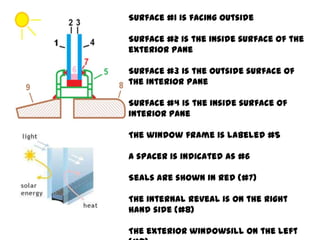
Surface #1 is facing outside
Surface #2 is the inside surface of the
exterior pane
Surface #3 is the outside surface of
the interior pane
Surface #4 is the inside surface of
interior pane

The window frame is labeled #5
A spacer is indicated as #6
Seals are shown in red (#7)
The internal reveal is on the right
hand side (#8)
The exterior windowsill on the left
Spacer: Spacer performs the role of keeping the glass panes
apart as well acts as a housing for the desiccant.
Desiccant: Or, the drying agent performs the most important
role in an IGU; that of absorbing the moisture from the
hermetically sealed space.
Secondary Sealant: This sealant is applied on the outside of the
unit. It performs several roles, chief among them of providing
structural strength.

Primary sealant: First line of defense for the hermetic seal.
Key quality areas
There are a few key areas that are of immense importance to ensure the
quality of IGU’s to ensure that clients get the performance they pay for.
Appropriate Type & Quantity of desiccant : Desiccants perform the most
important role of absorbing moisture and keeping the air inside the IGU’s
dry. The glass processor must use the correct type and quantity of
drying agent inside the IGU. Not using the correct quantity or type of
desiccant is one of the ways for a glass processor to significantly cut
costs by cutting corners.
Automatic Vs. Manual Desiccant filling: The main issue is that the drying
agent should never make contact with ambient air during the process of
filling the desiccant inside the spacers. As soon as the desiccant makes
contact with air, it starts absorbing moisture reducing life cycle
performance.

Auto Desiccant Station
Desiccant is filled & sealed automatically without contact with ambient
Number of joints in the Spacers: Ideally the spacer should have no joints. Jointless spacers are structurally stronger. However, cost & performance tradeoffs
require that an automatically bent spacer system in a single piece assembly with
one side joint be used. Many processors use 4 corner joints for the spacers. This
reduces the structural shear strength of IGU’s.
Spacer Bending Station :- Automatic Spacer Bending creates spacers in a single
piece assembly with one side-joint
Enclosed Environment: In India, IGU's should be made in an enclosed & conditioned
environment; ideally at a relative humidity of less than 62% and an ambient
temperature of less than 24 C. This prevents excess moisture being absorbed by the
IGU's during production, as well as prevents dust from entering the units.
Secondary Sealant quantity: The secondary sealant along with the spacer
provides the unit with rigidity. The gap between the spacer and the edge of the
glass pane that controls the amount of secondary sealant to be filled should be
appropriate for the size of the insulated glass unit.
Equipment: IGUs should be made using the proper IGU manufacturing line. A
manually made IGU by sticking 2-panes together will not perform over the
lifecycle of glazing.
Standards: Due to the absence of any standards in India, it is highly recommended
that IGU’s should be made to an international standard keeping several quality
areas, including the ones above, in mind. Some applicable standards for IGUs are:
a. EN 1279-2
PRODUCTION PROCESS
First and foremost the right glass combination is selected according the clients requirement.
The choices are limitless, for e.g. the glasses can be monolithic, annealed, tempered,
Laminated, Tinted and/or reflective.

Step 1.
All spacer bars are cut to size, and are then filled with a desiccant for moisture absorption.
The spacer bar is an aluminum bar that comes in various widths to customize the amount of
airspace, which is required within the unit. The spacer bar sizes are as followed:
5.5mm / 7.5mm / 9.5mm / 11.5mm / 13.5mm / 14.5mm / 15.5mm / 17.5mm
19.5mm / 23.5mm.
Step 2.
The spacer bars are filled with a high quality desiccant, and then assembled and prepared for
the primary seal. This system ensures that the desiccant does not come into the contact of air
and hence its moisture absorbing capability is intact till it goes inside the insulating glass unit.
Step 3.
Then, P.I.B(poly isobutyl) is applied to the spacer bar as the primary seal. The primary seal
acts as the first seal that keeps the spacer bar at place and sticks both the panes of glass
together separated by a uniform distance.
Step 4
Glass is then put through the washer and arrives on to the quality control check point.
Step 5
Quality control must then inspect to ensure the glass is clean and flawless. After the
inspection has been done, the pre-prepared spacer bar is then applied. The glass with the
spacer bar attached is then sent to the holding point.
Step 6.
The second piece of glass is then also put through the washer and inspected all the same, and
then let through to the holding point, in which case the machine automatically aligns the two
sheets of glass
Step 7.

The two sheets are then pressed in the large glass press, and the automatically released out
the other end. Then the Insulated Glass Unit is transported using the glass lift and is then
ready for the application of the secondary seal.
Step 8.
The secondary seal is applied all around the unit, in either butyl or silicon depending on the
size and what the purpose of the unit is.
Step 9.
Once the secondary seal process is complete, the unit is left to dry, which brings us to the end
of the manufacturing process.
Properties of Insulated Glass
Description

Spacer Thickness

Double or Triple pane Insulated glass units separated by
aluminum spacers
6, 8, 10, 12, 15, 18, 24mm available in stock Thicker
spacers made on special order

Spacer Bending

Full automatic
Single piece assembly with one side joint
Corner key assembly available (not recommended)

Desiccant Filling

Full automatic No contact of desiccant with ambient air

Desiccants type

Molecular sieve IV

Environment

Enclosed air-conditioned
£ 24 ° C temperature
£ 62% Relative humidity
Polyurethane, Poly sulphide, and/or Silicone based from
reputed manufacturers.
In service temperature range -30 ° C to 80 ° C Short
exposure (up to 1 hour) 100 ° C to160 ° C

Secondary sealants
(performance parameters)

Space between glass edge &
spacer

Please see Next Slide
Configuration

2x 4mm glass (short side)
• > 500mm
• <500mm

Joint
depth

5mm
5mm

Beneath depth

3mm
3mm

2x 5mm glass (short
side)
• > 500mm
• <500mm

5mm
5mm

3mm
3mm

2x 6mm glass (short
side)
• > 500mm
• <500mm

5mm
6mm

3mm
4mm

2x 8mm glass (short
side)
• > 500mm
• <500mm

6mm
8mm

4mm
6mm

Arched units 2x 4mm

6mm

4mm

Arched Units > 2x 4mm
thick

8mm

6mm
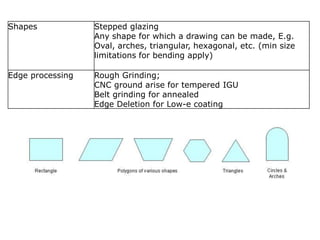
Shapes

Stepped glazing
Any shape for which a drawing can be made, E.g.
Oval, arches, triangular, hexagonal, etc. (min size
limitations for bending apply)

Edge processing

Rough Grinding;
CNC ground arise for tempered IGU
Belt grinding for annealed
Edge Deletion for Low-e coating
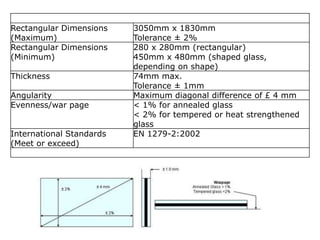
Rectangular Dimensions
(Maximum)
Rectangular Dimensions
(Minimum)
Thickness
Angularity
Evenness/war page

International Standards
(Meet or exceed)

3050mm x 1830mm
Tolerance ± 2%
280 x 280mm (rectangular)
450mm x 480mm (shaped glass,
depending on shape)
74mm max.
Tolerance ± 1mm
Maximum diagonal difference of £ 4 mm
< 1% for annealed glass
< 2% for tempered or heat strengthened
glass
EN 1279-2:2002

Glass dgu making

  • 1.
    IGUs’ are basicallymultiple layered glass panes that have very dry air or inert gas between the glass panes. The glass panes are hermetically sealed.
  • 2.
    Surface #1 isfacing outside Surface #2 is the inside surface of the exterior pane Surface #3 is the outside surface of the interior pane Surface #4 is the inside surface of interior pane The window frame is labeled #5 A spacer is indicated as #6 Seals are shown in red (#7) The internal reveal is on the right hand side (#8) The exterior windowsill on the left
  • 3.
    Spacer: Spacer performsthe role of keeping the glass panes apart as well acts as a housing for the desiccant. Desiccant: Or, the drying agent performs the most important role in an IGU; that of absorbing the moisture from the hermetically sealed space. Secondary Sealant: This sealant is applied on the outside of the unit. It performs several roles, chief among them of providing structural strength. Primary sealant: First line of defense for the hermetic seal.
  • 4.
    Key quality areas Thereare a few key areas that are of immense importance to ensure the quality of IGU’s to ensure that clients get the performance they pay for. Appropriate Type & Quantity of desiccant : Desiccants perform the most important role of absorbing moisture and keeping the air inside the IGU’s dry. The glass processor must use the correct type and quantity of drying agent inside the IGU. Not using the correct quantity or type of desiccant is one of the ways for a glass processor to significantly cut costs by cutting corners. Automatic Vs. Manual Desiccant filling: The main issue is that the drying agent should never make contact with ambient air during the process of filling the desiccant inside the spacers. As soon as the desiccant makes contact with air, it starts absorbing moisture reducing life cycle performance. Auto Desiccant Station Desiccant is filled & sealed automatically without contact with ambient
  • 5.
    Number of jointsin the Spacers: Ideally the spacer should have no joints. Jointless spacers are structurally stronger. However, cost & performance tradeoffs require that an automatically bent spacer system in a single piece assembly with one side joint be used. Many processors use 4 corner joints for the spacers. This reduces the structural shear strength of IGU’s. Spacer Bending Station :- Automatic Spacer Bending creates spacers in a single piece assembly with one side-joint Enclosed Environment: In India, IGU's should be made in an enclosed & conditioned environment; ideally at a relative humidity of less than 62% and an ambient temperature of less than 24 C. This prevents excess moisture being absorbed by the IGU's during production, as well as prevents dust from entering the units. Secondary Sealant quantity: The secondary sealant along with the spacer provides the unit with rigidity. The gap between the spacer and the edge of the glass pane that controls the amount of secondary sealant to be filled should be appropriate for the size of the insulated glass unit. Equipment: IGUs should be made using the proper IGU manufacturing line. A manually made IGU by sticking 2-panes together will not perform over the lifecycle of glazing. Standards: Due to the absence of any standards in India, it is highly recommended that IGU’s should be made to an international standard keeping several quality areas, including the ones above, in mind. Some applicable standards for IGUs are: a. EN 1279-2
  • 6.
    PRODUCTION PROCESS First andforemost the right glass combination is selected according the clients requirement. The choices are limitless, for e.g. the glasses can be monolithic, annealed, tempered, Laminated, Tinted and/or reflective. Step 1. All spacer bars are cut to size, and are then filled with a desiccant for moisture absorption. The spacer bar is an aluminum bar that comes in various widths to customize the amount of airspace, which is required within the unit. The spacer bar sizes are as followed: 5.5mm / 7.5mm / 9.5mm / 11.5mm / 13.5mm / 14.5mm / 15.5mm / 17.5mm 19.5mm / 23.5mm. Step 2. The spacer bars are filled with a high quality desiccant, and then assembled and prepared for the primary seal. This system ensures that the desiccant does not come into the contact of air and hence its moisture absorbing capability is intact till it goes inside the insulating glass unit. Step 3. Then, P.I.B(poly isobutyl) is applied to the spacer bar as the primary seal. The primary seal acts as the first seal that keeps the spacer bar at place and sticks both the panes of glass together separated by a uniform distance. Step 4 Glass is then put through the washer and arrives on to the quality control check point.
  • 7.
    Step 5 Quality controlmust then inspect to ensure the glass is clean and flawless. After the inspection has been done, the pre-prepared spacer bar is then applied. The glass with the spacer bar attached is then sent to the holding point. Step 6. The second piece of glass is then also put through the washer and inspected all the same, and then let through to the holding point, in which case the machine automatically aligns the two sheets of glass Step 7. The two sheets are then pressed in the large glass press, and the automatically released out the other end. Then the Insulated Glass Unit is transported using the glass lift and is then ready for the application of the secondary seal. Step 8. The secondary seal is applied all around the unit, in either butyl or silicon depending on the size and what the purpose of the unit is. Step 9. Once the secondary seal process is complete, the unit is left to dry, which brings us to the end of the manufacturing process.
  • 8.
    Properties of InsulatedGlass Description Spacer Thickness Double or Triple pane Insulated glass units separated by aluminum spacers 6, 8, 10, 12, 15, 18, 24mm available in stock Thicker spacers made on special order Spacer Bending Full automatic Single piece assembly with one side joint Corner key assembly available (not recommended) Desiccant Filling Full automatic No contact of desiccant with ambient air Desiccants type Molecular sieve IV Environment Enclosed air-conditioned £ 24 ° C temperature £ 62% Relative humidity Polyurethane, Poly sulphide, and/or Silicone based from reputed manufacturers. In service temperature range -30 ° C to 80 ° C Short exposure (up to 1 hour) 100 ° C to160 ° C Secondary sealants (performance parameters) Space between glass edge & spacer Please see Next Slide
  • 9.
    Configuration 2x 4mm glass(short side) • > 500mm • <500mm Joint depth 5mm 5mm Beneath depth 3mm 3mm 2x 5mm glass (short side) • > 500mm • <500mm 5mm 5mm 3mm 3mm 2x 6mm glass (short side) • > 500mm • <500mm 5mm 6mm 3mm 4mm 2x 8mm glass (short side) • > 500mm • <500mm 6mm 8mm 4mm 6mm Arched units 2x 4mm 6mm 4mm Arched Units > 2x 4mm thick 8mm 6mm
  • 10.
    Shapes Stepped glazing Any shapefor which a drawing can be made, E.g. Oval, arches, triangular, hexagonal, etc. (min size limitations for bending apply) Edge processing Rough Grinding; CNC ground arise for tempered IGU Belt grinding for annealed Edge Deletion for Low-e coating
  • 11.
    Rectangular Dimensions (Maximum) Rectangular Dimensions (Minimum) Thickness Angularity Evenness/warpage International Standards (Meet or exceed) 3050mm x 1830mm Tolerance ± 2% 280 x 280mm (rectangular) 450mm x 480mm (shaped glass, depending on shape) 74mm max. Tolerance ± 1mm Maximum diagonal difference of £ 4 mm < 1% for annealed glass < 2% for tempered or heat strengthened glass EN 1279-2:2002