TOPICS :-
 Introduction To Windows
 Desktop
 Control Panel
 Date & Time
 Functions Of An Operating System
 Mouse
o Mouse Pointer
o Mouse Clicks
o Mouse Wheel
 Quick Review
Introduction :-
Windows is an Operating System that
Microsoft has produced for use on personal
computers. It is the follow-up to the
Windows Vista Operating System, which
was released in 2006.
An Operating System allows your computer to
manage software and perform essential tasks.
It is also a Graphical User Interface (GUI)
that allows you to visually interact with your
computer’s functions in a logical, fun, and
easy way.
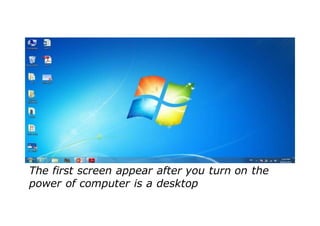
The first screen appear after you turn on the
power of computer is a desktop
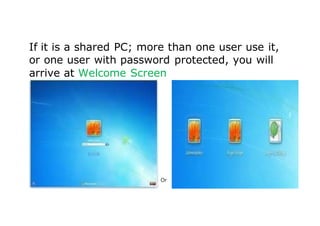
If it is a shared PC; more than one user use it,
or one user with password protected, you will
arrive at Welcome Screen
Or
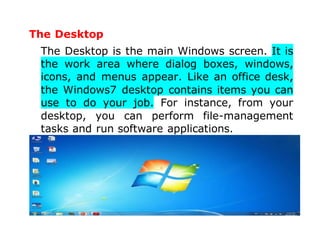
The Desktop
The Desktop is the main Windows screen. It is
the work area where dialog boxes, windows,
icons, and menus appear. Like an office desk,
the Windows7 desktop contains items you can
use to do your job. For instance, from your
desktop, you can perform file-management
tasks and run software applications.
Working with Control Panel
You can use Control Panel to change settings
for Windows. These settings control nearly
everything about how Windows looks and
works, and you can use them to set up
Windows so that it's just right for you.
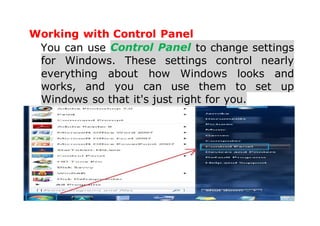
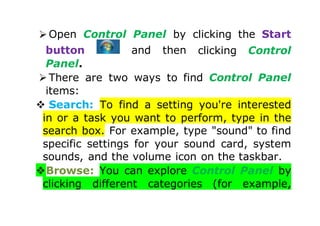
 Open Control Panel by clicking the Start
button and then clicking Control
Panel.
 There are two ways to find Control Panel
items:
 Search: To find a setting you're interested
in or a task you want to perform, type in the
search box. For example, type "sound" to find
specific settings for your sound card, system
sounds, and the volume icon on the taskbar.
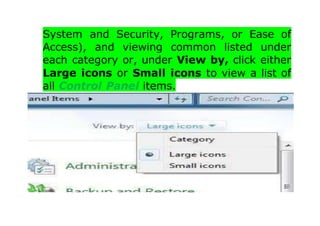
Browse: You can explore Control Panel by
clicking different categories (for example,
System and Security, Programs, or Ease of
Access), and viewing common listed under
each category or, under View by, click either
Large icons or Small icons to view a list of
all Control Panel items.
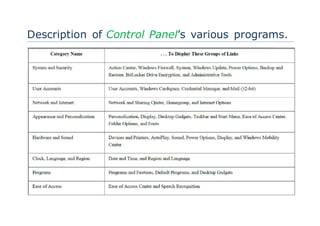
Description of Control Panel’s various programs.
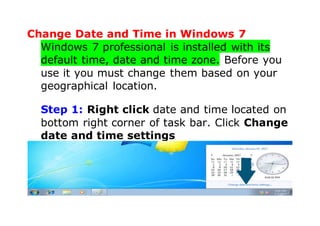
Change Date and Time in Windows 7
Windows 7 professional is installed with its
default time, date and time zone. Before you
use it you must change them based on your
geographical location.
Step 1: Right click date and time located on
bottom right corner of task bar. Click Change
date and time settings
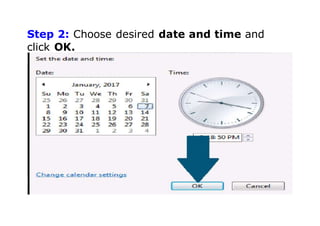
Step 2: Choose desired date and time and
click OK.
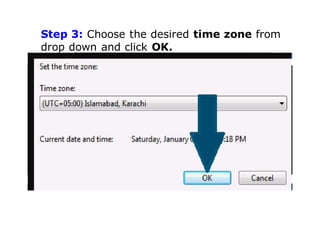
Step 3: Choose the desired time zone from
drop down and click OK.
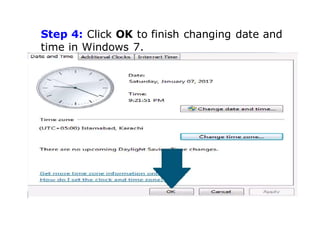
Step 4: Click OK to finish changing date and
time in Windows 7.
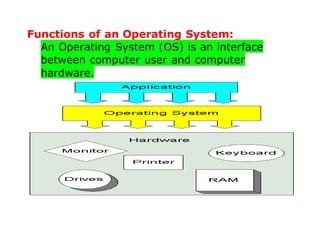
Functions of an Operating System:
An Operating System (OS) is an interface
between computer user and computer
hardware.
An Operating System is software which
performs all the basic tasks like file
management, memory management, process
management, handling input and output, and
controlling peripheral devices such as disk
drives and printers.
Functions of an Operating System.
ļ‚· Memory Management
ļ‚· Processor Management
ļ‚· Device Management
ļ‚· File Management
ļ‚· Security
ļ‚· Control over system performance
ļ‚· Job accounting
ļ‚· Error detecting aids
ļ‚· Coordination between other software and
users.
Using Mouse
The mouse is a hand-held device used to work
within the Windows environment. The following
list describes basic mouse functions:
ļ‚· Point to and select objects on the screen.
ļ‚· Select and/or move data or files by dragging
and dropping.
ļ‚· Start programs and shortcuts, or open files.
ļ‚· Scroll application windows or web pages by
clicking and holding a scroll bar, or by
moving the mouse wheel (the third button
wheel on some mouse models).
Mouse pointer
The mouse pointer is the graphic image of
the cursor displayed on-screen when the
mouse is active. As the pointer moves over
objects, the image changes to reflect the
associated function. For example, the
standard pointing image of an
arrow is Normal Select. However, when the
computer is processing a command,
the Busy circle displays on the screen.
Mouse clicks
The following list describes the types of
mouse clicks:
ļ‚· Click - Single press on the left mouse
button; selects data and performs
commands.
ļ‚· Double-click - Two rapid presses on the left
mouse button; opens files or folders, opens
shortcuts (a double-click must be two clicks
in rapid succession or it may be interpreted
as two single clicks).
ļ‚· Right-click - One press on the right mouse
button displays shortcut menus and drop-
down menus. In some applications, right-
clicking a menu item can access contextual
information or specific help for that item.
ļ‚· Drag-and-drop or select - press and hold
on the left mouse button. When using the
select feature within text, the text is selected
or highlighted. When using the drag-and-
drop on the file and folder level, you can
move files or folders:
ļ‚· From one folder to another
ļ‚· To the desktop
ļ‚· From the desktop to a folder
ļ‚· From any location to the Recycle Bin
Mouse wheel
The mouse wheel provides vertical scrolling
and panning functions in applications with
active scroll bars. Roll the mouse wheel up
or down to scroll, or press the mouse wheel
to activate panning.
Quick Review
 Windows is an Operating System that
Microsoft has produced for use on personal
computers.
 An Operating System allows your
computer to manage software and perform
essential tasks.
 Desktop is the work area where dialog
boxes, windows, icons, and menus appear.
 Control Panel is used to change settings
for Windows.
Windows 7 part 1

Windows 7 part 1

  • 2.
    TOPICS :-  IntroductionTo Windows  Desktop  Control Panel  Date & Time  Functions Of An Operating System  Mouse o Mouse Pointer o Mouse Clicks o Mouse Wheel  Quick Review
  • 3.
    Introduction :- Windows isan Operating System that Microsoft has produced for use on personal computers. It is the follow-up to the Windows Vista Operating System, which was released in 2006. An Operating System allows your computer to manage software and perform essential tasks. It is also a Graphical User Interface (GUI) that allows you to visually interact with your computer’s functions in a logical, fun, and easy way.
  • 4.
    The first screenappear after you turn on the power of computer is a desktop
  • 5.
    If it isa shared PC; more than one user use it, or one user with password protected, you will arrive at Welcome Screen Or
  • 6.
    The Desktop The Desktopis the main Windows screen. It is the work area where dialog boxes, windows, icons, and menus appear. Like an office desk, the Windows7 desktop contains items you can use to do your job. For instance, from your desktop, you can perform file-management tasks and run software applications.
  • 7.
    Working with ControlPanel You can use Control Panel to change settings for Windows. These settings control nearly everything about how Windows looks and works, and you can use them to set up Windows so that it's just right for you.
  • 8.
     Open ControlPanel by clicking the Start button and then clicking Control Panel.  There are two ways to find Control Panel items:  Search: To find a setting you're interested in or a task you want to perform, type in the search box. For example, type "sound" to find specific settings for your sound card, system sounds, and the volume icon on the taskbar. Browse: You can explore Control Panel by clicking different categories (for example,
  • 9.
    System and Security,Programs, or Ease of Access), and viewing common listed under each category or, under View by, click either Large icons or Small icons to view a list of all Control Panel items.
  • 10.
    Description of ControlPanel’s various programs.
  • 11.
    Change Date andTime in Windows 7 Windows 7 professional is installed with its default time, date and time zone. Before you use it you must change them based on your geographical location. Step 1: Right click date and time located on bottom right corner of task bar. Click Change date and time settings
  • 12.
    Step 2: Choosedesired date and time and click OK.
  • 13.
    Step 3: Choosethe desired time zone from drop down and click OK.
  • 14.
    Step 4: ClickOK to finish changing date and time in Windows 7.
  • 15.
    Functions of anOperating System: An Operating System (OS) is an interface between computer user and computer hardware.
  • 16.
    An Operating Systemis software which performs all the basic tasks like file management, memory management, process management, handling input and output, and controlling peripheral devices such as disk drives and printers. Functions of an Operating System. ļ‚· Memory Management ļ‚· Processor Management ļ‚· Device Management ļ‚· File Management
  • 17.
    ļ‚· Security ļ‚· Controlover system performance ļ‚· Job accounting ļ‚· Error detecting aids ļ‚· Coordination between other software and users.
  • 18.
    Using Mouse The mouseis a hand-held device used to work within the Windows environment. The following list describes basic mouse functions: ļ‚· Point to and select objects on the screen. ļ‚· Select and/or move data or files by dragging and dropping. ļ‚· Start programs and shortcuts, or open files. ļ‚· Scroll application windows or web pages by clicking and holding a scroll bar, or by moving the mouse wheel (the third button wheel on some mouse models).
  • 19.
    Mouse pointer The mousepointer is the graphic image of the cursor displayed on-screen when the mouse is active. As the pointer moves over objects, the image changes to reflect the associated function. For example, the standard pointing image of an arrow is Normal Select. However, when the computer is processing a command, the Busy circle displays on the screen.
  • 20.
    Mouse clicks The followinglist describes the types of mouse clicks: ļ‚· Click - Single press on the left mouse button; selects data and performs commands. ļ‚· Double-click - Two rapid presses on the left mouse button; opens files or folders, opens shortcuts (a double-click must be two clicks in rapid succession or it may be interpreted as two single clicks).
  • 21.
    ļ‚· Right-click -One press on the right mouse button displays shortcut menus and drop- down menus. In some applications, right- clicking a menu item can access contextual information or specific help for that item. ļ‚· Drag-and-drop or select - press and hold on the left mouse button. When using the select feature within text, the text is selected or highlighted. When using the drag-and- drop on the file and folder level, you can move files or folders: ļ‚· From one folder to another
  • 22.
    ļ‚· To thedesktop ļ‚· From the desktop to a folder ļ‚· From any location to the Recycle Bin Mouse wheel The mouse wheel provides vertical scrolling and panning functions in applications with active scroll bars. Roll the mouse wheel up or down to scroll, or press the mouse wheel to activate panning.
  • 23.
    Quick Review  Windowsis an Operating System that Microsoft has produced for use on personal computers.  An Operating System allows your computer to manage software and perform essential tasks.  Desktop is the work area where dialog boxes, windows, icons, and menus appear.  Control Panel is used to change settings for Windows.