TOPICS :-
 Mouse
o Change The Mouse Pointer Looks
o Change The Mouse Pointer Speed
o Mouse Double Click Speed
 Window Media Player
 Desktop Background
 Screen Savers
 Taskbar
 Jump List
 Disk Cleanup
 Quick Review
 Assignment
Changing the Look of Mouse Pointer
To change the mouse pointer (cursor) image:
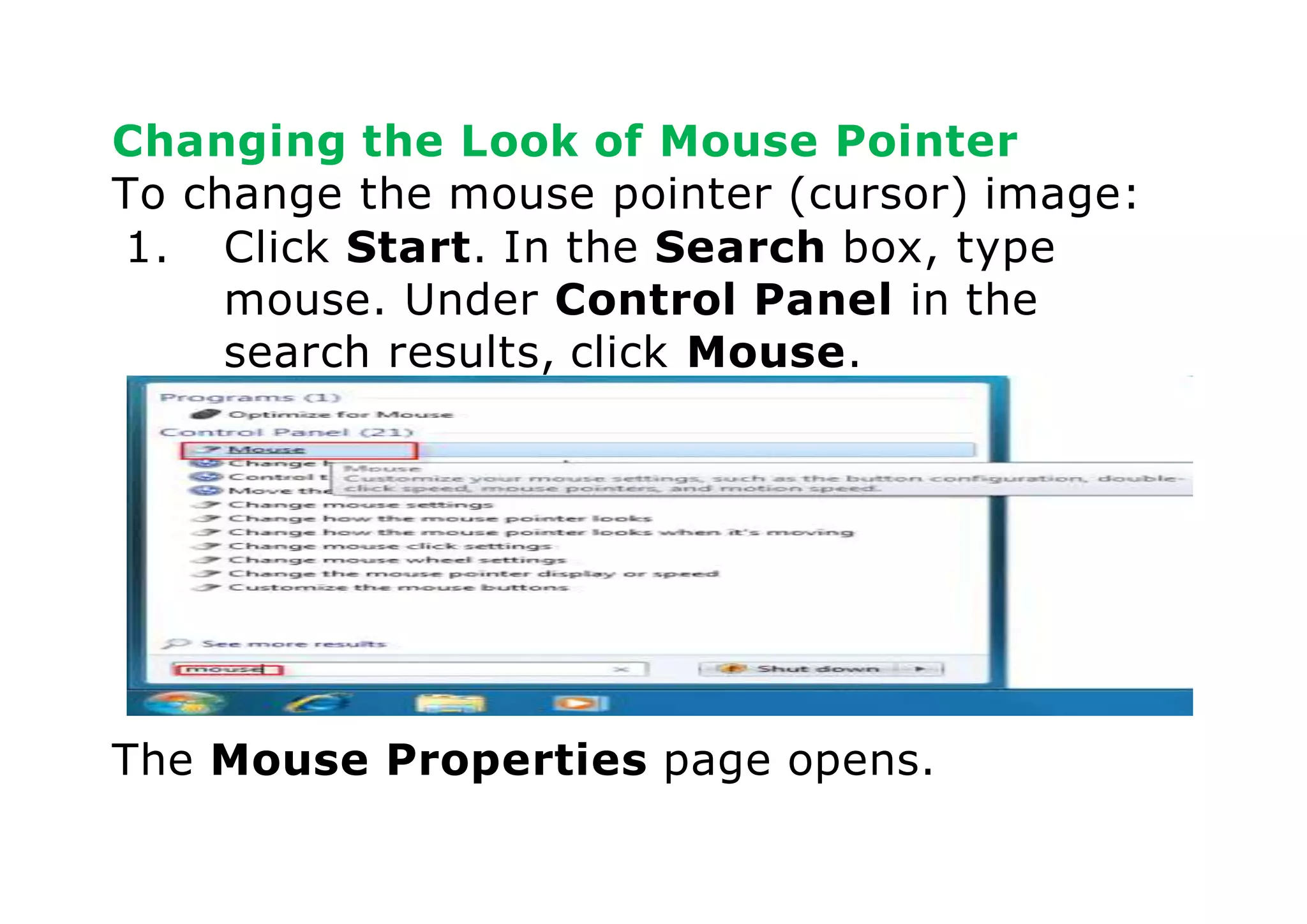
1. Click Start. In the Search box, type
mouse. Under Control Panel in the
search results, click Mouse.
The Mouse Properties page opens.
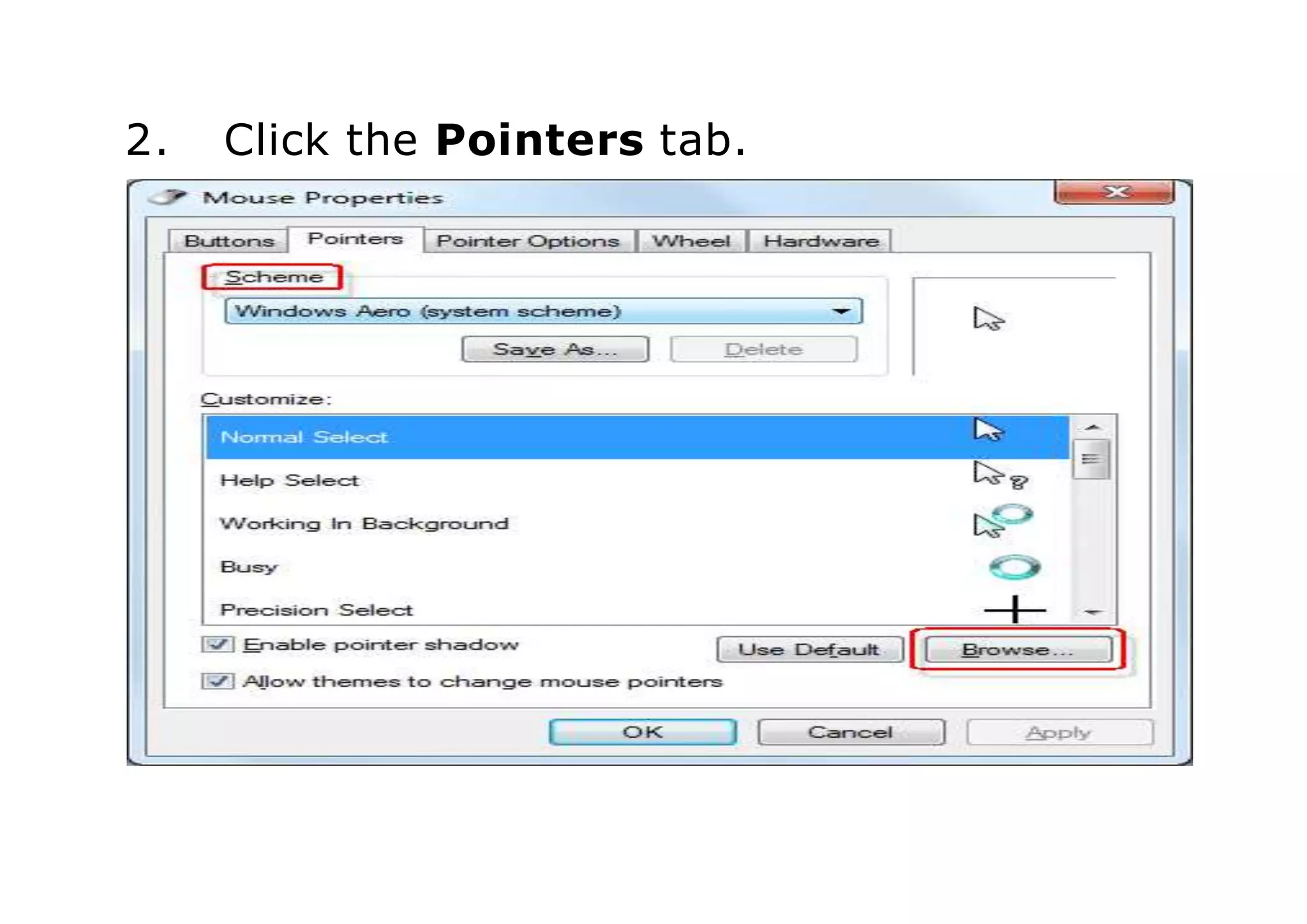
2. Click the Pointers tab.
3. In the Customize box, click the pointer
function (such as Normal Select), and click
Browse to choose a new pointer image.
To change the entire scheme of pointers, for
example, to change the size of all the
pointers, click the down arrow in
the Scheme field and select a new pointer
scheme from the list.
4. To save your changes, click Apply, and
then click OK.
Changing Mouse Pointer Speed
Use these steps to change the mouse pointer
speed:
1. Click Start. In the Search box,
type mouse. Under Control Panel in the
search results, click Mouse. The Mouse
Properties page opens.
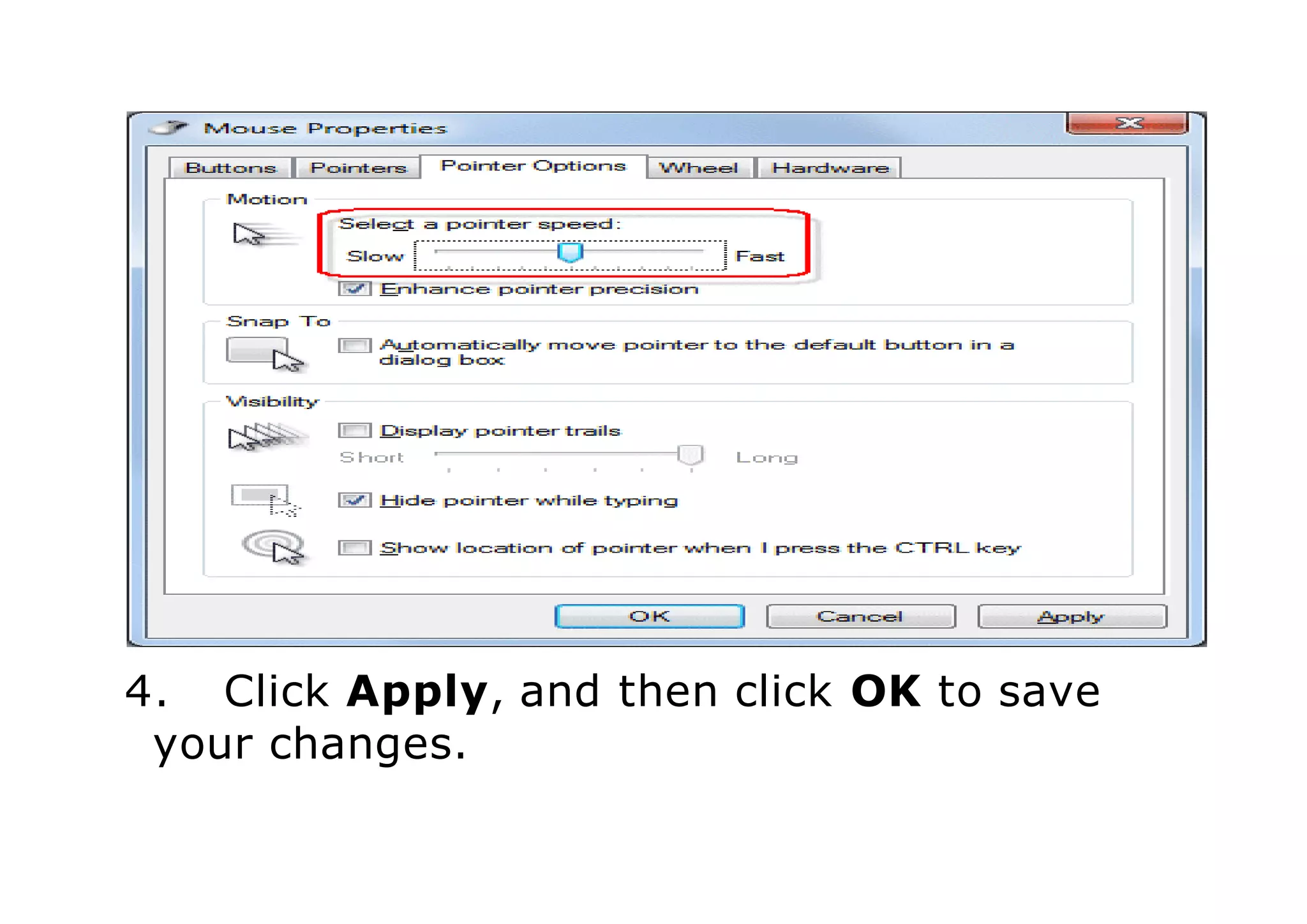
2. Click the Pointer Options tab.
3. In the Motion field, click and hold the
slide bar while moving the mouse to the right
or left, to adjust the mouse speed.
4. Click Apply, and then click OK to save
your changes.
Adjusting Mouse for Right-hand or Left-
hand Use
Use the following steps to adjust the mouse
for right-hand or left-hand use:
1. Click Start. In the Search box,
type mouse. Under Control Panel in the
search results, click Mouse. The Mouse
Properties page opens.
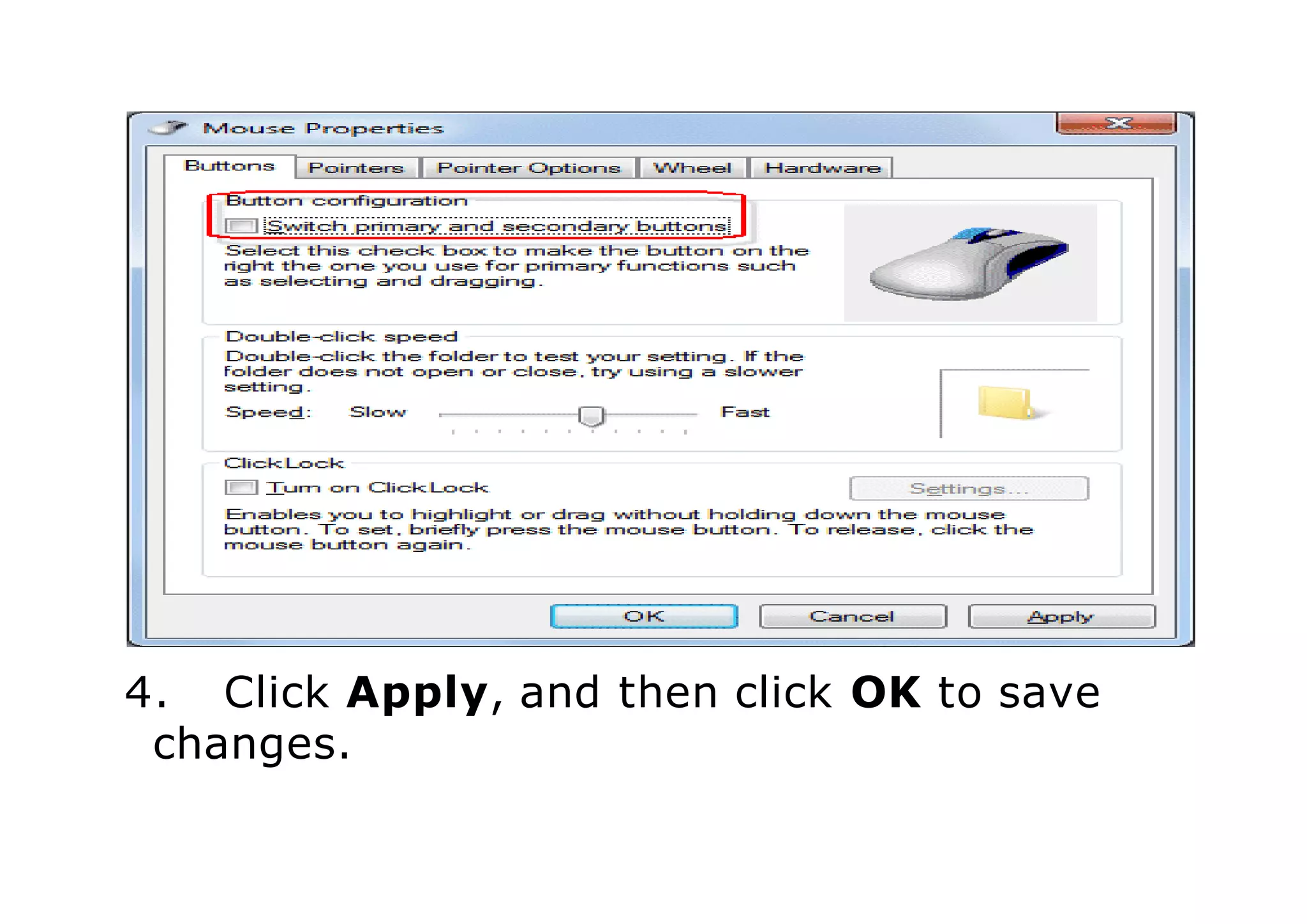
2. Click the Buttons tab.
3. In the Button configuration area,
select Switch primary and secondary
buttons to switch to left-hand use.
4. Click Apply, and then click OK to save
changes.
Adjusting Double-Click Speed
Use these steps to adjust the mouse double-
click speed.
1. Click Start. In the Search box,
type mouse. Under Control Panel in the
search results, click Mouse. The Mouse
Properties page opens.
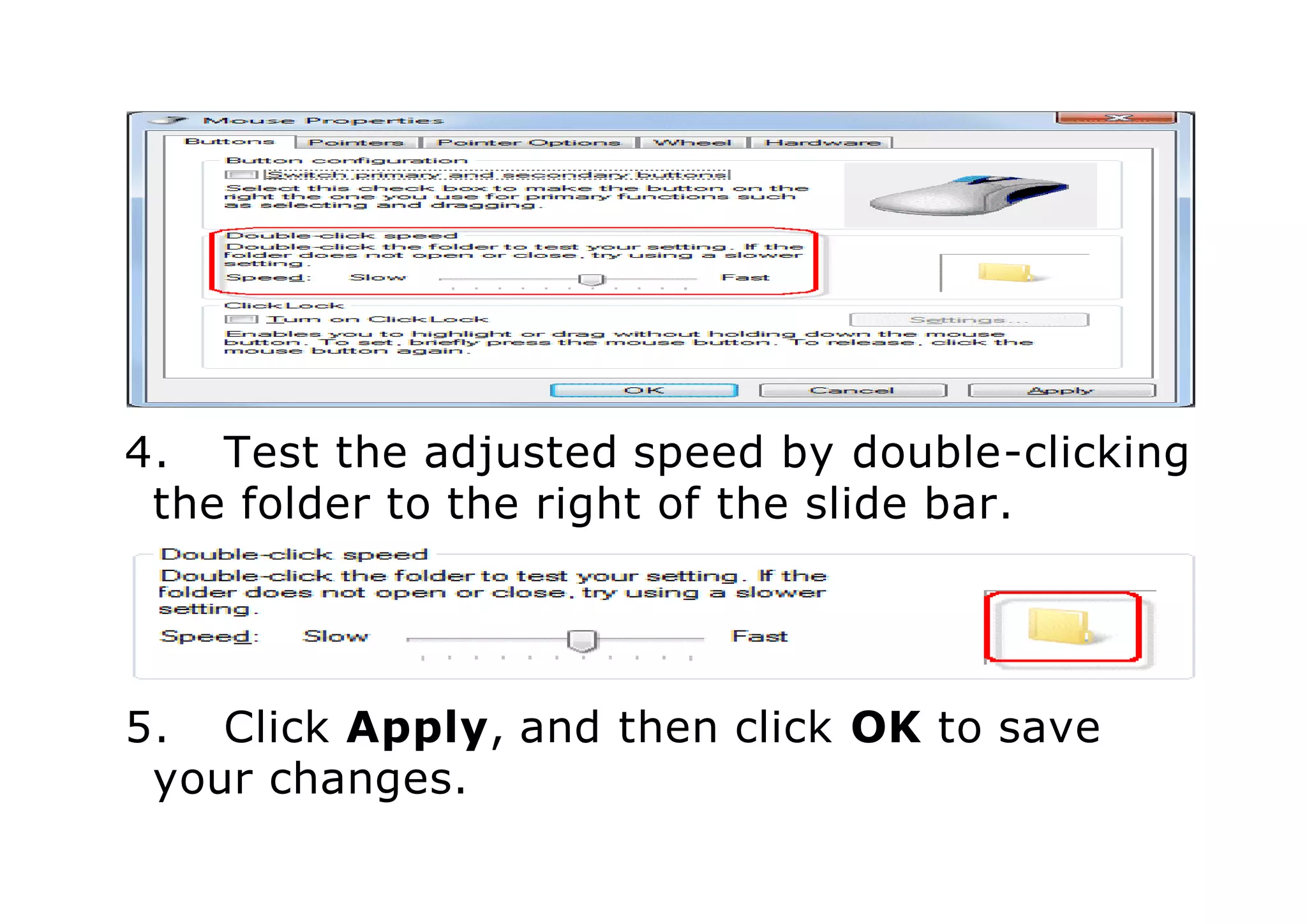
2. Click the Buttons tab.
3. In the Double-click speed area, click and
hold the slide bar while moving the mouse to
the right or left, to adjust the double-click
speed.
4. Test the adjusted speed by double-clicking
the folder to the right of the slide bar.
5. Click Apply, and then click OK to save
your changes.
Window Media Player : -
Windows Media Player (WMP) is a deprecated
media player and media library application
developed by Microsoft that is used for
playing audio, video and viewing images on
personal computers running the Microsoft
Windows Operating System.
Copy a CD to Another CD Using Windows 7
Windows 7 comes with Windows Media Player,
a program that is primarily used to play music
and video, but is also capable of ripping and
burning CDs. In order to burn your own copy
of the CD, you'll need a computer with a CD
burning drive.
Step 1
Start "Windows Media Player." To do this,
click on the Windows Media Player button
located in your task bar. It looks like a square
with an orange "Play" button on it.
Step 2
Insert the CD you wish to copy into your CD
drive. After your computer reads the CD, a list
of songs on the CD will appear in Windows
Media Player. Click the "Rip" button, located in
the top-right corner. Windows Media Player
will copy all of the files off of the CD onto your
computer.
Step 3
Insert the CD you want to copy the files to.
You'll need to have a CD-R or a CD-RW, as
these are the only type of CDs that are
formatted to allow for copied files. From the
Windows Media Player library, select the
songs that you ripped from the previous CD,
then right-click, and select "Add to Burn List."
Step 4
Click "Start Burn." The songs will be copied
onto your new CD.
Desktop Background
Desktop background (also called wallpaper)
can be a digital picture from your personal
collection or one that comes with Windows.
You can also select a color for your desktop
background or use a color to frame your
background picture. Windows comes with lots
of desktop background choices.
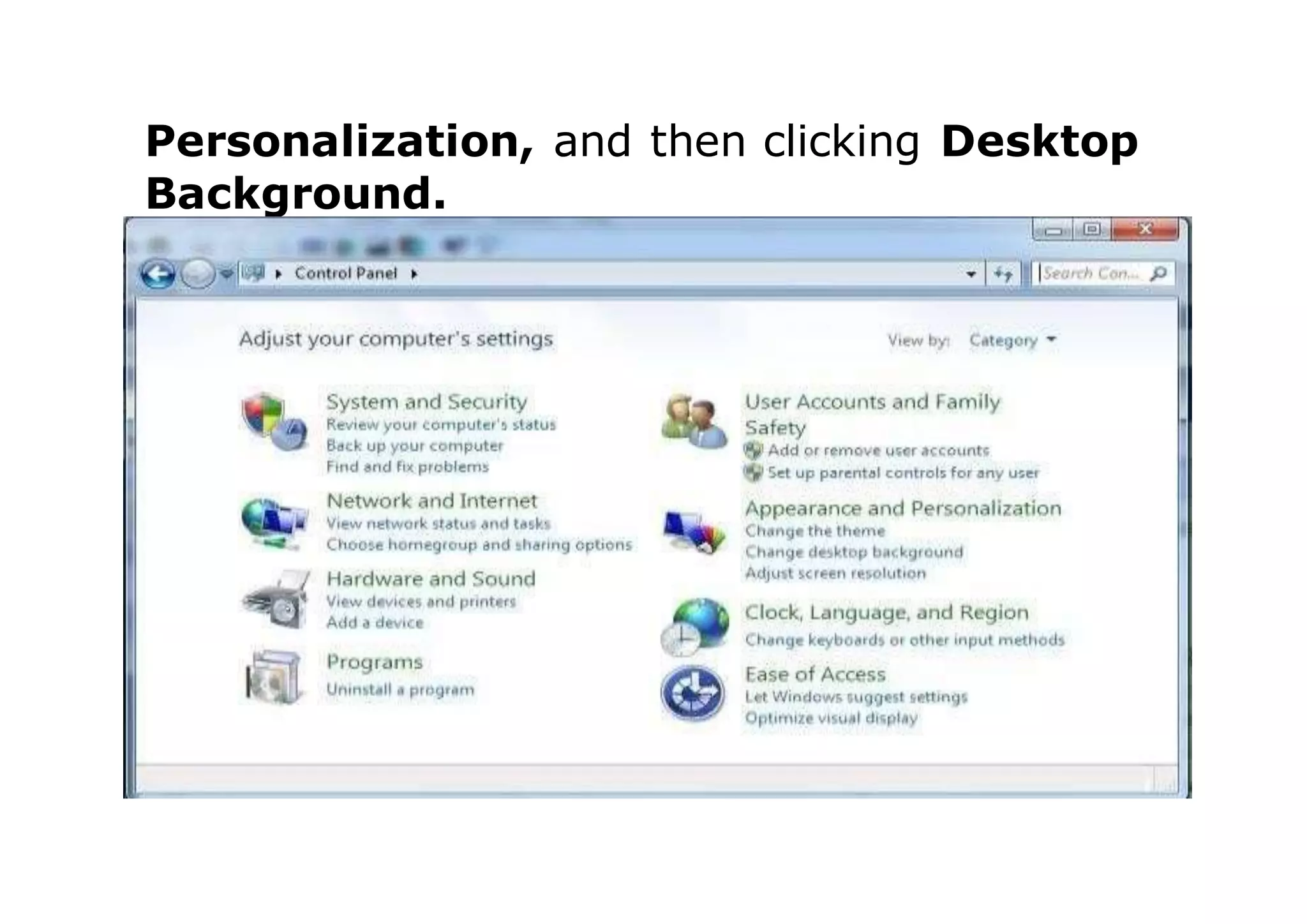
Change the desktop background
 Open Desktop Background by clicking the
Start button, clicking Control Panel, clicking
Appearance and Personalization, clicking
Personalization, and then clicking Desktop
Background.
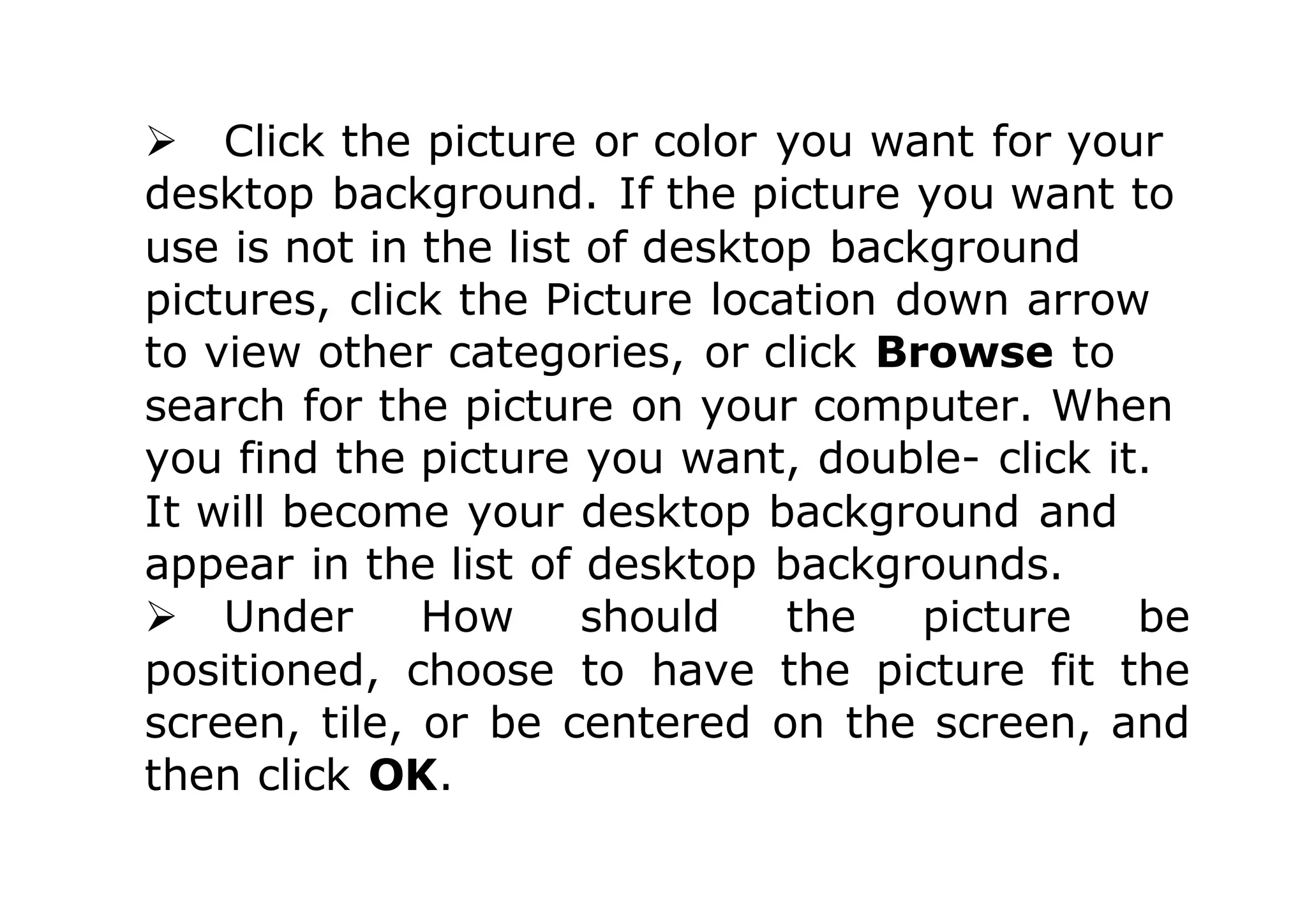
 Click the picture or color you want for your
desktop background. If the picture you want to
use is not in the list of desktop background
pictures, click the Picture location down arrow
to view other categories, or click Browse to
search for the picture on your computer. When
you find the picture you want, double- click it.
It will become your desktop background and
appear in the list of desktop backgrounds.
 Under How should the picture be
positioned, choose to have the picture fit the
screen, tile, or be centered on the screen, and
then click OK.
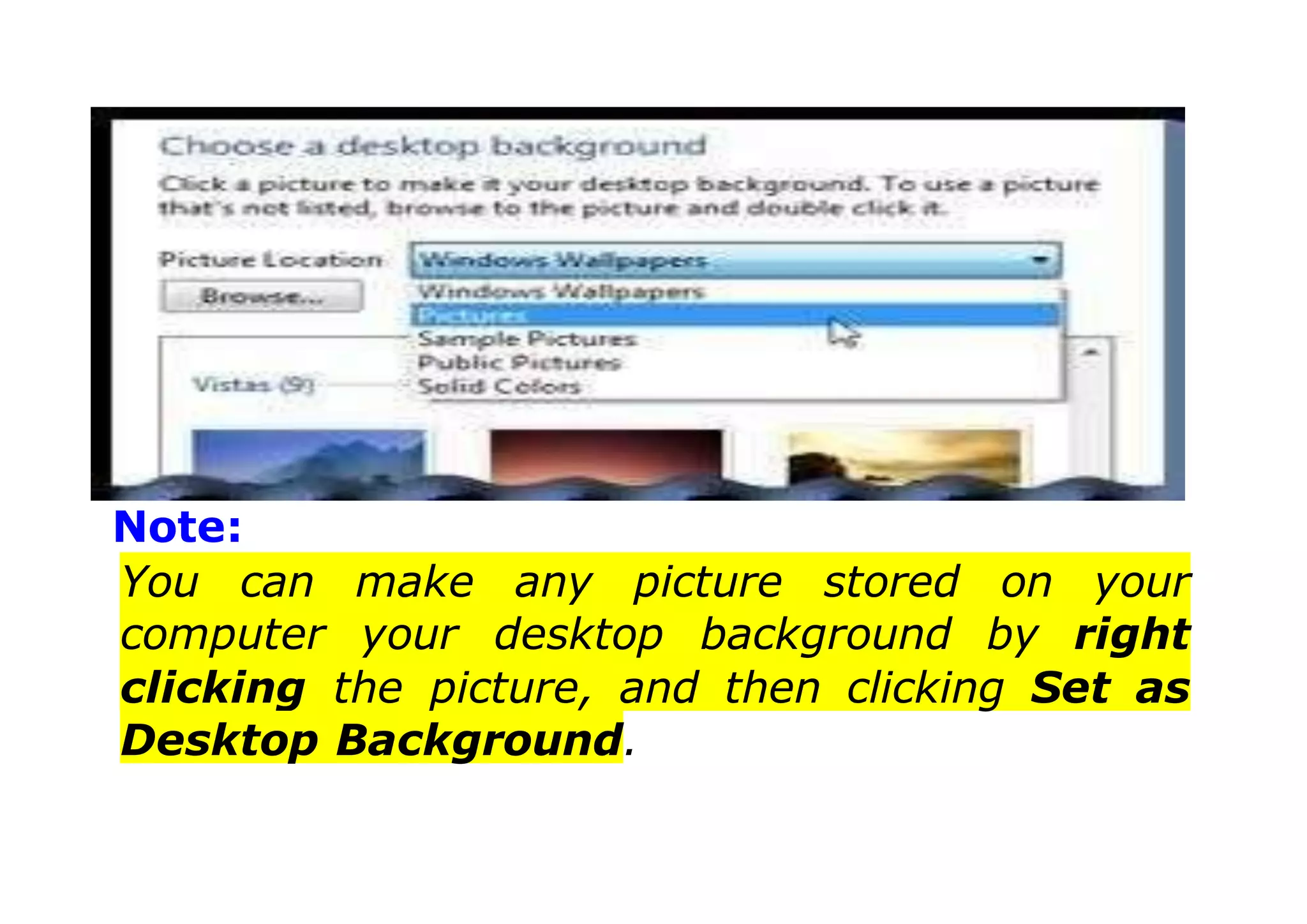
Note:
You can make any picture stored on your
computer your desktop background by right
clicking the picture, and then clicking Set as
Desktop Background.
Screen Saver
Windows comes with several screen savers.
You can also create your own screen savers
from personal pictures you've saved on your
computer.
Change A Screen Saver
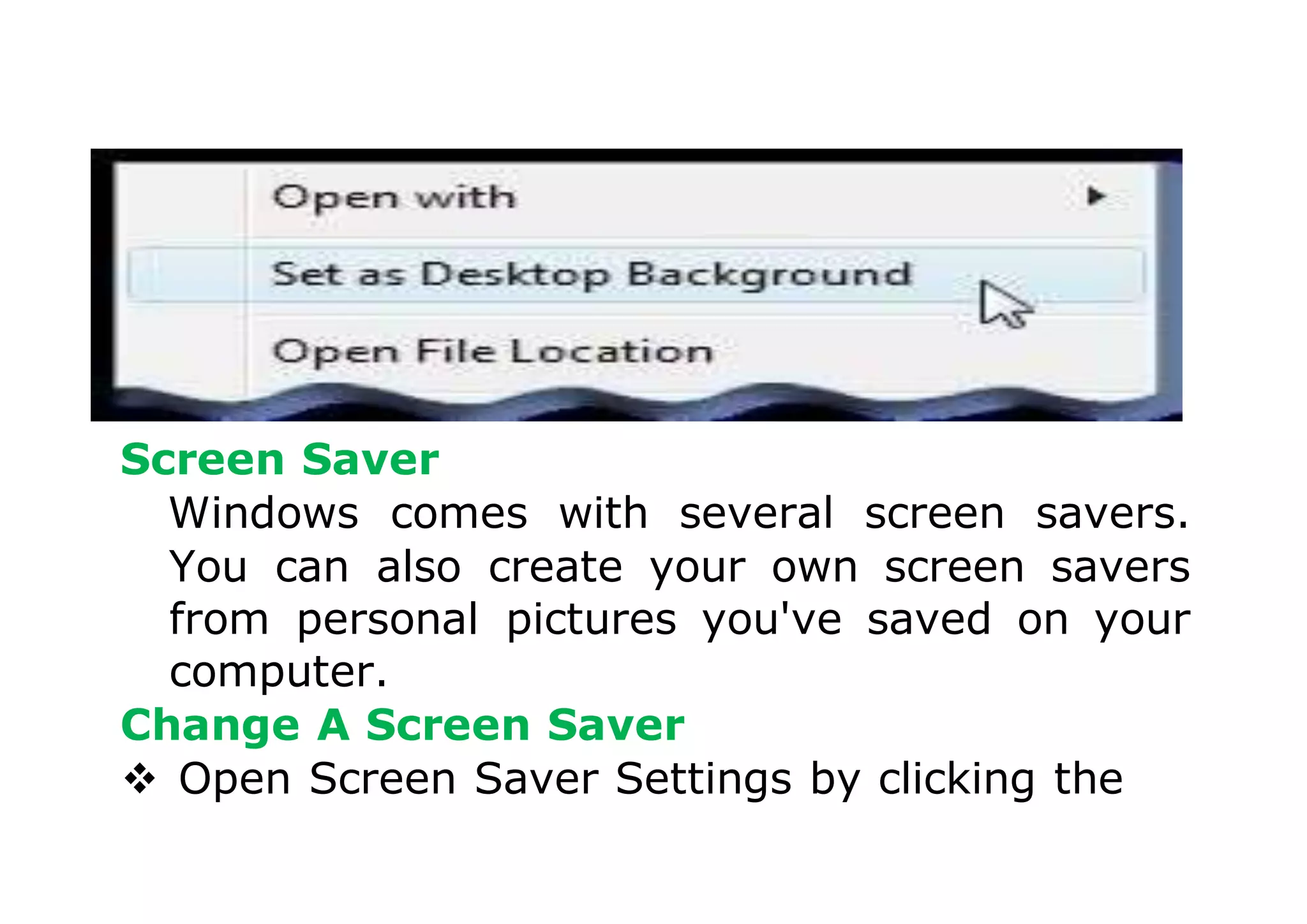
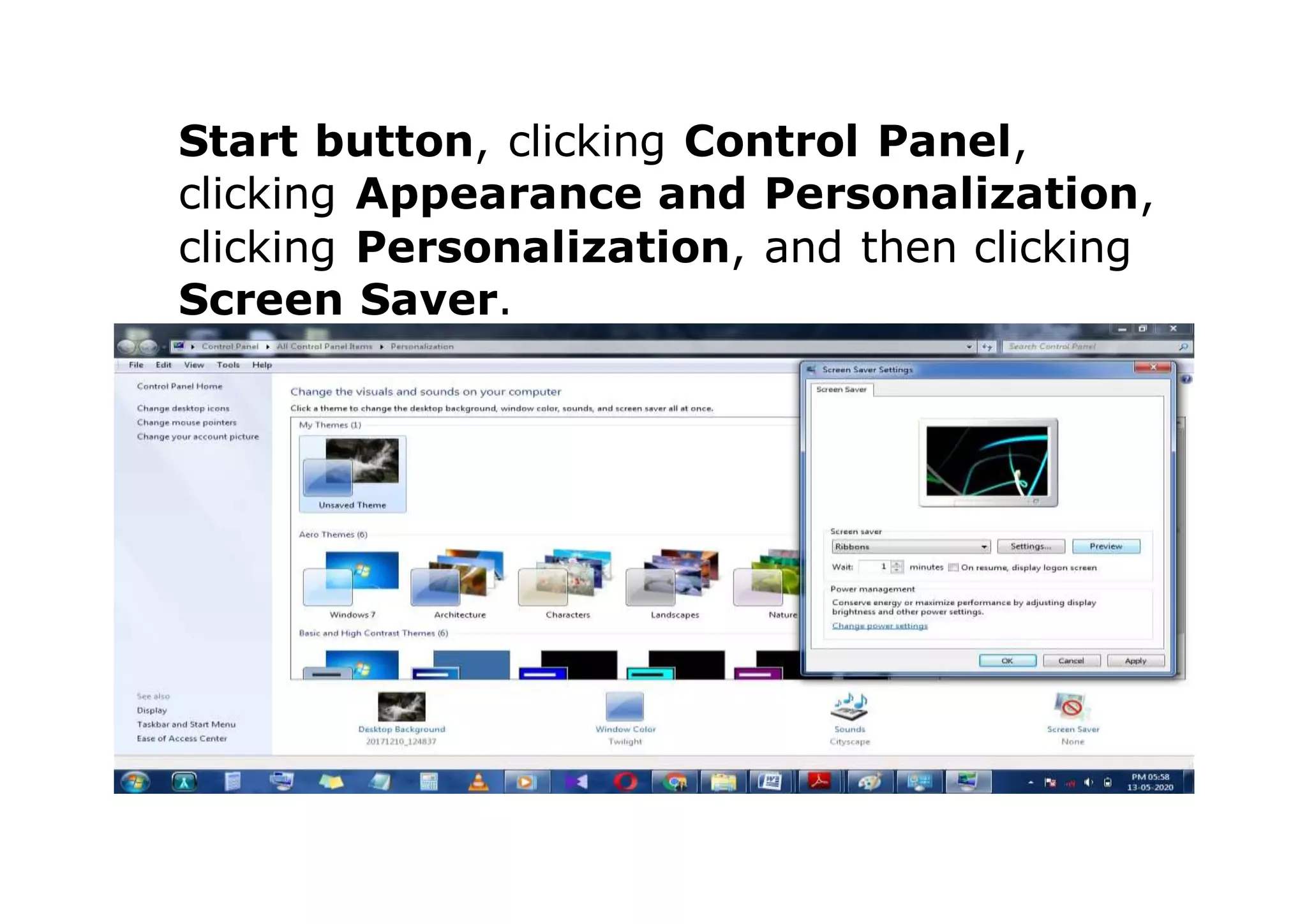
 Open Screen Saver Settings by clicking the
Start button, clicking Control Panel,
clicking Appearance and Personalization,
clicking Personalization, and then clicking
Screen Saver.
 Under Screen saver, in the drop-down list,
click the screen saver you want to use.
 Click Preview to see what your chosen
screen saver will look like.
 Click OK.
Note:
You can change wallpaper and screen saver by
right click on the desktop and then choose
personalize.
Taskbar
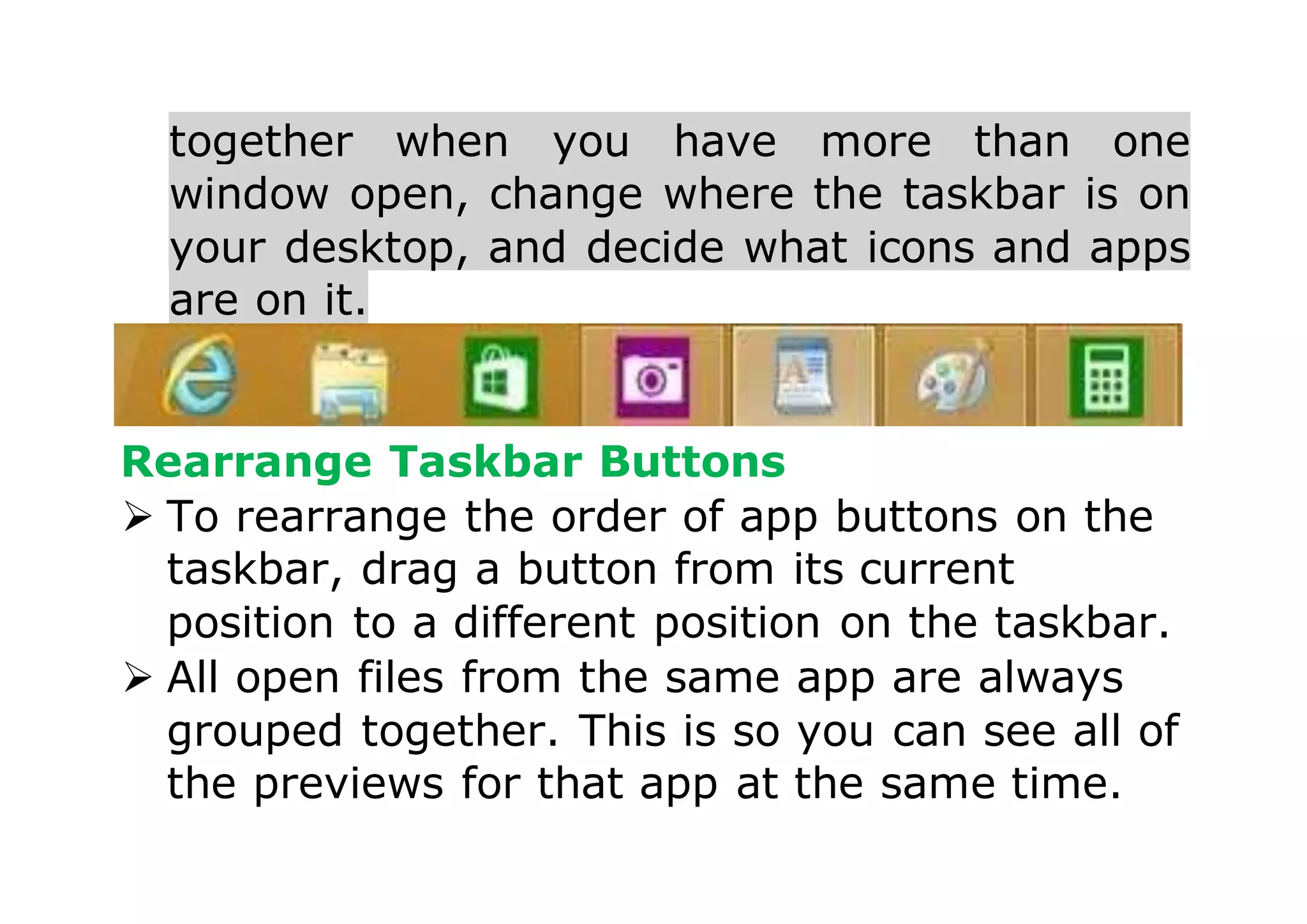
You can customize the taskbar, including the
way taskbar buttons look, how they group
together when you have more than one
window open, change where the taskbar is on
your desktop, and decide what icons and apps
are on it.
Rearrange Taskbar Buttons
 To rearrange the order of app buttons on the
taskbar, drag a button from its current
position to a different position on the taskbar.
 All open files from the same app are always
grouped together. This is so you can see all of
the previews for that app at the same time.
Drag files from Jump Lists
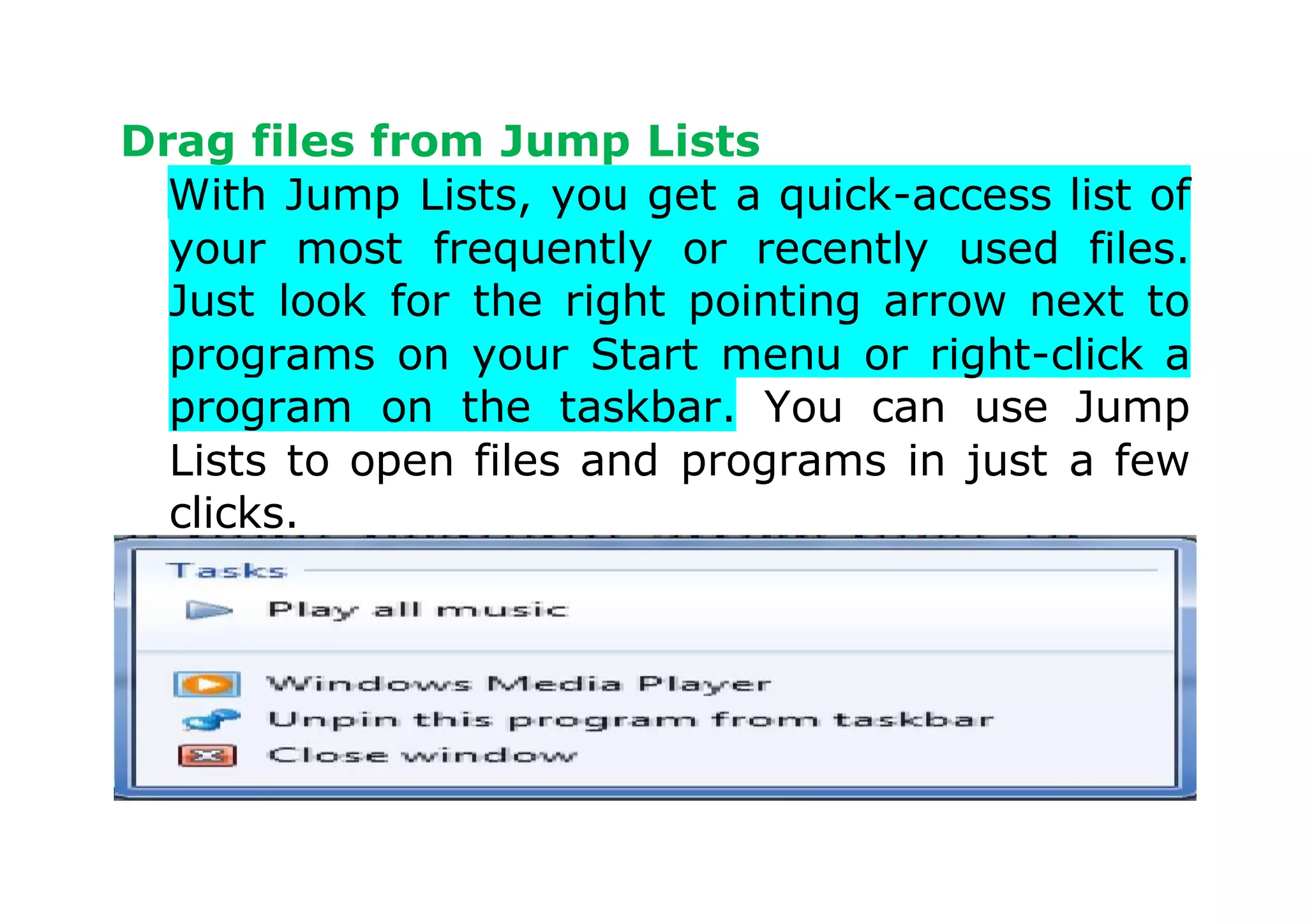
With Jump Lists, you get a quick-access list of
your most frequently or recently used files.
Just look for the right pointing arrow next to
programs on your Start menu or right-click a
program on the taskbar. You can use Jump
Lists to open files and programs in just a few
clicks.
Disk Cleanup :-
Disk Clean-up (cleanmgr.exe) is a computer
maintenance utility included in Microsoft
Windows designed to free up disk space on a
computer's hard drive. The utility first
searches and analyzes the hard drive for files
that are no longer of any use, and then
removes the unnecessary files. There are a
number of different categories that Disk
Clean-up targets when performing the initial
disk analysis:
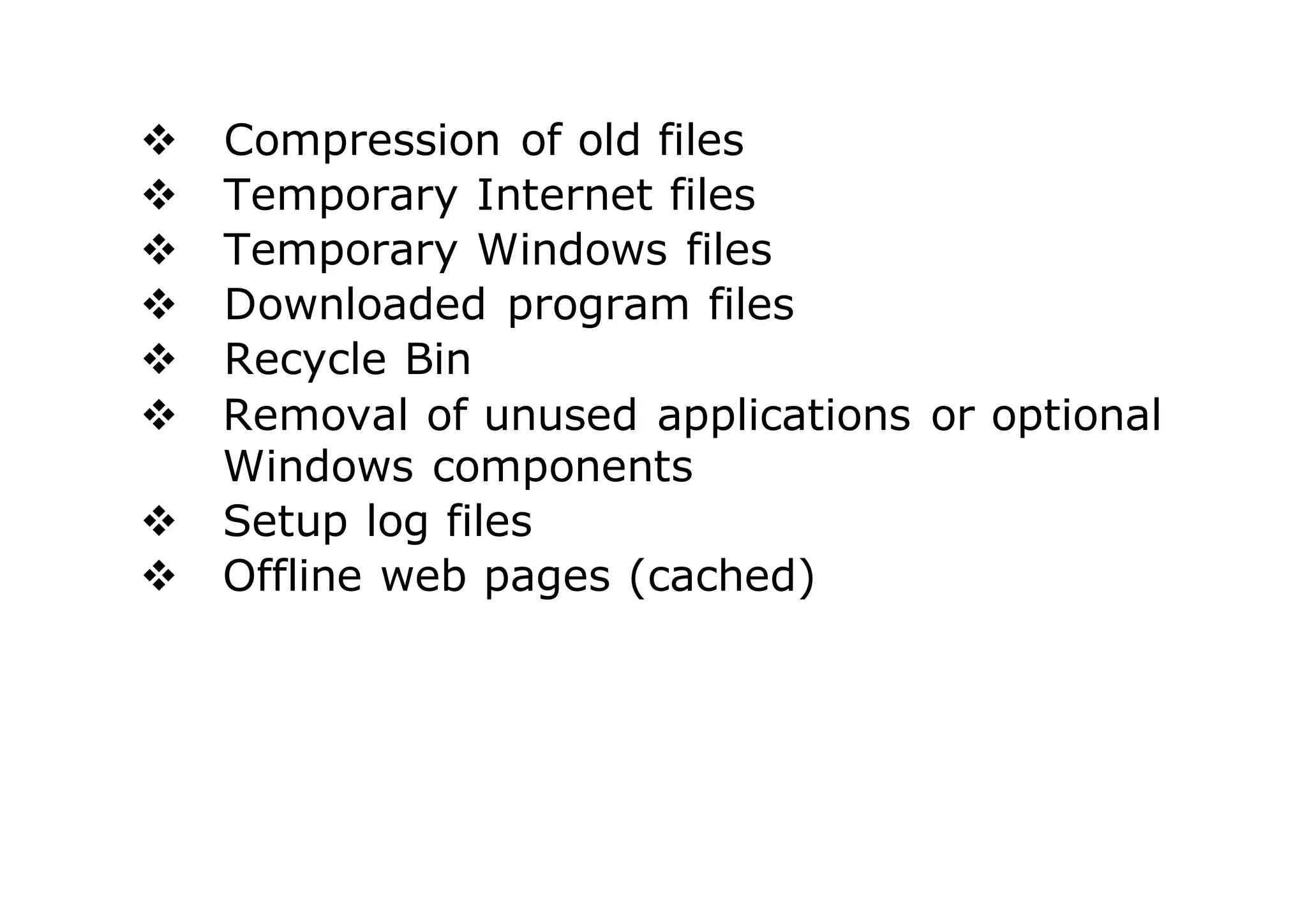
 Compression of old files
 Temporary Internet files
 Temporary Windows files
 Downloaded program files
 Recycle Bin
 Removal of unused applications or optional
Windows components
 Setup log files
 Offline web pages (cached)
Quick Review :-
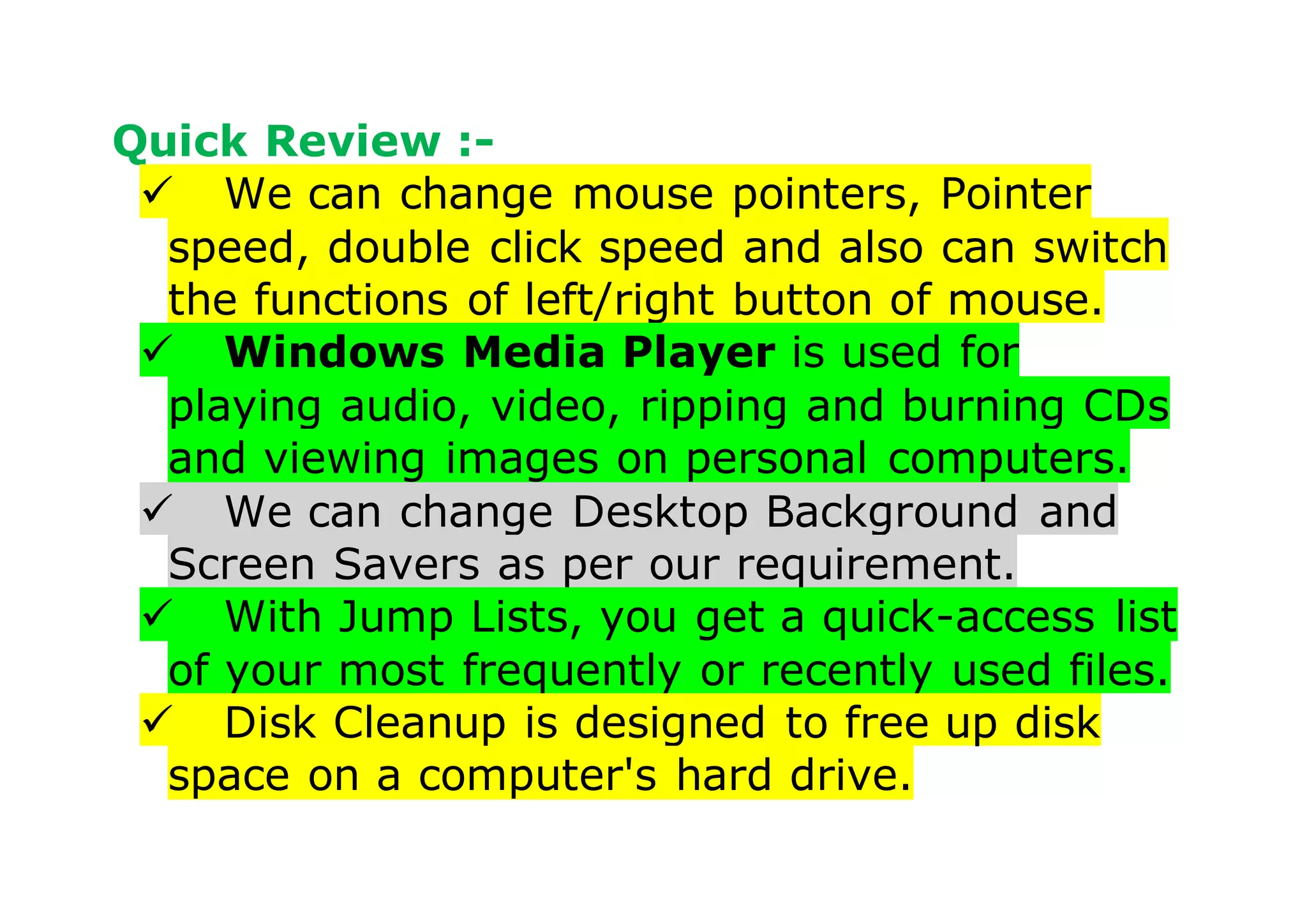
 We can change mouse pointers, Pointer
speed, double click speed and also can switch
the functions of left/right button of mouse.
 Windows Media Player is used for
playing audio, video, ripping and burning CDs
and viewing images on personal computers.
 We can change Desktop Background and
Screen Savers as per our requirement.
 With Jump Lists, you get a quick-access list
of your most frequently or recently used files.
 Disk Cleanup is designed to free up disk
space on a computer's hard drive.
Assignments :-
1.Write the steps to change the theme.
2.Write the steps to change the date & time.
3.Who designed Windows?
4.What is an operating system?
5. What are the important functions of an
Operating System?
6.What do you understand by ripping?
7. What are the options available in
taskbar, when you right click on it ?
Windows 7 part 2

Windows 7 part 2

  • 2.
    TOPICS :-  Mouse oChange The Mouse Pointer Looks o Change The Mouse Pointer Speed o Mouse Double Click Speed  Window Media Player  Desktop Background  Screen Savers  Taskbar  Jump List  Disk Cleanup  Quick Review  Assignment
  • 3.
    Changing the Lookof Mouse Pointer To change the mouse pointer (cursor) image: 1. Click Start. In the Search box, type mouse. Under Control Panel in the search results, click Mouse. The Mouse Properties page opens.
  • 4.
    2. Click thePointers tab.
  • 5.
    3. In theCustomize box, click the pointer function (such as Normal Select), and click Browse to choose a new pointer image. To change the entire scheme of pointers, for example, to change the size of all the pointers, click the down arrow in the Scheme field and select a new pointer scheme from the list. 4. To save your changes, click Apply, and then click OK.
  • 6.
    Changing Mouse PointerSpeed Use these steps to change the mouse pointer speed: 1. Click Start. In the Search box, type mouse. Under Control Panel in the search results, click Mouse. The Mouse Properties page opens. 2. Click the Pointer Options tab. 3. In the Motion field, click and hold the slide bar while moving the mouse to the right or left, to adjust the mouse speed.
  • 7.
    4. Click Apply,and then click OK to save your changes.
  • 8.
    Adjusting Mouse forRight-hand or Left- hand Use Use the following steps to adjust the mouse for right-hand or left-hand use: 1. Click Start. In the Search box, type mouse. Under Control Panel in the search results, click Mouse. The Mouse Properties page opens. 2. Click the Buttons tab. 3. In the Button configuration area, select Switch primary and secondary buttons to switch to left-hand use.
  • 9.
    4. Click Apply,and then click OK to save changes.
  • 10.
    Adjusting Double-Click Speed Usethese steps to adjust the mouse double- click speed. 1. Click Start. In the Search box, type mouse. Under Control Panel in the search results, click Mouse. The Mouse Properties page opens. 2. Click the Buttons tab. 3. In the Double-click speed area, click and hold the slide bar while moving the mouse to the right or left, to adjust the double-click speed.
  • 11.
    4. Test theadjusted speed by double-clicking the folder to the right of the slide bar. 5. Click Apply, and then click OK to save your changes.
  • 12.
    Window Media Player: - Windows Media Player (WMP) is a deprecated media player and media library application developed by Microsoft that is used for playing audio, video and viewing images on personal computers running the Microsoft Windows Operating System. Copy a CD to Another CD Using Windows 7 Windows 7 comes with Windows Media Player, a program that is primarily used to play music and video, but is also capable of ripping and burning CDs. In order to burn your own copy
  • 13.
    of the CD,you'll need a computer with a CD burning drive. Step 1 Start "Windows Media Player." To do this, click on the Windows Media Player button located in your task bar. It looks like a square with an orange "Play" button on it. Step 2 Insert the CD you wish to copy into your CD drive. After your computer reads the CD, a list of songs on the CD will appear in Windows Media Player. Click the "Rip" button, located in the top-right corner. Windows Media Player
  • 14.
    will copy allof the files off of the CD onto your computer. Step 3 Insert the CD you want to copy the files to. You'll need to have a CD-R or a CD-RW, as these are the only type of CDs that are formatted to allow for copied files. From the Windows Media Player library, select the songs that you ripped from the previous CD, then right-click, and select "Add to Burn List." Step 4 Click "Start Burn." The songs will be copied onto your new CD.
  • 15.
    Desktop Background Desktop background(also called wallpaper) can be a digital picture from your personal collection or one that comes with Windows. You can also select a color for your desktop background or use a color to frame your background picture. Windows comes with lots of desktop background choices. Change the desktop background  Open Desktop Background by clicking the Start button, clicking Control Panel, clicking Appearance and Personalization, clicking
  • 16.
    Personalization, and thenclicking Desktop Background.
  • 17.
     Click thepicture or color you want for your desktop background. If the picture you want to use is not in the list of desktop background pictures, click the Picture location down arrow to view other categories, or click Browse to search for the picture on your computer. When you find the picture you want, double- click it. It will become your desktop background and appear in the list of desktop backgrounds.  Under How should the picture be positioned, choose to have the picture fit the screen, tile, or be centered on the screen, and then click OK.
  • 18.
    Note: You can makeany picture stored on your computer your desktop background by right clicking the picture, and then clicking Set as Desktop Background.
  • 19.
    Screen Saver Windows comeswith several screen savers. You can also create your own screen savers from personal pictures you've saved on your computer. Change A Screen Saver  Open Screen Saver Settings by clicking the
  • 20.
    Start button, clickingControl Panel, clicking Appearance and Personalization, clicking Personalization, and then clicking Screen Saver.
  • 21.
     Under Screensaver, in the drop-down list, click the screen saver you want to use.  Click Preview to see what your chosen screen saver will look like.  Click OK. Note: You can change wallpaper and screen saver by right click on the desktop and then choose personalize. Taskbar You can customize the taskbar, including the way taskbar buttons look, how they group
  • 22.
    together when youhave more than one window open, change where the taskbar is on your desktop, and decide what icons and apps are on it. Rearrange Taskbar Buttons  To rearrange the order of app buttons on the taskbar, drag a button from its current position to a different position on the taskbar.  All open files from the same app are always grouped together. This is so you can see all of the previews for that app at the same time.
  • 23.
    Drag files fromJump Lists With Jump Lists, you get a quick-access list of your most frequently or recently used files. Just look for the right pointing arrow next to programs on your Start menu or right-click a program on the taskbar. You can use Jump Lists to open files and programs in just a few clicks.
  • 24.
    Disk Cleanup :- DiskClean-up (cleanmgr.exe) is a computer maintenance utility included in Microsoft Windows designed to free up disk space on a computer's hard drive. The utility first searches and analyzes the hard drive for files that are no longer of any use, and then removes the unnecessary files. There are a number of different categories that Disk Clean-up targets when performing the initial disk analysis:
  • 25.
     Compression ofold files  Temporary Internet files  Temporary Windows files  Downloaded program files  Recycle Bin  Removal of unused applications or optional Windows components  Setup log files  Offline web pages (cached)
  • 26.
    Quick Review :- We can change mouse pointers, Pointer speed, double click speed and also can switch the functions of left/right button of mouse.  Windows Media Player is used for playing audio, video, ripping and burning CDs and viewing images on personal computers.  We can change Desktop Background and Screen Savers as per our requirement.  With Jump Lists, you get a quick-access list of your most frequently or recently used files.  Disk Cleanup is designed to free up disk space on a computer's hard drive.
  • 27.
    Assignments :- 1.Write thesteps to change the theme. 2.Write the steps to change the date & time. 3.Who designed Windows? 4.What is an operating system? 5. What are the important functions of an Operating System? 6.What do you understand by ripping? 7. What are the options available in taskbar, when you right click on it ?