Windows Firewall
Windows Firewall
Presented by :
Soban Ahmad
036
Waqar-ul-Malik
050
Our Discussing topics
 What is a firewall?
 Firewall types
 How a firewall works
 Default firewall behavior
 Windows 7 firewall features
 Configuring Windows 7 firewall
What is a firewall
 A firewall is software or hardware that helps prevent hackers
and some types of malware from getting to your PC through
a network or the Internet. It does this by checking the info
that’s coming from the Internet or a network and then either
blocking it or allowing it to pass through to your PC.
Firewall Types
Following are the types of Firewall Types
 Packet filtering
 stateful
 proxy
Packet filtering
makes each filtering decision on a packet by packet basis
without regard to previous packets in any directon
Stateful firewall
keeps track of packet flows and filters based on flow
information
Proxy firewall
works on a per-application basis. User sends to proxy,
proxy creates new packet sourced from proxy.
Firewall Types
 Network-based vs host-based
 Network-based runs a router, multi-layer switch or
dedicated firewall
 Host-based firewall runs on computer running OS
such as Windows 7 or UNIX
 Hardware vs software firewall
 Hardware firewall chassis designed for specifically to
operate as a firewall; highest performance
6
Windows Firewall
 Host-based, stateful software firewall
 Evaluates each packet as it arrives or leaves and determines
whether that packet is allowed or denied based on flow
 Windows 7 firewall is improved over XP version
Default Firewall Behavior
 Default is to allow all outbound traffic and
response inbound traffic; deny all other inbound
traffic
How Firewall Works
 Incoming packet is inspected and compared
against a list of allowed traffic.
 If packet matches a list entry, packet passed to
TCP/IP protocol for further processing.
 If the packet does not match a list entry then
packet is discarded
 If logging is enabled, Windows creates an entry in the
Firewall logging file
How List is Populated
 When enabled connection sends a packet, the
firewall creates an entry in the list for response
traffic.
 Allow rules can be manually created with
Advanced Security.
10
Windows 7 Firewall
 Windows Firewall features
 Inbound filtering
 Outbound filtering
 Firewall rules combined with IPsec rules
 Support for complex rules
 Support for logging
Locations and the Firewall
 Windows Firewall with Advanced Security
is a network location aware application
 Windows 7 stores the firewall properties
based on location types
 Configuration for each location type is
called a profile
 In each profile you can:
 Enable or disable Windows Firewall
 Configure inbound and/or outbound connections
 Customize logging and other settings
Locations and Firewall
Settings
 As the network location connected to changes,
the Windows Firewall profile changes.
 Windows Firewall can therefore automatically
allow incoming traffic for a specific desktop
management tool when the computer is on a
domain network but block similar traffic when the
computer is connected to public or private
networks.
Locations and Firewall
Settings
 Location types: domain, public, and private.
 Domain - the connection is authenticated to
a domain controller for the domain of which
it is a member.
 By default, all other networks are initially
classified as public networks.
 User can identify the network as either public
or private.
 Public profile: For use when in locations such as
airports or coffee shops.
 Private profile: For use when connected at a
home or office and behind an edge device.
 To classify a network as a private network, the
user must have administrator credentials.
Locations and Firewall
Settings
 While a computer may be connected to
multiple network locations at the same time,
only one profile can be active at a time. The
active profile is determined as follows:
 If all interfaces are authenticated to the
domain controller for the domain of which
the computer is a member, the domain
profile is applied.
 If at least one interface is connected to a
private network location and all other
interfaces are either authenticated to the
domain controller or are connected to
private network locations, the private profile
is applied.
 Otherwise, the public profile is applied.
Configuring Windows
Firewall
 Control Panel – Windows Firewall
16
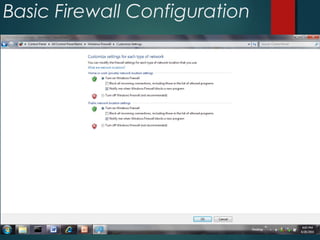
Basic Firewall Configuration
17
Advanced Firewall Configuration
 Allows you to configure more complex rules, outgoing filtering,
and IPsec rules
18
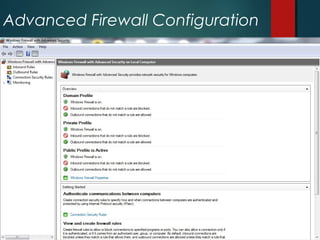
Advanced Firewall Configuration
19
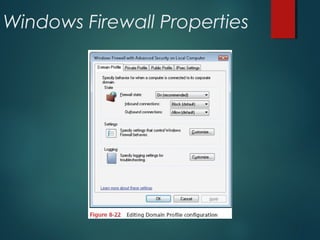
Windows Firewall Properties
20
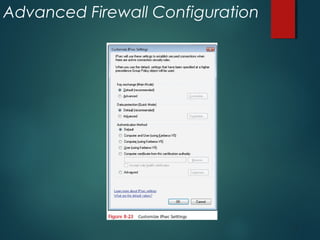
IPSec Settings
 IPsec is a system for securing and authenticating IP-based
network connections
 IPsec defaults - you can configure
 Key exchange protocols
 Data protection protocols
 Authentication Method
21
Advanced Firewall Configuration
22
Advanced Firewall
Configuration
 View and Edit Firewall Rules
 A large number of inbound and outbound rules are created by
default in Windows Vista
23
Advanced Firewall Configuration
24
Advanced Firewall Configuration
 View and Edit Firewall Rules
 You modify an existing rule by opening its properties
 Tabs in the properties of an outbound rule
 General
 Programs and Services
 Computers
 Protocols and Ports
 Scope
 Advanced
 Create New Firewall Rules
 A wizard guides you through the process
25
Advanced Firewall Configuration
26
Advanced Firewall Configuration
 Create New Firewall Rules
 Rule types you can create with the Outbound Rule Wizard
 Program
 Port
 Predefined
 Custom
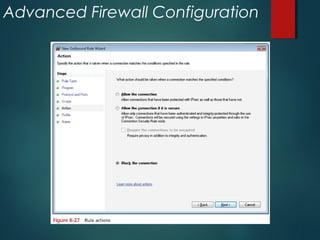
 Actions for a rule
 Allow the connection
 Allow the connection if it is secure
 Block the connection
27
Advanced Firewall Configuration
28
Advanced Firewall Configuration
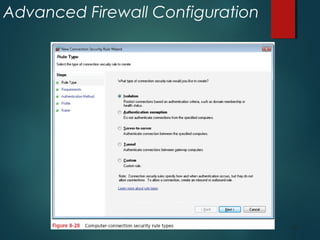
 Create New Computer-Connection Security Rules
 Use IPsec to authenticate and secure communication between
two computers
 Security rule types
 Isolation
 Authentication exemption
 Server-to-server
 Tunnel
 Custom
29
Advanced Firewall Configuration
30
Advanced Firewall Configuration
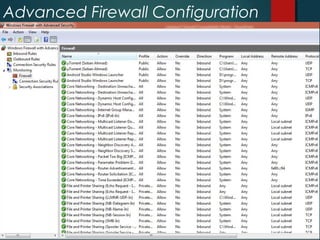
 Monitor Windows Firewall Rules and Connections
 Firewall node allows you to see rules that are enabled in one
screen
 Connection Security node allows you to see the computer
connection security rules that are enabled and any security
associations that are active
 Security association
 Rules for communication between two computers
31
Advanced Firewall Configuration
Windows 7 firewall & its configuration

Windows 7 firewall & its configuration

  • 1.
    Windows Firewall Windows Firewall Presentedby : Soban Ahmad 036 Waqar-ul-Malik 050
  • 2.
    Our Discussing topics What is a firewall?  Firewall types  How a firewall works  Default firewall behavior  Windows 7 firewall features  Configuring Windows 7 firewall
  • 3.
    What is afirewall  A firewall is software or hardware that helps prevent hackers and some types of malware from getting to your PC through a network or the Internet. It does this by checking the info that’s coming from the Internet or a network and then either blocking it or allowing it to pass through to your PC.
  • 4.
    Firewall Types Following arethe types of Firewall Types  Packet filtering  stateful  proxy Packet filtering makes each filtering decision on a packet by packet basis without regard to previous packets in any directon Stateful firewall keeps track of packet flows and filters based on flow information Proxy firewall works on a per-application basis. User sends to proxy, proxy creates new packet sourced from proxy.
  • 5.
    Firewall Types  Network-basedvs host-based  Network-based runs a router, multi-layer switch or dedicated firewall  Host-based firewall runs on computer running OS such as Windows 7 or UNIX  Hardware vs software firewall  Hardware firewall chassis designed for specifically to operate as a firewall; highest performance
  • 6.
    6 Windows Firewall  Host-based,stateful software firewall  Evaluates each packet as it arrives or leaves and determines whether that packet is allowed or denied based on flow  Windows 7 firewall is improved over XP version
  • 7.
    Default Firewall Behavior Default is to allow all outbound traffic and response inbound traffic; deny all other inbound traffic
  • 8.
    How Firewall Works Incoming packet is inspected and compared against a list of allowed traffic.  If packet matches a list entry, packet passed to TCP/IP protocol for further processing.  If the packet does not match a list entry then packet is discarded  If logging is enabled, Windows creates an entry in the Firewall logging file
  • 9.
    How List isPopulated  When enabled connection sends a packet, the firewall creates an entry in the list for response traffic.  Allow rules can be manually created with Advanced Security.
  • 10.
    10 Windows 7 Firewall Windows Firewall features  Inbound filtering  Outbound filtering  Firewall rules combined with IPsec rules  Support for complex rules  Support for logging
  • 11.
    Locations and theFirewall  Windows Firewall with Advanced Security is a network location aware application  Windows 7 stores the firewall properties based on location types  Configuration for each location type is called a profile  In each profile you can:  Enable or disable Windows Firewall  Configure inbound and/or outbound connections  Customize logging and other settings
  • 12.
    Locations and Firewall Settings As the network location connected to changes, the Windows Firewall profile changes.  Windows Firewall can therefore automatically allow incoming traffic for a specific desktop management tool when the computer is on a domain network but block similar traffic when the computer is connected to public or private networks.
  • 13.
    Locations and Firewall Settings Location types: domain, public, and private.  Domain - the connection is authenticated to a domain controller for the domain of which it is a member.  By default, all other networks are initially classified as public networks.  User can identify the network as either public or private.  Public profile: For use when in locations such as airports or coffee shops.  Private profile: For use when connected at a home or office and behind an edge device.  To classify a network as a private network, the user must have administrator credentials.
  • 14.
    Locations and Firewall Settings While a computer may be connected to multiple network locations at the same time, only one profile can be active at a time. The active profile is determined as follows:  If all interfaces are authenticated to the domain controller for the domain of which the computer is a member, the domain profile is applied.  If at least one interface is connected to a private network location and all other interfaces are either authenticated to the domain controller or are connected to private network locations, the private profile is applied.  Otherwise, the public profile is applied.
  • 15.
    Configuring Windows Firewall  ControlPanel – Windows Firewall
  • 16.
  • 17.
    17 Advanced Firewall Configuration Allows you to configure more complex rules, outgoing filtering, and IPsec rules
  • 18.
  • 19.
  • 20.
    20 IPSec Settings  IPsecis a system for securing and authenticating IP-based network connections  IPsec defaults - you can configure  Key exchange protocols  Data protection protocols  Authentication Method
  • 21.
  • 22.
    22 Advanced Firewall Configuration  Viewand Edit Firewall Rules  A large number of inbound and outbound rules are created by default in Windows Vista
  • 23.
  • 24.
    24 Advanced Firewall Configuration View and Edit Firewall Rules  You modify an existing rule by opening its properties  Tabs in the properties of an outbound rule  General  Programs and Services  Computers  Protocols and Ports  Scope  Advanced  Create New Firewall Rules  A wizard guides you through the process
  • 25.
  • 26.
    26 Advanced Firewall Configuration Create New Firewall Rules  Rule types you can create with the Outbound Rule Wizard  Program  Port  Predefined  Custom  Actions for a rule  Allow the connection  Allow the connection if it is secure  Block the connection
  • 27.
  • 28.
    28 Advanced Firewall Configuration Create New Computer-Connection Security Rules  Use IPsec to authenticate and secure communication between two computers  Security rule types  Isolation  Authentication exemption  Server-to-server  Tunnel  Custom
  • 29.
  • 30.
    30 Advanced Firewall Configuration Monitor Windows Firewall Rules and Connections  Firewall node allows you to see rules that are enabled in one screen  Connection Security node allows you to see the computer connection security rules that are enabled and any security associations that are active  Security association  Rules for communication between two computers
  • 31.