Literature Review
Antti Ollila 24.2.2016
KOG520
University of Jyväskylä
 Computers…
◦ …are logical
◦ …are bad at making informed decisions
◦ …do not make mistakes
◦ …are designed, operated, built and maintained…
◦ … by humans
(Saariluoma 2013, TJTA103 opening lecture)
 Humans can be…
◦ …unskilled
◦ …taking unnecessary risks
◦ …careless
◦ …tired, sick, etc.
 Humans are needed to make technology work
(Saariluoma 2013, TJTA103 opening lecture)
 Happens everywhere
◦ and all the time
 Email to wrong recipient
 Cashier giving too much change
 More complexity, bigger impact
◦ UK: disclosed personal information on 25m citizens
◦ Italy: Costa Concordia
◦ Finland: Nokia Water Crisis
 3rd most significant threat in 2003(Whitman)
 46% of cyber security incidents in UK 2011-
2012(Lee)
 Weakest link in the cyber security chain
Whitman, M. E. (2003). Enemy at the gate: threats to information security. Communications of the ACM,
46(8), 91-95.
Lee, M. G. (2012, October). Securing the human to protect the system: Human factors in cyber security. In
System Safety, incorporating the Cyber Security Conference 2012, 7th IET International Conference on (pp.
1-5). IET.
 Google Scholar, IEEEXplore, sciencedirect
◦ ”Cyber Security Human Error”
◦ ”Cyber Security Human Factor”
◦ ”Usable Security”
◦ ”Cyber Security Usability”
◦ Years 2010-2016
 Forward searching from articles found or read
before
 Toward Automated Reduction of Human Errors based on
Cognitive Analysis (Miyamoto, D. & Takahashi, T. 2013)
 Securing the Human to Protect the System: Human Factors
in Cyber Security (Lee, M.G. 2012)
 Measuring the Human Factor of Cyber Security (Bowen et
al. 2011)
 Alice in Warningland: A Large-Scale Field Study of Browser
Security Warning Effectiveness (Akhawe, D. & Felt, A. P.
2013)
 Guidelines for Usable Cybersecurity: Past and Present
(Nurse et al. 2011)
 Framework to gather data to understand
human error
 Less biased than questionnaires
 Cognitive psychology
◦ Monitor eye movement and facial skin temperature
when performing tasks
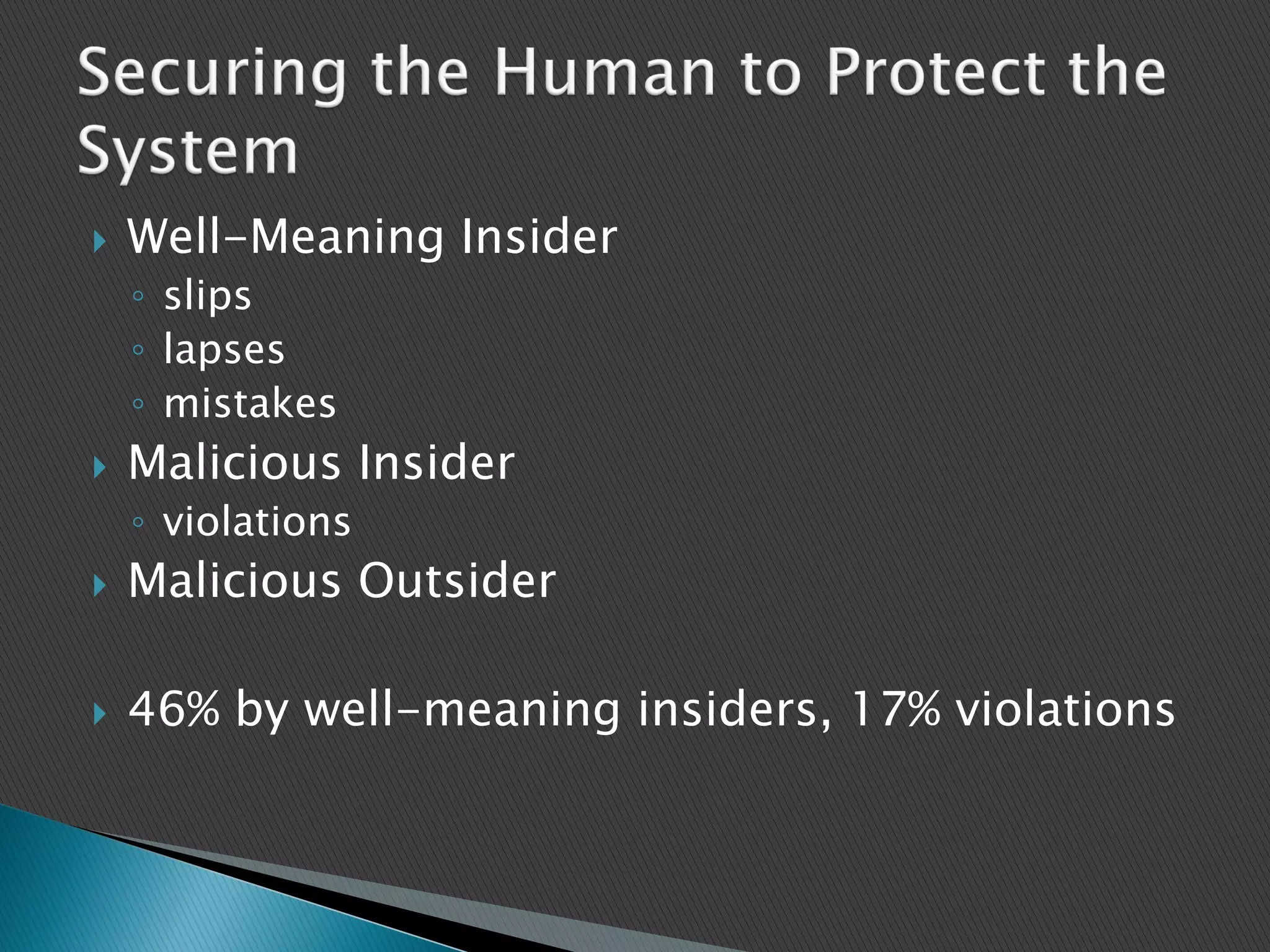
 Well-Meaning Insider
◦ slips
◦ lapses
◦ mistakes
 Malicious Insider
◦ violations
 Malicious Outsider
 46% by well-meaning insiders, 17% violations
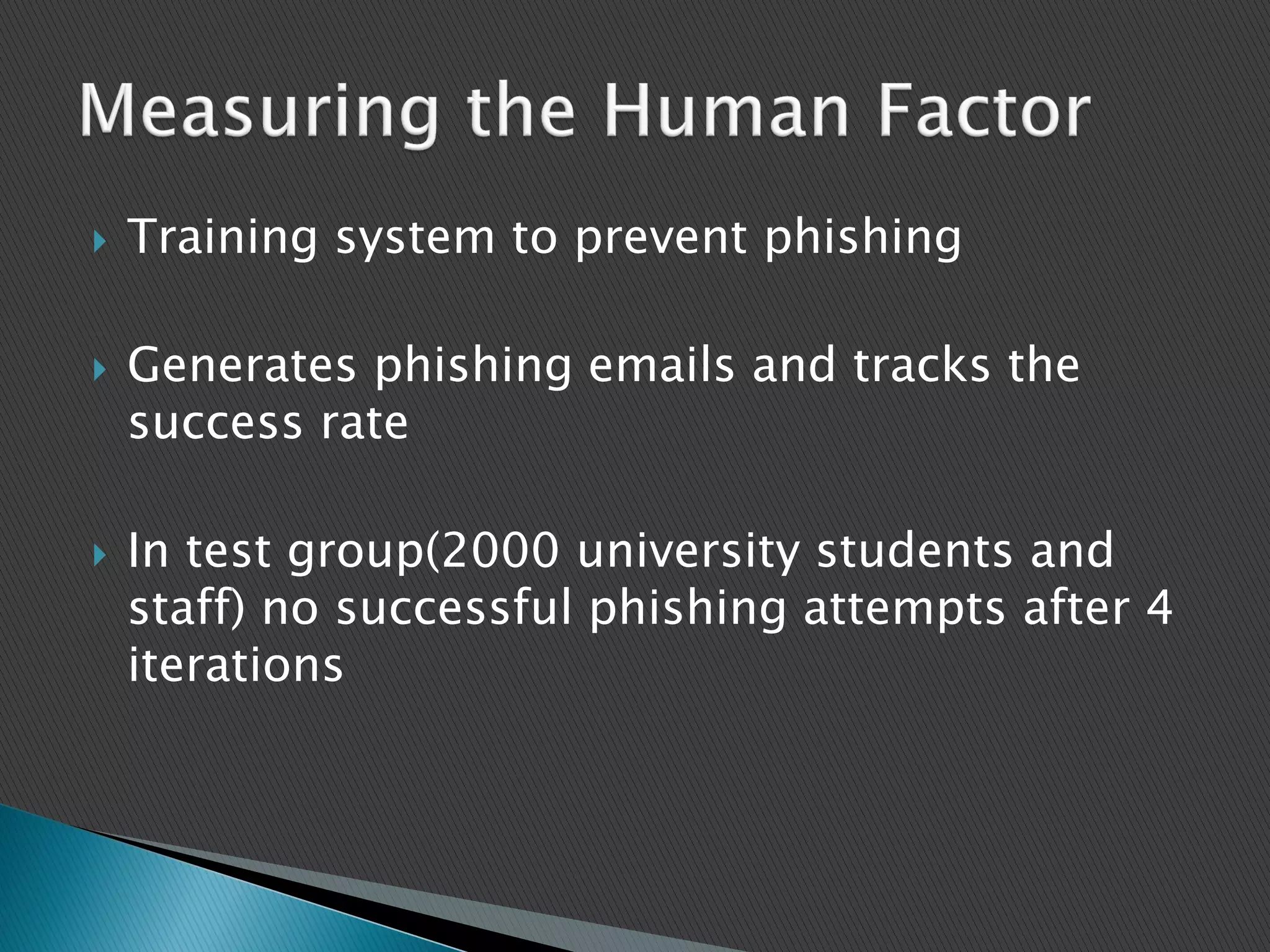
 Training system to prevent phishing
 Generates phishing emails and tracks the
success rate
 In test group(2000 university students and
staff) no successful phishing attempts after 4
iterations
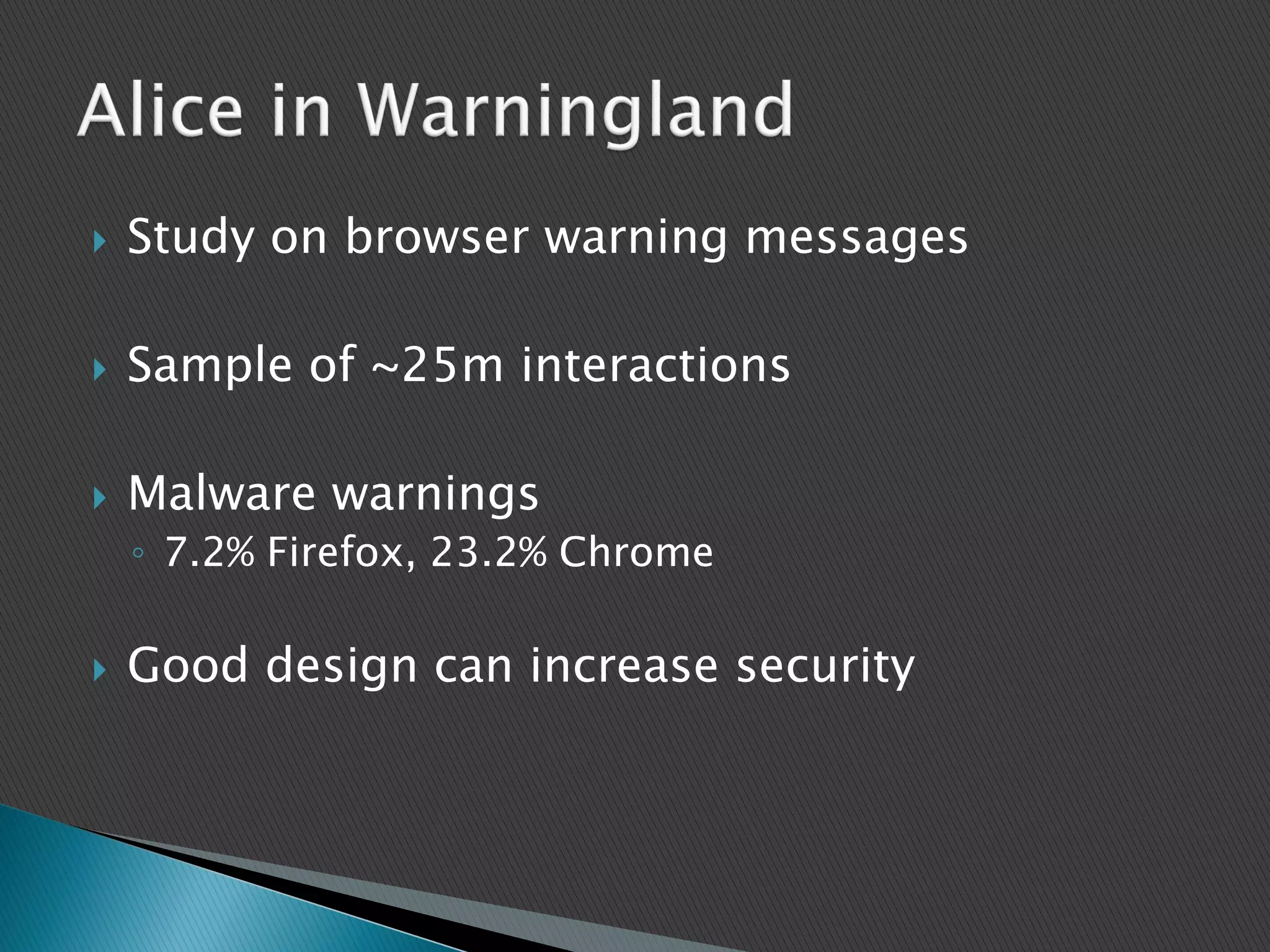
 Study on browser warning messages
 Sample of ~25m interactions
 Malware warnings
◦ 7.2% Firefox, 23.2% Chrome
 Good design can increase security
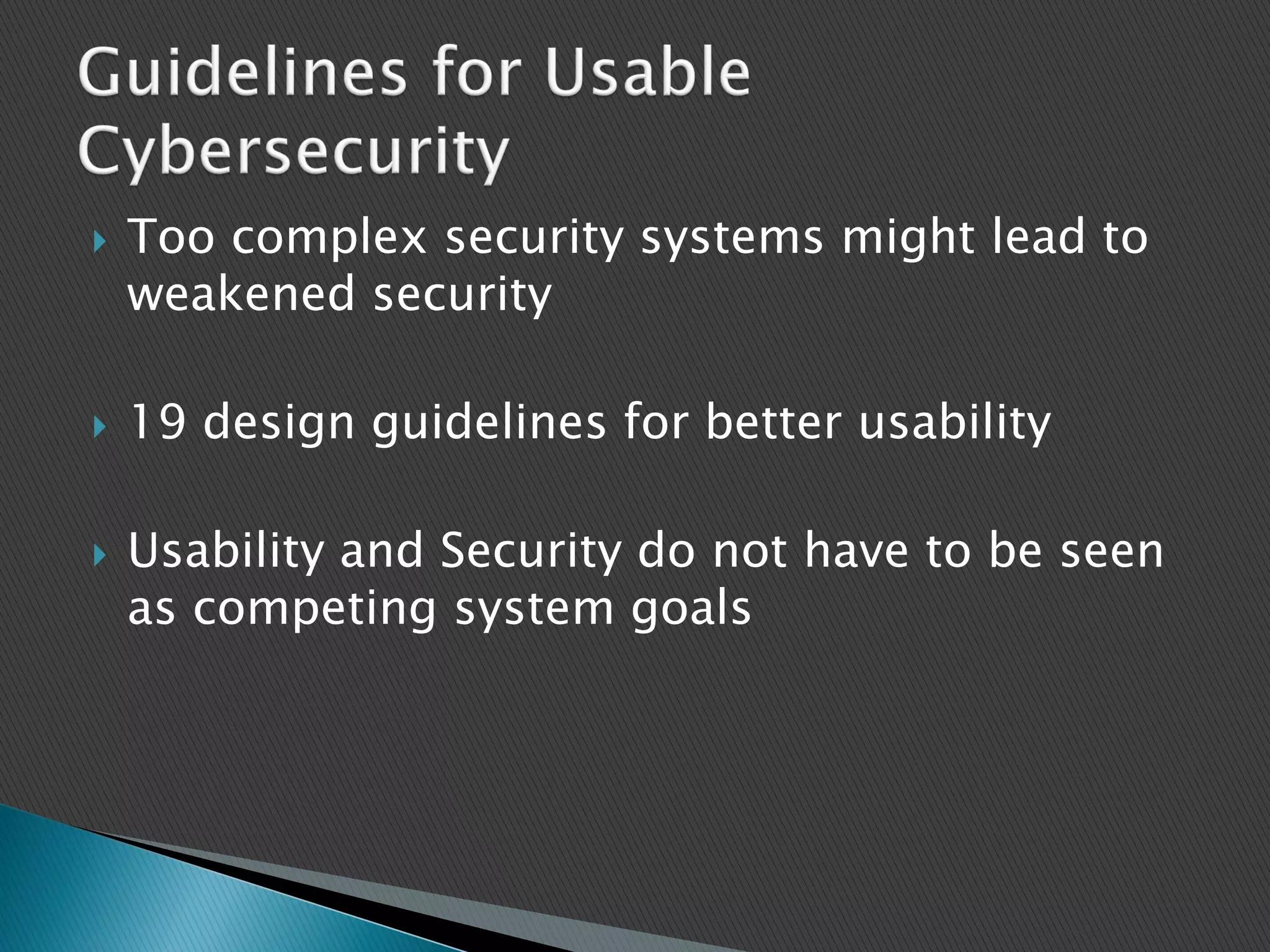
 Too complex security systems might lead to
weakened security
 19 design guidelines for better usability
 Usability and Security do not have to be seen
as competing system goals
 Security is rarely primary task
 Not everyone is a security specialist
◦ And also the experts make errors
 Human error is significant threat to
information security...
 ...but it can be mitigated to some extent by
design and training
 ”Companies spend millions of dollars on
firewalls and secure access devices, and it’s
money wasted because none of these
measures address the weakest link in the
security chain: the people who use,
administer and operate computer systems”
-Kevin Mitnick

Human Error in Cyber Security

  • 1.
    Literature Review Antti Ollila24.2.2016 KOG520 University of Jyväskylä
  • 2.
     Computers… ◦ …arelogical ◦ …are bad at making informed decisions ◦ …do not make mistakes ◦ …are designed, operated, built and maintained… ◦ … by humans (Saariluoma 2013, TJTA103 opening lecture)
  • 3.
     Humans canbe… ◦ …unskilled ◦ …taking unnecessary risks ◦ …careless ◦ …tired, sick, etc.  Humans are needed to make technology work (Saariluoma 2013, TJTA103 opening lecture)
  • 4.
     Happens everywhere ◦and all the time  Email to wrong recipient  Cashier giving too much change  More complexity, bigger impact ◦ UK: disclosed personal information on 25m citizens ◦ Italy: Costa Concordia ◦ Finland: Nokia Water Crisis
  • 5.
     3rd mostsignificant threat in 2003(Whitman)  46% of cyber security incidents in UK 2011- 2012(Lee)  Weakest link in the cyber security chain Whitman, M. E. (2003). Enemy at the gate: threats to information security. Communications of the ACM, 46(8), 91-95. Lee, M. G. (2012, October). Securing the human to protect the system: Human factors in cyber security. In System Safety, incorporating the Cyber Security Conference 2012, 7th IET International Conference on (pp. 1-5). IET.
  • 6.
     Google Scholar,IEEEXplore, sciencedirect ◦ ”Cyber Security Human Error” ◦ ”Cyber Security Human Factor” ◦ ”Usable Security” ◦ ”Cyber Security Usability” ◦ Years 2010-2016  Forward searching from articles found or read before
  • 7.
     Toward AutomatedReduction of Human Errors based on Cognitive Analysis (Miyamoto, D. & Takahashi, T. 2013)  Securing the Human to Protect the System: Human Factors in Cyber Security (Lee, M.G. 2012)  Measuring the Human Factor of Cyber Security (Bowen et al. 2011)  Alice in Warningland: A Large-Scale Field Study of Browser Security Warning Effectiveness (Akhawe, D. & Felt, A. P. 2013)  Guidelines for Usable Cybersecurity: Past and Present (Nurse et al. 2011)
  • 8.
     Framework togather data to understand human error  Less biased than questionnaires  Cognitive psychology ◦ Monitor eye movement and facial skin temperature when performing tasks
  • 9.
     Well-Meaning Insider ◦slips ◦ lapses ◦ mistakes  Malicious Insider ◦ violations  Malicious Outsider  46% by well-meaning insiders, 17% violations
  • 10.
     Training systemto prevent phishing  Generates phishing emails and tracks the success rate  In test group(2000 university students and staff) no successful phishing attempts after 4 iterations
  • 11.
     Study onbrowser warning messages  Sample of ~25m interactions  Malware warnings ◦ 7.2% Firefox, 23.2% Chrome  Good design can increase security
  • 12.
     Too complexsecurity systems might lead to weakened security  19 design guidelines for better usability  Usability and Security do not have to be seen as competing system goals
  • 13.
     Security israrely primary task  Not everyone is a security specialist ◦ And also the experts make errors  Human error is significant threat to information security...  ...but it can be mitigated to some extent by design and training
  • 14.
     ”Companies spendmillions of dollars on firewalls and secure access devices, and it’s money wasted because none of these measures address the weakest link in the security chain: the people who use, administer and operate computer systems” -Kevin Mitnick