Fire walls
Most organizations today have an internal network that interconnects their 
computer systems. But, the Internet is inherently an insecure network. An 
Internet connection effectively extends the enterprise network to include all 
30,000+ other Internet-connected networks. This breaches the physical 
security perimeter between the enterprise network and the outside world.
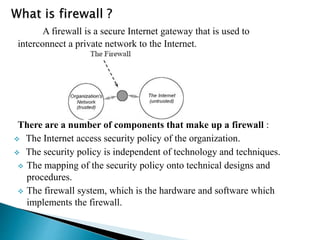
A firewall is a secure Internet gateway that is used to 
interconnect a private network to the Internet. 
There are a number of components that make up a firewall : 
 The Internet access security policy of the organization. 
 The security policy is independent of technology and techniques. 
 The mapping of the security policy onto technical designs and 
procedures. 
 The firewall system, which is the hardware and software which 
implements the firewall.
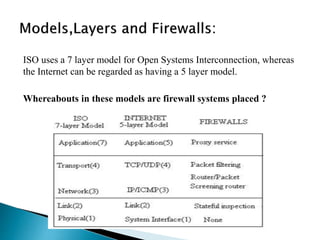
ISO uses a 7 layer model for Open Systems Interconnection, whereas 
the Internet can be regarded as having a 5 layer model. 
Whereabouts in these models are firewall systems placed ?
Packet filtering routers were the first type of firewall to be invented. A 
packet filtering router should be able to filter IP packets based on the 
following four fields: 
 source IP address 
 destination IP address 
 TCP/UDP source port 
 TCP/UDP destination port 
Filtering is used to: 
 block connections from specific hosts or networks 
 block connections to specific hosts or networks 
 block connections to specific ports 
 block connections from specific ports
This is a software module that runs in the operating system of a 
Windows or Unix PC firewall, and inspects the packets that are 
arriving. The inspection is driven by security rules configured into the 
machine by the security officer. Headers from all seven layers of the 
ISO model are inspected, and information about the packets is fed into 
dynamic state tables that store information about the connection.
An application level firewall is created by installing a (bastion) host 
computer running the appropriate application(s), between the packet 
filtering router and the intranet. 
 FTP : 
poses a security threat because confidential information may be 
exported from the organization. 
 TELNET: 
Allows users to login to remote machines. 
 HTTP : 
Accesses remote web pages.
With content filtering, the application data is handed over to a 
content filtering server that unpacks the data to see what is inside, and 
harmful content is then disposed. 
Authentication: 
It has already been noted that simple passwords can not be relied 
upon to provide authentication information over the Internet. 
TYPES: 
1. SOCKS Authentication 
2. RADIUS 
3. Hardware Based One Time Passwords
SOCKS provide an authentication layer for the firewall that can be 
used by all application proxis. Calls come into the SOCKS service, are 
authenticated by it, then a call is opened up to the application proxy which 
does further application level filtering before making a call to the 
application on the intranet. 
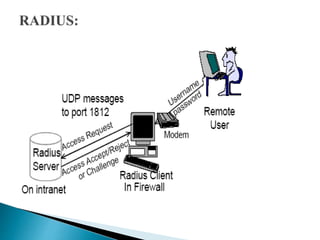
2.RADIUS: 
The Remote Authentication Dial In User Service (RADIUS). The mode 
of operation is as follows: 
1. The user dials into the network via a modem. 
2. The receiving computer acts as a RADIUS client, and will usually 
ask the user for username and password. 
3. The RADIUS client sends an Access Request message to the 
RADIUS server including the username and password.
An increasingly common authentication method is the use of 
one-time passwords. 
There are two popular variants of one-time passwords. One is 
based on a challenge response mechanism, the other on synchronized 
clocks.
The Dual Homed Gateway: 
This is a secure firewall design comprising an application 
gateway and a packet filtering router. It is called “dual homed”. 
The Screened Host Gateway: 
The screened host gateway is similar to the above, but more 
flexible and less secure, since trusted traffic may pass directly from the 
Internet into the private network, thereby bypassing the application gateway. 
The Screened Subnet Gateway: 
This configuration creates a small isolated network between the 
Internet and the corporate network, which is sometimes referred to as the 
demilitarized zone (DMZ). 
Double Proxying and a DMZ: 
It is more secure that the screened subnet seen in the previous 
section. It is used by a bank to protect its internal network from direct access 
from the Internet.
The concepts which we have provided prove 
the versatile nature of firewall and provide apprehensive idea of 
choosing the suitable configuration.
Firewalls

Firewalls

  • 1.
  • 2.
    Most organizations todayhave an internal network that interconnects their computer systems. But, the Internet is inherently an insecure network. An Internet connection effectively extends the enterprise network to include all 30,000+ other Internet-connected networks. This breaches the physical security perimeter between the enterprise network and the outside world.
  • 3.
    A firewall isa secure Internet gateway that is used to interconnect a private network to the Internet. There are a number of components that make up a firewall :  The Internet access security policy of the organization.  The security policy is independent of technology and techniques.  The mapping of the security policy onto technical designs and procedures.  The firewall system, which is the hardware and software which implements the firewall.
  • 4.
    ISO uses a7 layer model for Open Systems Interconnection, whereas the Internet can be regarded as having a 5 layer model. Whereabouts in these models are firewall systems placed ?
  • 5.
    Packet filtering routerswere the first type of firewall to be invented. A packet filtering router should be able to filter IP packets based on the following four fields:  source IP address  destination IP address  TCP/UDP source port  TCP/UDP destination port Filtering is used to:  block connections from specific hosts or networks  block connections to specific hosts or networks  block connections to specific ports  block connections from specific ports
  • 6.
    This is asoftware module that runs in the operating system of a Windows or Unix PC firewall, and inspects the packets that are arriving. The inspection is driven by security rules configured into the machine by the security officer. Headers from all seven layers of the ISO model are inspected, and information about the packets is fed into dynamic state tables that store information about the connection.
  • 7.
    An application levelfirewall is created by installing a (bastion) host computer running the appropriate application(s), between the packet filtering router and the intranet.  FTP : poses a security threat because confidential information may be exported from the organization.  TELNET: Allows users to login to remote machines.  HTTP : Accesses remote web pages.
  • 8.
    With content filtering,the application data is handed over to a content filtering server that unpacks the data to see what is inside, and harmful content is then disposed. Authentication: It has already been noted that simple passwords can not be relied upon to provide authentication information over the Internet. TYPES: 1. SOCKS Authentication 2. RADIUS 3. Hardware Based One Time Passwords
  • 9.
    SOCKS provide anauthentication layer for the firewall that can be used by all application proxis. Calls come into the SOCKS service, are authenticated by it, then a call is opened up to the application proxy which does further application level filtering before making a call to the application on the intranet. 2.RADIUS: The Remote Authentication Dial In User Service (RADIUS). The mode of operation is as follows: 1. The user dials into the network via a modem. 2. The receiving computer acts as a RADIUS client, and will usually ask the user for username and password. 3. The RADIUS client sends an Access Request message to the RADIUS server including the username and password.
  • 11.
    An increasingly commonauthentication method is the use of one-time passwords. There are two popular variants of one-time passwords. One is based on a challenge response mechanism, the other on synchronized clocks.
  • 12.
    The Dual HomedGateway: This is a secure firewall design comprising an application gateway and a packet filtering router. It is called “dual homed”. The Screened Host Gateway: The screened host gateway is similar to the above, but more flexible and less secure, since trusted traffic may pass directly from the Internet into the private network, thereby bypassing the application gateway. The Screened Subnet Gateway: This configuration creates a small isolated network between the Internet and the corporate network, which is sometimes referred to as the demilitarized zone (DMZ). Double Proxying and a DMZ: It is more secure that the screened subnet seen in the previous section. It is used by a bank to protect its internal network from direct access from the Internet.
  • 13.
    The concepts whichwe have provided prove the versatile nature of firewall and provide apprehensive idea of choosing the suitable configuration.