Wind as a Geomorphic Agent
Wind is common in arid desert regions because:
Air near the surface is heated and rises, cooler
air comes in to replace hot rising air and this
movement of air results in winds.
Arid regions have little or no soil moisture to
hold rock and mineral fragments.
Wind has the ability to transport, erode, and
deposit sediment. The deserts having mobile
sands are called “ergs” ( Arabic word- means
region of shifting sands)
• Sediment Transportation by Wind
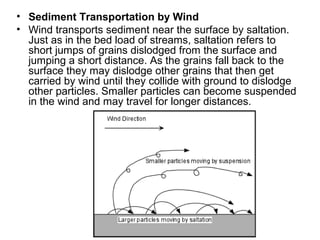
• Wind transports sediment near the surface by saltation.
Just as in the bed load of streams, saltation refers to
short jumps of grains dislodged from the surface and
jumping a short distance. As the grains fall back to the
surface they may dislodge other grains that then get
carried by wind until they collide with ground to dislodge
other particles. Smaller particles can become suspended
in the wind and may travel for longer distances.
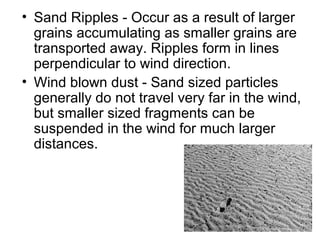
• Sand Ripples - Occur as a result of larger
grains accumulating as smaller grains are
transported away. Ripples form in lines
perpendicular to wind direction.
• Wind blown dust - Sand sized particles
generally do not travel very far in the wind,
but smaller sized fragments can be
suspended in the wind for much larger
distances.
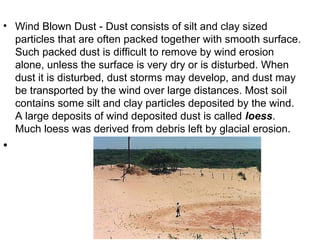
• Wind Blown Dust - Dust consists of silt and clay sized
particles that are often packed together with smooth surface.
Such packed dust is difficult to remove by wind erosion
alone, unless the surface is very dry or is disturbed. When
dust it is disturbed, dust storms may develop, and dust may
be transported by the wind over large distances. Most soil
contains some silt and clay particles deposited by the wind.
A large deposits of wind deposited dust is called loess.
Much loess was derived from debris left by glacial erosion.
•
• Wind Erosion
• Wind can be effective agent of erosion anywhere that it is strong
enough to act. Wind can erode by deflation and abrasion.
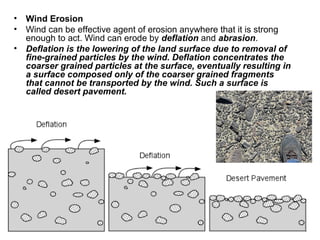
• Deflation is the lowering of the land surface due to removal of
fine-grained particles by the wind. Deflation concentrates the
coarser grained particles at the surface, eventually resulting in
a surface composed only of the coarser grained fragments
that cannot be transported by the wind. Such a surface is
called desert pavement.
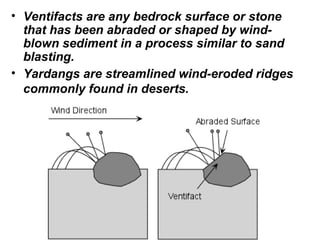
• Ventifacts are any bedrock surface or stone
that has been abraded or shaped by wind-
blown sediment in a process similar to sand
blasting.
• Yardangs are streamlined wind-eroded ridges
commonly found in deserts.
• Wind Deposits
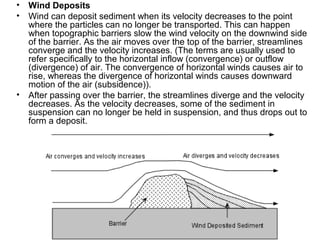
• Wind can deposit sediment when its velocity decreases to the point
where the particles can no longer be transported. This can happen
when topographic barriers slow the wind velocity on the downwind side
of the barrier. As the air moves over the top of the barrier, streamlines
converge and the velocity increases. (The terms are usually used to
refer specifically to the horizontal inflow (convergence) or outflow
(divergence) of air. The convergence of horizontal winds causes air to
rise, whereas the divergence of horizontal winds causes downward
motion of the air (subsidence)).
• After passing over the barrier, the streamlines diverge and the velocity
decreases. As the velocity decreases, some of the sediment in
suspension can no longer be held in suspension, and thus drops out to
form a deposit.
• Topographic barriers can be such things as rocks,
vegetation, and human made structures that protrude above
the land surface.
• Sand Dunes - Sand dunes form when there is (1) a ready
supply of sand, (2) a steady wind, and (3) some kind of
obstacle such as vegetation, rocks, or fences, to trap
some of the sand. Sand dunes form when moving air
slows down on the downwind side of an obstacle. The
sand grains drop out and form a mound that becomes a
dune.
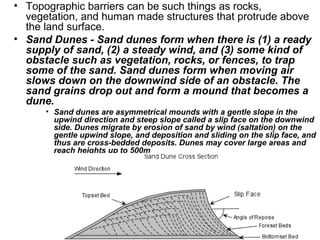
• Sand dunes are asymmetrical mounds with a gentle slope in the
upwind direction and steep slope called a slip face on the downwind
side. Dunes migrate by erosion of sand by wind (saltation) on the
gentle upwind slope, and deposition and sliding on the slip face, and
thus are cross-bedded deposits. Dunes may cover large areas and
reach heights up to 500m
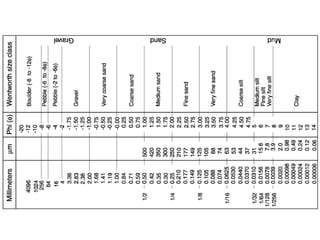
• Loess is a geologic term that refers to deposits of silt
(sediment with particles 2-64 microns in diameter) that
have been laid down by wind action (aeolian activity to
geologists).
• Dust in Ocean Sediments and Glacial Ice. - Dust can be
transported by the wind and by glacial ice onto the
surface of the oceans. As a result, much of the fine
grained continent-derived sediment that reaches the
abyssal plains of the oceans was originally transported
by winds or icebergs.
• Volcanic Ash - During explosive volcanic eruptions, large
quantities of dust-sized tephra can be ejected into the
atmosphere. If ejected high enough, such ash can
become suspended in the wind and carried for long
distances. Eventually it will settle out to become wind-
deposited sediment.
Wind.agent- Geomorhology Chapter

Wind.agent- Geomorhology Chapter

  • 1.
    Wind as aGeomorphic Agent Wind is common in arid desert regions because: Air near the surface is heated and rises, cooler air comes in to replace hot rising air and this movement of air results in winds. Arid regions have little or no soil moisture to hold rock and mineral fragments. Wind has the ability to transport, erode, and deposit sediment. The deserts having mobile sands are called “ergs” ( Arabic word- means region of shifting sands)
  • 2.
    • Sediment Transportationby Wind • Wind transports sediment near the surface by saltation. Just as in the bed load of streams, saltation refers to short jumps of grains dislodged from the surface and jumping a short distance. As the grains fall back to the surface they may dislodge other grains that then get carried by wind until they collide with ground to dislodge other particles. Smaller particles can become suspended in the wind and may travel for longer distances.
  • 3.
    • Sand Ripples- Occur as a result of larger grains accumulating as smaller grains are transported away. Ripples form in lines perpendicular to wind direction. • Wind blown dust - Sand sized particles generally do not travel very far in the wind, but smaller sized fragments can be suspended in the wind for much larger distances.
  • 4.
    • Wind BlownDust - Dust consists of silt and clay sized particles that are often packed together with smooth surface. Such packed dust is difficult to remove by wind erosion alone, unless the surface is very dry or is disturbed. When dust it is disturbed, dust storms may develop, and dust may be transported by the wind over large distances. Most soil contains some silt and clay particles deposited by the wind. A large deposits of wind deposited dust is called loess. Much loess was derived from debris left by glacial erosion. •
  • 5.
    • Wind Erosion •Wind can be effective agent of erosion anywhere that it is strong enough to act. Wind can erode by deflation and abrasion. • Deflation is the lowering of the land surface due to removal of fine-grained particles by the wind. Deflation concentrates the coarser grained particles at the surface, eventually resulting in a surface composed only of the coarser grained fragments that cannot be transported by the wind. Such a surface is called desert pavement.
  • 6.
    • Ventifacts areany bedrock surface or stone that has been abraded or shaped by wind- blown sediment in a process similar to sand blasting. • Yardangs are streamlined wind-eroded ridges commonly found in deserts.
  • 7.
    • Wind Deposits •Wind can deposit sediment when its velocity decreases to the point where the particles can no longer be transported. This can happen when topographic barriers slow the wind velocity on the downwind side of the barrier. As the air moves over the top of the barrier, streamlines converge and the velocity increases. (The terms are usually used to refer specifically to the horizontal inflow (convergence) or outflow (divergence) of air. The convergence of horizontal winds causes air to rise, whereas the divergence of horizontal winds causes downward motion of the air (subsidence)). • After passing over the barrier, the streamlines diverge and the velocity decreases. As the velocity decreases, some of the sediment in suspension can no longer be held in suspension, and thus drops out to form a deposit.
  • 8.
    • Topographic barrierscan be such things as rocks, vegetation, and human made structures that protrude above the land surface. • Sand Dunes - Sand dunes form when there is (1) a ready supply of sand, (2) a steady wind, and (3) some kind of obstacle such as vegetation, rocks, or fences, to trap some of the sand. Sand dunes form when moving air slows down on the downwind side of an obstacle. The sand grains drop out and form a mound that becomes a dune. • Sand dunes are asymmetrical mounds with a gentle slope in the upwind direction and steep slope called a slip face on the downwind side. Dunes migrate by erosion of sand by wind (saltation) on the gentle upwind slope, and deposition and sliding on the slip face, and thus are cross-bedded deposits. Dunes may cover large areas and reach heights up to 500m
  • 9.
    • Loess isa geologic term that refers to deposits of silt (sediment with particles 2-64 microns in diameter) that have been laid down by wind action (aeolian activity to geologists). • Dust in Ocean Sediments and Glacial Ice. - Dust can be transported by the wind and by glacial ice onto the surface of the oceans. As a result, much of the fine grained continent-derived sediment that reaches the abyssal plains of the oceans was originally transported by winds or icebergs. • Volcanic Ash - During explosive volcanic eruptions, large quantities of dust-sized tephra can be ejected into the atmosphere. If ejected high enough, such ash can become suspended in the wind and carried for long distances. Eventually it will settle out to become wind- deposited sediment.