A2GEOGRAPHY - COASTALENVIRONMENTS
8.2 CHARACTERISTICS AND FORMATION OF
COASTAL LANDFORMS
TOPIC 8.2
CHARACTERISTICS
AND FORMATION
OF COASTAL
LANDFORMS
Learners should be able to explain the formation of
erosional landforms:
cliffs and wave-cut platforms, caves, arches and stacks
Learners should be able to explain the formation of
depositional landforms:
beaches in cross section (profile) and plan, swash and drift
aligned beaches, simple and compound, spits, tombolos,
offshore bars, barrier beaches, coastal dunes, tidal
sedimentation in estuaries, coastal saltmarshes and
mangroves.
Learners should understand the role of sea level change in
the formation of coastal landforms.
CLIFFED COASTS
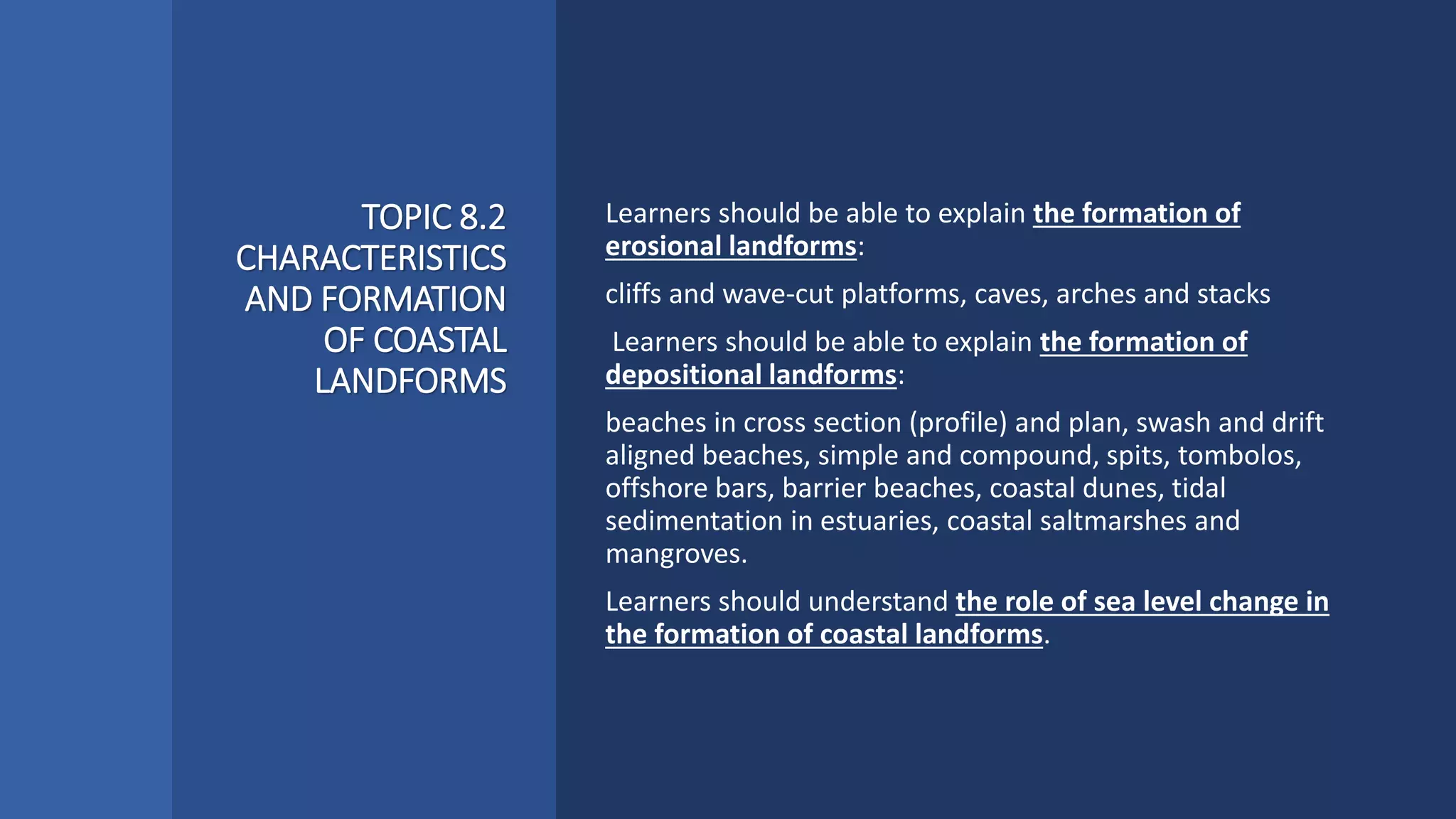
A cliffed coast, also called an abrasion coast, is a form of coast where the
action of marine waves has formed steep cliffs that may or may not be
precipitous.
ALLUVIAL
(FLAT) COASTS
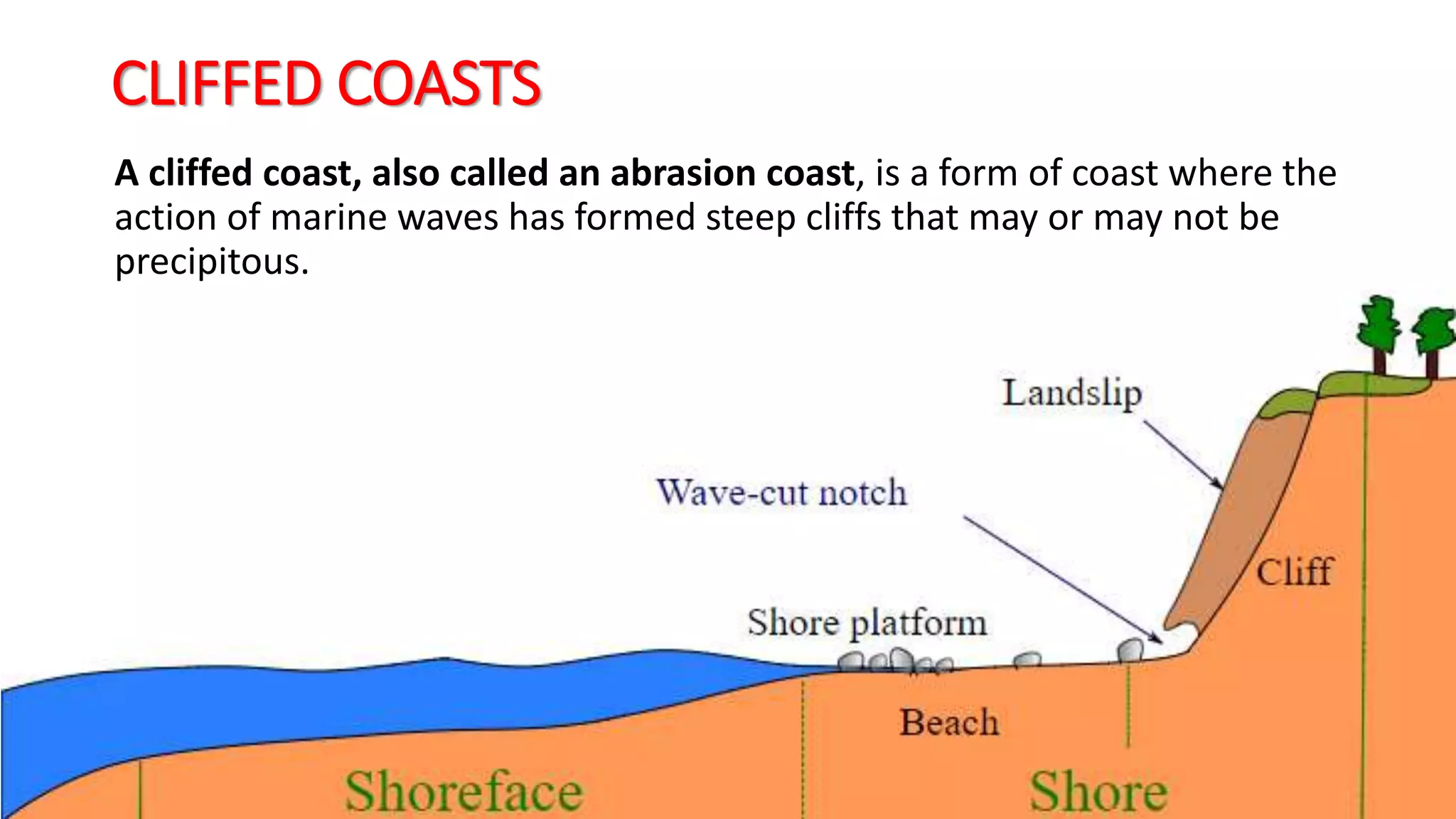
A cliffed coast is different than a flat or
alluvial coast.
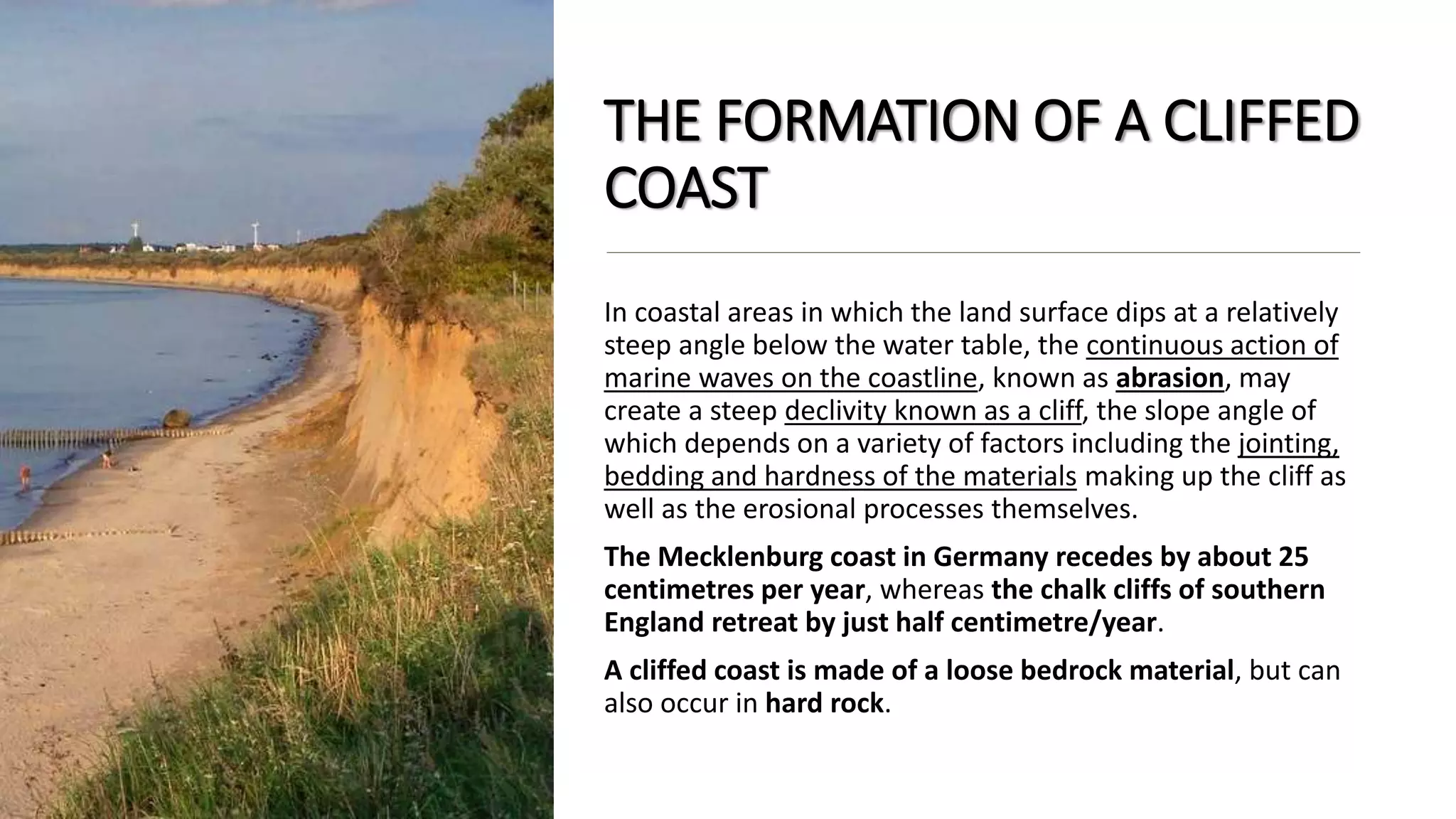
THE FORMATION OF A CLIFFED
COAST
In coastal areas in which the land surface dips at a relatively
steep angle below the water table, the continuous action of
marine waves on the coastline, known as abrasion, may
create a steep declivity known as a cliff, the slope angle of
which depends on a variety of factors including the jointing,
bedding and hardness of the materials making up the cliff as
well as the erosional processes themselves.
The Mecklenburg coast in Germany recedes by about 25
centimetres per year, whereas the chalk cliffs of southern
England retreat by just half centimetre/year.
A cliffed coast is made of a loose bedrock material, but can
also occur in hard rock.
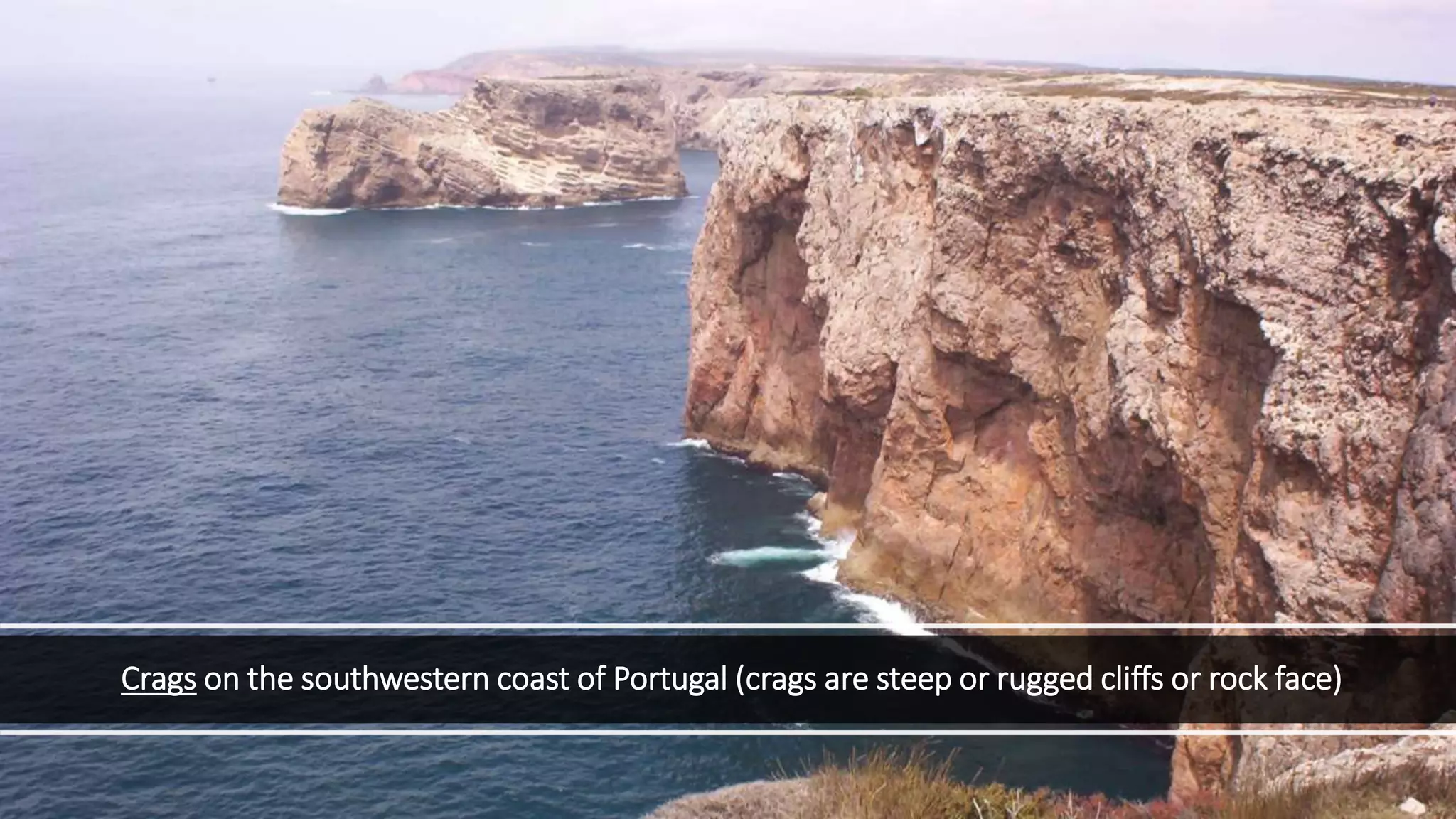
Crags on the southwestern coast of Portugal (crags are steep or rugged cliffs or rock face)
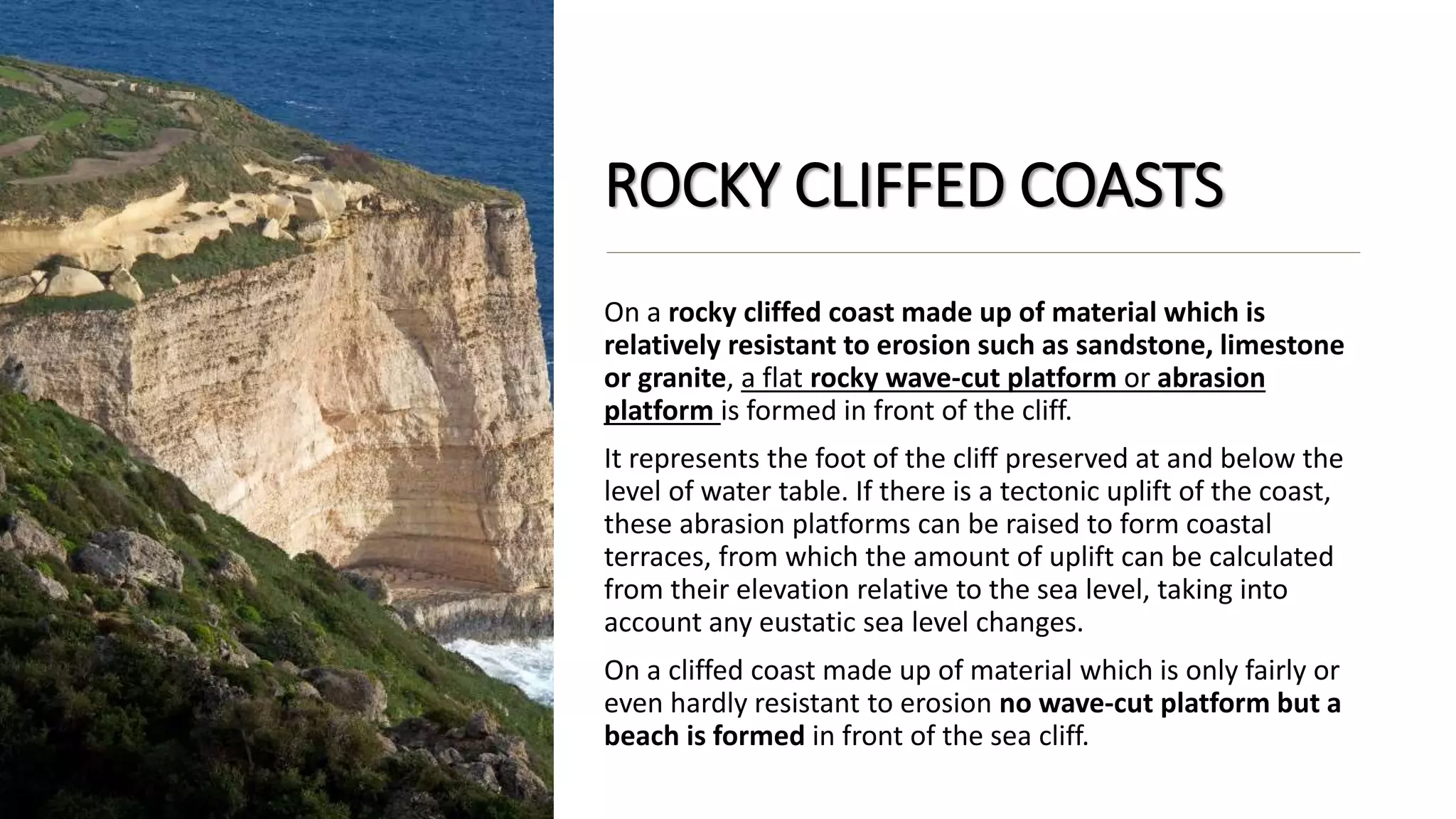
ROCKY CLIFFED COASTS
On a rocky cliffed coast made up of material which is
relatively resistant to erosion such as sandstone, limestone
or granite, a flat rocky wave-cut platform or abrasion
platform is formed in front of the cliff.
It represents the foot of the cliff preserved at and below the
level of water table. If there is a tectonic uplift of the coast,
these abrasion platforms can be raised to form coastal
terraces, from which the amount of uplift can be calculated
from their elevation relative to the sea level, taking into
account any eustatic sea level changes.
On a cliffed coast made up of material which is only fairly or
even hardly resistant to erosion no wave-cut platform but a
beach is formed in front of the sea cliff.
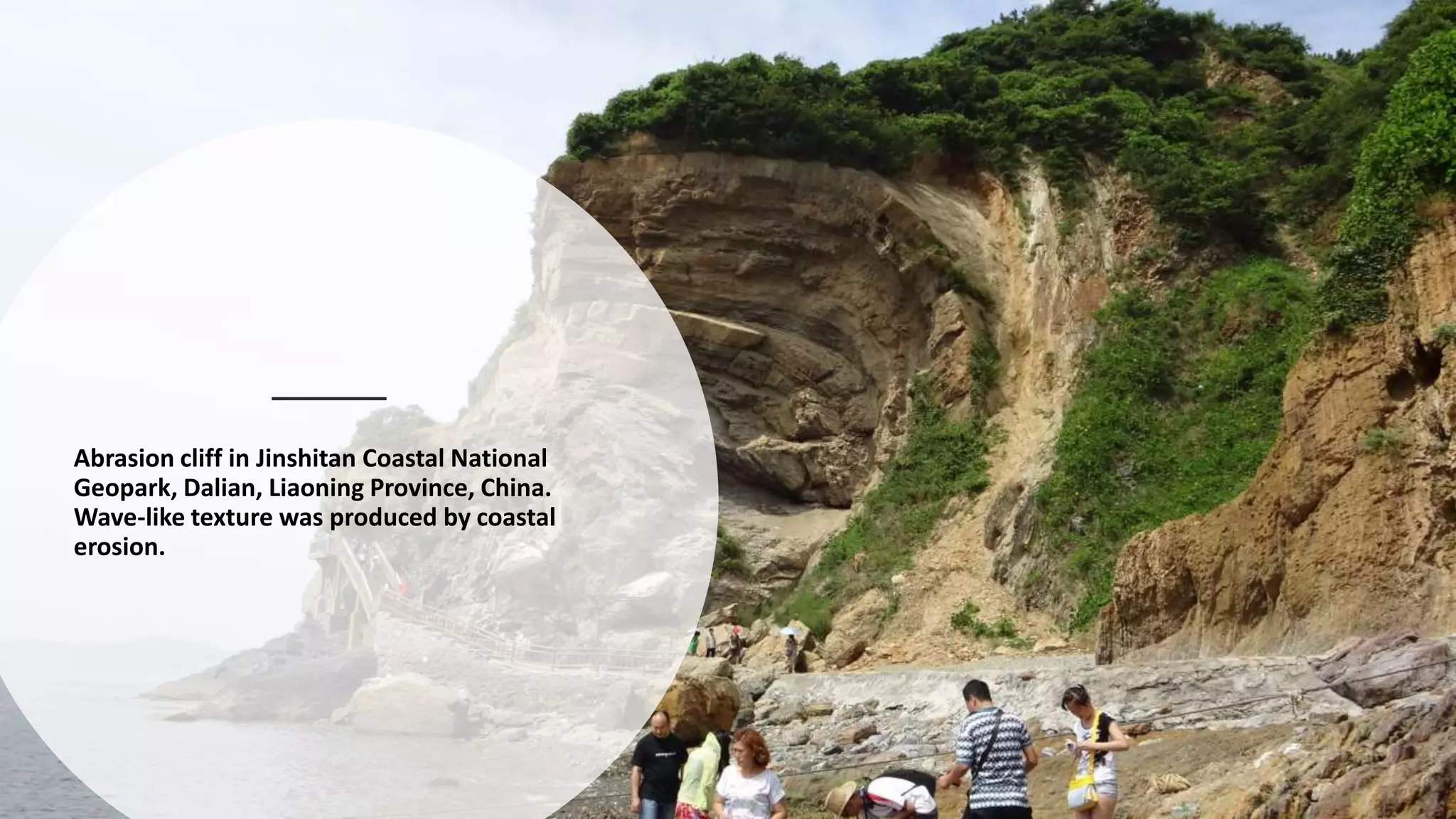
Abrasion cliff in Jinshitan Coastal National
Geopark, Dalian, Liaoning Province, China.
Wave-like texture was produced by coastal
erosion.
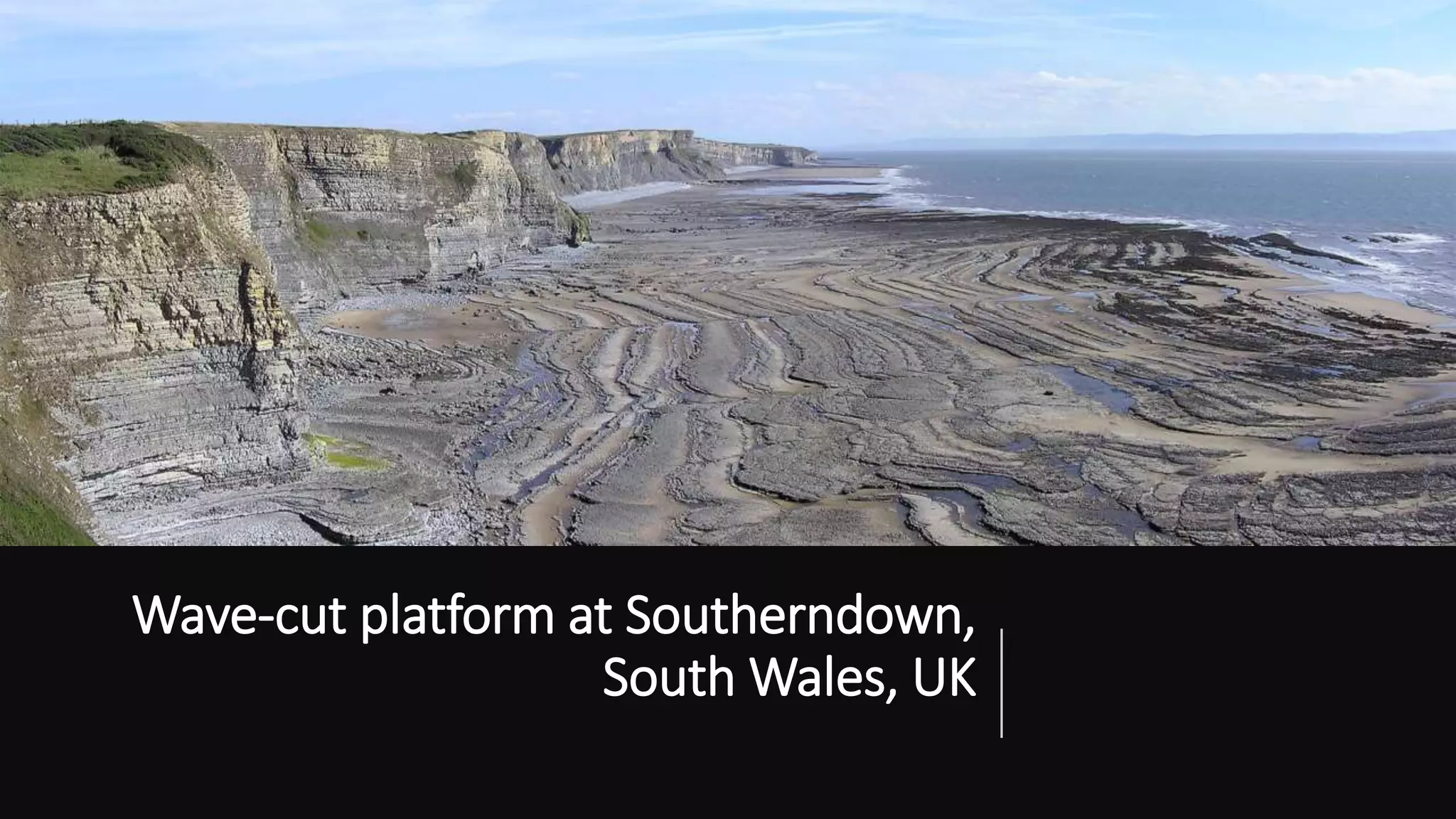
Wave-cut platform at Southerndown,
South Wales, UK
ROCKY CLIFFED COASTS
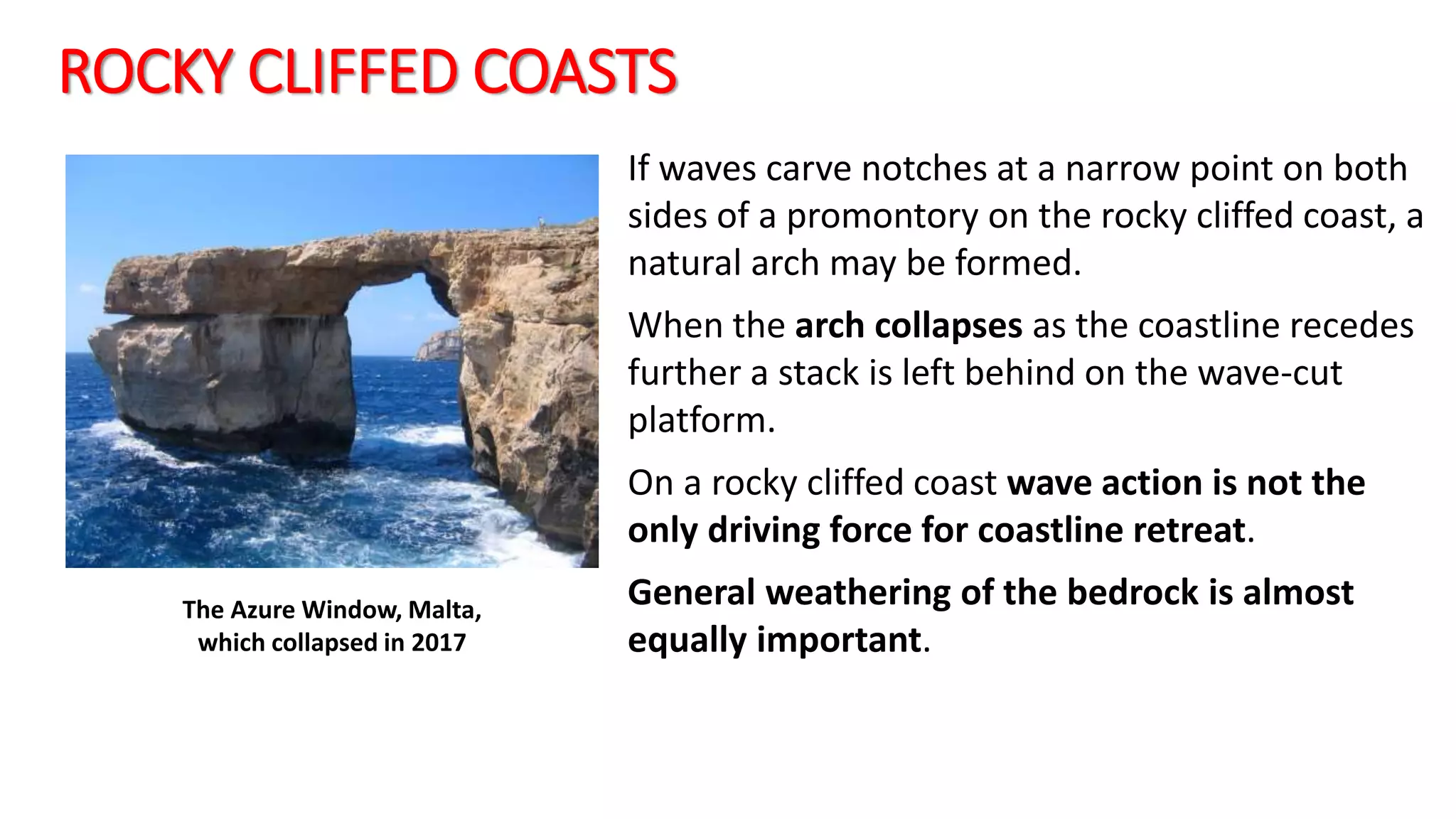
If waves carve notches at a narrow point on both
sides of a promontory on the rocky cliffed coast, a
natural arch may be formed.
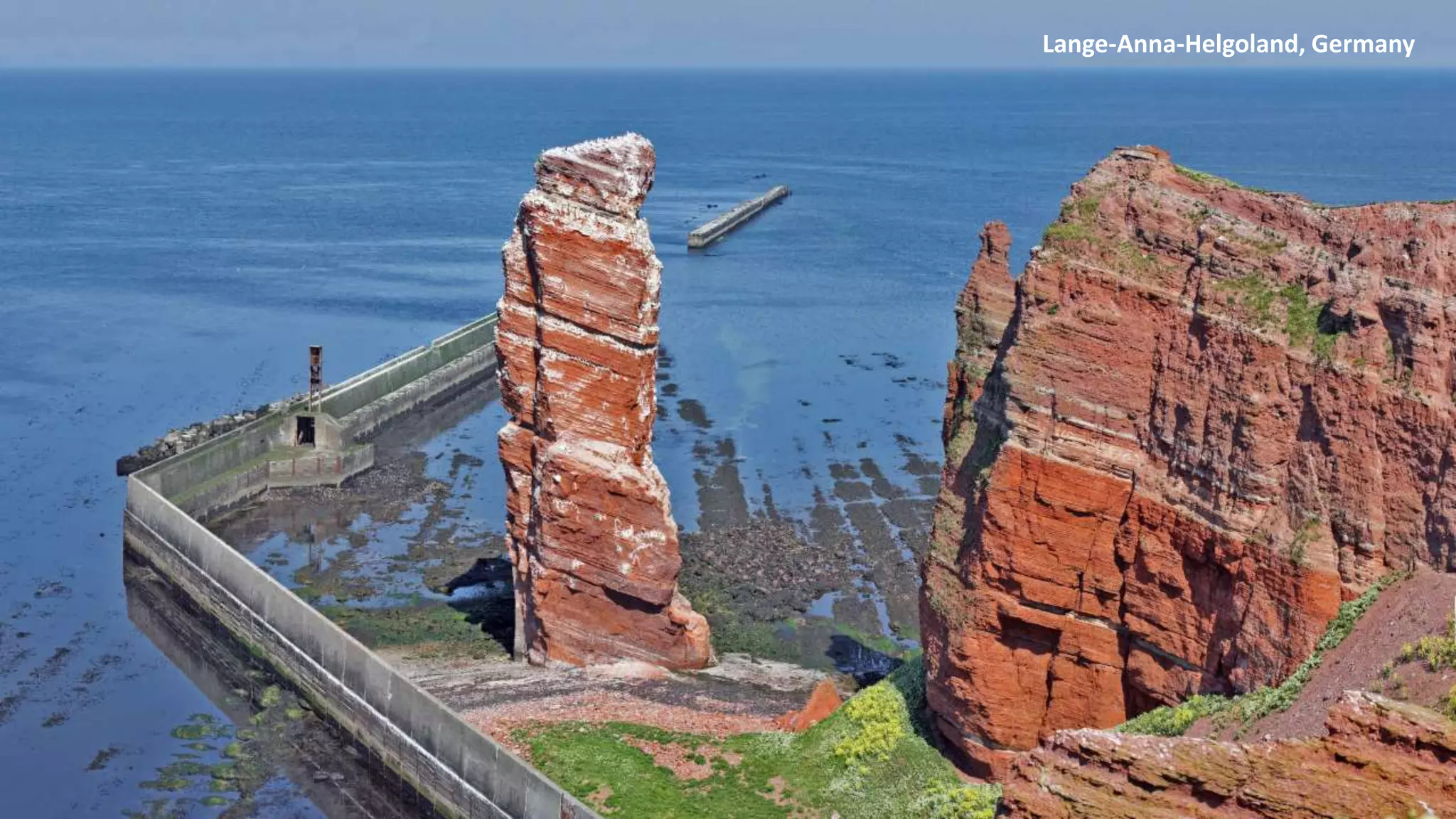
When the arch collapses as the coastline recedes
further a stack is left behind on the wave-cut
platform.
On a rocky cliffed coast wave action is not the
only driving force for coastline retreat.
General weathering of the bedrock is almost
equally important.
The Azure Window, Malta,
which collapsed in 2017
Lange-Anna-Helgoland, Germany
LIVING AND DEAD
CLIFFS
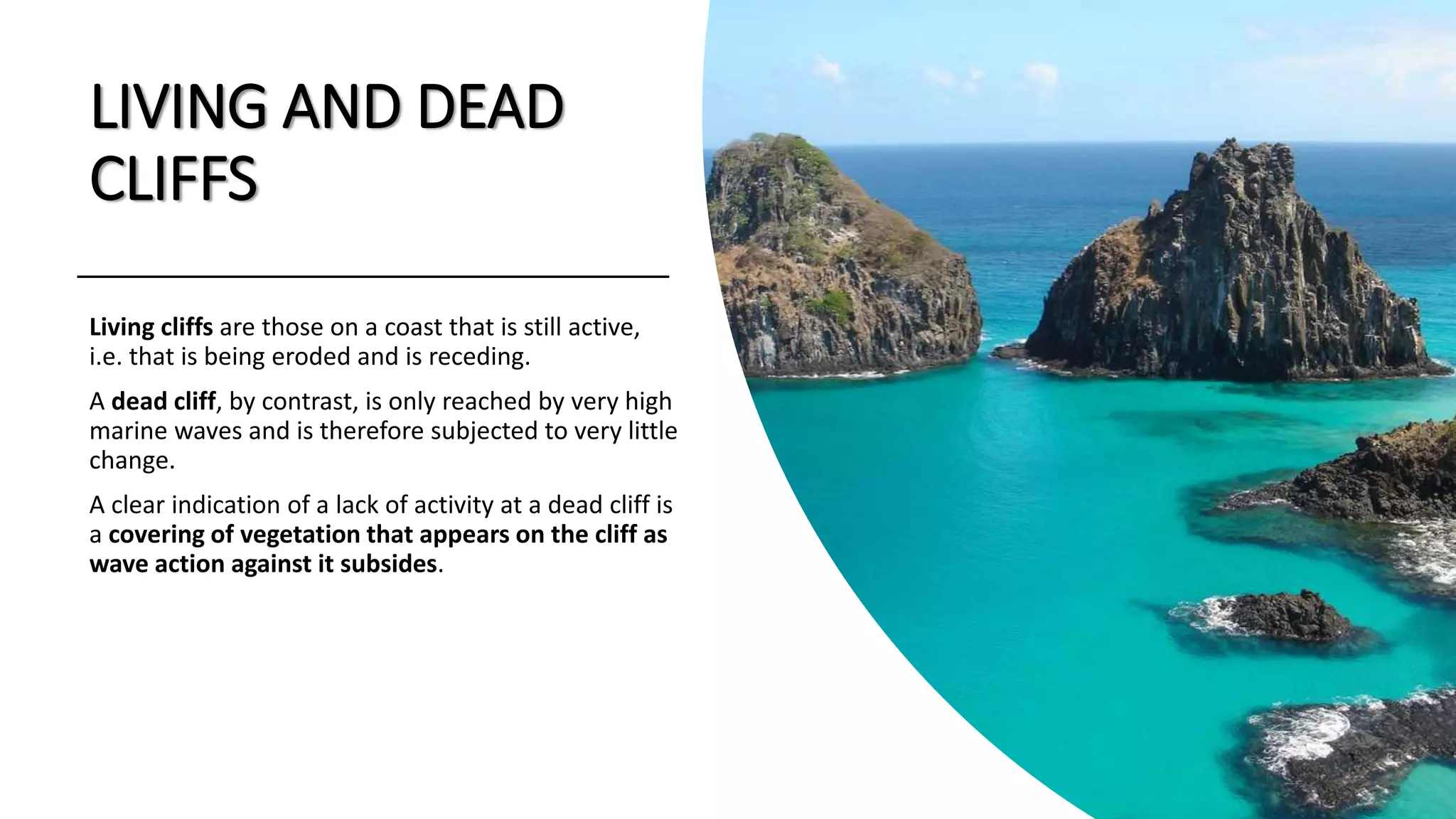
Living cliffs are those on a coast that is still active,
i.e. that is being eroded and is receding.
A dead cliff, by contrast, is only reached by very high
marine waves and is therefore subjected to very little
change.
A clear indication of a lack of activity at a dead cliff is
a covering of vegetation that appears on the cliff as
wave action against it subsides.
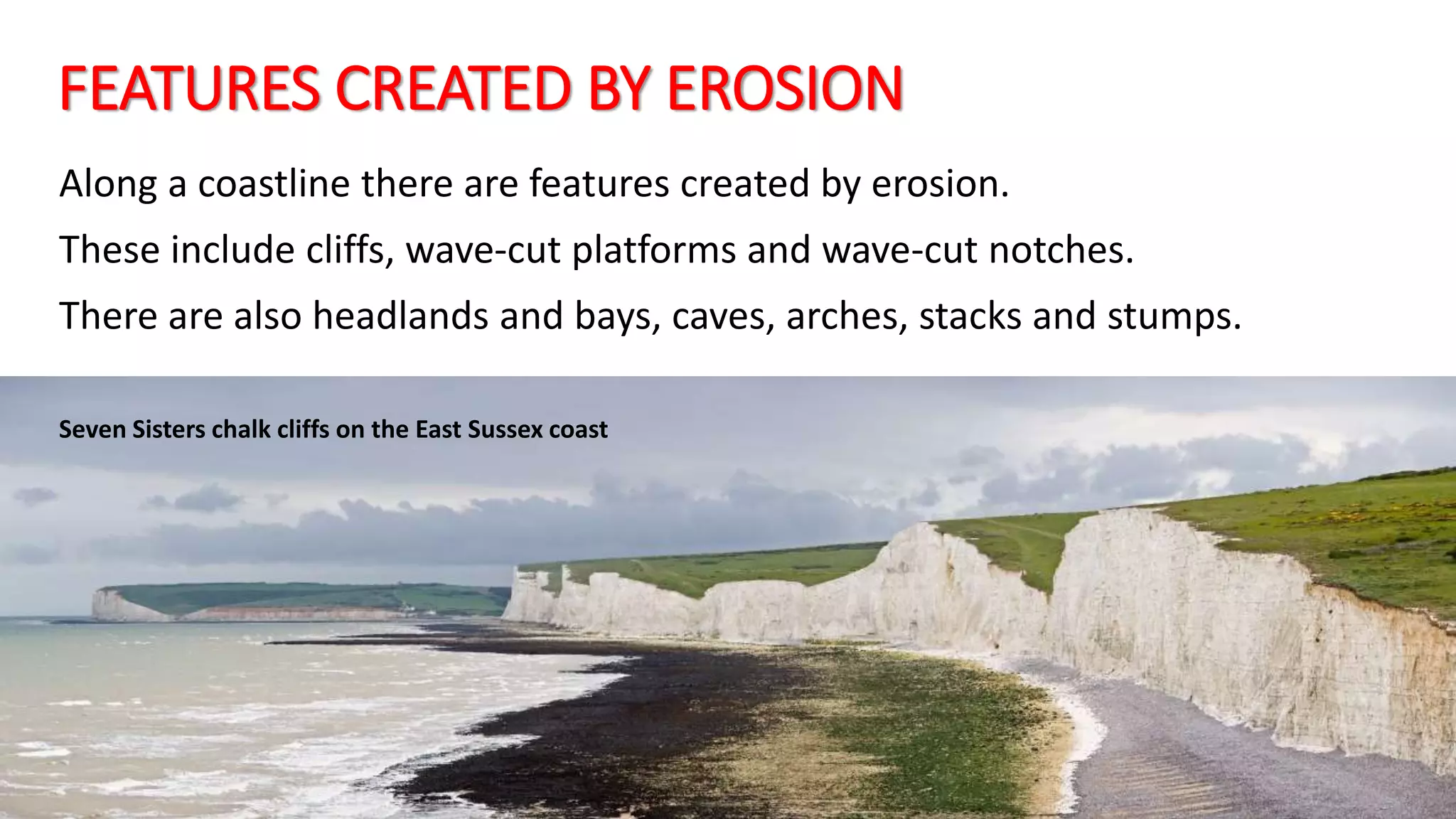
FEATURES CREATED BY EROSION
Along a coastline there are features created by erosion.
These include cliffs, wave-cut platforms and wave-cut notches.
There are also headlands and bays, caves, arches, stacks and stumps.
Seven Sisters chalk cliffs on the East Sussex coast
CLIFFS
One of the most common
features of a coastline is
a cliff.
01
Cliffs are shaped through
a combination of erosion
and weathering - the
breakdown of rocks
caused by weather
conditions.
02
Soft rock, eg. sand and
clay, erodes easily to
create gently sloping
cliffs.
03
Hard rock, eg. chalk, is
more resistant
and erodes slowly to
create steep cliffs.
04
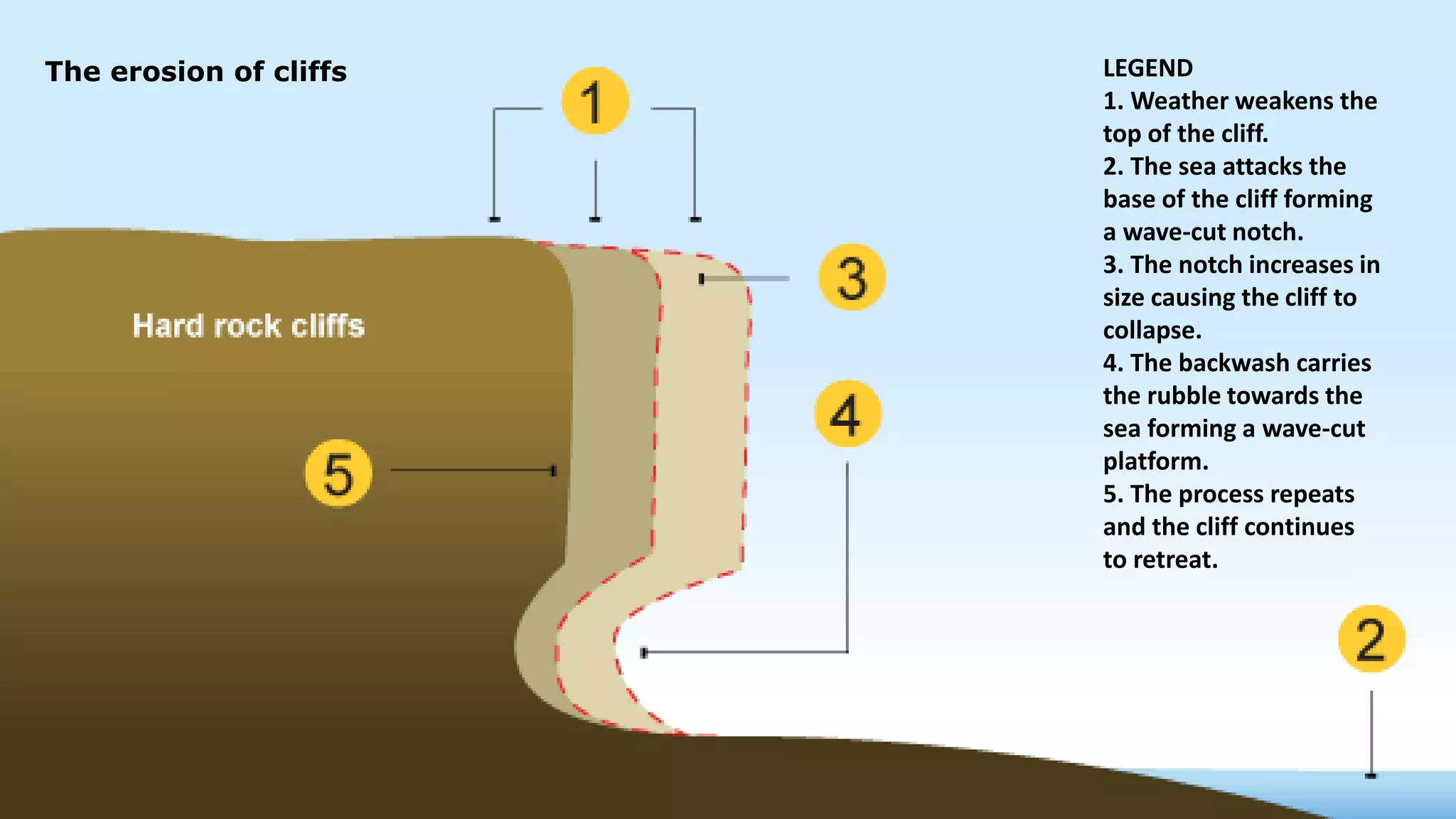
The erosion of cliffs LEGEND
1. Weather weakens the
top of the cliff.
2. The sea attacks the
base of the cliff forming
a wave-cut notch.
3. The notch increases in
size causing the cliff to
collapse.
4. The backwash carries
the rubble towards the
sea forming a wave-cut
platform.
5. The process repeats
and the cliff continues
to retreat.
SEA CLIFFS
FORMATION
• Wave erosion undercuts the steep shorelines
and create the coastal cliffs.
• A sea cliff is a vertical precipice created by
waves crashing directly on a steeply inclined
slope.
• Hydraulic action, abrasion, and chemical
solution all work to cut a notch at the high
water level near the base of the cliff.
HEADLANDS AND BAYS
Headlands are formed when the sea attacks a section of coast with alternating bands of
hard and soft rock.
The bands of soft rock, such as sand and clay, erode more quickly than those of more
resistant rock, such as chalk.
This leaves a section of land jutting out into the sea called a headland.
The areas where the soft rock has eroded away, next to the headland, are called bays.
GEOLOGY
Geology is the study of the
types of rocks that make up
the Earth's crust.
Coastlines where the
geology alternates between
strata (or bands) of hard
rock and soft rock are called
discordant coastlines.
A concordant coastline has
the same type of rock along
its length. Concordant
coastlines tend to have
fewer bays and headlands.
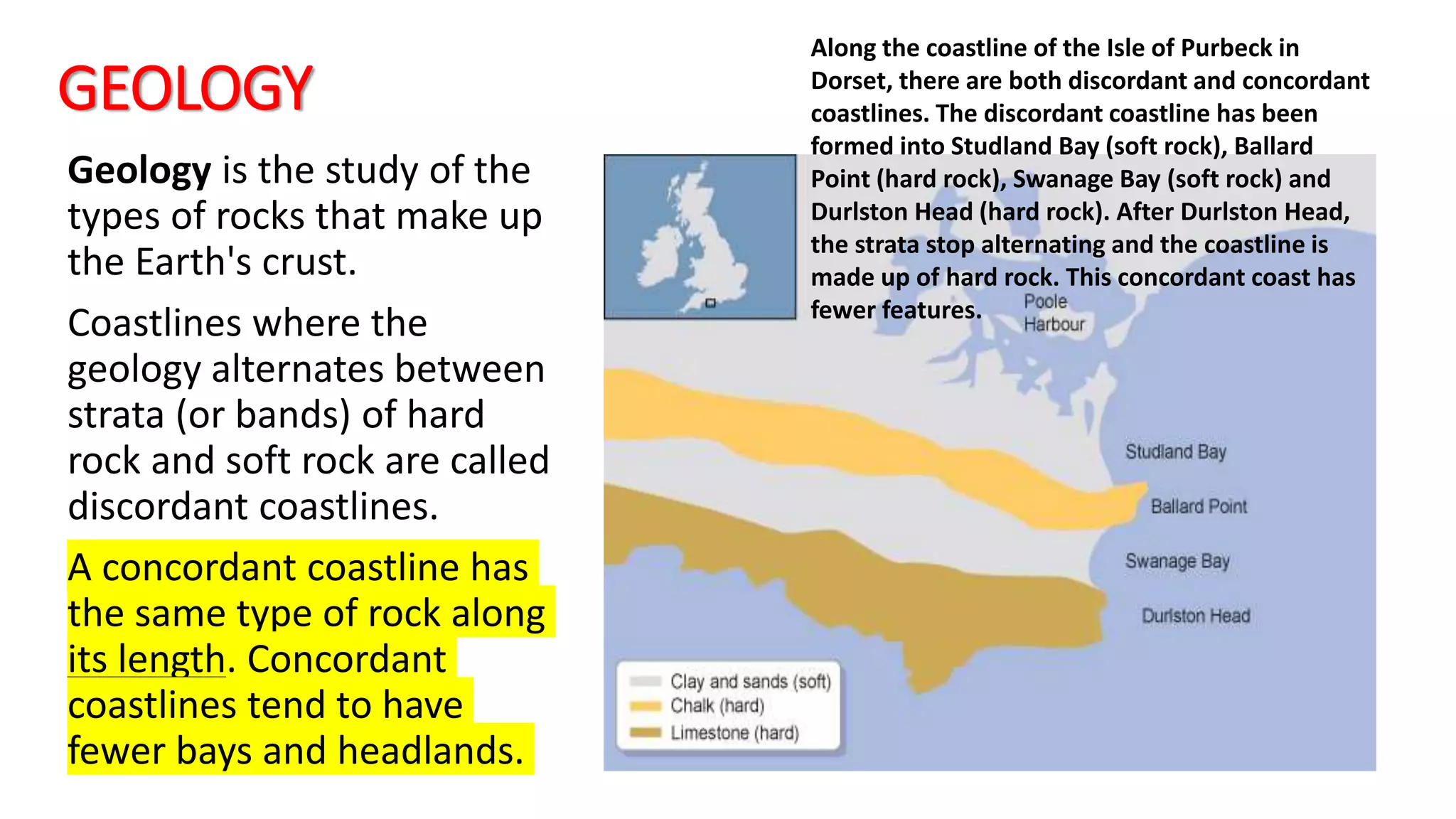
Along the coastline of the Isle of Purbeck in
Dorset, there are both discordant and concordant
coastlines. The discordant coastline has been
formed into Studland Bay (soft rock), Ballard
Point (hard rock), Swanage Bay (soft rock) and
Durlston Head (hard rock). After Durlston Head,
the strata stop alternating and the coastline is
made up of hard rock. This concordant coast has
fewer features.
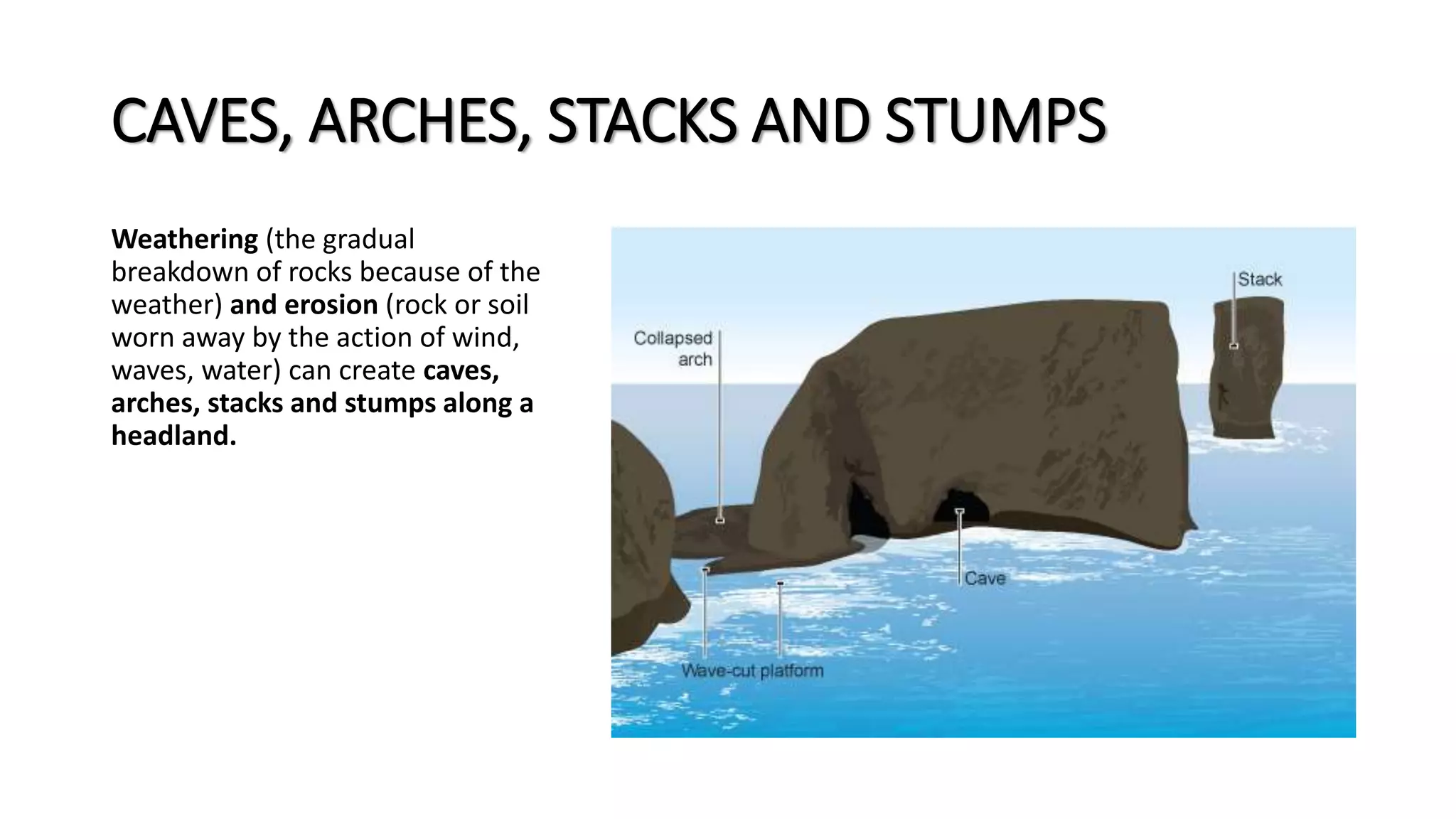
CAVES, ARCHES, STACKS AND STUMPS
Weathering (the gradual
breakdown of rocks because of the
weather) and erosion (rock or soil
worn away by the action of wind,
waves, water) can create caves,
arches, stacks and stumps along a
headland.
SEA CAVES
Caves occur when waves force their way into
cracks in the cliff face.
The water contains sand and other materials that
grind away at the rock until the cracks become a
cave.
Hydraulic action is the predominant process.
Constant undercutting and erosion causes the
cliffs to retreat landward.
Sea caves form along lines of weakness in
cohesive but well-jointed bedrock.
Sea caves are prominent headlands where wave
refraction attacks the shore.
ARCHES,
STACKS AND
STUMPS
If the cave is formed in a headland, it may eventually
break through to the other side forming an arch.
The arch will gradually become bigger until it can no
longer support the top of the arch. When the arch
collapses, it leaves the headland on one side and a
stack (a tall column of rock) on the other.
The stack will be attacked at the base in the same way
that a wave-cut notch is formed. This weakens the
structure and it will eventually collapse to form a
stump.
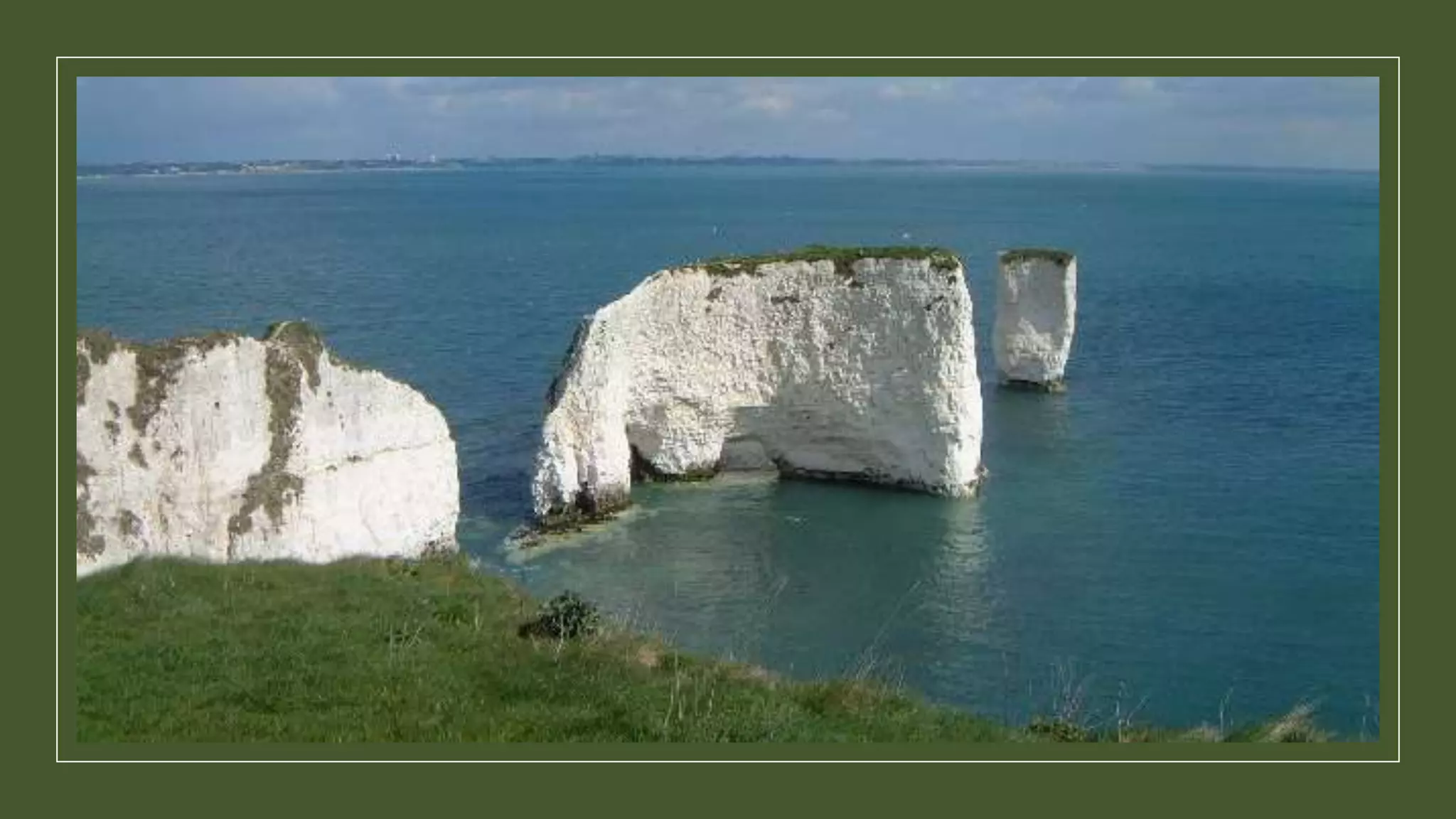
One of the best examples in Britain is Old Harry Rocks,
a stack found off a headland in the Isle of Purbeck.
SEA ARCHES
A sea arch forms when sea caves merge from
opposite sides of a headland.
If the arch collapses, a pillar of rock remains
behind as a sea stack.
A sea arch is a natural opening eroded out of a
cliff face by marine processes.
Some arches appear to have developed from
surge channels, which are created by wave
refraction causing the focussing of wave fronts on
the side of a headland.
Caves produced on either side of a promontory
may become joined over time to become a tunnel
and, finally, an arch.
SEA ARCHES AND SEA TUNNELS
Sea arches have been
regarded as ephemeral forms
tending to survive over
periods of just few decades to
several centuries.
01
The term sea tunnel can be
used to describe a hole in the
cliff line where the arch itself
is considerably longer than
the width of the entrance.
02
• sub-aerial processes of weathering and mass
movement (frost shattering, carbonation-solution,
hydrolysis)
• lithology and rock structure
• isostatic and eustatic sea level changes
• human activity
THE FACTORS INFLUENCING
CLIFF FORMS
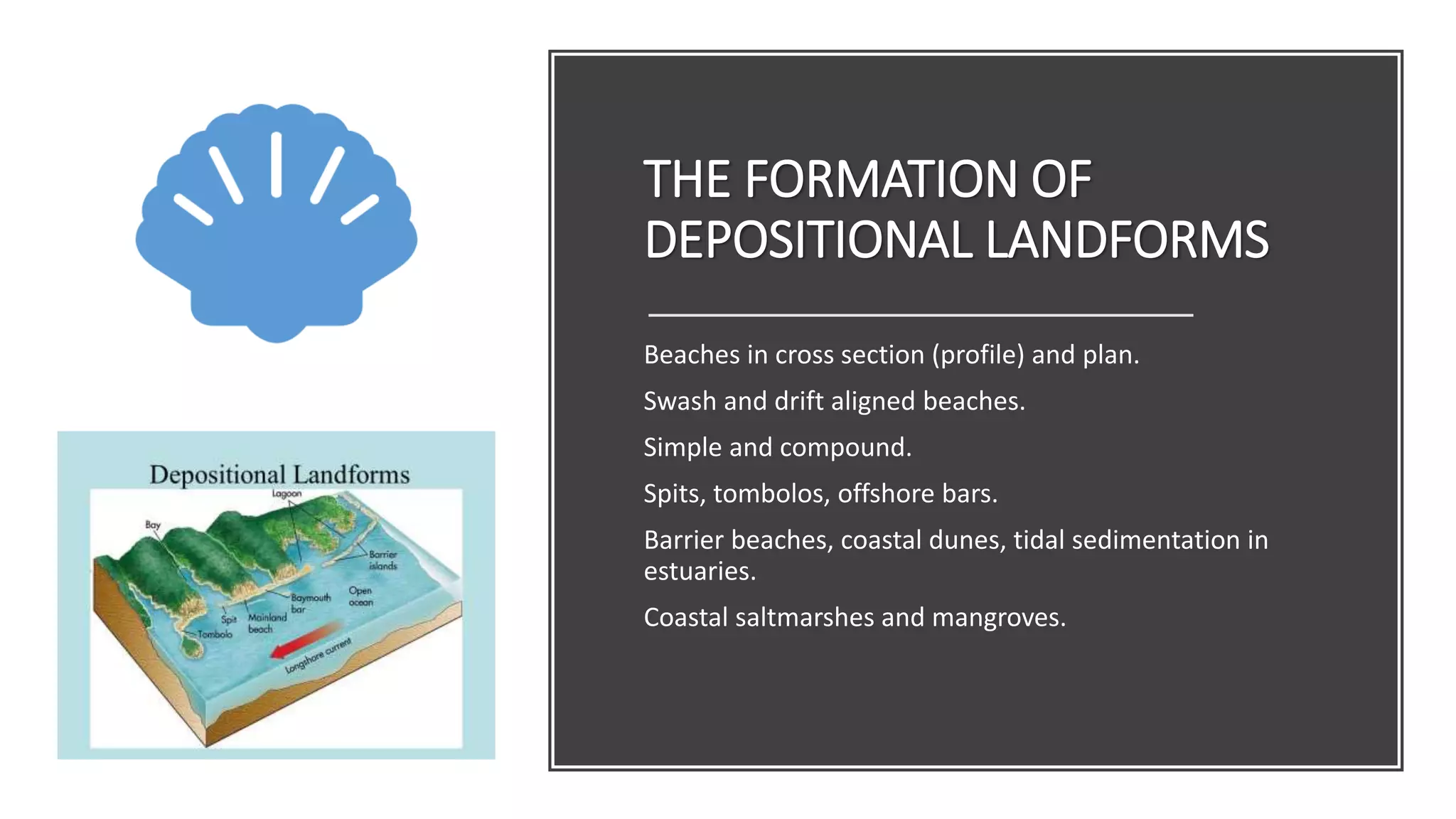
THE FORMATION OF
DEPOSITIONAL LANDFORMS
Beaches in cross section (profile) and plan.
Swash and drift aligned beaches.
Simple and compound.
Spits, tombolos, offshore bars.
Barrier beaches, coastal dunes, tidal sedimentation in
estuaries.
Coastal saltmarshes and mangroves.
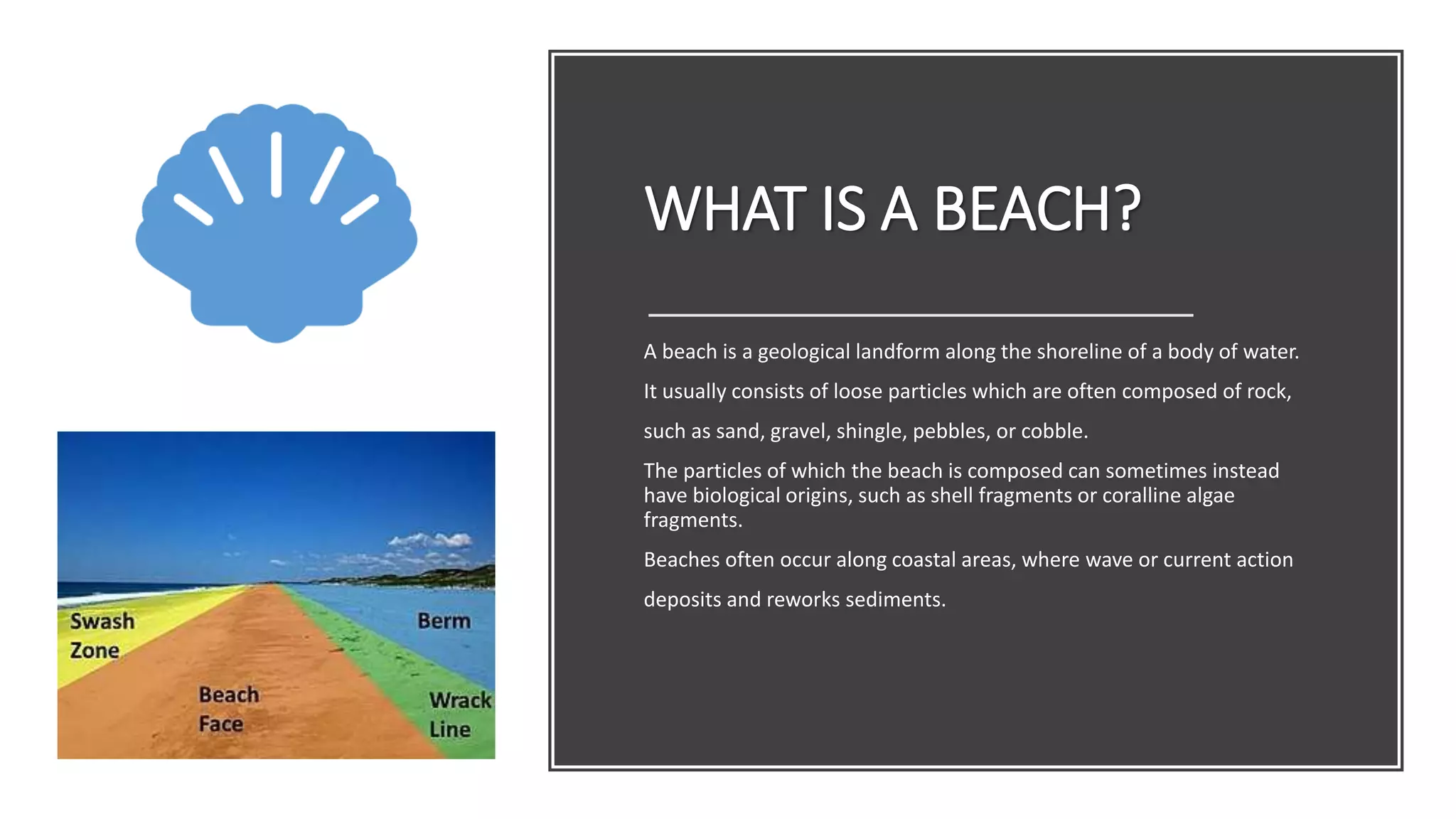
WHAT IS A BEACH?
A beach is a geological landform along the shoreline of a body of water.
It usually consists of loose particles which are often composed of rock,
such as sand, gravel, shingle, pebbles, or cobble.
The particles of which the beach is composed can sometimes instead
have biological origins, such as shell fragments or coralline algae
fragments.
Beaches often occur along coastal areas, where wave or current action
deposits and reworks sediments.
THE PROFILE OF A
BEACH
Although the seashore is most commonly associated
with the word "beach", beaches are not only found
by the sea or ocean: beaches also occur at the margin
of the land along lakes and rivers where sediments
are reworked or deposited.
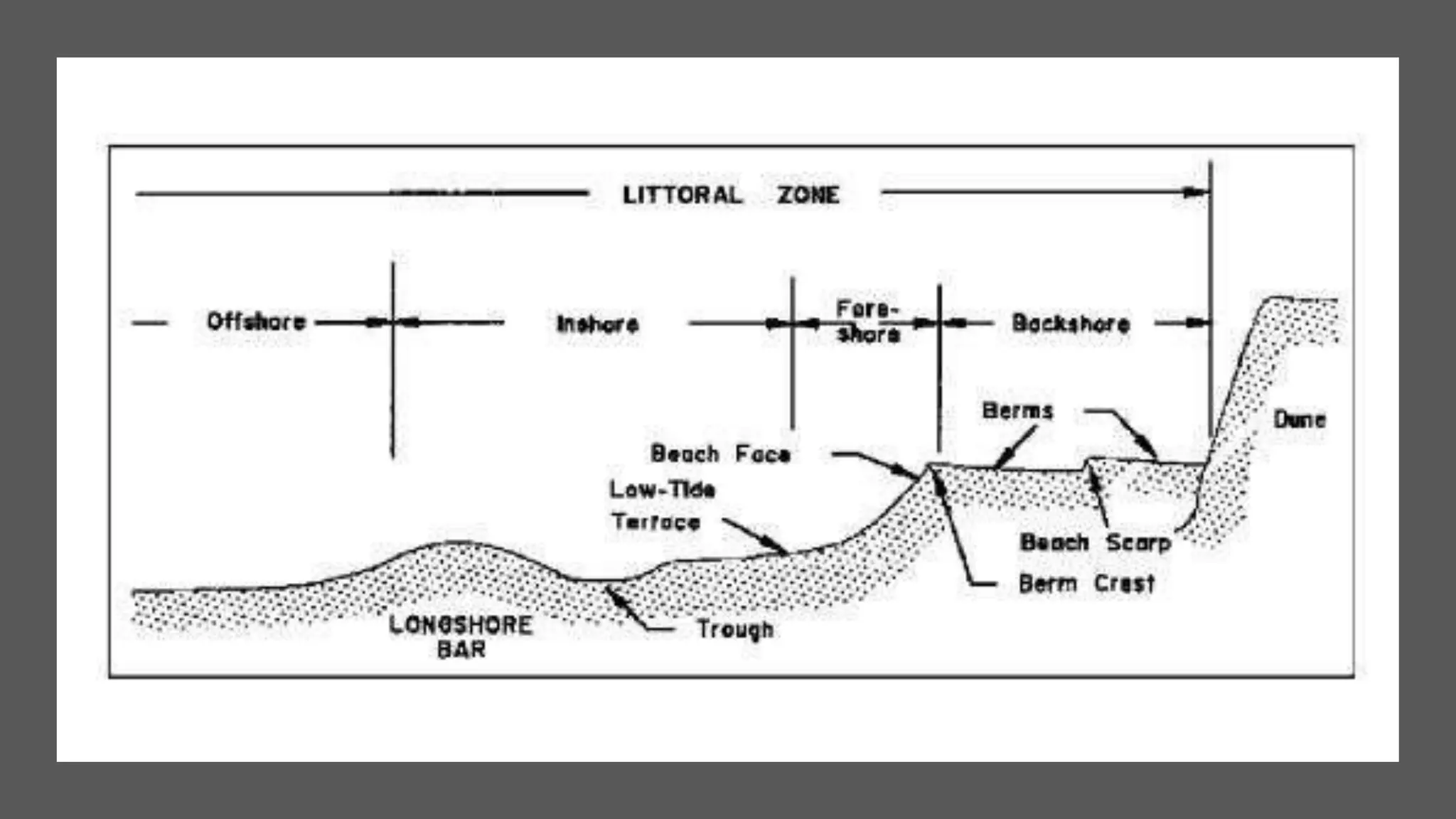
A profile of a beach is a cross section of the landform
showing the shape, length, steepness and features.
A plan of a beach is a bird’s eye view which shows it’s
shape in relation to surrounding features.
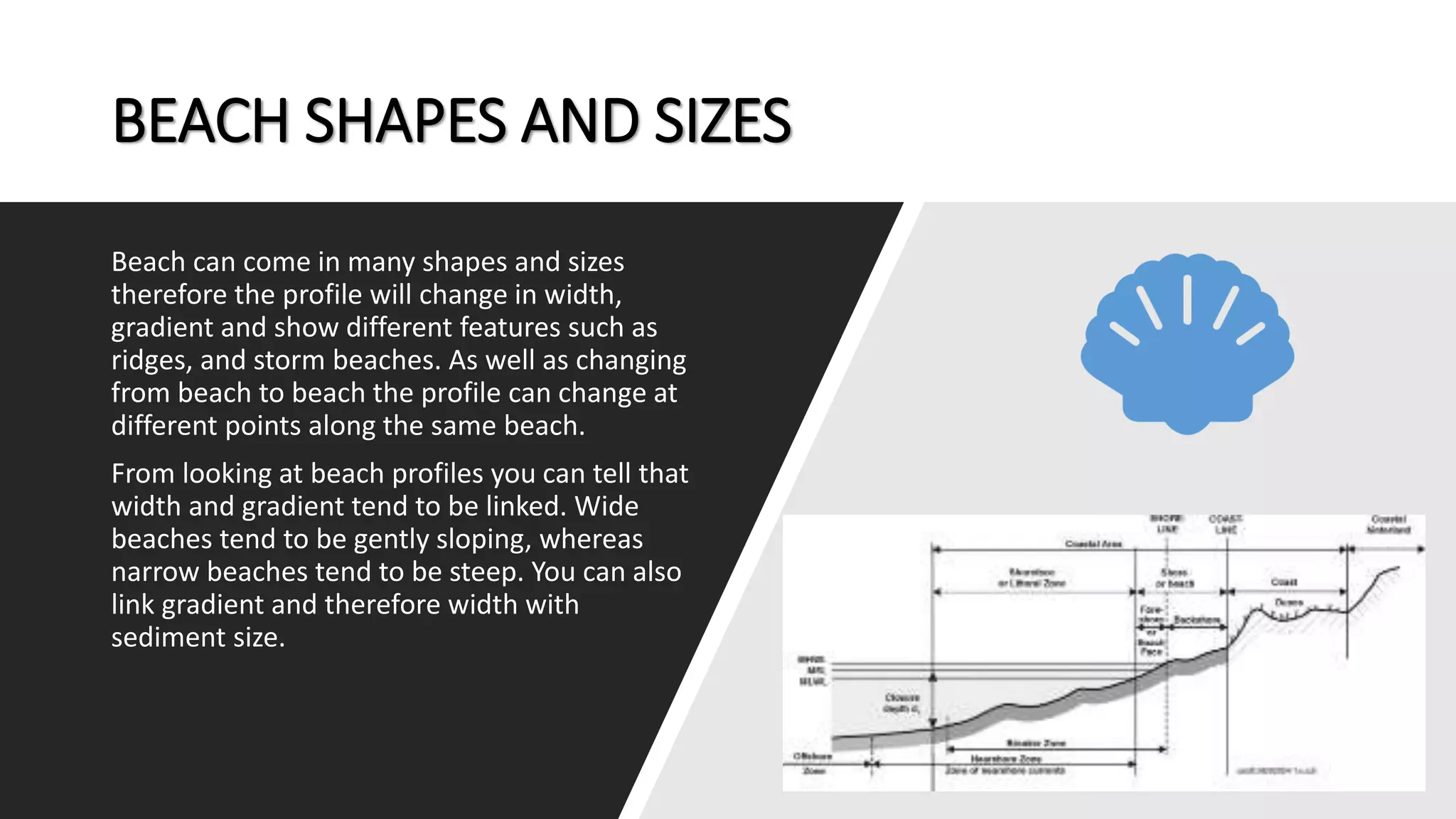
BEACH SHAPES AND SIZES
Beach can come in many shapes and sizes
therefore the profile will change in width,
gradient and show different features such as
ridges, and storm beaches. As well as changing
from beach to beach the profile can change at
different points along the same beach.
From looking at beach profiles you can tell that
width and gradient tend to be linked. Wide
beaches tend to be gently sloping, whereas
narrow beaches tend to be steep. You can also
link gradient and therefore width with
sediment size.
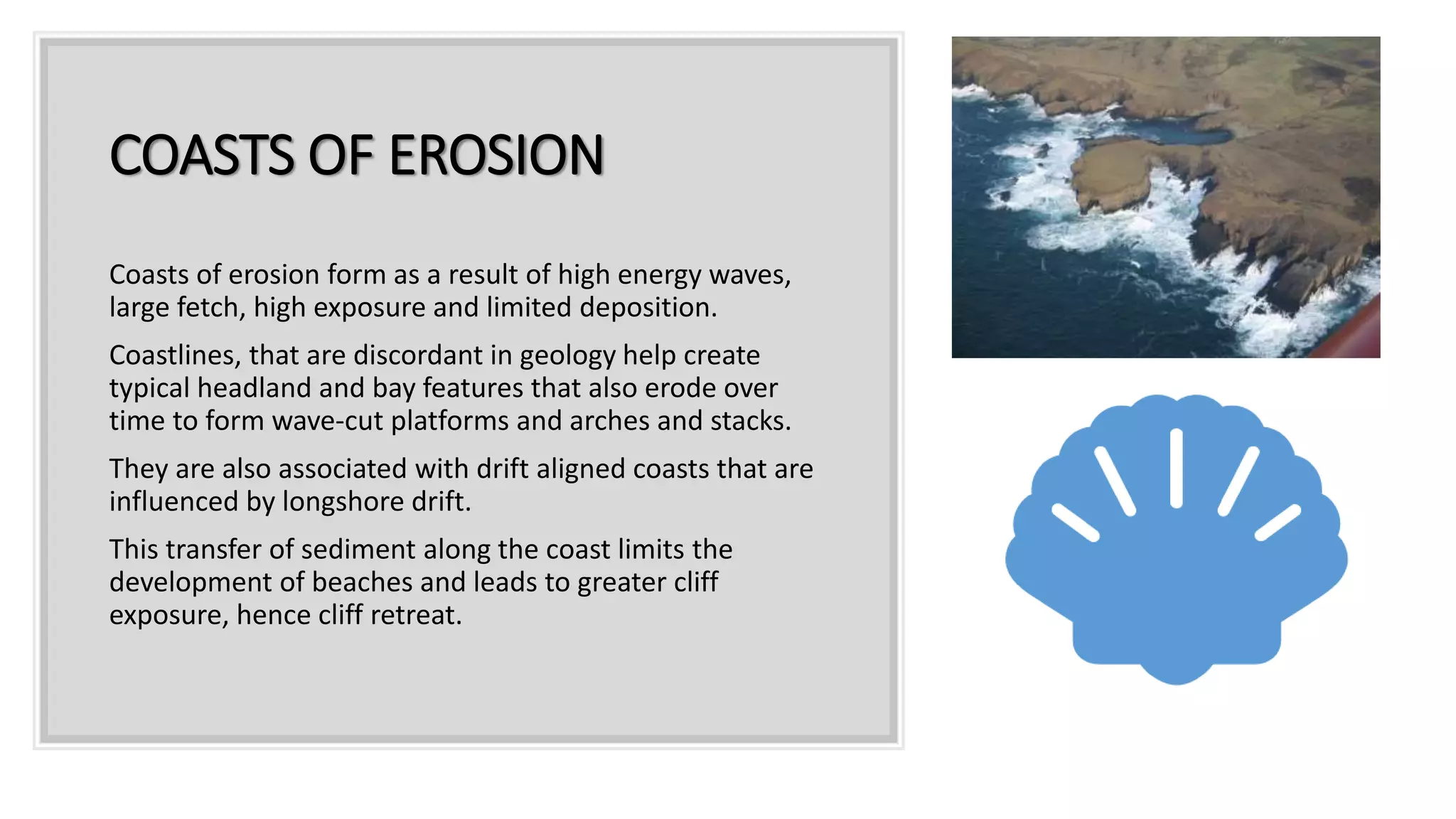
COASTS OF EROSION
Coasts of erosion form as a result of high energy waves,
large fetch, high exposure and limited deposition.
Coastlines, that are discordant in geology help create
typical headland and bay features that also erode over
time to form wave-cut platforms and arches and stacks.
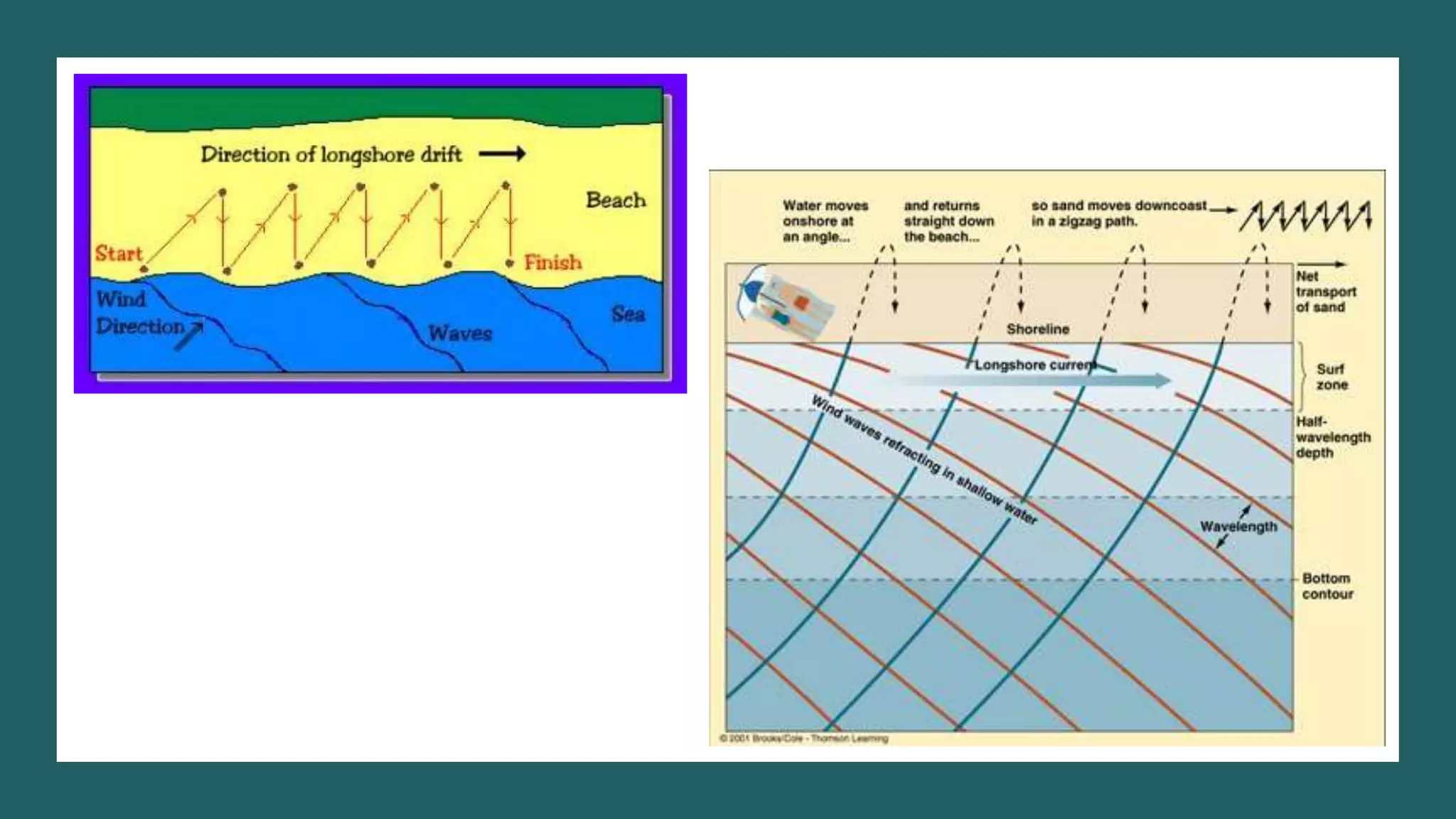
They are also associated with drift aligned coasts that are
influenced by longshore drift.
This transfer of sediment along the coast limits the
development of beaches and leads to greater cliff
exposure, hence cliff retreat.
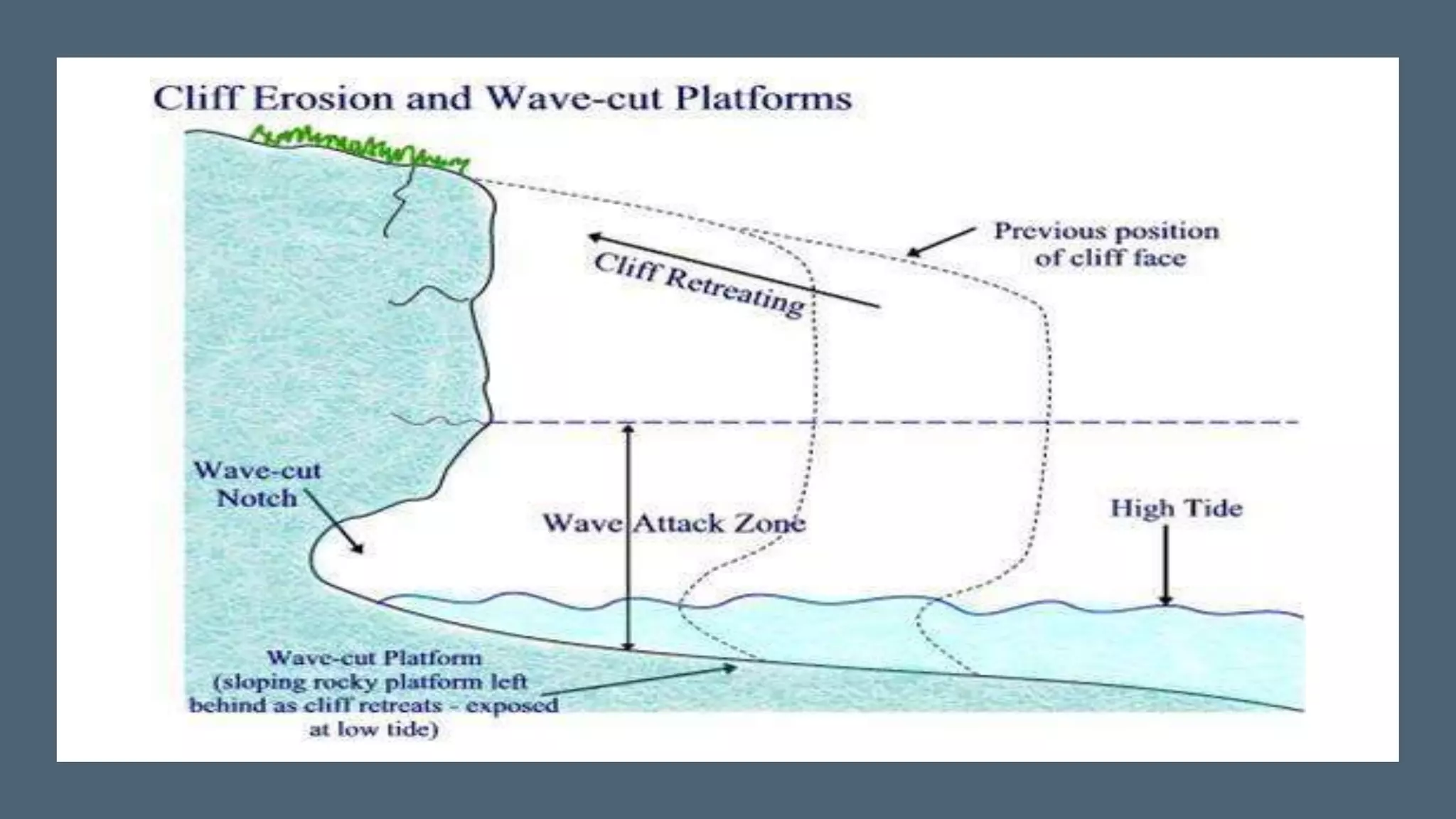
WAVE-CUT PLATFORMS
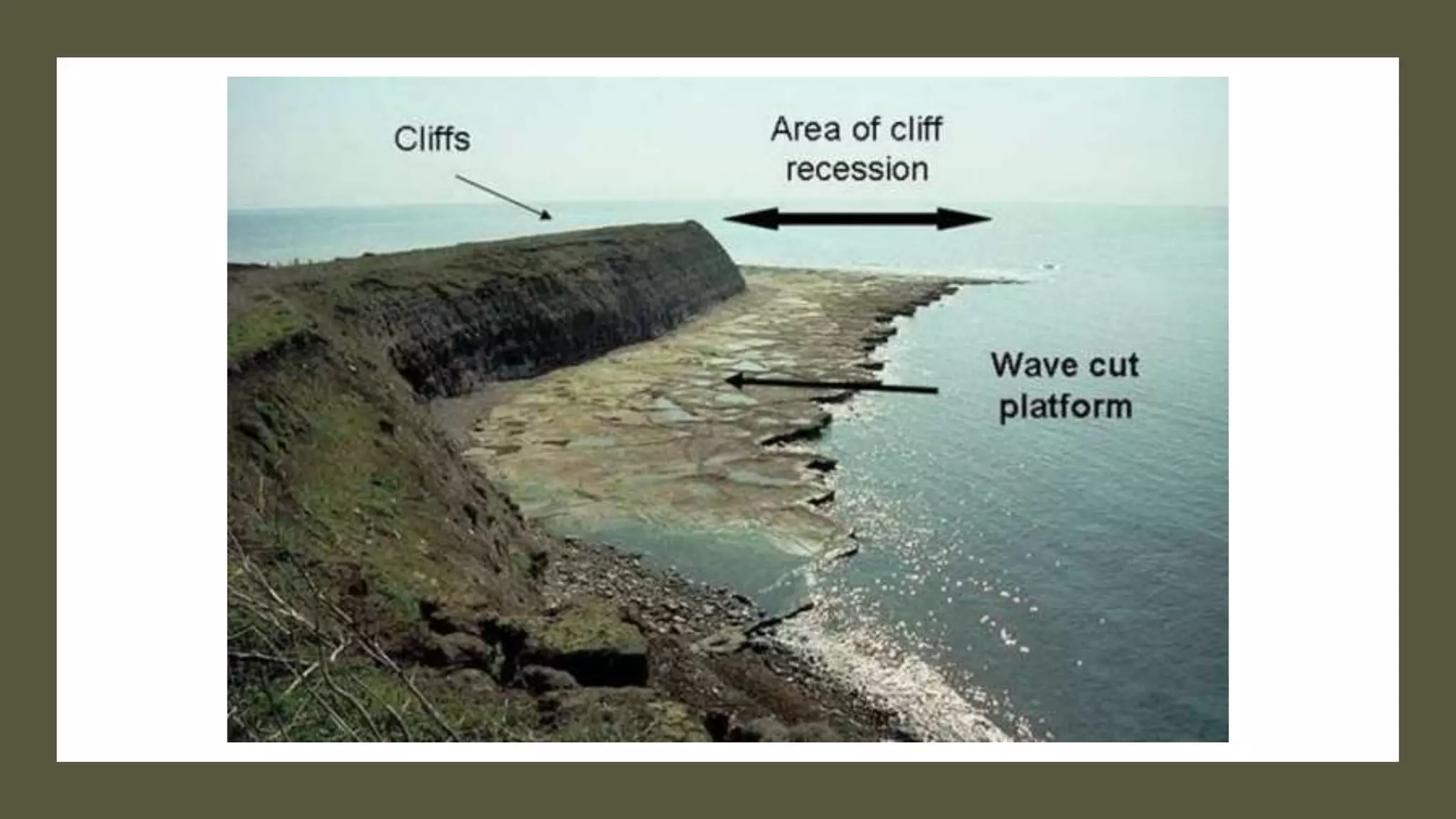
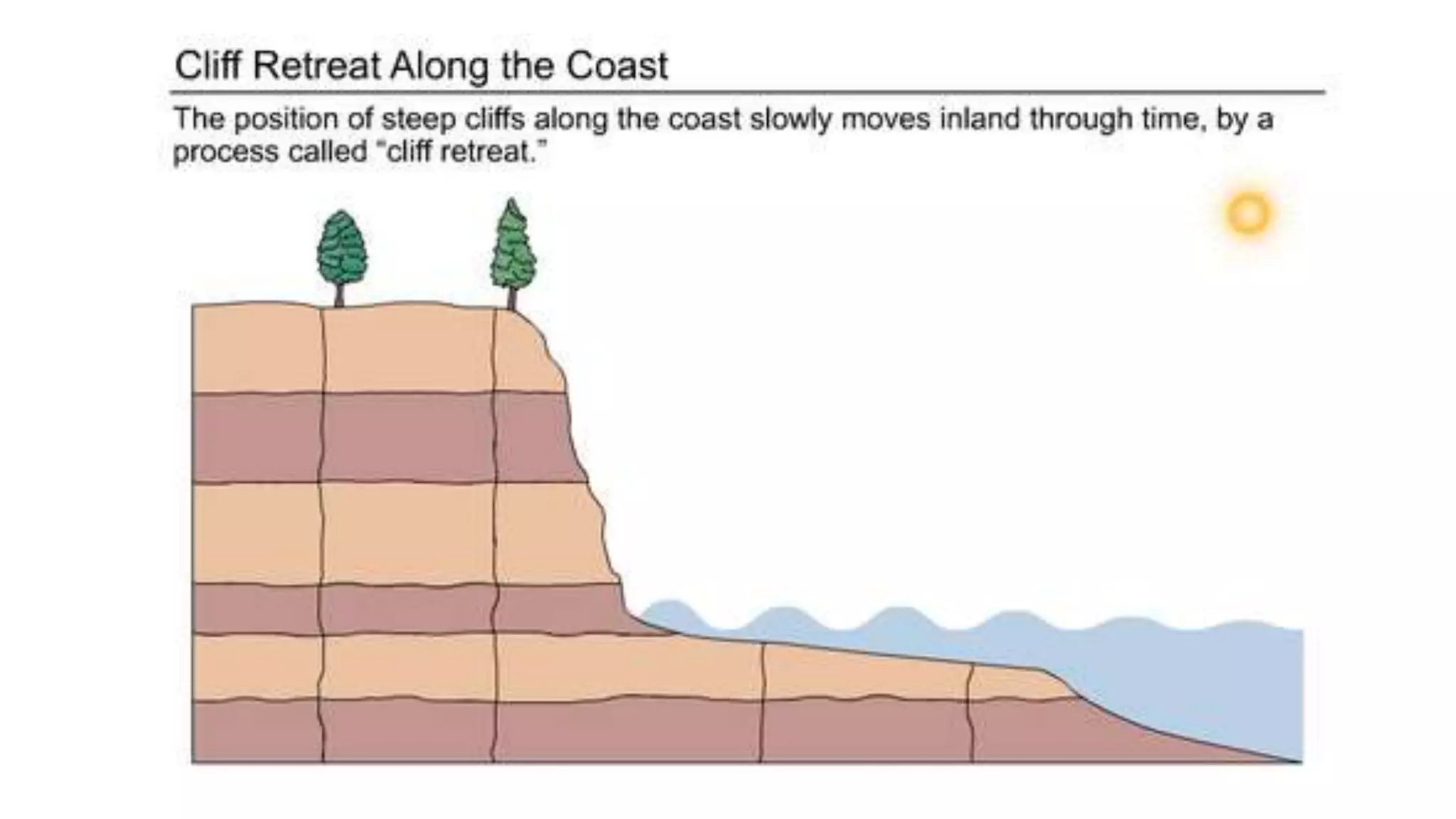
Wave cut platforms as illustrated in the diagram and shown
in the photograph are remnants of the previous cliff line.
They form as a ledge of bedrock left behind as the Cliff
retreats.
The platform slopes at 4-5 degree angle down to the sea.
It forms as waves erode the base of the cliff in the inter-tidal
zone.
Waves scour away at the base through processes of abrasion,
hydraulic action and solution, until over time a wave-cut
notch forms.
LARGER WAVE-CUT PLATFORMS
As the notch enlarges, the cliff face becomes undermined until at some
point it collapses under its own weight. Attrition and transportation then
remove the cliff debris leaving behind a small bedrock ledge, which marks
the old cliff line. This process is repeated over time as the cliff retreats
forming a larger wave-cut platform. Eventually a beach may develop on
the platform which will provide some protection to the cliff and in turn
slows down the rate of retreat. Wave-cut platforms are characterised by
their gentle sloping angle, hard bedrock and rock pools, which develop
unique coastal ecosystems.
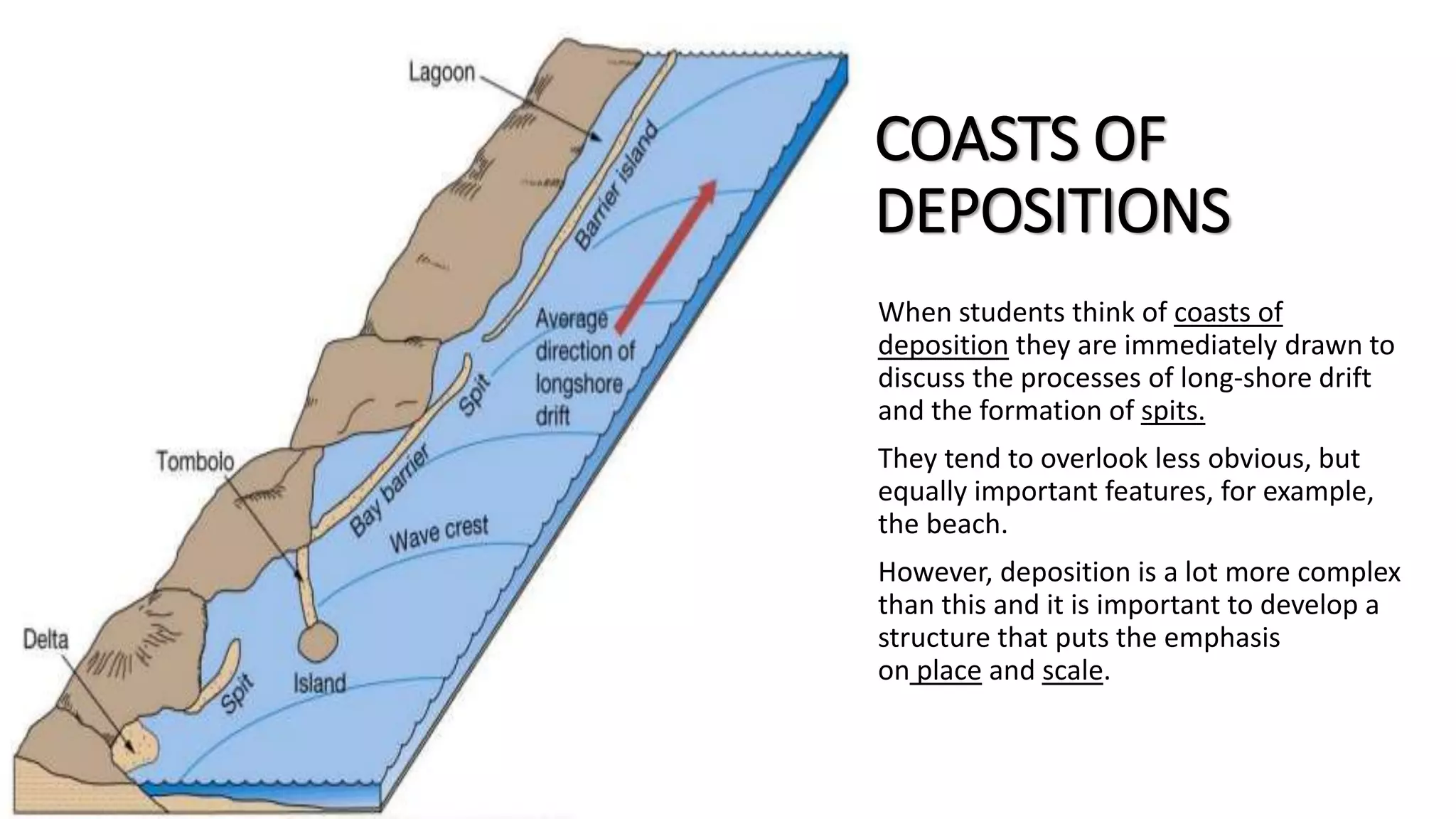
COASTS OF
DEPOSITIONS
When students think of coasts of
deposition they are immediately drawn to
discuss the processes of long-shore drift
and the formation of spits.
They tend to overlook less obvious, but
equally important features, for example,
the beach.
However, deposition is a lot more complex
than this and it is important to develop a
structure that puts the emphasis
on place and scale.
SWASH AND
DRIFT ALIGNED BEACHES
The starting point to discussing depositional features is
with swash and drift aligned beaches.
Remember, a swash aligned beach brings in waves parallel
to the shore and as result, they build up beaches.
Swash aligned beaches are more influenced by
constructive wave patterns, which are also important for
building up large beaches.
In contrast, drift aligned coasts bring in waves at an angle
to the shoreline and so therefore, the waves tend to
transport sediment down the coast, keeping beaches
relatively narrow.
SWASH AND DRIFT ALIGNED BEACHES cont.
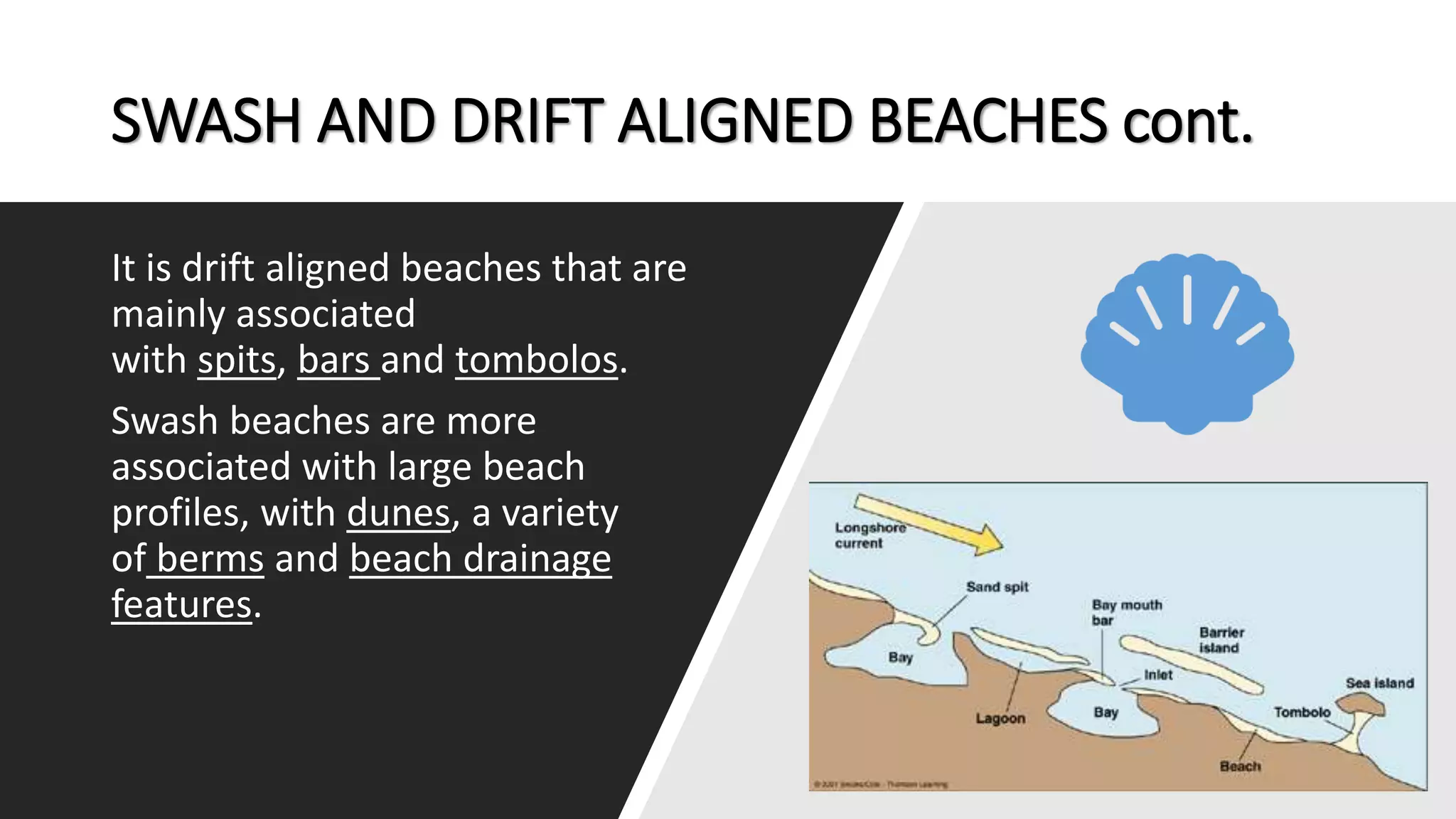
It is drift aligned beaches that are
mainly associated
with spits, bars and tombolos.
Swash beaches are more
associated with large beach
profiles, with dunes, a variety
of berms and beach drainage
features.
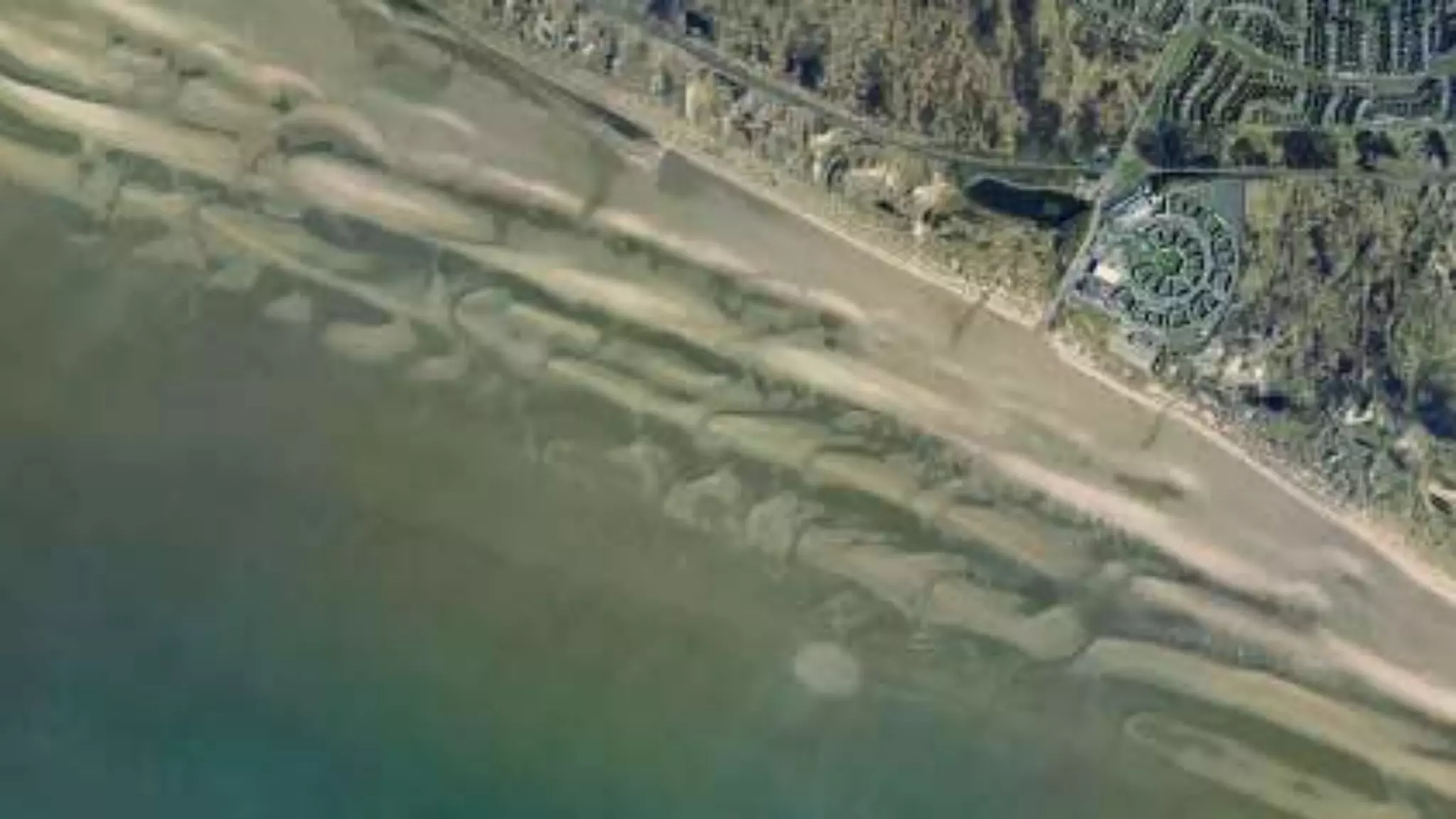
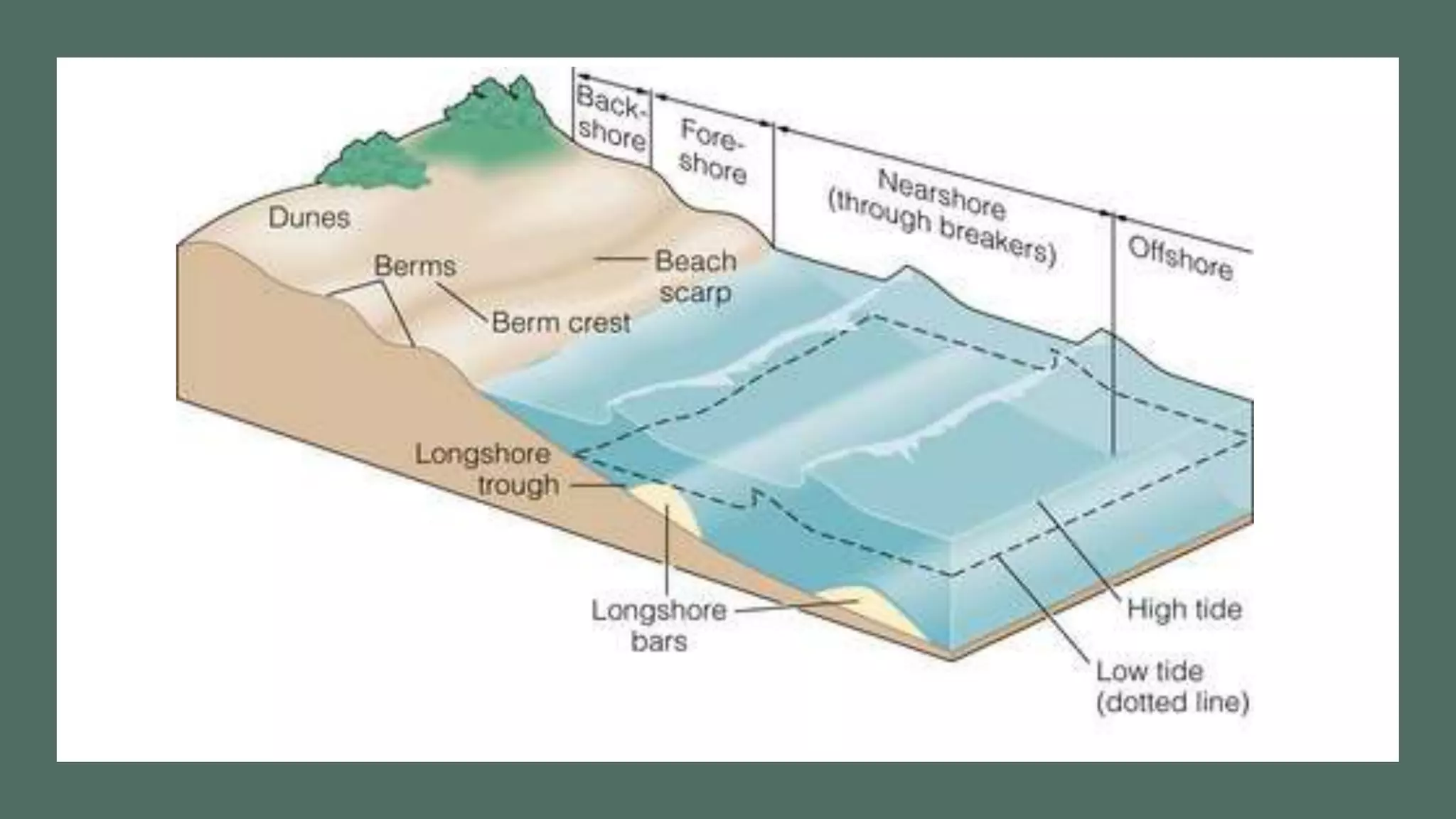
THE BEACH PROFILE
The beach profile extends from the offshore zone to the backshore zone.
The beach itself forms from the nearshore to the backshore within the
tidal range.
At coasts dominated by destructive waves the beach profile is narrow and
steep. The tidal range will also be smaller.
At coasts dominated by constructive waves, large wide and flat beaches
develop and the tidal range is more extensive.
It is on these large relatively flat beaches that a greater number of
depositional features occur.
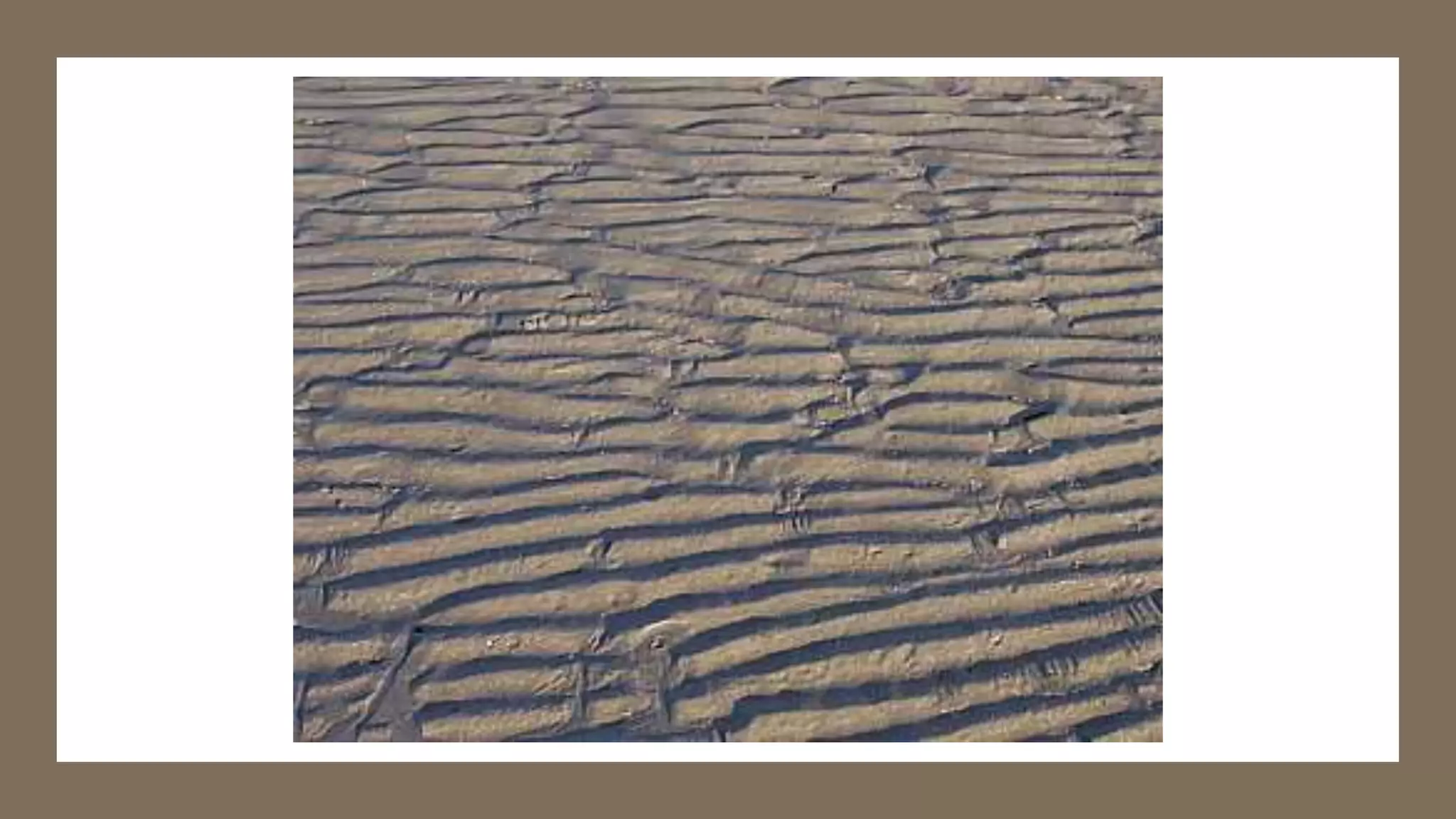
RIDGES AND RUNNELS
The smallest in scale, are beach drainage features, such as ridges and
runnels. Ridges and runnels form in the foreshore zone.
Ridges are areas of the foreshore that are raised above the adjacent
shore which dips into a Runnel. The cross-section is similar to that of hills
and valleys but at a much smaller scale.
Ridge and runnel systems are formed due to the interaction of tides,
currents, sediments and the beach topography. They will only form on
shallow gradient beaches. They form as a simple drainage routes for
incoming and outgoing tides. Water flows in and out via the runnel,
creating a hollow channel.
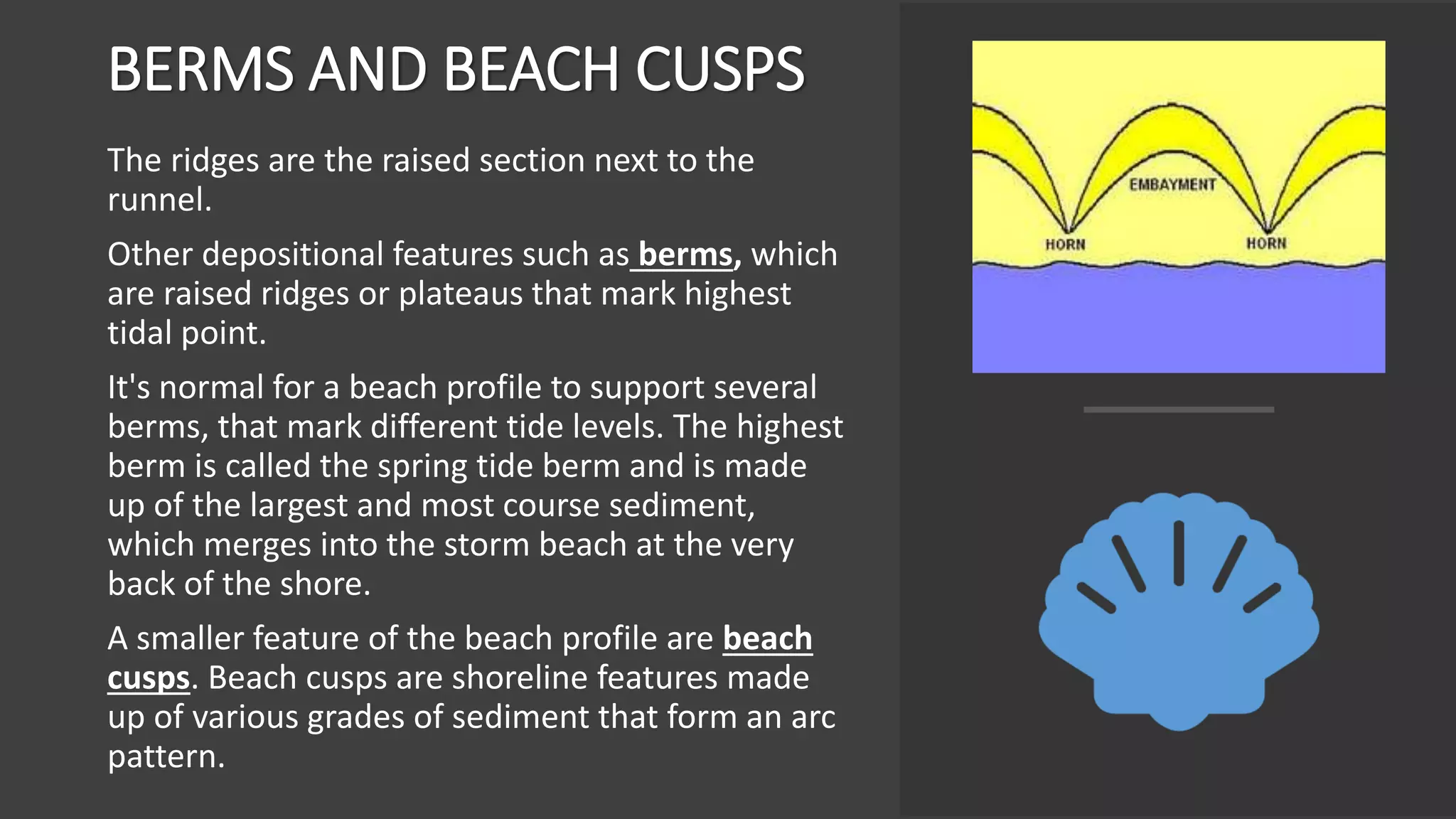
BERMS AND BEACH CUSPS
The ridges are the raised section next to the
runnel.
Other depositional features such as berms, which
are raised ridges or plateaus that mark highest
tidal point.
It's normal for a beach profile to support several
berms, that mark different tide levels. The highest
berm is called the spring tide berm and is made
up of the largest and most course sediment,
which merges into the storm beach at the very
back of the shore.
A smaller feature of the beach profile are beach
cusps. Beach cusps are shoreline features made
up of various grades of sediment that form an arc
pattern.
HORNS AND EMBAYMENTS
The horns are made up of coarser materials and the embayment contains
finer grain sediment. They are most noticeable on shorelines with coarser
sediment such as pebble beaches, however, they can occur on beaches
with sediment of any size.
They nearly always occur in a regular pattern with cusps of equal size and
spacing. Cusps are most often a few metres long, however they may
reach 60m across. It's unclear how cusps form but once they do they are
a self sustaining formation.
This is because once an oncoming wave hits the horn of a beach cusp it is
split and forced into two directions.
HORNS AND EMBAYMENTS
The breaking of a wave into the cusps slows its velocity, causing coarser
sediment to fall out of suspension and be deposited on the horns.
The waves then flow along the embayments (picking up finer sediment)
and run into one another in the middle. After this collision these waves
attempt to flow back out to sea where they are met by incoming waves.
Once the cusp is established, coarser sediment is constantly being
deposited on the horn and finer sediment is being eroded away from the
embayments.
In this way a positive feedback occurs which should at least maintain the
cusp size if not increase their size.
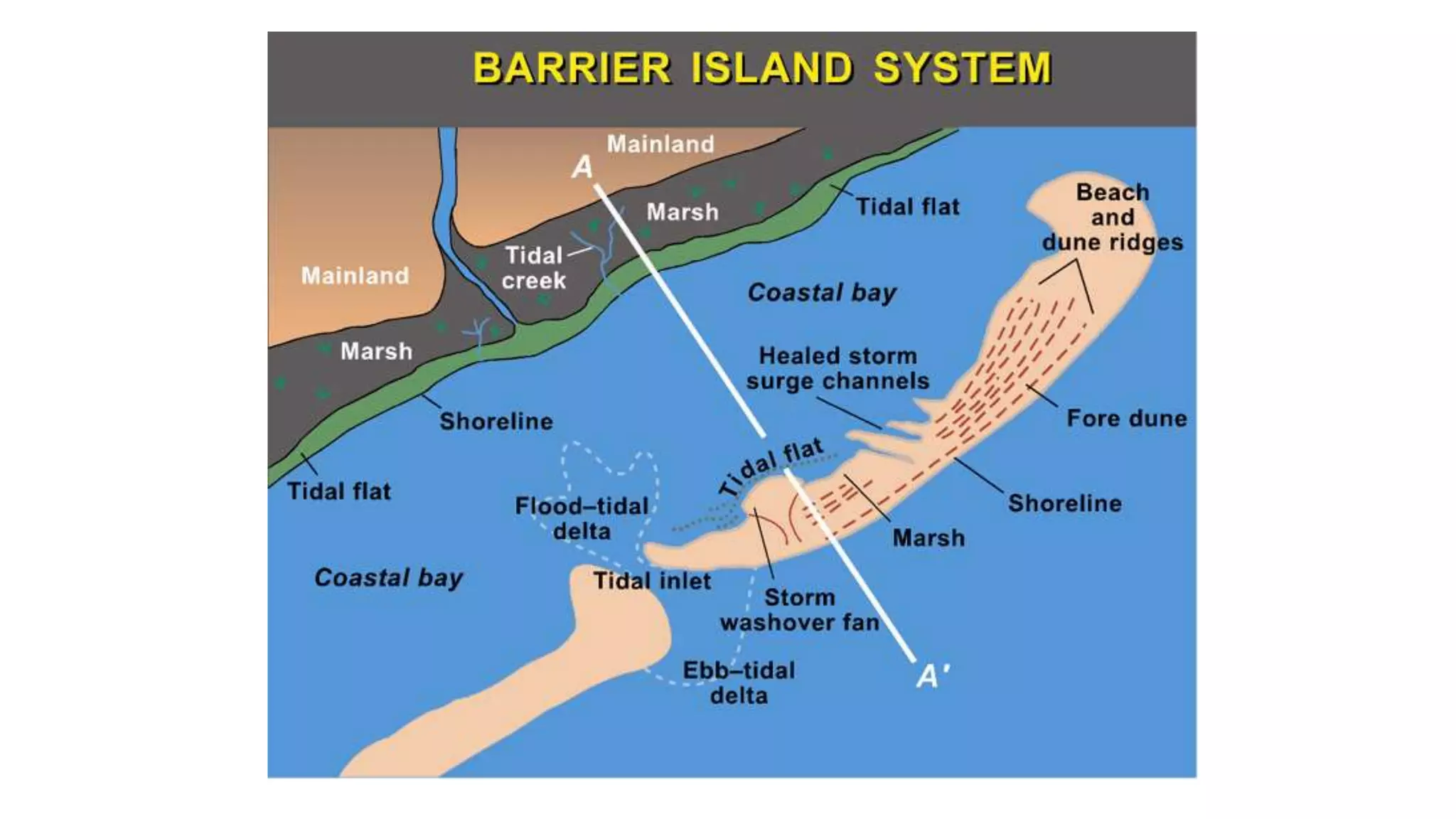
BARRIER ISLANDS
Offshore bars are elongated ridges and mounds of sand or gravel
deposited beyond a shoreline by currents and waves.
The term offshore bar has been used to describe both submerged bars,
and emergent islands separated from a shoreline by a lagoon, features
more correctly identified as barrier islands.
Submerged bars are only exposed at low tide, if ever, while barrier islands
remain at least partially exposed, even at high tide.
SAND BUDGET
Longshore, tidal, and fluvial currents construct submerged bars in
shallow water coastal environments. The amount of unconsolidated
sediment available in a shore-zone system, called its sand budget,
determines the number of bars and other depositional features that form
along the coastline. A shore-zone system's dominant mode of sediment
transport controls the shapes and orientations of its depositional forms,
including the types of submerged bars.
Some form as a result of long currents that develop a trough and bar
feature in the nearshore zone. In other cases, storms, with destructive
waves with high breakers and strong backwash drag berm sediment
offshore to help form longshore bars. These bars then migrate shoreward
under calmer more constructive wave patterns.
This process also helps create the steep shore facing slopes of berms.
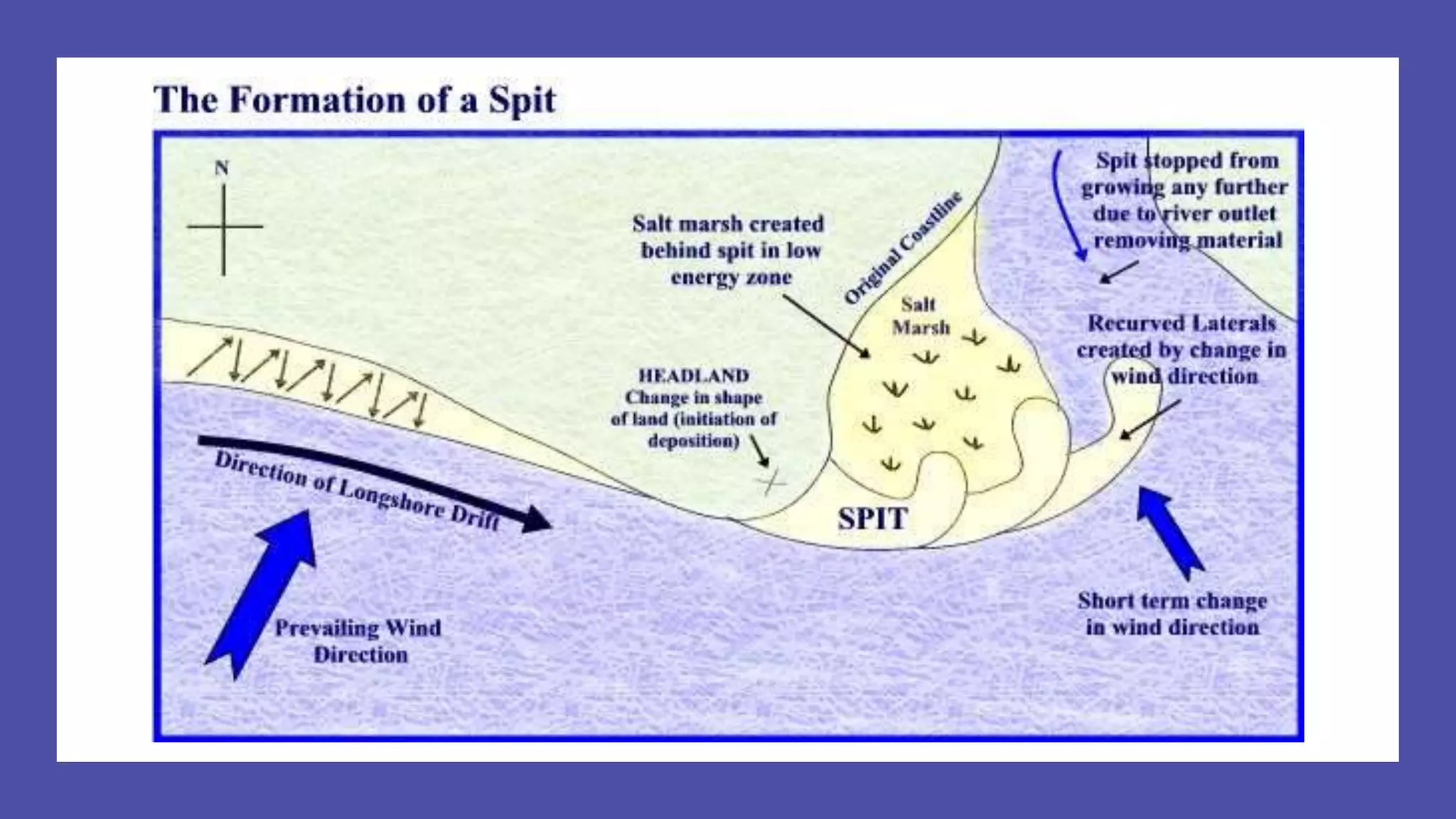
SPITS
Spits are long narrow ridges of sand and shingle which project from the
coastline into the sea. The formation of a spit begins due to a change in
the direction of the coastline, where a low energy zone is found.
This can also be at the mouth of the estuary. The main source of material
building up a spit is from long shore drift and current, which brings
material from further down the coast.
Where there is a break in the coastline and a slight drop in energy, long
shore drift will deposit material at a faster rate than it can be removed
and gradually a ridge is built up, projecting outwards into the sea - this
continues to grow by the process of long shore drift and the deposition of
material.
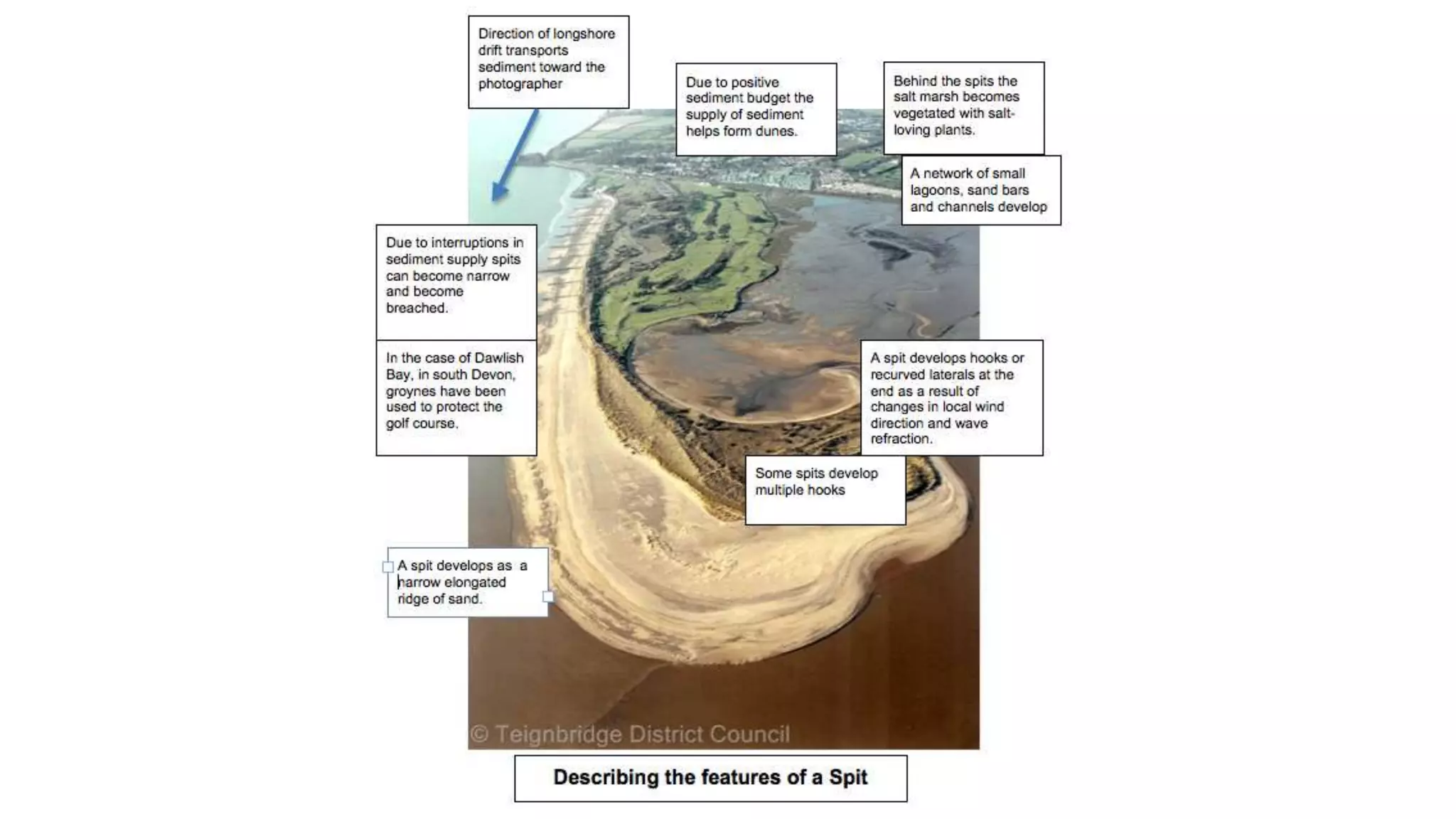
A change in prevailing wind direction often causes the end of spits to
become hooked (also known as a recurved lateral).
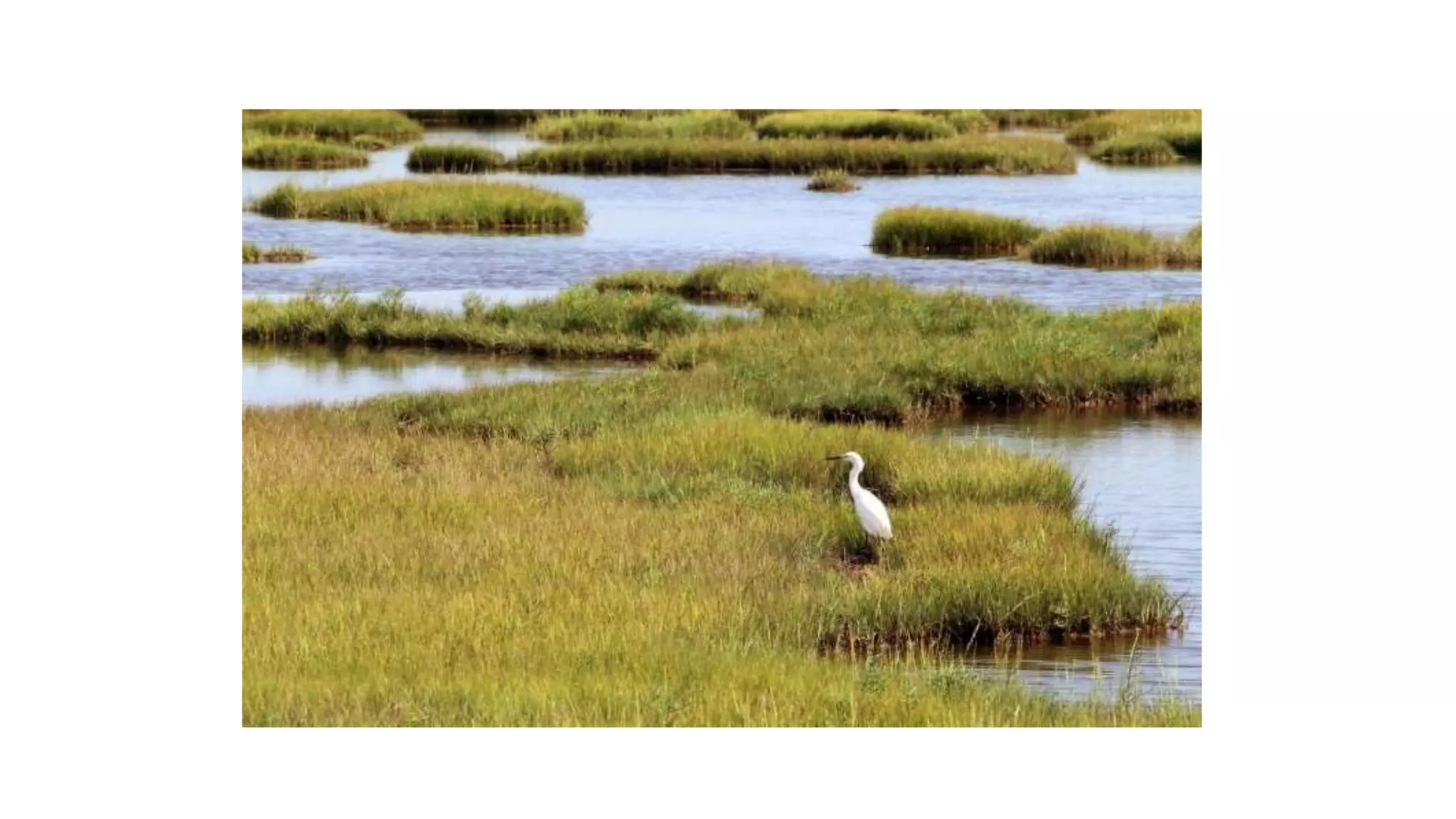
SALT MARSHES
On the spit itself, sand dunes often form and salt-loving
vegetation colonises.
Water becomes trapped behind the spit, creating a low energy zone, as
the water begins to stagnate, mud and marshland often begins to
colonise behind the spit; spits may continue to grow until deposition can
no longer occur, for example due to increased depth, or the spit begins to
cross the mouth of a river and the water removes the material faster than
it can deposited - preventing further build up.
These marshland are called salt marshes.
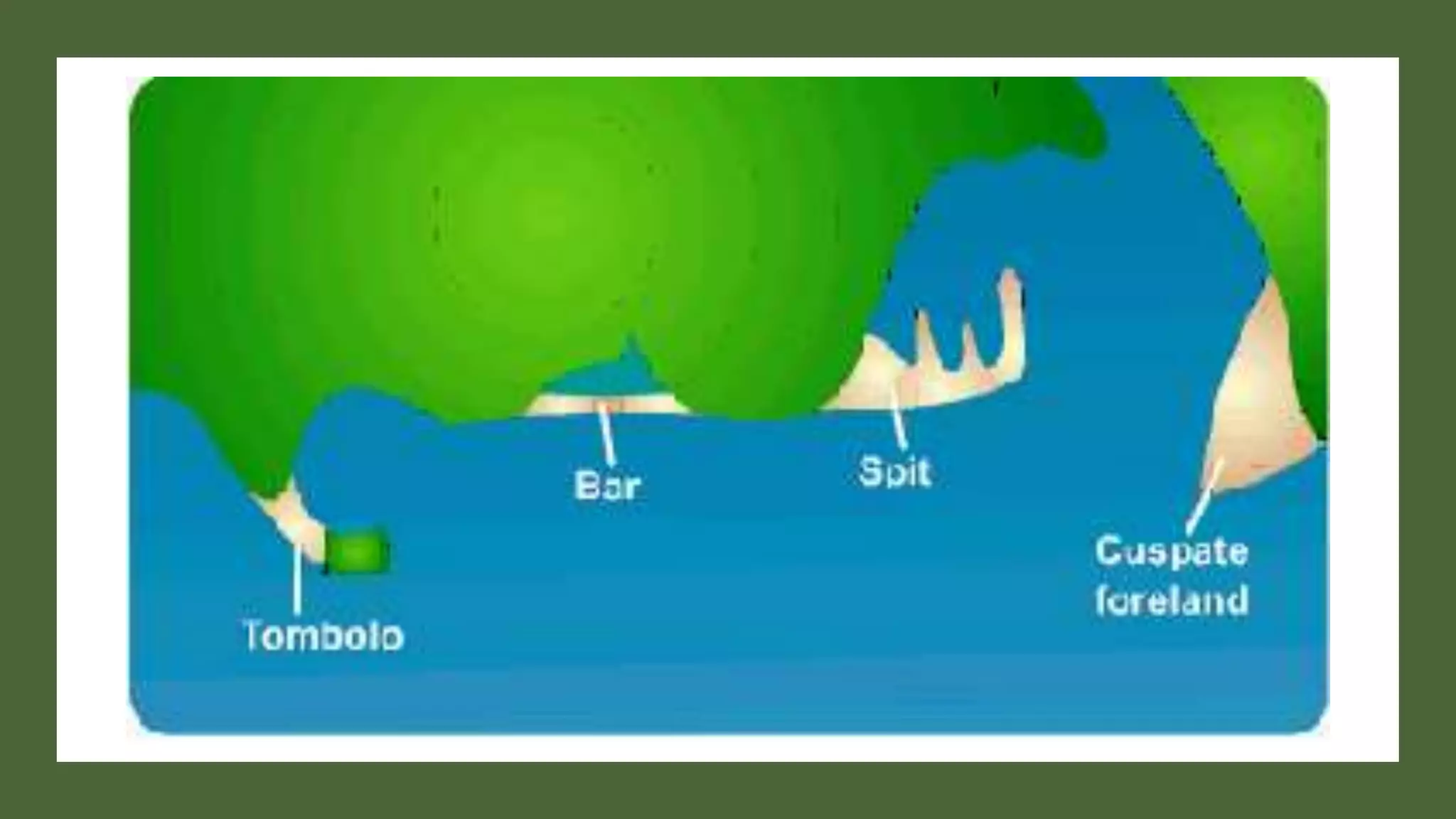
BARS AND TOMBOLO
Bars forms in a similar way to spits, as longshore drift transports
sediment and shingle down the beach it deposits it low energy zones,
such as bays.
At a bay the bar, if continued to be fed by sediment will extend across the
bay cutting off a lagoon behind. In some area, bars extend to join the
mainland to an island.
This forms a sediment ridge called a tombolo.
CUSPATE FORELANDS
Cuspate forelands can be described as triangular beaches.
They form due to longshore drift moving sediment in opposing
directions. The two sets of storm waves build up a series of ridges, each
protecting the material behind it, creating the triangular feature.
Cuspate forelands form due to the positioning of the coast and their
orientation to incoming tides and prevailing winds.
DUNE FORMATION AND EVOLUTION
Dunesform typically on large flat beach profiles with a large sediment
supply to the backshore.
Dunes develop in a different way to other depositional features because
they are the result of the interaction between marine processes and the
atmosphere.
In brief, dunes begin to form beyond the strandline of the beach where
dry sediment is transported by wind through saltation and suspension.
Beach litter and debris that collects on the storm beach acts as an
obstacle to saltation and sediment begins to build up.
EMBRYO DUNES AND MARRAM GRASSES
Over time, an embryo dune develops, which may become vegetated
by marram grasses.
Vegetation stabilizes the dunes in two ways.
Firstly, the roots bind the sand together, and secondly the above ground
vegetation traps particles of sand as they are blown over the surface.
When dunes are less vegetated they remain unstable and so they
migrate.
DUNE FORMATION AND CLIMAX COMMUNITY
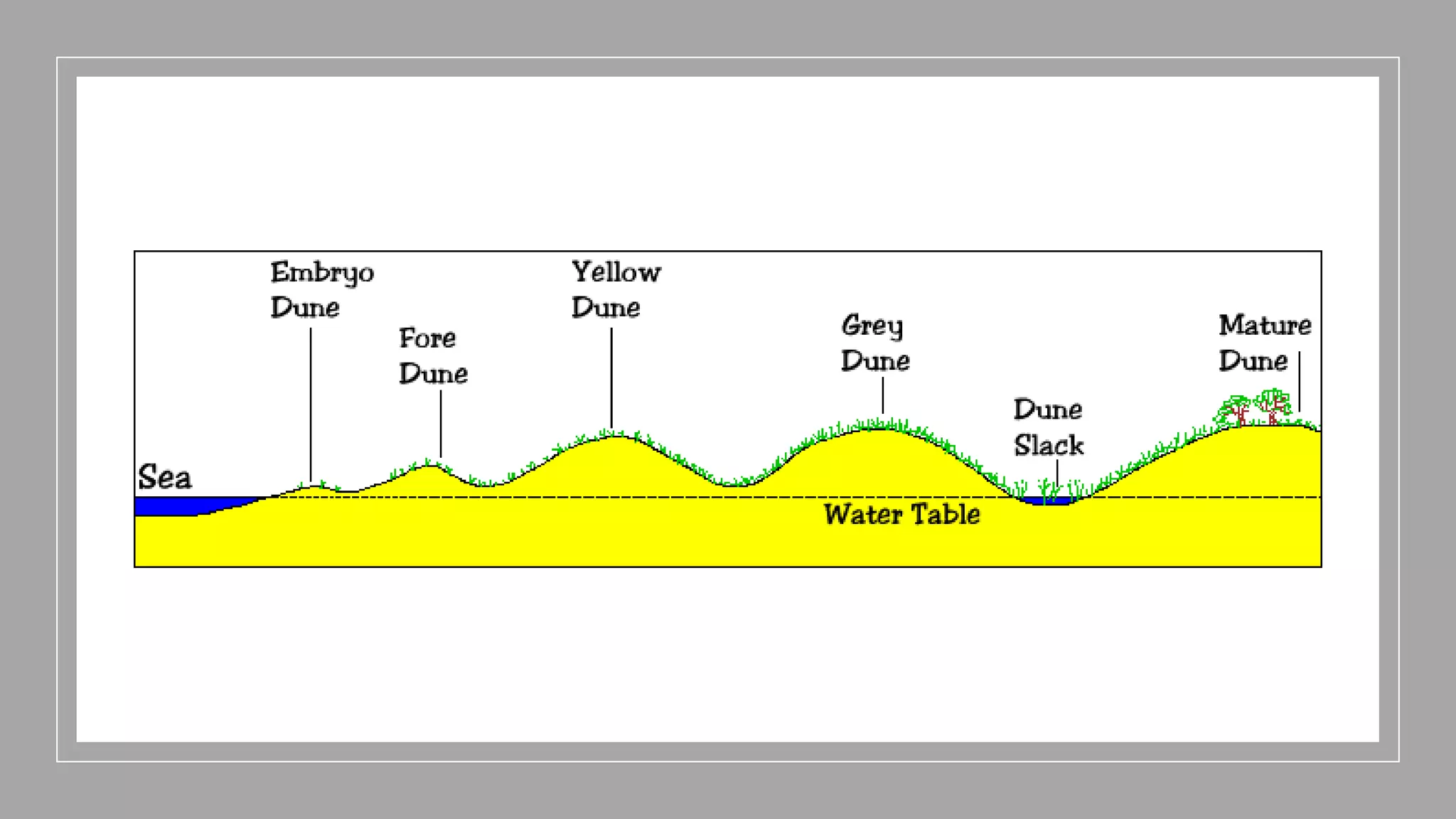
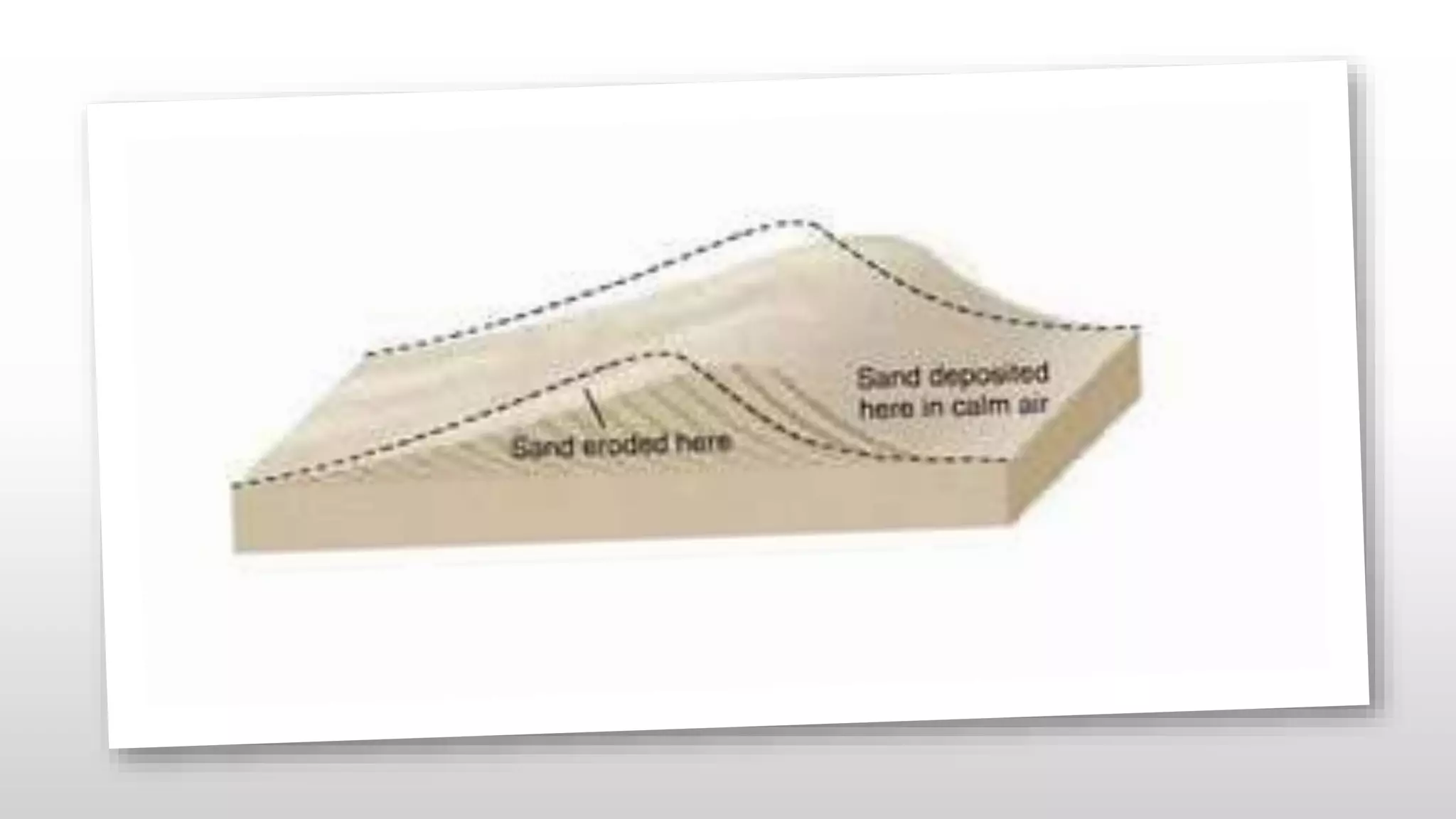
Dunes have a typical form, the windward side is gentle sloping and
shaped my wind movement. The leeward side faces away from the shore
and is steeper and unstable. Dunes increase in size inland. As vegetation
stabilizes the dunes, fore dunes and yellow dunes develop.
Within dune profiles there is clear crest and trough pattern. The troughs
are called slacks and result form a positive feedback of continued removal
of sediment out of the trough with its transfer by wind up the win ward
side of the next dune.
It is common for the slack to be eroded so much that it reaches the water
table where salt rich ponds are found. Biodiversity increases inland as
more and more plants colonise the dune system.
The climax community is the typical climax community of the climate.
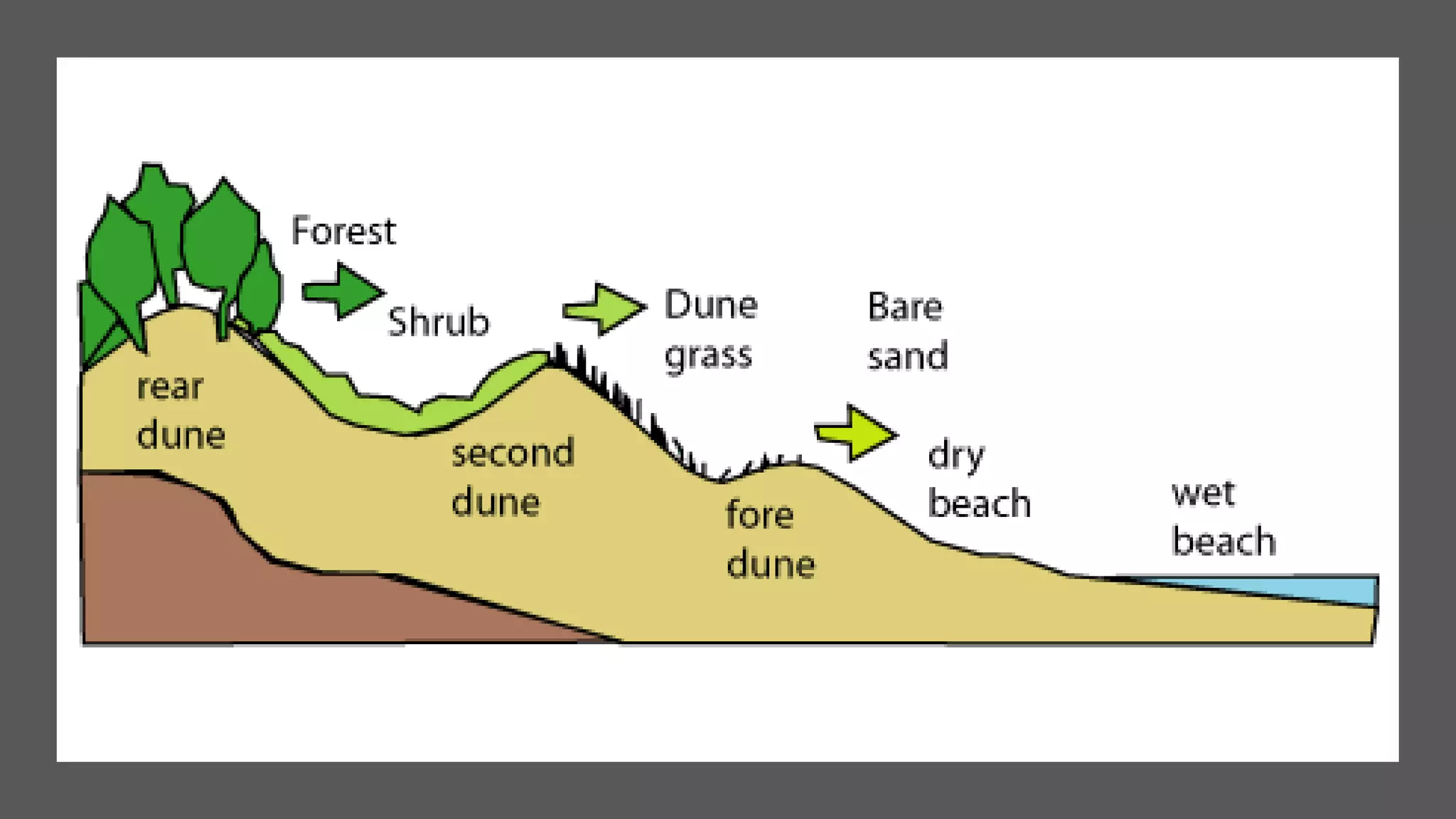
DUNE PLANT SUCCESSION
Coastal sand dunes or psammoseres provide a range of habitats for
plants and animals. The habitats nearest to the beach are harsh - the
plants may suffer stress from lack of moisture and nutrients, exposure to
salt spray and wind abrasion and ground instability.
Only the toughest pioneer plants can colonise the embryo dunes at the
back of the beach. Marram tends to dominate the large dunes facing the
beach. With increasing distance inland, the number of species and the
amount of ground cover also increases, reflecting the time available for
soil development and the increased availability of moisture, humus and
nutrients. Shrubs and woodland are found only on the oldest, stable
dunes farther inland.
At sites with limited human disturbance this woodland may approach the
climax vegetation for sandy soils in an area.
DUNE PLANT SUCCESSION cont.
At Muriwai Beach there is some vegetation at the back of the beach.
Beyond the strand line pioneer species include sea rocket and sand couch but
the ground cover is <10%.
The pioneers act to stabilise the sand and their decay slowly adds humus to the
sand. No soil profile is developed and Ca contents are high.
These hardy plants may have to cope with high sand temperatures, high salt
contents, drought and very unstable ground.
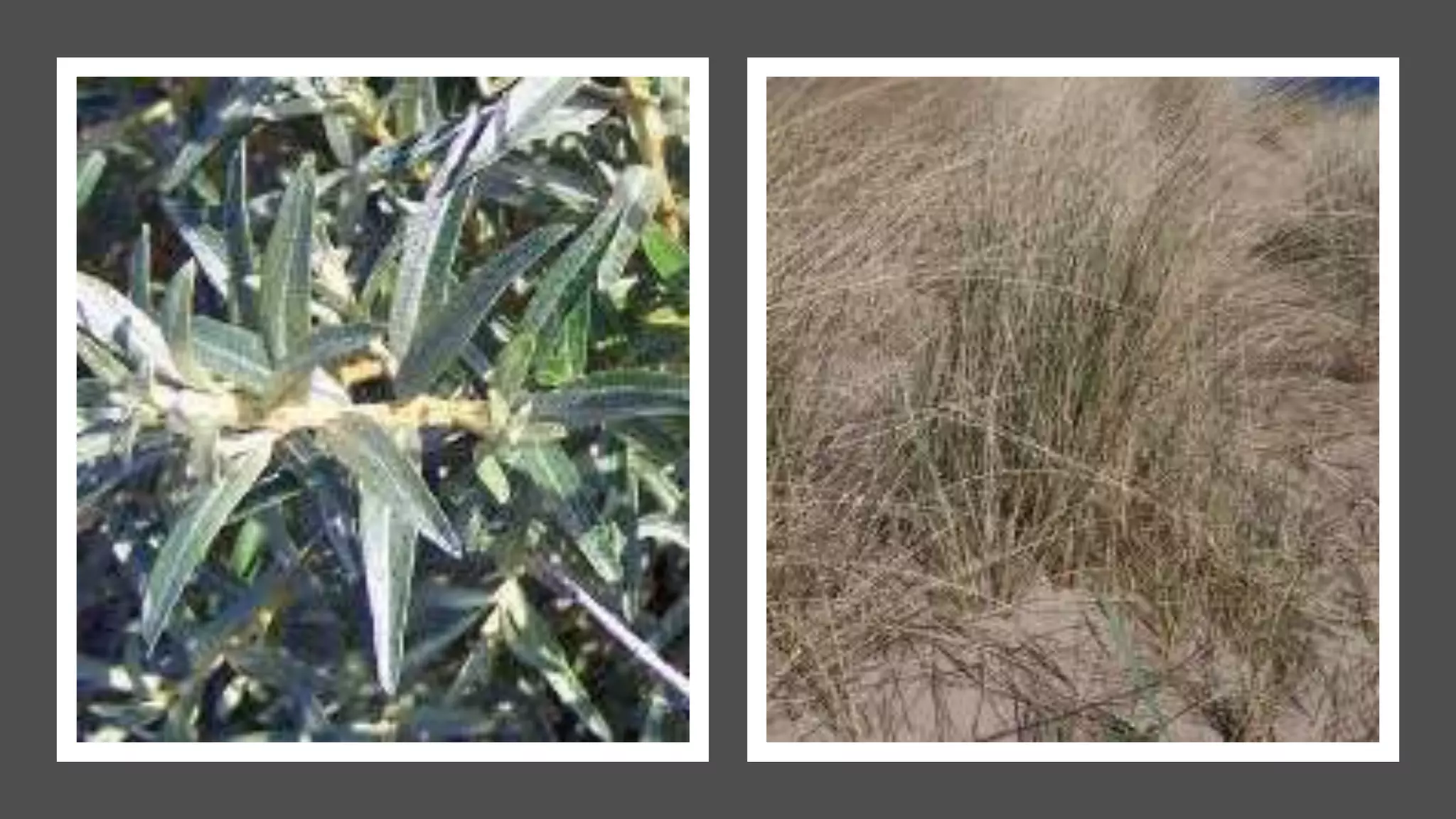
Marram is adapted to this harsh environment in several ways:
Leaves: tough, ribbed leave surface to minimise damage from sand blasting.
Central leaf fold helps to reduce evaporation. Long, thin shape allows leaves to
bend with the wind.
Root systems: long and strong to hold sand together and to tap water at depth.
Salt tolerance: high.
DUNE PLANT SUCCESSION cont.
The older dunes are being invaded by shrubs. These included hawthorn
and sea buckthorn. This latter shrub is an aggressive coloniser. Sea
buckthorn is a legume – it has nitrogen-fixing bacteria on its roots - and
also provides leaf litter. The soils on the older dunes are therefore richer
in nutrients and thicker. The shrubs provide cover and act as wind breaks.
This means that these areas provide habitats for a range of animals,
including snails, and birds, including finches and other song birds.
The climax vegetation (definition: the final stage of plant succession
where there is a stable environment and vegetation is in equilibrium with
the local climate) in this area should be oak woodland.
None occurs here because the oldest part of the dune systems is
managed intensively for recreation. All woodland was removed to create
the golf course. The many human influences on the vegetation succession
means that Muriwai can provide a good example of a plagiosere.

A2 CAMBRIDGE GEOGRAPHY: CHARACTERISTICS AND FORMATION OF COASTAL LANDFORMS

  • 1.
    A2GEOGRAPHY - COASTALENVIRONMENTS 8.2CHARACTERISTICS AND FORMATION OF COASTAL LANDFORMS
  • 2.
    TOPIC 8.2 CHARACTERISTICS AND FORMATION OFCOASTAL LANDFORMS Learners should be able to explain the formation of erosional landforms: cliffs and wave-cut platforms, caves, arches and stacks Learners should be able to explain the formation of depositional landforms: beaches in cross section (profile) and plan, swash and drift aligned beaches, simple and compound, spits, tombolos, offshore bars, barrier beaches, coastal dunes, tidal sedimentation in estuaries, coastal saltmarshes and mangroves. Learners should understand the role of sea level change in the formation of coastal landforms.
  • 3.
    CLIFFED COASTS A cliffedcoast, also called an abrasion coast, is a form of coast where the action of marine waves has formed steep cliffs that may or may not be precipitous.
  • 4.
    ALLUVIAL (FLAT) COASTS A cliffedcoast is different than a flat or alluvial coast.
  • 5.
    THE FORMATION OFA CLIFFED COAST In coastal areas in which the land surface dips at a relatively steep angle below the water table, the continuous action of marine waves on the coastline, known as abrasion, may create a steep declivity known as a cliff, the slope angle of which depends on a variety of factors including the jointing, bedding and hardness of the materials making up the cliff as well as the erosional processes themselves. The Mecklenburg coast in Germany recedes by about 25 centimetres per year, whereas the chalk cliffs of southern England retreat by just half centimetre/year. A cliffed coast is made of a loose bedrock material, but can also occur in hard rock.
  • 6.
    Crags on thesouthwestern coast of Portugal (crags are steep or rugged cliffs or rock face)
  • 7.
    ROCKY CLIFFED COASTS Ona rocky cliffed coast made up of material which is relatively resistant to erosion such as sandstone, limestone or granite, a flat rocky wave-cut platform or abrasion platform is formed in front of the cliff. It represents the foot of the cliff preserved at and below the level of water table. If there is a tectonic uplift of the coast, these abrasion platforms can be raised to form coastal terraces, from which the amount of uplift can be calculated from their elevation relative to the sea level, taking into account any eustatic sea level changes. On a cliffed coast made up of material which is only fairly or even hardly resistant to erosion no wave-cut platform but a beach is formed in front of the sea cliff.
  • 8.
    Abrasion cliff inJinshitan Coastal National Geopark, Dalian, Liaoning Province, China. Wave-like texture was produced by coastal erosion.
  • 9.
    Wave-cut platform atSoutherndown, South Wales, UK
  • 10.
    ROCKY CLIFFED COASTS Ifwaves carve notches at a narrow point on both sides of a promontory on the rocky cliffed coast, a natural arch may be formed. When the arch collapses as the coastline recedes further a stack is left behind on the wave-cut platform. On a rocky cliffed coast wave action is not the only driving force for coastline retreat. General weathering of the bedrock is almost equally important. The Azure Window, Malta, which collapsed in 2017
  • 11.
  • 12.
    LIVING AND DEAD CLIFFS Livingcliffs are those on a coast that is still active, i.e. that is being eroded and is receding. A dead cliff, by contrast, is only reached by very high marine waves and is therefore subjected to very little change. A clear indication of a lack of activity at a dead cliff is a covering of vegetation that appears on the cliff as wave action against it subsides.
  • 13.
    FEATURES CREATED BYEROSION Along a coastline there are features created by erosion. These include cliffs, wave-cut platforms and wave-cut notches. There are also headlands and bays, caves, arches, stacks and stumps. Seven Sisters chalk cliffs on the East Sussex coast
  • 14.
    CLIFFS One of themost common features of a coastline is a cliff. 01 Cliffs are shaped through a combination of erosion and weathering - the breakdown of rocks caused by weather conditions. 02 Soft rock, eg. sand and clay, erodes easily to create gently sloping cliffs. 03 Hard rock, eg. chalk, is more resistant and erodes slowly to create steep cliffs. 04
  • 15.
    The erosion ofcliffs LEGEND 1. Weather weakens the top of the cliff. 2. The sea attacks the base of the cliff forming a wave-cut notch. 3. The notch increases in size causing the cliff to collapse. 4. The backwash carries the rubble towards the sea forming a wave-cut platform. 5. The process repeats and the cliff continues to retreat.
  • 16.
    SEA CLIFFS FORMATION • Waveerosion undercuts the steep shorelines and create the coastal cliffs. • A sea cliff is a vertical precipice created by waves crashing directly on a steeply inclined slope. • Hydraulic action, abrasion, and chemical solution all work to cut a notch at the high water level near the base of the cliff.
  • 17.
    HEADLANDS AND BAYS Headlandsare formed when the sea attacks a section of coast with alternating bands of hard and soft rock. The bands of soft rock, such as sand and clay, erode more quickly than those of more resistant rock, such as chalk. This leaves a section of land jutting out into the sea called a headland. The areas where the soft rock has eroded away, next to the headland, are called bays.
  • 18.
    GEOLOGY Geology is thestudy of the types of rocks that make up the Earth's crust. Coastlines where the geology alternates between strata (or bands) of hard rock and soft rock are called discordant coastlines. A concordant coastline has the same type of rock along its length. Concordant coastlines tend to have fewer bays and headlands. Along the coastline of the Isle of Purbeck in Dorset, there are both discordant and concordant coastlines. The discordant coastline has been formed into Studland Bay (soft rock), Ballard Point (hard rock), Swanage Bay (soft rock) and Durlston Head (hard rock). After Durlston Head, the strata stop alternating and the coastline is made up of hard rock. This concordant coast has fewer features.
  • 19.
    CAVES, ARCHES, STACKSAND STUMPS Weathering (the gradual breakdown of rocks because of the weather) and erosion (rock or soil worn away by the action of wind, waves, water) can create caves, arches, stacks and stumps along a headland.
  • 20.
    SEA CAVES Caves occurwhen waves force their way into cracks in the cliff face. The water contains sand and other materials that grind away at the rock until the cracks become a cave. Hydraulic action is the predominant process. Constant undercutting and erosion causes the cliffs to retreat landward. Sea caves form along lines of weakness in cohesive but well-jointed bedrock. Sea caves are prominent headlands where wave refraction attacks the shore.
  • 21.
    ARCHES, STACKS AND STUMPS If thecave is formed in a headland, it may eventually break through to the other side forming an arch. The arch will gradually become bigger until it can no longer support the top of the arch. When the arch collapses, it leaves the headland on one side and a stack (a tall column of rock) on the other. The stack will be attacked at the base in the same way that a wave-cut notch is formed. This weakens the structure and it will eventually collapse to form a stump. One of the best examples in Britain is Old Harry Rocks, a stack found off a headland in the Isle of Purbeck.
  • 22.
    SEA ARCHES A seaarch forms when sea caves merge from opposite sides of a headland. If the arch collapses, a pillar of rock remains behind as a sea stack. A sea arch is a natural opening eroded out of a cliff face by marine processes. Some arches appear to have developed from surge channels, which are created by wave refraction causing the focussing of wave fronts on the side of a headland. Caves produced on either side of a promontory may become joined over time to become a tunnel and, finally, an arch.
  • 24.
    SEA ARCHES ANDSEA TUNNELS Sea arches have been regarded as ephemeral forms tending to survive over periods of just few decades to several centuries. 01 The term sea tunnel can be used to describe a hole in the cliff line where the arch itself is considerably longer than the width of the entrance. 02
  • 25.
    • sub-aerial processesof weathering and mass movement (frost shattering, carbonation-solution, hydrolysis) • lithology and rock structure • isostatic and eustatic sea level changes • human activity THE FACTORS INFLUENCING CLIFF FORMS
  • 26.
    THE FORMATION OF DEPOSITIONALLANDFORMS Beaches in cross section (profile) and plan. Swash and drift aligned beaches. Simple and compound. Spits, tombolos, offshore bars. Barrier beaches, coastal dunes, tidal sedimentation in estuaries. Coastal saltmarshes and mangroves.
  • 27.
    WHAT IS ABEACH? A beach is a geological landform along the shoreline of a body of water. It usually consists of loose particles which are often composed of rock, such as sand, gravel, shingle, pebbles, or cobble. The particles of which the beach is composed can sometimes instead have biological origins, such as shell fragments or coralline algae fragments. Beaches often occur along coastal areas, where wave or current action deposits and reworks sediments.
  • 28.
    THE PROFILE OFA BEACH Although the seashore is most commonly associated with the word "beach", beaches are not only found by the sea or ocean: beaches also occur at the margin of the land along lakes and rivers where sediments are reworked or deposited. A profile of a beach is a cross section of the landform showing the shape, length, steepness and features. A plan of a beach is a bird’s eye view which shows it’s shape in relation to surrounding features.
  • 30.
    BEACH SHAPES ANDSIZES Beach can come in many shapes and sizes therefore the profile will change in width, gradient and show different features such as ridges, and storm beaches. As well as changing from beach to beach the profile can change at different points along the same beach. From looking at beach profiles you can tell that width and gradient tend to be linked. Wide beaches tend to be gently sloping, whereas narrow beaches tend to be steep. You can also link gradient and therefore width with sediment size.
  • 31.
    COASTS OF EROSION Coastsof erosion form as a result of high energy waves, large fetch, high exposure and limited deposition. Coastlines, that are discordant in geology help create typical headland and bay features that also erode over time to form wave-cut platforms and arches and stacks. They are also associated with drift aligned coasts that are influenced by longshore drift. This transfer of sediment along the coast limits the development of beaches and leads to greater cliff exposure, hence cliff retreat.
  • 33.
    WAVE-CUT PLATFORMS Wave cutplatforms as illustrated in the diagram and shown in the photograph are remnants of the previous cliff line. They form as a ledge of bedrock left behind as the Cliff retreats. The platform slopes at 4-5 degree angle down to the sea. It forms as waves erode the base of the cliff in the inter-tidal zone. Waves scour away at the base through processes of abrasion, hydraulic action and solution, until over time a wave-cut notch forms.
  • 35.
    LARGER WAVE-CUT PLATFORMS Asthe notch enlarges, the cliff face becomes undermined until at some point it collapses under its own weight. Attrition and transportation then remove the cliff debris leaving behind a small bedrock ledge, which marks the old cliff line. This process is repeated over time as the cliff retreats forming a larger wave-cut platform. Eventually a beach may develop on the platform which will provide some protection to the cliff and in turn slows down the rate of retreat. Wave-cut platforms are characterised by their gentle sloping angle, hard bedrock and rock pools, which develop unique coastal ecosystems.
  • 37.
    COASTS OF DEPOSITIONS When studentsthink of coasts of deposition they are immediately drawn to discuss the processes of long-shore drift and the formation of spits. They tend to overlook less obvious, but equally important features, for example, the beach. However, deposition is a lot more complex than this and it is important to develop a structure that puts the emphasis on place and scale.
  • 39.
    SWASH AND DRIFT ALIGNEDBEACHES The starting point to discussing depositional features is with swash and drift aligned beaches. Remember, a swash aligned beach brings in waves parallel to the shore and as result, they build up beaches. Swash aligned beaches are more influenced by constructive wave patterns, which are also important for building up large beaches. In contrast, drift aligned coasts bring in waves at an angle to the shoreline and so therefore, the waves tend to transport sediment down the coast, keeping beaches relatively narrow.
  • 41.
    SWASH AND DRIFTALIGNED BEACHES cont. It is drift aligned beaches that are mainly associated with spits, bars and tombolos. Swash beaches are more associated with large beach profiles, with dunes, a variety of berms and beach drainage features.
  • 42.
    THE BEACH PROFILE Thebeach profile extends from the offshore zone to the backshore zone. The beach itself forms from the nearshore to the backshore within the tidal range. At coasts dominated by destructive waves the beach profile is narrow and steep. The tidal range will also be smaller. At coasts dominated by constructive waves, large wide and flat beaches develop and the tidal range is more extensive. It is on these large relatively flat beaches that a greater number of depositional features occur.
  • 44.
    RIDGES AND RUNNELS Thesmallest in scale, are beach drainage features, such as ridges and runnels. Ridges and runnels form in the foreshore zone. Ridges are areas of the foreshore that are raised above the adjacent shore which dips into a Runnel. The cross-section is similar to that of hills and valleys but at a much smaller scale. Ridge and runnel systems are formed due to the interaction of tides, currents, sediments and the beach topography. They will only form on shallow gradient beaches. They form as a simple drainage routes for incoming and outgoing tides. Water flows in and out via the runnel, creating a hollow channel.
  • 46.
    BERMS AND BEACHCUSPS The ridges are the raised section next to the runnel. Other depositional features such as berms, which are raised ridges or plateaus that mark highest tidal point. It's normal for a beach profile to support several berms, that mark different tide levels. The highest berm is called the spring tide berm and is made up of the largest and most course sediment, which merges into the storm beach at the very back of the shore. A smaller feature of the beach profile are beach cusps. Beach cusps are shoreline features made up of various grades of sediment that form an arc pattern.
  • 47.
    HORNS AND EMBAYMENTS Thehorns are made up of coarser materials and the embayment contains finer grain sediment. They are most noticeable on shorelines with coarser sediment such as pebble beaches, however, they can occur on beaches with sediment of any size. They nearly always occur in a regular pattern with cusps of equal size and spacing. Cusps are most often a few metres long, however they may reach 60m across. It's unclear how cusps form but once they do they are a self sustaining formation. This is because once an oncoming wave hits the horn of a beach cusp it is split and forced into two directions.
  • 48.
    HORNS AND EMBAYMENTS Thebreaking of a wave into the cusps slows its velocity, causing coarser sediment to fall out of suspension and be deposited on the horns. The waves then flow along the embayments (picking up finer sediment) and run into one another in the middle. After this collision these waves attempt to flow back out to sea where they are met by incoming waves. Once the cusp is established, coarser sediment is constantly being deposited on the horn and finer sediment is being eroded away from the embayments. In this way a positive feedback occurs which should at least maintain the cusp size if not increase their size.
  • 49.
    BARRIER ISLANDS Offshore barsare elongated ridges and mounds of sand or gravel deposited beyond a shoreline by currents and waves. The term offshore bar has been used to describe both submerged bars, and emergent islands separated from a shoreline by a lagoon, features more correctly identified as barrier islands. Submerged bars are only exposed at low tide, if ever, while barrier islands remain at least partially exposed, even at high tide.
  • 51.
    SAND BUDGET Longshore, tidal,and fluvial currents construct submerged bars in shallow water coastal environments. The amount of unconsolidated sediment available in a shore-zone system, called its sand budget, determines the number of bars and other depositional features that form along the coastline. A shore-zone system's dominant mode of sediment transport controls the shapes and orientations of its depositional forms, including the types of submerged bars. Some form as a result of long currents that develop a trough and bar feature in the nearshore zone. In other cases, storms, with destructive waves with high breakers and strong backwash drag berm sediment offshore to help form longshore bars. These bars then migrate shoreward under calmer more constructive wave patterns. This process also helps create the steep shore facing slopes of berms.
  • 52.
    SPITS Spits are longnarrow ridges of sand and shingle which project from the coastline into the sea. The formation of a spit begins due to a change in the direction of the coastline, where a low energy zone is found. This can also be at the mouth of the estuary. The main source of material building up a spit is from long shore drift and current, which brings material from further down the coast. Where there is a break in the coastline and a slight drop in energy, long shore drift will deposit material at a faster rate than it can be removed and gradually a ridge is built up, projecting outwards into the sea - this continues to grow by the process of long shore drift and the deposition of material. A change in prevailing wind direction often causes the end of spits to become hooked (also known as a recurved lateral).
  • 54.
    SALT MARSHES On thespit itself, sand dunes often form and salt-loving vegetation colonises. Water becomes trapped behind the spit, creating a low energy zone, as the water begins to stagnate, mud and marshland often begins to colonise behind the spit; spits may continue to grow until deposition can no longer occur, for example due to increased depth, or the spit begins to cross the mouth of a river and the water removes the material faster than it can deposited - preventing further build up. These marshland are called salt marshes.
  • 56.
    BARS AND TOMBOLO Barsforms in a similar way to spits, as longshore drift transports sediment and shingle down the beach it deposits it low energy zones, such as bays. At a bay the bar, if continued to be fed by sediment will extend across the bay cutting off a lagoon behind. In some area, bars extend to join the mainland to an island. This forms a sediment ridge called a tombolo.
  • 58.
    CUSPATE FORELANDS Cuspate forelandscan be described as triangular beaches. They form due to longshore drift moving sediment in opposing directions. The two sets of storm waves build up a series of ridges, each protecting the material behind it, creating the triangular feature. Cuspate forelands form due to the positioning of the coast and their orientation to incoming tides and prevailing winds.
  • 60.
    DUNE FORMATION ANDEVOLUTION Dunesform typically on large flat beach profiles with a large sediment supply to the backshore. Dunes develop in a different way to other depositional features because they are the result of the interaction between marine processes and the atmosphere. In brief, dunes begin to form beyond the strandline of the beach where dry sediment is transported by wind through saltation and suspension. Beach litter and debris that collects on the storm beach acts as an obstacle to saltation and sediment begins to build up.
  • 62.
    EMBRYO DUNES ANDMARRAM GRASSES Over time, an embryo dune develops, which may become vegetated by marram grasses. Vegetation stabilizes the dunes in two ways. Firstly, the roots bind the sand together, and secondly the above ground vegetation traps particles of sand as they are blown over the surface. When dunes are less vegetated they remain unstable and so they migrate.
  • 63.
    DUNE FORMATION ANDCLIMAX COMMUNITY Dunes have a typical form, the windward side is gentle sloping and shaped my wind movement. The leeward side faces away from the shore and is steeper and unstable. Dunes increase in size inland. As vegetation stabilizes the dunes, fore dunes and yellow dunes develop. Within dune profiles there is clear crest and trough pattern. The troughs are called slacks and result form a positive feedback of continued removal of sediment out of the trough with its transfer by wind up the win ward side of the next dune. It is common for the slack to be eroded so much that it reaches the water table where salt rich ponds are found. Biodiversity increases inland as more and more plants colonise the dune system. The climax community is the typical climax community of the climate.
  • 65.
    DUNE PLANT SUCCESSION Coastalsand dunes or psammoseres provide a range of habitats for plants and animals. The habitats nearest to the beach are harsh - the plants may suffer stress from lack of moisture and nutrients, exposure to salt spray and wind abrasion and ground instability. Only the toughest pioneer plants can colonise the embryo dunes at the back of the beach. Marram tends to dominate the large dunes facing the beach. With increasing distance inland, the number of species and the amount of ground cover also increases, reflecting the time available for soil development and the increased availability of moisture, humus and nutrients. Shrubs and woodland are found only on the oldest, stable dunes farther inland. At sites with limited human disturbance this woodland may approach the climax vegetation for sandy soils in an area.
  • 67.
    DUNE PLANT SUCCESSIONcont. At Muriwai Beach there is some vegetation at the back of the beach. Beyond the strand line pioneer species include sea rocket and sand couch but the ground cover is <10%. The pioneers act to stabilise the sand and their decay slowly adds humus to the sand. No soil profile is developed and Ca contents are high. These hardy plants may have to cope with high sand temperatures, high salt contents, drought and very unstable ground. Marram is adapted to this harsh environment in several ways: Leaves: tough, ribbed leave surface to minimise damage from sand blasting. Central leaf fold helps to reduce evaporation. Long, thin shape allows leaves to bend with the wind. Root systems: long and strong to hold sand together and to tap water at depth. Salt tolerance: high.
  • 69.
    DUNE PLANT SUCCESSIONcont. The older dunes are being invaded by shrubs. These included hawthorn and sea buckthorn. This latter shrub is an aggressive coloniser. Sea buckthorn is a legume – it has nitrogen-fixing bacteria on its roots - and also provides leaf litter. The soils on the older dunes are therefore richer in nutrients and thicker. The shrubs provide cover and act as wind breaks. This means that these areas provide habitats for a range of animals, including snails, and birds, including finches and other song birds. The climax vegetation (definition: the final stage of plant succession where there is a stable environment and vegetation is in equilibrium with the local climate) in this area should be oak woodland. None occurs here because the oldest part of the dune systems is managed intensively for recreation. All woodland was removed to create the golf course. The many human influences on the vegetation succession means that Muriwai can provide a good example of a plagiosere.