Department of Applied Geology
Dr.Harisingh Gour vishwavidyala
Sagar,Madhya pradesh
Wind Depositional Features
seminar
Guided by
Prof.P.k.Kathal
Poornnima U.M.
M.tech 1st sem
Reg.No.Y24251027
Contents
• Introduction
• Aeolian environment of deposition
• Deposition
• Depositional landforms
• conclusion
Introduction
• Wind ,a geomorphological agent which cause erosion and deposition
• The features formed by the wind is called Aeolian Features
• Effective in areas without vegetation
• Depending upon the velocity and grain size of the material carried , material forms mainly
two types of deposits
• Accumulation of sand
• Deposit of silt and clay
Environments
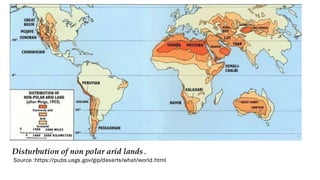
• In arid , semiarid and sub-humid regions show the best development of aeolian
landforms (Generallay occurs in central and western region of northern hemisphere)
• In non desertic regions such as along the shore lines, areas of glacial outwash
Disturbution of non polar arid lands.
Source :https://pubs.usgs.gov/gip/deserts/what/world.html
Wind
Deposition
• Factors which led to depositional landforms:
• 1. Decreased Wind Speed: Wind must slow down,
allowing particles to settle.
• 2. Topography: Presence of obstacles (hills,
mountains, or valleys) to disrupt airflow.
• 3. Moisture: Availability of moisture helps
particles stick together.
• 4. Gravity: Particles must be heavier than air.
• 5. Surface Roughness: Rough surfaces help trap
particles.
Deposition take place in 3 ways (Bagnold ,1941):
• Sedimentation
• Accretion
• Enroachment
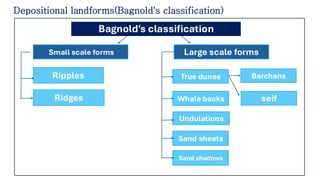
Depositional landforms(Bagnold's classification)
f
Bagnold's classification
Small scale forms Large scale forms
Ripples
Ridges
True dunes
Whale backs
Undulations
Sand sheets
Sand shadows
Barchans
seif
• 'mobile heap of sand whose existence is
independent of either ground form/fixed wind
obstruction' (Defined by bagnold)
Kelso Dunes at Mojave National Preserve, California
https://en.wikipedia.org/wiki/Dune#f/med
Sand dunes
Dune formation
• On obstruction ,wind leaves some of the
transported sand
• Gradually adds heights to the evolving dune
• On windward sand moves up and leeward
side slumps where wind eddies remove
particles
• These simultaneous processes shape the
dune
▪ At critical height , particles begin to slip forward and leeward slope slumps
▪ These processes on the windward and leeward sides continue , gradually the dunes
move towards the slip-face side
https://www.google.com/gasearch
Barchans
• Cresent shaped dunes.
• Occurs when the sand
supply in limited and
unidirectional winds.
• These dunes migrates in
downwind direction.
• Several barchan dunes
align together
perpendicular to the
wind to form transverse
dune(linear dunes).
https://www.google.com/gasearch/barchandunes
▪ A linear dune , resulting from bidirectional
converging winds.
▪ When the barchans moves into the
bidirectional regime , one horn elongates.
https://www.google.com/gasearch/>longitudinal
https://media.springernature.com/lw685/springer-
static/image/prt%3A978-1-4614-3134
Seif/Longitudinal dunes
https://upload.wikimedia.org/wikipedia/commons/0/09/P
Parabolic dunes
• An inversion of
barchans dunes
• Horns points windward.
• Typically in moist
region.(coastal regions)
• Form where vegetation
cover is broken , from a
deflation hallow or
blow out.
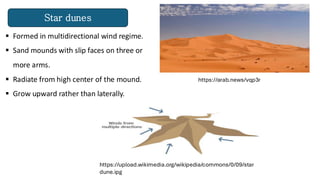
▪ Formed in multidirectional wind regime.
▪ Sand mounds with slip faces on three or
more arms.
▪ Radiate from high center of the mound.
▪ Grow upward rather than laterally.
Star dunes
https://upload.wikimedia.org/wikipedia/commons/0/09/star
dune.ipg
https://arab.news/vqp3r
• Accumulations of sand
• Occupying areas < 30,000 km with at
least 10 dunes spaced at distances
exceeding dune wavelength
• Contain small and simple dunes.
• Chains of transverse & seif dunes,
barchans & other features develop on
whalebacks to make dune fields.
Dunefield
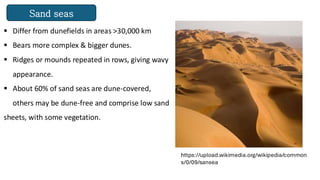
▪ Differ from dunefields in areas >30,000 km
▪ Bears more complex & bigger dunes.
▪ Ridges or mounds repeated in rows, giving wavy
appearance.
▪ About 60% of sand seas are dune-covered,
others may be dune-free and comprise low sand
sheets, with some vegetation.
Sand seas
https://upload.wikimedia.org/wikipedia/common
s/0/09/sansea
▪ Small scale , wave like undulations.
▪ Shape changes quickly
▪ Perpendicular to wind direction.
▪ Long, undulating features
▪ Saltation is main process of their formation.
▪ Particles on leeward side protected from wind impact
▪ Crest receives grains faster than it loses them
▪ Depressions lose grains faster than they receive &
hence get hollowed
Sand ripples
Sand Ridges
https://www.google.com/gasearch?q=sand%20ripples&source
https://www.google.com/gasearchq=sand%20rridges&source
Whalebacks
▪ Flat-topped sand ridge extending parallel to wind
▪ Bagnold: residue from the series of dune chains downwind
▪ larger dimensions, may be 100 miles long, 2 miles wide, and 150 feet high
Sand sheet
▪ Sheet like sand blanket with nearly featureless, but there are often tabular-planar
depositional features and various ripple like bed forms.
https://www.google.com/gasearch?q=sand%20sheet&source
▪ Formed due to obstacle in path of
wind.
▪ Flow velocity dips in the lee of
obstacle than surrounding.
▪ Thus sand collect on leeward side &
form the Sand Shadow close to
obstacle in its shelter
Sand Shadow
https://www.google.com/gasearchq=sand%20sandshadow&source=
sh/x/gs/m2/5#imgrc=Z1lZ5c410PdgM&imgdii=XTDDaf6zDPJtGM
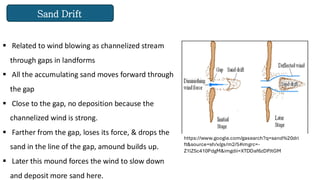
▪ Related to wind blowing as channelized stream
through gaps in landforms
▪ All the accumulating sand moves forward through
the gap
▪ Close to the gap, no deposition because the
channelized wind is strong.
▪ Farther from the gap, loses its force, & drops the
sand in the line of the gap, amound builds up.
▪ Later this mound forces the wind to slow down
and deposit more sand here.
Sand Drift
https://www.google.com/gasearch?q=sand%20dri
ft&source=sh/x/gs/m2/5#imgrc=-
Z1lZ5c410PdgM&imgdii=XTDDaf6zDPJtGM
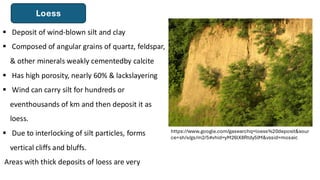
▪ Deposit of wind-blown silt and clay
▪ Composed of angular grains of quartz, feldspar,
& other minerals weakly cementedby calcite
▪ Has high porosity, nearly 60% & lackslayering
▪ Wind can carry silt for hundreds or
eventhousands of km and then deposit it as
loess.
▪ Due to interlocking of silt particles, forms
vertical cliffs and bluffs.
Areas with thick deposits of loess are very
Loess
https://www.google.com/gasearchq=loess%20deposit&sour
ce=sh/x/gs/m2/5#vhid=yM26lX8Rtdy5lM&vssid=mosaic
▪ The fine sediments transported by wind and gets deposited on or mixed with snow or
ice.
▪ When snow melts or sublimates , the sediments are redeposited onto the surface
below, forming a pattern knowns as denivation features.
Niveo- aeolian deposition(Deposition in polar climates)
Layers of sand and snow deposited by wind on a beach of Lake Michigan
https://www.google.com/gasearch?q=sand%20&source=sh/x/gs/m2/5#imgrc=-
Z1lZ5c410PdgM&imgdii=XTDDaf6zDPJtGM
Conclusion
•The stratigraphic record of wind-deposited sediment can be deciphered to understand the
history of our planet.
•For example, aeolianite, indurated coastal dune material cemented by CaCO3, derived from
the dissolution of shell fragments within the sand overlies many elevated marine terraces.
Aeolianite-capped terraces, dated using a variety of luminescence techniques, provide critical
evidence for sea-level heights in the past, allowing us to understand the timing and
magnitude of sea-level change over the past half million years.
•Paleocurrent direction
References
https://academistan.com/geography/geomorphology/aeolian-landforms-erosional-and-
Depositional/​
https://courses.lumenlearning.com/earthscienceck12/chapter/wind-erosion-and-deposition/
https://en.wikipedia.org/wiki/Aeolian_ processes​
https://researchportal.helsinki.fi/en/publications/wind-as-a-geomorphic-agent-in-cold-climates​
Huggett, R.J. (2011). Fundamentals of Geomorphology 3rd Edition. London & New York:​
Routledge, Taylor & Francis Group​
Plummer, Charles C., Carlson, Diane H. & Hammersley, Lisa (2016). Physical Geology. Mc​
Graw Hill Education​
Summerfield, M. A. (2013). Global Geomorphology. London & New York: Routledge, Taylor​
& Francis Group​
Thornbury, W. D. (1954). Principles of Geomorphology. New York: John Wiley & Sons, Inc.,
London: Chapman & Hall, Ltd.​
Thank you

Wind Depositional Features Seminar Presentation

  • 1.
    Department of AppliedGeology Dr.Harisingh Gour vishwavidyala Sagar,Madhya pradesh Wind Depositional Features seminar Guided by Prof.P.k.Kathal Poornnima U.M. M.tech 1st sem Reg.No.Y24251027
  • 2.
    Contents • Introduction • Aeolianenvironment of deposition • Deposition • Depositional landforms • conclusion
  • 3.
    Introduction • Wind ,ageomorphological agent which cause erosion and deposition • The features formed by the wind is called Aeolian Features • Effective in areas without vegetation • Depending upon the velocity and grain size of the material carried , material forms mainly two types of deposits • Accumulation of sand • Deposit of silt and clay
  • 4.
    Environments • In arid, semiarid and sub-humid regions show the best development of aeolian landforms (Generallay occurs in central and western region of northern hemisphere) • In non desertic regions such as along the shore lines, areas of glacial outwash
  • 5.
    Disturbution of nonpolar arid lands. Source :https://pubs.usgs.gov/gip/deserts/what/world.html
  • 6.
    Wind Deposition • Factors whichled to depositional landforms: • 1. Decreased Wind Speed: Wind must slow down, allowing particles to settle. • 2. Topography: Presence of obstacles (hills, mountains, or valleys) to disrupt airflow. • 3. Moisture: Availability of moisture helps particles stick together. • 4. Gravity: Particles must be heavier than air. • 5. Surface Roughness: Rough surfaces help trap particles.
  • 7.
    Deposition take placein 3 ways (Bagnold ,1941): • Sedimentation • Accretion • Enroachment
  • 8.
    Depositional landforms(Bagnold's classification) f Bagnold'sclassification Small scale forms Large scale forms Ripples Ridges True dunes Whale backs Undulations Sand sheets Sand shadows Barchans seif
  • 9.
    • 'mobile heapof sand whose existence is independent of either ground form/fixed wind obstruction' (Defined by bagnold) Kelso Dunes at Mojave National Preserve, California https://en.wikipedia.org/wiki/Dune#f/med Sand dunes
  • 10.
    Dune formation • Onobstruction ,wind leaves some of the transported sand • Gradually adds heights to the evolving dune • On windward sand moves up and leeward side slumps where wind eddies remove particles • These simultaneous processes shape the dune
  • 11.
    ▪ At criticalheight , particles begin to slip forward and leeward slope slumps ▪ These processes on the windward and leeward sides continue , gradually the dunes move towards the slip-face side https://www.google.com/gasearch
  • 12.
    Barchans • Cresent shapeddunes. • Occurs when the sand supply in limited and unidirectional winds. • These dunes migrates in downwind direction. • Several barchan dunes align together perpendicular to the wind to form transverse dune(linear dunes). https://www.google.com/gasearch/barchandunes
  • 13.
    ▪ A lineardune , resulting from bidirectional converging winds. ▪ When the barchans moves into the bidirectional regime , one horn elongates. https://www.google.com/gasearch/>longitudinal https://media.springernature.com/lw685/springer- static/image/prt%3A978-1-4614-3134 Seif/Longitudinal dunes
  • 14.
    https://upload.wikimedia.org/wikipedia/commons/0/09/P Parabolic dunes • Aninversion of barchans dunes • Horns points windward. • Typically in moist region.(coastal regions) • Form where vegetation cover is broken , from a deflation hallow or blow out.
  • 15.
    ▪ Formed inmultidirectional wind regime. ▪ Sand mounds with slip faces on three or more arms. ▪ Radiate from high center of the mound. ▪ Grow upward rather than laterally. Star dunes https://upload.wikimedia.org/wikipedia/commons/0/09/star dune.ipg https://arab.news/vqp3r
  • 16.
    • Accumulations ofsand • Occupying areas < 30,000 km with at least 10 dunes spaced at distances exceeding dune wavelength • Contain small and simple dunes. • Chains of transverse & seif dunes, barchans & other features develop on whalebacks to make dune fields. Dunefield
  • 17.
    ▪ Differ fromdunefields in areas >30,000 km ▪ Bears more complex & bigger dunes. ▪ Ridges or mounds repeated in rows, giving wavy appearance. ▪ About 60% of sand seas are dune-covered, others may be dune-free and comprise low sand sheets, with some vegetation. Sand seas https://upload.wikimedia.org/wikipedia/common s/0/09/sansea
  • 18.
    ▪ Small scale, wave like undulations. ▪ Shape changes quickly ▪ Perpendicular to wind direction. ▪ Long, undulating features ▪ Saltation is main process of their formation. ▪ Particles on leeward side protected from wind impact ▪ Crest receives grains faster than it loses them ▪ Depressions lose grains faster than they receive & hence get hollowed Sand ripples Sand Ridges https://www.google.com/gasearch?q=sand%20ripples&source https://www.google.com/gasearchq=sand%20rridges&source
  • 19.
    Whalebacks ▪ Flat-topped sandridge extending parallel to wind ▪ Bagnold: residue from the series of dune chains downwind ▪ larger dimensions, may be 100 miles long, 2 miles wide, and 150 feet high Sand sheet ▪ Sheet like sand blanket with nearly featureless, but there are often tabular-planar depositional features and various ripple like bed forms. https://www.google.com/gasearch?q=sand%20sheet&source
  • 20.
    ▪ Formed dueto obstacle in path of wind. ▪ Flow velocity dips in the lee of obstacle than surrounding. ▪ Thus sand collect on leeward side & form the Sand Shadow close to obstacle in its shelter Sand Shadow https://www.google.com/gasearchq=sand%20sandshadow&source= sh/x/gs/m2/5#imgrc=Z1lZ5c410PdgM&imgdii=XTDDaf6zDPJtGM
  • 21.
    ▪ Related towind blowing as channelized stream through gaps in landforms ▪ All the accumulating sand moves forward through the gap ▪ Close to the gap, no deposition because the channelized wind is strong. ▪ Farther from the gap, loses its force, & drops the sand in the line of the gap, amound builds up. ▪ Later this mound forces the wind to slow down and deposit more sand here. Sand Drift https://www.google.com/gasearch?q=sand%20dri ft&source=sh/x/gs/m2/5#imgrc=- Z1lZ5c410PdgM&imgdii=XTDDaf6zDPJtGM
  • 22.
    ▪ Deposit ofwind-blown silt and clay ▪ Composed of angular grains of quartz, feldspar, & other minerals weakly cementedby calcite ▪ Has high porosity, nearly 60% & lackslayering ▪ Wind can carry silt for hundreds or eventhousands of km and then deposit it as loess. ▪ Due to interlocking of silt particles, forms vertical cliffs and bluffs. Areas with thick deposits of loess are very Loess https://www.google.com/gasearchq=loess%20deposit&sour ce=sh/x/gs/m2/5#vhid=yM26lX8Rtdy5lM&vssid=mosaic
  • 23.
    ▪ The finesediments transported by wind and gets deposited on or mixed with snow or ice. ▪ When snow melts or sublimates , the sediments are redeposited onto the surface below, forming a pattern knowns as denivation features. Niveo- aeolian deposition(Deposition in polar climates) Layers of sand and snow deposited by wind on a beach of Lake Michigan https://www.google.com/gasearch?q=sand%20&source=sh/x/gs/m2/5#imgrc=- Z1lZ5c410PdgM&imgdii=XTDDaf6zDPJtGM
  • 24.
    Conclusion •The stratigraphic recordof wind-deposited sediment can be deciphered to understand the history of our planet. •For example, aeolianite, indurated coastal dune material cemented by CaCO3, derived from the dissolution of shell fragments within the sand overlies many elevated marine terraces. Aeolianite-capped terraces, dated using a variety of luminescence techniques, provide critical evidence for sea-level heights in the past, allowing us to understand the timing and magnitude of sea-level change over the past half million years. •Paleocurrent direction
  • 25.
    References https://academistan.com/geography/geomorphology/aeolian-landforms-erosional-and- Depositional/​ https://courses.lumenlearning.com/earthscienceck12/chapter/wind-erosion-and-deposition/ https://en.wikipedia.org/wiki/Aeolian_ processes​ https://researchportal.helsinki.fi/en/publications/wind-as-a-geomorphic-agent-in-cold-climates​ Huggett, R.J.(2011). Fundamentals of Geomorphology 3rd Edition. London & New York:​ Routledge, Taylor & Francis Group​ Plummer, Charles C., Carlson, Diane H. & Hammersley, Lisa (2016). Physical Geology. Mc​ Graw Hill Education​ Summerfield, M. A. (2013). Global Geomorphology. London & New York: Routledge, Taylor​ & Francis Group​ Thornbury, W. D. (1954). Principles of Geomorphology. New York: John Wiley & Sons, Inc., London: Chapman & Hall, Ltd.​
  • 26.