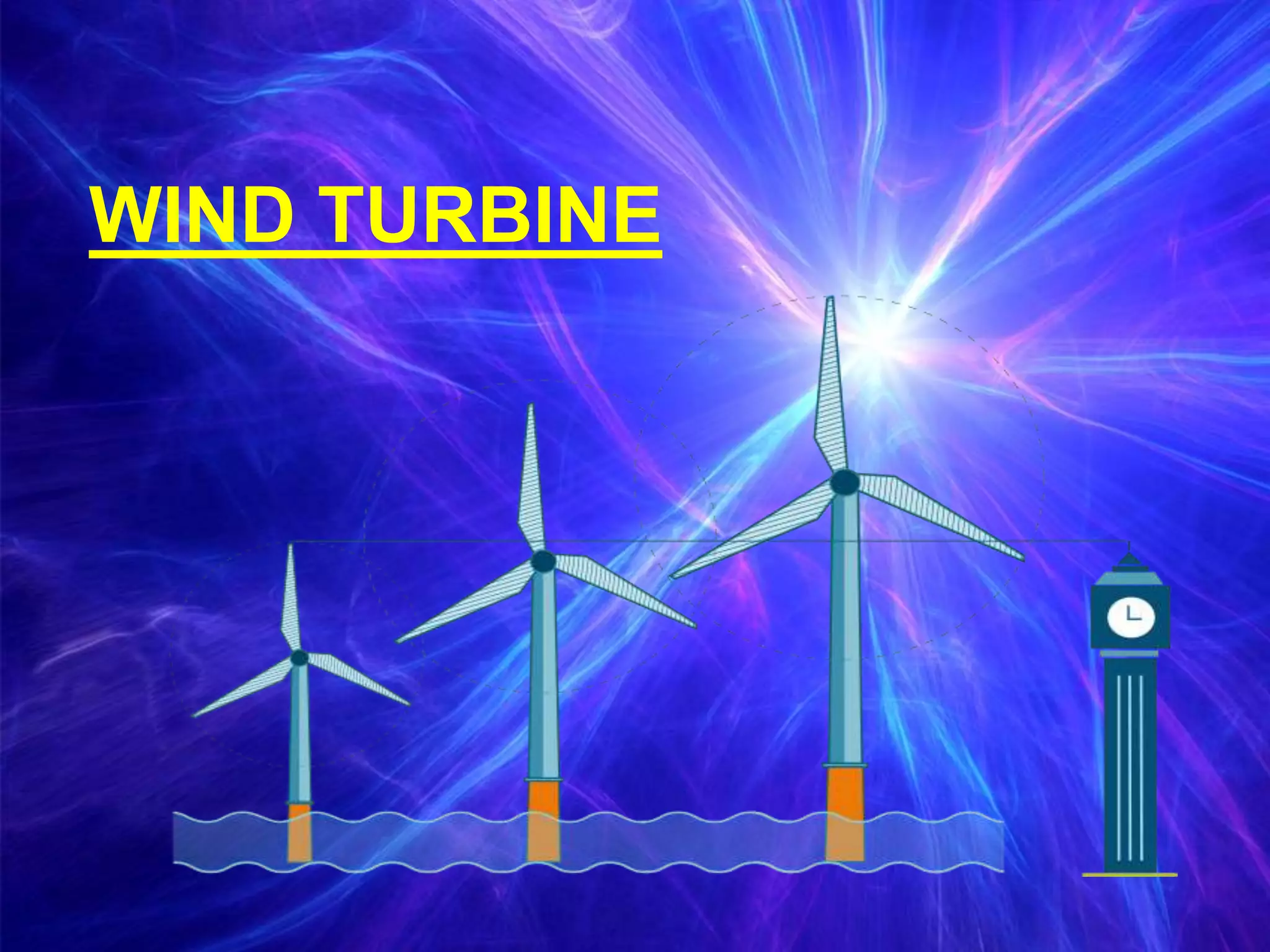
WIND TURBINE
Title and Content
Introduction
Wind turbine types
Horizontal axis wind turbines (HAWT)
Vertical axis wind turbines (VAWT)
The tip-speed ratio
Wind turbine power calculation
Betz Limit or Betz' Law
Power Coefficient (Cp)
ROOH UL AMIN PAKISTAN
Introduction
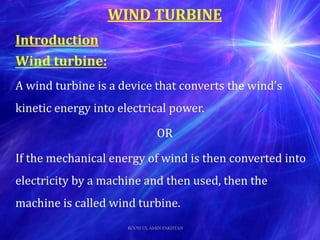
Wind turbine:
A wind turbine is a device that converts the wind's
kinetic energy into electrical power.
OR
If the mechanical energy of wind is then converted into
electricity by a machine and then used, then the
machine is called wind turbine.
WIND TURBINE
ROOH UL AMIN PAKISTAN
Wind turbine types:
Wind turbines can rotate about either a horizontal or a
vertical axis.
1. HORIZONTAL AXIS WIND TURBINES (HAWT)
2. VERTICAL AXIS WIND TURBINES (VAWT)
There are No. of available design for both and each has
certain advantages and disadvantages.
WIND TURBINE
ROOH UL AMIN PAKISTAN
WIND TURBINE
HORIZONTAL AXIS WIND TURBINES (HAWT)
The horizontal wind turbine is a turbine in which the axis
of the rotor's rotation is parallel to the wind stream and
the ground.
It is the most common wind turbine designed in addition
being parallel to the ground. The axis of blade rotation is
parallel to the wind flow.
There are three types of HAWT.
 Up wind turbine
 Down wind turbine
 Shrouded wind turbine
ROOH UL AMIN PAKISTAN
HORIZONTAL AXIS WIND TURBINES (HAWT)
Up wind turbine
Some wind turbines are designed to operate in an
up-wind mode. (with the blade up wind the tower).
Large wind turbines used a motor driven mechanism
that turns the machine in response to the wind
direction.
ROOH UL AMIN PAKISTAN
Down wind turbine
Other wind turbines are operating in a downwind
mode. So, that the wind passes the tower before striking
the blades.
Shrouded wind turbine
Some turbines have an added structural design
feature called an augmenter. The augmenter is intended
to increase the amount of wind passing through the
blades.
HORIZONTAL AXIS WIND TURBINES (HAWT)
ROOH UL AMIN PAKISTAN
VERTICAL AXIS WIND TURBINES (VAWT)
The rotor of the VAWT rotates vertically around its axis
instead of horizontally.
It is not as common as their horizontal counter parts. The
main reason for this is as that they do not take advantage
of higher wind speed at higher altitude above the ground.
The most common examples of VAWT are
 ANOMOMETRE
 SAVONIOUS WIND TURBINE
WIND TURBINE
ROOH UL AMIN PAKISTAN
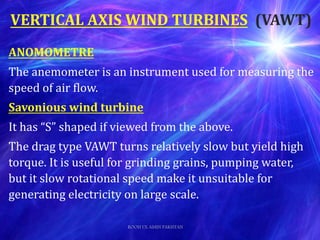
ANOMOMETRE
The anemometer is an instrument used for measuring the
speed of air flow.
Savonious wind turbine
It has “S” shaped if viewed from the above.
The drag type VAWT turns relatively slow but yield high
torque. It is useful for grinding grains, pumping water,
but it slow rotational speed make it unsuitable for
generating electricity on large scale.
VERTICAL AXIS WIND TURBINES (VAWT)
ROOH UL AMIN PAKISTAN
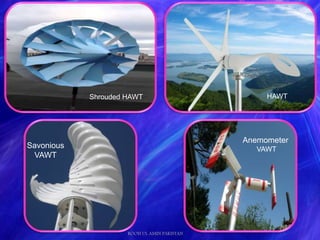
Shrouded HAWT
Anemometer
VAWTSavonious
VAWT
HAWT
ROOH UL AMIN PAKISTAN
The tip-speed ratio:
It is referred to the ratio between the wind speed and the speed of
the tips of the wind turbine blades.
TSR () = Tip speed of blades / wind speed
 = Lambda
If the rotor of the wind turbine turns too slowly, most of the
wind will pass undisturbed through the gap between the rotor
blades. Alternatively, if the rotor turns too quickly, the blades will
appear like a solid wall to the wind.
Also, rotor blades create turbulence as they spin through the air. If
the next blade arrives too quickly, it will hit that turbulent air
Therefore, wind turbines are designed with optimal tip speed
ratios to extract as much power out of the wind as possible.
WIND TURBINE
ROOH UL AMIN PAKISTAN
WIND TURBINE
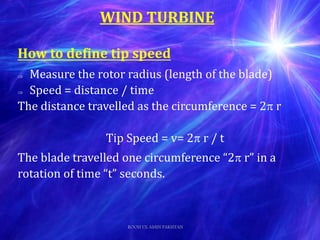
How to define tip speed
 Measure the rotor radius (length of the blade)
 Speed = distance / time
The distance travelled as the circumference = 2 r
Tip Speed = v= 2 r / t
The blade travelled one circumference “2 r” in a
rotation of time “t” seconds.
ROOH UL AMIN PAKISTAN
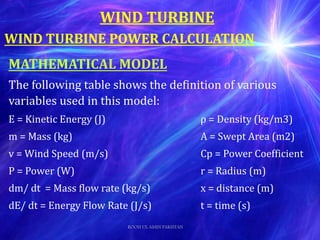
WIND TURBINE POWER CALCULATION
WIND TURBINE
MATHEMATICAL MODEL
The following table shows the definition of various
variables used in this model:
E = Kinetic Energy (J) ρ = Density (kg/m3)
m = Mass (kg) A = Swept Area (m2)
v = Wind Speed (m/s) Cp = Power Coefficient
P = Power (W) r = Radius (m)
dm/ dt = Mass flow rate (kg/s) x = distance (m)
dE/ dt = Energy Flow Rate (J/s) t = time (s)
ROOH UL AMIN PAKISTAN
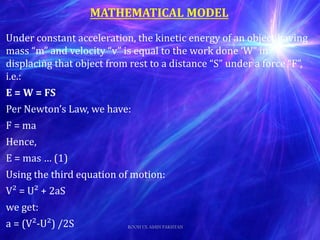
Under constant acceleration, the kinetic energy of an object having
mass “m” and velocity “v” is equal to the work done ‘W” in
displacing that object from rest to a distance “S” under a force “F”,
i.e.:
E = W = FS
Per Newton’s Law, we have:
F = ma
Hence,
E = mas … (1)
Using the third equation of motion:
V² = U² + 2aS
we get:
a = (V²-U²) /2S
MATHEMATICAL MODEL
ROOH UL AMIN PAKISTAN
MATHEMATICAL MODEL
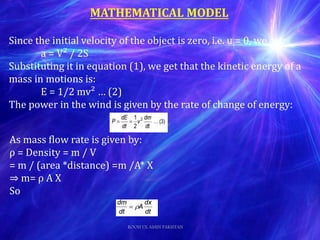
Since the initial velocity of the object is zero, i.e. u = 0, we get:
a = V² / 2S
Substituting it in equation (1), we get that the kinetic energy of a
mass in motions is:
E = 1/2 mv² … (2)
The power in the wind is given by the rate of change of energy:
As mass flow rate is given by:
ρ = Density = m / V
= m / (area *distance) =m /A* X
⇒ m= ρ A X
So
ROOH UL AMIN PAKISTAN
and the rate of change of distance is given by:
v = dt / dx
we get:
dm / dt = ρ Av
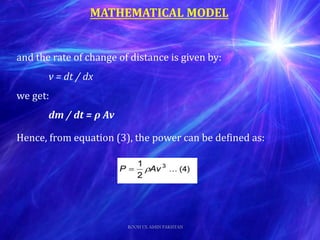
Hence, from equation (3), the power can be defined as:
MATHEMATICAL MODEL
ROOH UL AMIN PAKISTAN
A German physicist Albert Betz concluded in 1919 that
no wind turbine can convert more than 16/27 (59.3%)
of the kinetic energy of the wind into mechanical
energy turning a rotor. To this day, this is known as the
Betz Limit or Betz' Law.
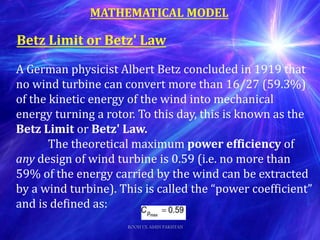
The theoretical maximum power efficiency of
any design of wind turbine is 0.59 (i.e. no more than
59% of the energy carried by the wind can be extracted
by a wind turbine). This is called the “power coefficient”
and is defined as:
Betz Limit or Betz' Law
MATHEMATICAL MODEL
ROOH UL AMIN PAKISTAN
MATHEMATICAL MODEL
Also, wind turbines cannot operate at this maximum limit. The Cp
value is unique to each turbine type and is a function of wind
speed that the turbine is operating in. Once we incorporate
various engineering requirements of a wind turbine - strength
and durability in particular - the
real world limit is well below the Betz Limit.
That is normally 45% to 50 %.
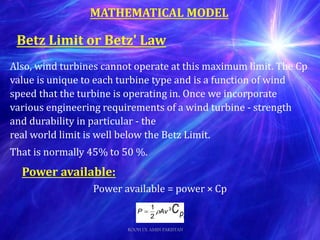
Power available:
Power available = power × Cp
Betz Limit or Betz' Law
ROOH UL AMIN PAKISTAN
Power Coefficient (Cp)
Power Coefficient (Cp) is a measure of wind turbine
efficiency often used by the wind power industry. Cp is
the ratio of actual electric power produced by a wind
turbine divided by the total wind power flowing into
the turbine blades at specific wind speed.
WIND TURBINE
ROOH UL AMIN PAKISTAN
THANKS
ROOH UL AMIN
PIMSAT KARACHI
PAKISTAN

Wind turbine

  • 1.
  • 2.
    Title and Content Introduction Windturbine types Horizontal axis wind turbines (HAWT) Vertical axis wind turbines (VAWT) The tip-speed ratio Wind turbine power calculation Betz Limit or Betz' Law Power Coefficient (Cp) ROOH UL AMIN PAKISTAN
  • 3.
    Introduction Wind turbine: A windturbine is a device that converts the wind's kinetic energy into electrical power. OR If the mechanical energy of wind is then converted into electricity by a machine and then used, then the machine is called wind turbine. WIND TURBINE ROOH UL AMIN PAKISTAN
  • 4.
    Wind turbine types: Windturbines can rotate about either a horizontal or a vertical axis. 1. HORIZONTAL AXIS WIND TURBINES (HAWT) 2. VERTICAL AXIS WIND TURBINES (VAWT) There are No. of available design for both and each has certain advantages and disadvantages. WIND TURBINE ROOH UL AMIN PAKISTAN
  • 5.
    WIND TURBINE HORIZONTAL AXISWIND TURBINES (HAWT) The horizontal wind turbine is a turbine in which the axis of the rotor's rotation is parallel to the wind stream and the ground. It is the most common wind turbine designed in addition being parallel to the ground. The axis of blade rotation is parallel to the wind flow. There are three types of HAWT.  Up wind turbine  Down wind turbine  Shrouded wind turbine ROOH UL AMIN PAKISTAN
  • 6.
    HORIZONTAL AXIS WINDTURBINES (HAWT) Up wind turbine Some wind turbines are designed to operate in an up-wind mode. (with the blade up wind the tower). Large wind turbines used a motor driven mechanism that turns the machine in response to the wind direction. ROOH UL AMIN PAKISTAN
  • 7.
    Down wind turbine Otherwind turbines are operating in a downwind mode. So, that the wind passes the tower before striking the blades. Shrouded wind turbine Some turbines have an added structural design feature called an augmenter. The augmenter is intended to increase the amount of wind passing through the blades. HORIZONTAL AXIS WIND TURBINES (HAWT) ROOH UL AMIN PAKISTAN
  • 8.
    VERTICAL AXIS WINDTURBINES (VAWT) The rotor of the VAWT rotates vertically around its axis instead of horizontally. It is not as common as their horizontal counter parts. The main reason for this is as that they do not take advantage of higher wind speed at higher altitude above the ground. The most common examples of VAWT are  ANOMOMETRE  SAVONIOUS WIND TURBINE WIND TURBINE ROOH UL AMIN PAKISTAN
  • 9.
    ANOMOMETRE The anemometer isan instrument used for measuring the speed of air flow. Savonious wind turbine It has “S” shaped if viewed from the above. The drag type VAWT turns relatively slow but yield high torque. It is useful for grinding grains, pumping water, but it slow rotational speed make it unsuitable for generating electricity on large scale. VERTICAL AXIS WIND TURBINES (VAWT) ROOH UL AMIN PAKISTAN
  • 10.
  • 11.
    The tip-speed ratio: Itis referred to the ratio between the wind speed and the speed of the tips of the wind turbine blades. TSR () = Tip speed of blades / wind speed  = Lambda If the rotor of the wind turbine turns too slowly, most of the wind will pass undisturbed through the gap between the rotor blades. Alternatively, if the rotor turns too quickly, the blades will appear like a solid wall to the wind. Also, rotor blades create turbulence as they spin through the air. If the next blade arrives too quickly, it will hit that turbulent air Therefore, wind turbines are designed with optimal tip speed ratios to extract as much power out of the wind as possible. WIND TURBINE ROOH UL AMIN PAKISTAN
  • 12.
    WIND TURBINE How todefine tip speed  Measure the rotor radius (length of the blade)  Speed = distance / time The distance travelled as the circumference = 2 r Tip Speed = v= 2 r / t The blade travelled one circumference “2 r” in a rotation of time “t” seconds. ROOH UL AMIN PAKISTAN
  • 13.
    WIND TURBINE POWERCALCULATION WIND TURBINE MATHEMATICAL MODEL The following table shows the definition of various variables used in this model: E = Kinetic Energy (J) ρ = Density (kg/m3) m = Mass (kg) A = Swept Area (m2) v = Wind Speed (m/s) Cp = Power Coefficient P = Power (W) r = Radius (m) dm/ dt = Mass flow rate (kg/s) x = distance (m) dE/ dt = Energy Flow Rate (J/s) t = time (s) ROOH UL AMIN PAKISTAN
  • 14.
    Under constant acceleration,the kinetic energy of an object having mass “m” and velocity “v” is equal to the work done ‘W” in displacing that object from rest to a distance “S” under a force “F”, i.e.: E = W = FS Per Newton’s Law, we have: F = ma Hence, E = mas … (1) Using the third equation of motion: V² = U² + 2aS we get: a = (V²-U²) /2S MATHEMATICAL MODEL ROOH UL AMIN PAKISTAN
  • 15.
    MATHEMATICAL MODEL Since theinitial velocity of the object is zero, i.e. u = 0, we get: a = V² / 2S Substituting it in equation (1), we get that the kinetic energy of a mass in motions is: E = 1/2 mv² … (2) The power in the wind is given by the rate of change of energy: As mass flow rate is given by: ρ = Density = m / V = m / (area *distance) =m /A* X ⇒ m= ρ A X So ROOH UL AMIN PAKISTAN
  • 16.
    and the rateof change of distance is given by: v = dt / dx we get: dm / dt = ρ Av Hence, from equation (3), the power can be defined as: MATHEMATICAL MODEL ROOH UL AMIN PAKISTAN
  • 17.
    A German physicistAlbert Betz concluded in 1919 that no wind turbine can convert more than 16/27 (59.3%) of the kinetic energy of the wind into mechanical energy turning a rotor. To this day, this is known as the Betz Limit or Betz' Law. The theoretical maximum power efficiency of any design of wind turbine is 0.59 (i.e. no more than 59% of the energy carried by the wind can be extracted by a wind turbine). This is called the “power coefficient” and is defined as: Betz Limit or Betz' Law MATHEMATICAL MODEL ROOH UL AMIN PAKISTAN
  • 18.
    MATHEMATICAL MODEL Also, windturbines cannot operate at this maximum limit. The Cp value is unique to each turbine type and is a function of wind speed that the turbine is operating in. Once we incorporate various engineering requirements of a wind turbine - strength and durability in particular - the real world limit is well below the Betz Limit. That is normally 45% to 50 %. Power available: Power available = power × Cp Betz Limit or Betz' Law ROOH UL AMIN PAKISTAN
  • 19.
    Power Coefficient (Cp) PowerCoefficient (Cp) is a measure of wind turbine efficiency often used by the wind power industry. Cp is the ratio of actual electric power produced by a wind turbine divided by the total wind power flowing into the turbine blades at specific wind speed. WIND TURBINE ROOH UL AMIN PAKISTAN
  • 20.
  • 21.
    ROOH UL AMIN PIMSATKARACHI PAKISTAN