Team Members
Bishal Shah(41021) Paras Panta (41048)
INSTRUCTOR: ASSISTANT PROFESSOR PRAMISH SHRESTHA SIR
3.
CONTENTS
Wind EnergyConversion System
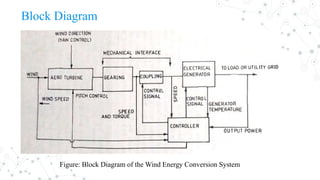
Block Diagram
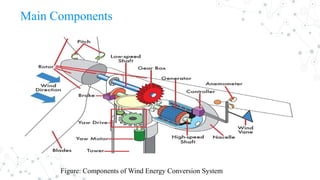
Main Components
Types of Wind Turbines
Types of Wind Turbines Generators
Types of Wind Energy Conversion System
Harvesting Maximum Energy
Advantages and Disadvantages
4.
Wind Energy Conversionsystem
❏ It is the system that uses wind energy to provide mechanical power to the wind
turbines that turns electrical generators that generates the required electrical power.
❏ Conversion of wind energy into mechanical energy is accomplished by moving
aerodynamic rotor blades and methods of mechanical power control.
❏ Wind turbine generator is used to convert this mechanical energy into electrical
energy.
5.
Wind Energy Conversionsystem
❏ When wind flows across the blade, the air pressure on one side of the blade decreases.
❏ Due to the difference in air pressure across the two sides of the blade,rotor start to
spin.
❏ Inside the nacelle, gearbox converts the low-speed rotation of the drive shaft into
high-speed rotation fast enough to drive the generator efficiently.
❏ The entire top part of the turbine (the rotors and nacelle) can be rotated by a yaw
motor, so it faces directly into the oncoming wind and captures the maximum amount
of energy.
.
6.
❏ If it'stoo windy or turbulent, brakes are applied to stop the rotors from turning (for
safety reasons).
❏ The electric current produced by the generator flows through a cable running down
through the inside of the turbine tower.
❏ A step-up transformer converts the electricity to about 50 times higher voltage so it
can be transmitted efficiently to the power grid.
❏ This translation of aerodynamic force to rotation of a generator creates electricity.
Wind Energy Conversion system
1) Rotor
Rotorreceives kinetic energy from the wind stream and transforms it into mechanical shaft power.
Consist of two or more blades which rotate about an axis (horizontal or vertical) at a rate
determined by the wind speed and the shape of the blades.
The blades are attached to the hub, which in turn is attached to the main shaft.
2) Shaft
Low speed shaft connects the rotor hub to the gear box.
High speed shaft drives the generator.
3) Gear Box
Gear box connects the low-speed shaft to the high-speed shaft and increases the rotational speeds
from about 30-60 rotations per minute (rpm), to about 1,000-1,800 rpm
This is the rotational speed required by most generators to produce electricity.
10.
4) Tower
Theblades and nacelle are mounted on top of a tower. The tower is constructed to hold the rotor
blades off the ground and at an ideal wind speed.
They are usually coated with a zinc-based finish and epoxy and urethane layers to provide
ultraviolet resistance.
Towers are usually between 50-100 m above the surface of the ground or water.
5) Anemometer
The anemometer measures wind speed and transmits wind speed data to the controller.
6) Brake
A turbine brake keeps the rotor from turning after it's been shut down by the pitch system.
Once the turbine blades are stopped by the controller, the brake keeps the turbine blades from
moving, which is necessary for maintenance.
11.
7) Controller
Thecontroller allows the machine to start at wind speeds of about 7–11 miles per hour (mph) and
shuts off the machine when wind speeds exceed 55–65 mph.
The controller turns off the turbine at higher wind speeds to avoid damage to different parts of
the turbine.
8) Nacelle
The nacelle sits atop the tower and contains the gearbox, low- and high-speed shafts, generator,
and brake.
Some nacelles are larger than a house and for a 1.5 MW geared turbine, can weigh more than 4.5
tons.
12.
9) Pitch System
The pitch system adjusts the angle of the wind turbine's blades with respect to the wind,
controlling the rotor speed.
By adjusting the angle of a turbine's blades, the pitch system controls how much energy the
blades can extract.
The pitch system can also "feather" the blades, adjusting their angle so they do not produce force
that would cause the rotor to spin.
10) Wind Vane
The wind vane measures wind direction and communicates with the yaw drive to orient the
turbine properly with respect to the wind.
11) Yaw Drive
The yaw drive rotates the nacelle on upwind turbines to keep them facing the wind when wind
direction changes. The yaw motors power the yaw drive to make this happen.
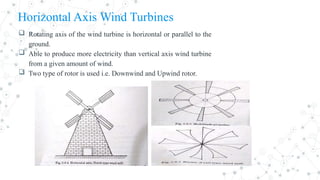
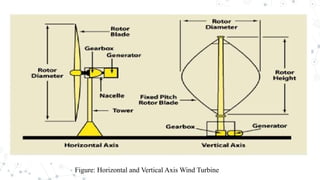
Horizontal Axis WindTurbines
Rotating axis of the wind turbine is horizontal or parallel to the
ground.
Able to produce more electricity than vertical axis wind turbine
from a given amount of wind.
Two type of rotor is used i.e. Downwind and Upwind rotor.
15.
Horizontal Axis WindTurbines
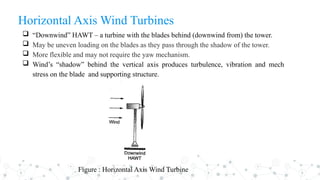
“Downwind” HAWT – a turbine with the blades behind (downwind from) the tower.
May be uneven loading on the blades as they pass through the shadow of the tower.
More flexible and may not require the yaw mechanism.
Wind’s “shadow” behind the vertical axis produces turbulence, vibration and mech
stress on the blade and supporting structure.
Figure : Horizontal Axis Wind Turbine
16.
Horizontal Axis WindTurbines
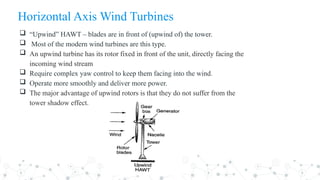
“Upwind” HAWT – blades are in front of (upwind of) the tower.
Most of the modern wind turbines are this type.
An upwind turbine has its rotor fixed in front of the unit, directly facing the
incoming wind stream
Require complex yaw control to keep them facing into the wind.
Operate more smoothly and deliver more power.
The major advantage of upwind rotors is that they do not suffer from the
tower shadow effect.
17.
Vertical Axis WindTurbines
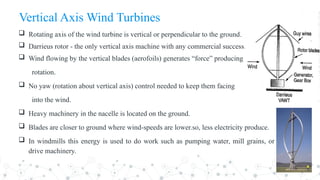
Rotating axis of the wind turbine is vertical or perpendicular to the ground.
Darrieus rotor - the only vertical axis machine with any commercial success.
Wind flowing by the vertical blades (aerofoils) generates “force” producing
rotation.
No yaw (rotation about vertical axis) control needed to keep them facing
into the wind.
Heavy machinery in the nacelle is located on the ground.
Blades are closer to ground where wind-speeds are lower.so, less electricity produce.
In windmills this energy is used to do work such as pumping water, mill grains, or
drive machinery.
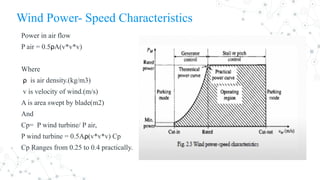
Wind Power- SpeedCharacteristics
Power in air flow
P air = 0.5ρA(v*v*v)
Where
ρ is air density.(kg/m3)
v is velocity of wind.(m/s)
A is area swept by blade(m2)
And
Cp= P wind turbine/ P air,
P wind turbine = 0.5Aρ(v*v*v) Cp
Cp Ranges from 0.25 to 0.4 practically.
20.
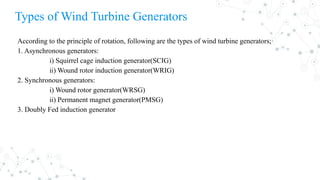
According to theprinciple of rotation, following are the types of wind turbine generators;
1. Asynchronous generators:
i) Squirrel cage induction generator(SCIG)
ii) Wound rotor induction generator(WRIG)
2. Synchronous generators:
i) Wound rotor generator(WRSG)
ii) Permanent magnet generator(PMSG)
3. Doubly Fed induction generator
Types of Wind Turbine Generators
21.
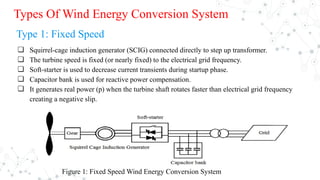
Types Of WindEnergy Conversion System
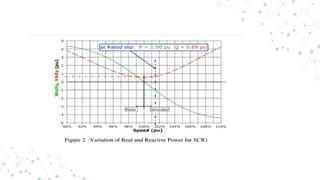
Type 1: Fixed Speed
❏ Squirrel-cage induction generator (SCIG) connected directly to step up transformer.
❏ The turbine speed is fixed (or nearly fixed) to the electrical grid frequency.
❏ Soft-starter is used to decrease current transients during startup phase.
❏ Capacitor bank is used for reactive power compensation.
❏ It generates real power (p) when the turbine shaft rotates faster than electrical grid frequency
creating a negative slip.
Figure 1: Fixed Speed Wind Energy Conversion System
23.
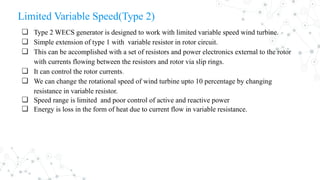
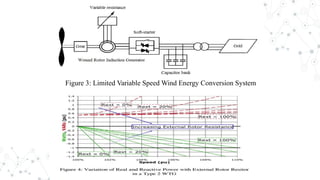
Limited Variable Speed(Type2)
❏ Type 2 WECS generator is designed to work with limited variable speed wind turbine.
❏ Simple extension of type 1 with variable resistor in rotor circuit.
❏ This can be accomplished with a set of resistors and power electronics external to the rotor
with currents flowing between the resistors and rotor via slip rings.
❏ It can control the rotor currents.
❏ We can change the rotational speed of wind turbine upto 10 percentage by changing
resistance in variable resistor.
❏ Speed range is limited and poor control of active and reactive power
❏ Energy is loss in the form of heat due to current flow in variable resistance.
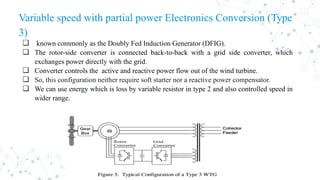
Variable speed withpartial power Electronics Conversion (Type
3)
❏ known commonly as the Doubly Fed Induction Generator (DFIG).
❏ The rotor-side converter is connected back-to-back with a grid side converter, which
exchanges power directly with the grid.
❏ Converter controls the active and reactive power flow out of the wind turbine.
❏ So, this configuration neither require soft starter nor a reactive power compensator.
❏ We can use energy which is loss by variable resistor in type 2 and also controlled speed in
wider range.
26.
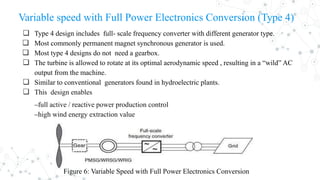
Variable speed withFull Power Electronics Conversion (Type 4)
❏ Type 4 design includes full- scale frequency converter with different generator type.
❏ Most commonly permanent magnet synchronous generator is used.
❏ Most type 4 designs do not need a gearbox.
❏ The turbine is allowed to rotate at its optimal aerodynamic speed , resulting in a “wild” AC
output from the machine.
❏ Similar to conventional generators found in hydroelectric plants.
❏ This design enables
‒full active / reactive power production control
‒high wind energy extraction value
Figure 6: Variable Speed with Full Power Electronics Conversion
27.
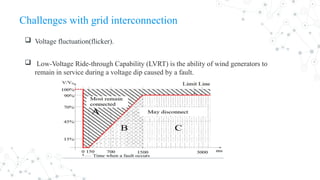
Challenges with gridinterconnection
Voltage fluctuation(flicker).
Low-Voltage Ride-through Capability (LVRT) is the ability of wind generators to
remain in service during a voltage dip caused by a fault.
28.
Harvesting Maximum Energy
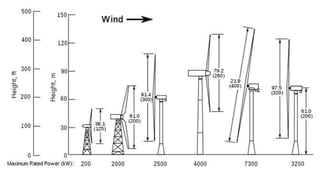
❏The longer the rotor blades, the more energy they can capture from the wind. The giant blades
(typically 70m or 230 feet in diameter, which is about 30 times the wingspan of an eagle)
multiply the wind's force , so a gentle breeze is often enough to make the blades turn around.
❏ Put a turbine's rotor blades high in the air, they capture considerably more wind energy than
they would lower down.
❏ More hub height from the ground empowers the rotor to practice high velocity of air.
❏ Typical wind turbines stand idle about 14 percent of the time, and most of the time they don't
generate maximum power. This is not a drawback, however, but a deliberate feature of their
design that allows them to work very efficiently in ever-changing winds.
30.
Advantages
❏ Very lowcarbon dioxide emissions (effectively zero once constructed).
❏ No air or water pollution.
❏ No environmental impacts from mining or drilling.
❏ Completely sustainable—unlike fossil fuels, wind will never run out.
❏ Turbines work almost anywhere in the world where it's reliably windy, unlike fossil-fuel
deposits that are concentrated only in certain regions.
❏ Unlike fossil-fueled power, wind energy operating costs are predictable years in advance.
31.
Disadvantages
❏ High upfront cost.
❏ Extra cost and complexity of balancing variable wind power with other forms of power.
❏ Extra cost of upgrading the power grid and transmission lines.
❏ Damage local wildlife.
❏ Large overall land take.
❏ Can't supply 100 percent of a country's power all year round, the way fossil fuels, nuclear,
hydroelectric, and biomass power can.