UNIT V
Widely Applicable
Teaching
Models, Instructional
Strategies, And Graphic
Organizers
Reported By: Jolly Ray Forteza Bederico
INTRODUCTION
Teaching models are ideal processes of instruction .
These have established patterns that are worth doing in
the classroom.
By the large, teaching models are anchored on certain
theories of learning and instruction with accompanying
syntax – the logical phases of instruction of a particular
teaching model – that guide teachers in the unfolding of
lessons.
TEACHING MODELS
Teaching Models are larger than a particular
strategy, method, or tactic.

These are broad overall approaches to instruction
that do not only help teachers in planning
instruction, but also guide them in acquiring
information, developing skills, internalizing
values, and engaging in other forms of learning
activities.
More importantly, teaching models are supported by the
exponents of theories of instruction each following a syntax
– logical phases of instruction of the model.
The teaching models that lend easily to integrative
teaching and learning are discovery learning, inquiry

learning, problem-based learning, cooperative
learning, decision-making and ACES teaching approach.
A. Discovery Learning.
This teaching model is based on the idea that content
is not given to learners in finished form. Rather, it is
discovered by learners before they can internalize it.
By the large, discovery learning is used to accoplish
three related education purposes like:
(1) to provide students with opportunities to think
independently
(2) to help students discover how knowledge
becomes know
(3) to promote higher-order or critical thinking skills
such as analysis, synthesis and evaluation
B. INQUIRY LEARNING

This is commonly known as the inquiry process which
is apparently the application of scientific method of
teaching.
C. Problem-based

Learning (PBL)

The essence of this model consists of presenting
students authentic and meaningful problem situations
to serve as springboards for investigation
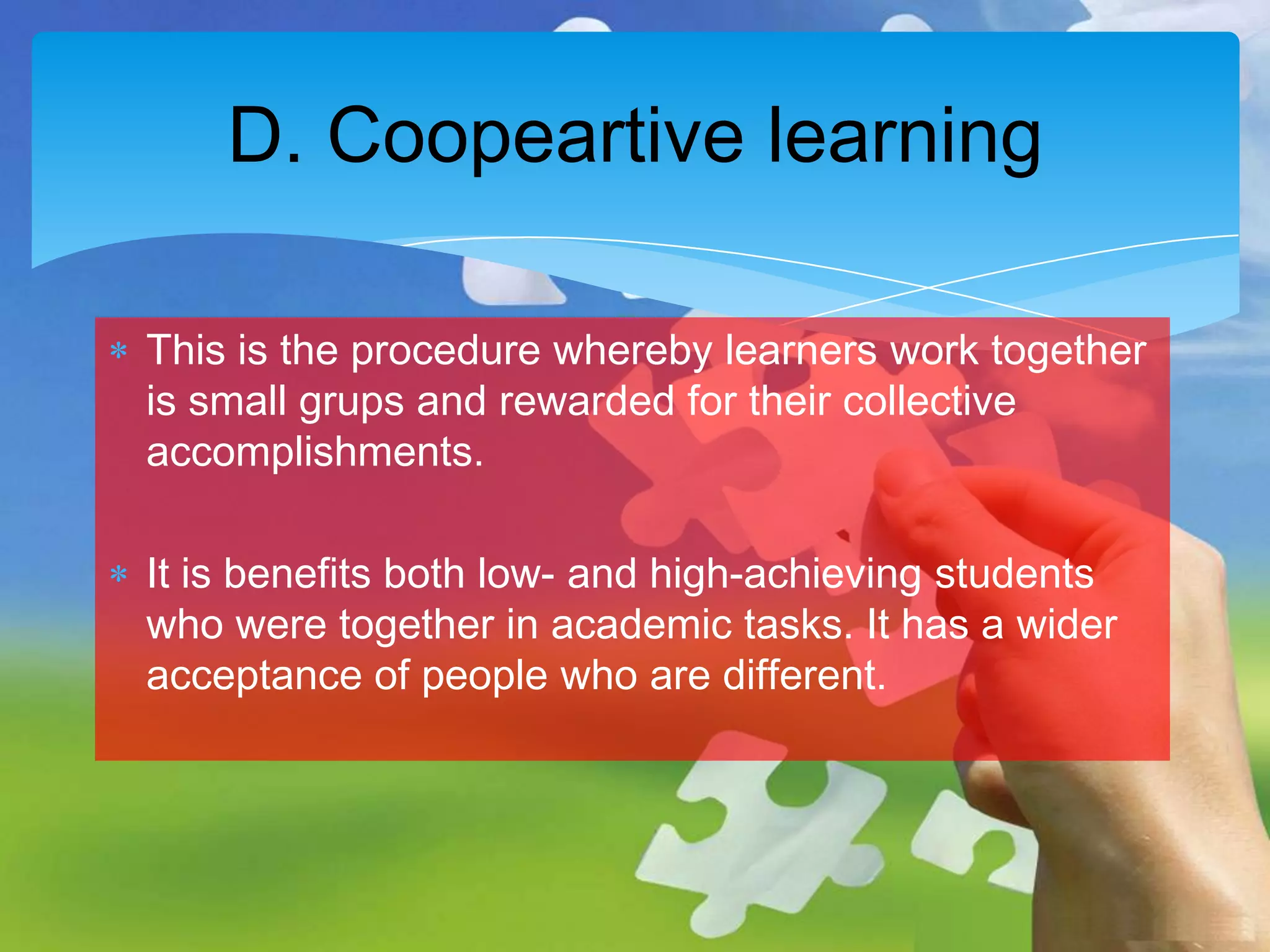
D. Coopeartive learning
This is the procedure whereby learners work together
is small grups and rewarded for their collective
accomplishments.
It is benefits both low- and high-achieving students
who were together in academic tasks. It has a wider
acceptance of people who are different.
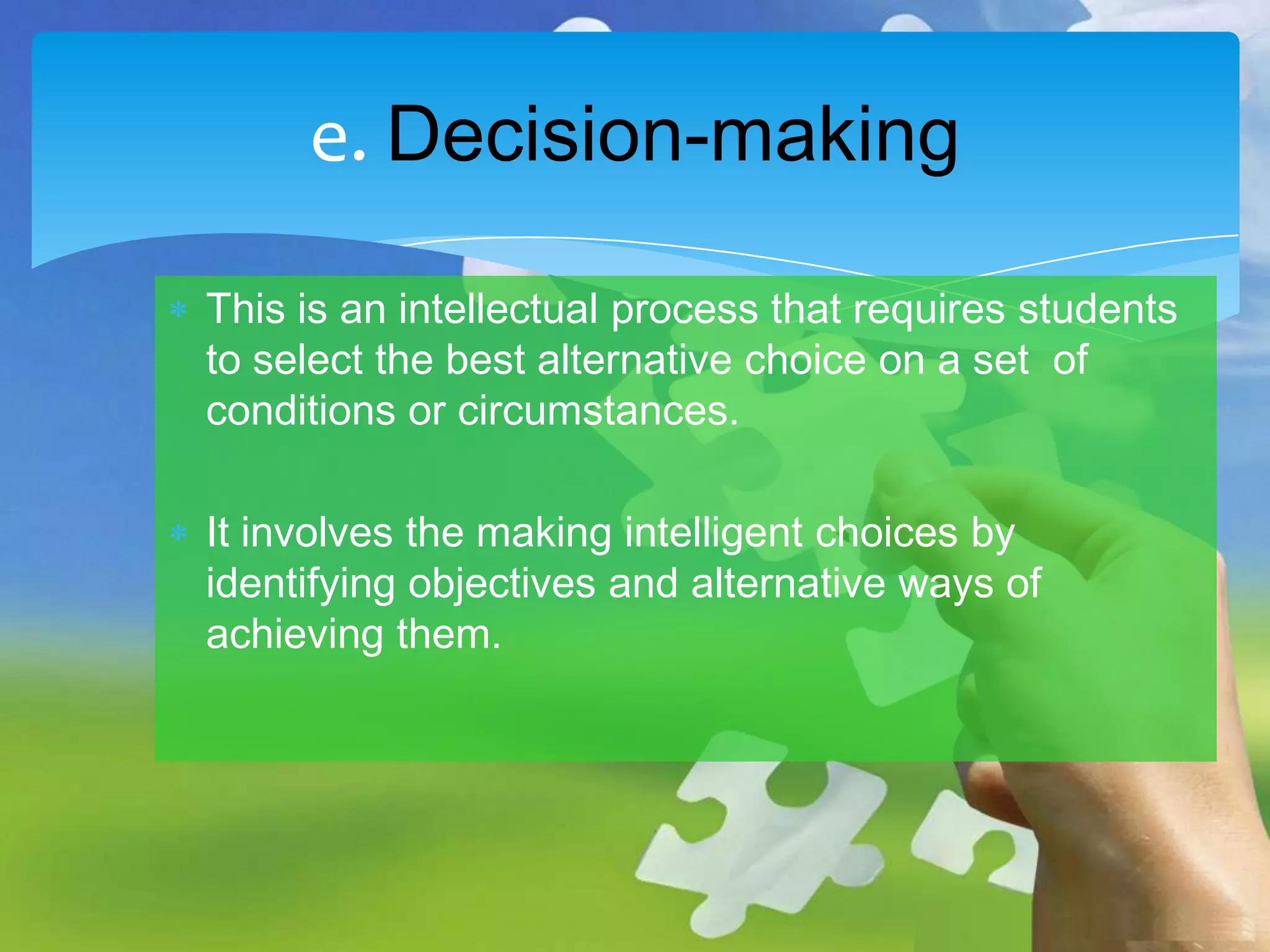
e. Decision-making
This is an intellectual process that requires students
to select the best alternative choice on a set of
conditions or circumstances.
It involves the making intelligent choices by
identifying objectives and alternative ways of
achieving them.
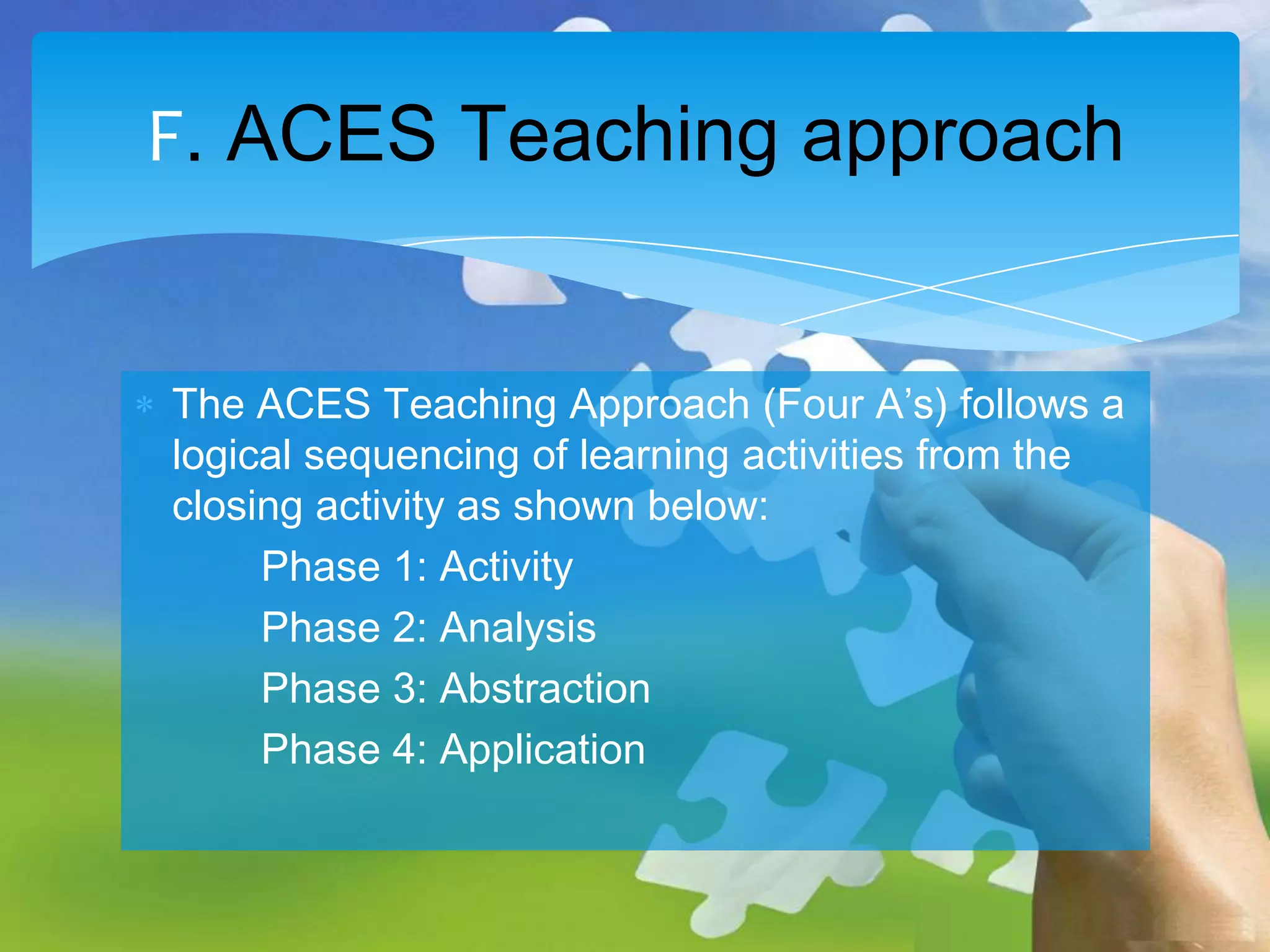
F. ACES Teaching approach
The ACES Teaching Approach (Four A’s) follows a
logical sequencing of learning activities from the
closing activity as shown below:
Phase 1: Activity
Phase 2: Analysis
Phase 3: Abstraction
Phase 4: Application
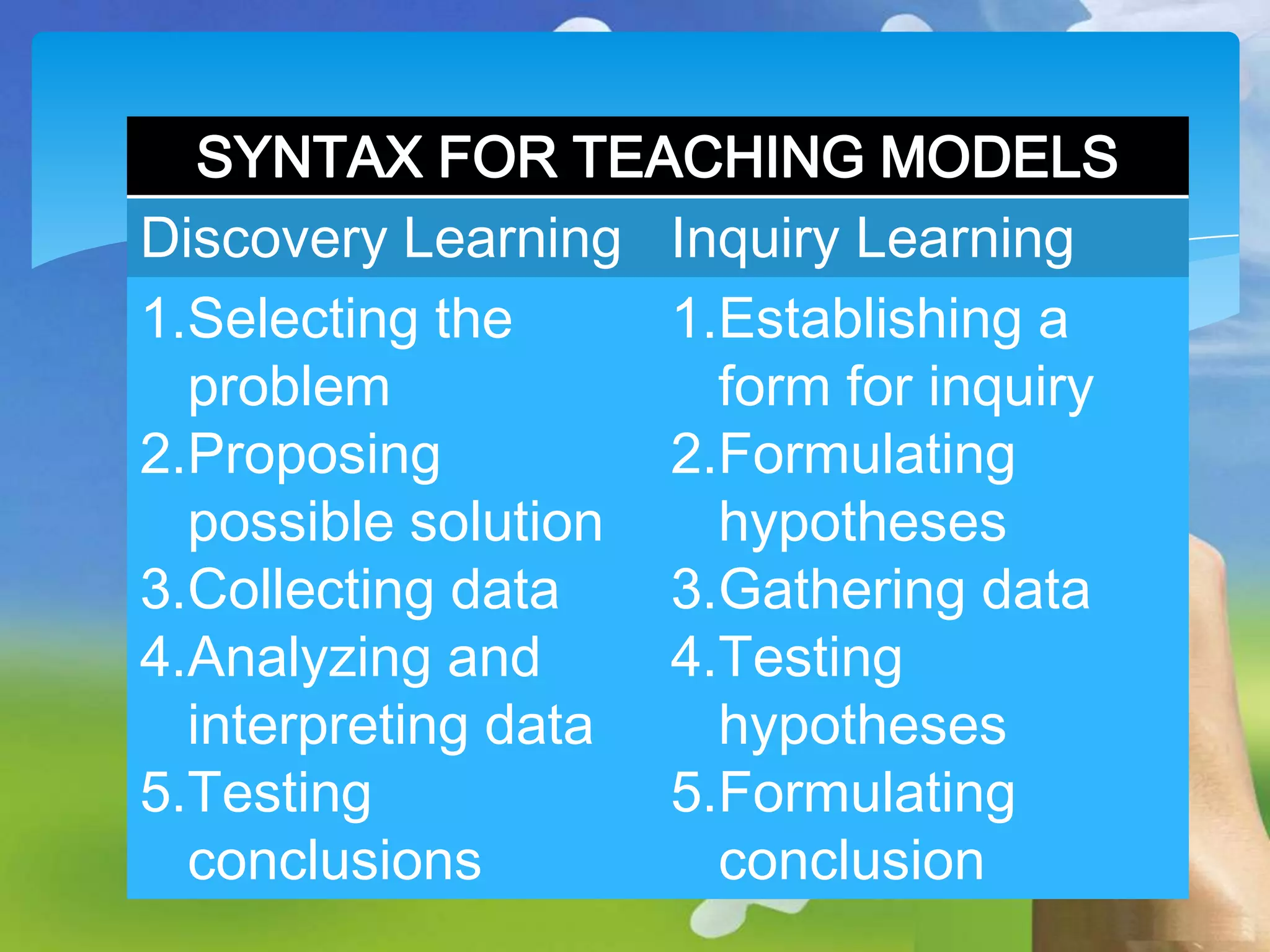
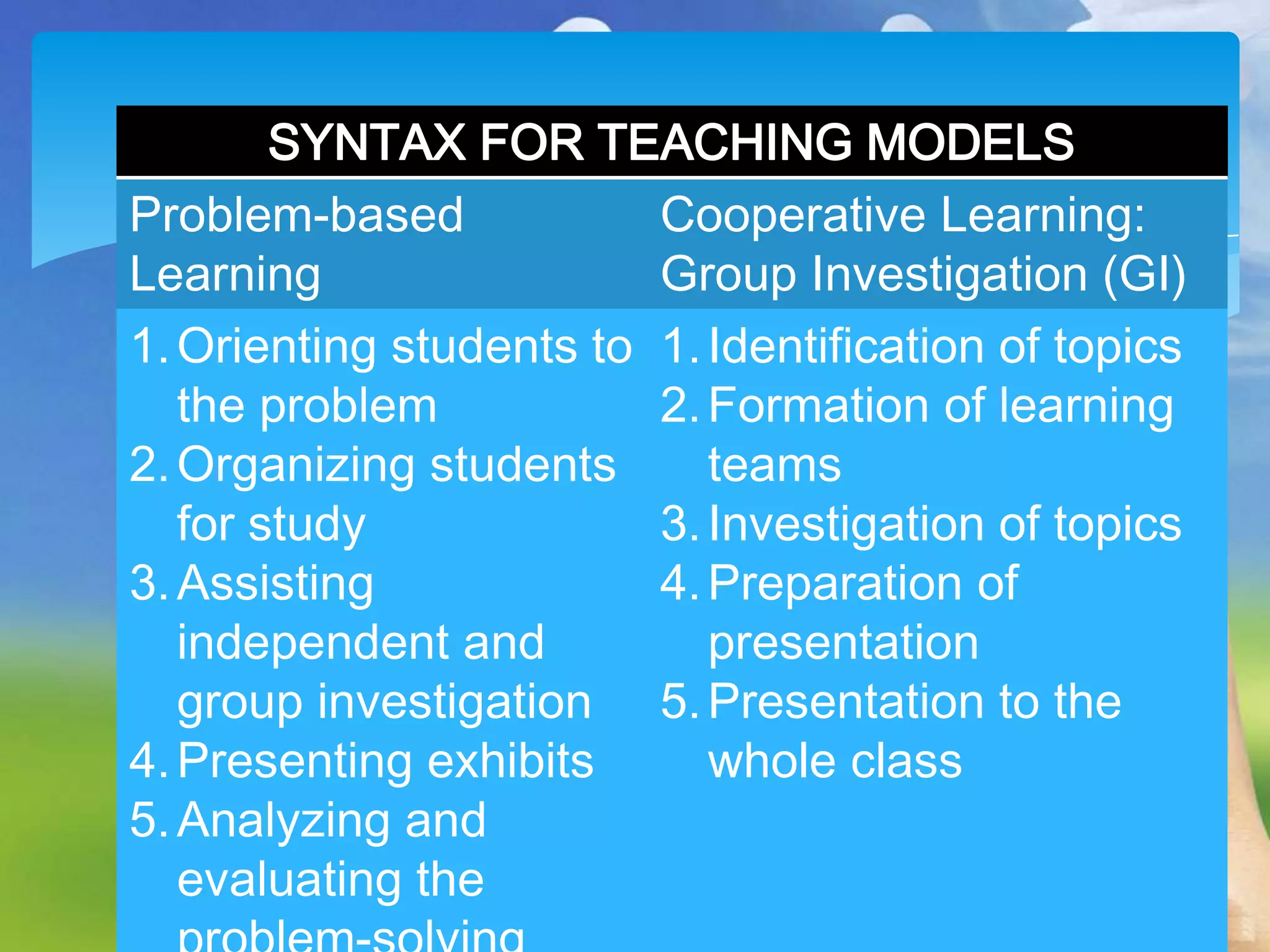
SYNTAX FOR TEACHING MODELS
Discovery Learning Inquiry Learning
1.Selecting the
1.Establishing a
problem
form for inquiry
2.Proposing
2.Formulating
possible solution
hypotheses
3.Collecting data
3.Gathering data
4.Analyzing and
4.Testing
interpreting data
hypotheses
5.Testing
5.Formulating
conclusions
conclusion
SYNTAX FOR TEACHING MODELS
Problem-based
Cooperative Learning:
Learning
Group Investigation (GI)
1. Orienting students to 1. Identification of topics
the problem
2. Formation of learning
2. Organizing students
teams
for study
3. Investigation of topics
3. Assisting
4. Preparation of
independent and
presentation
group investigation 5. Presentation to the
4. Presenting exhibits
whole class
5. Analyzing and
evaluating the
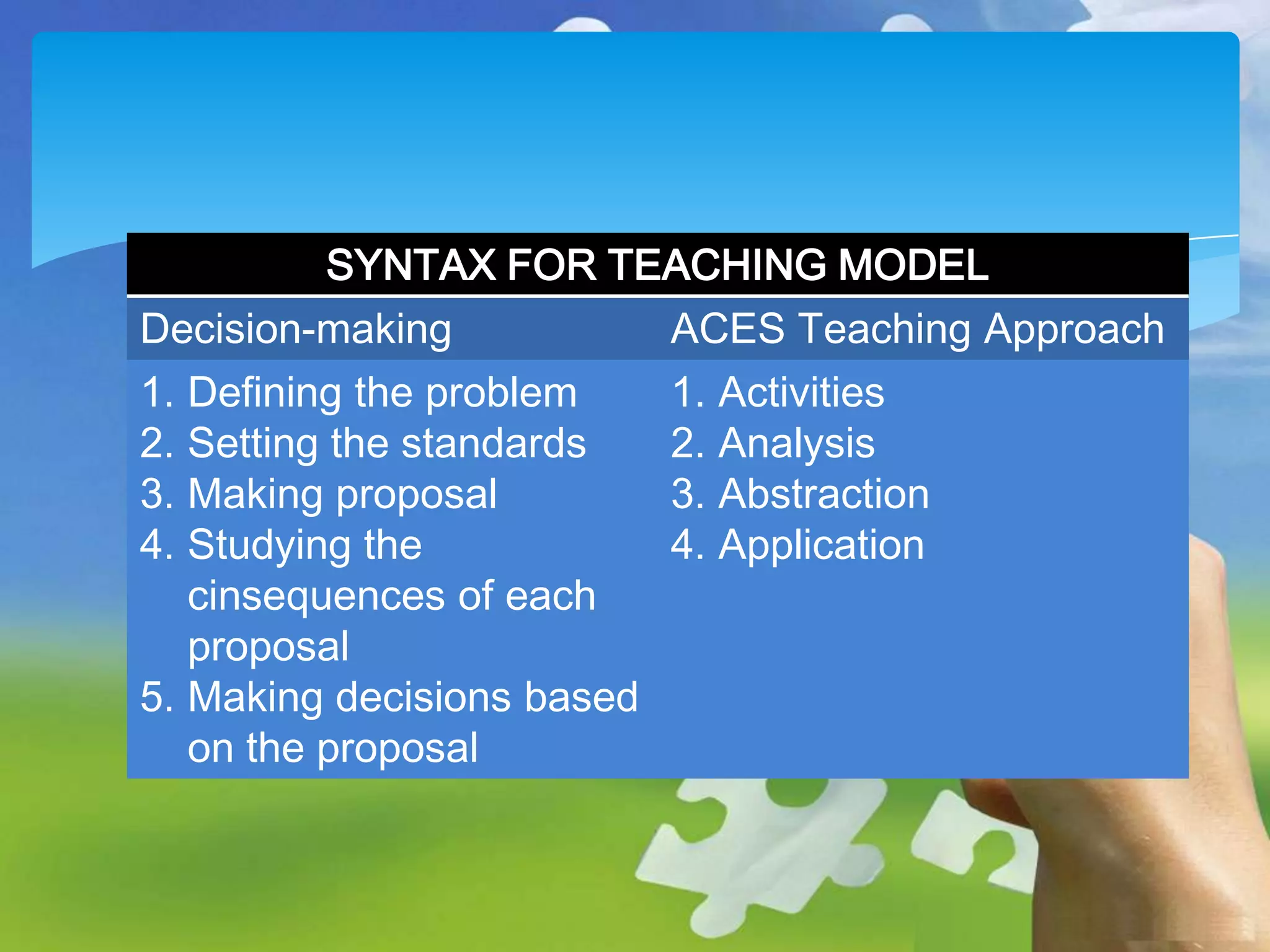
SYNTAX FOR TEACHING MODEL

Decision-making
1. Defining the problem
2. Setting the standards
3. Making proposal
4. Studying the
cinsequences of each
proposal
5. Making decisions based
on the proposal

ACES Teaching Approach
1. Activities
2. Analysis
3. Abstraction
4. Application
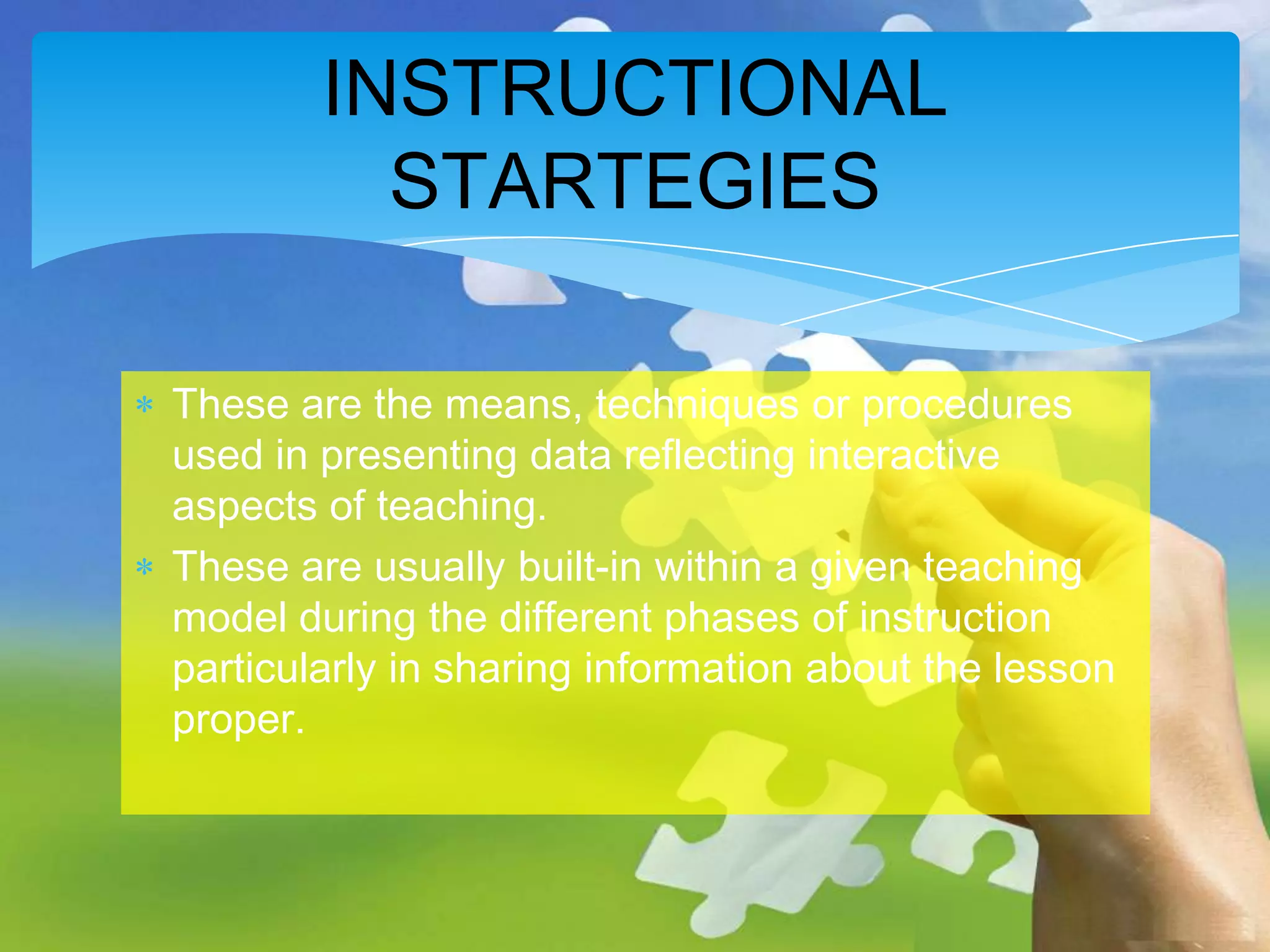
INSTRUCTIONAL
STARTEGIES
These are the means, techniques or procedures
used in presenting data reflecting interactive
aspects of teaching.
These are usually built-in within a given teaching
model during the different phases of instruction
particularly in sharing information about the lesson
proper.
A. Lecture

Lectures are used when introducing a
topic, defining an issue, presenting a
dilemna, explaining a process and in summarizing
a key points.
These are well-planned oral presentations on a
given topic by teachers or a reporter.
B. Roundtable Discussion
A roundtable discussion usually involves a small number
of students, perhaps no fewer than three and no more
than eight.
A relax atmosphere must prevail and the presentation
must be conversational rather than oratorical.
Roundtable discussion can be used in the classroom by
having a group of students discuss a problem before the
class or by dividing the class into several discussion
without an audience.
C. Panel Discussion
A panel discussion is similar to roundtable
discussion in many aspects, but there are some
differences.
The procedures is more formal than that of
roundable discussion. It usually begins with a
short statement from each discussant before the
panel is opened for free discussion by the
members of the panel.
D. BRAINSTORMING
This strategy or technique is often used by
teachers in analyzing issue, an event, or a problem
that calls for a solutions.
Once the problems or issue is presented to the
class, the students are asked to suggest possible
solutions to the problems.
E. Role Playing
This stategy or technique helps students understand
the perspective of others. It enables students to
identify with others in a variety of situations.

It develops empathy, concerns for others, and other
prosocial behaviors by having students enact an
incident or problem and propose desirable solutions.
F. SOCIO-DRAMA

This strategy or technique used in summarizing or
communicationg highlights of learning experiences
through a pantomine, skits anf dramatization.
Designing

Graphic
Organizers
Graphic Organizers are essential tools of learning.
These are forms of visual representations of both
teachers and students in teaching-learning
process.
Simply put, these are visual representation of
knowledge that are conceptualized.
Developed, and utilized to ensure effective
instruction.
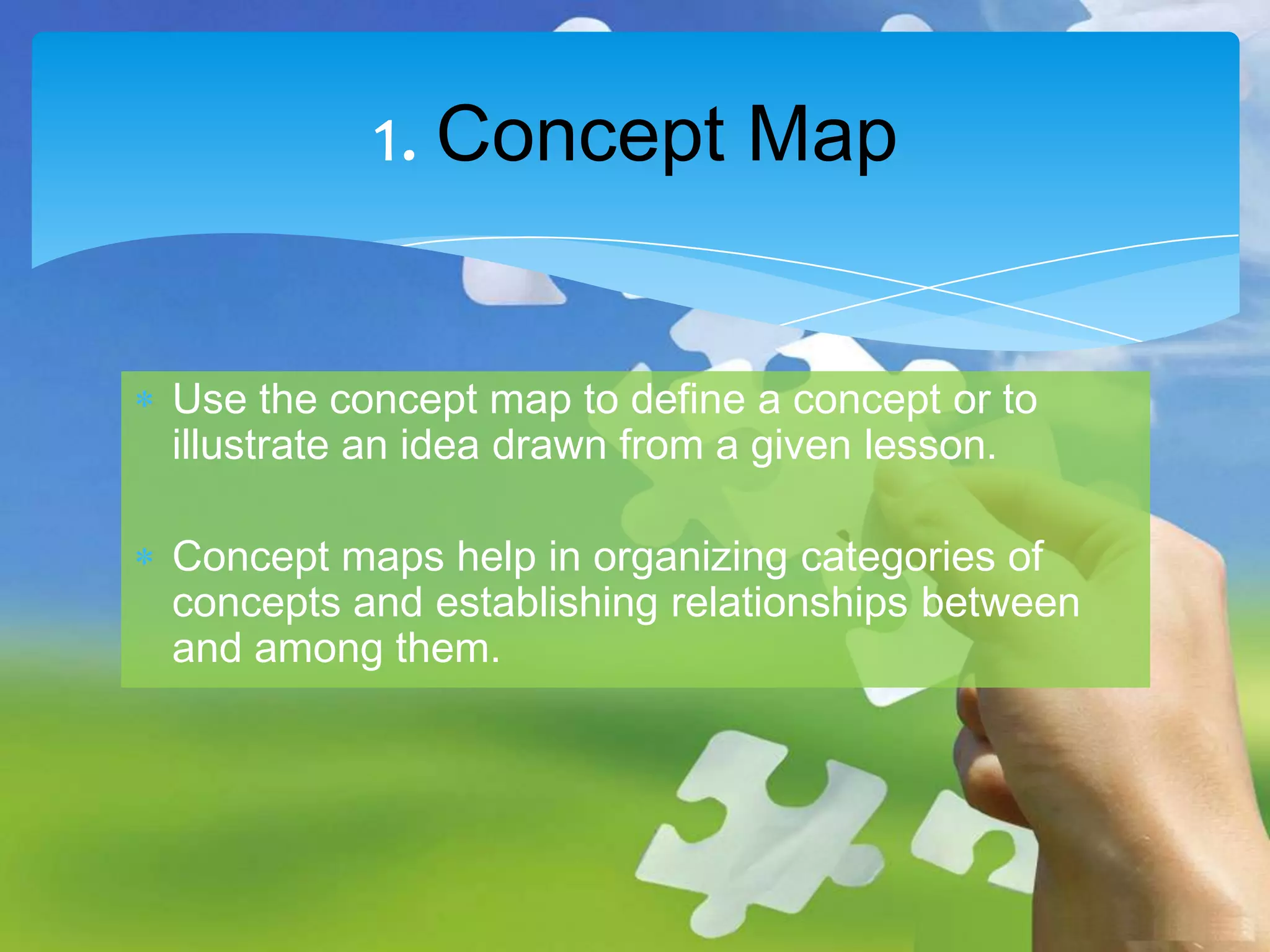
1. Concept Map
Use the concept map to define a concept or to
illustrate an idea drawn from a given lesson.
Concept maps help in organizing categories of
concepts and establishing relationships between
and among them.
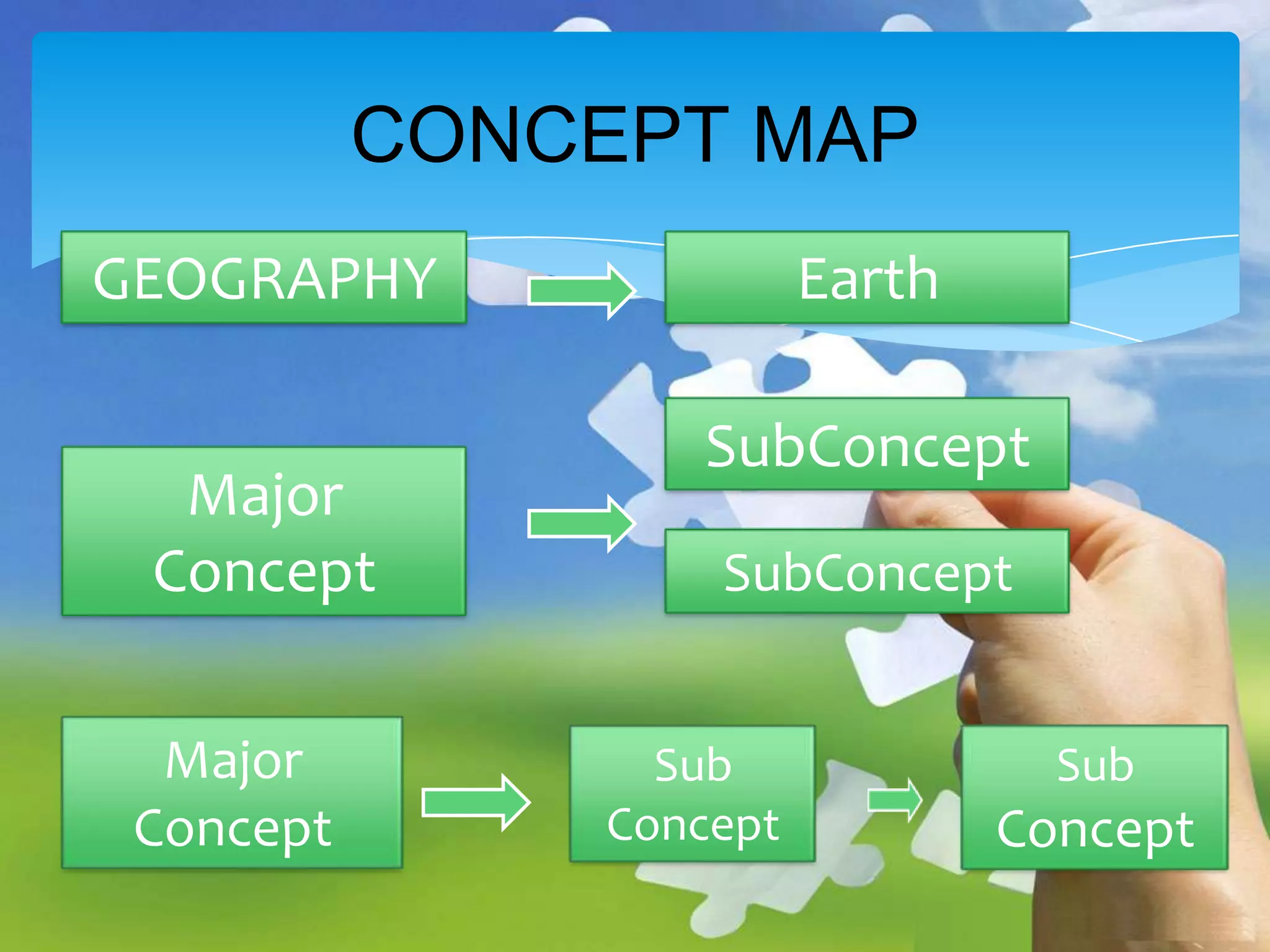
CONCEPT MAP
GEOGRAPHY
Major
Concept
Major
Concept

Earth

SubConcept
SubConcept
Sub
Concept

Sub

Concept
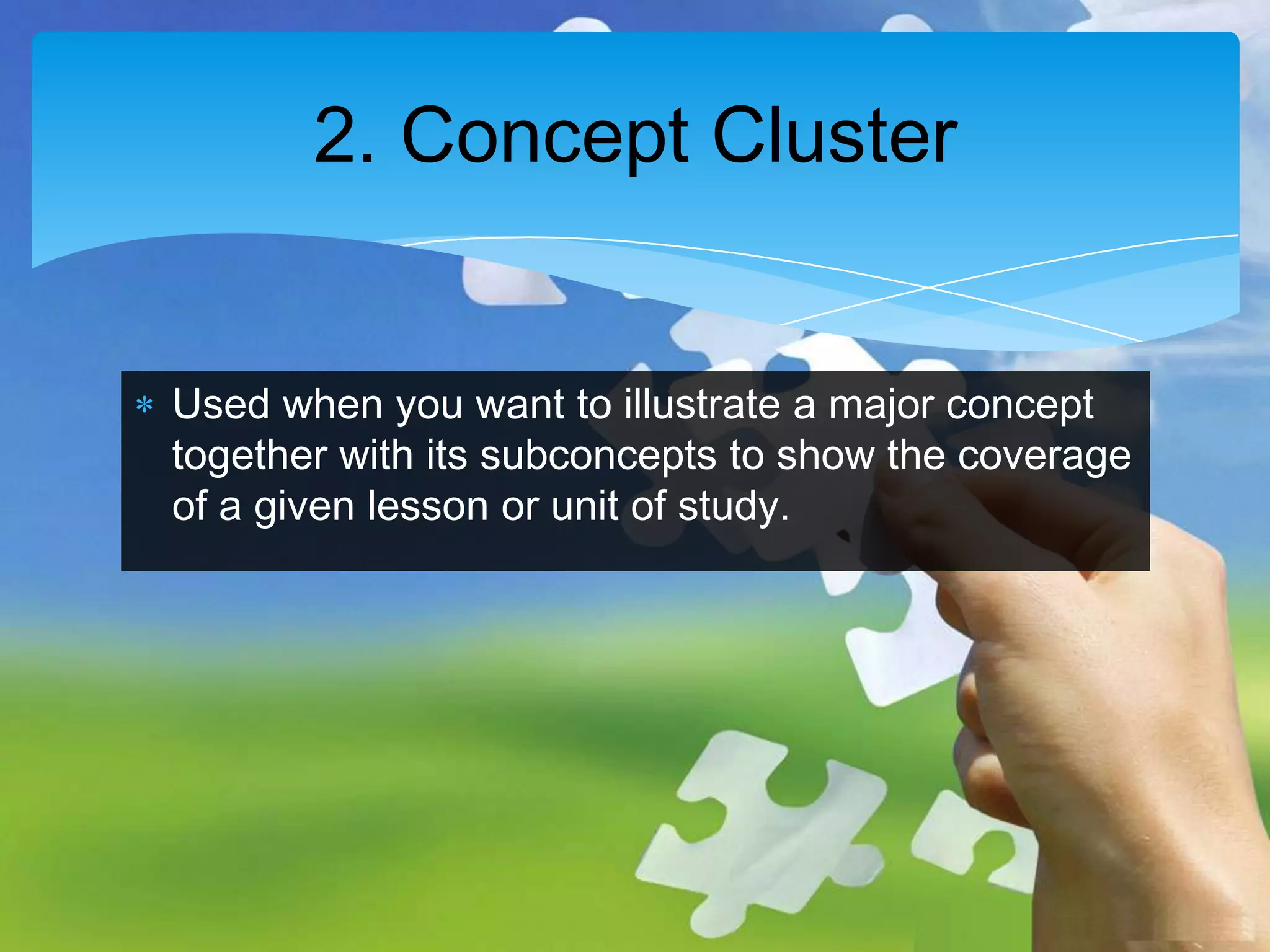
2. Concept Cluster

Used when you want to illustrate a major concept
together with its subconcepts to show the coverage
of a given lesson or unit of study.
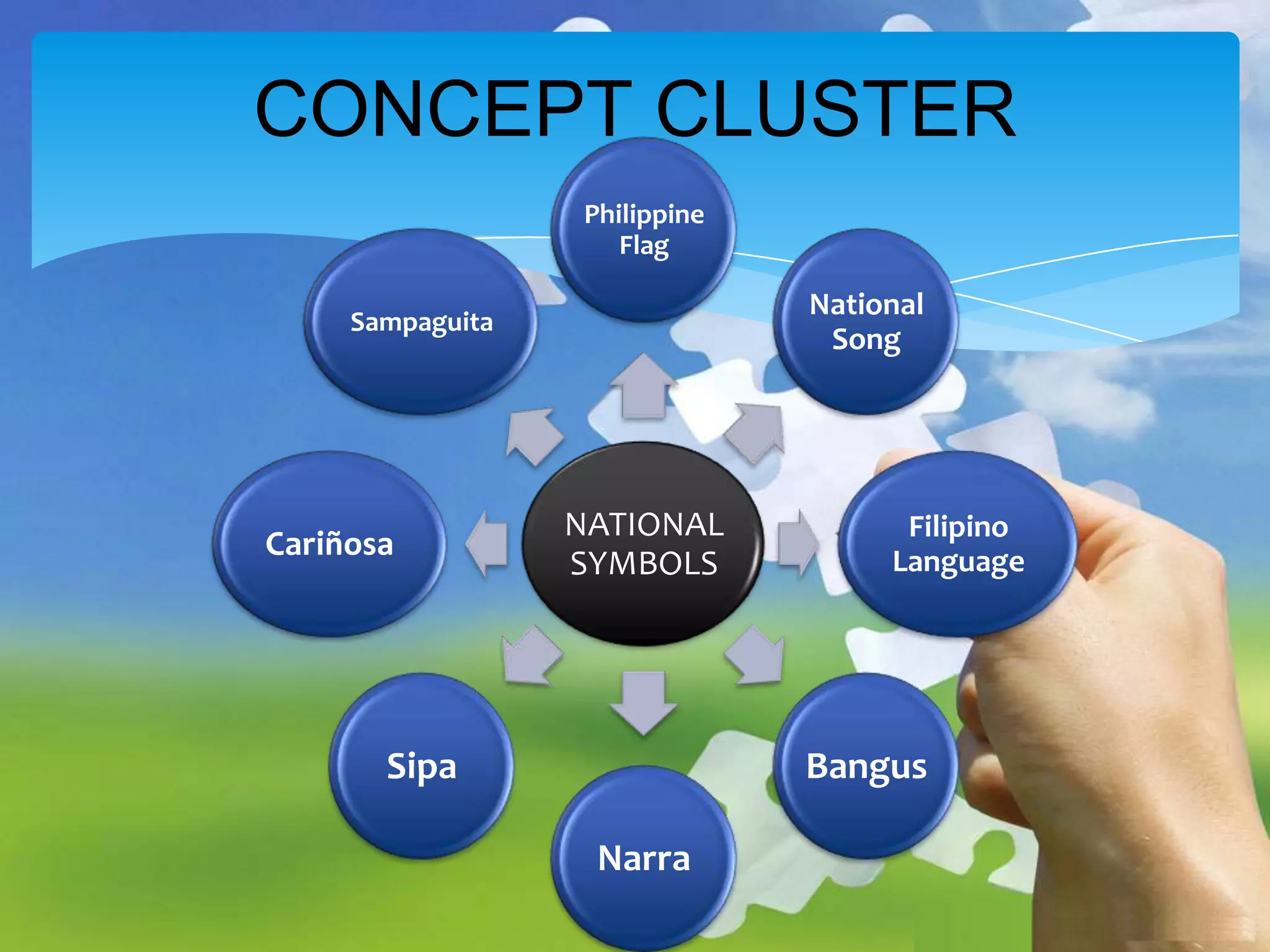
CONCEPT CLUSTER
Philippine
Flag

National
Song

Sampaguita

Cariñosa

NATIONAL
SYMBOLS

Sipa

Filipino
Language

Bangus
Narra
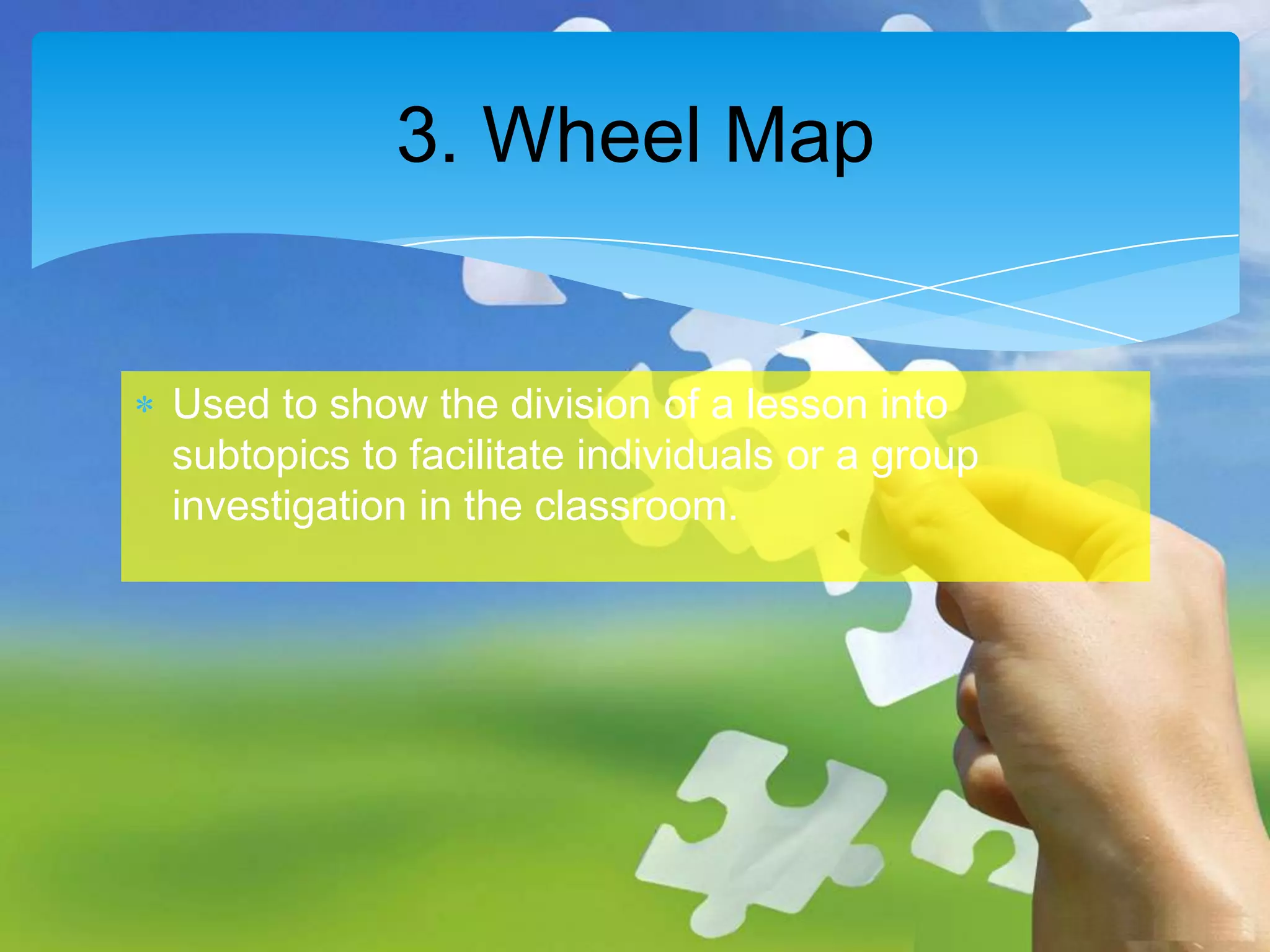
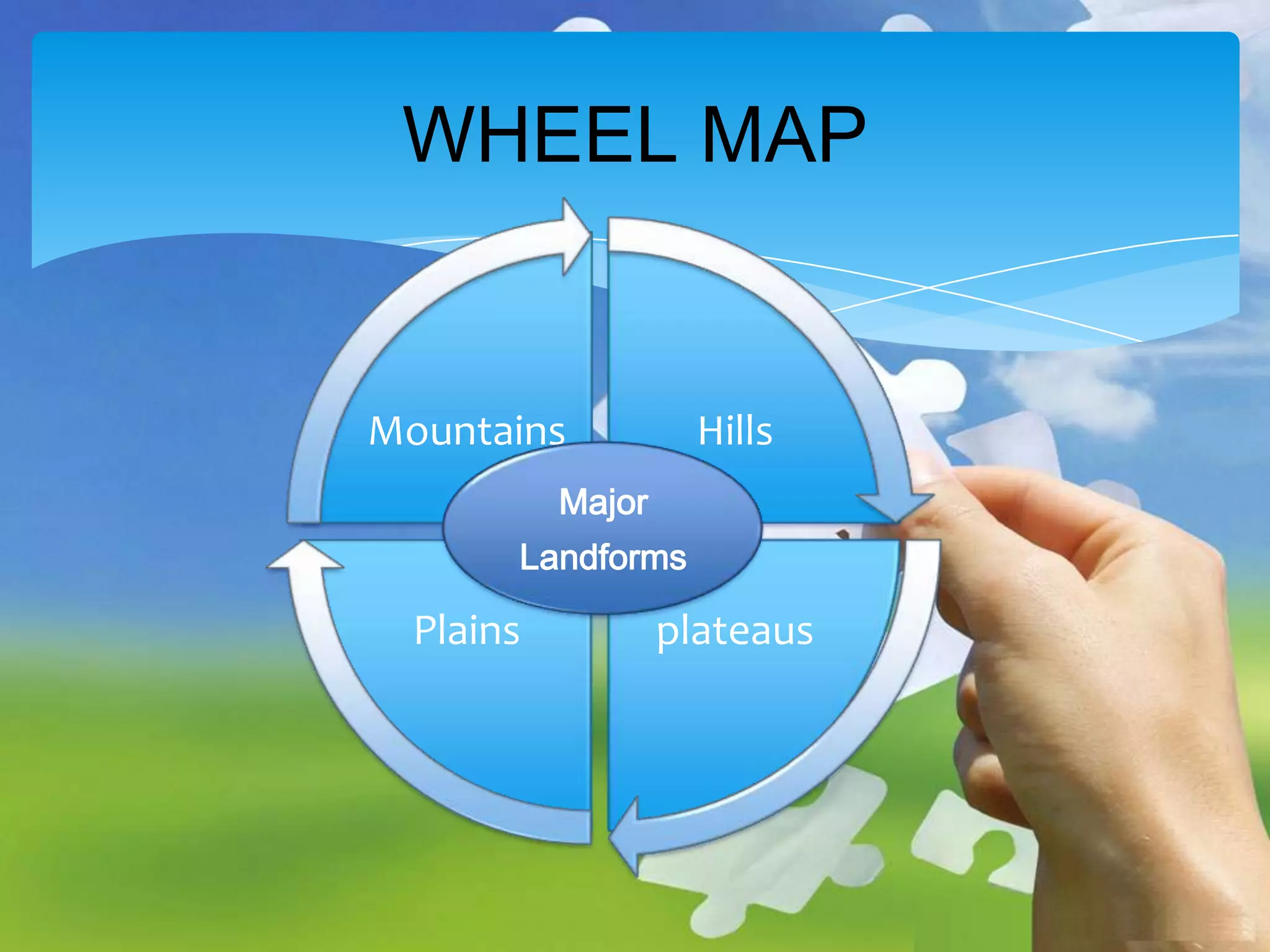
3. Wheel Map

Used to show the division of a lesson into
subtopics to facilitate individuals or a group
investigation in the classroom.
WHEEL MAP

Mountains

Hills

Major
Landforms

Plains

plateaus
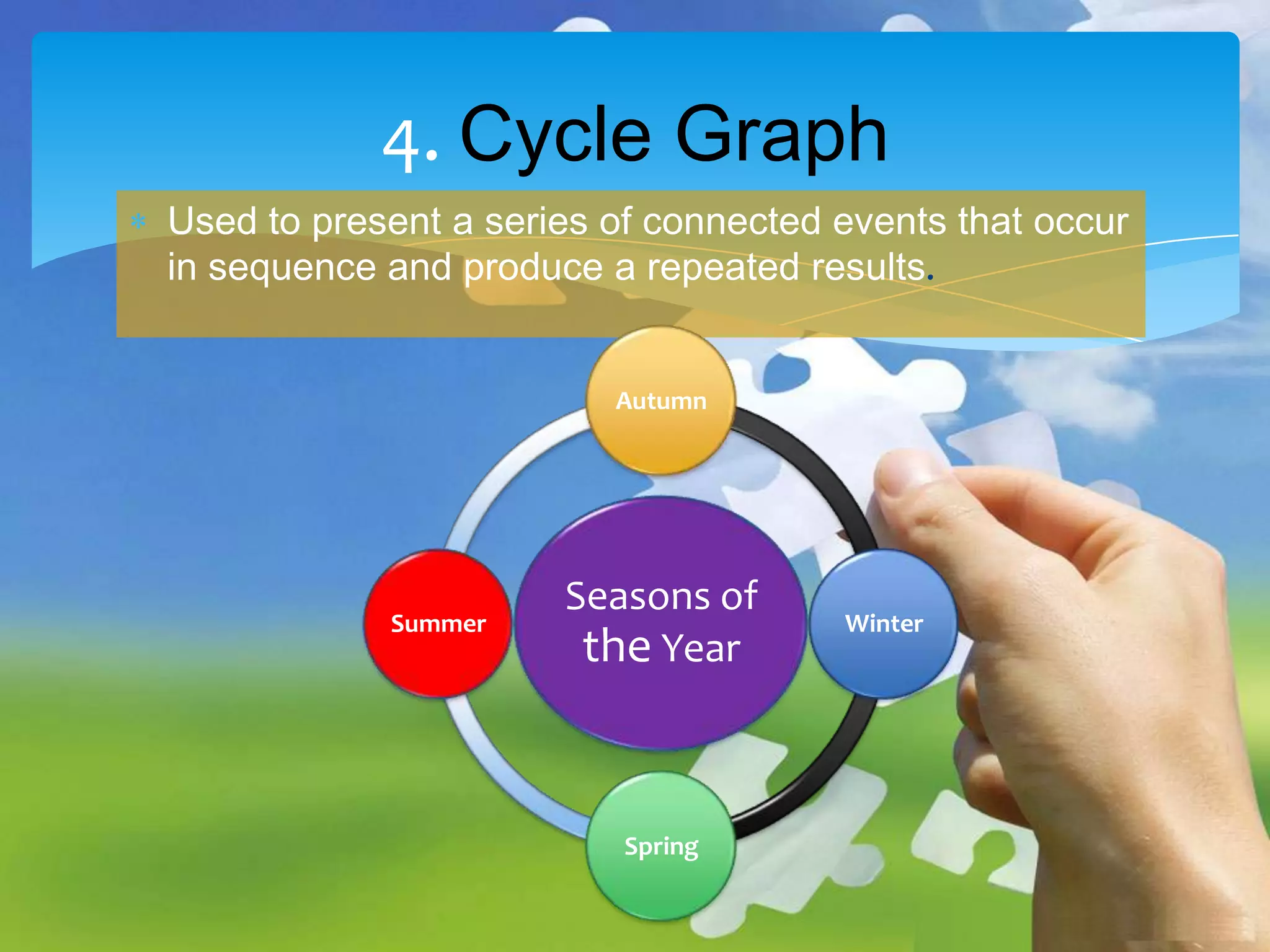
4. Cycle Graph
Used to present a series of connected events that occur
in sequence and produce a repeated results.

Autumn

Summer

Seasons of
the Year

Spring

Winter
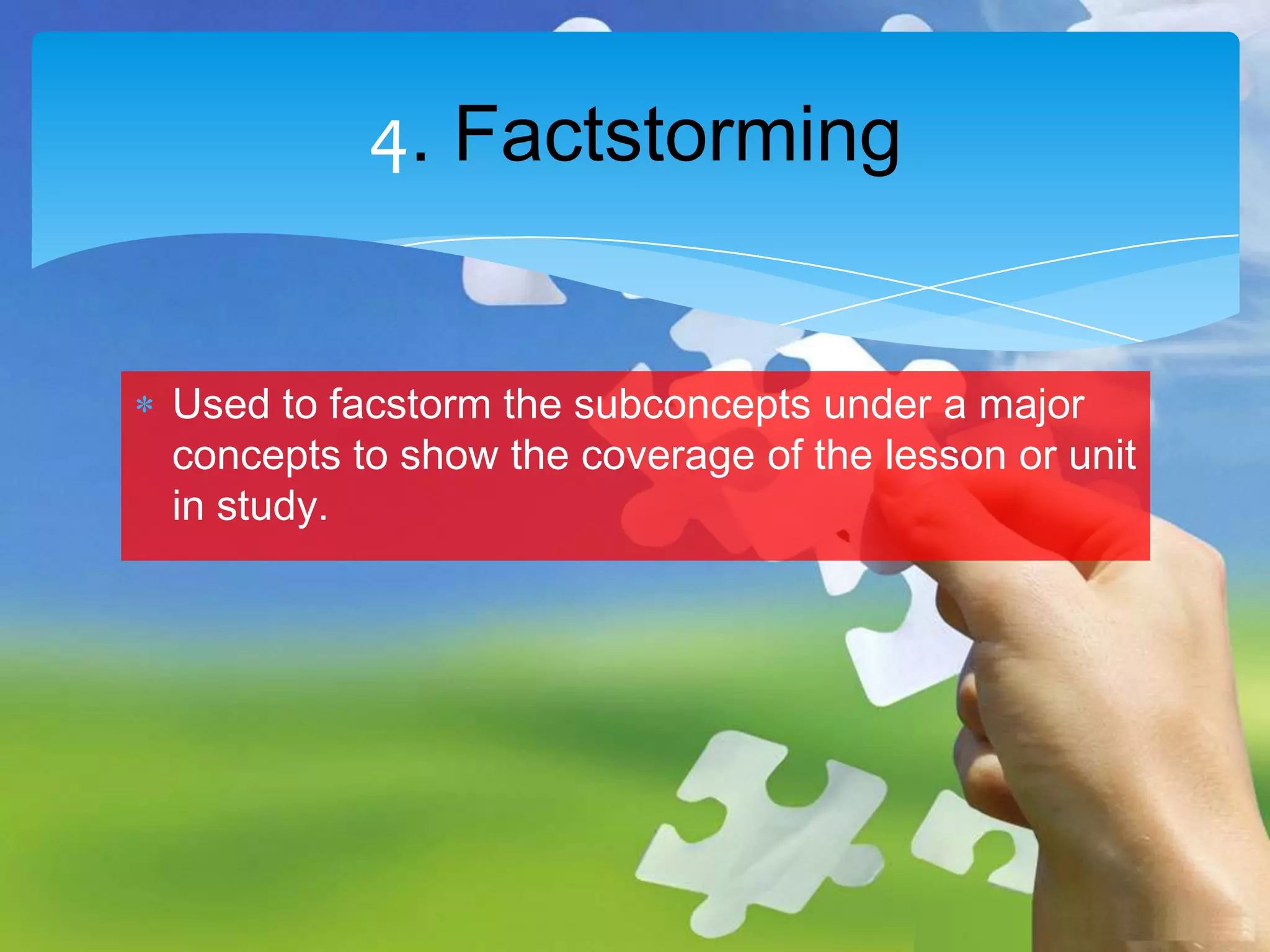
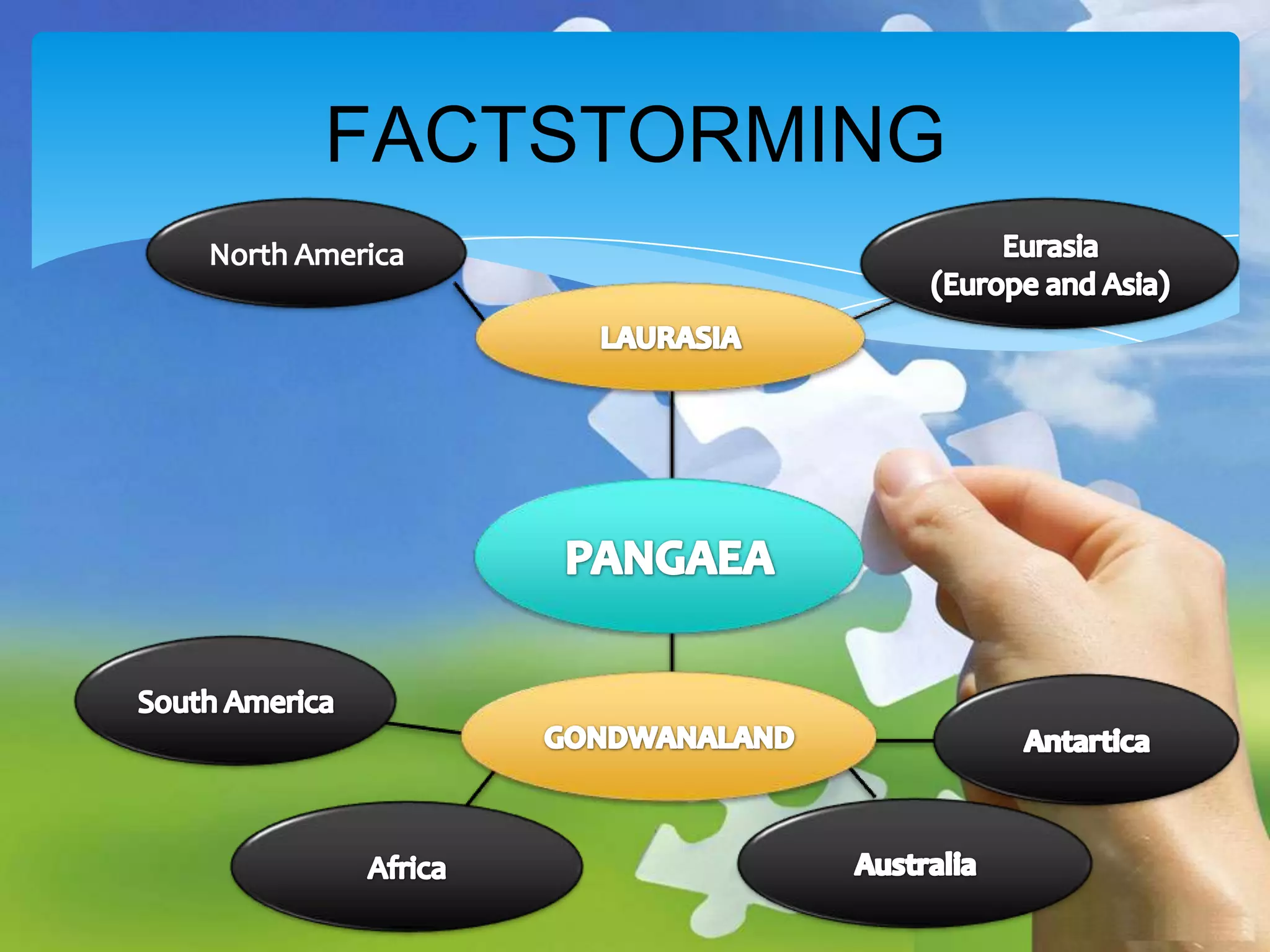
4. Factstorming
Used to facstorm the subconcepts under a major
concepts to show the coverage of the lesson or unit
in study.
FACTSTORMING
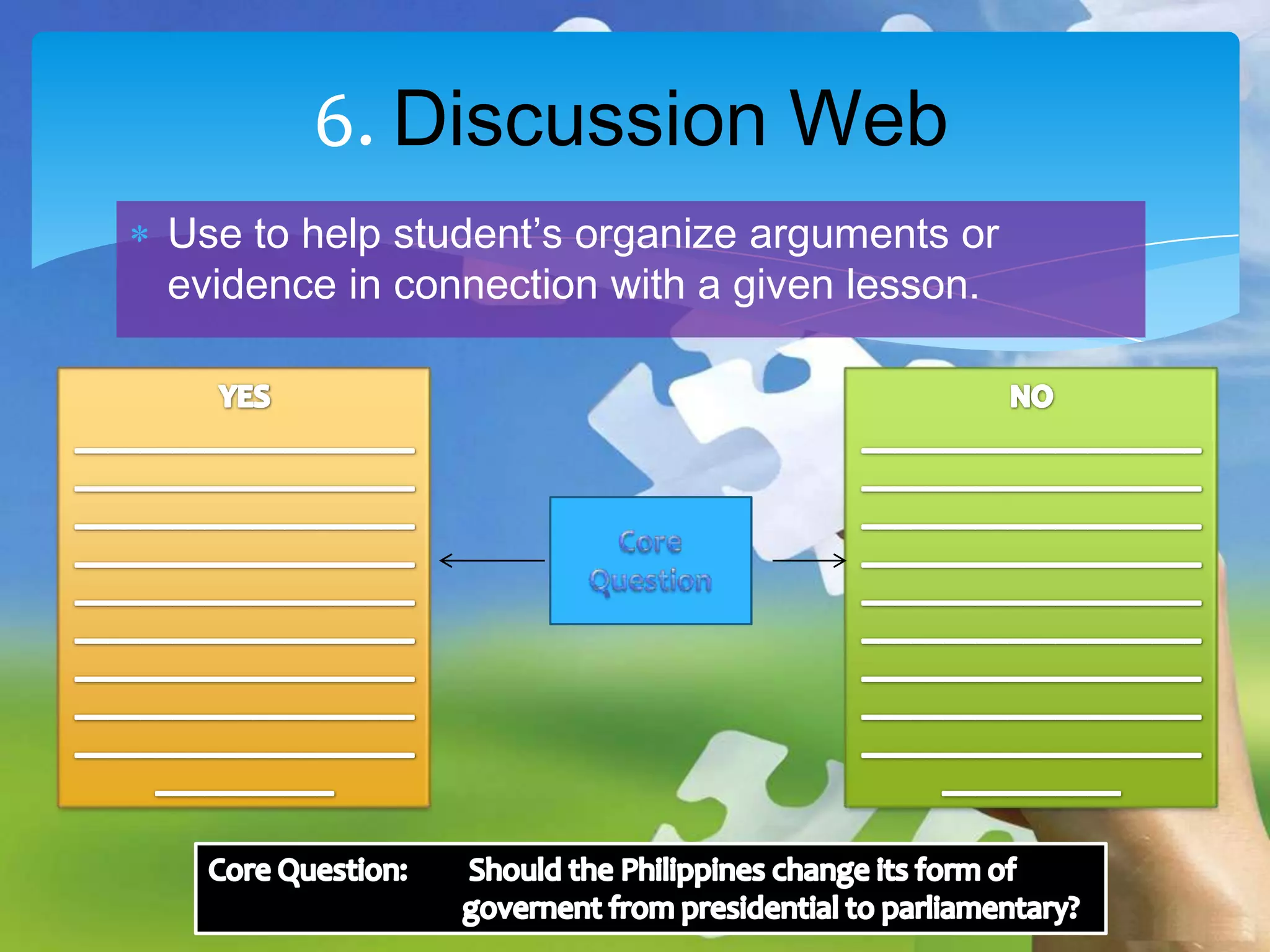
6. Discussion Web
Use to help student’s organize arguments or
evidence in connection with a given lesson.
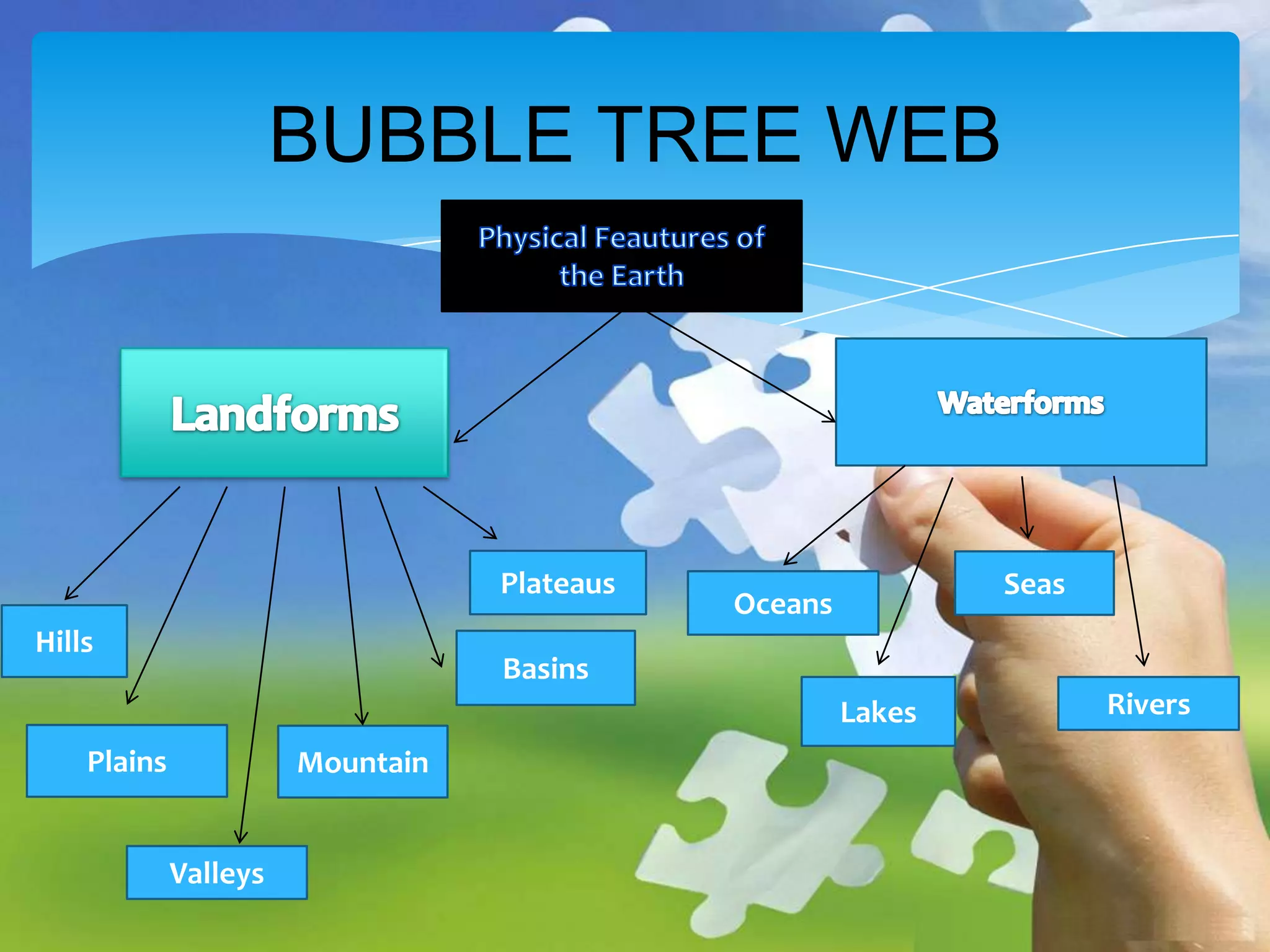
7. Bubble Tree Web
Use to represent relationships among concepts. It
is usually used with information that can be
categorized beneath a core or main understanding.
BUBBLE TREE WEB

Plateaus
Hills

Seas

Oceans

Basins
Lakes

Plains

Mountain
Valleys

Rivers
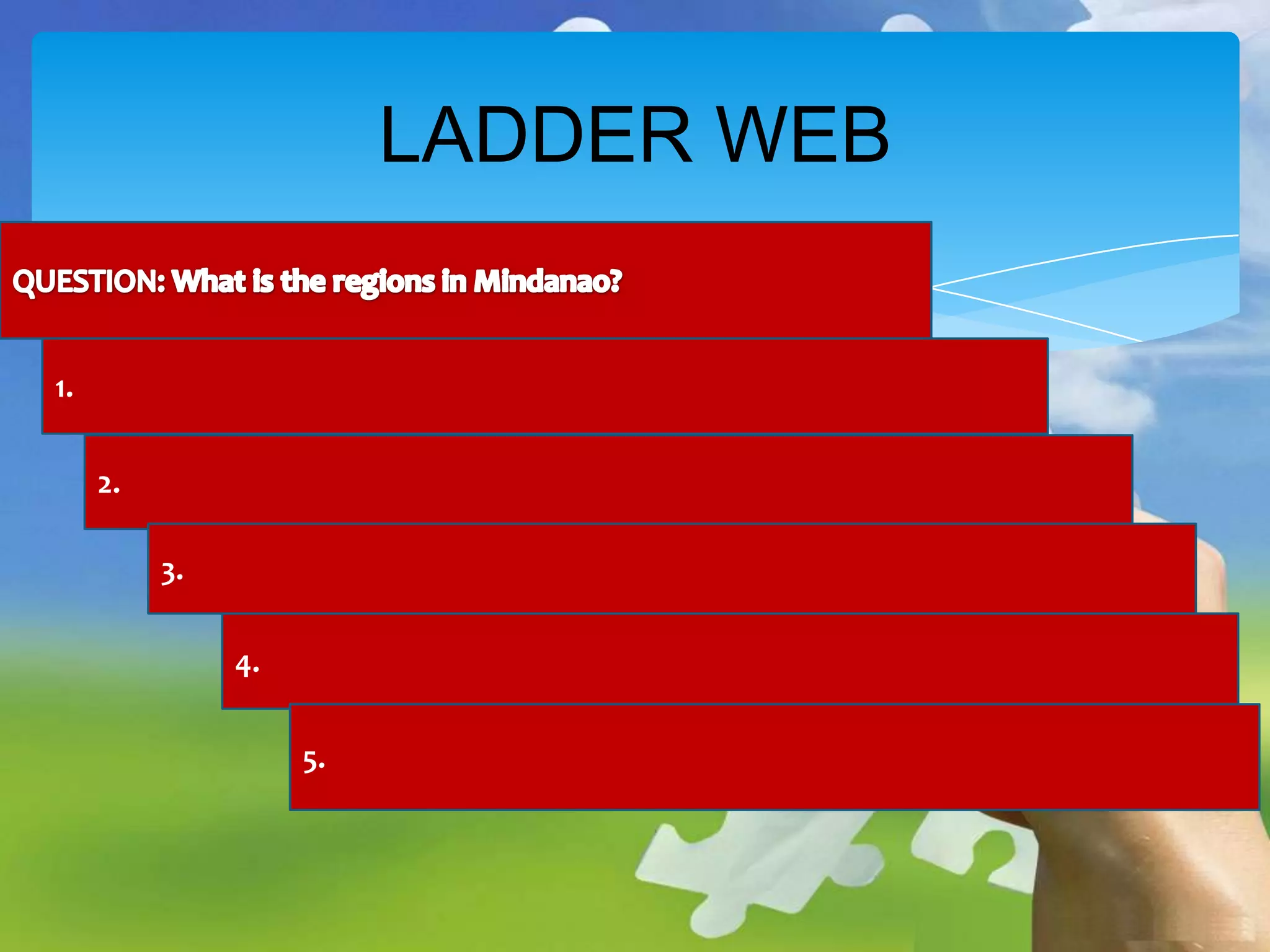
8. Ladder Web

Use to answer questions that call for answers in
enumeration.
A ladder web gives a logical presentation of data
recorded as a result of an investigation
LADDER WEB

1.
2.
3.
4.
5.
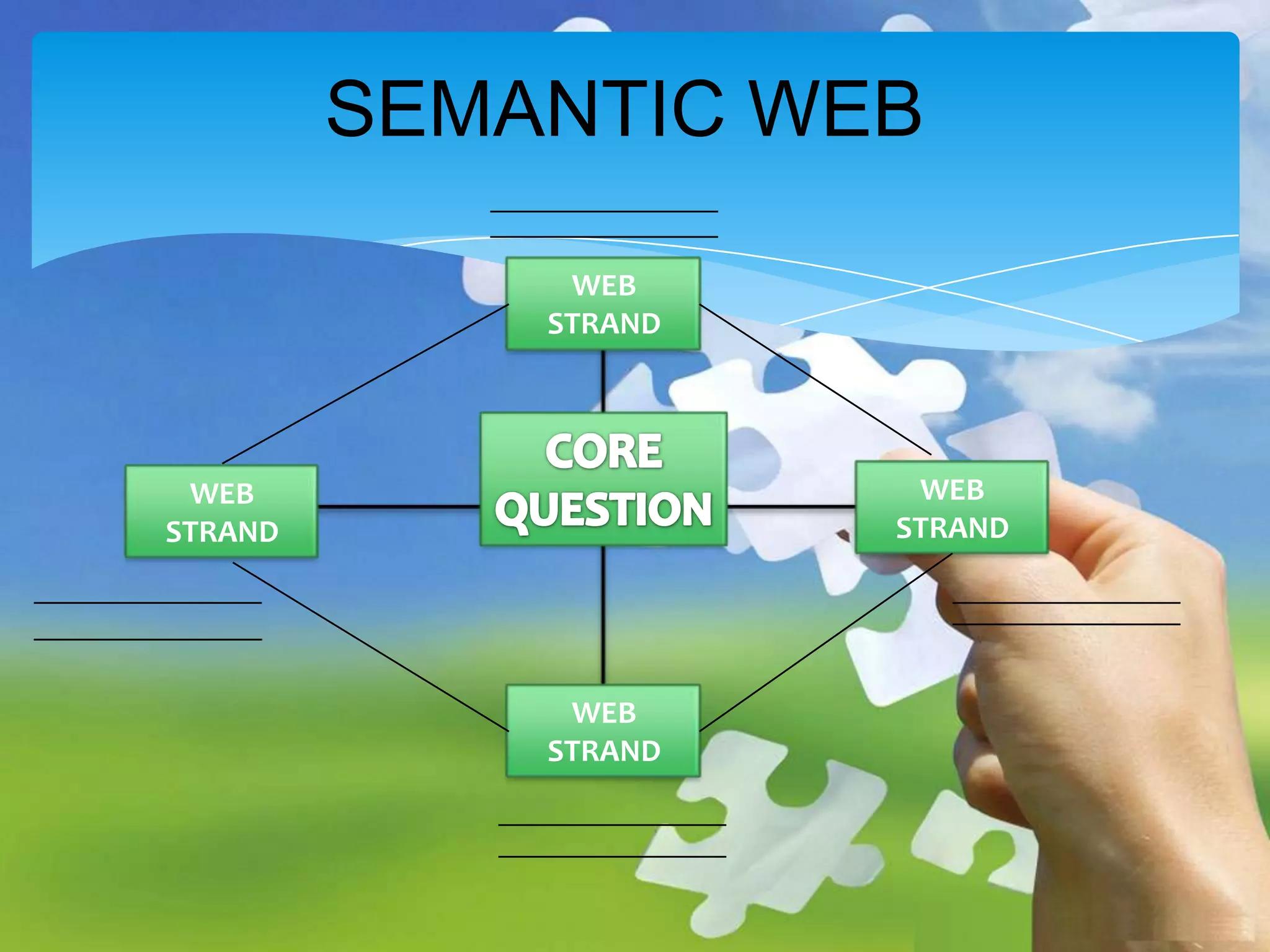
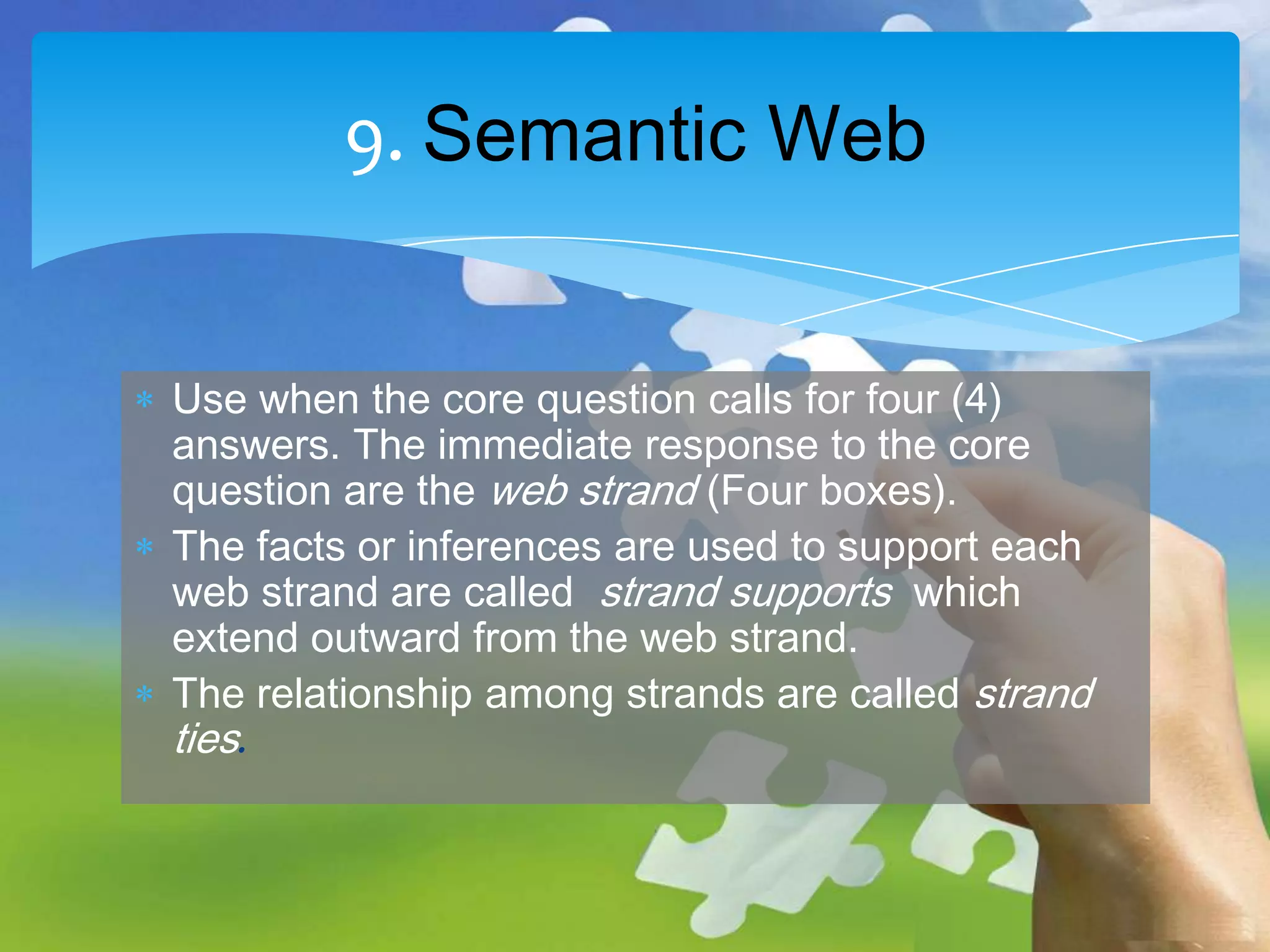
9. Semantic Web
Use when the core question calls for four (4)
answers. The immediate response to the core
question are the web strand (Four boxes).
The facts or inferences are used to support each
web strand are called strand supports which
extend outward from the web strand.
The relationship among strands are called strand
ties.
SEMANTIC WEB
WEB
STRAND

WEB
STRAND

WEB
STRAND

WEB
STRAND
10. Venn Diagram
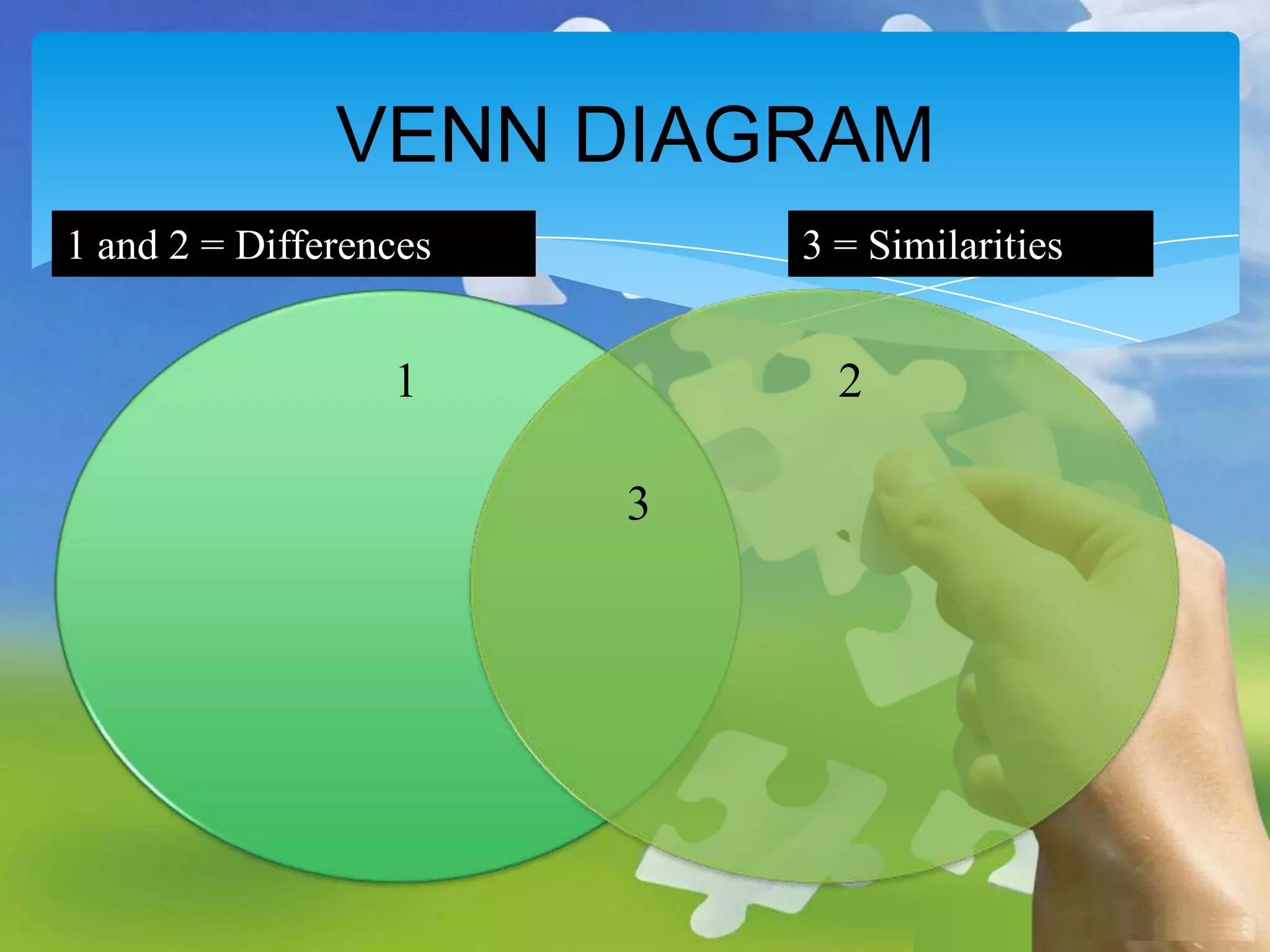
VENN DIAGRAM
1 and 2 = Differences

3 = Similarities

1

2
3
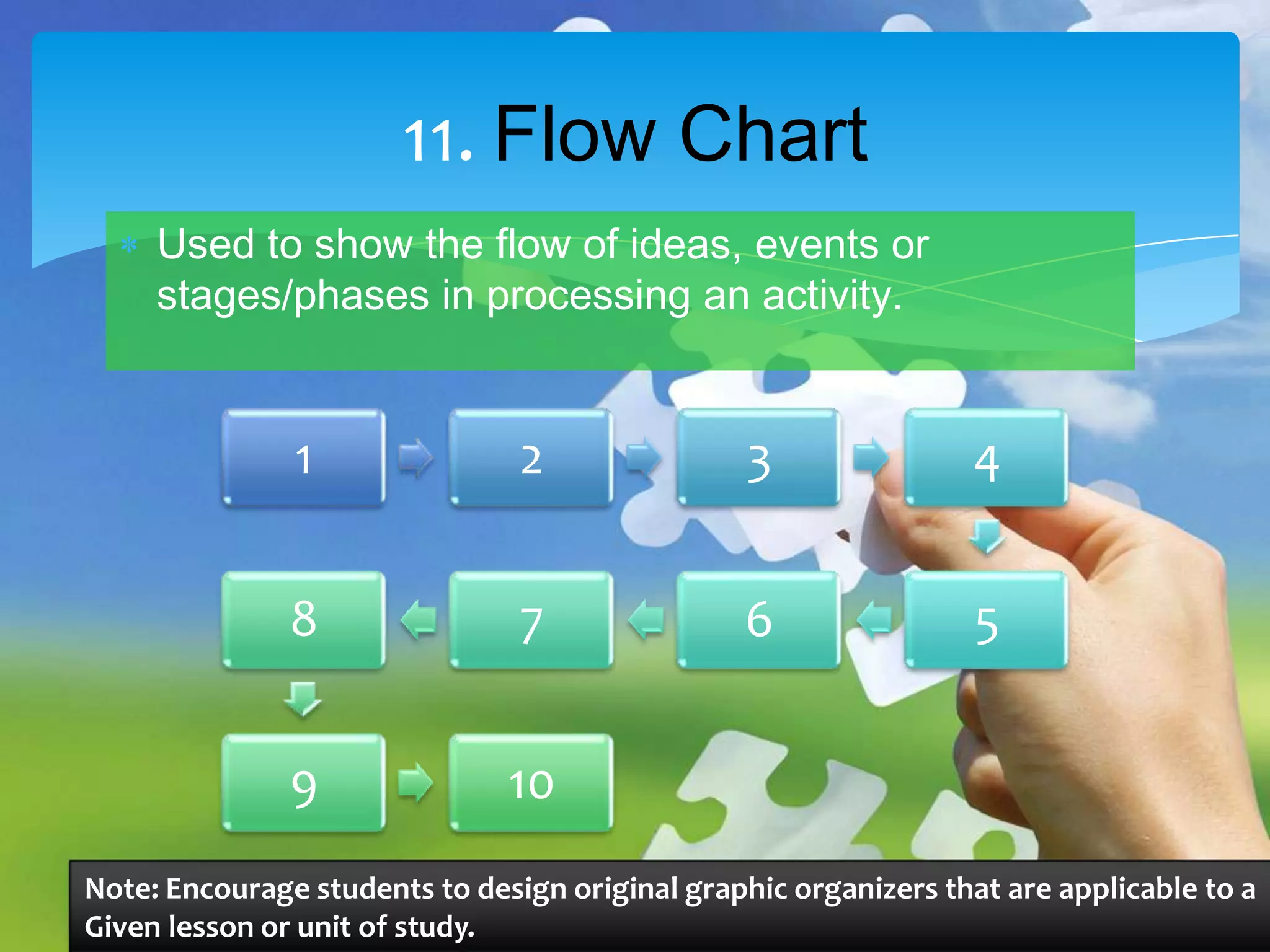
11. Flow Chart
Used to show the flow of ideas, events or
stages/phases in processing an activity.

1

2

3

4

8

7

6

5

9

10

Note: Encourage students to design original graphic organizers that are applicable to a
Given lesson or unit of study.
Measurement of Learning:
ASSESSMENT AND EVALUATION
Assessment is the ongoing process of gathering
and analyzing evidence of what students know and
what they do not know.
It is a process of interpreting information about the
students in order to plan instruction and evaluate
achievement.
Evaluation is the process of interpreting the
evidence and making judgements and decisions
based on the evidence.

1. Diagnostic Evaluation – which intends to asess

skills, abilities, interests and difficulties of students
and is usually adminstrates at the beginning of a
lesson or units.
2. Fomative Evaluation – which is used to monitor
student’s progess and provide meaningful and
immediate feedback as to what students have to do
achieve a standards.
3.Summatative evaluation – which is the last
judgement, the final grade, the end result, and the
summary of what the students learned.

Widely applicable teaching models, instructional strategies and

  • 1.
    UNIT V Widely Applicable Teaching Models,Instructional Strategies, And Graphic Organizers Reported By: Jolly Ray Forteza Bederico
  • 2.
    INTRODUCTION Teaching models areideal processes of instruction . These have established patterns that are worth doing in the classroom. By the large, teaching models are anchored on certain theories of learning and instruction with accompanying syntax – the logical phases of instruction of a particular teaching model – that guide teachers in the unfolding of lessons.
  • 3.
  • 4.
    Teaching Models arelarger than a particular strategy, method, or tactic. These are broad overall approaches to instruction that do not only help teachers in planning instruction, but also guide them in acquiring information, developing skills, internalizing values, and engaging in other forms of learning activities.
  • 5.
    More importantly, teachingmodels are supported by the exponents of theories of instruction each following a syntax – logical phases of instruction of the model. The teaching models that lend easily to integrative teaching and learning are discovery learning, inquiry learning, problem-based learning, cooperative learning, decision-making and ACES teaching approach.
  • 6.
    A. Discovery Learning. Thisteaching model is based on the idea that content is not given to learners in finished form. Rather, it is discovered by learners before they can internalize it. By the large, discovery learning is used to accoplish three related education purposes like:
  • 7.
    (1) to providestudents with opportunities to think independently (2) to help students discover how knowledge becomes know (3) to promote higher-order or critical thinking skills such as analysis, synthesis and evaluation
  • 8.
    B. INQUIRY LEARNING Thisis commonly known as the inquiry process which is apparently the application of scientific method of teaching. C. Problem-based Learning (PBL) The essence of this model consists of presenting students authentic and meaningful problem situations to serve as springboards for investigation
  • 9.
    D. Coopeartive learning Thisis the procedure whereby learners work together is small grups and rewarded for their collective accomplishments. It is benefits both low- and high-achieving students who were together in academic tasks. It has a wider acceptance of people who are different.
  • 10.
    e. Decision-making This isan intellectual process that requires students to select the best alternative choice on a set of conditions or circumstances. It involves the making intelligent choices by identifying objectives and alternative ways of achieving them.
  • 11.
    F. ACES Teachingapproach The ACES Teaching Approach (Four A’s) follows a logical sequencing of learning activities from the closing activity as shown below: Phase 1: Activity Phase 2: Analysis Phase 3: Abstraction Phase 4: Application
  • 12.
    SYNTAX FOR TEACHINGMODELS Discovery Learning Inquiry Learning 1.Selecting the 1.Establishing a problem form for inquiry 2.Proposing 2.Formulating possible solution hypotheses 3.Collecting data 3.Gathering data 4.Analyzing and 4.Testing interpreting data hypotheses 5.Testing 5.Formulating conclusions conclusion
  • 13.
    SYNTAX FOR TEACHINGMODELS Problem-based Cooperative Learning: Learning Group Investigation (GI) 1. Orienting students to 1. Identification of topics the problem 2. Formation of learning 2. Organizing students teams for study 3. Investigation of topics 3. Assisting 4. Preparation of independent and presentation group investigation 5. Presentation to the 4. Presenting exhibits whole class 5. Analyzing and evaluating the
  • 14.
    SYNTAX FOR TEACHINGMODEL Decision-making 1. Defining the problem 2. Setting the standards 3. Making proposal 4. Studying the cinsequences of each proposal 5. Making decisions based on the proposal ACES Teaching Approach 1. Activities 2. Analysis 3. Abstraction 4. Application
  • 16.
    INSTRUCTIONAL STARTEGIES These are themeans, techniques or procedures used in presenting data reflecting interactive aspects of teaching. These are usually built-in within a given teaching model during the different phases of instruction particularly in sharing information about the lesson proper.
  • 17.
    A. Lecture Lectures areused when introducing a topic, defining an issue, presenting a dilemna, explaining a process and in summarizing a key points. These are well-planned oral presentations on a given topic by teachers or a reporter.
  • 18.
    B. Roundtable Discussion Aroundtable discussion usually involves a small number of students, perhaps no fewer than three and no more than eight. A relax atmosphere must prevail and the presentation must be conversational rather than oratorical. Roundtable discussion can be used in the classroom by having a group of students discuss a problem before the class or by dividing the class into several discussion without an audience.
  • 19.
    C. Panel Discussion Apanel discussion is similar to roundtable discussion in many aspects, but there are some differences. The procedures is more formal than that of roundable discussion. It usually begins with a short statement from each discussant before the panel is opened for free discussion by the members of the panel.
  • 20.
    D. BRAINSTORMING This strategyor technique is often used by teachers in analyzing issue, an event, or a problem that calls for a solutions. Once the problems or issue is presented to the class, the students are asked to suggest possible solutions to the problems.
  • 21.
    E. Role Playing Thisstategy or technique helps students understand the perspective of others. It enables students to identify with others in a variety of situations. It develops empathy, concerns for others, and other prosocial behaviors by having students enact an incident or problem and propose desirable solutions.
  • 22.
    F. SOCIO-DRAMA This strategyor technique used in summarizing or communicationg highlights of learning experiences through a pantomine, skits anf dramatization.
  • 23.
  • 24.
    Graphic Organizers areessential tools of learning. These are forms of visual representations of both teachers and students in teaching-learning process. Simply put, these are visual representation of knowledge that are conceptualized. Developed, and utilized to ensure effective instruction.
  • 25.
    1. Concept Map Usethe concept map to define a concept or to illustrate an idea drawn from a given lesson. Concept maps help in organizing categories of concepts and establishing relationships between and among them.
  • 26.
  • 27.
    2. Concept Cluster Usedwhen you want to illustrate a major concept together with its subconcepts to show the coverage of a given lesson or unit of study.
  • 28.
  • 29.
    3. Wheel Map Usedto show the division of a lesson into subtopics to facilitate individuals or a group investigation in the classroom.
  • 30.
  • 31.
    4. Cycle Graph Usedto present a series of connected events that occur in sequence and produce a repeated results. Autumn Summer Seasons of the Year Spring Winter
  • 32.
    4. Factstorming Used tofacstorm the subconcepts under a major concepts to show the coverage of the lesson or unit in study.
  • 33.
  • 34.
    6. Discussion Web Useto help student’s organize arguments or evidence in connection with a given lesson.
  • 35.
    7. Bubble TreeWeb Use to represent relationships among concepts. It is usually used with information that can be categorized beneath a core or main understanding.
  • 36.
  • 37.
    8. Ladder Web Useto answer questions that call for answers in enumeration. A ladder web gives a logical presentation of data recorded as a result of an investigation
  • 38.
  • 39.
    9. Semantic Web Usewhen the core question calls for four (4) answers. The immediate response to the core question are the web strand (Four boxes). The facts or inferences are used to support each web strand are called strand supports which extend outward from the web strand. The relationship among strands are called strand ties.
  • 40.
  • 41.
  • 42.
    VENN DIAGRAM 1 and2 = Differences 3 = Similarities 1 2 3
  • 43.
    11. Flow Chart Usedto show the flow of ideas, events or stages/phases in processing an activity. 1 2 3 4 8 7 6 5 9 10 Note: Encourage students to design original graphic organizers that are applicable to a Given lesson or unit of study.
  • 44.
    Measurement of Learning: ASSESSMENTAND EVALUATION Assessment is the ongoing process of gathering and analyzing evidence of what students know and what they do not know. It is a process of interpreting information about the students in order to plan instruction and evaluate achievement.
  • 45.
    Evaluation is theprocess of interpreting the evidence and making judgements and decisions based on the evidence. 1. Diagnostic Evaluation – which intends to asess skills, abilities, interests and difficulties of students and is usually adminstrates at the beginning of a lesson or units.
  • 46.
    2. Fomative Evaluation– which is used to monitor student’s progess and provide meaningful and immediate feedback as to what students have to do achieve a standards. 3.Summatative evaluation – which is the last judgement, the final grade, the end result, and the summary of what the students learned.

Editor's Notes

  • #26 1. something thought or imagined: something that somebody has thought up, or that somebody might be able to imagine 2. broad principle affecting perception and behavior: a broad abstract idea or a guiding general principle, e.g. one that determines how a person or culture behaves, or how nature, reality, or events are perceived Microsoft® Encarta® 2009. © 1993-2008 Microsoft Corporation. All rights reserved.
  • #33 something known to be true: something that can be shown to be true, to exist, or to have happenedMicrosoft® Encarta® 2009. © 1993-2008 Microsoft Corporation. All rights reserved.excellent: excellent or impressive (informal