INTEGRATED
MULTIDISCIPLINARY
AND
INTEGRATED
INTERDISCIPLINARY
THEMATIC UNITS
What is a thematic unit
Thematic units are units of instruction
that address a central theme. These
are the instructional units that lead to
the development of integrated study.
Thematic units facilitate the crossing
of boundaries between two or more
disciplines
Guidelines in preparing
thematic units
1. Choose a learning area in any grade/year level.
2. Draw the content from the learning competencies.
3. Identify the theme for the chosen learning
competencies.
4. Identify the disciplines/learning area that can help
enhance the development of the theme and the
supporting learning competencies.
5. Select the appropriate teaching model/alternative
teaching strategy that can be utilized in the
conduct of the unit of study.
6. Use graphic organizers if
needed
7. Prepare appropriate readings
for the core as well as for the
other sub-topics drawn from
other disciplines/ learning
areas.
8. Use authentic assessment in
the unit of study.
9. Provide learning tasks that are
integrative and interactive.
10. Focus all learning tasks to the
theme of the unit of study.
The DIFFERENCE between
IMTU & IITU
Presentation of Objectives
• In the IMTU the objectives are presented through
different disciplines such as ; geography, history, values
education and music
• In the IITU the objectives are only 12 and were not
presented through disciplines
Integrated multidisciplinary
thematic unit
Integrated interdisciplinary
thematic unit
The objectives are presented by
discipline
The objectives are not presented
by discipline
Presentation of
Content Instruction
Integrated multidisciplinary
thematic unit
Integrated interdisciplinary
thematic unit
The topics and disciplines were both
mentioned
Only the topics are mentioned
Ex.
•The Philippine Archipelago
(Geography)
•The Founding of the Katipunan
(History)
•The teachings of the Katipunan
(Values Education)
•The Songs of the Katipuneros
(Music)
•The Philippine Archipelago
•The Founding of the Katipunan
•The teachings of the Katipunan
•The Songs of the Katipuneros
Use of
Teaching Models
- teaching models are
prescribe tested steps and
procedures to effectively
generate desired outcomes.
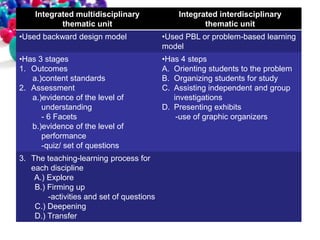
3. The teaching-learning process for
each discipline
A.) Explore
B.) Firming up
-activities and set of questions
C.) Deepening
D.) Transfer
Integrated multidisciplinary
thematic unit
Integrated interdisciplinary
thematic unit
•Used backward design model •Used PBL or problem-based learning
model
•Has 3 stages
1. Outcomes
a.)content standards
2. Assessment
a.)evidence of the level of
understanding
- 6 Facets
b.)evidence of the level of
performance
-quiz/ set of questions
•Has 4 steps
A. Orienting students to the problem
B. Organizing students for study
C. Assisting independent and group
investigations
D. Presenting exhibits
-use of graphic organizers
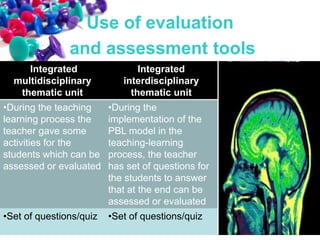
Use of evaluation
and assessment tools
Integrated
multidisciplinary
thematic unit
Integrated
interdisciplinary
thematic unit
•During the teaching
learning process the
teacher gave some
activities for the
students which can be
assessed or evaluated
•During the
implementation of the
PBL model in the
teaching-learning
process, the teacher
has set of questions for
the students to answer
that at the end can be
assessed or evaluated
•Set of questions/quiz •Set of questions/quiz
Integrated Multidisciplinary thematic unit and

Integrated Multidisciplinary thematic unit and

  • 1.
  • 2.
    What is athematic unit Thematic units are units of instruction that address a central theme. These are the instructional units that lead to the development of integrated study. Thematic units facilitate the crossing of boundaries between two or more disciplines
  • 3.
    Guidelines in preparing thematicunits 1. Choose a learning area in any grade/year level. 2. Draw the content from the learning competencies. 3. Identify the theme for the chosen learning competencies. 4. Identify the disciplines/learning area that can help enhance the development of the theme and the supporting learning competencies. 5. Select the appropriate teaching model/alternative teaching strategy that can be utilized in the conduct of the unit of study.
  • 4.
    6. Use graphicorganizers if needed 7. Prepare appropriate readings for the core as well as for the other sub-topics drawn from other disciplines/ learning areas. 8. Use authentic assessment in the unit of study. 9. Provide learning tasks that are integrative and interactive. 10. Focus all learning tasks to the theme of the unit of study.
  • 5.
  • 6.
    Presentation of Objectives •In the IMTU the objectives are presented through different disciplines such as ; geography, history, values education and music • In the IITU the objectives are only 12 and were not presented through disciplines Integrated multidisciplinary thematic unit Integrated interdisciplinary thematic unit The objectives are presented by discipline The objectives are not presented by discipline
  • 7.
    Presentation of Content Instruction Integratedmultidisciplinary thematic unit Integrated interdisciplinary thematic unit The topics and disciplines were both mentioned Only the topics are mentioned Ex. •The Philippine Archipelago (Geography) •The Founding of the Katipunan (History) •The teachings of the Katipunan (Values Education) •The Songs of the Katipuneros (Music) •The Philippine Archipelago •The Founding of the Katipunan •The teachings of the Katipunan •The Songs of the Katipuneros
  • 8.
    Use of Teaching Models -teaching models are prescribe tested steps and procedures to effectively generate desired outcomes.
  • 9.
    3. The teaching-learningprocess for each discipline A.) Explore B.) Firming up -activities and set of questions C.) Deepening D.) Transfer Integrated multidisciplinary thematic unit Integrated interdisciplinary thematic unit •Used backward design model •Used PBL or problem-based learning model •Has 3 stages 1. Outcomes a.)content standards 2. Assessment a.)evidence of the level of understanding - 6 Facets b.)evidence of the level of performance -quiz/ set of questions •Has 4 steps A. Orienting students to the problem B. Organizing students for study C. Assisting independent and group investigations D. Presenting exhibits -use of graphic organizers
  • 10.
    Use of evaluation andassessment tools Integrated multidisciplinary thematic unit Integrated interdisciplinary thematic unit •During the teaching learning process the teacher gave some activities for the students which can be assessed or evaluated •During the implementation of the PBL model in the teaching-learning process, the teacher has set of questions for the students to answer that at the end can be assessed or evaluated •Set of questions/quiz •Set of questions/quiz