PROBLEM/PROJECT-BASED LEARNING
IN SOCIAL STUDIES
Prepared by:
CATHERINE KAYE T. ORIESGA
BSED Social Studies 2B
TABLE OF CONTENTS
WHAT is PROBLEM-BASED and
PROJECT-BASED LEARNING
THE BENEFITS of PROBLEM-
BASED and PROJECT-BASED
LEARNING
THE CHALLENGES of PROBLEM-
BASED and PROJECT-BASED
LEARNING
PROBLEM-BASED LEARNING
in SOCIAL STUDIES
01
03
02
04
PROJECT-BASED LEARNING in
SOCIAL STUDIES
05
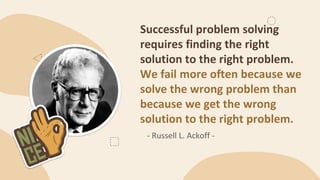
Successful problem solving
requires finding the right
solution to the right problem.
We fail more often because we
solve the wrong problem than
because we get the wrong
solution to the right problem.
- Russell L. Ackoff -
WHAT is PROBLEM-
BASED and
PROJECT-BASED
LEARNING
01
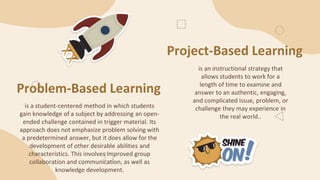
Project-Based Learning
is a student-centered method in which students
gain knowledge of a subject by addressing an open-
ended challenge contained in trigger material. Its
approach does not emphasize problem solving with
a predetermined answer, but it does allow for the
development of other desirable abilities and
characteristics. This involves improved group
collaboration and communication, as well as
knowledge development.
is an instructional strategy that
allows students to work for a
length of time to examine and
answer to an authentic, engaging,
and complicated issue, problem, or
challenge they may experience in
the real world..
Problem-Based Learning
THE BENEFITS OF
PROBLEM-BASED
and PROJECT-BASED
LEARNING
02
1
2
3
4
Development of
Long-Term
Knowledge
Retention
Use of Diverse
Instruction Types
Continuous
Engagement
Development of
Transferable Skills
BENEFITS OF PROBLEM-BASED LEARNING
Improvement of
Teamwork and
Interpersonal Skills
5
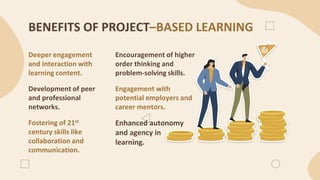
BENEFITS OF PROJECT–BASED LEARNING
Deeper engagement
and interaction with
learning content.
Encouragement of higher
order thinking and
problem-solving skills.
Development of peer
and professional
networks.
Engagement with
potential employers and
career mentors.
Fostering of 21st
century skills like
collaboration and
communication.
Enhanced autonomy
and agency in
learning.
THE CHALLENGES OF
PROBLEM-BASED
and PROJECT-BASED
LEARNING
03
Teacher
Unpreparedness
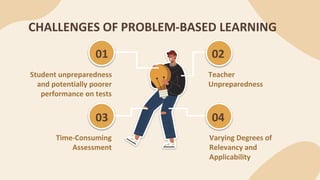
CHALLENGES OF PROBLEM-BASED LEARNING
Time-Consuming
Assessment
Student unpreparedness
and potentially poorer
performance on tests
02
04
03
01
Varying Degrees of
Relevancy and
Applicability
CHALLENGES OF PROJECT-BASED LEARNING
Project-based learning is a worthwhile pursuit for
schools to achieve because it integrates what
students are acquiring with the needs of the modern
workplace. Despite this, an increasing majority of
educators are abandoning the method due to a huge
series of unsuccessful attempts. Teamwork, an
essential quality that can cause conflict and student
free-riding, and the challenge of teachers and
students face adapting to non-traditional teaching and
learning roles are the two most significant challenges.
Demanding workloads for teachers and students, a
superficial gain of content knowledge, a lack of clear
implementation guidelines, a lack of focus on
identified learning outcomes, a lack of trained
personnel who can lead PBL, and a lack of adequate
professional development to train PBL are all
significant challenges (Bogler, 2016).
PROBLEM-BASED
LEARNING in SOCIAL
STUDIES
04
PROBLEM-BASED LEARNING in
SOCIAL STUDIES
Problem-based learning uses complex, real-world
issues as the classroom's subject matter,
encouraging students to develop problem-solving
skills and learn concepts instead of just absorbing
facts.
This can take shape in a variety of different ways.
For example, a problem-based learning project could
involve students pitching ideas and creating their
own business plans to solve a societal need.
Students could work independently or in a group to
conceptualize, design, and launch their innovative
product in front of classmates and community
leaders.
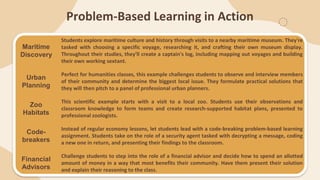
Problem-Based Learning in Action
Maritime
Discovery
Students explore maritime culture and history through visits to a nearby maritime museum. They're
tasked with choosing a specific voyage, researching it, and crafting their own museum display.
Throughout their studies, they'll create a captain's log, including mapping out voyages and building
their own working sextant.
Urban
Planning
Perfect for humanities classes, this example challenges students to observe and interview members
of their community and determine the biggest local issue. They formulate practical solutions that
they will then pitch to a panel of professional urban planners.
Zoo
Habitats
This scientific example starts with a visit to a local zoo. Students use their observations and
classroom knowledge to form teams and create research-supported habitat plans, presented to
professional zoologists.
Code-
breakers
Instead of regular economy lessons, let students lead with a code-breaking problem-based learning
assignment. Students take on the role of a security agent tasked with decrypting a message, coding
a new one in return, and presenting their findings to the classroom.
Financial
Advisors
Challenge students to step into the role of a financial advisor and decide how to spend an allotted
amount of money in a way that most benefits their community. Have them present their solution
and explain their reasoning to the class.
PROJECT-BASED
LEARNING in SOCIAL
STUDIES
05
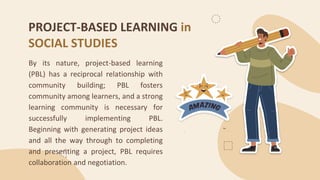
PROJECT-BASED LEARNING in
SOCIAL STUDIES
By its nature, project-based learning
(PBL) has a reciprocal relationship with
community building; PBL fosters
community among learners, and a strong
learning community is necessary for
successfully implementing PBL.
Beginning with generating project ideas
and all the way through to completing
and presenting a project, PBL requires
collaboration and negotiation.
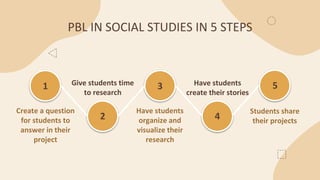
1
2
3
4
Create a question
for students to
answer in their
project
Give students time
to research
Have students
organize and
visualize their
research
Have students
create their stories
PBL IN SOCIAL STUDIES IN 5 STEPS
Students share
their projects
5
REFERENCES:
● 5 Advantages and Disadvantages of Problem-Based Learning [+ Activity Design Steps]. (2016,
December 14). Prodigy. https://www.prodigygame.com/main-en/blog/advantages-disadvantages-
problem-based-learning/
● Azzano, T. (2020, December 7). Getting Started With PBL in Social Studies. GEORGE LUCAS
EDUCATIONAL FOUNDATION. https://www.edutopia.org/article/getting-started-pbl-social-
studies#:~:text=When%20I%20became%20a%20teacher,broader%20audience%20than%20their%2
0teacher
● Bogler, M. (2016, August 18). Implementing Project-Based Learning: Challenges and Solutions.
ProjectPals. https://www.projectpals.com/project-based-learning-blog/implementing-project-
based-learning-challenges-and-solutions
● Dave, S. (2022, February 23). Project Based Learning: Benefits and Techniques of PBL. Practera.
https://practera.com/project-based-learning-benefits-and-techniques/
● Nilson, L. B. (2010). Teaching at its best: A research-based resource for college instructors (2nd ed.).
San Francisco, CA: Jossey-Bass.
● What is Problem-Based Learning (PBL) | Hun School of Princeton. (2020). The Hun School of
Princeton. https://www.hunschool.org/resources/problem-based-learning
PREPARED BY:
CATHERINE KAYE T. ORIESGA
BSED SOCIAL STUDIES 2B
THANK YOU!

Problem/Project-Based Learning in Social Studies

  • 1.
    PROBLEM/PROJECT-BASED LEARNING IN SOCIALSTUDIES Prepared by: CATHERINE KAYE T. ORIESGA BSED Social Studies 2B
  • 2.
    TABLE OF CONTENTS WHATis PROBLEM-BASED and PROJECT-BASED LEARNING THE BENEFITS of PROBLEM- BASED and PROJECT-BASED LEARNING THE CHALLENGES of PROBLEM- BASED and PROJECT-BASED LEARNING PROBLEM-BASED LEARNING in SOCIAL STUDIES 01 03 02 04 PROJECT-BASED LEARNING in SOCIAL STUDIES 05
  • 3.
    Successful problem solving requiresfinding the right solution to the right problem. We fail more often because we solve the wrong problem than because we get the wrong solution to the right problem. - Russell L. Ackoff -
  • 4.
    WHAT is PROBLEM- BASEDand PROJECT-BASED LEARNING 01
  • 5.
    Project-Based Learning is astudent-centered method in which students gain knowledge of a subject by addressing an open- ended challenge contained in trigger material. Its approach does not emphasize problem solving with a predetermined answer, but it does allow for the development of other desirable abilities and characteristics. This involves improved group collaboration and communication, as well as knowledge development. is an instructional strategy that allows students to work for a length of time to examine and answer to an authentic, engaging, and complicated issue, problem, or challenge they may experience in the real world.. Problem-Based Learning
  • 6.
    THE BENEFITS OF PROBLEM-BASED andPROJECT-BASED LEARNING 02
  • 7.
    1 2 3 4 Development of Long-Term Knowledge Retention Use ofDiverse Instruction Types Continuous Engagement Development of Transferable Skills BENEFITS OF PROBLEM-BASED LEARNING Improvement of Teamwork and Interpersonal Skills 5
  • 8.
    BENEFITS OF PROJECT–BASEDLEARNING Deeper engagement and interaction with learning content. Encouragement of higher order thinking and problem-solving skills. Development of peer and professional networks. Engagement with potential employers and career mentors. Fostering of 21st century skills like collaboration and communication. Enhanced autonomy and agency in learning.
  • 9.
    THE CHALLENGES OF PROBLEM-BASED andPROJECT-BASED LEARNING 03
  • 10.
    Teacher Unpreparedness CHALLENGES OF PROBLEM-BASEDLEARNING Time-Consuming Assessment Student unpreparedness and potentially poorer performance on tests 02 04 03 01 Varying Degrees of Relevancy and Applicability
  • 11.
    CHALLENGES OF PROJECT-BASEDLEARNING Project-based learning is a worthwhile pursuit for schools to achieve because it integrates what students are acquiring with the needs of the modern workplace. Despite this, an increasing majority of educators are abandoning the method due to a huge series of unsuccessful attempts. Teamwork, an essential quality that can cause conflict and student free-riding, and the challenge of teachers and students face adapting to non-traditional teaching and learning roles are the two most significant challenges. Demanding workloads for teachers and students, a superficial gain of content knowledge, a lack of clear implementation guidelines, a lack of focus on identified learning outcomes, a lack of trained personnel who can lead PBL, and a lack of adequate professional development to train PBL are all significant challenges (Bogler, 2016).
  • 12.
  • 13.
    PROBLEM-BASED LEARNING in SOCIALSTUDIES Problem-based learning uses complex, real-world issues as the classroom's subject matter, encouraging students to develop problem-solving skills and learn concepts instead of just absorbing facts. This can take shape in a variety of different ways. For example, a problem-based learning project could involve students pitching ideas and creating their own business plans to solve a societal need. Students could work independently or in a group to conceptualize, design, and launch their innovative product in front of classmates and community leaders.
  • 14.
    Problem-Based Learning inAction Maritime Discovery Students explore maritime culture and history through visits to a nearby maritime museum. They're tasked with choosing a specific voyage, researching it, and crafting their own museum display. Throughout their studies, they'll create a captain's log, including mapping out voyages and building their own working sextant. Urban Planning Perfect for humanities classes, this example challenges students to observe and interview members of their community and determine the biggest local issue. They formulate practical solutions that they will then pitch to a panel of professional urban planners. Zoo Habitats This scientific example starts with a visit to a local zoo. Students use their observations and classroom knowledge to form teams and create research-supported habitat plans, presented to professional zoologists. Code- breakers Instead of regular economy lessons, let students lead with a code-breaking problem-based learning assignment. Students take on the role of a security agent tasked with decrypting a message, coding a new one in return, and presenting their findings to the classroom. Financial Advisors Challenge students to step into the role of a financial advisor and decide how to spend an allotted amount of money in a way that most benefits their community. Have them present their solution and explain their reasoning to the class.
  • 15.
  • 16.
    PROJECT-BASED LEARNING in SOCIALSTUDIES By its nature, project-based learning (PBL) has a reciprocal relationship with community building; PBL fosters community among learners, and a strong learning community is necessary for successfully implementing PBL. Beginning with generating project ideas and all the way through to completing and presenting a project, PBL requires collaboration and negotiation.
  • 17.
    1 2 3 4 Create a question forstudents to answer in their project Give students time to research Have students organize and visualize their research Have students create their stories PBL IN SOCIAL STUDIES IN 5 STEPS Students share their projects 5
  • 18.
    REFERENCES: ● 5 Advantagesand Disadvantages of Problem-Based Learning [+ Activity Design Steps]. (2016, December 14). Prodigy. https://www.prodigygame.com/main-en/blog/advantages-disadvantages- problem-based-learning/ ● Azzano, T. (2020, December 7). Getting Started With PBL in Social Studies. GEORGE LUCAS EDUCATIONAL FOUNDATION. https://www.edutopia.org/article/getting-started-pbl-social- studies#:~:text=When%20I%20became%20a%20teacher,broader%20audience%20than%20their%2 0teacher ● Bogler, M. (2016, August 18). Implementing Project-Based Learning: Challenges and Solutions. ProjectPals. https://www.projectpals.com/project-based-learning-blog/implementing-project- based-learning-challenges-and-solutions ● Dave, S. (2022, February 23). Project Based Learning: Benefits and Techniques of PBL. Practera. https://practera.com/project-based-learning-benefits-and-techniques/ ● Nilson, L. B. (2010). Teaching at its best: A research-based resource for college instructors (2nd ed.). San Francisco, CA: Jossey-Bass. ● What is Problem-Based Learning (PBL) | Hun School of Princeton. (2020). The Hun School of Princeton. https://www.hunschool.org/resources/problem-based-learning
  • 19.
    PREPARED BY: CATHERINE KAYET. ORIESGA BSED SOCIAL STUDIES 2B THANK YOU!