The Affective,
Cognitive Experience
for Self-learning
(ACES) Approach
Gretchen C. Dawaton,MBA
At the end of the topic the
students should be able to:
• Differentiate approach with strategy
• Define the ACES approach
• Enumerate the advantages and
disadvantages of filmshowing strategy
• Appreciate filmshowing as a teaching and
learning strategy
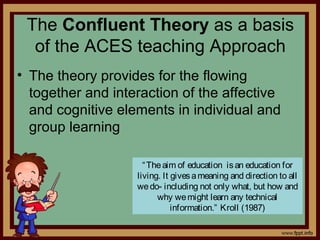
The Confluent Theory as a basis
of the ACES teaching Approach
• The theory provides for the flowing
together and interaction of the affective
and cognitive elements in individual and
group learning
“Theaim of education isan education for
living. It givesameaning and direction to all
wedo- including not only what, but how and
why wemight learn any technical
information.” Kroll (1987)
The Teacher as Facilitator of
Affective and Cognitive Learning
“Values are caught, not taught”
The ACES teaching approach
• puts a heavy premium on the affective
development of the students not
because the affective scope precedes
the other dimensions, but because the
former serves as the most vital force in
the integration of the students
personality for a fuller and viable way
of life.
This Approach therefore makes
the learners become more
aware of themselves, their assets
and liabilities
Learn to maintain and reinforce their
strengths
Replace their liabilities with positive
traits
The Teacher as Values Director
Tasks to do:
Processing of Learnings
Directing the Focus of Awareness
Providing Cognitive Inputs
Directing Values to be Learned
Planning with, and Monitoring Action
Learning Styles of the Students
The ACES Methodology and Phases of
Value Learning
• Employs both inductive and deductive
method
• Applies the Andragogy or Experiential
Learning Approach
Phases of Value Learning
• Learning Trigger Phase
• Values Clarification
• Directive Phase or Inculcation Phase
• Action Phase
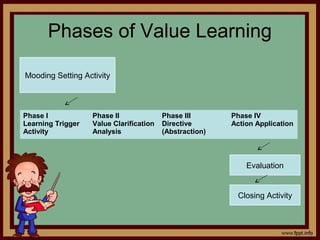
Phases of Value Learning
Mooding Setting Activity
Phase I
Learning Trigger
Activity
Phase II
Value Clarification
Analysis
Phase III
Directive
(Abstraction)
Phase IV
Action Application
Evaluation
Closing Activity
Seven Elements of Andragogical
Process
1. Climate Setting
A climate of mutual respect
A climate of collaborativeness
A climate of mutual trust
A climate of supportiveness
A climate of openness and authenticity
A climate of pleasure
A climate of humanness
Seven Elements of Andragogical
Process
2.Involving learners in mutual planning
3. Involving participants in diagnosing their
needs for learning
4. Involving learners in formulating their
learning objectives
5. Involving learners in designing learning
plans
Seven Elements of Andragogical
Process
6. Involving learners carry out their learning
plans
7. Involving learners in evaluating their
learning
Film Showing as a Teaching Strategy
• Formerly, films or motion pictures were
thought to be meaning for recreation and
amusement only. Today, they are
increasingly used as a device for teaching.
They are an indispensable means of
education and instruction. They bring an
element of realism into the classroom,
which cannot be obtained by any other
medium of instruction.
•
Film Showing as a Teaching Strategy
• When a film show is going to be arranged,
the teacher should see that it is really
needed in connection with the studies
which are going on. The teacher must
discuss the background of the learning
situations presented in the film show,
previous to presentation. It should serve
the purpose of recapitulation.
Advantages
• Films are a comfortable, familiar medium
to contemporary students that can keep
student interest in the theories and
concepts under discussion.
• Students can see the theories and
concepts in action.
• In more than a figurative sense, theories
and concepts leap from the screen.
Disadvantages
• Students can vary in their reaction to
actresses, actors, and characters in a film.
• The content of scenes might distract some
students from the theories and concepts
the scenes portray.
• Humor, drama, terror, and language can
distract people.
• Using film scenes in class takes time away
from other classroom activities

Aces approach

  • 1.
    The Affective, Cognitive Experience forSelf-learning (ACES) Approach Gretchen C. Dawaton,MBA
  • 2.
    At the endof the topic the students should be able to: • Differentiate approach with strategy • Define the ACES approach • Enumerate the advantages and disadvantages of filmshowing strategy • Appreciate filmshowing as a teaching and learning strategy
  • 3.
    The Confluent Theoryas a basis of the ACES teaching Approach • The theory provides for the flowing together and interaction of the affective and cognitive elements in individual and group learning “Theaim of education isan education for living. It givesameaning and direction to all wedo- including not only what, but how and why wemight learn any technical information.” Kroll (1987)
  • 4.
    The Teacher asFacilitator of Affective and Cognitive Learning “Values are caught, not taught”
  • 5.
    The ACES teachingapproach • puts a heavy premium on the affective development of the students not because the affective scope precedes the other dimensions, but because the former serves as the most vital force in the integration of the students personality for a fuller and viable way of life.
  • 6.
    This Approach thereforemakes the learners become more aware of themselves, their assets and liabilities Learn to maintain and reinforce their strengths Replace their liabilities with positive traits
  • 7.
    The Teacher asValues Director Tasks to do: Processing of Learnings Directing the Focus of Awareness Providing Cognitive Inputs Directing Values to be Learned Planning with, and Monitoring Action Learning Styles of the Students
  • 8.
    The ACES Methodologyand Phases of Value Learning • Employs both inductive and deductive method • Applies the Andragogy or Experiential Learning Approach
  • 9.
    Phases of ValueLearning • Learning Trigger Phase • Values Clarification • Directive Phase or Inculcation Phase • Action Phase
  • 10.
    Phases of ValueLearning Mooding Setting Activity Phase I Learning Trigger Activity Phase II Value Clarification Analysis Phase III Directive (Abstraction) Phase IV Action Application Evaluation Closing Activity
  • 11.
    Seven Elements ofAndragogical Process 1. Climate Setting A climate of mutual respect A climate of collaborativeness A climate of mutual trust A climate of supportiveness A climate of openness and authenticity A climate of pleasure A climate of humanness
  • 12.
    Seven Elements ofAndragogical Process 2.Involving learners in mutual planning 3. Involving participants in diagnosing their needs for learning 4. Involving learners in formulating their learning objectives 5. Involving learners in designing learning plans
  • 13.
    Seven Elements ofAndragogical Process 6. Involving learners carry out their learning plans 7. Involving learners in evaluating their learning
  • 15.
    Film Showing asa Teaching Strategy • Formerly, films or motion pictures were thought to be meaning for recreation and amusement only. Today, they are increasingly used as a device for teaching. They are an indispensable means of education and instruction. They bring an element of realism into the classroom, which cannot be obtained by any other medium of instruction. •
  • 16.
    Film Showing asa Teaching Strategy • When a film show is going to be arranged, the teacher should see that it is really needed in connection with the studies which are going on. The teacher must discuss the background of the learning situations presented in the film show, previous to presentation. It should serve the purpose of recapitulation.
  • 17.
    Advantages • Films area comfortable, familiar medium to contemporary students that can keep student interest in the theories and concepts under discussion. • Students can see the theories and concepts in action. • In more than a figurative sense, theories and concepts leap from the screen.
  • 18.
    Disadvantages • Students canvary in their reaction to actresses, actors, and characters in a film. • The content of scenes might distract some students from the theories and concepts the scenes portray. • Humor, drama, terror, and language can distract people. • Using film scenes in class takes time away from other classroom activities