Thematic teaching starts with the identification of a
THEME the underlying concept that allows for the
structure and organization of specific content across
disciplines.
The THEME is the topic of interest that provides the
core for group activities.
It helps learners see meaningful connections across
disciplines or learning areas (SUBJECTS).
More importantly, THEMES provide relevance for the
learners by drawing together concepts under one
umbrella.
Lessons could be studied thematically in
social
studies,
e.g.,
environmental
hazards, wars and conflicts, human rights
violation, economic progress and the like.
These themes could be developed also in
reading, language, music, physical education
and art.
Moreover the dynamics of interactive
teaching can produce themes that are
meaningful, interesting and cohesive.
THEMATIC means that the same topic is
used to develop the teaching plan
(CONTENT AND INSTRUCTION) for each of the
different subjects in which students are
enrolled.
Presented in this unit are two models
in presenting thematic units:
1. the integrated multidisciplinary
thematic unit
2. the integrates interdisciplinary
thematic unit
Both approaches use the following
steps
in
planning
instruction
(Kellough, 2003):

Select a suitable topic or theme
Select goals of the unit
Select suitable specific learning
objectives
Detail the instructional procedures
Plan
for
preassessment
and
assessment of student learning
Provide
for
the
materials
for
instruction
This is a modification of the unidisciplinary teaching unit
which addresses a single discipline.
This attempts to combine two ore more disciplines into one
single approach.
Likewise, it draws related topics from multiple disciplines.

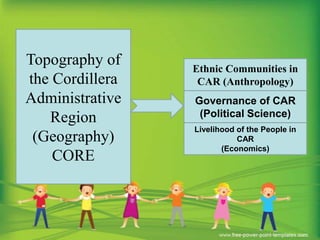
For examples, when geography is considered a core, related
topics could be drawn from other disciplines to supplement the
content of the core.
In the process, however, the disciplinal boundaries are still
retained as well as the disciplines identity.
Topography of
the Cordillera
Administrative
Region
(Geography)
CORE

Ethnic Communities in
CAR (Anthropology)
Governance of CAR
(Political Science)
Livelihood of the People in
CAR
(Economics)
This unit gives a sense of cohesiveness and
structure to student learning and avoid the piecemeal
approach that might otherwise unfold.
Kellough (2003) explains that the interdisciplinary
unit is a tool used to link the learning experiences of
students in many ways to engage them fully in the
learning process.
┼Friegberg (2000) points that interdisciplinary units can help achieve the
following objectives:
┼Emphasize that the process of learning is learning sometimes best pursued as
an interconnected whole rather than as a series of specific subjects.
┼Encourage students to work cooperatively in partnership and in small groups
that focus on the social values of learning.
┼Teach students to be independent problem solvers and thinkers.
┼Assists students to develop their own individual interests and learning styles.
┼Help students find out what they need to know and what they need to learn
rather than always expecting the teacher to give it to them.
‫ﺕ‬Comprising
the
interdisciplinary teaching team
on the school-based level could
be two to five teachers from
different subject areas working
together to plan of study.
‫ﺕ‬Makabayan is interdisciplinary
and its teaching team includes
the teachers teaching Social
Thematic teaching

Thematic teaching

  • 3.
    Thematic teaching startswith the identification of a THEME the underlying concept that allows for the structure and organization of specific content across disciplines. The THEME is the topic of interest that provides the core for group activities. It helps learners see meaningful connections across disciplines or learning areas (SUBJECTS). More importantly, THEMES provide relevance for the learners by drawing together concepts under one umbrella.
  • 4.
    Lessons could bestudied thematically in social studies, e.g., environmental hazards, wars and conflicts, human rights violation, economic progress and the like. These themes could be developed also in reading, language, music, physical education and art. Moreover the dynamics of interactive teaching can produce themes that are meaningful, interesting and cohesive.
  • 6.
    THEMATIC means thatthe same topic is used to develop the teaching plan (CONTENT AND INSTRUCTION) for each of the different subjects in which students are enrolled. Presented in this unit are two models in presenting thematic units: 1. the integrated multidisciplinary thematic unit 2. the integrates interdisciplinary thematic unit
  • 7.
    Both approaches usethe following steps in planning instruction (Kellough, 2003): Select a suitable topic or theme Select goals of the unit Select suitable specific learning objectives Detail the instructional procedures Plan for preassessment and assessment of student learning Provide for the materials for instruction
  • 9.
    This is amodification of the unidisciplinary teaching unit which addresses a single discipline. This attempts to combine two ore more disciplines into one single approach. Likewise, it draws related topics from multiple disciplines. For examples, when geography is considered a core, related topics could be drawn from other disciplines to supplement the content of the core. In the process, however, the disciplinal boundaries are still retained as well as the disciplines identity.
  • 10.
    Topography of the Cordillera Administrative Region (Geography) CORE EthnicCommunities in CAR (Anthropology) Governance of CAR (Political Science) Livelihood of the People in CAR (Economics)
  • 12.
    This unit givesa sense of cohesiveness and structure to student learning and avoid the piecemeal approach that might otherwise unfold. Kellough (2003) explains that the interdisciplinary unit is a tool used to link the learning experiences of students in many ways to engage them fully in the learning process.
  • 13.
    ┼Friegberg (2000) pointsthat interdisciplinary units can help achieve the following objectives: ┼Emphasize that the process of learning is learning sometimes best pursued as an interconnected whole rather than as a series of specific subjects. ┼Encourage students to work cooperatively in partnership and in small groups that focus on the social values of learning. ┼Teach students to be independent problem solvers and thinkers. ┼Assists students to develop their own individual interests and learning styles. ┼Help students find out what they need to know and what they need to learn rather than always expecting the teacher to give it to them.
  • 15.
    ‫ﺕ‬Comprising the interdisciplinary teaching team onthe school-based level could be two to five teachers from different subject areas working together to plan of study. ‫ﺕ‬Makabayan is interdisciplinary and its teaching team includes the teachers teaching Social