The Code of Ethics for
Professional Teachers in
Their Dual Role as
Educator and Parent.
Code of Ethics for Professional
Teachers adopted and promulgated
by the Board for Professional
Teachers through Board Resolution
No. 435, series of 1997, pursuant to
the provisions of paragraph (e),
Article II of RA No. 7836, otherwise
known as the “Philippine Teachers
Professionalization Act of 1994”
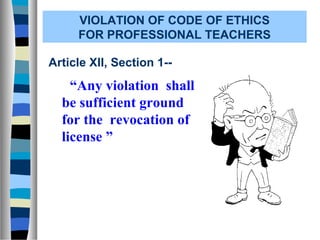
VIOLATION OF CODE OF ETHICS
FOR PROFESSIONAL TEACHERS
Article XII, Section 1--

“Any violation shall
be sufficient ground
for the revocation of
license ”
TEACHERS AS PROFESSIONALS
Duly licensed professionals who
possess dignity and reputation with
high moral values as well as technical
and professional competence. In the
practice of their noble profession, they
strictly adhere to observe, and practice
this set of ethical and moral principles,
standard and values.
(Preamble, Code of Ethics for
Professional Teachers)
“Every teacher shall merit reasonable
social recognition for which purpose he shall
behave with honor and dignity at all times and
refrain from such activities as gambling,
smoking, drunkenness and other excesses,
much less illicit relations.”
(Code of Ethics, Article III, Section 3)

“A teacher shall place premium upon selfrespect and self-discipline as the principle of
personal behavior in all relationships with
others and in all situations.”
(Code of Ethics, Article XI, Section 2)
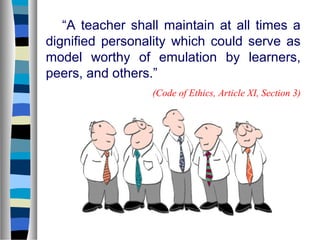
“A teacher shall maintain at all times a
dignified personality which could serve as
model worthy of emulation by learners,
peers, and others.”
(Code of Ethics, Article XI, Section 3)
“As teacher, (one) serves as an example to
his/her pupils .
Consequently, teachers must adhere to the
exacting standards of morality and decency. xxx
A teacher both in his official and personal
conduct must display exemplary behavior.”
He must freely and willingly accept
restrictions on his conduct that might be viewed
irksome xxx the personal behavior of teachers,
IN AND OUTSIDE THE CLASSROOM, must be
beyond reproach they must observe a high
standard of integrity and honesty.”
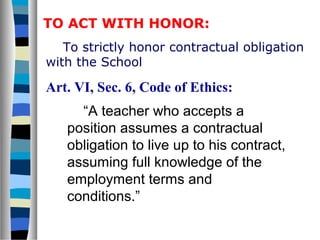
TO ACT WITH HONOR:
To strictly honor contractual obligation
with the School

Art. VI, Sec. 6, Code of Ethics:
“A teacher who accepts a
position assumes a contractual
obligation to live up to his contract,
assuming full knowledge of the
employment terms and
conditions.”
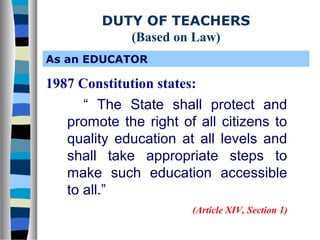
DUTY OF TEACHERS
(Based on Law)
As an EDUCATOR

1987 Constitution states:
“ The State shall protect and
promote the right of all citizens to
quality education at all levels and
shall take appropriate steps to
make such education accessible
to all.”
(Article XIV, Section 1)
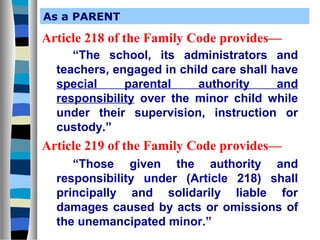
As a PARENT

Article 218 of the Family Code provides—
“The school, its administrators and
teachers, engaged in child care shall have
special
parental
authority
and
responsibility over the minor child while
under their supervision, instruction or
custody.”

Article 219 of the Family Code provides—
“Those given the authority and
responsibility under (Article 218) shall
principally and solidarily liable for
damages caused by acts or omissions of
the unemancipated minor.”
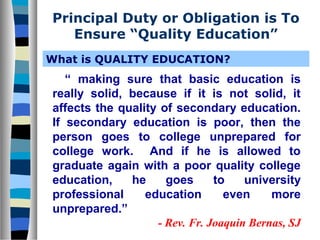
Principal Duty or Obligation is To
Ensure “Quality Education”
What is QUALITY EDUCATION?

“ making sure that basic education is
really solid, because if it is not solid, it
affects the quality of secondary education.
If secondary education is poor, then the
person goes to college unprepared for
college work. And if he is allowed to
graduate again with a poor quality college
education,
he
goes
to
university
professional
education
even
more
unprepared.”
- Rev. Fr. Joaquin Bernas, SJ
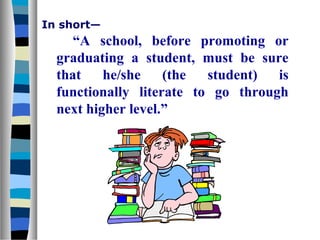
In short—

“A school, before promoting or
graduating a student, must be sure
that
he/she
(the
student)
is
functionally literate to go through
next higher level.”
To ensure Quality Education:
1) Must be COMPETENT and EFFICIENT

Code of Ethics for Professional Teachers,
Article IV, Section 2—

“Every teacher shall uphold the
highest possible standards of
quality education, shall make the
best preparation for the career of
teaching, and shall be at his best at
all times in the practice of his
profession.”
BP 232 (Education Act of 1982), Section 16 (2)
provides—
“The teacher shall be accountable for
efficient and effective attainment of
specified learning objectives .”
Code of Ethics further mandates that—
“Every teacher shall participate in the
continuing professional education (CPE)
program of the PRC, and shall pursue such
other studies as will improve his efficiency,
enhance the prestige of the profession, and
strengthen his competence, virtue and
productivity in order to be nationally and
internationally competitive.”
(Article IV, Section 3)
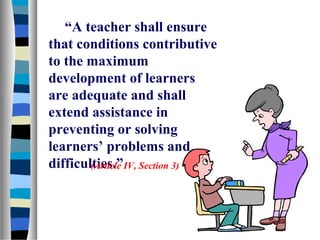
“A teacher shall ensure
that conditions contributive
to the maximum
development of learners
are adequate and shall
extend assistance in
preventing or solving
learners’ problems and
difficulties.”IV, Section 3)
(Article
In short—

A teacher is expected to be efficient and
competent in the performance of his academic
duties at all times.
Otherwise,
A teacher who has consistently shows his
inability to efficiently perform his duties and
responsibilities, within a common performance
standards should not be allowed to stay in
school.
The MRPS provides as just cause of
terminating a faculty—

“Gross inefficiency and incompetence in the
performance of his duties.”
(Section 3 (a))
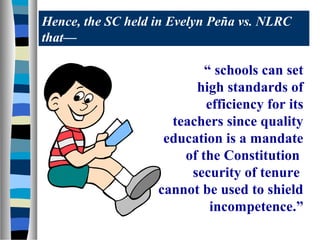
Hence, the SC held in Evelyn Peña vs. NLRC
that—

“ schools can set
high standards of
efficiency for its
teachers since quality
education is a mandate
of the Constitution
security of tenure
cannot be used to shield
incompetence.”
2) Must EVALUATE LEARNERS
(i) Duty to give grades/evaluation
Section 16(3) of BP 232, TEACHER
SHALL—

“Render
regular
reports
on
performance of each student and to the
latter and to the latter’s parents and
guardians with specific suggestions for
improvement.”
and...
Must promptly render or give
grades. Otherwise, the unjustified or
unreasonable delay in giving grades
constitutes gross neglect of duty.
In the case of University of the East vs. Romeo A.
Jader, the SC declared—
“It is the contractual obligation of the
school (through the teachers) to TIMELY
INFORM AND FURNISH sufficient notice and
information to each and every student as to
whether he/she had already complied with
all the requirements .”
“The negligent act of a teacher who fails
to observe the rules of the school, for
instance, by not promptly submitting a
student’s grade is not only imputable to the
teacher but is an act of the school being
his/her employer .”
In evaluating/giving grades the following
rules of conduct must be observed—
Code of Ethics provides—

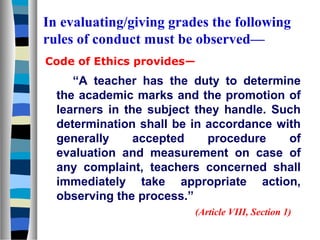
“A teacher has the duty to determine
the academic marks and the promotion of
learners in the subject they handle. Such
determination shall be in accordance with
generally
accepted
procedure
of
evaluation and measurement on case of
any complaint, teachers concerned shall
immediately take appropriate action,
observing the process.”
(Article VIII, Section 1)
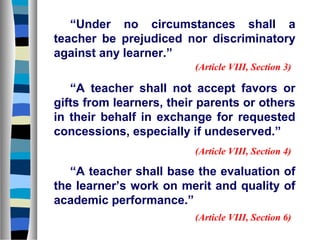
“Under no circumstances shall a
teacher be prejudiced nor discriminatory
against any learner.”
(Article VIII, Section 3)

“A teacher shall not accept favors or
gifts from learners, their parents or others
in their behalf in exchange for requested
concessions, especially if undeserved.”
(Article VIII, Section 4)

“A teacher shall base the evaluation of
the learner’s work on merit and quality of
academic performance.”
(Article VIII, Section 6)
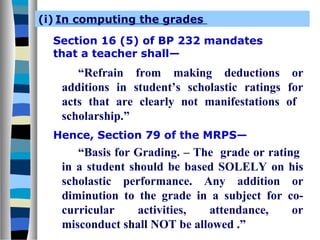
(i) In computing the grades
Section 16 (5) of BP 232 mandates
that a teacher shall—

“Refrain from making deductions or
additions in student’s scholastic ratings for
acts that are clearly not manifestations of
scholarship.”
Hence, Section 79 of the MRPS—

“Basis for Grading. – The grade or rating
in a student should be based SOLELY on his
scholastic performance. Any addition or
diminution to the grade in a subject for cocurricular
activities,
attendance,
or
misconduct shall NOT be allowed .”
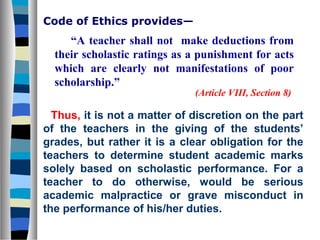
Code of Ethics provides—

“A teacher shall not make deductions from
their scholastic ratings as a punishment for acts
which are clearly not manifestations of poor
scholarship.”
(Article VIII, Section 8)

Thus, it is not a matter of discretion on the part
of the teachers in the giving of the students’
grades, but rather it is a clear obligation for the
teachers to determine student academic marks
solely based on scholastic performance. For a
teacher to do otherwise, would be serious
academic malpractice or grave misconduct in
the performance of his/her duties.
In Padilla vs. NLRC, SBC the Supreme Court
said—

“This Court is convinced that the
pressure and influence exerted by (a
teacher) on his colleague to change a
failing grade to passing one
constitute serious misconduct which
is a valid ground for dismissing an
employee.”
B. As a PARENT:(In Loco Parentis) Principal
Duty to Exercise Parental Authority and
Responsibility

Article 218, Family Code provides—

“The school, its administrators
and teachers engaged in child care
shall have special parental authority
and responsibility over the minor
child while under their supervision,
instruction or custody.”
Code of Ethics states—

“A teacher shall recognize that
the interest and welfare of learners
are his first and foremost concern,
and shall handle each learner justly
and impartially.”
(Article VII, Section 2)
Parental Authority to Discipline

“As parents, the teachers shall use
discipline not to punish but to correct,
not to force, but to motivate; and not to
obey with rigid cadence, but to choose
to follow the right way.
Hence, teachers cannot generally
use methods of punishing or such
degree of penalties that a good mother
or a good father would not likely use on
her/his own children.”
Corporal Punishment - Article 233 (2nd par.)

“In no case
inflict corporal
punishment upon the child.”

Definition: An act that inflict pain or
harm upon a child’s body as punishment
for wrong doing usually through beating
and spanking
Elements:
(a) physical contact
(b) to inflict pain
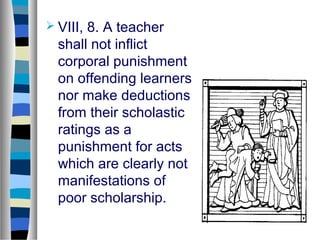
 VIII,

8. A teacher
shall not inflict
corporal punishment
on offending learners
nor make deductions
from their scholastic
ratings as a
punishment for acts
which are clearly not
manifestations of
poor scholarship.
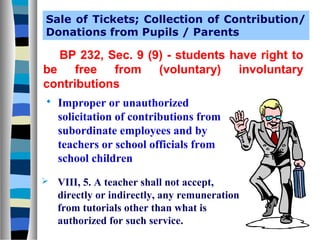
Sale of Tickets; Collection of Contribution/
Donations from Pupils / Parents

BP 232, Sec. 9 (9) - students have right to
be free from (voluntary) involuntary
contributions




Improper or unauthorized
solicitation of contributions from
subordinate employees and by
teachers or school officials from
school children
VIII, 5. A teacher shall not accept,
directly or indirectly, any remuneration
from tutorials other than what is
authorized for such service.
Anita Y. Salvarria vs. Letran College, et al.
(296 SCRA 184)
The Supreme Court declared-“Petitioner contended that her
dismissal was arbitrarily, having been
effected without just cause, on the
premise that the solicitation of funds
was initiated by the students and that
her participation was merely limited to
approving the same. ”
If there is one person more
knowledgeable of policy against
illegal exactions from students, it
would be Salvarria.
Hence, regardless of who initiated
the collections, the fact that the
same was approved or indorsed by
petitioner, made her ‘in effect the
author of the project.’”
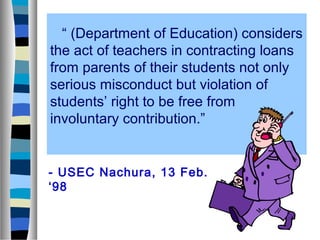
“ (Department of Education) considers
the act of teachers in contracting loans
from parents of their students not only
serious misconduct but violation of
students’ right to be free from
involuntary contribution.”

- USEC Nachura, 13 Feb.
‘98
Parental Responsibility

The student / pupil while in school,
is in the custody and hence, the
responsibility of the school authorities
as long as he is under the control and
influence of the school,
whether the semester
has not yet begun
or has already ended.
In Am
adora vs. CA, the Supreme Court
said-Even if the student is just relaxing
in the campus in the company of his
classmates, the student is still within
the custody and subject to the
discipline and responsibility of the
teachers .
Hence-A teacher required to exercise
special parental authority but who
fails to observe all the diligence of
a good father of a family in the
custody and care of the pupils and
students, shall be held liable for
gross neglect of duty.
“The Court takes this opportunity to
pay a sincere tribute to the school
teachers, who are always at the forefront
in the battle against illiteracy and
ignorance. If only because it is they who
open the minds of their pupils to an
unexplored world awash will the magic of
letters and numbers, which is an
extraordinary feat indeed, these humble
mentors deserve all our respect and
appreciation.”
Justice Isagani A. Cruz
Chiang Kai Shek School vs. CA
G.R. No. 58028, April 18, 1989
Halley’s Comet
A memorandum, as it goes
down the chain of command
in an educational institution.
SUBJECT : Operation Halley’s Comet
FROM
: Chairman of the Board of Trustees
TO
: The President

Tomorrow evening at approximately eight
(8) p.m., Halley’s Comet will be visible in this
area, an event which occurs only once every
seventy five (75) years. Have the students
fall out in the football field in uniforms and I
will explain this rare phenomenon to them.
In case of rain, we will not be able to see
anything, so assemble the students in the
auditorium and I will show them film of it.
FROM
TO

: The President
: Vice President for Academic Affairs

By order of the Chairman of the Board,
tomorrow, at eight in the evening, Halley’s
Comet will appear above the football field,
if it rains, fall the students out in uniforms.
Then lead them to the auditorium where
the rare phenomenon will take place,
something which occurs only once every
seventy five years.
FROM
TO

: Vice President for
Academic Affairs
: College Dean

By order of the Chairman of the Board,
in uniform, at eight o’clock in the evening
tomorrow, the phenomenal Halley’s Comet
will appear in the auditorium. In case of
rain in the football field, the Chairman of
the Board will give another order,
something which occurs once every
seventy five years.aria
FROM
TO

: Dean of College
: Academic Coordinators

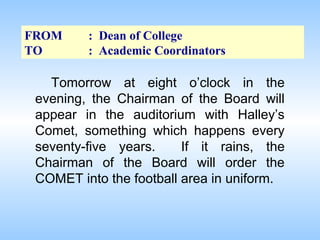
Tomorrow at eight o’clock in the
evening, the Chairman of the Board will
appear in the auditorium with Halley’s
Comet, something which happens every
seventy-five years.
If it rains, the
Chairman of the Board will order the
COMET into the football area in uniform.
FROM
TO

: Academic Coordinators
: Department Heads

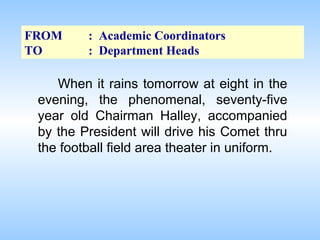
When it rains tomorrow at eight in the
evening, the phenomenal, seventy-five
year old Chairman Halley, accompanied
by the President will drive his Comet thru
the football field area theater in uniform.
-END-

Code of ethics for teachers

  • 1.
    The Code ofEthics for Professional Teachers in Their Dual Role as Educator and Parent.
  • 2.
    Code of Ethicsfor Professional Teachers adopted and promulgated by the Board for Professional Teachers through Board Resolution No. 435, series of 1997, pursuant to the provisions of paragraph (e), Article II of RA No. 7836, otherwise known as the “Philippine Teachers Professionalization Act of 1994”
  • 3.
    VIOLATION OF CODEOF ETHICS FOR PROFESSIONAL TEACHERS Article XII, Section 1-- “Any violation shall be sufficient ground for the revocation of license ”
  • 4.
    TEACHERS AS PROFESSIONALS Dulylicensed professionals who possess dignity and reputation with high moral values as well as technical and professional competence. In the practice of their noble profession, they strictly adhere to observe, and practice this set of ethical and moral principles, standard and values. (Preamble, Code of Ethics for Professional Teachers)
  • 5.
    “Every teacher shallmerit reasonable social recognition for which purpose he shall behave with honor and dignity at all times and refrain from such activities as gambling, smoking, drunkenness and other excesses, much less illicit relations.” (Code of Ethics, Article III, Section 3) “A teacher shall place premium upon selfrespect and self-discipline as the principle of personal behavior in all relationships with others and in all situations.” (Code of Ethics, Article XI, Section 2)
  • 6.
    “A teacher shallmaintain at all times a dignified personality which could serve as model worthy of emulation by learners, peers, and others.” (Code of Ethics, Article XI, Section 3)
  • 7.
    “As teacher, (one)serves as an example to his/her pupils . Consequently, teachers must adhere to the exacting standards of morality and decency. xxx A teacher both in his official and personal conduct must display exemplary behavior.” He must freely and willingly accept restrictions on his conduct that might be viewed irksome xxx the personal behavior of teachers, IN AND OUTSIDE THE CLASSROOM, must be beyond reproach they must observe a high standard of integrity and honesty.”
  • 8.
    TO ACT WITHHONOR: To strictly honor contractual obligation with the School Art. VI, Sec. 6, Code of Ethics: “A teacher who accepts a position assumes a contractual obligation to live up to his contract, assuming full knowledge of the employment terms and conditions.”
  • 9.
    DUTY OF TEACHERS (Basedon Law) As an EDUCATOR 1987 Constitution states: “ The State shall protect and promote the right of all citizens to quality education at all levels and shall take appropriate steps to make such education accessible to all.” (Article XIV, Section 1)
  • 10.
    As a PARENT Article218 of the Family Code provides— “The school, its administrators and teachers, engaged in child care shall have special parental authority and responsibility over the minor child while under their supervision, instruction or custody.” Article 219 of the Family Code provides— “Those given the authority and responsibility under (Article 218) shall principally and solidarily liable for damages caused by acts or omissions of the unemancipated minor.”
  • 11.
    Principal Duty orObligation is To Ensure “Quality Education” What is QUALITY EDUCATION? “ making sure that basic education is really solid, because if it is not solid, it affects the quality of secondary education. If secondary education is poor, then the person goes to college unprepared for college work. And if he is allowed to graduate again with a poor quality college education, he goes to university professional education even more unprepared.” - Rev. Fr. Joaquin Bernas, SJ
  • 12.
    In short— “A school,before promoting or graduating a student, must be sure that he/she (the student) is functionally literate to go through next higher level.”
  • 13.
    To ensure QualityEducation: 1) Must be COMPETENT and EFFICIENT Code of Ethics for Professional Teachers, Article IV, Section 2— “Every teacher shall uphold the highest possible standards of quality education, shall make the best preparation for the career of teaching, and shall be at his best at all times in the practice of his profession.”
  • 14.
    BP 232 (EducationAct of 1982), Section 16 (2) provides— “The teacher shall be accountable for efficient and effective attainment of specified learning objectives .” Code of Ethics further mandates that— “Every teacher shall participate in the continuing professional education (CPE) program of the PRC, and shall pursue such other studies as will improve his efficiency, enhance the prestige of the profession, and strengthen his competence, virtue and productivity in order to be nationally and internationally competitive.” (Article IV, Section 3)
  • 15.
    “A teacher shallensure that conditions contributive to the maximum development of learners are adequate and shall extend assistance in preventing or solving learners’ problems and difficulties.”IV, Section 3) (Article
  • 16.
    In short— A teacheris expected to be efficient and competent in the performance of his academic duties at all times. Otherwise, A teacher who has consistently shows his inability to efficiently perform his duties and responsibilities, within a common performance standards should not be allowed to stay in school. The MRPS provides as just cause of terminating a faculty— “Gross inefficiency and incompetence in the performance of his duties.” (Section 3 (a))
  • 17.
    Hence, the SCheld in Evelyn Peña vs. NLRC that— “ schools can set high standards of efficiency for its teachers since quality education is a mandate of the Constitution security of tenure cannot be used to shield incompetence.”
  • 18.
    2) Must EVALUATELEARNERS (i) Duty to give grades/evaluation Section 16(3) of BP 232, TEACHER SHALL— “Render regular reports on performance of each student and to the latter and to the latter’s parents and guardians with specific suggestions for improvement.” and... Must promptly render or give grades. Otherwise, the unjustified or unreasonable delay in giving grades constitutes gross neglect of duty.
  • 19.
    In the caseof University of the East vs. Romeo A. Jader, the SC declared— “It is the contractual obligation of the school (through the teachers) to TIMELY INFORM AND FURNISH sufficient notice and information to each and every student as to whether he/she had already complied with all the requirements .” “The negligent act of a teacher who fails to observe the rules of the school, for instance, by not promptly submitting a student’s grade is not only imputable to the teacher but is an act of the school being his/her employer .”
  • 20.
    In evaluating/giving gradesthe following rules of conduct must be observed— Code of Ethics provides— “A teacher has the duty to determine the academic marks and the promotion of learners in the subject they handle. Such determination shall be in accordance with generally accepted procedure of evaluation and measurement on case of any complaint, teachers concerned shall immediately take appropriate action, observing the process.” (Article VIII, Section 1)
  • 21.
    “Under no circumstancesshall a teacher be prejudiced nor discriminatory against any learner.” (Article VIII, Section 3) “A teacher shall not accept favors or gifts from learners, their parents or others in their behalf in exchange for requested concessions, especially if undeserved.” (Article VIII, Section 4) “A teacher shall base the evaluation of the learner’s work on merit and quality of academic performance.” (Article VIII, Section 6)
  • 22.
    (i) In computingthe grades Section 16 (5) of BP 232 mandates that a teacher shall— “Refrain from making deductions or additions in student’s scholastic ratings for acts that are clearly not manifestations of scholarship.” Hence, Section 79 of the MRPS— “Basis for Grading. – The grade or rating in a student should be based SOLELY on his scholastic performance. Any addition or diminution to the grade in a subject for cocurricular activities, attendance, or misconduct shall NOT be allowed .”
  • 23.
    Code of Ethicsprovides— “A teacher shall not make deductions from their scholastic ratings as a punishment for acts which are clearly not manifestations of poor scholarship.” (Article VIII, Section 8) Thus, it is not a matter of discretion on the part of the teachers in the giving of the students’ grades, but rather it is a clear obligation for the teachers to determine student academic marks solely based on scholastic performance. For a teacher to do otherwise, would be serious academic malpractice or grave misconduct in the performance of his/her duties.
  • 24.
    In Padilla vs.NLRC, SBC the Supreme Court said— “This Court is convinced that the pressure and influence exerted by (a teacher) on his colleague to change a failing grade to passing one constitute serious misconduct which is a valid ground for dismissing an employee.”
  • 25.
    B. As aPARENT:(In Loco Parentis) Principal Duty to Exercise Parental Authority and Responsibility Article 218, Family Code provides— “The school, its administrators and teachers engaged in child care shall have special parental authority and responsibility over the minor child while under their supervision, instruction or custody.”
  • 26.
    Code of Ethicsstates— “A teacher shall recognize that the interest and welfare of learners are his first and foremost concern, and shall handle each learner justly and impartially.” (Article VII, Section 2)
  • 27.
    Parental Authority toDiscipline “As parents, the teachers shall use discipline not to punish but to correct, not to force, but to motivate; and not to obey with rigid cadence, but to choose to follow the right way. Hence, teachers cannot generally use methods of punishing or such degree of penalties that a good mother or a good father would not likely use on her/his own children.”
  • 28.
    Corporal Punishment -Article 233 (2nd par.) “In no case inflict corporal punishment upon the child.” Definition: An act that inflict pain or harm upon a child’s body as punishment for wrong doing usually through beating and spanking Elements: (a) physical contact (b) to inflict pain
  • 29.
     VIII, 8. Ateacher shall not inflict corporal punishment on offending learners nor make deductions from their scholastic ratings as a punishment for acts which are clearly not manifestations of poor scholarship.
  • 30.
    Sale of Tickets;Collection of Contribution/ Donations from Pupils / Parents BP 232, Sec. 9 (9) - students have right to be free from (voluntary) involuntary contributions   Improper or unauthorized solicitation of contributions from subordinate employees and by teachers or school officials from school children VIII, 5. A teacher shall not accept, directly or indirectly, any remuneration from tutorials other than what is authorized for such service.
  • 31.
    Anita Y. Salvarriavs. Letran College, et al. (296 SCRA 184) The Supreme Court declared-“Petitioner contended that her dismissal was arbitrarily, having been effected without just cause, on the premise that the solicitation of funds was initiated by the students and that her participation was merely limited to approving the same. ”
  • 32.
    If there isone person more knowledgeable of policy against illegal exactions from students, it would be Salvarria. Hence, regardless of who initiated the collections, the fact that the same was approved or indorsed by petitioner, made her ‘in effect the author of the project.’”
  • 33.
    “ (Department ofEducation) considers the act of teachers in contracting loans from parents of their students not only serious misconduct but violation of students’ right to be free from involuntary contribution.” - USEC Nachura, 13 Feb. ‘98
  • 34.
    Parental Responsibility The student/ pupil while in school, is in the custody and hence, the responsibility of the school authorities as long as he is under the control and influence of the school, whether the semester has not yet begun or has already ended.
  • 35.
    In Am adora vs.CA, the Supreme Court said-Even if the student is just relaxing in the campus in the company of his classmates, the student is still within the custody and subject to the discipline and responsibility of the teachers .
  • 36.
    Hence-A teacher requiredto exercise special parental authority but who fails to observe all the diligence of a good father of a family in the custody and care of the pupils and students, shall be held liable for gross neglect of duty.
  • 37.
    “The Court takesthis opportunity to pay a sincere tribute to the school teachers, who are always at the forefront in the battle against illiteracy and ignorance. If only because it is they who open the minds of their pupils to an unexplored world awash will the magic of letters and numbers, which is an extraordinary feat indeed, these humble mentors deserve all our respect and appreciation.” Justice Isagani A. Cruz Chiang Kai Shek School vs. CA G.R. No. 58028, April 18, 1989
  • 38.
    Halley’s Comet A memorandum,as it goes down the chain of command in an educational institution.
  • 39.
    SUBJECT : OperationHalley’s Comet FROM : Chairman of the Board of Trustees TO : The President Tomorrow evening at approximately eight (8) p.m., Halley’s Comet will be visible in this area, an event which occurs only once every seventy five (75) years. Have the students fall out in the football field in uniforms and I will explain this rare phenomenon to them. In case of rain, we will not be able to see anything, so assemble the students in the auditorium and I will show them film of it.
  • 40.
    FROM TO : The President :Vice President for Academic Affairs By order of the Chairman of the Board, tomorrow, at eight in the evening, Halley’s Comet will appear above the football field, if it rains, fall the students out in uniforms. Then lead them to the auditorium where the rare phenomenon will take place, something which occurs only once every seventy five years.
  • 41.
    FROM TO : Vice Presidentfor Academic Affairs : College Dean By order of the Chairman of the Board, in uniform, at eight o’clock in the evening tomorrow, the phenomenal Halley’s Comet will appear in the auditorium. In case of rain in the football field, the Chairman of the Board will give another order, something which occurs once every seventy five years.aria
  • 42.
    FROM TO : Dean ofCollege : Academic Coordinators Tomorrow at eight o’clock in the evening, the Chairman of the Board will appear in the auditorium with Halley’s Comet, something which happens every seventy-five years. If it rains, the Chairman of the Board will order the COMET into the football area in uniform.
  • 43.
    FROM TO : Academic Coordinators :Department Heads When it rains tomorrow at eight in the evening, the phenomenal, seventy-five year old Chairman Halley, accompanied by the President will drive his Comet thru the football field area theater in uniform.
  • 44.

Editor's Notes