Inquiry 
Approach 
in Social 
Studies
•“Tell me and I'll forget; show 
me and I may remember; 
involve me and I'll 
understand.”
• - an act of asking for information. 
• - any process that has the aim of 
augmenting knowledge, resolving doubt, 
or solving a problem.
• - a way of dealing with something. 
• - technique, strategy
What is Inquiry Approach in Social 
Studies? 
• Inquiry teaching is a process of 
asking and answering key social 
studies questions. It is a student-centered 
method of education 
focused on asking questions.
• It is an approach to learning that 
involves a process of exploring the 
natural or material world that 
leads to asking questions and 
making discoveries in the search 
for new understandings.
Characteristics 
• Students are encouraged to ask question 
which is meaningful to them. The teacher’s 
job in an inquiry learning environment is 
not to provide knowledge, but instead to 
help the students along the process of 
discovering knowledge themselves.
Benefits of 
Inquiry 
Approach
1. It teaches problem-solving, 
critical thinking skills, and 
disciplinary content;
2. It promotes the transfer of 
concepts to new problem 
questions;
3. It teaches students how 
to learn and builds self-directed 
learning skills; and
4. It develops student ownership 
of their inquiry and enhances 
student interest in the subject 
matter.
Importanc 
e of 
Inquiry 
Approach
 It helps us in understanding 
of how to get and make sense 
of the mass of data.
 Inquiry implies a need or want to 
know premise. Inquiry is not so much 
seeking the right answer- because 
often there is none- but rather 
seeking appropriate resolutions to 
questions and issues.
Elements The 
attributes that 
experts use to 
generate new 
knowledge
• Experts see patterns and meanings not apparent 
to novices. 
• Experts have in-depth knowledge of their fields, 
structured so that it is most useful. 
• Experts' knowledge is not just a set of facts -- it is 
structured to be accessible, transferable, and 
applicable to a variety of situations. 
• Experts can easily retrieve their knowledge and 
learn new information in their fields with little 
effort.
* Effect on Social 
Relationships 
- Inquiry Approach has an effect on our Social 
Relationships. As what they said, it is an 
approach to learning that involves a process of 
exploring the natural or material world that leads 
to asking questions and making discoveries in 
the search for new understandings and engaged 
them in active learning based on their own 
questions.
* Effect on Cognitive 
Development 
What is Cognitive Development? 
Cognitive Development is a comprehensive 
theory about the nature and development of 
human intelligence, first developed by Swiss 
developmental psychologist Jean Piaget. It 
focuses on a child's development in terms of 
information processing, conceptual resources, 
perceptual skill, language learning, and other 
aspects of brain development. In other words, 
cognitive development is the emergence of the 
ability to think and understand.
EFFECT ON ACHIEVEMENT 
 One of the important missing pieces in many 
modern schools is a coherent and simplified 
process for increasing knowledge of a subject 
from lower grades to upper grades. Students often 
have difficulty understanding how various 
activities within a particular subject relate to each 
other. Much more confusion results when the 
learner tries to interrelate the various subjects 
taught at school.
EFFECT ON MOTIVATION 
 teaches problem-solving, critical thinking skills, and disciplinary 
content 
 promotes the transfer of concepts to new problem questions 
 teaches students how to learn and builds self-directed learning 
skills 
 develops student ownership of their inquiry and enhances 
student interest in the subject matter 
 Activating Prior Knowledge 
 By bringing the students' own background and experiences to 
the learning table, students will find ways to connect to the topic 
and will have activated some basis for creating meaning with the 
text they are reading. The personal connection to learning 
increases a student's motivation to explore, read, and struggle 
with difficulties as they arise.
Deductive teaching (also called direct 
instruction) is much less “constructively” 
and is based on the idea that a highly 
structured presentation of content 
creates optimal learning for students. 
The instructor using a deductive 
approach typically presents a general 
concept by first defining it and then 
providing examples or illustrations that 
demonstrate the idea. 
Students are given opportunities to 
practice, with instructor guidance and 
feed back.
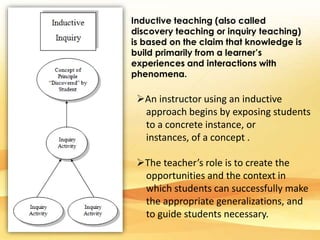
Inductive teaching (also called 
discovery teaching or inquiry teaching) 
is based on the claim that knowledge is 
build primarily from a learner’s 
experiences and interactions with 
phenomena. 
An instructor using an inductive 
approach begins by exposing students 
to a concrete instance, or 
instances, of a concept . 
The teacher’s role is to create the 
opportunities and the context in 
which students can successfully make 
the appropriate generalizations, and 
to guide students necessary.
1. Encourage curiosity. 
2. Help students understand the structure of the 
new information. 
3. Design inductive science labs or activities. 
4. Encourage students to develop coding 
systems. 
5. Design activities that are problem oriented 
6. Foster intuitive thinking in the classroom.
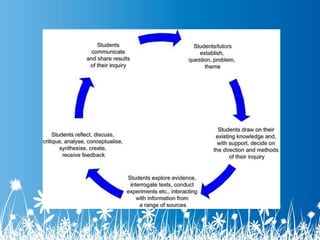
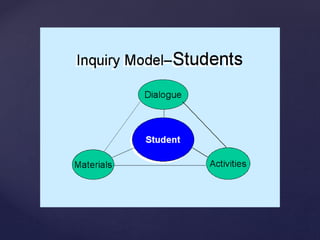
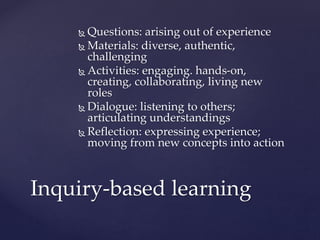
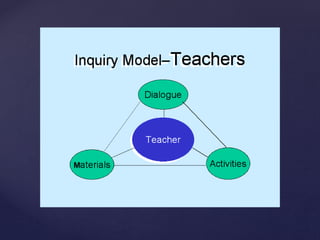
 Questions: arising out of experience 
 Materials: diverse, authentic, 
challenging 
 Activities: engaging. hands-on, 
creating, collaborating, living new 
roles 
 Dialogue: listening to others; 
articulating understandings 
 Reflection: expressing experience; 
moving from new concepts into action 
Inquiry-based learning
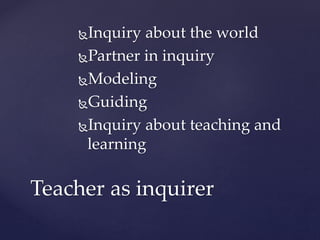
Inquiry about the world 
Partner in inquiry 
Modeling 
Guiding 
Inquiry about teaching and 
learning 
Teacher as inquirer
As a guide for the experimentation we 
so freely encourage, the table opposite 
will be helpful. We must caution, 
however, that it is rife with half-truths-- 
despite our best efforts at disclosure. We 
are dealing here with living things 
whose colors, habits, and general 
constitutions will vary with locale and 
with the skill of the individual gardener. 
Learning to teach - 1
This unpredictability, which strikes 
terror into the heart of the beginner, is 
in fact one of the glories of gardening. 
Things change, certainly from year to 
year and sometimes from morning to 
evening. There are mysteries, surprises, 
and always, lessons to be learned. After 
almost 40 years hard at it, we are only 
beginning. 
–Amos Pettingill, The Garden Book, 1986 
Learning to teach - 2

inquiry aproach in Social Studies

  • 1.
    Inquiry Approach inSocial Studies
  • 2.
    •“Tell me andI'll forget; show me and I may remember; involve me and I'll understand.”
  • 3.
    • - anact of asking for information. • - any process that has the aim of augmenting knowledge, resolving doubt, or solving a problem.
  • 4.
    • - away of dealing with something. • - technique, strategy
  • 5.
    What is InquiryApproach in Social Studies? • Inquiry teaching is a process of asking and answering key social studies questions. It is a student-centered method of education focused on asking questions.
  • 6.
    • It isan approach to learning that involves a process of exploring the natural or material world that leads to asking questions and making discoveries in the search for new understandings.
  • 7.
    Characteristics • Studentsare encouraged to ask question which is meaningful to them. The teacher’s job in an inquiry learning environment is not to provide knowledge, but instead to help the students along the process of discovering knowledge themselves.
  • 8.
  • 9.
    1. It teachesproblem-solving, critical thinking skills, and disciplinary content;
  • 10.
    2. It promotesthe transfer of concepts to new problem questions;
  • 11.
    3. It teachesstudents how to learn and builds self-directed learning skills; and
  • 12.
    4. It developsstudent ownership of their inquiry and enhances student interest in the subject matter.
  • 13.
    Importanc e of Inquiry Approach
  • 14.
     It helpsus in understanding of how to get and make sense of the mass of data.
  • 15.
     Inquiry impliesa need or want to know premise. Inquiry is not so much seeking the right answer- because often there is none- but rather seeking appropriate resolutions to questions and issues.
  • 16.
    Elements The attributesthat experts use to generate new knowledge
  • 17.
    • Experts seepatterns and meanings not apparent to novices. • Experts have in-depth knowledge of their fields, structured so that it is most useful. • Experts' knowledge is not just a set of facts -- it is structured to be accessible, transferable, and applicable to a variety of situations. • Experts can easily retrieve their knowledge and learn new information in their fields with little effort.
  • 20.
    * Effect onSocial Relationships - Inquiry Approach has an effect on our Social Relationships. As what they said, it is an approach to learning that involves a process of exploring the natural or material world that leads to asking questions and making discoveries in the search for new understandings and engaged them in active learning based on their own questions.
  • 21.
    * Effect onCognitive Development What is Cognitive Development? Cognitive Development is a comprehensive theory about the nature and development of human intelligence, first developed by Swiss developmental psychologist Jean Piaget. It focuses on a child's development in terms of information processing, conceptual resources, perceptual skill, language learning, and other aspects of brain development. In other words, cognitive development is the emergence of the ability to think and understand.
  • 22.
    EFFECT ON ACHIEVEMENT  One of the important missing pieces in many modern schools is a coherent and simplified process for increasing knowledge of a subject from lower grades to upper grades. Students often have difficulty understanding how various activities within a particular subject relate to each other. Much more confusion results when the learner tries to interrelate the various subjects taught at school.
  • 23.
    EFFECT ON MOTIVATION  teaches problem-solving, critical thinking skills, and disciplinary content  promotes the transfer of concepts to new problem questions  teaches students how to learn and builds self-directed learning skills  develops student ownership of their inquiry and enhances student interest in the subject matter  Activating Prior Knowledge  By bringing the students' own background and experiences to the learning table, students will find ways to connect to the topic and will have activated some basis for creating meaning with the text they are reading. The personal connection to learning increases a student's motivation to explore, read, and struggle with difficulties as they arise.
  • 25.
    Deductive teaching (alsocalled direct instruction) is much less “constructively” and is based on the idea that a highly structured presentation of content creates optimal learning for students. The instructor using a deductive approach typically presents a general concept by first defining it and then providing examples or illustrations that demonstrate the idea. Students are given opportunities to practice, with instructor guidance and feed back.
  • 26.
    Inductive teaching (alsocalled discovery teaching or inquiry teaching) is based on the claim that knowledge is build primarily from a learner’s experiences and interactions with phenomena. An instructor using an inductive approach begins by exposing students to a concrete instance, or instances, of a concept . The teacher’s role is to create the opportunities and the context in which students can successfully make the appropriate generalizations, and to guide students necessary.
  • 27.
    1. Encourage curiosity. 2. Help students understand the structure of the new information. 3. Design inductive science labs or activities. 4. Encourage students to develop coding systems. 5. Design activities that are problem oriented 6. Foster intuitive thinking in the classroom.
  • 29.
     Questions: arisingout of experience  Materials: diverse, authentic, challenging  Activities: engaging. hands-on, creating, collaborating, living new roles  Dialogue: listening to others; articulating understandings  Reflection: expressing experience; moving from new concepts into action Inquiry-based learning
  • 33.
    Inquiry about theworld Partner in inquiry Modeling Guiding Inquiry about teaching and learning Teacher as inquirer
  • 34.
    As a guidefor the experimentation we so freely encourage, the table opposite will be helpful. We must caution, however, that it is rife with half-truths-- despite our best efforts at disclosure. We are dealing here with living things whose colors, habits, and general constitutions will vary with locale and with the skill of the individual gardener. Learning to teach - 1
  • 35.
    This unpredictability, whichstrikes terror into the heart of the beginner, is in fact one of the glories of gardening. Things change, certainly from year to year and sometimes from morning to evening. There are mysteries, surprises, and always, lessons to be learned. After almost 40 years hard at it, we are only beginning. –Amos Pettingill, The Garden Book, 1986 Learning to teach - 2