1
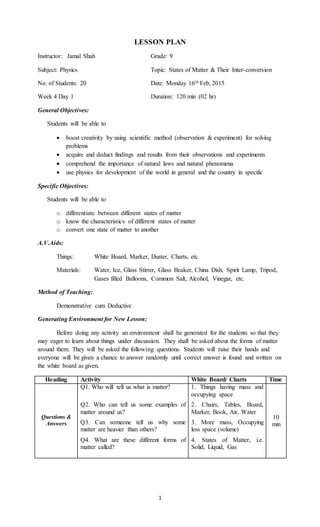
LESSON PLAN
Instructor: Jamal Shah Grade: 9
Subject: Physics Topic: States of Matter & Their Inter-conversion
No. of Students: 20 Date: Monday 16th Feb, 2015
Week 4 Day 1 Duration: 120 min (02 hr)
General Objectives:
Students will be able to
 boost creativity by using scientific method (observation & experiment) for solving
problems
 acquire and deduct findings and results from their observations and experiments
 comprehend the importance of natural laws and natural phenomena
 use physics for development of the world in general and the country in specific
Specific Objectives:
Students will be able to
o differentiate between different states of matter
o know the characteristics of different states of matter
o convert one state of matter to another
A.V.Aids:
Things: White Board, Marker, Duster, Charts, etc.
Materials: Water, Ice, Glass Stirrer, Glass Beaker, China Dish, Spirit Lamp, Tripod,
Gases filled Balloons, Common Salt, Alcohol, Vinegar, etc.
Method of Teaching:
Demonstrative cum Deductive
Generating Environment for New Lesson:
Before doing any activity an environment shall be generated for the students so that they
may eager to learn about things under discussion. They shall be asked about the forms of matter
around them. They will be asked the following questions. Students will raise their hands and
everyone will be given a chance to answer randomly until correct answer is found and written on
the white board as given.
Heading Activity White Board/ Charts Time
Questions &
Answers
Q1. Who will tell us what is matter?
Q2. Who can tell us some examples of
matter around us?
Q3. Can someone tell us why some
matter are heavier than others?
Q4. What are these different forms of
matter called?
1. Things having mass and
occupying space
2. Chairs, Tables, Board,
Marker, Book, Air, Water
3. More mass, Occupying
less space (volume)
4. States of Matter, i.e.
Solid, Liquid, Gas
10
min
2
Announcement
of Topic
Finding the correct or incorrect answer of
the last question, the topic will be
announced as;
‘Today we are going to see why
matter is found in these different
forms’
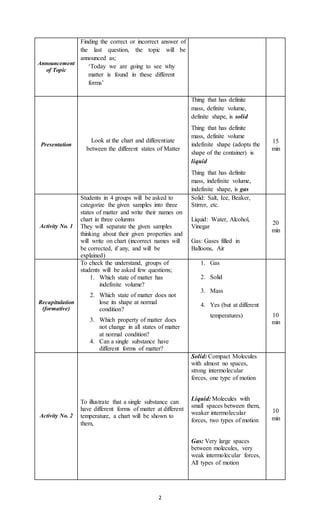
Presentation
Look at the chart and differentiate
between the different states of Matter
Thing that has definite
mass, definite volume,
definite shape, is solid
Thing that has definite
mass, definite volume
indefinite shape (adopts the
shape of the container) is
liquid
Thing that has definite
mass, indefinite volume,
indefinite shape, is gas
15
min
Activity No. 1
Students in 4 groups will be asked to
categorize the given samples into three
states of matter and write their names on
chart in three columns
They will separate the given samples
thinking about their given properties and
will write on chart (incorrect names will
be corrected, if any, and will be
explained)
Solid: Salt, Ice, Beaker,
Stirrer, etc.
Liquid: Water, Alcohol,
Vinegar
Gas: Gases filled in
Balloons, Air
20
min
Recapitulation
(formative)
To check the understand, groups of
students will be asked few questions;
1. Which state of matter has
indefinite volume?
2. Which state of matter does not
lose its shape at normal
condition?
3. Which property of matter does
not change in all states of matter
at normal condition?
4. Can a single substance have
different forms of matter?
1. Gas
2. Solid
3. Mass
4. Yes (but at different
temperatures) 10
min
Activity No. 2
To illustrate that a single substance can
have different forms of matter at different
temperature, a chart will be shown to
them,
Solid: Compact Molecules
with almost no spaces,
strong intermolecular
forces, one type of motion
Liquid: Molecules with
small spaces between them,
weaker intermolecular
forces, two types of motion
Gas: Very large spaces
between molecules, very
weak intermolecular forces,
All types of motion
10
min
3
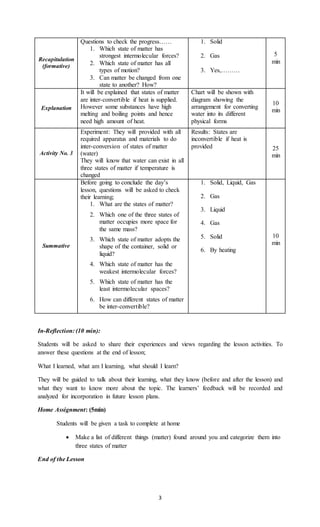
Recapitulation
(formative)
Questions to check the progress……
1. Which state of matter has
strongest intermolecular forces?
2. Which state of matter has all
types of motion?
3. Can matter be changed from one
state to another? How?
1. Solid
2. Gas
3. Yes,………
5
min
Explanation
It will be explained that states of matter
are inter-convertible if heat is supplied.
However some substances have high
melting and boiling points and hence
need high amount of heat.
Chart will be shown with
diagram showing the
arrangement for converting
water into its different
physical forms
10
min
Activity No. 3
Experiment: They will provided with all
required apparatus and materials to do
inter-conversion of states of matter
(water)
They will know that water can exist in all
three states of matter if temperature is
changed
Results: States are
inconvertible if heat is
provided 25
min
Summative
Before going to conclude the day’s
lesson, questions will be asked to check
their learning;
1. What are the states of matter?
2. Which one of the three states of
matter occupies more space for
the same mass?
3. Which state of matter adopts the
shape of the container, solid or
liquid?
4. Which state of matter has the
weakest intermolecular forces?
5. Which state of matter has the
least intermolecular spaces?
6. How can different states of matter
be inter-convertible?
1. Solid, Liquid, Gas
2. Gas
3. Liquid
4. Gas
5. Solid
6. By heating
10
min
In-Reflection: (10 min):
Students will be asked to share their experiences and views regarding the lesson activities. To
answer these questions at the end of lesson;
What I learned, what am I learning, what should I learn?
They will be guided to talk about their learning, what they know (before and after the lesson) and
what they want to know more about the topic. The learners’ feedback will be recorded and
analyzed for incorporation in future lesson plans.
Home Assignment: (5min)
Students will be given a task to complete at home
 Make a list of different things (matter) found around you and categorize them into
three states of matter
End of the Lesson

Lesson Plan JamShah

  • 1.
    1 LESSON PLAN Instructor: JamalShah Grade: 9 Subject: Physics Topic: States of Matter & Their Inter-conversion No. of Students: 20 Date: Monday 16th Feb, 2015 Week 4 Day 1 Duration: 120 min (02 hr) General Objectives: Students will be able to  boost creativity by using scientific method (observation & experiment) for solving problems  acquire and deduct findings and results from their observations and experiments  comprehend the importance of natural laws and natural phenomena  use physics for development of the world in general and the country in specific Specific Objectives: Students will be able to o differentiate between different states of matter o know the characteristics of different states of matter o convert one state of matter to another A.V.Aids: Things: White Board, Marker, Duster, Charts, etc. Materials: Water, Ice, Glass Stirrer, Glass Beaker, China Dish, Spirit Lamp, Tripod, Gases filled Balloons, Common Salt, Alcohol, Vinegar, etc. Method of Teaching: Demonstrative cum Deductive Generating Environment for New Lesson: Before doing any activity an environment shall be generated for the students so that they may eager to learn about things under discussion. They shall be asked about the forms of matter around them. They will be asked the following questions. Students will raise their hands and everyone will be given a chance to answer randomly until correct answer is found and written on the white board as given. Heading Activity White Board/ Charts Time Questions & Answers Q1. Who will tell us what is matter? Q2. Who can tell us some examples of matter around us? Q3. Can someone tell us why some matter are heavier than others? Q4. What are these different forms of matter called? 1. Things having mass and occupying space 2. Chairs, Tables, Board, Marker, Book, Air, Water 3. More mass, Occupying less space (volume) 4. States of Matter, i.e. Solid, Liquid, Gas 10 min
  • 2.
    2 Announcement of Topic Finding thecorrect or incorrect answer of the last question, the topic will be announced as; ‘Today we are going to see why matter is found in these different forms’ Presentation Look at the chart and differentiate between the different states of Matter Thing that has definite mass, definite volume, definite shape, is solid Thing that has definite mass, definite volume indefinite shape (adopts the shape of the container) is liquid Thing that has definite mass, indefinite volume, indefinite shape, is gas 15 min Activity No. 1 Students in 4 groups will be asked to categorize the given samples into three states of matter and write their names on chart in three columns They will separate the given samples thinking about their given properties and will write on chart (incorrect names will be corrected, if any, and will be explained) Solid: Salt, Ice, Beaker, Stirrer, etc. Liquid: Water, Alcohol, Vinegar Gas: Gases filled in Balloons, Air 20 min Recapitulation (formative) To check the understand, groups of students will be asked few questions; 1. Which state of matter has indefinite volume? 2. Which state of matter does not lose its shape at normal condition? 3. Which property of matter does not change in all states of matter at normal condition? 4. Can a single substance have different forms of matter? 1. Gas 2. Solid 3. Mass 4. Yes (but at different temperatures) 10 min Activity No. 2 To illustrate that a single substance can have different forms of matter at different temperature, a chart will be shown to them, Solid: Compact Molecules with almost no spaces, strong intermolecular forces, one type of motion Liquid: Molecules with small spaces between them, weaker intermolecular forces, two types of motion Gas: Very large spaces between molecules, very weak intermolecular forces, All types of motion 10 min
  • 3.
    3 Recapitulation (formative) Questions to checkthe progress…… 1. Which state of matter has strongest intermolecular forces? 2. Which state of matter has all types of motion? 3. Can matter be changed from one state to another? How? 1. Solid 2. Gas 3. Yes,……… 5 min Explanation It will be explained that states of matter are inter-convertible if heat is supplied. However some substances have high melting and boiling points and hence need high amount of heat. Chart will be shown with diagram showing the arrangement for converting water into its different physical forms 10 min Activity No. 3 Experiment: They will provided with all required apparatus and materials to do inter-conversion of states of matter (water) They will know that water can exist in all three states of matter if temperature is changed Results: States are inconvertible if heat is provided 25 min Summative Before going to conclude the day’s lesson, questions will be asked to check their learning; 1. What are the states of matter? 2. Which one of the three states of matter occupies more space for the same mass? 3. Which state of matter adopts the shape of the container, solid or liquid? 4. Which state of matter has the weakest intermolecular forces? 5. Which state of matter has the least intermolecular spaces? 6. How can different states of matter be inter-convertible? 1. Solid, Liquid, Gas 2. Gas 3. Liquid 4. Gas 5. Solid 6. By heating 10 min In-Reflection: (10 min): Students will be asked to share their experiences and views regarding the lesson activities. To answer these questions at the end of lesson; What I learned, what am I learning, what should I learn? They will be guided to talk about their learning, what they know (before and after the lesson) and what they want to know more about the topic. The learners’ feedback will be recorded and analyzed for incorporation in future lesson plans. Home Assignment: (5min) Students will be given a task to complete at home  Make a list of different things (matter) found around you and categorize them into three states of matter End of the Lesson