NATURE AND STRUCTURE
OF SCIENCE
BY:
DR. RAKHI SAWLANI
CONTENT LIST
• MEANING AND DEFINITION OF SCIENCE
• NATURE AND STRUCTURE OF SCIENCE
• CHARACTERISTICS OF SCIENCE
• THREE DIFFERENT FACETS OF SCIENCE
• SCIENCE AS PROCESS, INQUIRY, ATTITUDE
MEANING AND DEFINITION OF SCIENCE
• Etymologically, The Word Science Is Derived From The Latin Word Termed As
“Scientia” Which Means “To Know”.
• According To Griggs, “In The Literal Sense Science Means The Pursuit Of
Knowledge But It Has A Wider Connotation For Our Purpose, And Can Be Said To
Mean A Knowledge Of Nature In The Widest Possible Form.”
• Einstein Defines Science As “An Attempt To Make The Science Is A Systematic
And Organized Body Of Knowledge.
• According To Frederik, Science Is A Cumulative And Endless Series Of Empirical
Observations Which Results In The Formation Of Concepts And Theories, Being
Subject To Modification In The Light Of Further Empirical Observations.
CHARACTERISTICS OF SCIENCE
1. Science Is A Study Of Natural Phenomenon.
2. It Is Organized & Systematized Learning.
3. It Is A Body Of Cumulative & Ordered Observations.
4. It Is The Knowledge Based On Observations, Experiments.
5. Science Is A Process As Well As The Product.
6. Science Is Concerned With Understanding The Properties Of External World Of
Nature.
7. Science Is A Body Of Knowledge And A Method Of Obtaining It For Wider
Usage.
8. Science Reveals That Knowledge Is Tentative And Constantly Changing.
9. Scientific Ideas Are The Result Of Experimentation And Observation By
Scientists.
10. Scientific Ideas Are Subject To Modification In The Light Of Further Empirical
NATURE OF SCIENCE
• Science Is Both A Product, A Systematic And Organized Body Of Useful
Knowledge
• It Has Been Accumulated By Scientists And The Process In Which They Acquire
This Knowledge.
• The True Nature Of Science Is Revealed More In The Way It Is Sought Rather
Than In What Is Found, Although The Two Efforts Cannot Be Truly Separated.
NATURE OF SCIENCE
• Science Helps To Make Descriptions - Scientists Try To Describe The
Phenomena In Nature And Establish Relationship. It Answers Questions Like
How, Where, When, Under What Circumstances.
• Science Makes Predictions - Extending Knowledge To Further Situation Is
Prediction. It Involves The Use Of Generalizations Or Application Of Knowledge
In New Situations.
• Science Is Based On Observation - Meticulous Observation Followed By Inference
Drawing Is An Essential Part Of Science. These Observations And Their
Conclusions Are Objective In Nature. Unbiased Approach Is Followed In Science.
• Science Is Concerned With Past, Present And Future - It Answers Questions
About The Past. Eg. Why Could The Dinosaurs Have Become Extinct? It Is
Involved With The Present. Eg. Search For Remedies To Diseases. It Also Dwells
In The Future. Eg. What Fuels Can Be Used In The Future?
• Scientific Ideas Are Subject To Change - It Is Never A Finished Product. There Is
A Lot More To Be Discovered. The Quest In Science Is Unending. Scientific Laws
Are Tentative And May Be Changed With Further Research. Science Is An Eternal
THREE FACETS OF SCIENCE
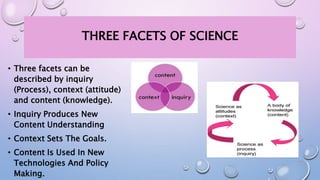
• Three facets can be
described by inquiry
(Process), context (attitude)
and content (knowledge).
• Inquiry Produces New
Content Understanding
• Context Sets The Goals.
• Content Is Used In New
Technologies And Policy
Making.
Accumulated and systematized body of knowledge
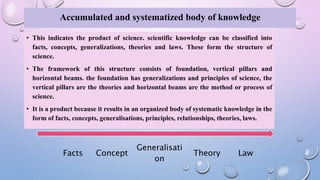
• This indicates the product of science. scientific knowledge can be classified into
facts, concepts, generalizations, theories and laws. These form the structure of
science.
• The framework of this structure consists of foundation, vertical pillars and
horizontal beams. the foundation has generalizations and principles of science, the
vertical pillars are the theories and horizontal beams are the method or process of
science.
• It is a product because it results in an organized body of systematic knowledge in the
form of facts, concepts, generalisations, principles, relationships, theories, laws.
Law
Theory
Generalisati
on
Concept
Facts
FACTS AND CONCEPTS
• FACTS
• These are the basis of all knowledge. a fact can be described as scientific fact
only when it has been arrived through the use of scientific method. the
confirmed and verified thoughts are called as scientific facts. hence, scientific
facts are considered to be highly reliable, valid and objective as compared to
simple facts. they are said to be the grassroots for any theory or law. the facts,
models or theories which are proved wrong are discarded and replaced by new
ones.
• CONCEPTS –
• A concept is a generalized idea suggested to the individual by object, symbol or
situation. they play a very important role in the understanding and application
of knowledge in daily life. concept to people of different ages and experience is
different.
• EG. CONCEPT OF A ANIMAL, SOLID, LIQUID, GASES
GENERALISATION AND THEORY
• GENERALIZATIONS – the facts give rise to concepts and when the facts and
concepts are properly classified on the basis of various scientific processes, they
give rise to generalizations. generalizations are very helpful in deriving useful
conclusions regarding scientific facts. actually facts, concepts and
generalizations are inter-related and inter-dependent.
• EG. ALL BODIES ARE ATTRACTED BY EARTH
• THEORY – when a scientist endeavors to fit the available broad interrelations and
general principles into orderly, logically constructed systems, such a system is
called a theory. a scientific theory is based on facts, concepts, generalized rules
and principles.
• EG. DARWIN’S THEORY
LAW
These are the factual statement of what always happens in certain
circumstances.
A number of similar facts give rise to a generalized fact. these generalized facts
or concepts are again subject to further verification through proper
experimentation.
The final conclusion drawn on the basis of these experiments is described as a
scientific law.
In this way many scientific facts and concepts after proper generalization and
further verification may be accepted as scientific law.
These are the broad generalizations which mean same for all the people
irrespective of their age and experience and holds good in different situations.
EG. NEWTON’S LAW OF MOTION, LAW OF GRAVITATIONAL FORCE
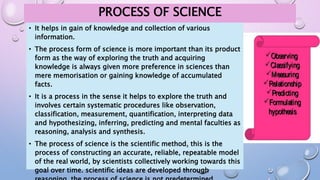
PROCESS OF SCIENCE
• It helps in gain of knowledge and collection of various
information.
• The process form of science is more important than its product
form as the way of exploring the truth and acquiring
knowledge is always given more preference in sciences than
mere memorisation or gaining knowledge of accumulated
facts.
• It is a process in the sense it helps to explore the truth and
involves certain systematic procedures like observation,
classification, measurement, quantification, interpreting data
and hypothesizing, inferring, predicting and mental faculties as
reasoning, analysis and synthesis.
• The process of science is the scientific method. this is the
process of constructing an accurate, reliable, repeatable model
of the real world, by scientists collectively working towards this
goal over time. scientific ideas are developed through
TRAINING IN SCIENTIFIC METHOD
The method of process adopted by science in the explanation of truth is quite
unique and distinct from the methods adopted in such study by other subjects.
it is known as scientific method.
The steps of scientific method are:
• I. NATURE AND AIM OF THE PROBLEM
• II. ANALYSIS OF THE PROBLEM
• III. TESTING AND VALIDITY OF THE VARIOUS SOLUTIONS OF THE PROBLEM
• IV. TESTING OF THE RESULTS
• V. RESULT THUS OBTAINED IS ACCEPTED AS LAW OR PRINCIPLE
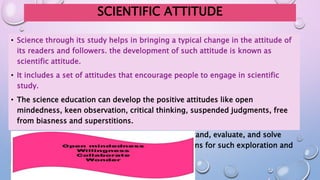
SCIENTIFIC ATTITUDE
• Science through its study helps in bringing a typical change in the attitude of
its readers and followers. the development of such attitude is known as
scientific attitude.
• It includes a set of attitudes that encourage people to engage in scientific
study.
• The science education can develop the positive attitudes like open
mindedness, keen observation, critical thinking, suspended judgments, free
from biasness and superstitions.
• Such attitude is helpful to an individual to understand, evaluate, and solve
many problems faced in life by adopting true means for such exploration and
believing in the results of such true findings.
DYNAMIC NATURE OF SCIENCE
The science constantly remains in search for truth
and what it gets on account of this search can
never be taken as absolutely and permanently
true. these results can be challenged and
modified or altered in view of the further
explanations and findings. therefore, the science
by its nature is always dynamic and not static.

Science-B.Ed.-Dr.RakhiSawlani.pptx

  • 1.
    NATURE AND STRUCTURE OFSCIENCE BY: DR. RAKHI SAWLANI
  • 2.
    CONTENT LIST • MEANINGAND DEFINITION OF SCIENCE • NATURE AND STRUCTURE OF SCIENCE • CHARACTERISTICS OF SCIENCE • THREE DIFFERENT FACETS OF SCIENCE • SCIENCE AS PROCESS, INQUIRY, ATTITUDE
  • 3.
    MEANING AND DEFINITIONOF SCIENCE • Etymologically, The Word Science Is Derived From The Latin Word Termed As “Scientia” Which Means “To Know”. • According To Griggs, “In The Literal Sense Science Means The Pursuit Of Knowledge But It Has A Wider Connotation For Our Purpose, And Can Be Said To Mean A Knowledge Of Nature In The Widest Possible Form.” • Einstein Defines Science As “An Attempt To Make The Science Is A Systematic And Organized Body Of Knowledge. • According To Frederik, Science Is A Cumulative And Endless Series Of Empirical Observations Which Results In The Formation Of Concepts And Theories, Being Subject To Modification In The Light Of Further Empirical Observations.
  • 4.
    CHARACTERISTICS OF SCIENCE 1.Science Is A Study Of Natural Phenomenon. 2. It Is Organized & Systematized Learning. 3. It Is A Body Of Cumulative & Ordered Observations. 4. It Is The Knowledge Based On Observations, Experiments. 5. Science Is A Process As Well As The Product. 6. Science Is Concerned With Understanding The Properties Of External World Of Nature. 7. Science Is A Body Of Knowledge And A Method Of Obtaining It For Wider Usage. 8. Science Reveals That Knowledge Is Tentative And Constantly Changing. 9. Scientific Ideas Are The Result Of Experimentation And Observation By Scientists. 10. Scientific Ideas Are Subject To Modification In The Light Of Further Empirical
  • 5.
    NATURE OF SCIENCE •Science Is Both A Product, A Systematic And Organized Body Of Useful Knowledge • It Has Been Accumulated By Scientists And The Process In Which They Acquire This Knowledge. • The True Nature Of Science Is Revealed More In The Way It Is Sought Rather Than In What Is Found, Although The Two Efforts Cannot Be Truly Separated.
  • 6.
    NATURE OF SCIENCE •Science Helps To Make Descriptions - Scientists Try To Describe The Phenomena In Nature And Establish Relationship. It Answers Questions Like How, Where, When, Under What Circumstances. • Science Makes Predictions - Extending Knowledge To Further Situation Is Prediction. It Involves The Use Of Generalizations Or Application Of Knowledge In New Situations. • Science Is Based On Observation - Meticulous Observation Followed By Inference Drawing Is An Essential Part Of Science. These Observations And Their Conclusions Are Objective In Nature. Unbiased Approach Is Followed In Science. • Science Is Concerned With Past, Present And Future - It Answers Questions About The Past. Eg. Why Could The Dinosaurs Have Become Extinct? It Is Involved With The Present. Eg. Search For Remedies To Diseases. It Also Dwells In The Future. Eg. What Fuels Can Be Used In The Future? • Scientific Ideas Are Subject To Change - It Is Never A Finished Product. There Is A Lot More To Be Discovered. The Quest In Science Is Unending. Scientific Laws Are Tentative And May Be Changed With Further Research. Science Is An Eternal
  • 7.
    THREE FACETS OFSCIENCE • Three facets can be described by inquiry (Process), context (attitude) and content (knowledge). • Inquiry Produces New Content Understanding • Context Sets The Goals. • Content Is Used In New Technologies And Policy Making.
  • 8.
    Accumulated and systematizedbody of knowledge • This indicates the product of science. scientific knowledge can be classified into facts, concepts, generalizations, theories and laws. These form the structure of science. • The framework of this structure consists of foundation, vertical pillars and horizontal beams. the foundation has generalizations and principles of science, the vertical pillars are the theories and horizontal beams are the method or process of science. • It is a product because it results in an organized body of systematic knowledge in the form of facts, concepts, generalisations, principles, relationships, theories, laws. Law Theory Generalisati on Concept Facts
  • 9.
    FACTS AND CONCEPTS •FACTS • These are the basis of all knowledge. a fact can be described as scientific fact only when it has been arrived through the use of scientific method. the confirmed and verified thoughts are called as scientific facts. hence, scientific facts are considered to be highly reliable, valid and objective as compared to simple facts. they are said to be the grassroots for any theory or law. the facts, models or theories which are proved wrong are discarded and replaced by new ones. • CONCEPTS – • A concept is a generalized idea suggested to the individual by object, symbol or situation. they play a very important role in the understanding and application of knowledge in daily life. concept to people of different ages and experience is different. • EG. CONCEPT OF A ANIMAL, SOLID, LIQUID, GASES
  • 10.
    GENERALISATION AND THEORY •GENERALIZATIONS – the facts give rise to concepts and when the facts and concepts are properly classified on the basis of various scientific processes, they give rise to generalizations. generalizations are very helpful in deriving useful conclusions regarding scientific facts. actually facts, concepts and generalizations are inter-related and inter-dependent. • EG. ALL BODIES ARE ATTRACTED BY EARTH • THEORY – when a scientist endeavors to fit the available broad interrelations and general principles into orderly, logically constructed systems, such a system is called a theory. a scientific theory is based on facts, concepts, generalized rules and principles. • EG. DARWIN’S THEORY
  • 11.
    LAW These are thefactual statement of what always happens in certain circumstances. A number of similar facts give rise to a generalized fact. these generalized facts or concepts are again subject to further verification through proper experimentation. The final conclusion drawn on the basis of these experiments is described as a scientific law. In this way many scientific facts and concepts after proper generalization and further verification may be accepted as scientific law. These are the broad generalizations which mean same for all the people irrespective of their age and experience and holds good in different situations. EG. NEWTON’S LAW OF MOTION, LAW OF GRAVITATIONAL FORCE
  • 12.
    PROCESS OF SCIENCE •It helps in gain of knowledge and collection of various information. • The process form of science is more important than its product form as the way of exploring the truth and acquiring knowledge is always given more preference in sciences than mere memorisation or gaining knowledge of accumulated facts. • It is a process in the sense it helps to explore the truth and involves certain systematic procedures like observation, classification, measurement, quantification, interpreting data and hypothesizing, inferring, predicting and mental faculties as reasoning, analysis and synthesis. • The process of science is the scientific method. this is the process of constructing an accurate, reliable, repeatable model of the real world, by scientists collectively working towards this goal over time. scientific ideas are developed through
  • 13.
    TRAINING IN SCIENTIFICMETHOD The method of process adopted by science in the explanation of truth is quite unique and distinct from the methods adopted in such study by other subjects. it is known as scientific method. The steps of scientific method are: • I. NATURE AND AIM OF THE PROBLEM • II. ANALYSIS OF THE PROBLEM • III. TESTING AND VALIDITY OF THE VARIOUS SOLUTIONS OF THE PROBLEM • IV. TESTING OF THE RESULTS • V. RESULT THUS OBTAINED IS ACCEPTED AS LAW OR PRINCIPLE
  • 14.
    SCIENTIFIC ATTITUDE • Sciencethrough its study helps in bringing a typical change in the attitude of its readers and followers. the development of such attitude is known as scientific attitude. • It includes a set of attitudes that encourage people to engage in scientific study. • The science education can develop the positive attitudes like open mindedness, keen observation, critical thinking, suspended judgments, free from biasness and superstitions. • Such attitude is helpful to an individual to understand, evaluate, and solve many problems faced in life by adopting true means for such exploration and believing in the results of such true findings.
  • 15.
    DYNAMIC NATURE OFSCIENCE The science constantly remains in search for truth and what it gets on account of this search can never be taken as absolutely and permanently true. these results can be challenged and modified or altered in view of the further explanations and findings. therefore, the science by its nature is always dynamic and not static.