Cover
THE ELEMENTARY SCIENCE
CURRICULUM
(Physics, Earth and Space Science)
Presenter:
Vanessa Shalom G. Odarve
BEED – 2A Student
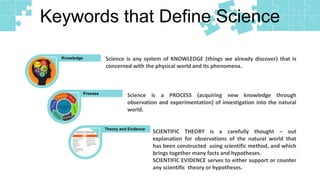
Keywords that Define Science
Knowledge
Process
Theory and Evidence
Science is any system of KNOWLEDGE (things we already discover) that is
concerned with the physical world and its phenomena.
Science is a PROCESS (acquiring new knowledge through
observation and experimentation) of investigation into the natural
world.
SCIENTIFIC THEORY is a carefully thought – out
explanation for observations of the natural world that
has been constructed using scientific method, and which
brings together many facts and hypotheses.
SCIENTIFIC EVIDENCE serves to either support or counter
any scientific theory or hypotheses.
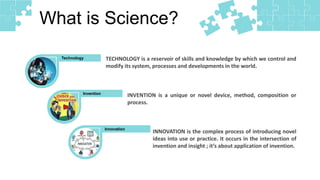
What is Science?
Technology
Invention
Innovation
TECHNOLOGY is a reservoir of skills and knowledge by which we control and
modify its system, processes and developments in the world.
INVENTION is a unique or novel device, method, composition or
process.
INNOVATION is the complex process of introducing novel
ideas into use or practice. It occurs in the intersection of
invention and insight ; it’s about application of invention.
• It has helped in satisfying many basic human
needs and improving living conditions.
• Advances in technology and science are
transforming our world at an incredible and
unimaginable pace.
• We cannot escape from and we cannot
measure the significance of science.
• Science has shaped the world.
Why Science is Valued?
• Technology and the products of scientific
knowledge surround us every day.
• Public and private policy decisions that impact
every aspect of our lives are driven by scientific
process and evidence.
• The enormously complex physical world
illustrates boundless scientific concepts.
• Being a “science literate” is not just an
advantage but an absolute necessity in the 21st
century.
Why Science is Valued?
What is Science?
• Science is derived from the Latin word Scientia
meaning knowledge.
• Commonly referred to as a systematic and
organized body of knowledge in any area of
inquiry that is acquired using the “scientific
method”.
• It has many facets and definitions that can be
summarized into the following:
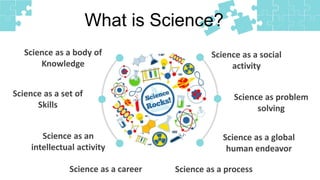
Science as a body of
Knowledge
What is Science?
Science as a set of
Skills
Science as an
intellectual activity
Science as a social
activity
Science as problem
solving
Science as a global
human endeavor
Science as a career Science as a process
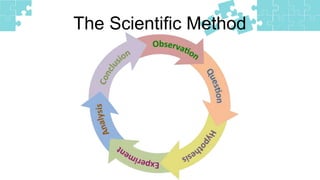
The Scientific Method
• It refers to a set of steps for verifying and
building scientific knowledge. Steps include
making valid observations, interpreting and
generalizing results.
• It allows researchers to independently and
impartially test preexisting knowledge and prior
findings and subjects them to scrutiny and
enhancements.
The Scientific Method
Applying the Scientific Method
• Observation:
A glass with paper towel inside is place in water.
• Question:
Will the paper towel inside the glass stays dry in
water?
• Hypothesis:
The paper towel will be wet in water.
The paper towel will stay dry in water.
• Experiment:
Conduct experiments
Applying the Scientific Method
• Analysis:
When the glass is lowered in the water, air is
trapped inside of the glass because of the water
pushing up from below. The paper towel will stay
dry if the air stays in the glass.
• Conclusion:
Regard or disregard your hypothesis based
on the collected data.
The Scientific Irony
We can probably enumerate lots
of things to express why the learners
love science like it challenges ideas
that they think are correct or maybe
because there is always something
new and interesting to discover which
makes it an exciting subject.
The Scientific Irony
Many learners would say I like
Science but hate science class. Isn’t it
ironic. Indeed, it is. All of us may love
Science but will lose interest for the
subject because of some underlying
factors. Being top of this reason why
learners hate science class even
The Scientific Irony
though they like Science is
because the “TEACHER IS
BORING”.
Research shows that the teacher is
the most important factor in the
effective delivery of classroom
instruction. Engaging classes are
facilitated by inspiring science
teachers. But what are the important
traits of an inspiring science teacher?
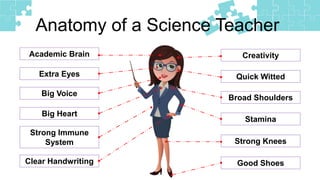
Anatomy of a Science Teacher
Academic Brain
Extra Eyes Quick Witted
Broad Shoulders
Big Voice
Creativity
Stamina
Strong Immune
System
Good Shoes
Big Heart
Strong Knees
Clear Handwriting
Like Benjamin Franklin said:
“Tell me and I forget.
Teach me and I remember.
Involve me and I learn.”
So, as future teachers, we need to acquire all
the traits needed to become effective,
engaging and inspiring.
Cover
Thank you for listening!
GOD BLESS US ALL!

The elementary science curriculum

  • 1.
    Cover THE ELEMENTARY SCIENCE CURRICULUM (Physics,Earth and Space Science) Presenter: Vanessa Shalom G. Odarve BEED – 2A Student
  • 3.
    Keywords that DefineScience Knowledge Process Theory and Evidence Science is any system of KNOWLEDGE (things we already discover) that is concerned with the physical world and its phenomena. Science is a PROCESS (acquiring new knowledge through observation and experimentation) of investigation into the natural world. SCIENTIFIC THEORY is a carefully thought – out explanation for observations of the natural world that has been constructed using scientific method, and which brings together many facts and hypotheses. SCIENTIFIC EVIDENCE serves to either support or counter any scientific theory or hypotheses.
  • 4.
    What is Science? Technology Invention Innovation TECHNOLOGYis a reservoir of skills and knowledge by which we control and modify its system, processes and developments in the world. INVENTION is a unique or novel device, method, composition or process. INNOVATION is the complex process of introducing novel ideas into use or practice. It occurs in the intersection of invention and insight ; it’s about application of invention.
  • 5.
    • It hashelped in satisfying many basic human needs and improving living conditions. • Advances in technology and science are transforming our world at an incredible and unimaginable pace. • We cannot escape from and we cannot measure the significance of science. • Science has shaped the world. Why Science is Valued?
  • 6.
    • Technology andthe products of scientific knowledge surround us every day. • Public and private policy decisions that impact every aspect of our lives are driven by scientific process and evidence. • The enormously complex physical world illustrates boundless scientific concepts. • Being a “science literate” is not just an advantage but an absolute necessity in the 21st century. Why Science is Valued?
  • 7.
    What is Science? •Science is derived from the Latin word Scientia meaning knowledge. • Commonly referred to as a systematic and organized body of knowledge in any area of inquiry that is acquired using the “scientific method”. • It has many facets and definitions that can be summarized into the following:
  • 8.
    Science as abody of Knowledge What is Science? Science as a set of Skills Science as an intellectual activity Science as a social activity Science as problem solving Science as a global human endeavor Science as a career Science as a process
  • 9.
    The Scientific Method •It refers to a set of steps for verifying and building scientific knowledge. Steps include making valid observations, interpreting and generalizing results. • It allows researchers to independently and impartially test preexisting knowledge and prior findings and subjects them to scrutiny and enhancements.
  • 10.
  • 11.
    Applying the ScientificMethod • Observation: A glass with paper towel inside is place in water. • Question: Will the paper towel inside the glass stays dry in water? • Hypothesis: The paper towel will be wet in water. The paper towel will stay dry in water. • Experiment: Conduct experiments
  • 12.
    Applying the ScientificMethod • Analysis: When the glass is lowered in the water, air is trapped inside of the glass because of the water pushing up from below. The paper towel will stay dry if the air stays in the glass. • Conclusion: Regard or disregard your hypothesis based on the collected data.
  • 13.
    The Scientific Irony Wecan probably enumerate lots of things to express why the learners love science like it challenges ideas that they think are correct or maybe because there is always something new and interesting to discover which makes it an exciting subject.
  • 14.
    The Scientific Irony Manylearners would say I like Science but hate science class. Isn’t it ironic. Indeed, it is. All of us may love Science but will lose interest for the subject because of some underlying factors. Being top of this reason why learners hate science class even
  • 15.
    The Scientific Irony thoughthey like Science is because the “TEACHER IS BORING”.
  • 16.
    Research shows thatthe teacher is the most important factor in the effective delivery of classroom instruction. Engaging classes are facilitated by inspiring science teachers. But what are the important traits of an inspiring science teacher?
  • 17.
    Anatomy of aScience Teacher Academic Brain Extra Eyes Quick Witted Broad Shoulders Big Voice Creativity Stamina Strong Immune System Good Shoes Big Heart Strong Knees Clear Handwriting
  • 18.
    Like Benjamin Franklinsaid: “Tell me and I forget. Teach me and I remember. Involve me and I learn.” So, as future teachers, we need to acquire all the traits needed to become effective, engaging and inspiring.
  • 19.
    Cover Thank you forlistening! GOD BLESS US ALL!