Objectives of Science
Teaching
Alina Ali
B.Ed(G) 1st Year
Jamia Millia Islamia
What is an objective ?
• In layman language…“I want to become a good
teacher” is a goal, but to become a teacher,
‘what all I should do to become a good
teacher?’ are the objectives to become a good
teacher.
• Objective is a part to aim- a narrower term
when compared to aim.
• It can be defined as- objective is a point or an
end view of possible achievement in terms of
what a student is able to do when the
educational system is directed towards
educational aims.
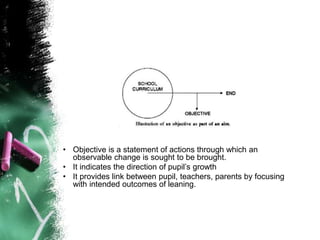
• Objective is a statement of actions through which an
observable change is sought to be brought.
• It indicates the direction of pupil’s growth
• It provides link between pupil, teachers, parents by focusing
with intended outcomes of leaning.
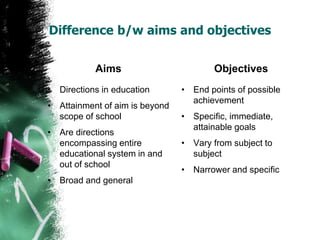
Difference b/w aims and objectives
Aims
• Directions in education
• Attainment of aim is beyond
scope of school
• Are directions
encompassing entire
educational system in and
out of school
• Broad and general
Objectives
• End points of possible
achievement
• Specific, immediate,
attainable goals
• Vary from subject to
subject
• Narrower and specific
Objectives of Science Teaching
• Should be determined by needs of people
• Learning in science involves children advancing
their ideas by trying them out in practical
• Purpose of science teaching is not only to
acquaint them with knowledge of scientific
facts, concepts but also to develop scientific
attitude in them.
Some of the objectives of teaching science in the school
curriculum should be directed towards:
• better understanding of the nature of science.
• acquisition of skills.
• development of scientific attitudes
• training in scientific method
• development of interest and appreciation
• helping the students fit themselves better in the
society
• helping students develop suitable career
interest
Towards development of scientific
attitude
• Open mindedness
• Curiosity
• Tolerance
• Honest doubt
• Respect for other’s point of view
• Critical observation and thought
• Freedom from superstition
• Judgment based on scientific facts
• Planned procedure in solving problems
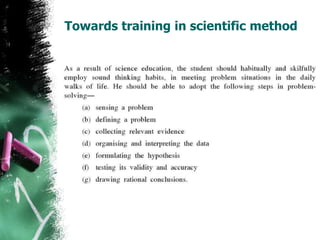
Towards training in scientific method
Towards development of interest and
appreciation
• Teaching of science should enable a student to
develop and enjoy personal interests, some of
which are related to science.
• Students should be able to recognize and enjoy
scientific aspects of their natural and man made
environment
• Students should be encouraged by including in
science curriculum activities like science clubs,
exhibitions, excursions etc.
Towards helping the students fit themselves
better in the society
• The science curriculum gives extensive practice
in working together both in large and small
groups thus promoting cooperation and
tolerance, besides enhancing self confidence,
self reliance, among students.
• Students gain practice in conducting their
projects, etc independently while having
increased contact with outside work.
Objectives as per NCF
(position paper on teaching of science)
• The main objectives at this stage are to arouse curiosity about
the world (natural environment, artifacts and people)
• To have the child engage in exploratory and hands-on activities
that lead to the development of basic cognitive and
psychomotor skills through language, observation, recording,
differentiation, classification, inference, drawing, illustrations,
design and fabrication, estimation and measurement.
• The curriculum should also help the child internalize the values
of cleanliness, honesty, co-operation, concern for life and
environment.
Primary Stage (Classes I to V)
• To develop the child’s practical and problem solving skills,
ability to analyze data; application of knowledge learnt;
understanding of concepts; understanding, reading and making
graphical representations; and solving simple numerical
exercises.
• students should have developed the critical ability to evaluate
the epistemological status of facts that they encounter in
science.
Above primary level
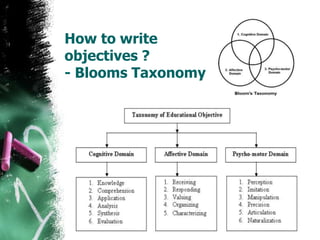
How to write
objectives ?
- Blooms Taxonomy
Thank You

Objectives of science

  • 1.
    Objectives of Science Teaching AlinaAli B.Ed(G) 1st Year Jamia Millia Islamia
  • 2.
    What is anobjective ? • In layman language…“I want to become a good teacher” is a goal, but to become a teacher, ‘what all I should do to become a good teacher?’ are the objectives to become a good teacher. • Objective is a part to aim- a narrower term when compared to aim. • It can be defined as- objective is a point or an end view of possible achievement in terms of what a student is able to do when the educational system is directed towards educational aims.
  • 3.
    • Objective isa statement of actions through which an observable change is sought to be brought. • It indicates the direction of pupil’s growth • It provides link between pupil, teachers, parents by focusing with intended outcomes of leaning.
  • 4.
    Difference b/w aimsand objectives Aims • Directions in education • Attainment of aim is beyond scope of school • Are directions encompassing entire educational system in and out of school • Broad and general Objectives • End points of possible achievement • Specific, immediate, attainable goals • Vary from subject to subject • Narrower and specific
  • 5.
    Objectives of ScienceTeaching • Should be determined by needs of people • Learning in science involves children advancing their ideas by trying them out in practical • Purpose of science teaching is not only to acquaint them with knowledge of scientific facts, concepts but also to develop scientific attitude in them.
  • 6.
    Some of theobjectives of teaching science in the school curriculum should be directed towards: • better understanding of the nature of science. • acquisition of skills. • development of scientific attitudes • training in scientific method • development of interest and appreciation • helping the students fit themselves better in the society • helping students develop suitable career interest
  • 7.
    Towards development ofscientific attitude • Open mindedness • Curiosity • Tolerance • Honest doubt • Respect for other’s point of view • Critical observation and thought • Freedom from superstition • Judgment based on scientific facts • Planned procedure in solving problems
  • 8.
    Towards training inscientific method
  • 9.
    Towards development ofinterest and appreciation • Teaching of science should enable a student to develop and enjoy personal interests, some of which are related to science. • Students should be able to recognize and enjoy scientific aspects of their natural and man made environment • Students should be encouraged by including in science curriculum activities like science clubs, exhibitions, excursions etc.
  • 10.
    Towards helping thestudents fit themselves better in the society • The science curriculum gives extensive practice in working together both in large and small groups thus promoting cooperation and tolerance, besides enhancing self confidence, self reliance, among students. • Students gain practice in conducting their projects, etc independently while having increased contact with outside work.
  • 11.
    Objectives as perNCF (position paper on teaching of science) • The main objectives at this stage are to arouse curiosity about the world (natural environment, artifacts and people) • To have the child engage in exploratory and hands-on activities that lead to the development of basic cognitive and psychomotor skills through language, observation, recording, differentiation, classification, inference, drawing, illustrations, design and fabrication, estimation and measurement. • The curriculum should also help the child internalize the values of cleanliness, honesty, co-operation, concern for life and environment. Primary Stage (Classes I to V)
  • 12.
    • To developthe child’s practical and problem solving skills, ability to analyze data; application of knowledge learnt; understanding of concepts; understanding, reading and making graphical representations; and solving simple numerical exercises. • students should have developed the critical ability to evaluate the epistemological status of facts that they encounter in science. Above primary level
  • 13.
    How to write objectives? - Blooms Taxonomy
  • 14.