DEIXIS
DEIXIS
Deixis, a term which is derived from the
Greek word δεῖξις (meaning “pointing”)
It is the location and identification of
persons, objects, events, processes and
activities being talked about, or referred to
in relation to the spatiotemporal context
created and sustained by the act of
utterance and the participation in it,
typically, of a single speaker and at least
one addressee. (Lyons 1977:637)
DEIXIS
DEIXIS
1. I prefer apples to oranges
2. I’ll see you there/then
3. Besides, she is a very nice
person
DEICTIC vs NON-DEICTIC
 DEICTICS are expressions that
have a deictic usage as basic
or central
NON-DEICTICS are expressions
that do not have such a usage
as basic or central
DEICTIC vs NON-DEICTIC
You, and you, but not you,
go back to your dorms!
(deitic)
Mary wishes that she
could visit the land of
Lilliput. (non-deictic)
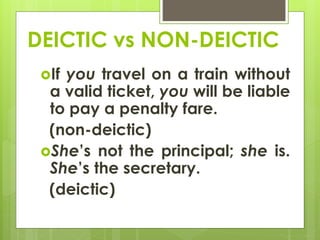
If you travel on a train without
a valid ticket, you will be liable
to pay a penalty fare.
(non-deictic)
She’s not the principal; she is.
She’s the secretary.
(deictic)
DEICTIC vs NON-DEICTIC
GESTURAL vs SYMBOLIC
GESTURAL can properly be
interpreted only by a direct,
moment by moment monitoring
of some physical aspects of
speech event.
SYMBOLIC involves knowing the
basic spatiotemporal parameter
or speech event
You, and you, but not you,
go back to your dorms!
(gestural)
This town is famous for its
small antique shops.
(symbolic)
GESTURAL vs SYMBOLIC
DEICTIC CENTER
DEICTIC CENTER
Deixis is organized in an
egocentric way (Lyons 1977: 646). In
fact, Russel (1905) called deictic
terms egocentric particulars. The
reason is that deixis is organized
relative to specific parameters of the
communicative event that place the
speaker as the center of deixis.
DEICTIC CENTER
DEICTIC CENTER&DEICTIC
CATEGORIES
The default deictic center, or
deictic origo (ground zero) in the
terminology of Buhler (1934), of the 3
major categories is the following:
o PERSON DEIXIS the central
anchorage point is the person who is
speaking
o for TIME DEIXIS is the time at which
the speaker produces the utterance
DEICTIC CENTER&DEICTIC
CATEGORIES
for PLACE DEIXIS is the place where the
speaker produces the utterance
DISCOURSE DEIXIS is defined in
terms of the text section in which
the utterance containing the
deictic element occurs
SOCIAL DEIXIS is defined in terms
of the speaker’s social status to
which that of the addressee is
relative
DEICTIC CENTER&DEICTIC
CATEGORIES
DEICTIC PROJECTION
The “egocentric” organization of
deixis is not always adhered to,
which gives rise to what Lyons (1977:
579) called deictic projection.
o Can I go to your office tomorrow at
12:00? (has no deictic projection)
o Can I come to your office
tomorrow at 12:00?
(has deictic projection)
CATEGORIES OF DEIXIS
PERSON DEIXIS
Person deixis is concerned with the
identification of interlocutor or participant-
roles in a speech event. It is commonly
expressed by:
 personal pronouns, and if relevant,
their associated predicate
agreements
Vocatives (kinship terms, titles and
proper names and in combination of
these)
PERSON DEIXIS
PERSONAL PRONOUNS/DISTINCTION
 First Person- grammaticalization of the
speaker’s reference to –him or herself, that is,
participant role with speaker inclusion [+S]
 Second Person- encoding of the speaker’s
reference to one or more addressees, that is,
the participant role with addressee inclusion
[+A]
 Third Person- grammaticalization of reference
to persons or entities which are neither
speaker nor addressee, that is, participant-
role and addressee exclusion [-S,-A]
PERSONAL PRONOUNS
First Person
I am ill.
 Second Person
She is ill.
PERSON DEIXIS
PERSONAL PRONOUNS/NUMBER
Two most common number
systems are:
1. Singular-Plural
woman- women
2. Singular-Dual-Plural
‘anta-’antumaa-’antum
PERSON DEIXIS
PERSONAL PRONOUNS/NUMBER
Plural of the first person does not
mean the same as plural of the third
person. For example in English, “WE”
does not mean plural speakers in
the same way that “THEY” means
more than one third person entity
(Levinson 1983: 69)
PERSON DEIXIS
PERSON DEIXIS
PERSONAL PRONOUNS/NUMBER
Many of the world’s languages
have two non-singular first person
pronouns, one meaning “we-
inclusive-of-addressee” and the
other meaning “we-exclusive-of-
addressee”
PERSONAL PRONOUNS/NUMBER
“WE-INCLUSIVE-OF-ADDRESSEE “
1. We can go all to the villain’s lair
today.
“WE-EXCLUSIVE-OF-ADDRESSEE”
1. We mean to stop your evil plans.
PERSON DEIXIS
PERSONAL PRONOUNS/GENDER
In all languages with pronominal
gender marking, gender can be
distinguished on third person, where
commonly two (masculine, feminine) or
three (masculine, feminine, neuter) genders
may be identified ; in some, gender
assignments can also be for second person;
in few, gender can be marked on first
person as well (e.g Greenberg 1963; 96,
Anderson and Keenan 1985; 269)
PERSON DEIXIS
PERSONAL PRONOUNS/GENDER
Furthermore, with regard to
person-gender marking, languages
tend to encode more gender
distinctions in the singular than the
plural. ((e.g Greenberg 1963; 96,
Anderson and Keenan 1985; 269)
And English language confirms
this (third-person singular: M:he,
F:she, N:it ; third-person plural: they)
PERSON DEIXISPERSON DEIXIS
VOCATIVES
Vocatives are NP’s that refer
to the addressee, but form no
part of an of the arguments of a
predicate. Vocatives in general
are grouped into two types: calls
or summonses; and addresses
PERSON DEIXIS
VOCATIVES
Calls/Summonses
1. Hey, daddy, look, a spider in the
corner!
2. John, if we don’t leave now, we’ll be
late for our next appointment.
3. Doctor Williams, do you think I need
a blood test?
PERSON DEIXIS
PERSON DEIXIS
VOCATIVES
Addresses
1. I am afraid, Sir, we are closing.
2. Do you fancy going to a concert
of African music, Lucy?
3. My view, Dean, is that we should
set up a new department of
linguistics.
TIME DEIXIS
TIME DEIXIS is concerned with the
encoding of temporal points and spans
relative to the time at which an utterance is
produced in a speech event.
Two Distinct Ways of Representing the
Passage of Time:
1. Time as constant and world as moving
through time from past into the future (the
years ahead)
2. World as stable and time as flowing
through the world from future to past (the
coming years)
CALENDRICAL vs. NON-CALENDRICAL
Calendrical- the time measure
periods a fixed length sequence of
naturally given units.
Example: July
Non-Calendrical- time measure periods
are used only as units of measure relative
to some fixed points of interest.
Example: Fortnight
TIME DEIXIS
CODING TIME vs. RECEIVING TIME
Coding Time- the moment of
utterance
Receiving Time- the moment of
reception
Under normal circumstances,
assuming the default deictic center, RT
can be taken to be identical to CT; in
this case, we have what Lyons (1977:
685) called deictic simultaneity.
TIME DEIXIS
In these cases, the speaker has to
decide whether the deictic center will
remain on the speaker and CT, or will be
shifted to the addressee and RT (Levinson
1983: 73-4, Fillmore 1997: 67-8)
1. This interview is being recorded today,
Wednesday 3 July, to be relayed on
Sunday 7 July.
2. This interview was recorded last
Wednesday, 3 July, to be relayed
today, Sunday 7 July.
TIME DEIXIS
TIME DEIXIS is commonly
grammaticalized in: (1) deictic
adverbs of time (2) tense
DEICTIC ADVERBS OF TIME- Now
and Then are the two pure noun
deictics which Anderson and
Keenan (1985: 297) called
temporal demonstratives.
TIME DEIXIS
PROXIMAL vs. DISTAL (Now&Then)
Now designates Proximal Time, and
following Levinson (1983: 74) it can be
given (time) span including CT.
Then refers to Distal Time and can be
reduced to meaning ‘not now’. It can
indicated time either in the past or in the
future.
TIME DEIXIS
DIURNAL SPANS (Today, Tomorrow,
Yesterday)
Today can be glossed as ‘the diurnal span
including CT’
Tomorrow can be glossed as ‘the diurnal
span following today’
Yesterday can be glossed as ‘the diurnal
span preceding today
TIME DEIXIS
(NowThen and
Today/Tomorrow/Yesterday)
1. Start the engine now!
2. John is now working as a
government’s spin-doctor.
3. Yesterday was a public holiday.
TIME DEIXIS
TENSE
Tense can be distinguished between
the following:
1. METALINGUISTIC TENSE (M-tense)
means the theoretical category of
tense
2. LIGUISTIC TENSE (L-tense) means
the linguistic realization of M-
tense
TIME DEIXIS
SPACE DEIXIS
SPACE DEIXIS is concerned with the
specification of location in space relative to
that of the participants at CT in a speech
event.
FRAMES OF SPATIAL REFERENCE, coined
by the Gestalt theorist, are coordinate
systems used to compute and specify the
locations of the objects with respect to other
objects. Cross-linguistically, there are 3
linguistic frames of reference to express
spatial relationships between the entity
(referent/figure) and the landmark (ground).
FRAME OF REFERENCE
1. INTRINSIC-based on object-centered
coordinates, which are determined by the
‘inherit features’ such as the sideness or
facets of the object to be used as ground
2. RELATIVE- based on a tenary spacial
relation between a viewpoint, and a
figure and a ground.
3. ABSOLUTE- based on a coordinate
system, but one that is an absolute
coordinates like NEWS.
SPACE DEIXIS
1. The dog is behind the car.
(intrinsic)
2. The dog is to the left of the car.
(relative)
3. The dog is (to the) east of the
car. (absolute)
SPACE DEIXIS
GRAMMATICALIZATION
1. Demonstratives
2. Deictics adverb of space
3. Deictically marked third-person
pronouns
4. Verbal affixes of motion and
verbs of motion
SPACE DEIXIS
DEMONSTRATIVES&DEICTICS
ADVERB OF SPACE- Parameters:
1. Distance
2. Visibility
3. Elevation
4. Side
(Hanks: 1992, Agha:1996,
Maning:2001)
SPACE DEIXIS
DEMONSTRATIVES&DEICTICS ADVERB OF
SPACE- Parameter:
DISTANCE
One Term System- German and French
Two Term System- Proximal and Distal
Three Term System- Proximal, Medial, Distal
Four Term System- (Samal) close to
speaker, close to addressee, close to
audience, away from all aforementioned
SPACE DEIXIS
DEMONSTRATIVES&DEICTICS ADVERB OF SPACE-
Parameter:
VISIBILITY
(Imai:2003)
1. Invisible remote- out of sight and far from the
speaker
2. Invisible occlusion- refers to entities that are
behind an obstacle
3. Invisible periphery- out of sight but audible
and/ or olfactory
SPACE DEIXIS
DEMONSTRATIVES&DEICTICS ADVERB OF
SPACE- Parameter:
ELEVATION
Elevation is the physical dimension of
height relative to the deictic center,
typically the speaker (Hyslop:1993,
Diessel:1999)
Examples: down/downwards, up/upwards
SPACE DEIXIS
DEICTICALLY MARKED THIRD PERSON PRONOUNS
1. near
2. far
3. remote
----
1. Proximity to the speaker’s front or side
2. Proximity to the speaker’s back
3. Remoteness anywhere from the speaker
----
1. Near
2. Mid-distant
3. Distant
4. Not visible
SPACE DEIXIS
DEICTIC DIRECTIONALS
1. Kinetic or deictic motion
affixes, morphemes, particles
2. Deictic motion verbs
SPACE DEIXIS
DEICTIC DIRECTIONALS
Two Deictic Directional Verbal Prefixes
(In Abaza)
1. indicates that movement denoted by the
verb is directed towards the speaker’s
location or CT
2. Indicates that it is directed away from the
speaker’s location or CT
Examples:
1. Come this way.
2. Go away.
SPACE DEIXIS
DIRECTIONAL MARKERS
1. Movement towards the speaker’s location at
CT
2. Movement towards the speaker’s location at
arrival time
3. Movement towards the addressee’s location
at CT
4. Movement towards the addressee’s location
at arrival time
5. Movement towards the home base
maintained at CT by either the speaker or
the addressee
SPACE DEIXIS
DIRECTIONAL MARKERS
1. John will come to the library next
week
SPACE DEIXIS
SOCIAL DEIXIS
SOCIAL DEIXIS
Social Deixis is concerned with the
codification of the social status of the speaker, the
addressee, or the third person or entity referred to,
as well as social relationships holding between
them (see, e.g., Levinson 1983: 63, Anderson and
Keenan 1985, Fillmore 1997: 111-12, Manning
2001)
Two Types (Comrie 1976, Levinson 1983: 90-1,
Brown and Levinson 1987)
1. absolute
2. relational
ABSOLUTE vs RELATIONAL
Absolute information in social deixis
can be illustrated by forms that are
reserved for authorized speakers or
authorized recipients
Relational information in social deixis
are reserved for authorized recipients,
restrictions are placed on most titles of
addressees
SOCIAL DEIXIS
ABSOLUTE vs RELATIONAL
Zhen- (reserved for the emperor to refer
himself in imperial China) [absolute]
Mr. President- [relational]
SOCIAL DEIXIS
RELATIONAL SOCIAL DEIXIS
Four Axes
1. Speaker and referent (referent
honorifics)- are forms employed by the
speaker to show respect towards the
referent
2. Speaker and addressee (addressee
honorifics)- are forms that used by the
speakers to show difference towards
the addressee
SOCIAL DEIXIS
RELATIONAL SOCIAL DEIXIS
Four Axes
3. Speaker and bystander (bystander
honorifics)- are forms used by the speaker to
signify respect to a bystander, including
participants in the role of audience and non-
participant overhearers
4. Speaker and setting (level of formality)-
relation between the speaker and the
speech event
SOCIAL DEIXIS
EXPRESSION OF SOCIAL DEIXIS
Personal Pronouns/ Marking of
Respect
T/V Distinction (Brown and Gilman
1960)
1. Familiar or T
2. Polite or V
SOCIAL DEIXIS
EXPRESSION OF SOCIAL DEIXIS
Forms of Address
1. First name (James)
2. Last Name (Bond)
3. Combination (James Bond)
4. Kinship Terms (uncle)
5. Titles borrowed from names of occupations (doctor)
6. Ranks in certain social/professional groups (colonel)
7. Combination of titles and names (Professor Sirn John
Lyons)
8. Others (Madam)
SOCIAL DEIXIS
EXPRESSION OF SOCIAL DEIXIS
Affixes, Clitics, Particles
(Korean)
1. (-na) marking intimate
2. (-e) familiar
3. (-ta) plain
4. (-eyo) polite
5. (-supnita) deferential
6. (-so) authoritative
(Trudgill 2000: 93)
SOCIAL DEIXIS
EXPRESSION OF SOCIAL DEIXIS
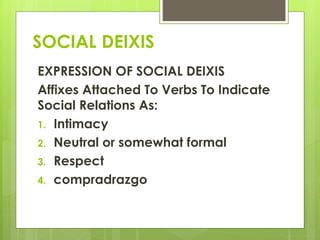
Affixes Attached To Verbs To Indicate
Social Relations As:
1. Intimacy
2. Neutral or somewhat formal
3. Respect
4. compradrazgo
SOCIAL DEIXIS
Discourse Deixis is concerned with
the use of a linguistic expression within
some utterance to point the current,
preceding or following utterances in the
same spoken or written discourse.
Alternatively, discourse deixis can
be said to refer to propositions (Lyons
1977, Webber 1991, Grenoble 1994,
Herring 1994, Fillmore 1997: 103-6, Diessel
1999: 101)
DISCOURSE DEIXIS
1. This is how birds evolved from predatory
dinosaurs.
2. That is tonight’s evening news.
3. Here goes the main argument.
4. In the last section, we discussed conversational
implicature, in this section, we consider
conventional implicature, and in the next
section, we shall compare and contrast them.
5. As already mentioned, the three main
branches of legal profession in England are
solicitors, barristers, and legal executives.
DISCOURSE DEIXIS

Deixis

  • 1.
  • 2.
    DEIXIS Deixis, a termwhich is derived from the Greek word δεῖξις (meaning “pointing”) It is the location and identification of persons, objects, events, processes and activities being talked about, or referred to in relation to the spatiotemporal context created and sustained by the act of utterance and the participation in it, typically, of a single speaker and at least one addressee. (Lyons 1977:637)
  • 3.
  • 4.
    DEIXIS 1. I preferapples to oranges 2. I’ll see you there/then 3. Besides, she is a very nice person
  • 6.
    DEICTIC vs NON-DEICTIC DEICTICS are expressions that have a deictic usage as basic or central NON-DEICTICS are expressions that do not have such a usage as basic or central
  • 7.
    DEICTIC vs NON-DEICTIC You,and you, but not you, go back to your dorms! (deitic) Mary wishes that she could visit the land of Lilliput. (non-deictic)
  • 8.
    If you travelon a train without a valid ticket, you will be liable to pay a penalty fare. (non-deictic) She’s not the principal; she is. She’s the secretary. (deictic) DEICTIC vs NON-DEICTIC
  • 9.
    GESTURAL vs SYMBOLIC GESTURALcan properly be interpreted only by a direct, moment by moment monitoring of some physical aspects of speech event. SYMBOLIC involves knowing the basic spatiotemporal parameter or speech event
  • 10.
    You, and you,but not you, go back to your dorms! (gestural) This town is famous for its small antique shops. (symbolic) GESTURAL vs SYMBOLIC
  • 11.
  • 12.
    DEICTIC CENTER Deixis isorganized in an egocentric way (Lyons 1977: 646). In fact, Russel (1905) called deictic terms egocentric particulars. The reason is that deixis is organized relative to specific parameters of the communicative event that place the speaker as the center of deixis.
  • 13.
  • 14.
    DEICTIC CENTER&DEICTIC CATEGORIES The defaultdeictic center, or deictic origo (ground zero) in the terminology of Buhler (1934), of the 3 major categories is the following: o PERSON DEIXIS the central anchorage point is the person who is speaking o for TIME DEIXIS is the time at which the speaker produces the utterance
  • 15.
    DEICTIC CENTER&DEICTIC CATEGORIES for PLACEDEIXIS is the place where the speaker produces the utterance
  • 16.
    DISCOURSE DEIXIS isdefined in terms of the text section in which the utterance containing the deictic element occurs SOCIAL DEIXIS is defined in terms of the speaker’s social status to which that of the addressee is relative DEICTIC CENTER&DEICTIC CATEGORIES
  • 17.
    DEICTIC PROJECTION The “egocentric”organization of deixis is not always adhered to, which gives rise to what Lyons (1977: 579) called deictic projection. o Can I go to your office tomorrow at 12:00? (has no deictic projection) o Can I come to your office tomorrow at 12:00? (has deictic projection)
  • 18.
    CATEGORIES OF DEIXIS PERSONDEIXIS Person deixis is concerned with the identification of interlocutor or participant- roles in a speech event. It is commonly expressed by:  personal pronouns, and if relevant, their associated predicate agreements Vocatives (kinship terms, titles and proper names and in combination of these)
  • 19.
    PERSON DEIXIS PERSONAL PRONOUNS/DISTINCTION First Person- grammaticalization of the speaker’s reference to –him or herself, that is, participant role with speaker inclusion [+S]  Second Person- encoding of the speaker’s reference to one or more addressees, that is, the participant role with addressee inclusion [+A]  Third Person- grammaticalization of reference to persons or entities which are neither speaker nor addressee, that is, participant- role and addressee exclusion [-S,-A]
  • 20.
    PERSONAL PRONOUNS First Person Iam ill.  Second Person She is ill. PERSON DEIXIS
  • 21.
    PERSONAL PRONOUNS/NUMBER Two mostcommon number systems are: 1. Singular-Plural woman- women 2. Singular-Dual-Plural ‘anta-’antumaa-’antum PERSON DEIXIS
  • 22.
    PERSONAL PRONOUNS/NUMBER Plural ofthe first person does not mean the same as plural of the third person. For example in English, “WE” does not mean plural speakers in the same way that “THEY” means more than one third person entity (Levinson 1983: 69) PERSON DEIXIS
  • 23.
    PERSON DEIXIS PERSONAL PRONOUNS/NUMBER Manyof the world’s languages have two non-singular first person pronouns, one meaning “we- inclusive-of-addressee” and the other meaning “we-exclusive-of- addressee”
  • 24.
    PERSONAL PRONOUNS/NUMBER “WE-INCLUSIVE-OF-ADDRESSEE “ 1.We can go all to the villain’s lair today. “WE-EXCLUSIVE-OF-ADDRESSEE” 1. We mean to stop your evil plans. PERSON DEIXIS
  • 25.
    PERSONAL PRONOUNS/GENDER In alllanguages with pronominal gender marking, gender can be distinguished on third person, where commonly two (masculine, feminine) or three (masculine, feminine, neuter) genders may be identified ; in some, gender assignments can also be for second person; in few, gender can be marked on first person as well (e.g Greenberg 1963; 96, Anderson and Keenan 1985; 269) PERSON DEIXIS
  • 26.
    PERSONAL PRONOUNS/GENDER Furthermore, withregard to person-gender marking, languages tend to encode more gender distinctions in the singular than the plural. ((e.g Greenberg 1963; 96, Anderson and Keenan 1985; 269) And English language confirms this (third-person singular: M:he, F:she, N:it ; third-person plural: they) PERSON DEIXISPERSON DEIXIS
  • 27.
    VOCATIVES Vocatives are NP’sthat refer to the addressee, but form no part of an of the arguments of a predicate. Vocatives in general are grouped into two types: calls or summonses; and addresses PERSON DEIXIS
  • 28.
    VOCATIVES Calls/Summonses 1. Hey, daddy,look, a spider in the corner! 2. John, if we don’t leave now, we’ll be late for our next appointment. 3. Doctor Williams, do you think I need a blood test? PERSON DEIXIS
  • 29.
    PERSON DEIXIS VOCATIVES Addresses 1. Iam afraid, Sir, we are closing. 2. Do you fancy going to a concert of African music, Lucy? 3. My view, Dean, is that we should set up a new department of linguistics.
  • 30.
    TIME DEIXIS TIME DEIXISis concerned with the encoding of temporal points and spans relative to the time at which an utterance is produced in a speech event. Two Distinct Ways of Representing the Passage of Time: 1. Time as constant and world as moving through time from past into the future (the years ahead) 2. World as stable and time as flowing through the world from future to past (the coming years)
  • 31.
    CALENDRICAL vs. NON-CALENDRICAL Calendrical-the time measure periods a fixed length sequence of naturally given units. Example: July Non-Calendrical- time measure periods are used only as units of measure relative to some fixed points of interest. Example: Fortnight TIME DEIXIS
  • 32.
    CODING TIME vs.RECEIVING TIME Coding Time- the moment of utterance Receiving Time- the moment of reception Under normal circumstances, assuming the default deictic center, RT can be taken to be identical to CT; in this case, we have what Lyons (1977: 685) called deictic simultaneity. TIME DEIXIS
  • 33.
    In these cases,the speaker has to decide whether the deictic center will remain on the speaker and CT, or will be shifted to the addressee and RT (Levinson 1983: 73-4, Fillmore 1997: 67-8) 1. This interview is being recorded today, Wednesday 3 July, to be relayed on Sunday 7 July. 2. This interview was recorded last Wednesday, 3 July, to be relayed today, Sunday 7 July. TIME DEIXIS
  • 34.
    TIME DEIXIS iscommonly grammaticalized in: (1) deictic adverbs of time (2) tense DEICTIC ADVERBS OF TIME- Now and Then are the two pure noun deictics which Anderson and Keenan (1985: 297) called temporal demonstratives. TIME DEIXIS
  • 35.
    PROXIMAL vs. DISTAL(Now&Then) Now designates Proximal Time, and following Levinson (1983: 74) it can be given (time) span including CT. Then refers to Distal Time and can be reduced to meaning ‘not now’. It can indicated time either in the past or in the future. TIME DEIXIS
  • 36.
    DIURNAL SPANS (Today,Tomorrow, Yesterday) Today can be glossed as ‘the diurnal span including CT’ Tomorrow can be glossed as ‘the diurnal span following today’ Yesterday can be glossed as ‘the diurnal span preceding today TIME DEIXIS
  • 37.
    (NowThen and Today/Tomorrow/Yesterday) 1. Startthe engine now! 2. John is now working as a government’s spin-doctor. 3. Yesterday was a public holiday. TIME DEIXIS
  • 38.
    TENSE Tense can bedistinguished between the following: 1. METALINGUISTIC TENSE (M-tense) means the theoretical category of tense 2. LIGUISTIC TENSE (L-tense) means the linguistic realization of M- tense TIME DEIXIS
  • 39.
    SPACE DEIXIS SPACE DEIXISis concerned with the specification of location in space relative to that of the participants at CT in a speech event. FRAMES OF SPATIAL REFERENCE, coined by the Gestalt theorist, are coordinate systems used to compute and specify the locations of the objects with respect to other objects. Cross-linguistically, there are 3 linguistic frames of reference to express spatial relationships between the entity (referent/figure) and the landmark (ground).
  • 40.
    FRAME OF REFERENCE 1.INTRINSIC-based on object-centered coordinates, which are determined by the ‘inherit features’ such as the sideness or facets of the object to be used as ground 2. RELATIVE- based on a tenary spacial relation between a viewpoint, and a figure and a ground. 3. ABSOLUTE- based on a coordinate system, but one that is an absolute coordinates like NEWS. SPACE DEIXIS
  • 41.
    1. The dogis behind the car. (intrinsic) 2. The dog is to the left of the car. (relative) 3. The dog is (to the) east of the car. (absolute) SPACE DEIXIS
  • 42.
    GRAMMATICALIZATION 1. Demonstratives 2. Deicticsadverb of space 3. Deictically marked third-person pronouns 4. Verbal affixes of motion and verbs of motion SPACE DEIXIS
  • 43.
    DEMONSTRATIVES&DEICTICS ADVERB OF SPACE-Parameters: 1. Distance 2. Visibility 3. Elevation 4. Side (Hanks: 1992, Agha:1996, Maning:2001) SPACE DEIXIS
  • 44.
    DEMONSTRATIVES&DEICTICS ADVERB OF SPACE-Parameter: DISTANCE One Term System- German and French Two Term System- Proximal and Distal Three Term System- Proximal, Medial, Distal Four Term System- (Samal) close to speaker, close to addressee, close to audience, away from all aforementioned SPACE DEIXIS
  • 45.
    DEMONSTRATIVES&DEICTICS ADVERB OFSPACE- Parameter: VISIBILITY (Imai:2003) 1. Invisible remote- out of sight and far from the speaker 2. Invisible occlusion- refers to entities that are behind an obstacle 3. Invisible periphery- out of sight but audible and/ or olfactory SPACE DEIXIS
  • 46.
    DEMONSTRATIVES&DEICTICS ADVERB OF SPACE-Parameter: ELEVATION Elevation is the physical dimension of height relative to the deictic center, typically the speaker (Hyslop:1993, Diessel:1999) Examples: down/downwards, up/upwards SPACE DEIXIS
  • 47.
    DEICTICALLY MARKED THIRDPERSON PRONOUNS 1. near 2. far 3. remote ---- 1. Proximity to the speaker’s front or side 2. Proximity to the speaker’s back 3. Remoteness anywhere from the speaker ---- 1. Near 2. Mid-distant 3. Distant 4. Not visible SPACE DEIXIS
  • 48.
    DEICTIC DIRECTIONALS 1. Kineticor deictic motion affixes, morphemes, particles 2. Deictic motion verbs SPACE DEIXIS
  • 49.
    DEICTIC DIRECTIONALS Two DeicticDirectional Verbal Prefixes (In Abaza) 1. indicates that movement denoted by the verb is directed towards the speaker’s location or CT 2. Indicates that it is directed away from the speaker’s location or CT Examples: 1. Come this way. 2. Go away. SPACE DEIXIS
  • 50.
    DIRECTIONAL MARKERS 1. Movementtowards the speaker’s location at CT 2. Movement towards the speaker’s location at arrival time 3. Movement towards the addressee’s location at CT 4. Movement towards the addressee’s location at arrival time 5. Movement towards the home base maintained at CT by either the speaker or the addressee SPACE DEIXIS
  • 51.
    DIRECTIONAL MARKERS 1. Johnwill come to the library next week SPACE DEIXIS
  • 52.
    SOCIAL DEIXIS SOCIAL DEIXIS SocialDeixis is concerned with the codification of the social status of the speaker, the addressee, or the third person or entity referred to, as well as social relationships holding between them (see, e.g., Levinson 1983: 63, Anderson and Keenan 1985, Fillmore 1997: 111-12, Manning 2001) Two Types (Comrie 1976, Levinson 1983: 90-1, Brown and Levinson 1987) 1. absolute 2. relational
  • 53.
    ABSOLUTE vs RELATIONAL Absoluteinformation in social deixis can be illustrated by forms that are reserved for authorized speakers or authorized recipients Relational information in social deixis are reserved for authorized recipients, restrictions are placed on most titles of addressees SOCIAL DEIXIS
  • 54.
    ABSOLUTE vs RELATIONAL Zhen-(reserved for the emperor to refer himself in imperial China) [absolute] Mr. President- [relational] SOCIAL DEIXIS
  • 55.
    RELATIONAL SOCIAL DEIXIS FourAxes 1. Speaker and referent (referent honorifics)- are forms employed by the speaker to show respect towards the referent 2. Speaker and addressee (addressee honorifics)- are forms that used by the speakers to show difference towards the addressee SOCIAL DEIXIS
  • 56.
    RELATIONAL SOCIAL DEIXIS FourAxes 3. Speaker and bystander (bystander honorifics)- are forms used by the speaker to signify respect to a bystander, including participants in the role of audience and non- participant overhearers 4. Speaker and setting (level of formality)- relation between the speaker and the speech event SOCIAL DEIXIS
  • 57.
    EXPRESSION OF SOCIALDEIXIS Personal Pronouns/ Marking of Respect T/V Distinction (Brown and Gilman 1960) 1. Familiar or T 2. Polite or V SOCIAL DEIXIS
  • 58.
    EXPRESSION OF SOCIALDEIXIS Forms of Address 1. First name (James) 2. Last Name (Bond) 3. Combination (James Bond) 4. Kinship Terms (uncle) 5. Titles borrowed from names of occupations (doctor) 6. Ranks in certain social/professional groups (colonel) 7. Combination of titles and names (Professor Sirn John Lyons) 8. Others (Madam) SOCIAL DEIXIS
  • 59.
    EXPRESSION OF SOCIALDEIXIS Affixes, Clitics, Particles (Korean) 1. (-na) marking intimate 2. (-e) familiar 3. (-ta) plain 4. (-eyo) polite 5. (-supnita) deferential 6. (-so) authoritative (Trudgill 2000: 93) SOCIAL DEIXIS
  • 60.
    EXPRESSION OF SOCIALDEIXIS Affixes Attached To Verbs To Indicate Social Relations As: 1. Intimacy 2. Neutral or somewhat formal 3. Respect 4. compradrazgo SOCIAL DEIXIS
  • 61.
    Discourse Deixis isconcerned with the use of a linguistic expression within some utterance to point the current, preceding or following utterances in the same spoken or written discourse. Alternatively, discourse deixis can be said to refer to propositions (Lyons 1977, Webber 1991, Grenoble 1994, Herring 1994, Fillmore 1997: 103-6, Diessel 1999: 101) DISCOURSE DEIXIS
  • 62.
    1. This ishow birds evolved from predatory dinosaurs. 2. That is tonight’s evening news. 3. Here goes the main argument. 4. In the last section, we discussed conversational implicature, in this section, we consider conventional implicature, and in the next section, we shall compare and contrast them. 5. As already mentioned, the three main branches of legal profession in England are solicitors, barristers, and legal executives. DISCOURSE DEIXIS