


Slide
Presented to: Sir Nazir Malik Presented by: Sunila Aslam Nazish Shakeel Ayesha Afzal Sunbal Javaid Durr-e-Nayab Sadaf Mahreen
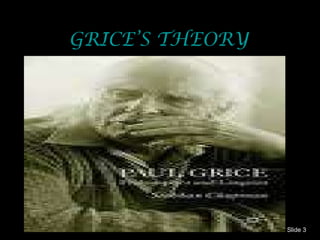
GRICE’S THEORY Slide
The Cooperative  Principle 1975 Slide
What is Cooperation? Cooperation can be understood as  an essential factor when speakers and listeners are interacting, in other words, it is the expectation   that the listener has towards the speaker. The speaker is supposed to convey true statements and say nothing more than what is required. Slide
Cooperation  When people talk with each other, they try to converse smoothly and successfully.  Cooperation is the basis  of successful conversations. Slide
The Cooperative Principle  A principle proposed by the  philosopher   Paul Grice  in  1975 ,whereby those involved in communication assume that both parties will normally seek to cooperate with each other to establish agreed meaning.  Slide
Cooperative Principle COOPERATIVE PRINCIPLE The idea that people cooperate with each other in conversing is generalized by Grice (1975). The speaker is co operative and intends to communicate something  That something must be more than what the words mean It leads to implicature Slide
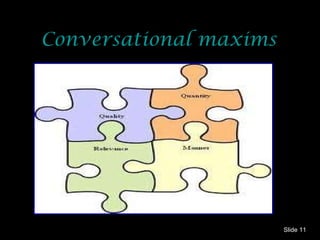
There is a set of guidelines for effective and rational use of language. Guidelines = a general cooperative principle + Four maxims of conversation. Slide
Cooperative principle and its four maxims Make your conversational contribution such as is required, at the stage as which it occurs, by the accepted purpose or direction of the talk exchange in which you are engaged. Specifically, there are four maxims under this general . Slide
Conversational maxims Slide
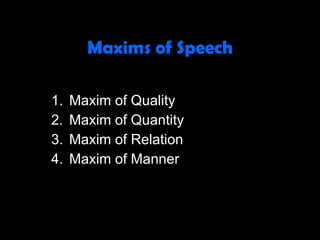
Maxims of Speech Maxim of Quality Maxim of Quantity Maxim of Relation Maxim of Manner
Maxim of Quality
Definition When engaged in conversation, the Maxim of Quality requires that you Do not say what you believe to be false. Do not say that for which you lack adequate evidence.     H.P. Grice (1975) Slide  H.P. Grice
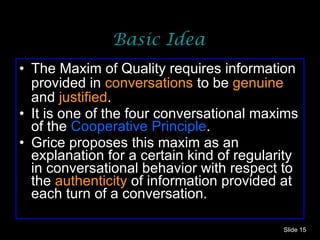
Basic Idea The Maxim of Quality requires information provided in  conversations  to be  genuine  and  justified . It is one of the four conversational maxims of the  Cooperative Principle .  Grice proposes this maxim as an explanation for a certain kind of regularity in conversational behavior with respect to the  authenticity  of information provided at each turn of a conversation.  Slide
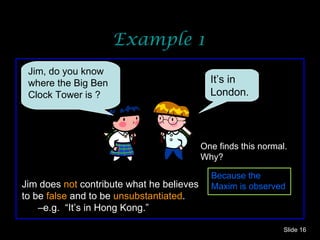
Example 1 Slide  Jim, do you know where the Big Ben Clock Tower is ? It’s in London. One finds this normal. Why? Because the Maxim is observed Jim does  not  contribute what he believes to be  false  and to be  unsubstantiated . – e.g.  “It’s in Hong Kong.”
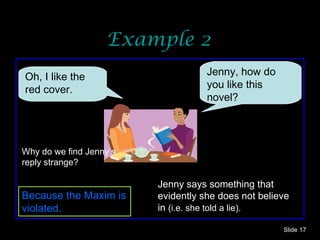
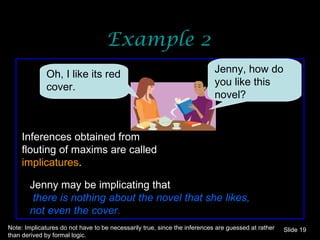
Example 2 Slide  Jenny, how do you like this novel? Oh, I like the red cover.  Because the Maxim is violated. Jenny says something that evidently she does not believe in  (i.e. she told a lie). Why do we find Jenny’s reply strange?
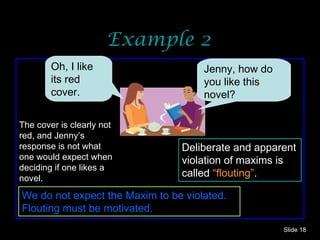
Example 2 Slide  The cover is clearly not red, and Jenny’s response is not what one would expect when deciding if one likes a novel. Deliberate and apparent violation of maxims is called  “flouting” . We do not expect the Maxim to be violated. Flouting must be motivated. Oh, I like its red cover.  Jenny, how do you like this novel?
Example 2 Oh, I like its red cover.  Jenny, how do you like this novel? Inferences obtained from flouting of maxims are called  implicatures . Jenny may be implicating that there is nothing about the novel that she likes, not even the cover. Note: Implicatures do not have to be necessarily true, since the inferences are guessed at rather than derived by formal logic. Slide
Maxim of Quantity
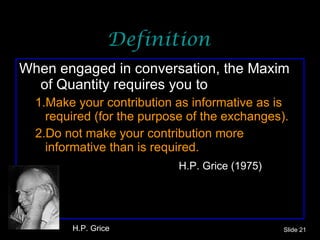
Definition When engaged in conversation, the Maxim of Quantity requires you to  Make your contribution as informative as is required (for the purpose of the exchanges). Do not make your contribution more informative than is required.     H.P. Grice (1975) Slide  H.P. Grice
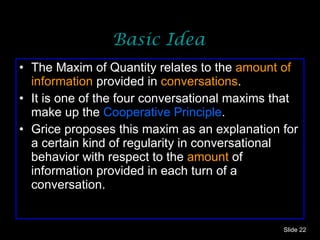
Basic Idea The Maxim of Quantity relates to the  amount of information  provided in  conversations . It is one of the four conversational maxims that make up the  Cooperative Principle .  Grice proposes this maxim as an explanation for a certain kind of regularity in conversational behavior with respect to the  amount  of information provided in each turn of a conversation.  Slide
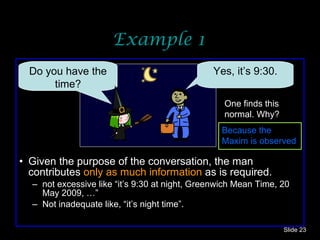
Example 1 Given the purpose of the conversation, the man contributes  only  as much   information  as is required. not excessive like “it’s 9:30 at night, Greenwich Mean Time, 20 May 2009, …” Not inadequate like, “it’s night time”. Slide  Do you have the time? Yes, it’s 9:30. One finds this normal. Why? Because the Maxim is observed
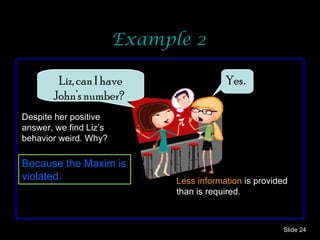
Example 2 Slide  Liz, can I have John’s number?   Yes . Despite her positive answer, we find Liz’s behavior weird. Why? Because the Maxim is violated. Less information  is provided than is required.
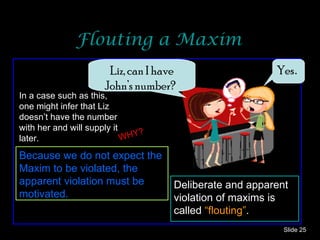
Flouting a Maxim Slide  Liz, can I have John’s number?   Yes . In a case such as this, one might infer that Liz doesn’t have the number with her and will supply it later. Because we do not expect the Maxim to be violated, the apparent violation must be motivated. WHY? Deliberate and apparent violation of maxims is called  “flouting” .
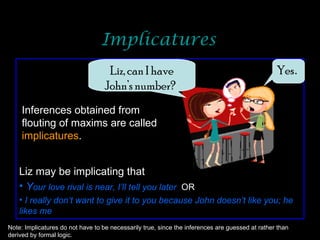
Implicatures Liz, can I have John’s number?   Yes . Inferences obtained from flouting of maxims are called  implicatures . Liz may be implicating that Y our love rival is near, I’ll tell you later  OR I really don’t want to give it to you because John doesn’t like you; he likes me Note: Implicatures do not have to be necessarily true, since the inferences are guessed at rather than derived by formal logic.
Maxim of Relation/Relevance
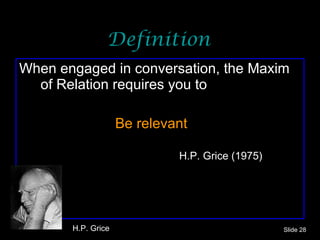
Definition When engaged in conversation, the Maxim of Relation requires you to  Be relevant      H.P. Grice (1975) Slide  H.P. Grice
Basic Idea The Maxim of Relation is one of the four conversational maxims of the  Cooperative Principle .  Grice proposes this maxim as an explanation for a certain kind of regularity in conversational behavior with respect to the  relevance  of information provided at each turn of a conversation.  Slide
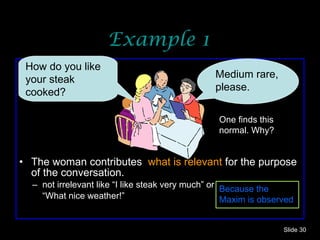
Example 1 The woman contributes  what is relevant  for the purpose of the conversation. not irrelevant like “I like steak very much” or  “ What nice weather!” Slide  Medium rare, please. How do you like your steak cooked? Because the Maxim is observed One finds this normal. Why?
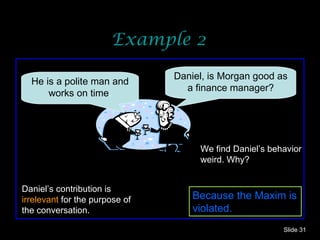
Example 2 Slide  Daniel, is Morgan good as a finance manager? He is a polite man and works on time . We find Daniel’s behavior weird. Why? Because the Maxim is violated. Daniel’s contribution is  irrelevant  for the purpose of the conversation.
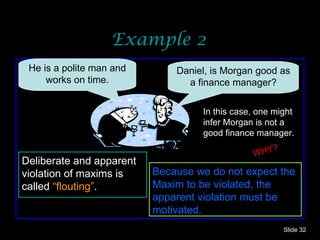
Example 2 Slide  He is a polite man and works on time. In this case, one might infer Morgan is not a good finance manager. Because we do not expect the Maxim to be violated, the apparent violation must be motivated. Deliberate and apparent violation of maxims is called  “flouting” . WHY? Daniel, is Morgan good as a finance manager?
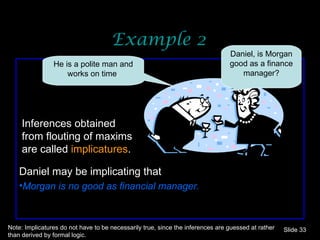
Example 2 Slide  Inferences obtained from flouting of maxims are called  implicatures . Daniel may be implicating that Morgan is no good as financial manager. Note: Implicatures do not have to be necessarily true, since the inferences are guessed at rather than derived by formal logic. He is a polite man and works on time . Daniel, is Morgan good as a finance manager?
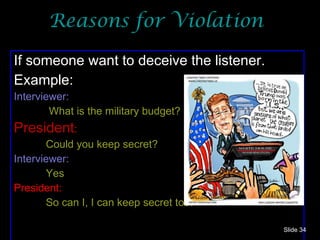
Reasons for Violation If someone want to deceive the listener. Example: Interviewer:   What is the military budget? President : Could you keep secret? Interviewer: Yes President: So can I, I can keep secret too. Slide
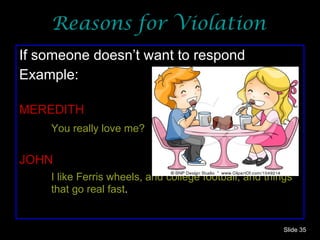
Reasons for Violation If someone doesn’t want to respond Example: MEREDITH You really love me? JOHN I like Ferris wheels, and college football, and things  that go real fast . Slide
Maxim of Manner
Definition When engaged in conversation, the Maxim of Manner requires you to  be perspicuous . Includes (but not restricted to)  Avoid obscurity of expression Avoid ambiguity. Be brief (avoid unnecessary prolixity). Be orderly.   H.P. Grice (1975) Slide  H.P. Grice
Example A: I hear you went to the opera last night, how was the lead singer? B : The singer produced a series of sounds corresponding closely to the score of an aria from “Rigoletto” Slide
Basic Idea The Maxim of Manner is  related to how something is being said in the conversation. It is one of the four conversational maxims that are part of the  Cooperative Principle .  Grice proposes this maxim as an explanation for a certain kind of regularity in conversational behavior with respect to the way information is provided at each turn of a conversation.  Slide
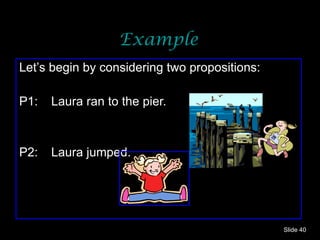
Example Let’s begin by considering two propositions: P1: Laura ran to the pier. P2: Laura jumped. Slide
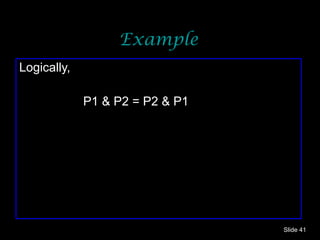
Example Logically,  P1 & P2 = P2 & P1 Slide
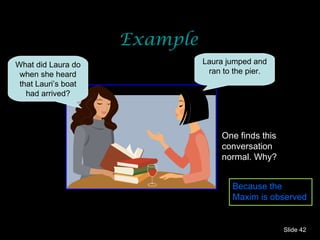
Example Slide  One finds this conversation normal. Why? Because the Maxim is observed Laura jumped and ran to the pier. What did Laura do when she heard that Lauri’s boat had arrived?
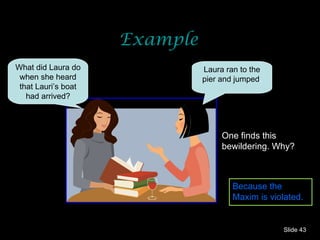
Example Slide  One finds this bewildering. Why? Because the Maxim is violated. What did Laura do when she heard that Lauri’s boat had arrived? Laura ran to the pier and jumped .
Example Logically,  P1 & P2 = P2 & P1 But  being   orderly   in the presentation of information is important in conversations. This is an effect of the  Maxim of Manner . Slide
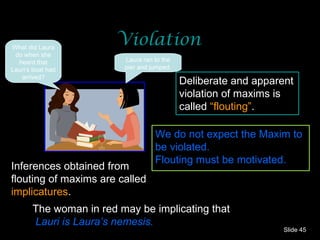
Violation Slide  What did Laura do when she heard that Lauri’s boat had arrived? Laura ran to the pier and jumped. Deliberate and apparent violation of maxims is called  “flouting” . We do not expect the Maxim to be violated. Flouting must be motivated. Inferences obtained from flouting of maxims are called  implicatures . The woman in red may be implicating that Lauri is Laura’s nemesis.
Scope of Manner Violations of the Maxim of Manner can take many forms: Order of presentation of information Vagueness and ambiguity Volume and pace Choice of words Attitude Even facial/gestural expressions Slide
Criticism Slide
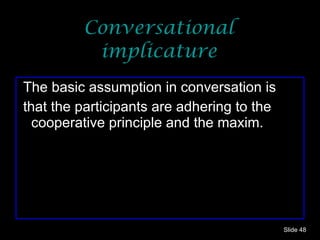
Conversational implicature The basic assumption in conversation is that the participants are adhering to the cooperative principle and the maxim. Slide
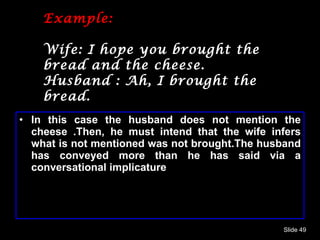
Example: Wife: I hope you brought the bread and the cheese. Husband : Ah, I brought the bread. In this case the husband does not mention the cheese .Then, he must intend that the wife infers what is not mentioned was not brought.The husband has conveyed more than he has said via a conversational implicature Slide
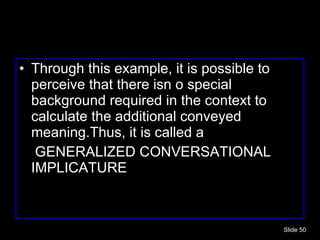
Through this example, it is possible to perceive that there isn o special background required in the context to calculate the additional conveyed meaning.Thus, it is called a  GENERALIZED CONVERSATIONAL IMPLICATURE Slide
Conversational implicatures According to Grice, utterance interpretation is not a matter of decoding messages, but rather involves (1) taking the meaning of the sentences together with contextual information,  (2) using inference rules  (3) working out what the speaker means on the basis of the assumption that the utterance conforms to the maxims. The main advantage of this approach from Grice’s point of view is that it provides a pragmatic explanation for a wide range of phenomena, especially for  conversational implicautres --- a kind of extra meaning that is not literally contained in the utterance. Slide
According to Grice, conversational implicatures can arise from either strictly and directly observing or deliberately and openly flouting the maxims, that is, speakers can produce implicatures in two ways: observance and non-observance of the maxims.  Ex. (1) Husband: Where are the car keys? Wife:  They’re on the table in the hall. The wife has answered clearly (manner) and truthfully (Quality), has given just the right amount of information (Quantity) and has directly addressed her husband’s goal in asking the question (Relation). She ahs said precisely what she meant, no more and no less. Slide
(2) He is a tiger. Example (2) is literally false, openly against the maxim of quality, for no human is a tiger. But the hearer still assumes that the speaker is being cooperative and then infers that he is trying to say something distinct from the literal meaning. He can then work out that probably the speaker meant to say that “he has some characteristics of a tiger”.  Slide
Particularized conversational implicatures Occur when a conversation takes place in a very specific context in which locally recognized inferences are assumed. Rick: Hey, coming to the wild party tonight? Tom: My parents are visiting. In order to make Tom’s response relevant, Rick has to draw on some assumed knowledge that one college student in this setting expects another to have. Tom will be spending that evening with his parents, and time spent with parents is quiet ( consequently +>  Tom not at party). Slide
Bert: Do vegetarians eat hamburger? Ernie: Do chickens have lips? In the above example, Ernie’s response does not provide a ‘yes’ or ‘no’ answer. Bert must assume that Ernie’s response Bert: Do vegetarians eat hamburger? Ernie: Do chickens have lips? means ‘ of course not!’. Slide
Scalar implicature Scalar implicatures occur when certain information is communicated by chhosing a WORD which expresses one value from a scale of values. From the highest to the lowest (all, most, many, some , few) (always, often  sometime) Slide
The basis of the scallar implicature is that when any form in a scale is asserted, the negeitive of all forms higher on the scale is implicated. I’m studying linguistics and I have completed some of the required  course. BY using(some of the required courses), the speaker creates an implicature (+> not all), but this is only one of the scale: <all, most, many , some few) Infact, the speaker creates the implicature( +> not all, +> not most,+> not many). Slide
Conventional implicatures are  not based on the cooperative  principle or the  maxims. They  do not have to occur in conversation, and they do not  depend on special contexts for their interpretation. Slide
Conventional implicatures Conventional implicatures are associated with specific words and result in additional conveyed meanings when those words are used. The English  conjunction  ‘ but’ is one of these words. YET BUT EVEN Slide
Mary suggested black, but I chose white. In this sentence, ‘ Mary suggested black’ is  contrasted, via the  conventional implicature of ‘but’, with my choosing white. Other English words such as ‘yet’ also have Conventional implicatures: Dennis isn’t here yet. In uttering this statement, the speaker produces an implicature that she/he expects the statement ‘Dennis is here’. The  conventional implicature of  ‘yet’ is that  the  present situation is expected to be different, or perhaps the opposite, at a later time . Slide
The End

Cooperative principle.

  • 1.
  • 2.
    Presented to: SirNazir Malik Presented by: Sunila Aslam Nazish Shakeel Ayesha Afzal Sunbal Javaid Durr-e-Nayab Sadaf Mahreen
  • 3.
  • 4.
    The Cooperative Principle 1975 Slide
  • 5.
    What is Cooperation?Cooperation can be understood as an essential factor when speakers and listeners are interacting, in other words, it is the expectation that the listener has towards the speaker. The speaker is supposed to convey true statements and say nothing more than what is required. Slide
  • 6.
    Cooperation Whenpeople talk with each other, they try to converse smoothly and successfully. Cooperation is the basis of successful conversations. Slide
  • 7.
    The Cooperative Principle A principle proposed by the philosopher Paul Grice in 1975 ,whereby those involved in communication assume that both parties will normally seek to cooperate with each other to establish agreed meaning. Slide
  • 8.
    Cooperative Principle COOPERATIVEPRINCIPLE The idea that people cooperate with each other in conversing is generalized by Grice (1975). The speaker is co operative and intends to communicate something That something must be more than what the words mean It leads to implicature Slide
  • 9.
    There is aset of guidelines for effective and rational use of language. Guidelines = a general cooperative principle + Four maxims of conversation. Slide
  • 10.
    Cooperative principle andits four maxims Make your conversational contribution such as is required, at the stage as which it occurs, by the accepted purpose or direction of the talk exchange in which you are engaged. Specifically, there are four maxims under this general . Slide
  • 11.
  • 12.
    Maxims of SpeechMaxim of Quality Maxim of Quantity Maxim of Relation Maxim of Manner
  • 13.
  • 14.
    Definition When engagedin conversation, the Maxim of Quality requires that you Do not say what you believe to be false. Do not say that for which you lack adequate evidence. H.P. Grice (1975) Slide H.P. Grice
  • 15.
    Basic Idea TheMaxim of Quality requires information provided in conversations to be genuine and justified . It is one of the four conversational maxims of the Cooperative Principle . Grice proposes this maxim as an explanation for a certain kind of regularity in conversational behavior with respect to the authenticity of information provided at each turn of a conversation. Slide
  • 16.
    Example 1 Slide Jim, do you know where the Big Ben Clock Tower is ? It’s in London. One finds this normal. Why? Because the Maxim is observed Jim does not contribute what he believes to be false and to be unsubstantiated . – e.g. “It’s in Hong Kong.”
  • 17.
    Example 2 Slide Jenny, how do you like this novel? Oh, I like the red cover. Because the Maxim is violated. Jenny says something that evidently she does not believe in (i.e. she told a lie). Why do we find Jenny’s reply strange?
  • 18.
    Example 2 Slide The cover is clearly not red, and Jenny’s response is not what one would expect when deciding if one likes a novel. Deliberate and apparent violation of maxims is called “flouting” . We do not expect the Maxim to be violated. Flouting must be motivated. Oh, I like its red cover. Jenny, how do you like this novel?
  • 19.
    Example 2 Oh,I like its red cover. Jenny, how do you like this novel? Inferences obtained from flouting of maxims are called implicatures . Jenny may be implicating that there is nothing about the novel that she likes, not even the cover. Note: Implicatures do not have to be necessarily true, since the inferences are guessed at rather than derived by formal logic. Slide
  • 20.
  • 21.
    Definition When engagedin conversation, the Maxim of Quantity requires you to Make your contribution as informative as is required (for the purpose of the exchanges). Do not make your contribution more informative than is required. H.P. Grice (1975) Slide H.P. Grice
  • 22.
    Basic Idea TheMaxim of Quantity relates to the amount of information provided in conversations . It is one of the four conversational maxims that make up the Cooperative Principle . Grice proposes this maxim as an explanation for a certain kind of regularity in conversational behavior with respect to the amount of information provided in each turn of a conversation. Slide
  • 23.
    Example 1 Giventhe purpose of the conversation, the man contributes only as much information as is required. not excessive like “it’s 9:30 at night, Greenwich Mean Time, 20 May 2009, …” Not inadequate like, “it’s night time”. Slide Do you have the time? Yes, it’s 9:30. One finds this normal. Why? Because the Maxim is observed
  • 24.
    Example 2 Slide Liz, can I have John’s number? Yes . Despite her positive answer, we find Liz’s behavior weird. Why? Because the Maxim is violated. Less information is provided than is required.
  • 25.
    Flouting a MaximSlide Liz, can I have John’s number? Yes . In a case such as this, one might infer that Liz doesn’t have the number with her and will supply it later. Because we do not expect the Maxim to be violated, the apparent violation must be motivated. WHY? Deliberate and apparent violation of maxims is called “flouting” .
  • 26.
    Implicatures Liz, canI have John’s number? Yes . Inferences obtained from flouting of maxims are called implicatures . Liz may be implicating that Y our love rival is near, I’ll tell you later OR I really don’t want to give it to you because John doesn’t like you; he likes me Note: Implicatures do not have to be necessarily true, since the inferences are guessed at rather than derived by formal logic.
  • 27.
  • 28.
    Definition When engagedin conversation, the Maxim of Relation requires you to Be relevant H.P. Grice (1975) Slide H.P. Grice
  • 29.
    Basic Idea TheMaxim of Relation is one of the four conversational maxims of the Cooperative Principle . Grice proposes this maxim as an explanation for a certain kind of regularity in conversational behavior with respect to the relevance of information provided at each turn of a conversation. Slide
  • 30.
    Example 1 Thewoman contributes what is relevant for the purpose of the conversation. not irrelevant like “I like steak very much” or “ What nice weather!” Slide Medium rare, please. How do you like your steak cooked? Because the Maxim is observed One finds this normal. Why?
  • 31.
    Example 2 Slide Daniel, is Morgan good as a finance manager? He is a polite man and works on time . We find Daniel’s behavior weird. Why? Because the Maxim is violated. Daniel’s contribution is irrelevant for the purpose of the conversation.
  • 32.
    Example 2 Slide He is a polite man and works on time. In this case, one might infer Morgan is not a good finance manager. Because we do not expect the Maxim to be violated, the apparent violation must be motivated. Deliberate and apparent violation of maxims is called “flouting” . WHY? Daniel, is Morgan good as a finance manager?
  • 33.
    Example 2 Slide Inferences obtained from flouting of maxims are called implicatures . Daniel may be implicating that Morgan is no good as financial manager. Note: Implicatures do not have to be necessarily true, since the inferences are guessed at rather than derived by formal logic. He is a polite man and works on time . Daniel, is Morgan good as a finance manager?
  • 34.
    Reasons for ViolationIf someone want to deceive the listener. Example: Interviewer: What is the military budget? President : Could you keep secret? Interviewer: Yes President: So can I, I can keep secret too. Slide
  • 35.
    Reasons for ViolationIf someone doesn’t want to respond Example: MEREDITH You really love me? JOHN I like Ferris wheels, and college football, and things that go real fast . Slide
  • 36.
  • 37.
    Definition When engagedin conversation, the Maxim of Manner requires you to be perspicuous . Includes (but not restricted to) Avoid obscurity of expression Avoid ambiguity. Be brief (avoid unnecessary prolixity). Be orderly. H.P. Grice (1975) Slide H.P. Grice
  • 38.
    Example A: Ihear you went to the opera last night, how was the lead singer? B : The singer produced a series of sounds corresponding closely to the score of an aria from “Rigoletto” Slide
  • 39.
    Basic Idea TheMaxim of Manner is related to how something is being said in the conversation. It is one of the four conversational maxims that are part of the Cooperative Principle . Grice proposes this maxim as an explanation for a certain kind of regularity in conversational behavior with respect to the way information is provided at each turn of a conversation. Slide
  • 40.
    Example Let’s beginby considering two propositions: P1: Laura ran to the pier. P2: Laura jumped. Slide
  • 41.
    Example Logically, P1 & P2 = P2 & P1 Slide
  • 42.
    Example Slide One finds this conversation normal. Why? Because the Maxim is observed Laura jumped and ran to the pier. What did Laura do when she heard that Lauri’s boat had arrived?
  • 43.
    Example Slide One finds this bewildering. Why? Because the Maxim is violated. What did Laura do when she heard that Lauri’s boat had arrived? Laura ran to the pier and jumped .
  • 44.
    Example Logically, P1 & P2 = P2 & P1 But being orderly in the presentation of information is important in conversations. This is an effect of the Maxim of Manner . Slide
  • 45.
    Violation Slide What did Laura do when she heard that Lauri’s boat had arrived? Laura ran to the pier and jumped. Deliberate and apparent violation of maxims is called “flouting” . We do not expect the Maxim to be violated. Flouting must be motivated. Inferences obtained from flouting of maxims are called implicatures . The woman in red may be implicating that Lauri is Laura’s nemesis.
  • 46.
    Scope of MannerViolations of the Maxim of Manner can take many forms: Order of presentation of information Vagueness and ambiguity Volume and pace Choice of words Attitude Even facial/gestural expressions Slide
  • 47.
  • 48.
    Conversational implicature Thebasic assumption in conversation is that the participants are adhering to the cooperative principle and the maxim. Slide
  • 49.
    Example: Wife: Ihope you brought the bread and the cheese. Husband : Ah, I brought the bread. In this case the husband does not mention the cheese .Then, he must intend that the wife infers what is not mentioned was not brought.The husband has conveyed more than he has said via a conversational implicature Slide
  • 50.
    Through this example,it is possible to perceive that there isn o special background required in the context to calculate the additional conveyed meaning.Thus, it is called a GENERALIZED CONVERSATIONAL IMPLICATURE Slide
  • 51.
    Conversational implicatures Accordingto Grice, utterance interpretation is not a matter of decoding messages, but rather involves (1) taking the meaning of the sentences together with contextual information, (2) using inference rules (3) working out what the speaker means on the basis of the assumption that the utterance conforms to the maxims. The main advantage of this approach from Grice’s point of view is that it provides a pragmatic explanation for a wide range of phenomena, especially for conversational implicautres --- a kind of extra meaning that is not literally contained in the utterance. Slide
  • 52.
    According to Grice,conversational implicatures can arise from either strictly and directly observing or deliberately and openly flouting the maxims, that is, speakers can produce implicatures in two ways: observance and non-observance of the maxims. Ex. (1) Husband: Where are the car keys? Wife: They’re on the table in the hall. The wife has answered clearly (manner) and truthfully (Quality), has given just the right amount of information (Quantity) and has directly addressed her husband’s goal in asking the question (Relation). She ahs said precisely what she meant, no more and no less. Slide
  • 53.
    (2) He isa tiger. Example (2) is literally false, openly against the maxim of quality, for no human is a tiger. But the hearer still assumes that the speaker is being cooperative and then infers that he is trying to say something distinct from the literal meaning. He can then work out that probably the speaker meant to say that “he has some characteristics of a tiger”. Slide
  • 54.
    Particularized conversational implicaturesOccur when a conversation takes place in a very specific context in which locally recognized inferences are assumed. Rick: Hey, coming to the wild party tonight? Tom: My parents are visiting. In order to make Tom’s response relevant, Rick has to draw on some assumed knowledge that one college student in this setting expects another to have. Tom will be spending that evening with his parents, and time spent with parents is quiet ( consequently +> Tom not at party). Slide
  • 55.
    Bert: Do vegetarianseat hamburger? Ernie: Do chickens have lips? In the above example, Ernie’s response does not provide a ‘yes’ or ‘no’ answer. Bert must assume that Ernie’s response Bert: Do vegetarians eat hamburger? Ernie: Do chickens have lips? means ‘ of course not!’. Slide
  • 56.
    Scalar implicature Scalarimplicatures occur when certain information is communicated by chhosing a WORD which expresses one value from a scale of values. From the highest to the lowest (all, most, many, some , few) (always, often sometime) Slide
  • 57.
    The basis ofthe scallar implicature is that when any form in a scale is asserted, the negeitive of all forms higher on the scale is implicated. I’m studying linguistics and I have completed some of the required course. BY using(some of the required courses), the speaker creates an implicature (+> not all), but this is only one of the scale: <all, most, many , some few) Infact, the speaker creates the implicature( +> not all, +> not most,+> not many). Slide
  • 58.
    Conventional implicatures are not based on the cooperative principle or the maxims. They do not have to occur in conversation, and they do not depend on special contexts for their interpretation. Slide
  • 59.
    Conventional implicatures Conventionalimplicatures are associated with specific words and result in additional conveyed meanings when those words are used. The English conjunction ‘ but’ is one of these words. YET BUT EVEN Slide
  • 60.
    Mary suggested black,but I chose white. In this sentence, ‘ Mary suggested black’ is contrasted, via the conventional implicature of ‘but’, with my choosing white. Other English words such as ‘yet’ also have Conventional implicatures: Dennis isn’t here yet. In uttering this statement, the speaker produces an implicature that she/he expects the statement ‘Dennis is here’. The conventional implicature of ‘yet’ is that the present situation is expected to be different, or perhaps the opposite, at a later time . Slide
  • 61.