1.1 Language characteristics
INTRODUCTION TO LANGUAGE
(Basing on Tanzanian Syllabus for English
Advanced Level learners)
9/24/2020samuelkessy46@gmail.com
The concept of language
 The term “language” is derived from a Latin word
“Lingua” which means tongue and French term
“Langue”.
 Defining the term Language is not simple as it is very
complex phenomenon. The complexity of this term
has lead to the presence of many definitions to define
what language is. This is due to the reason that people
seem to view things from different perspectives.
 However, most definitions seem to have some
resemblances, various scholars had the following
views on the concept of the term ‘language’
9/24/2020samuelkessy46@gmail.com
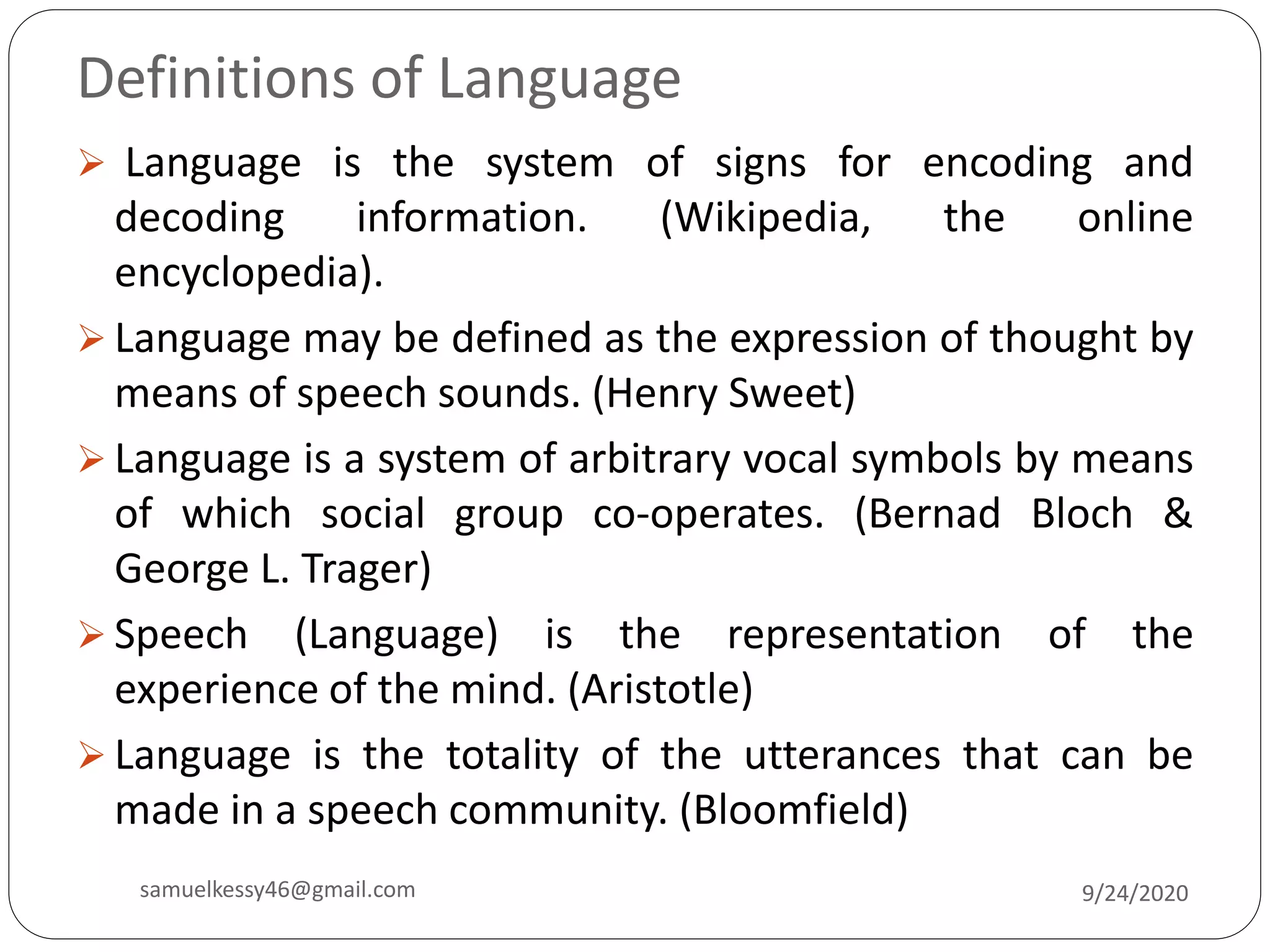
Definitions of Language
 Language is the system of signs for encoding and
decoding information. (Wikipedia, the online
encyclopedia).
 Language may be defined as the expression of thought by
means of speech sounds. (Henry Sweet)
 Language is a system of arbitrary vocal symbols by means
of which social group co-operates. (Bernad Bloch &
George L. Trager)
 Speech (Language) is the representation of the
experience of the mind. (Aristotle)
 Language is the totality of the utterances that can be
made in a speech community. (Bloomfield)
9/24/2020samuelkessy46@gmail.com
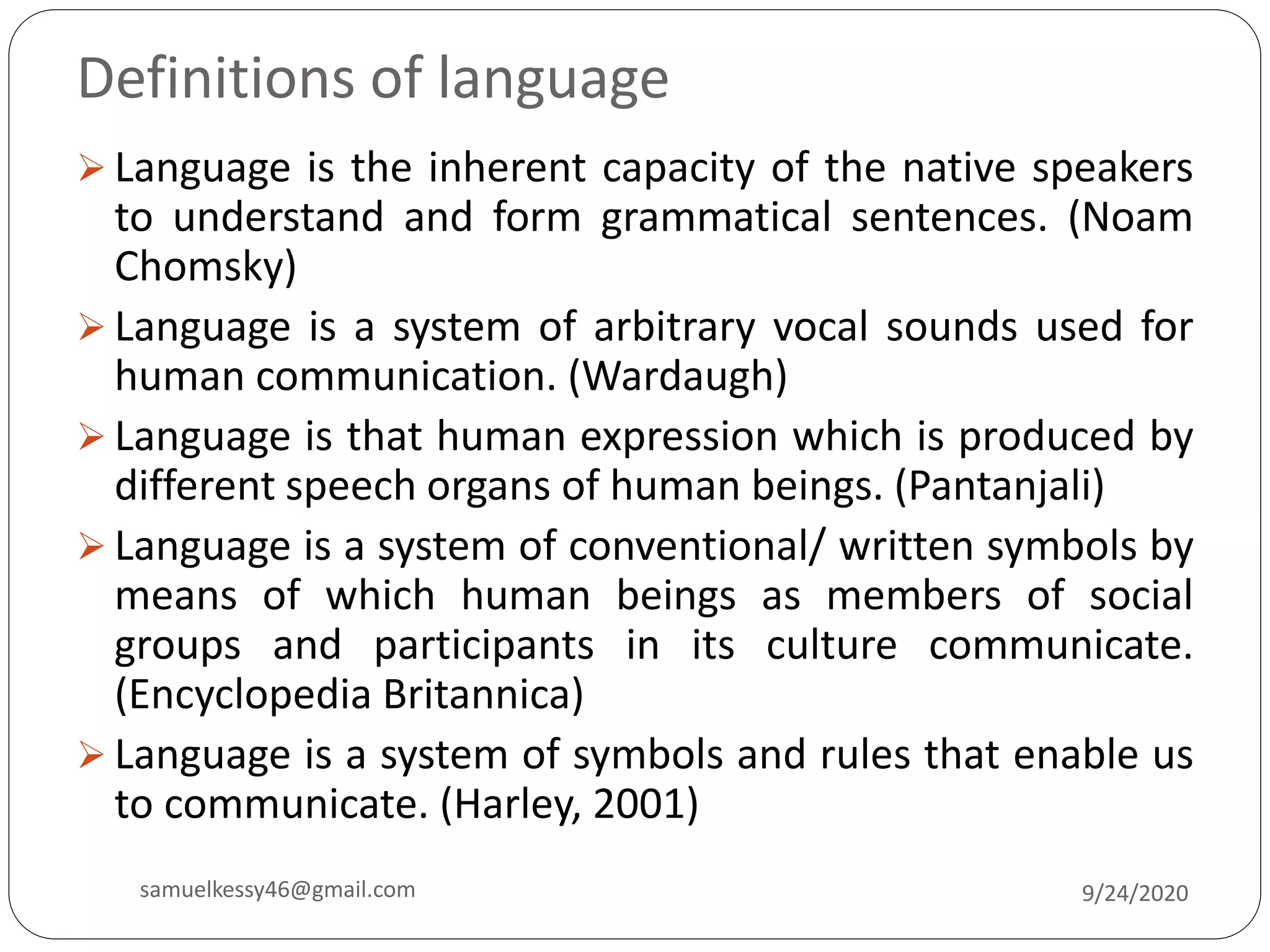
Definitions of language
 Language is the inherent capacity of the native speakers
to understand and form grammatical sentences. (Noam
Chomsky)
 Language is a system of arbitrary vocal sounds used for
human communication. (Wardaugh)
 Language is that human expression which is produced by
different speech organs of human beings. (Pantanjali)
 Language is a system of conventional/ written symbols by
means of which human beings as members of social
groups and participants in its culture communicate.
(Encyclopedia Britannica)
 Language is a system of symbols and rules that enable us
to communicate. (Harley, 2001)
9/24/2020samuelkessy46@gmail.com
What is Language?
 Thus, the above definitions have spoken mostly about five
elements such as; system, arbitrary, vocal, symbol and
communication. Therefore, in defining the term language,
the above elements must not be left out.
System; A system can be defined as a set of elements
standing in interaction. In other words it is a group of
things which have something in common. This includes
any grouping with any sort of relationship. A good
example of the system can be drawn from digestive
system of the human being as well as reproductive
system. These systems comprises different elements
which are working together to perform common activity.
9/24/2020samuelkessy46@gmail.com
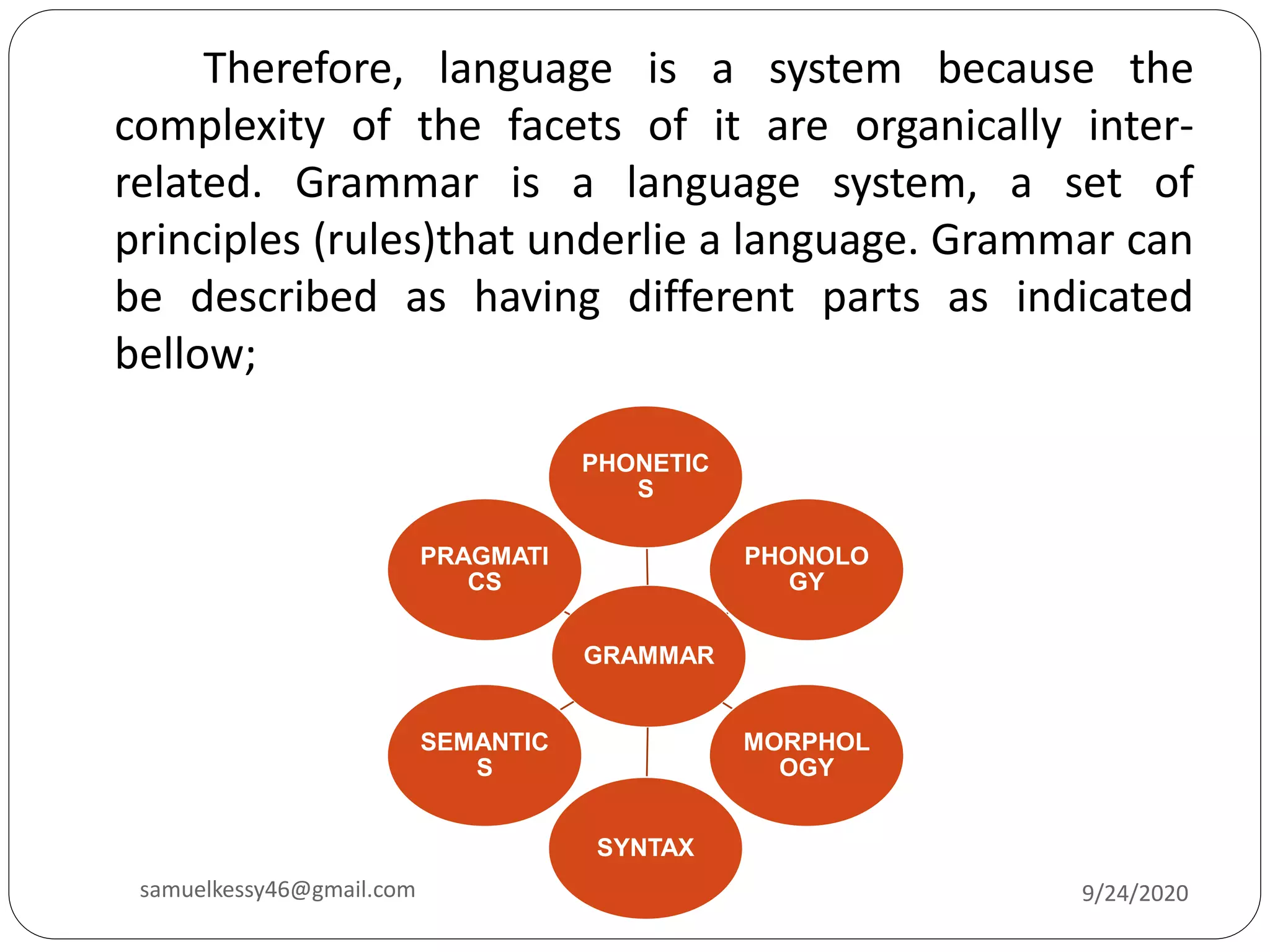
Therefore, language is a system because the
complexity of the facets of it are organically inter-
related. Grammar is a language system, a set of
principles (rules)that underlie a language. Grammar can
be described as having different parts as indicated
bellow;
GRAMMAR
PHONETIC
S
PHONOLO
GY
MORPHOL
OGY
SYNTAX
SEMANTIC
S
PRAGMATI
CS
9/24/2020samuelkessy46@gmail.com
The terms are also used to refer subfields of
Linguistics. These parts are working together as
subsystems to constitute the large system (language) as
follows;
The study of acoustics and articulation of speech is
called phonetics. The translation of the sound waves into
mental representation of the speech sounds and analyze
them into syllables is called phonology. Then, when we
take these groups of sounds and organize them into
meaningful units (morphemes) and words, this level is
called morphology. Next, you organize the words into
phrases and sentences, this will be another subfield called
syntax. Finally, you take the sentences and phrases you
hear and translate them into thoughts and ideas, by doing
this is what we refer to as semantics. 9/24/2020samuelkessy46@gmail.com
In a nutshell;
 Phonetics; is the study of characteristics of speech sounds.
 Phonology; is the branch of linguistics which studies the sound
systems of language.
 Morphology; is the branch of linguistics which studies the
word structure.
 Syntax; is the branch of linguistics which deals with sentence
structure.
 Semantics; is the study of the meaning of words phrases and
sentences in a language.
 Pragmatics; is the study of the speaker’s meaning. It is
concerned with the study of meaning as communicated by a
speaker or writer and interpreted by a listener or reader.
9/24/2020samuelkessy46@gmail.com
Arbitrary; This means that, there is no connection
between a form of word and its meaning. For instance,
the word ‘cat’ has no any relationship with the real object
like wise in the words like tree, car and house. If language
were not arbitrary different languages would not use
different words for the same thing like in English=tree,
French=Obre, German=Baum, Swahili=Mti.
Vocal; Language is primary speech oriented. Its graphical
representation comes later. Language is an organization
of sounds, the sounds produced from the mouth with the
help of various organs of speech to convey some
meaningful message. Language is vocal in as much it is
made up of sounds which can be produced by the organs
of speech.
9/24/2020samuelkessy46@gmail.com
 Symbol; language is considered as symbol because it is made
up of elements that stand for the referent of the word.
Symbols can be words, images, body language etc. Language
itself is a symbolic of the words we speak and write. It can also
be a symbol of culture. Also it is often a symbol or reflection of
intellect. Example, the word cat is symbolic of the idea cat, ‘a
small domestic animal that likes to attack mouse’. The word
‘yes’ is a symbol of confirmation.
 Communication; language is essential means of
communication among members of the society. We use
language for making good relationship with other members in
the society, to learn and transmit knowledge as well as to
express feelings, ideas and emotion to others.
9/24/2020samuelkessy46@gmail.com
The definition of language
 Therefore, basing on the discussed elements, we can
define the term language as, “a system of arbitrary vocal
symbols that is used in human communication.”
 The scientific study of language is called linguistics.
Language and a language
 A language; is a subcategory of human communication
peculiar to a particular people, region or socio-political
background.
 The term language is more general term and it refers to
all languages than ‘a language’ which refers to one
language, that is a given variety spoken by a given speech
community like, Swahili and English. The distinction is
usually made by capitalizing ‘L’ of the more general term.
 There are approximately 6,500 languages that are spoken
in the world. 9/24/2020samuelkessy46@gmail.com
LANGUAGE CHARACTERISTICS
 We all think that all animals are capable of
communicating with other members of their own species.
But we can ask ourselves that, Is it possible that other
animals could learn to communicate with humans using a
language? Or does human language have properties that
make it so unique and hence unlearn by other animals?
 Linguist Charles Hocket proposed what he called the
‘design features’ that distinguish human language from
other communication systems like animal systems. The
features have been studied and examined by many
researchers for so many years and the following are the
features of human language that remain on almost every
researcher’s list;
9/24/2020samuelkessy46@gmail.com
Displacement; This is the property of human language
that allows language users to talk about things and events
not present in he immediate environment. It also allows
us to talk about things and places whose existence we can
not even be sure of, like angels, heaven and hell. Talking
about animal communication, it seems to be designed for
this moment, here and now and it isn't used to relate
events that are fore removed in time and place.
Productivity/creativity/open-endedness; Is the ability of
language users to understand and create never-before-
heard utterances. Human are continually creating new
expressions by manipulating their linguistic resources to
describe new objects and situations. On the other hand,
the communication system of other creatures are nor like
that.
9/24/2020samuelkessy46@gmail.com
 Arbitrariness; refers to the fact that there is no “natural”
connection between a linguistic form and its meaning.
Arbitrariness in language means that there is no connection
between the form of the signal (word) and the thing it refers
to. For instance in English, the word ‘ dog’ has no natural
relationship with that hairy four legged barking object out in
the world.
 Interchangeability; Is the ability of individuals to both transmit
and receive messages. Human being can both produce
messages by speaking or singing and receive the messages
from others by listening or watching.
 Reflexivity; Humans are clearly able to reflect on language and
its uses. This property accounts for the fact that we can use
language to think and talk about language itself, making it one
of the distinguishing features of human language.
9/24/2020samuelkessy46@gmail.com
Duality/double articulation; Human language is organized
at two levels or layers of simultaneously. Such layers are,
layer of meaningless (sound level) and layer of
meaningful (meaning level). This duality of levels is one of
the most economical features of human language
because with limited set of discrete sounds, we are
capable of producing a very large number of sound
combinations (eg. words) that are distinct in meaning. For
example, the sounds /n, b, i/ can be combined to form
meaningful words like bin as well as nib. Also, suffixes can
be attached to many roots and words can be combined to
create different sentences. Among other animals, each
communicative signal appears to be fixed form that can
not be broken down in to separate parts.
9/24/2020samuelkessy46@gmail.com
Discreteness; Is the property of language that allows us to
combine together discrete units in order to create large
communicative units. For example, words can be broken
down into units of sounds, consider the bellow sentence;
He is cool
The sentence is composed of may discrete units; first,
there are independent words such as, he, is, cool. These
words are composed of smaller discrete units, the
individual sounds [h], [i], [I], [z], [k], [u], [ɭ].
Every language has a limited number of sounds between
roughly 10-100. English for example has about 50 sounds.
The communication system that can put pieces together
in different ways has much expressive capability than one
that does not. If were limited to only 100/so meanings,
then language would not be nearly so useful as it turns to
be.
9/24/2020samuelkessy46@gmail.com
Semanticity; This is the property requiring that all signals in a
communication systems have a meaning or a function. In
short, words have meanings, if words or sentences didn’t have
meaning, then we would be unable to use them to
communicate.
Cultural transmission; There are aspects of language that we
can acquire through communicative interaction with other
language users. While we may inherit physical features such as
brown eyes and dark hair from our parents. But we do not
inherit their language. We acquire a language in a culture with
other speakers and not from parental genes. Thus, children
from Sukuma parents will learn Sukuma if their parents
interact with them in Sukuma, But they will learn English if
their parents interact with them in English. The general
pattern in animal communication is that, animals are born
with a set of specific signals that are produced instinctively.
9/24/2020samuelkessy46@gmail.com
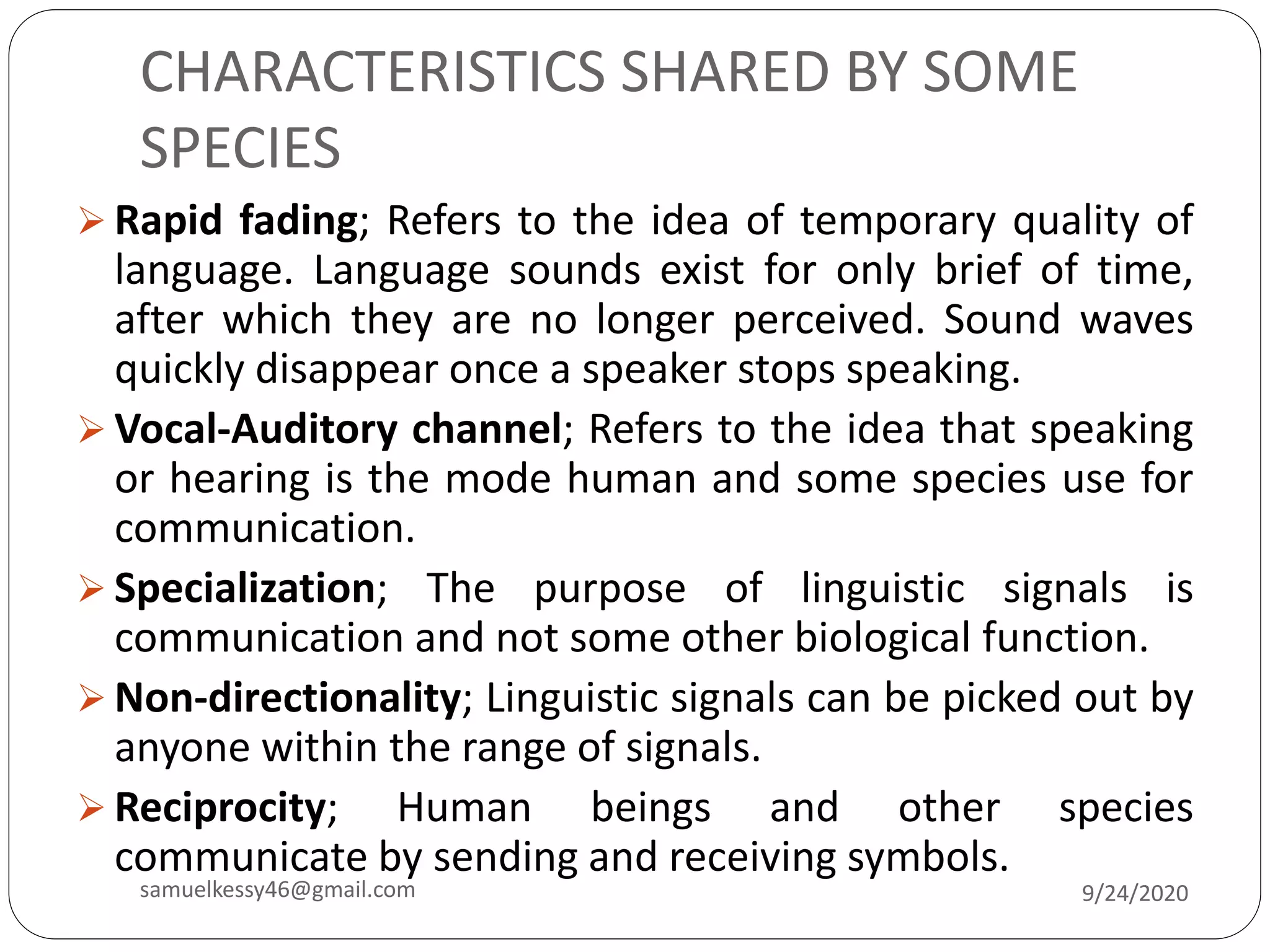
CHARACTERISTICS SHARED BY SOME
SPECIES
 Rapid fading; Refers to the idea of temporary quality of
language. Language sounds exist for only brief of time,
after which they are no longer perceived. Sound waves
quickly disappear once a speaker stops speaking.
 Vocal-Auditory channel; Refers to the idea that speaking
or hearing is the mode human and some species use for
communication.
 Specialization; The purpose of linguistic signals is
communication and not some other biological function.
 Non-directionality; Linguistic signals can be picked out by
anyone within the range of signals.
 Reciprocity; Human beings and other species
communicate by sending and receiving symbols.
9/24/2020samuelkessy46@gmail.com
REFERENCES
Carnie, A. (2002). Syntax: A Generative Introduction. Malden,
MA: Blackwell Publishers.
Denham, K. E., & Lobeck, A. C. (2013). Linguistics for Everyone
(2nd Ed.): An Introduction. Boston, MA: Wadsworth/ Cengage
Learning.
Fromkin, V., Rodman, R., & Hyams, N. (2013). An Introduction to
Language (10th Ed.). Boston, MA: Thomson Wadsworth.
Jannedy, S., Poletto, R., Weldon, T. L., & Ohio State University.
(1994). Language Files: Materials for an Introduction to
Language and Linguistics. Columbus: Ohio State University
Press.
O’Grady, W., Dobrovolsky, M., & Aronoff, M. (1997).
Contemporary Linguistics: An Introduction (3rd Ed.). New York:
St. Martin’s Press.
Yule, G. (2014). The Study of Language (5th Ed.). Cambridge, UK:
Cambridge University Press.
9/24/2020samuelkessy46@gmail.com

Introduction to language 1

  • 1.
    1.1 Language characteristics INTRODUCTIONTO LANGUAGE (Basing on Tanzanian Syllabus for English Advanced Level learners) 9/24/2020samuelkessy46@gmail.com
  • 2.
    The concept oflanguage  The term “language” is derived from a Latin word “Lingua” which means tongue and French term “Langue”.  Defining the term Language is not simple as it is very complex phenomenon. The complexity of this term has lead to the presence of many definitions to define what language is. This is due to the reason that people seem to view things from different perspectives.  However, most definitions seem to have some resemblances, various scholars had the following views on the concept of the term ‘language’ 9/24/2020samuelkessy46@gmail.com
  • 3.
    Definitions of Language Language is the system of signs for encoding and decoding information. (Wikipedia, the online encyclopedia).  Language may be defined as the expression of thought by means of speech sounds. (Henry Sweet)  Language is a system of arbitrary vocal symbols by means of which social group co-operates. (Bernad Bloch & George L. Trager)  Speech (Language) is the representation of the experience of the mind. (Aristotle)  Language is the totality of the utterances that can be made in a speech community. (Bloomfield) 9/24/2020samuelkessy46@gmail.com
  • 4.
    Definitions of language Language is the inherent capacity of the native speakers to understand and form grammatical sentences. (Noam Chomsky)  Language is a system of arbitrary vocal sounds used for human communication. (Wardaugh)  Language is that human expression which is produced by different speech organs of human beings. (Pantanjali)  Language is a system of conventional/ written symbols by means of which human beings as members of social groups and participants in its culture communicate. (Encyclopedia Britannica)  Language is a system of symbols and rules that enable us to communicate. (Harley, 2001) 9/24/2020samuelkessy46@gmail.com
  • 5.
    What is Language? Thus, the above definitions have spoken mostly about five elements such as; system, arbitrary, vocal, symbol and communication. Therefore, in defining the term language, the above elements must not be left out. System; A system can be defined as a set of elements standing in interaction. In other words it is a group of things which have something in common. This includes any grouping with any sort of relationship. A good example of the system can be drawn from digestive system of the human being as well as reproductive system. These systems comprises different elements which are working together to perform common activity. 9/24/2020samuelkessy46@gmail.com
  • 6.
    Therefore, language isa system because the complexity of the facets of it are organically inter- related. Grammar is a language system, a set of principles (rules)that underlie a language. Grammar can be described as having different parts as indicated bellow; GRAMMAR PHONETIC S PHONOLO GY MORPHOL OGY SYNTAX SEMANTIC S PRAGMATI CS 9/24/2020samuelkessy46@gmail.com
  • 7.
    The terms arealso used to refer subfields of Linguistics. These parts are working together as subsystems to constitute the large system (language) as follows; The study of acoustics and articulation of speech is called phonetics. The translation of the sound waves into mental representation of the speech sounds and analyze them into syllables is called phonology. Then, when we take these groups of sounds and organize them into meaningful units (morphemes) and words, this level is called morphology. Next, you organize the words into phrases and sentences, this will be another subfield called syntax. Finally, you take the sentences and phrases you hear and translate them into thoughts and ideas, by doing this is what we refer to as semantics. 9/24/2020samuelkessy46@gmail.com
  • 8.
    In a nutshell; Phonetics; is the study of characteristics of speech sounds.  Phonology; is the branch of linguistics which studies the sound systems of language.  Morphology; is the branch of linguistics which studies the word structure.  Syntax; is the branch of linguistics which deals with sentence structure.  Semantics; is the study of the meaning of words phrases and sentences in a language.  Pragmatics; is the study of the speaker’s meaning. It is concerned with the study of meaning as communicated by a speaker or writer and interpreted by a listener or reader. 9/24/2020samuelkessy46@gmail.com
  • 9.
    Arbitrary; This meansthat, there is no connection between a form of word and its meaning. For instance, the word ‘cat’ has no any relationship with the real object like wise in the words like tree, car and house. If language were not arbitrary different languages would not use different words for the same thing like in English=tree, French=Obre, German=Baum, Swahili=Mti. Vocal; Language is primary speech oriented. Its graphical representation comes later. Language is an organization of sounds, the sounds produced from the mouth with the help of various organs of speech to convey some meaningful message. Language is vocal in as much it is made up of sounds which can be produced by the organs of speech. 9/24/2020samuelkessy46@gmail.com
  • 10.
     Symbol; languageis considered as symbol because it is made up of elements that stand for the referent of the word. Symbols can be words, images, body language etc. Language itself is a symbolic of the words we speak and write. It can also be a symbol of culture. Also it is often a symbol or reflection of intellect. Example, the word cat is symbolic of the idea cat, ‘a small domestic animal that likes to attack mouse’. The word ‘yes’ is a symbol of confirmation.  Communication; language is essential means of communication among members of the society. We use language for making good relationship with other members in the society, to learn and transmit knowledge as well as to express feelings, ideas and emotion to others. 9/24/2020samuelkessy46@gmail.com
  • 11.
    The definition oflanguage  Therefore, basing on the discussed elements, we can define the term language as, “a system of arbitrary vocal symbols that is used in human communication.”  The scientific study of language is called linguistics. Language and a language  A language; is a subcategory of human communication peculiar to a particular people, region or socio-political background.  The term language is more general term and it refers to all languages than ‘a language’ which refers to one language, that is a given variety spoken by a given speech community like, Swahili and English. The distinction is usually made by capitalizing ‘L’ of the more general term.  There are approximately 6,500 languages that are spoken in the world. 9/24/2020samuelkessy46@gmail.com
  • 12.
    LANGUAGE CHARACTERISTICS  Weall think that all animals are capable of communicating with other members of their own species. But we can ask ourselves that, Is it possible that other animals could learn to communicate with humans using a language? Or does human language have properties that make it so unique and hence unlearn by other animals?  Linguist Charles Hocket proposed what he called the ‘design features’ that distinguish human language from other communication systems like animal systems. The features have been studied and examined by many researchers for so many years and the following are the features of human language that remain on almost every researcher’s list; 9/24/2020samuelkessy46@gmail.com
  • 13.
    Displacement; This isthe property of human language that allows language users to talk about things and events not present in he immediate environment. It also allows us to talk about things and places whose existence we can not even be sure of, like angels, heaven and hell. Talking about animal communication, it seems to be designed for this moment, here and now and it isn't used to relate events that are fore removed in time and place. Productivity/creativity/open-endedness; Is the ability of language users to understand and create never-before- heard utterances. Human are continually creating new expressions by manipulating their linguistic resources to describe new objects and situations. On the other hand, the communication system of other creatures are nor like that. 9/24/2020samuelkessy46@gmail.com
  • 14.
     Arbitrariness; refersto the fact that there is no “natural” connection between a linguistic form and its meaning. Arbitrariness in language means that there is no connection between the form of the signal (word) and the thing it refers to. For instance in English, the word ‘ dog’ has no natural relationship with that hairy four legged barking object out in the world.  Interchangeability; Is the ability of individuals to both transmit and receive messages. Human being can both produce messages by speaking or singing and receive the messages from others by listening or watching.  Reflexivity; Humans are clearly able to reflect on language and its uses. This property accounts for the fact that we can use language to think and talk about language itself, making it one of the distinguishing features of human language. 9/24/2020samuelkessy46@gmail.com
  • 15.
    Duality/double articulation; Humanlanguage is organized at two levels or layers of simultaneously. Such layers are, layer of meaningless (sound level) and layer of meaningful (meaning level). This duality of levels is one of the most economical features of human language because with limited set of discrete sounds, we are capable of producing a very large number of sound combinations (eg. words) that are distinct in meaning. For example, the sounds /n, b, i/ can be combined to form meaningful words like bin as well as nib. Also, suffixes can be attached to many roots and words can be combined to create different sentences. Among other animals, each communicative signal appears to be fixed form that can not be broken down in to separate parts. 9/24/2020samuelkessy46@gmail.com
  • 16.
    Discreteness; Is theproperty of language that allows us to combine together discrete units in order to create large communicative units. For example, words can be broken down into units of sounds, consider the bellow sentence; He is cool The sentence is composed of may discrete units; first, there are independent words such as, he, is, cool. These words are composed of smaller discrete units, the individual sounds [h], [i], [I], [z], [k], [u], [ɭ]. Every language has a limited number of sounds between roughly 10-100. English for example has about 50 sounds. The communication system that can put pieces together in different ways has much expressive capability than one that does not. If were limited to only 100/so meanings, then language would not be nearly so useful as it turns to be. 9/24/2020samuelkessy46@gmail.com
  • 17.
    Semanticity; This isthe property requiring that all signals in a communication systems have a meaning or a function. In short, words have meanings, if words or sentences didn’t have meaning, then we would be unable to use them to communicate. Cultural transmission; There are aspects of language that we can acquire through communicative interaction with other language users. While we may inherit physical features such as brown eyes and dark hair from our parents. But we do not inherit their language. We acquire a language in a culture with other speakers and not from parental genes. Thus, children from Sukuma parents will learn Sukuma if their parents interact with them in Sukuma, But they will learn English if their parents interact with them in English. The general pattern in animal communication is that, animals are born with a set of specific signals that are produced instinctively. 9/24/2020samuelkessy46@gmail.com
  • 18.
    CHARACTERISTICS SHARED BYSOME SPECIES  Rapid fading; Refers to the idea of temporary quality of language. Language sounds exist for only brief of time, after which they are no longer perceived. Sound waves quickly disappear once a speaker stops speaking.  Vocal-Auditory channel; Refers to the idea that speaking or hearing is the mode human and some species use for communication.  Specialization; The purpose of linguistic signals is communication and not some other biological function.  Non-directionality; Linguistic signals can be picked out by anyone within the range of signals.  Reciprocity; Human beings and other species communicate by sending and receiving symbols. 9/24/2020samuelkessy46@gmail.com
  • 19.
    REFERENCES Carnie, A. (2002).Syntax: A Generative Introduction. Malden, MA: Blackwell Publishers. Denham, K. E., & Lobeck, A. C. (2013). Linguistics for Everyone (2nd Ed.): An Introduction. Boston, MA: Wadsworth/ Cengage Learning. Fromkin, V., Rodman, R., & Hyams, N. (2013). An Introduction to Language (10th Ed.). Boston, MA: Thomson Wadsworth. Jannedy, S., Poletto, R., Weldon, T. L., & Ohio State University. (1994). Language Files: Materials for an Introduction to Language and Linguistics. Columbus: Ohio State University Press. O’Grady, W., Dobrovolsky, M., & Aronoff, M. (1997). Contemporary Linguistics: An Introduction (3rd Ed.). New York: St. Martin’s Press. Yule, G. (2014). The Study of Language (5th Ed.). Cambridge, UK: Cambridge University Press. 9/24/2020samuelkessy46@gmail.com