The Origins
of
Language
PRESENTED BY:
IBRAHIM T. ISMAIL
BAROZH S. GHADHBAN JUNE 2015
Outline
 Introduction
 The origin of language
 The divine sources
 The natural sound source
 The oral-gesture source
 The physical adaption source
 The genetic (innateness) source
 Conclusion
What is Language ?
When and how language
begun ?
The origins of language:
 No one knows exactly when or how human beings
came up with spoken language.
 One hypothesis is that language began between
100,000 and 50,000 years ago, with the advent of
modern man, i.e. homo sapiens.
 This is well before the invention of the written
language, about 5,000 years ago. We have direct
evidence and artifacts about writing.
The divine source:
 Genesis 2/19: God created Adam and “whatsoever
Adam called every living creature, was the name
thereof.”
 The Qur’an: He said, “O Adam, inform them of their
names.” And when he had informed them of their
names… (Al Baqarah, 2/31-33)
 A Hindu belief: language came from Saraswati, wife
of Brahma, creator of the universe.
The divine source(cont.)
 Attempts to find a divine, God-given language
 Psamtik carried out an experiment with two babies
depriving them of human contact. They uttered the
word bekos ‘bread’ in Phrygian!!
 King James the Fourth did a similar experiment and
the kids were reported to speak Hebrew.
 The fact is children who are deprived of any language
contact cannot learn any language.
The natural sound source:
 Language emerged from natural sounds.
 Primitive words are considered to be imitations of
natural sounds that people hear around them.
 The natural sound a bird makes is argued to have
been used to describe that particular animal.
 The fact that in many languages there are words such
as drip, click, meow and honk that sound like what
they mean supports this claim.
 Not every sound is onomatopoeic in languages!!
Some theories of origins of language
invented by Max Müller
The Bow-wow theory:
According to this theory, language began when
our ancestors started imitating the natural
sounds around them. The first speech
was onomatopoeic--marked by echoic
words such as moo, meow, splash,
cuckoo, and bang.
The Yo-he-ho theory:
based on the notion that speech arose
from physical environmental needs which
produced communal, rhythmical grunts
which later on developed into chants
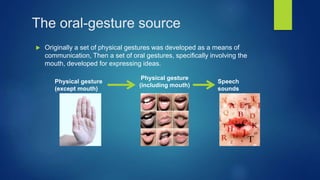
The oral-gesture source
 Originally a set of physical gestures was developed as a means of
communication, Then a set of oral gestures, specifically involving the
mouth, developed for expressing ideas.
Physical gesture
(except mouth)
Physical gesture
(including mouth)
Speech
sounds
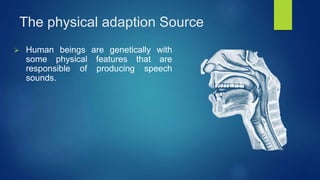
The physical adaption Source
 Human beings are genetically with
some physical features that are
responsible of producing speech
sounds.
The genetic (innateness) source
 According to Chomsky, language is
partly innate and partly acquired.
Conclusion
 All presented theories do not precisely demonstrate
what is the origin language, but that is clear-cut in the
past people were only able do some gestures and
produce a few sounds.
References
 Vajda, E. The Origin of Language, retrieved from:
http://pandora.cii.wwu.edu/vajda/ling201/test1materials/o
rigin_of_language.htm
 Wijaya, A. (year). The Origins of Language. (article).
Retrieved from:
http://awinlanguage.blogspot.com.tr/2013/04/the-origins-
of-language.html
 Yule,G.,(2010), The Study Of Language. 4th ed,
Cambridge, Cambridge university press.

The origins of language

  • 1.
    The Origins of Language PRESENTED BY: IBRAHIMT. ISMAIL BAROZH S. GHADHBAN JUNE 2015
  • 2.
    Outline  Introduction  Theorigin of language  The divine sources  The natural sound source  The oral-gesture source  The physical adaption source  The genetic (innateness) source  Conclusion
  • 3.
    What is Language? When and how language begun ?
  • 4.
    The origins oflanguage:  No one knows exactly when or how human beings came up with spoken language.  One hypothesis is that language began between 100,000 and 50,000 years ago, with the advent of modern man, i.e. homo sapiens.  This is well before the invention of the written language, about 5,000 years ago. We have direct evidence and artifacts about writing.
  • 5.
    The divine source: Genesis 2/19: God created Adam and “whatsoever Adam called every living creature, was the name thereof.”  The Qur’an: He said, “O Adam, inform them of their names.” And when he had informed them of their names… (Al Baqarah, 2/31-33)  A Hindu belief: language came from Saraswati, wife of Brahma, creator of the universe.
  • 6.
    The divine source(cont.) Attempts to find a divine, God-given language  Psamtik carried out an experiment with two babies depriving them of human contact. They uttered the word bekos ‘bread’ in Phrygian!!  King James the Fourth did a similar experiment and the kids were reported to speak Hebrew.  The fact is children who are deprived of any language contact cannot learn any language.
  • 7.
    The natural soundsource:  Language emerged from natural sounds.  Primitive words are considered to be imitations of natural sounds that people hear around them.  The natural sound a bird makes is argued to have been used to describe that particular animal.  The fact that in many languages there are words such as drip, click, meow and honk that sound like what they mean supports this claim.  Not every sound is onomatopoeic in languages!!
  • 8.
    Some theories oforigins of language invented by Max Müller
  • 9.
    The Bow-wow theory: Accordingto this theory, language began when our ancestors started imitating the natural sounds around them. The first speech was onomatopoeic--marked by echoic words such as moo, meow, splash, cuckoo, and bang.
  • 10.
    The Yo-he-ho theory: basedon the notion that speech arose from physical environmental needs which produced communal, rhythmical grunts which later on developed into chants
  • 11.
    The oral-gesture source Originally a set of physical gestures was developed as a means of communication, Then a set of oral gestures, specifically involving the mouth, developed for expressing ideas. Physical gesture (except mouth) Physical gesture (including mouth) Speech sounds
  • 12.
    The physical adaptionSource  Human beings are genetically with some physical features that are responsible of producing speech sounds.
  • 13.
    The genetic (innateness)source  According to Chomsky, language is partly innate and partly acquired.
  • 14.
    Conclusion  All presentedtheories do not precisely demonstrate what is the origin language, but that is clear-cut in the past people were only able do some gestures and produce a few sounds.
  • 15.
    References  Vajda, E.The Origin of Language, retrieved from: http://pandora.cii.wwu.edu/vajda/ling201/test1materials/o rigin_of_language.htm  Wijaya, A. (year). The Origins of Language. (article). Retrieved from: http://awinlanguage.blogspot.com.tr/2013/04/the-origins- of-language.html  Yule,G.,(2010), The Study Of Language. 4th ed, Cambridge, Cambridge university press.