1
Private_for class lectureonly
ENG404: Language, Mind and Brain
1. Beginning concepts
What is language? Creativity of human language, language characteristics, non-human
communication systems, language as distinct from speech, thought, and
communication.
2.
2
Private_for class lectureonly
Introduction:
We human beings are social beings.
We interact with one another for various reasons using language as a medium of communication.
Whatever else people do when they come together — whether they play, fight, etc. — they talk.
We live in a world of language.
We talk to friends, associates, teachers, parents, rivals, and even enemies.
We talk face-to-face and over all manner of electronic media, and everyone responds with more
talk.
Hardly a moment of our waking lives is free from words, and even our dreams are filled with talk.
We also talk when there is no one to answer.
Sometimes, some people talk aloud in their sleep.
We talk to our pets and sometimes to ourselves.
3.
3
Private_for class lectureonly
The use of language is an integral part of being human.
Human life cannot be imagined without a language because language is essential to human existence.
We use language not merely as an expression of thoughts, feelings, and intentions, but as a form of
maintaining social relationships, sharing knowledge and reflecting our identity.
Language is important for human connection, influencing how we think, interpret the world, and relate
to others.
But what is this so-called language?
4.
4
Private_for class lectureonly
1. What is language?
In a general sense, language is a medium of human communication.
It can be through various means such as spoken form, written form, sign, gesture, etc.
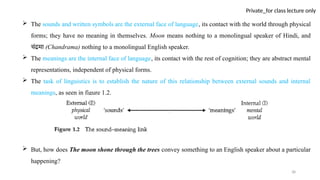
General Definition:
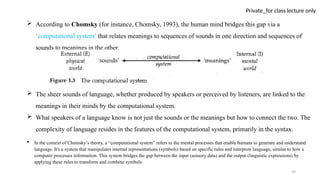
1. Language is a system of conventional spoken or written symbols by means of which human beings, as
members of a social group and participants in its culture, communicate. (Encyclopaedia Britannica)
5.
5
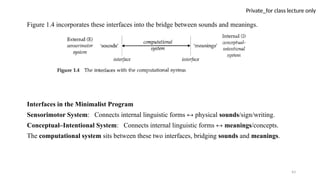
Private_for class lectureonly
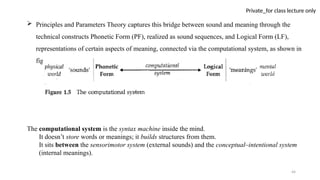
In a technical sense, we can say language is a system of arbitrary symbols and rules used by humans to
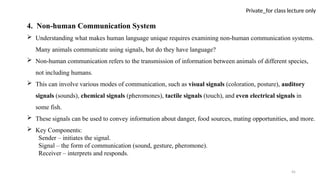
communicate thoughts, emotions, ideas, and information. It can be through spoken form, written form
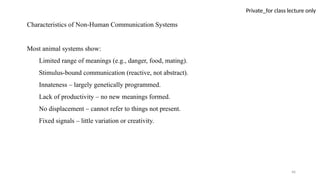
or signed forms and is governed by certain grammatical rules that structure sounds, words, and
sentences.
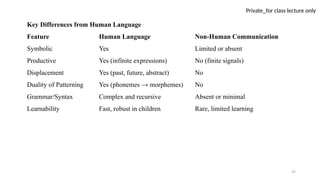
6.
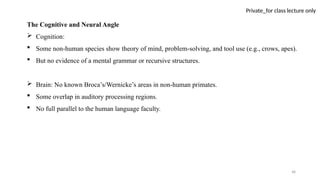
6
Private_for class lectureonly
1.1 Formal definitions from Linguistics:
1. Language is a symbol system based on pure or arbitrary conventions... infinitely extendable and
modifiable according to the changing needs and conditions of the speakers. (Robins, 1985)
• According to this definition, language is a symbol system. Every language (that exists in the written form)
selects some symbols for its selected sounds.
• For the sound /k/, in English we have the symbol k and in Hindi we have d. These symbols form the alphabet
of the language and join in different combinations (according to a well laid out system) to form meaningful
words.
• The system here is purely arbitrary in the sense that there is no one to one correspondence between the
structure of a word and the thing it stands for.
• Shakespeare, for example, used the word stomach to mean courage. (If you dare fight today, come to the field.
If not, when you have stomachs. Spoken by Octavius to Brutus and Cassius, in William Shakespeare’s Julius
Caesar,
Act 5, Scene 1).
• Similarly, words like astronaut are of quite recent origin in the English language
7.
7
Private_for class lectureonly
2. Language is a purely human and non-instinctive method of communicating ideas, emotions and desires
by means of a system of voluntarily produced symbols. (Sapir, 1921)
• There are two terms in this definition that call for discussion: human and non-instinctive. Language, as Sapir
rightly said, is human. Only humans possess language and all normal humans uniformly possess it. Animals do have
a communication system but it is not a developed system. That is why language is said to be species-specific and
species-uniform.
• Also, language does not pass from a parent to a child. In this sense, it is non-instinctive. A child has to learn
language and he/she learns the language of the society he/she is placed in.
8.
8
Private_for class lectureonly
3. Language is the institution whereby humans communicate and interact with each other by means of
habitually used oral-auditory arbitrary symbols. (Hall, 1969)
• This definition rightly gives more prominence to the fact that language is primarily speech produced by oral-
auditory symbols. A speaker produces some string of oral sounds that get conveyed through the air to the listener
who, through his hearing organs, receives the sound waves and conveys these to the brain that interprets these
symbols to arrive at a meaning.
9.
9
Private_for class lectureonly
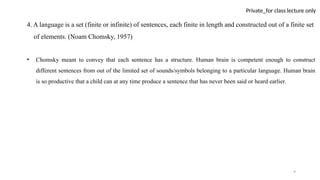
4. A language is a set (finite or infinite) of sentences, each finite in length and constructed out of a finite set
of elements. (Noam Chomsky, 1957)
• Chomsky meant to convey that each sentence has a structure. Human brain is competent enough to construct
different sentences from out of the limited set of sounds/symbols belonging to a particular language. Human brain
is so productive that a child can at any time produce a sentence that has never been said or heard earlier.
10.
10
Private_for class lectureonly
In short,
Language is seen as a system of arbitrary symbols governed by rules
(It means that the connection between the words we use and the things they represent is not inherent or
natural, but rather established by convention and agreement within a language community).
Complexity of human language: But human language is unparalleled in its complexity compared to any
other communication system.
11.
11
Private_for class lectureonly
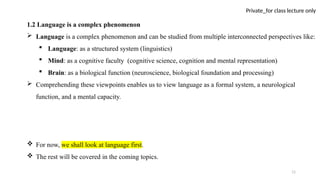
1.2 Language is a complex phenomenon
Language is a complex phenomenon and can be studied from multiple interconnected perspectives like:
Language: as a structured system (linguistics)
Mind: as a cognitive faculty (cognitive science, cognition and mental representation)
Brain: as a biological function (neuroscience, biological foundation and processing)
Comprehending these viewpoints enables us to view language as a formal system, a neurological
function, and a mental capacity.
For now, we shall look at language first.
The rest will be covered in the coming topics.
12.
12
Private_for class lectureonly
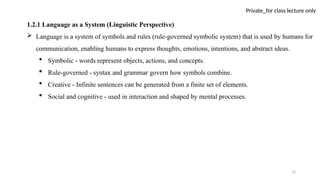
1.2.1 Language as a System (Linguistic Perspective)
Language is a system of symbols and rules (rule-governed symbolic system) that is used by humans for
communication, enabling humans to express thoughts, emotions, intentions, and abstract ideas.
Symbolic - words represent objects, actions, and concepts.
Rule-governed - syntax and grammar govern how symbols combine.
Creative - Infinite sentences can be generated from a finite set of elements.
Social and cognitive - used in interaction and shaped by mental processes.
13.
13
Private_for class lectureonly
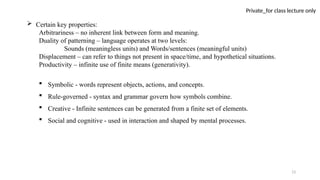
Certain key properties:
Arbitrariness – no inherent link between form and meaning.
Duality of patterning – language operates at two levels:
Sounds (meaningless units) and Words/sentences (meaningful units)
Displacement – can refer to things not present in space/time, and hypothetical situations.
Productivity – infinite use of finite means (generativity).
Symbolic - words represent objects, actions, and concepts.
Rule-governed - syntax and grammar govern how symbols combine.
Creative - Infinite sentences can be generated from a finite set of elements.
Social and cognitive - used in interaction and shaped by mental processes.
14.
14
Private_for class lectureonly
1.3 Key Properties of Human Language
1) Reflexivity
While we tend to think of communication as the primary function of human language, it is not its only
distinguishing feature.
• All creatures communicate in some way, even if it is not through vocalization. However, we suspect that
other creatures are not reflecting on the way they create their communicative messages or reviewing
how they work (or not).
• Eg. one barking dog is probably not offering advice to another barking dog along the lines of “Hey, how
are you” or “ Hey, you should lower your bark” or “Hey, keep silent”. They’re not barking about
barking.
• But humans are clearly able to reflect on language and its uses (e.g. “I wish he wouldn’t use so many
technical terms”). This is reflexivity.
15.
15
Private_for class lectureonly
• The property of reflexivity (or “reflexiveness”) accounts for the fact that we can use language to think
and talk about language itself, making it one of the distinguishing features of human language.
• Indeed, without this general ability, we wouldn’t be able to reflect on or identify any of the other
distinct properties of human language.
We will look in detail at another five of them: displacement, arbitrariness, productivity, cultural
transmission and duality.
16.
16
Private_for class lectureonly
2) Displacement
Humans: humans can talk about things that happened in the past or will happen in the future.
• It allows the users of language to talk about things and events not present in the immediate environment.
• In short, displacement means humans language can be used to talk about things that are not present—the messages
can refer to things in remote time (past and future) or space (here or elsewhere).
Animal: When your pet cat comes home and stands at your feet, calling meow, you are likely to understand this
message as relating to that immediate time and place. If you ask your cat where it has been and what it was up to,
you’ll probably get the same meow response.
• Animal communication is generally considered to lack this property.
Exception - For example, when a worker bee finds a source of nectar and returns to the beehive, it can perform a
complex dance routine to communicate to the other bees the location of this nectar.
• Round dance – if source of nectar is less that about 100m away. Does not communicate the direction.
• Waggle dance – if source of nectar is more than 100m away from hive. Communicates both distance and direction.
17.
17
Private_for class lectureonly
Indeed, displacement allows humans to talk about things and places (e.g. angels, fairies, Santa Claus,
Superman, heaven) whose existence we cannot even be sure of.
Animal communication is generally considered to lack this property
18.
18
Private_for class lectureonly
3) Arbitrariness
The relationship between a word/sound and what it represent is arbitrary. It means there is no inherent link
between form and meaning.
Eg. the object like (tree) and the word that describes it is arbitrary.
• A written word does not look like its meaning.
• For Example - We can’t just look at the Arabic word كلب ((pronounced kalb)) and, from its shape, determine
that it has a natural and obvious meaning any more than we can with its English translation form dog.
• It is generally the case that there is no “natural” connection between a linguistic form and its meaning; the
connection is quite arbitrary (based on random choice).
• The linguistic form has no natural or ‘iconic’ relationship with that hairy four-legged barking object out in the
world.
• So, there is no logical connection between the form of the signal and the thing it refers to. For example, dog in
English is Hund in German and perro in Spanish, and kutta in Hindi.
19.
19
Private_for class lectureonly
4) Productivity
Productivity Language users can understand and create never-before-heard utterances.
Creative - Infinite sentences can be generated from a finite set of elements.
infinite use of finite means (generativity).
Humans: humans are continually creating new expressions by manipulating their linguistic resources to
describe new objects and situations.
This property is described as productivity (or “creativity” or “open-endedness”) and essentially means
that the potential number of utterances in any human language is infinite.
Animal: Other creatures do not have this kind of flexibility in their communication system.
This lack of productivity in animal communication can be described in terms of fixed reference.
Each signal in the communication system of other creatures seems to be fixed in terms of relating to a
particular occasion or purpose.
20.
20
Private_for class lectureonly
5) Cultural transmission
This process whereby a language is passed on from one generation to the next is described as cultural
transmission. It is clear that humans are born with some kind of predisposition to acquire language in a
general sense. However, we are not born with the ability to produce utterances in a specific language,
such as English. We acquire our first language as children in a culture with other speakers and not from
parental genes.
• An infant born to Korean parents in Korea, but adopted and brought up from birth by English speakers
in the United States, will have physical characteristics inherited from his or her natural parents, but will
inevitably speak English.
• A kitten, given comparable early experiences, will produce meow regardless of place.
• The general pattern in animal communication is that creatures are born with a set of specific signals that
are produced instinctively.
21.
21
Private_for class lectureonly
What kind of evidence is used to support the idea that language is culturally transmitted?
In the case of some birds, there is evidence that instinct has to combine with learning to produce the
right song. If those birds spend their first seven weeks without hearing other birds, they will
instinctively produce songs or calls, but those songs will be abnormal in some way
Human infants, growing up in isolation, produce no ‘instinctive’ language.
Cultural transmission of a specific language is crucial in the human acquisition process
The importance of cultural transmission: - It gives flexibility to the language.
22.
22
Private_for class lectureonly
6) Duality
Duality is the property of organization of language into two layers or levels at the same time in terms of
speech production: physical / sound level and words/ sentences/ meaning levels .
• The physical level / Sounds (meaningless units) is at which we can produce individual sounds like (n, b, i).
As individual sounds, none of these discrete forms has any intrinsic (real) meaning.
• The meaning level / Words and sentences (meaningful units) is when we produce those sounds in a
particular combination, as in (bin), which is different from the meaning of the combination in (nib), so, at
one level, we have distinct sounds, and at another level, we have distinct meanings.
• So, duality of patterning A large number of meaningful utterances can be recombined in a systematic way
from a small number of discrete parts of language. For example, suffixes can be attached to many roots,
and words can be combined to create novel sentences.
• So, language operates at two levels: Sounds (meaningless units) and Words/sentences (meaningful units)
23.
23
Private_for class lectureonly
Human – produce words
Animal – While dogs can produce the sound "woof", the individual sounds "w", "oo", and "f" within
that sound don't have separate meanings or functions like they do in human language.
Human language utilizes duality of patterning, where sounds combine into meaningful units (words),
which can then be further combined into sentences. Dogs don't demonstrate this duality; "woof" is a
single, unanalyzed unit of communication.
The importance Duality: - This duality of levels is, in fact, one of the most economical features of
human language because, with a limited set of discrete sounds, we are capable of producing a very large
number of sound combinations (e.g. words) which are distinct in meaning.
24.
24
Private_for class lectureonly
2. Creativity of Human Language
A good place to begin is by thinking about some of the unique features of human language.
Language is a system that allows people immense creativity.
• This is not the same creativity of people who write essays, fiction, or poetry.
• Instead, this is the linguistic creativity that is commonplace to every person who knows a language.
• The creativity of human language is different from the communication system of any other animal
in a number of respects.
o Eg. speakers of a language can create and understand novel sentences for an entire lifetime. Consider
the fact that almost every sentence that a person hears every day is a brand new event not previously
experienced, but which can be understood with little difficulty.
25.
25
Private_for class lectureonly
o Similarly, when speaking, people constantly produce novel sentences with no conscious effort. This is
true for every person who speaks or has ever spoken a language. We can extend this observation to
every person who uses a signed language to produce and comprehend novel sentences.
o This remarkable ability to deal with novelty in language is possible because every language consists of
a set of principles by which arbitrary elements (the sounds of speech, the gestures of sign language) are
combined into words, which in turn are combined into sentences.
o Everyone who knows a language knows a relatively small number of principles, a small number of
sounds put together to create words, and a large but finite vocabulary. This finite knowledge provides
the person who knows a language with infinite creativity.
26.
26
Private_for class lectureonly
• A second important kind of creativity humans possess is that we can use language to communicate
anything we can think of. No other animal communication system affords its users such an unlimited
range of topics.
o Many mammals have complex sets of calls and cries, but they can communicate only certain kinds of
information, such as whether danger is coming from the ground or the air, who is ready to mate, where
food is located, and so forth.
o The philosopher Bertrand Russell once said, “No matter how eloquently a dog may bark, he cannot tell
you his parents were poor but honest” (Gleason and Ratner 1993: 9).
27.
27
Private_for class lectureonly
• Language is so flexible that it not only allows people to say anything they can think of; it also allows
people to use language for a vast array of purposes.
• Language is used to communicate, to interact socially, to entertain, and to inform.
• All cultural institutions – schools, communities, governments – depend upon language to function.
• Written and audio-recorded language allows people to communicate and convey information – as well
as interact and entertain – across vast spans of space and time.
• It is probably the case that human dominance of the planet has been possible because of the power of
human language as a medium for transmitting knowledge (Dennett 2009).
28.
28
Private_for class lectureonly
3. Some Characteristics of the Linguistic System
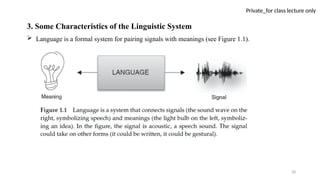
Language is a formal system for pairing signals with meanings (see Figure 1.1).
29.
29
Private_for class lectureonly
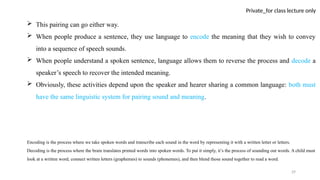
This pairing can go either way.
When people produce a sentence, they use language to encode the meaning that they wish to convey
into a sequence of speech sounds.
When people understand a spoken sentence, language allows them to reverse the process and decode a
speaker’s speech to recover the intended meaning.
Obviously, these activities depend upon the speaker and hearer sharing a common language: both must
have the same linguistic system for pairing sound and meaning.
Encoding is the process where we take spoken words and transcribe each sound in the word by representing it with a written letter or letters.
Decoding is the process where the brain translates printed words into spoken words. To put it simply, it’s the process of sounding out words. A child must
look at a written word, connect written letters (graphemes) to sounds (phonemes), and then blend those sound together to read a word.
30.
30
Private_for class lectureonly
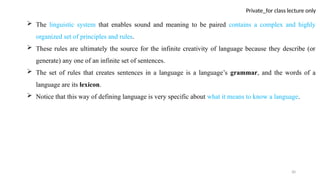
The linguistic system that enables sound and meaning to be paired contains a complex and highly
organized set of principles and rules.
These rules are ultimately the source for the infinite creativity of language because they describe (or
generate) any one of an infinite set of sentences.
The set of rules that creates sentences in a language is a language’s grammar, and the words of a
language are its lexicon.
Notice that this way of defining language is very specific about what it means to know a language.
31.
31
Private_for class lectureonly
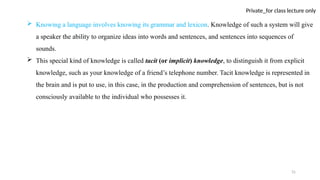
Knowing a language involves knowing its grammar and lexicon. Knowledge of such a system will give
a speaker the ability to organize ideas into words and sentences, and sentences into sequences of
sounds.
This special kind of knowledge is called tacit (or implicit) knowledge, to distinguish it from explicit
knowledge, such as your knowledge of a friend’s telephone number. Tacit knowledge is represented in
the brain and is put to use, in this case, in the production and comprehension of sentences, but is not
consciously available to the individual who possesses it.
32.
32
Private_for class lectureonly
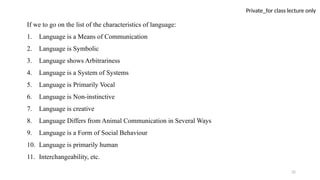
If we to go on the list of the characteristics of language:
1. Language is a Means of Communication
2. Language is Symbolic
3. Language shows Arbitrariness
4. Language is a System of Systems
5. Language is Primarily Vocal
6. Language is Non-instinctive
7. Language is creative
8. Language Differs from Animal Communication in Several Ways
9. Language is a Form of Social Behaviour
10. Language is primarily human
11. Interchangeability, etc.
33.
33
Private_for class lectureonly
3.1 The Universality of Human Language
Linguists tend to refer to human language as a single entity, despite the fact that there are many different
versions spoken by the thousands of different language communities around the world.
All human languages have a grammar and a lexicon, which together allow the creation of an infinite set
of sentences to convey any possible thought.
The fact that all humans have languages of similar organization and function strongly suggests that
language is part of the human biological endowment, as the communication systems of animals are
specific to their species. The universality of human language has profound consequences for the way
psycholinguists analyze the human use of language.
34.
34
Private_for class lectureonly
At the same time, linguists are interested in understanding what is specific and what is universal, not
only about knowledge of language but also about the mechanisms that put that knowledge of language
to use. The majority of the world’s population is bilingual or multilingual, and most of the world’s
children grow up in environments that expose them to multiple languages (Romaine 1995). These facts
indicate that the mechanisms for representing and processing language can handle efficiently more than
one linguistic code.
35.
35
Private_for class lectureonly
3.2 Relating ‘sounds’ and ‘meanings’: How Language Pairs Sound and Meaning
In any human language, the principles and rules of the grammar organize words from the lexicon into
sentences used to convey meaning.
Three kinds of rule systems make up a grammar. Phonological rules describe the sound patterns of the
language; they are used to create individual words and are responsible for the rhythm and intonation of
speech. Morphological rules and syntactic rules are involved in creating the structural organization of
words and sentences, that is, the relationships between words and phrases in sentences.
36.
36
Private_for class lectureonly
The focus of all Chomsky’s theories has been on what we know about language and where this
knowledge comes from. The major concern is always the human mind. The claims of UG Theory have
repercussions for how we conceive of human beings and for what makes a human being. Language is
seen as something in the individual mind of every human being.
Hence, it deals with general properties of language found everywhere rather than the idiosyncrasies of a
particular language, such as English or Korean - what is common to human beings, not what
distinguishes one person from another. Everybody knows language: what is it that we know and how
did we come to acquire it?
37.
37
Private_for class lectureonly
As well as this invisible existence within our minds, language also consists of physical events and
objects, whether the sounds of speech or the symbols of writing: language relates to things outside our
minds. The fundamental question for linguistics since Aristotle has been how language bridges the gap
between the intangible interior world of knowledge and the concrete physical world of sounds and
objects; ‘each language can be regarded as a particular relationship between sounds and meaning’
(Chomsky, 1972a, p. 17). So a sentence such as:
The moon shone through the trees.
consists on the one hand of a sequence of sounds or letters, on the other of a set of meanings about an
object called ‘the moon’ and a relationship with some other objects called ‘trees’.
38.
38
Private_for class lectureonly
The sounds and written symbols are the external face of language, its contact with the world through physical
forms; they have no meaning in themselves. Moon means nothing to a monolingual speaker of Hindi, and
चंद्रमा (Chandrama) nothing to a monolingual English speaker.
The meanings are the internal face of language, its contact with the rest of cognition; they are abstract mental
representations, independent of physical forms.
The task of linguistics is to establish the nature of this relationship between external sounds and internal
meanings, as seen in figure 1.2.
But, how does The moon shone through the trees convey something to an English speaker about a particular
happening?
39.
39
Private_for class lectureonly
According to Chomsky (for instance, Chomsky, 1993), the human mind bridges this gap via a
‘computational system’ that relates meanings to sequences of sounds in one direction and sequences of
sounds to meanings in the other.
The sheer sounds of language, whether produced by speakers or perceived by listeners, are linked to the
meanings in their minds by the computational system.
What speakers of a language know is not just the sounds or the meanings but how to connect the two. The
complexity of language resides in the features of the computational system, primarily in the syntax.
In the context of Chomsky’s theory, a “computational system” refers to the mental processes that enable humans to generate and understand
language. It's a system that manipulates internal representations (symbols) based on specific rules and interprets language, similar to how a
computer processes information. This system bridges the gap between the input (sensory data) and the output (linguistic expressions) by
applying these rules to transform and combine symbols.
40.
40
Private_for class lectureonly
Since the late 1990s, as part of the Minimalist Program (MP), Chomsky has been interested in exploring
How the central computational system of language (syntax and related operations) interacts with:
1. Physical expressions of language (sound/speech, sign, writing)
2. Mental representation of concepts (thought, meaning)
Core question:
What happens at the points of contact between the computational system and other cognitive system?
41.
41
Private_for class lectureonly
Interface system:
At the point of contact with sounds, the mind needs to change the internal forms of language used by the
computational system into actual physical sounds or letters through complex commands to muscles, called
by Chomsky (2001a) the ‘sensorimotor system’; i.e. the moon is said using the appropriate articulations.
In reverse, the listener’s mind has to convert sounds into the forms of representation used by the
computational system, so that is perceived as the phrase the moon.
Sensorimotor system: Interface that links abstract linguistic forms to physical articulation/perception.
Production:
Internal linguistic form → motor commands → physical sounds/letters
Example: the moon → appropriate articulations → spoken phrase
Perception:
Sounds → internal representation in the computational system
Example: Hearing the moon → recognized as the phrase the moon
Bi-directional role: Handles both externalization (speaking/writing) and comprehension (listening/reading).
42.
42
Private_for class lectureonly
At the point of contact with meanings, the mind needs to change the representation of language used by
the computational system into the general concepts used by the mind, called ‘the conceptual-
intentional system’ (Chomsky, 2001a), i.e. moon is connected to the concept of ‘earth's satellite’.
Going in the opposite direction, while speaking the mind has to convert the concepts into linguistic
representation for the computational system, i.e. ‘earth’s satellite’ is converted into moon.
Conceptual–Intentional System: Interface linking linguistic representations to general concepts in the mind
Function:
Interpretation (comprehension):
Internal linguistic form → general conceptual meaning
Example: moon → concept earth’s satellite
Formulation (production):
Conceptual meaning → linguistic representation
Example: earth’s satellite → moon
43.
43
Private_for class lectureonly
Figure 1.4 incorporates these interfaces into the bridge between sounds and meanings.
Interfaces in the Minimalist Program
Sensorimotor System: Connects internal linguistic forms ↔ physical sounds/sign/writing.
Conceptual–Intentional System: Connects internal linguistic forms ↔ meanings/concepts.
The computational system sits between these two interfaces, bridging sounds and meanings.
44.
44
Private_for class lectureonly
Principles and Parameters Theory captures this bridge between sound and meaning through the
technical constructs Phonetic Form (PF), realized as sound sequences, and Logical Form (LF),
representations of certain aspects of meaning, connected via the computational system, as shown in
figure 1.5:
The computational system is the syntax machine inside the mind.
It doesn’t store words or meanings; it builds structures from them.
It sits between the sensorimotor system (external sounds) and the conceptual–intentional system
(internal meanings).
45.
45
Private_for class lectureonly
4. Non-human Communication System
Understanding what makes human language unique requires examining non-human communication systems.
Many animals communicate using signals, but do they have language?
Non-human communication refers to the transmission of information between animals of different species,
not including humans.
This can involve various modes of communication, such as visual signals (coloration, posture), auditory
signals (sounds), chemical signals (pheromones), tactile signals (touch), and even electrical signals in
some fish.
These signals can be used to convey information about danger, food sources, mating opportunities, and more.
Key Components:
Sender – initiates the signal.
Signal – the form of communication (sound, gesture, pheromone).
Receiver – interprets and responds.
46.
46
Private_for class lectureonly
Characteristics of Non-Human Communication Systems
Most animal systems show:
Limited range of meanings (e.g., danger, food, mating).
Stimulus-bound communication (reactive, not abstract).
Innateness – largely genetically programmed.
Lack of productivity – no new meanings formed.
No displacement – cannot refer to things not present.
Fixed signals – little variation or creativity.
47.
47
Private_for class lectureonly
Key Differences from Human Language
Feature Human Language Non-Human Communication
Symbolic Yes Limited or absent
Productive Yes (infinite expressions) No (finite signals)
Displacement Yes (past, future, abstract) No
Duality of Patterning Yes (phonemes → morphemes) No
Grammar/Syntax Complex and recursive Absent or minimal
Learnability Fast, robust in children Rare, limited learning
48.
48
Private_for class lectureonly
The Cognitive and Neural Angle
Cognition:
Some non-human species show theory of mind, problem-solving, and tool use (e.g., crows, apes).
But no evidence of a mental grammar or recursive structures.
Brain: No known Broca’s/Wernicke’s areas in non-human primates.
Some overlap in auditory processing regions.
No full parallel to the human language faculty.
49.
49
Private_for class lectureonly
Non-human communication systems are rich and diverse but lack the core properties of human
language.
Studying them informs our understanding of:
The evolution of language
The role of mind and brain
The biological basis of linguistic capacity
50.
50
Private_for class lectureonly
5. Language as distinct from speech, thought, and communication
5.1 Language:
Language is the primary communication system for humans, and it is not synonymous with speech,
thought or communication.
Usually language conveys thoughts through speech, but Language is independent from speech, thought,
and communication.
While speech, thought and communication interact with language, they are separate systems with
distinct properties.
Language is a specialised cognitive system that can operate independently of these processes.
51.
51
Private_for class lectureonly
Key points:
Independence of Language
Even though language often works with speech, thought, and communication, it is not the same as any
of them.
Language has its own structure and principles.
Sign language included
Sign languages are just as structured as any spoken language and are just as capable of conveying an
unlimited range of topics.
What differs between signed and spoken languages is the transmission mode:
Gestural for the former and articulatory-phonetic (speech) for the latter.
Difference is mode of transmission, not linguistic capacity.
52.
52
Private_for class lectureonly
5.2 Language vs Speech:
Speech ought not to be confused with language, though speech is indeed the most frequent mode for
transmitting linguistic information.
Other modes for transmission include the gestures used in sign language and the graphic
representations used in writing.
Language can exist independently of speech.
Another mode for transmitting linguistic information is writing, but writing is markedly different from
both speaking and signing. Writing systems are invented by people who already use language, so the
central difference is that writing is a cultural artifact, while speaking and signing are biological.
53.
53
Private_for class lectureonly
Speech is the oral-aural mode of transmission of language.
Involves articulation (tongue, lips, vocal cords) and auditory perception.
Speech is just one possible medium of transmitting language, but not the only one.
Language: The abstract, rule-governed system of symbols and structures (phonology, morphology,
syntax, semantics, pragmatics).
Exists independent of modality — can be expressed through speech, sign, or writing.
Important distinction: A person who loses the ability to speak (speech) due to vocal cord injury can still
have intact language competence (e.g., writing, signing).
54.
54
Private_for class lectureonly
5.3 Language vs Thought:
It is tempting to confuse thought and language, because we verbalize our thoughts using language.
But thought is not equal to Language: Thinking is possible without language, though we often express
thoughts through language.
The distinction between language and thought (or general intelligence) becomes clear when one
considers who can think but cannot communicate through language.
Among these kinds of individuals are infants and people who suffer from neurological pathologies that
have impaired their language ability.
Infants – can think but lack language skills.
Neurological pathologies – some individuals have normal intelligence but impaired language.
Moreover, many animals can think but cannot communicate using language.
In the language pathologies, we observe pronounced mismatches between level of intellectual
development and linguistic ability.
55.
55
Private_for class lectureonly
So, thought is a mental process of reasoning, problem-solving, memory, and concept formation.
Thought can exist without language — animals, pre-verbal infants, and individuals with aphasia can
still think.
The thoughts that people have are distinct from the language (or languages) in which they encode them.
Bilinguals can use either of their languages to transmit the thoughts they want to convey. It may be that
one of the languages of a given bilingual will have a richer vocabulary for conveying certain thoughts,
as in the person who prefers to speak about art in English and about soccer in Hindi. Perhaps it is more
convenient to convey information in one of the two languages; for example, memorizing word lists in
one language will facilitate recall in that same language.
Language: is a code that can represent thoughts in a structured, shareable form.
It transforms conceptual content into linguistic form (Chomsky’s “conceptual-intentional system”).
56.
56
Private_for class lectureonly
5.4 Language vs Communication:
Language is the primary communication system for human beings, but it is not the only way to
communicate, so language can be distinguished from communication in general.
Many forms of communication are not linguistic; these include non-verbal, mathematical, and aesthetic
communication through music or the visual arts.
Language beyond information transfer: Frequently, language is not used to communicate or transfer
information; language can be used aesthetically (consider poetry or song lyrics) or as a means to
negotiate social interactions (greetings vary by context).
One of the wonderful things about language is that it can be studied in many different ways. Such as its
Social characteristics → how language functions in communities.
Cultural characteristics → how language reflects traditions, beliefs, identity.
Aesthetic characteristics → artistic uses (poetry, literature, song).
57.
57
Private_for class lectureonly
In psycholinguistics, however, researchers are primarily concerned with the underlying structure of
language as a (sees language as) biologically based characteristic of humans, derived (rooted in) from
the human neurological organization and function.
Lastly, human language, which is used for human communication, is:
Unique: Human language exists only in humans.
Universal: Its general structural principles are shared across all human communities.
Human species-specific: No other species naturally possesses human language.
58.
58
Private_for class lectureonly
If we look at how they relate in the human mind, the usual order would be:
1. Thought formation – The mind formulates an idea or intention/ideas are formed in the mind (can be
pre-linguistic).
2. Linguistic encoding – The thought is converted into a structured language form (via the brain’s
computational system). -meaning to say the thought is encoded into a structured linguistic representation
in the brain.
3. Speech/sign/writing production – The encoded language is physically expressed. /
The language representation is physically expressed (spoken, signed, or written).
4. Communication – The recipient receives and interprets the message. /
The speech or other signals are received and interpreted by the receiver/hearer.
So, the flow is:
Thought → Language → Speech → Communication
But communication from others can also influence our thoughts, and that restarts the cycle.
59.
59
Private_for class lectureonly
References
Chomsky, N. (1965). Aspects of the Theory of Syntax.
Fernández, Eva M. & Cairns, Helen S. (2010). Fundamentals of Psycholinguistics. Wiley Blackwell.
Fromkin, V., Rodman, R., & Hyams, N. (2018). An Introduction to Language.
Vivian J. Cook & Mark Newson (2007). Chomsky’s Universal Grammar: An Introduction. Wiley Blackwell.
Yule, G. (2020). The study of language (8th ed.). Cambridge University Press.