Linguistics: An Introduction
Cao Ning
School of English Language
Longdong University
1 About LANGUAGE
 The definition of Language
 Design Features of Language
 Functions of Language
2 About LINGUISTICS
 Main branches of linguistics
 Important distinctions in linguistics
Key points in this unit
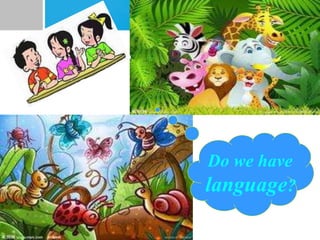
Does the animal have language?
Linguistics
 Linguistics, simply, is the study of language.
Then,
 What is languages ?
 Is language human specific ?
 Do animals have language?
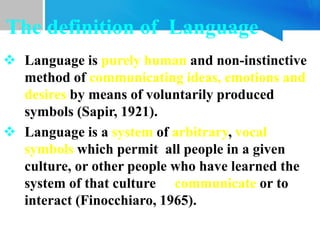
 Language is purely human and non-instinctive
method of communicating ideas, emotions and
desires by means of voluntarily produced
symbols (Sapir, 1921).
 Language is a system of arbitrary, vocal
symbols which permit all people in a given
culture, or other people who have learned the
system of that culture to communicate or to
interact (Finocchiaro, 1965).
The definition of Language
Language is a system of communication by
sound, operating through the organs of speech,
among members of a given community, and
using vocal symbols possessing arbitrary
conventional meaning (Pei, 1966)
The definition of Language
The generally accepted definition:
Language is a system of arbitrary
vocal symbols used for human
communication (Wardhaugh, 1972).
The definition of Language
Explanations
Firstly, language is a system, i.e., elements of
language are combined according to rules. “iblk”,
“Been he wounded has” are unacceptable.
Secondly, language is arbitrary in the sense that there
is no intrinsic connection between the word ‘pen’ and
the thing we use to write with.
 Explanations
The fact that different language have different
words for the same object is a good illustration of the
arbitrary nature of language.
This also explain the symbolic nature of language:
words are just symbols; they are associated with
objects, actions, ideas, etc, by convention. “A rose by
any other name would smell as sweet” .(Romeo and
Juliet)
Thirdly, language is vocal because the primary
medium is sound for all languages, no matter how well
developed their writing systems are. All evidence points
to the fact that writing systems came into being much
later than the spoken forms and that they are only
attempts to capture sounds and meaning on paper.
“children – spoken language – read and write”
Explanations
Design Features of Language refer to the
quintessential characteristics of human language,
which can distinguish any human language
system from any non-human language system.
They cover: Arbitrariness, Duality, Creativity,
Displacement, and Cultural transmission.
Design Features of Language
Arbitrariness
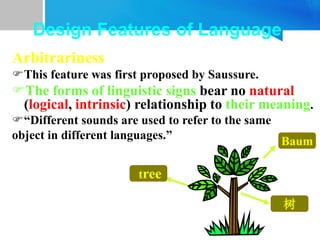
This feature was first proposed by Saussure.
The forms of linguistic signs bear no natural
(logical, intrinsic) relationship to their meaning.
“Different sounds are used to refer to the same
object in different languages.”
tree
树
Baum
Arbitrariness
• At lexical level:
• A rose by any other name would smell
as sweet (Shakespeare's Romeo and Juliet,
1594 )
Arbitrariness
• at the syntactic level
• language is not arbitrary at the syntactic level.
• (a) He came in and sat down.
• (b) He sat down and came in.
• (c) He sat down after he came in.
How to understand
Arbitrariness and convention?
Duality
Language possess the property of having two
levels of structures:
Sounds (lower or basic level)
Meaning (higher level)
Sounds are combined with one another to form
meaningful units such as words. The secondary
units sounds are meaningless and the primary
units have distinct and identifiable meaning.
Design Features of Language
 Language can be used to send messages we
have never said or heard before.
 Creativity is unique to human language.
 Language is creative in that it makes
possible the construction and interpretation of
new signals by its users.
Creativity
Creativity
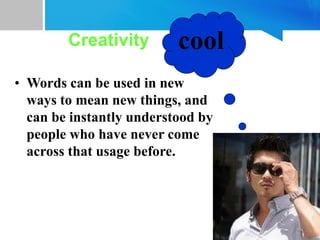
• Words can be used in new
ways to mean new things, and
can be instantly understood by
people who have never come
across that usage before.
cool
Creativity
• Language is resourceful because of its
duality and its recursiveness.
• The recursive nature of language provides a
potential to create an infinite number of
/endless sentences.
• “Limited rules can produce unlimited
sentences.” (Chomsky,1958).
• For instance:
• This is the cat that killed the rat that ate the malt
that lay in the house that Jack built.
• He bought a book which was written by a teacher
who taught in a school which was known for its
graduates who ...
• 从前有座山………
Creativity
Creativity
 Users can understand and produce words or
sentences they have never heard before. Every day
we sent messages that have never been sent before
and understand novel messages.
 Much of what we say and hear for the first time;
yet there seems no problem of understanding.
Design Features of Language
Displacement
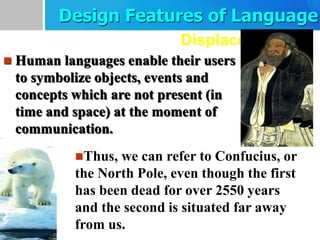
 Human languages enable their users
to symbolize objects, events and
concepts which are not present (in
time and space) at the moment of
communication.
Thus, we can refer to Confucius, or
the North Pole, even though the first
has been dead for over 2550 years
and the second is situated far away
from us.
Design Features of Language
Displacement
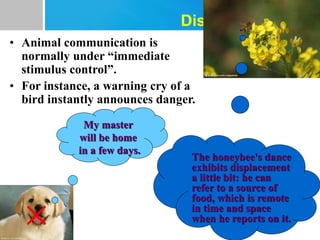
• Animal communication is
normally under “immediate
stimulus control”.
• For instance, a warning cry of a
bird instantly announces danger.
My master
will be home
in a few days.
The honeybee's dance
exhibits displacement
a little bit: he can
refer to a source of
food, which is remote
in time and space
when he reports on it.
×
Displacement
• Human language is stimulus-free. What we
are talking about need not be triggered by
any external stimulus in the world or any
internal state.
• Our language enables us to communicate
about things that do not exist or do not yet
exist.
Displacement
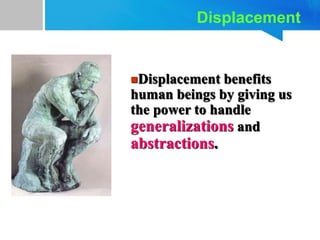
Displacement benefits
human beings by giving us
the power to handle
generalizations and
abstractions.
Cultural transmission
 Animal call systems are genetically transmitted.
 Language is culturally transmitted. It is passed
on from one generation to the next by teaching
and learning, rather than by instinct.
Design Features of Language
Topics for discussion
• No matter how eloquently a dog may bark, he cannot
tell you that his parents were poor but honest.
- Bertrand Russell
• A rose by other name would smell as sweet.
– Shakespeare
• He bought a book which was written by a teacher
who taught in a school which was known for its
graduates who …
• /tr/, /a/, /n/, /s/, /l/, /ei/, /t/- translate – translate a
novel- translate a novel by Lu Xun
Do we have
language?
Questions
• What if there were no language?
• What function does language play in daily life?
language functions
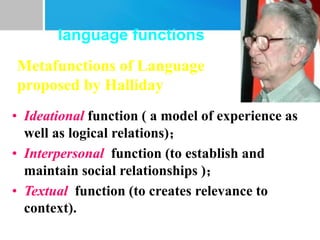
• Ideational function ( a model of experience as
well as logical relations);
• Interpersonal function (to establish and
maintain social relationships );
• Textual function (to creates relevance to
context).
Metafunctions of Language
proposed by Halliday
language functions
• Informative
• Interpersonal
• Performative
• Emotive
• Phatic communion
• Recreational
• Metalingual
Functions of Language
• Informative
• Language is used to convey messages, that is to
inform somebody of some information.
• Declarative sentences are employed to realize the
function.
• One of the features of this function is the proposition
has the true or false value,
• e.g. Water boils at 90ºC. Water boils at 100ºC.
• Interpersonal
• By far the most important sociological use of
language, and by which people establish and
maintain their status in a society, “polite
expressions, humble words”, expression of identity.
• For example, the ways in which people address
others (Dear Sir, Dear Professor, Johnny), and refer
to themselves (yours, your obedient servant ) indicate
the various grades of interpersonal relations.
Functions of Language
• Interpersonal
• In the framework of functional grammar,
it is concerned with interaction between
the addresser and addressee in the
discourse situation and the addresser's
attitude toward what he speaks or writes
about.
Functions of Language
Performative function
• This concept originates from the philosophical
study of language represented by Austin and
Searle, whose theory now forms the back-bone
of pragmatics. For example,
– I now declare the meeting open.
– I bet you two pounds it will rain tomorrow.
Functions of Language
• Performative function
It is to change the social status of persons, as in
marriage ceremonies, the sentencing of criminals, the
blessing of children, the naming of a ship at a launching
ceremony, and the cursing of enemies. (formal and
ritualized)
Functions of Language
– For example, in Chinese
when someone breaks a bowl
or a plate the host or the
people present are likely to
say 岁岁平安 as a means of
controlling the invisible
forces which the believers feel
might affect their lives
adversely.
 The performative function can extend to the
control of reality as on some magical or
religious occasions.
• Emotive function
to change the emotional status of an audience for
or against someone or something: swear words,
obscenities, involuntary verbal reactions to beautiful
art or scenery; conventional words/phrases, e.g.,
My God, Damn it, What a sight, Wow, Ugh, Ow…)
Functions of Language
• Phatic communion
It refers to the social interaction of language.
Small, seemingly meaningless topic to maintain a
comfortable relationship between people without
involving any factual content, “health, weather”
Expressions that help define and maintain
interpersonal relations, such as slangs, jokes, jargons,
ritualistic exchanges, switches to social and regional
dialects.
Functions of Language
Phatic communion
• We all use such small, seemingly meaningless
expressions to maintain a comfortable
relationship between people without involving
any factual content.
• Good morning, God bless you, Nice day,
hello
• 吃饭了吗?到哪里去?
• Greetings, farewells, and comments on the
weather in English and on clothing in Chinese
Recreational function
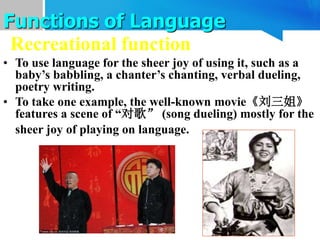
• To use language for the sheer joy of using it, such as a
baby’s babbling, a chanter’s chanting, verbal dueling,
poetry writing.
• To take one example, the well-known movie《刘三姐》
features a scene of “对歌” (song dueling) mostly for the
sheer joy of playing on language.
Functions of Language
Metalingual function
• Language can be used to talk about itself.
• metalanguage (元语言;纯理语言):certain kinds of
linguistic signs or terms for the analysis and description
of particular studies, e.g. approving, formal, non
technical, old-fashioned; [u] , [c], etc.
Functions of Language
• Functions of Language
Informative Hello, do you know …?
I heard that …
With language people can express
themselves and communicate with others.
Inter-personal Dear sir, Dear professor, John, yours,
your obedient servant
By language people establish and maintain
their social status in a society.
Performative Marriage ceremonies, the sentence of a
criminal, sui sui ping an (to break a
bowl on Spring Festival)
People use language to change social status
or control the reality on some special
occasions
Emotive Oh, my God! What a sight.
And hurrah!
Language can be used to get rid of the
nervous energy when we are under stress
Phatic Good morning! Thank you.
God bless you.
language is used to maintain a comfortable
relationship between people without
involving any factual content
Recreational Tip tongue, poetry writing gives people
the pleasure of using language.
People use language for the sheer of joy.
Meta-lingual book---- number of printed or written
sheets of paper bound together in a
cover.
People use language to talk about language
itself.
Linguistics
 Linguistics can be defined as the scientific
or systematic study of language. It is a
science in the sense that it scientifically
studies the rules, systems and principles of
human languages.
Linguistics has two main purposes
• One is that it studies the nature of language
and tries to establish a theory of language and
describes languages in the light of the theory
established.
• The other is that it examines all the forms of
language in general and seeks a scientific
understanding of the ways in which it is
organized to fulfill the needs it serves and the
functions it performs in human life.
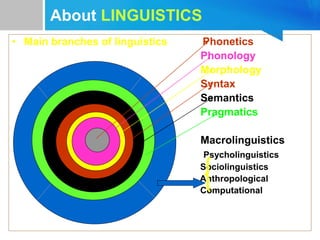
About LINGUISTICS
• Main branches of linguistics Phonetics
Phonology
Morphology
Syntax
Semantics
Pragmatics
Macrolinguistics
Psycholinguistics
Sociolinguistics
Anthropological
Computational
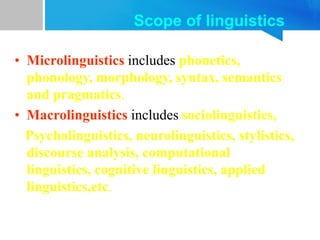
Scope of linguistics
• Microlinguistics includes phonetics,
phonology, morphology, syntax, semantics
and pragmatics.
• Macrolinguistics includes sociolinguistics,
Psycholinguistics, neurolinguistics, stylistics,
discourse analysis, computational
linguistics, cognitive linguistics, applied
linguistics,etc.
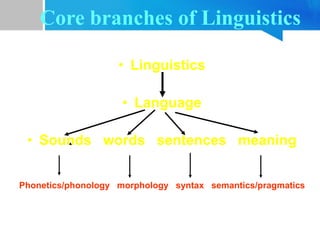
Core branches of Linguistics
• Linguistics
• Language
• Sounds words sentences meaning
Phonetics/phonology morphology syntax semantics/pragmatics
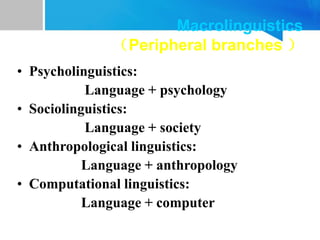
Macrolinguistics
(Peripheral branches )
• Psycholinguistics:
Language + psychology
• Sociolinguistics:
Language + society
• Anthropological linguistics:
Language + anthropology
• Computational linguistics:
Language + computer
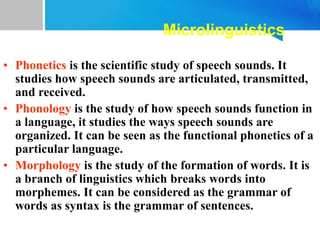
Microlinguistics
• Phonetics is the scientific study of speech sounds. It
studies how speech sounds are articulated, transmitted,
and received.
• Phonology is the study of how speech sounds function in
a language, it studies the ways speech sounds are
organized. It can be seen as the functional phonetics of a
particular language.
• Morphology is the study of the formation of words. It is
a branch of linguistics which breaks words into
morphemes. It can be considered as the grammar of
words as syntax is the grammar of sentences.
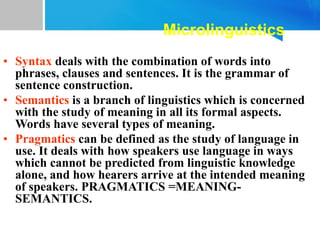
Microlinguistics
• Syntax deals with the combination of words into
phrases, clauses and sentences. It is the grammar of
sentence construction.
• Semantics is a branch of linguistics which is concerned
with the study of meaning in all its formal aspects.
Words have several types of meaning.
• Pragmatics can be defined as the study of language in
use. It deals with how speakers use language in ways
which cannot be predicted from linguistic knowledge
alone, and how hearers arrive at the intended meaning
of speakers. PRAGMATICS =MEANING-
SEMANTICS.
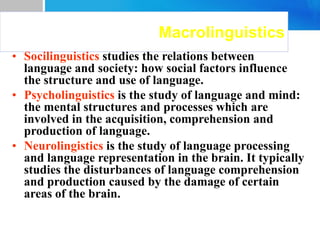
Macrolinguistics
• Socilinguistics studies the relations between
language and society: how social factors influence
the structure and use of language.
• Psycholinguistics is the study of language and mind:
the mental structures and processes which are
involved in the acquisition, comprehension and
production of language.
• Neurolingistics is the study of language processing
and language representation in the brain. It typically
studies the disturbances of language comprehension
and production caused by the damage of certain
areas of the brain.
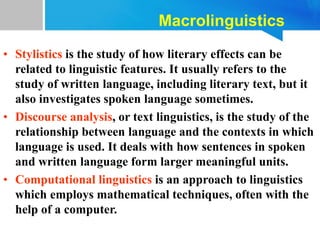
Macrolinguistics
• Stylistics is the study of how literary effects can be
related to linguistic features. It usually refers to the
study of written language, including literary text, but it
also investigates spoken language sometimes.
• Discourse analysis, or text linguistics, is the study of the
relationship between language and the contexts in which
language is used. It deals with how sentences in spoken
and written language form larger meaningful units.
• Computational linguistics is an approach to linguistics
which employs mathematical techniques, often with the
help of a computer.
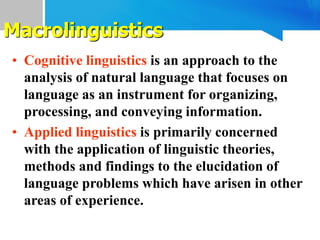
• Cognitive linguistics is an approach to the
analysis of natural language that focuses on
language as an instrument for organizing,
processing, and conveying information.
• Applied linguistics is primarily concerned
with the application of linguistic theories,
methods and findings to the elucidation of
language problems which have arisen in other
areas of experience.
Macrolinguistics
• Descriptive vs. prescriptive(描述和规定)
If a linguistic study describes and analyzes the
language people actually use, it is said to be
descriptive; if it aims to lay down rules for “correct”
behavior, i. e., to tell people what they should say and
what they should not say, it is said to be prescriptive.
Important distinctions in linguistics
Descriptive vs. prescriptive
• Don't say X.
People don't say X.
• The first is a prescriptive command, while
the second is a descriptive statement.
• The distinction lies in prescribing how
things ought to be and describing how
things are.
• Most modern linguistics is descriptive. It attempts to
describe what people actually say. Traditional
grammars told people how to use a language.
• As traditional grammars tried to lay down rules, they
are often called prescriptive.
• Descriptive grammars attempt to tell what is in the
language, while prescriptive grammars tell people
what should be in the language.
• Language changes and develops. The changes should
be observed and described. This does not deny that
languages have rules.
Descriptive vs. prescriptive
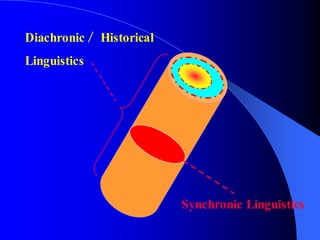
Synchronic vs. Diachronic
• Language can be studied at a given point in time or over
time.
• When we study language at one particular time /at some
point of time in history, it is called synchronic linguistics.
• When we study language developments through time, it
is called diachronic or historical linguistics.
• Synchronic linguistics focuses on the state of language at
any point in history while diachronic linguistics focuses
on the differences in two or more than two states of
language over decades or centuries.
Important distinctions in linguistics
Synchronic Linguistics
Diachronic/ Historical
Linguistics
• Langue vs. Parole
The distinction made by Swiss linguist F. de Saussure
in the early 20th century.
Langue and parole are French words.
Langue refers to the abstract linguistic system shared
by all the members of a speech community, and parole
refers to the realization of langue in actual use.
Langue is the set of conventions and rules which
language users all have to abide by, and parole is the
concrete use of the conventions and the application of
the rules.
Langue is abstract; it is not the language people
actually use. Parole is concrete; it refers to the naturally
occurring language events.
Important distinctions in linguistics
Competence vs. Performance
• Proposed by American linguist N. Chomsky in the late
1950’s.
• Competence: the ideal user’s knowledge of the rules of
his language.
• Performance: the actual realization of this knowledge in
linguistic communication.
• According to Chomsky, a speaker has internalized a set
of rules about his language, this enables him to produce
and understand an infinitely large number of sentences
and recognize sentences that are ungrammatical and
ambiguous.
Important distinctions in linguistics
Then, what’s the
distinction between
Chomsky’s and Saussure’s
• Langue is a social product, and a set of
conventions for a community, while competence is
deemed as a property of the mind of each individual.
• Sussure looks at language more from a
sociological or sociolinguistic point of view than
Chomsky since the latter deals with his issues
psychologically or psycholinguistically.
Important distinctions in linguistics
Etic vs. Emic
• The two terms originate from the American linguist
Pike’s(派克) distinction of phonetics and phonemics.
• Etic is related to an approach to the study of a particular
language or culture that is general, non-structural and
objective in its perspective.
• Being etic means making far too many, as well as
behaviorally inconsequential, differentiations, just as
was often the case with phonetic vs. phonemic analysis in
linguistics proper.
Important distinctions in linguistics
• Emic is related to an approach to the study of a
particular language or culture in terms of its internal
elements and their functioning rather than in terms
of any existing external scheme.
• That is to say, an emic set of speech acts and events
must be one that is validated as meaningful via final
resource to the native members of a speech
community rather than via appeal to the
investigator’s ingenuity or intuition alone.
Important distinctions in linguistics

very good for lang.ppt

  • 1.
    Linguistics: An Introduction CaoNing School of English Language Longdong University
  • 2.
    1 About LANGUAGE The definition of Language  Design Features of Language  Functions of Language 2 About LINGUISTICS  Main branches of linguistics  Important distinctions in linguistics Key points in this unit Does the animal have language?
  • 3.
    Linguistics  Linguistics, simply,is the study of language. Then,  What is languages ?  Is language human specific ?  Do animals have language?
  • 4.
     Language ispurely human and non-instinctive method of communicating ideas, emotions and desires by means of voluntarily produced symbols (Sapir, 1921).  Language is a system of arbitrary, vocal symbols which permit all people in a given culture, or other people who have learned the system of that culture to communicate or to interact (Finocchiaro, 1965). The definition of Language
  • 5.
    Language is asystem of communication by sound, operating through the organs of speech, among members of a given community, and using vocal symbols possessing arbitrary conventional meaning (Pei, 1966) The definition of Language
  • 6.
    The generally accepteddefinition: Language is a system of arbitrary vocal symbols used for human communication (Wardhaugh, 1972). The definition of Language
  • 7.
    Explanations Firstly, language isa system, i.e., elements of language are combined according to rules. “iblk”, “Been he wounded has” are unacceptable. Secondly, language is arbitrary in the sense that there is no intrinsic connection between the word ‘pen’ and the thing we use to write with.
  • 8.
     Explanations The factthat different language have different words for the same object is a good illustration of the arbitrary nature of language. This also explain the symbolic nature of language: words are just symbols; they are associated with objects, actions, ideas, etc, by convention. “A rose by any other name would smell as sweet” .(Romeo and Juliet)
  • 9.
    Thirdly, language isvocal because the primary medium is sound for all languages, no matter how well developed their writing systems are. All evidence points to the fact that writing systems came into being much later than the spoken forms and that they are only attempts to capture sounds and meaning on paper. “children – spoken language – read and write” Explanations
  • 10.
    Design Features ofLanguage refer to the quintessential characteristics of human language, which can distinguish any human language system from any non-human language system. They cover: Arbitrariness, Duality, Creativity, Displacement, and Cultural transmission. Design Features of Language
  • 11.
    Design Features ofLanguage Arbitrariness This feature was first proposed by Saussure. The forms of linguistic signs bear no natural (logical, intrinsic) relationship to their meaning. “Different sounds are used to refer to the same object in different languages.” tree 树 Baum
  • 12.
    Arbitrariness • At lexicallevel: • A rose by any other name would smell as sweet (Shakespeare's Romeo and Juliet, 1594 )
  • 13.
    Arbitrariness • at thesyntactic level • language is not arbitrary at the syntactic level. • (a) He came in and sat down. • (b) He sat down and came in. • (c) He sat down after he came in.
  • 14.
  • 15.
    Duality Language possess theproperty of having two levels of structures: Sounds (lower or basic level) Meaning (higher level) Sounds are combined with one another to form meaningful units such as words. The secondary units sounds are meaningless and the primary units have distinct and identifiable meaning. Design Features of Language
  • 16.
    Design Features ofLanguage  Language can be used to send messages we have never said or heard before.  Creativity is unique to human language.  Language is creative in that it makes possible the construction and interpretation of new signals by its users. Creativity
  • 17.
    Creativity • Words canbe used in new ways to mean new things, and can be instantly understood by people who have never come across that usage before. cool
  • 18.
    Creativity • Language isresourceful because of its duality and its recursiveness. • The recursive nature of language provides a potential to create an infinite number of /endless sentences. • “Limited rules can produce unlimited sentences.” (Chomsky,1958).
  • 19.
    • For instance: •This is the cat that killed the rat that ate the malt that lay in the house that Jack built. • He bought a book which was written by a teacher who taught in a school which was known for its graduates who ... • 从前有座山……… Creativity
  • 20.
    Creativity  Users canunderstand and produce words or sentences they have never heard before. Every day we sent messages that have never been sent before and understand novel messages.  Much of what we say and hear for the first time; yet there seems no problem of understanding. Design Features of Language
  • 21.
    Displacement  Human languagesenable their users to symbolize objects, events and concepts which are not present (in time and space) at the moment of communication. Thus, we can refer to Confucius, or the North Pole, even though the first has been dead for over 2550 years and the second is situated far away from us. Design Features of Language
  • 22.
    Displacement • Animal communicationis normally under “immediate stimulus control”. • For instance, a warning cry of a bird instantly announces danger. My master will be home in a few days. The honeybee's dance exhibits displacement a little bit: he can refer to a source of food, which is remote in time and space when he reports on it. ×
  • 23.
    Displacement • Human languageis stimulus-free. What we are talking about need not be triggered by any external stimulus in the world or any internal state. • Our language enables us to communicate about things that do not exist or do not yet exist.
  • 24.
    Displacement Displacement benefits human beingsby giving us the power to handle generalizations and abstractions.
  • 25.
    Cultural transmission  Animalcall systems are genetically transmitted.  Language is culturally transmitted. It is passed on from one generation to the next by teaching and learning, rather than by instinct. Design Features of Language
  • 26.
    Topics for discussion •No matter how eloquently a dog may bark, he cannot tell you that his parents were poor but honest. - Bertrand Russell • A rose by other name would smell as sweet. – Shakespeare • He bought a book which was written by a teacher who taught in a school which was known for its graduates who … • /tr/, /a/, /n/, /s/, /l/, /ei/, /t/- translate – translate a novel- translate a novel by Lu Xun
  • 27.
  • 28.
    Questions • What ifthere were no language? • What function does language play in daily life?
  • 29.
    language functions • Ideationalfunction ( a model of experience as well as logical relations); • Interpersonal function (to establish and maintain social relationships ); • Textual function (to creates relevance to context). Metafunctions of Language proposed by Halliday
  • 30.
    language functions • Informative •Interpersonal • Performative • Emotive • Phatic communion • Recreational • Metalingual
  • 31.
    Functions of Language •Informative • Language is used to convey messages, that is to inform somebody of some information. • Declarative sentences are employed to realize the function. • One of the features of this function is the proposition has the true or false value, • e.g. Water boils at 90ºC. Water boils at 100ºC.
  • 32.
    • Interpersonal • Byfar the most important sociological use of language, and by which people establish and maintain their status in a society, “polite expressions, humble words”, expression of identity. • For example, the ways in which people address others (Dear Sir, Dear Professor, Johnny), and refer to themselves (yours, your obedient servant ) indicate the various grades of interpersonal relations. Functions of Language
  • 33.
    • Interpersonal • Inthe framework of functional grammar, it is concerned with interaction between the addresser and addressee in the discourse situation and the addresser's attitude toward what he speaks or writes about. Functions of Language
  • 34.
    Performative function • Thisconcept originates from the philosophical study of language represented by Austin and Searle, whose theory now forms the back-bone of pragmatics. For example, – I now declare the meeting open. – I bet you two pounds it will rain tomorrow. Functions of Language
  • 35.
    • Performative function Itis to change the social status of persons, as in marriage ceremonies, the sentencing of criminals, the blessing of children, the naming of a ship at a launching ceremony, and the cursing of enemies. (formal and ritualized) Functions of Language
  • 36.
    – For example,in Chinese when someone breaks a bowl or a plate the host or the people present are likely to say 岁岁平安 as a means of controlling the invisible forces which the believers feel might affect their lives adversely.  The performative function can extend to the control of reality as on some magical or religious occasions.
  • 37.
    • Emotive function tochange the emotional status of an audience for or against someone or something: swear words, obscenities, involuntary verbal reactions to beautiful art or scenery; conventional words/phrases, (e.g., My God, Damn it, What a sight, Wow, Ugh, Ow…) Functions of Language
  • 38.
    • Phatic communion Itrefers to the social interaction of language. Small, seemingly meaningless topic to maintain a comfortable relationship between people without involving any factual content, “health, weather” Expressions that help define and maintain interpersonal relations, such as slangs, jokes, jargons, ritualistic exchanges, switches to social and regional dialects. Functions of Language
  • 39.
    Phatic communion • Weall use such small, seemingly meaningless expressions to maintain a comfortable relationship between people without involving any factual content. • Good morning, God bless you, Nice day, hello • 吃饭了吗?到哪里去? • Greetings, farewells, and comments on the weather in English and on clothing in Chinese
  • 40.
    Recreational function • Touse language for the sheer joy of using it, such as a baby’s babbling, a chanter’s chanting, verbal dueling, poetry writing. • To take one example, the well-known movie《刘三姐》 features a scene of “对歌” (song dueling) mostly for the sheer joy of playing on language. Functions of Language
  • 41.
    Metalingual function • Languagecan be used to talk about itself. • metalanguage (元语言;纯理语言):certain kinds of linguistic signs or terms for the analysis and description of particular studies, e.g. approving, formal, non technical, old-fashioned; [u] , [c], etc. Functions of Language
  • 42.
    • Functions ofLanguage Informative Hello, do you know …? I heard that … With language people can express themselves and communicate with others. Inter-personal Dear sir, Dear professor, John, yours, your obedient servant By language people establish and maintain their social status in a society. Performative Marriage ceremonies, the sentence of a criminal, sui sui ping an (to break a bowl on Spring Festival) People use language to change social status or control the reality on some special occasions Emotive Oh, my God! What a sight. And hurrah! Language can be used to get rid of the nervous energy when we are under stress Phatic Good morning! Thank you. God bless you. language is used to maintain a comfortable relationship between people without involving any factual content Recreational Tip tongue, poetry writing gives people the pleasure of using language. People use language for the sheer of joy. Meta-lingual book---- number of printed or written sheets of paper bound together in a cover. People use language to talk about language itself.
  • 43.
    Linguistics  Linguistics canbe defined as the scientific or systematic study of language. It is a science in the sense that it scientifically studies the rules, systems and principles of human languages.
  • 44.
    Linguistics has twomain purposes • One is that it studies the nature of language and tries to establish a theory of language and describes languages in the light of the theory established. • The other is that it examines all the forms of language in general and seeks a scientific understanding of the ways in which it is organized to fulfill the needs it serves and the functions it performs in human life.
  • 45.
    About LINGUISTICS • Mainbranches of linguistics Phonetics Phonology Morphology Syntax Semantics Pragmatics Macrolinguistics Psycholinguistics Sociolinguistics Anthropological Computational
  • 46.
    Scope of linguistics •Microlinguistics includes phonetics, phonology, morphology, syntax, semantics and pragmatics. • Macrolinguistics includes sociolinguistics, Psycholinguistics, neurolinguistics, stylistics, discourse analysis, computational linguistics, cognitive linguistics, applied linguistics,etc.
  • 47.
    Core branches ofLinguistics • Linguistics • Language • Sounds words sentences meaning Phonetics/phonology morphology syntax semantics/pragmatics
  • 48.
    Macrolinguistics (Peripheral branches ) •Psycholinguistics: Language + psychology • Sociolinguistics: Language + society • Anthropological linguistics: Language + anthropology • Computational linguistics: Language + computer
  • 49.
    Microlinguistics • Phonetics isthe scientific study of speech sounds. It studies how speech sounds are articulated, transmitted, and received. • Phonology is the study of how speech sounds function in a language, it studies the ways speech sounds are organized. It can be seen as the functional phonetics of a particular language. • Morphology is the study of the formation of words. It is a branch of linguistics which breaks words into morphemes. It can be considered as the grammar of words as syntax is the grammar of sentences.
  • 50.
    Microlinguistics • Syntax dealswith the combination of words into phrases, clauses and sentences. It is the grammar of sentence construction. • Semantics is a branch of linguistics which is concerned with the study of meaning in all its formal aspects. Words have several types of meaning. • Pragmatics can be defined as the study of language in use. It deals with how speakers use language in ways which cannot be predicted from linguistic knowledge alone, and how hearers arrive at the intended meaning of speakers. PRAGMATICS =MEANING- SEMANTICS.
  • 51.
    Macrolinguistics • Socilinguistics studiesthe relations between language and society: how social factors influence the structure and use of language. • Psycholinguistics is the study of language and mind: the mental structures and processes which are involved in the acquisition, comprehension and production of language. • Neurolingistics is the study of language processing and language representation in the brain. It typically studies the disturbances of language comprehension and production caused by the damage of certain areas of the brain.
  • 52.
    Macrolinguistics • Stylistics isthe study of how literary effects can be related to linguistic features. It usually refers to the study of written language, including literary text, but it also investigates spoken language sometimes. • Discourse analysis, or text linguistics, is the study of the relationship between language and the contexts in which language is used. It deals with how sentences in spoken and written language form larger meaningful units. • Computational linguistics is an approach to linguistics which employs mathematical techniques, often with the help of a computer.
  • 53.
    • Cognitive linguisticsis an approach to the analysis of natural language that focuses on language as an instrument for organizing, processing, and conveying information. • Applied linguistics is primarily concerned with the application of linguistic theories, methods and findings to the elucidation of language problems which have arisen in other areas of experience. Macrolinguistics
  • 54.
    • Descriptive vs.prescriptive(描述和规定) If a linguistic study describes and analyzes the language people actually use, it is said to be descriptive; if it aims to lay down rules for “correct” behavior, i. e., to tell people what they should say and what they should not say, it is said to be prescriptive. Important distinctions in linguistics
  • 55.
    Descriptive vs. prescriptive •Don't say X. People don't say X. • The first is a prescriptive command, while the second is a descriptive statement. • The distinction lies in prescribing how things ought to be and describing how things are.
  • 56.
    • Most modernlinguistics is descriptive. It attempts to describe what people actually say. Traditional grammars told people how to use a language. • As traditional grammars tried to lay down rules, they are often called prescriptive. • Descriptive grammars attempt to tell what is in the language, while prescriptive grammars tell people what should be in the language. • Language changes and develops. The changes should be observed and described. This does not deny that languages have rules. Descriptive vs. prescriptive
  • 57.
    Synchronic vs. Diachronic •Language can be studied at a given point in time or over time. • When we study language at one particular time /at some point of time in history, it is called synchronic linguistics. • When we study language developments through time, it is called diachronic or historical linguistics. • Synchronic linguistics focuses on the state of language at any point in history while diachronic linguistics focuses on the differences in two or more than two states of language over decades or centuries. Important distinctions in linguistics
  • 58.
  • 59.
    • Langue vs.Parole The distinction made by Swiss linguist F. de Saussure in the early 20th century. Langue and parole are French words. Langue refers to the abstract linguistic system shared by all the members of a speech community, and parole refers to the realization of langue in actual use. Langue is the set of conventions and rules which language users all have to abide by, and parole is the concrete use of the conventions and the application of the rules. Langue is abstract; it is not the language people actually use. Parole is concrete; it refers to the naturally occurring language events. Important distinctions in linguistics
  • 60.
    Competence vs. Performance •Proposed by American linguist N. Chomsky in the late 1950’s. • Competence: the ideal user’s knowledge of the rules of his language. • Performance: the actual realization of this knowledge in linguistic communication. • According to Chomsky, a speaker has internalized a set of rules about his language, this enables him to produce and understand an infinitely large number of sentences and recognize sentences that are ungrammatical and ambiguous. Important distinctions in linguistics
  • 61.
    Then, what’s the distinctionbetween Chomsky’s and Saussure’s
  • 62.
    • Langue isa social product, and a set of conventions for a community, while competence is deemed as a property of the mind of each individual. • Sussure looks at language more from a sociological or sociolinguistic point of view than Chomsky since the latter deals with his issues psychologically or psycholinguistically. Important distinctions in linguistics
  • 63.
    Etic vs. Emic •The two terms originate from the American linguist Pike’s(派克) distinction of phonetics and phonemics. • Etic is related to an approach to the study of a particular language or culture that is general, non-structural and objective in its perspective. • Being etic means making far too many, as well as behaviorally inconsequential, differentiations, just as was often the case with phonetic vs. phonemic analysis in linguistics proper. Important distinctions in linguistics
  • 64.
    • Emic isrelated to an approach to the study of a particular language or culture in terms of its internal elements and their functioning rather than in terms of any existing external scheme. • That is to say, an emic set of speech acts and events must be one that is validated as meaningful via final resource to the native members of a speech community rather than via appeal to the investigator’s ingenuity or intuition alone. Important distinctions in linguistics

Editor's Notes