Columbian Exchange
Mrs. Sample
Sixth Grade
Social Studies
What is the Columbian Exchange?
• Trading of Culture
• Named after Christopher Columbus
• The Exchange of crops, good, animals, and
diseases
• Began after Columbus voyage in 1492
Resource: Brainpop
• Columbian Exchange
http://www.brainpop.com/socialstudies/worldhi
story/columbianexchange/
How did it begin?
• Christopher Columbus arrives in the New
World in 1492.
• Begins and exchange between the Old World
(Europe) and the New World (the Americas).
• As the Spanish Empire spreads- the native
people begin to decline.
– Indigenous population = native people

• African slaves also become part of this
exchange.
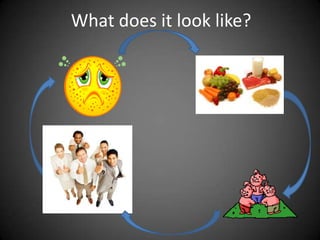
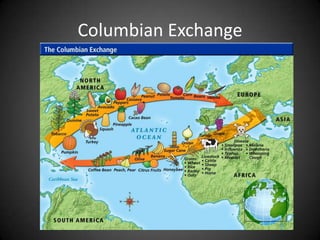
What does it look like?
What was the Impact?
• Turn to some one next to you and discuss:
• What are some positive impacts of the
exchange on the Natives and the Europeans?
• What do you think are some of the negative
impacts?
Decline of Indigenous Population
• New diseases were introduced into Latin
America by European Explorers.
• This included smallpox, measles, whooping
cough, typhoid fever, and influenza.
• Native Americans did not have an immunity to
these diseases and they died by the millions.
• Healers did not know how to treat the
diseases.
• Between 1492 and 1650, more than 80% of
Native Americans died of European diseases.
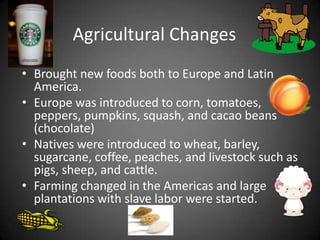
Agricultural Changes
• Brought new foods both to Europe and Latin
America.
• Europe was introduced to corn, tomatoes,
peppers, pumpkins, squash, and cacao beans
(chocolate)
• Natives were introduced to wheat, barley,
sugarcane, coffee, peaches, and livestock such as
pigs, sheep, and cattle.
• Farming changed in the Americas and large
plantations with slave labor were started.
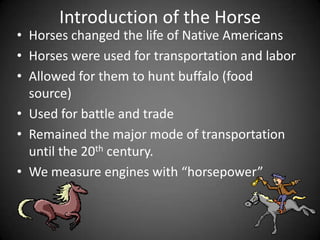
Introduction of the Horse

• Horses changed the life of Native Americans
• Horses were used for transportation and labor
• Allowed for them to hunt buffalo (food
source)
• Used for battle and trade
• Remained the major mode of transportation
until the 20th century.
• We measure engines with “horsepower”
Columbian Exchange

Columbian Exchange

  • 1.
  • 2.
    What is theColumbian Exchange? • Trading of Culture • Named after Christopher Columbus • The Exchange of crops, good, animals, and diseases • Began after Columbus voyage in 1492
  • 3.
    Resource: Brainpop • ColumbianExchange http://www.brainpop.com/socialstudies/worldhi story/columbianexchange/
  • 4.
    How did itbegin? • Christopher Columbus arrives in the New World in 1492. • Begins and exchange between the Old World (Europe) and the New World (the Americas). • As the Spanish Empire spreads- the native people begin to decline. – Indigenous population = native people • African slaves also become part of this exchange.
  • 5.
    What does itlook like?
  • 6.
    What was theImpact? • Turn to some one next to you and discuss: • What are some positive impacts of the exchange on the Natives and the Europeans? • What do you think are some of the negative impacts?
  • 7.
    Decline of IndigenousPopulation • New diseases were introduced into Latin America by European Explorers. • This included smallpox, measles, whooping cough, typhoid fever, and influenza. • Native Americans did not have an immunity to these diseases and they died by the millions. • Healers did not know how to treat the diseases. • Between 1492 and 1650, more than 80% of Native Americans died of European diseases.
  • 8.
    Agricultural Changes • Broughtnew foods both to Europe and Latin America. • Europe was introduced to corn, tomatoes, peppers, pumpkins, squash, and cacao beans (chocolate) • Natives were introduced to wheat, barley, sugarcane, coffee, peaches, and livestock such as pigs, sheep, and cattle. • Farming changed in the Americas and large plantations with slave labor were started.
  • 9.
    Introduction of theHorse • Horses changed the life of Native Americans • Horses were used for transportation and labor • Allowed for them to hunt buffalo (food source) • Used for battle and trade • Remained the major mode of transportation until the 20th century. • We measure engines with “horsepower”
  • 10.