The document discusses different types of maps and their uses. It explains that maps are drawings that represent the earth's surface at a reduced scale to fit on a page. While globes are useful for studying the entire earth, maps provide more detailed information about specific regions. There are different types of maps like physical maps, political maps, and thematic maps that focus on natural features, borders, or specific data like transportation or rainfall. Maps allow distances and locations to be accurately measured using scales that relate distances on the map to actual distances on ground. Symbols, directions, and scales are important components of maps that provide detailed information in a clear format.
Made by: AnkitaNandi
Class: VI-D Roll no:03
Kendriya Vidyalaya
Barrack pore (AFS)
2.
We have learntin the previous chapter about
the advantages of a globe. However, globe has
limitations as well. A globe can be useful when we want
to study the earth as a whole. But, when we want to
study only the part of earth, as about our country,
states, districts, towns & villages, it is of little help. In
such situation we use maps.
A map is a representation or a drawing of
the earth’s surface according to a scale. But it’s
impossible to flatten a round shape completely. We
find that maps are useful to us for various purposes.
One map shows a small area and a few facts. Another
map may contain as many facts as a big book. When
many maps are put together we get an Atlas book.
Atlases are of different sizes, measurements drawn on
different scales. Maps provide more information than
the globe. They are of different types. Some of them
are described below:
3.
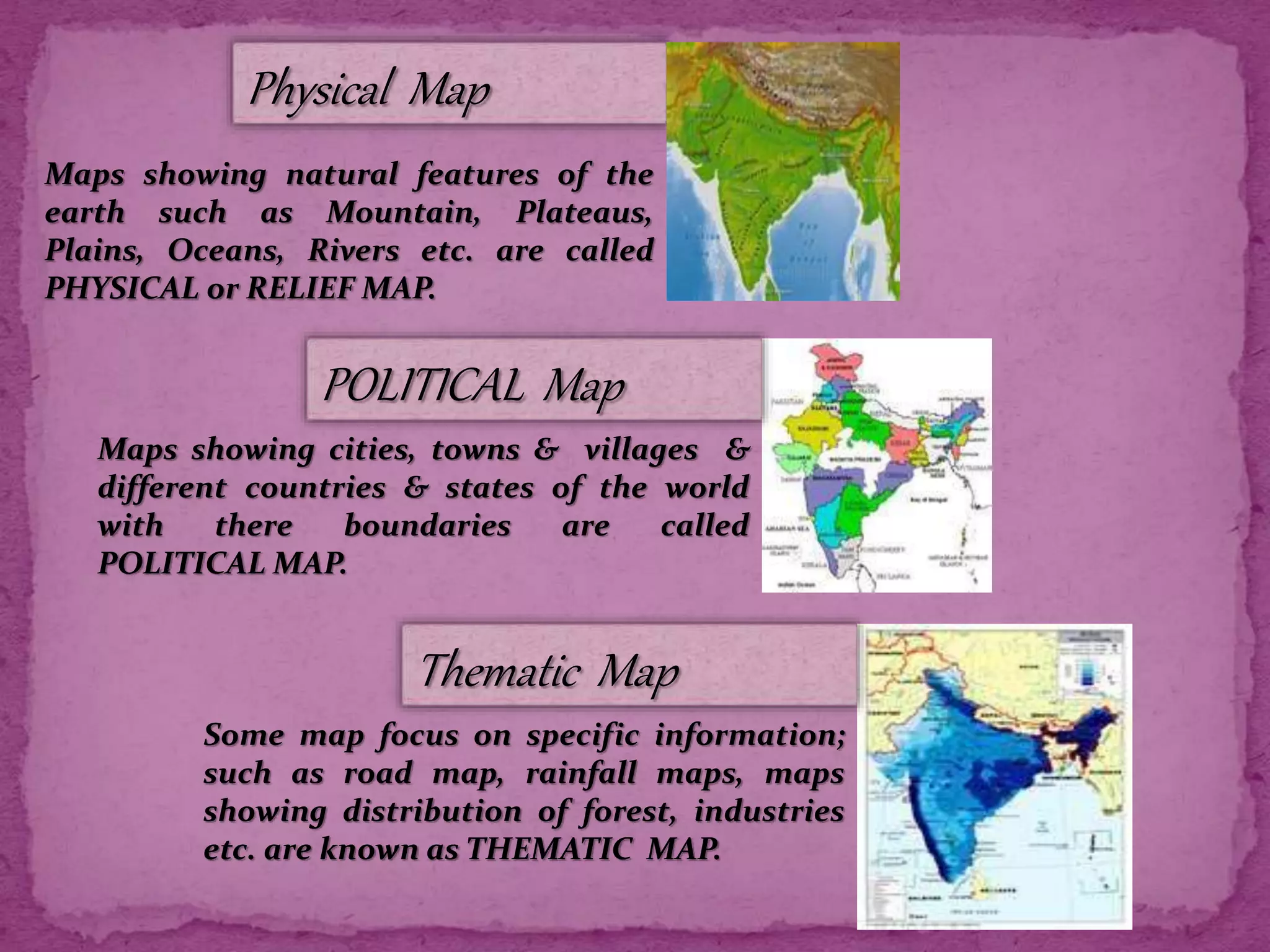
Physical Map
Maps showingnatural features of the
earth such as Mountain, Plateaus,
Plains, Oceans, Rivers etc. are called
PHYSICAL or RELIEF MAP.
POLITICAL Map
Maps showing cities, towns & villages &
different countries & states of the world
with there boundaries are called
POLITICAL MAP.
Thematic Map
Some map focus on specific information;
such as road map, rainfall maps, maps
showing distribution of forest, industries
etc. are known as THEMATIC MAP.
4.
SKETCH
A SKETCH isa drawing
mainly based on memory
and spot observation and
not to scale. Sometimes a
rough drawing is required
of an area to tell where a
particular place is located
with respect to others
places. Supposes, you want
go to your friend’s house,
but you don’t know the
way. Your friend will make
a rough drawing to show
the way to his/her house.
Such a rough drawing is
drawing is drawn without
the scale, & is called a
SKETCH MAP.
5.
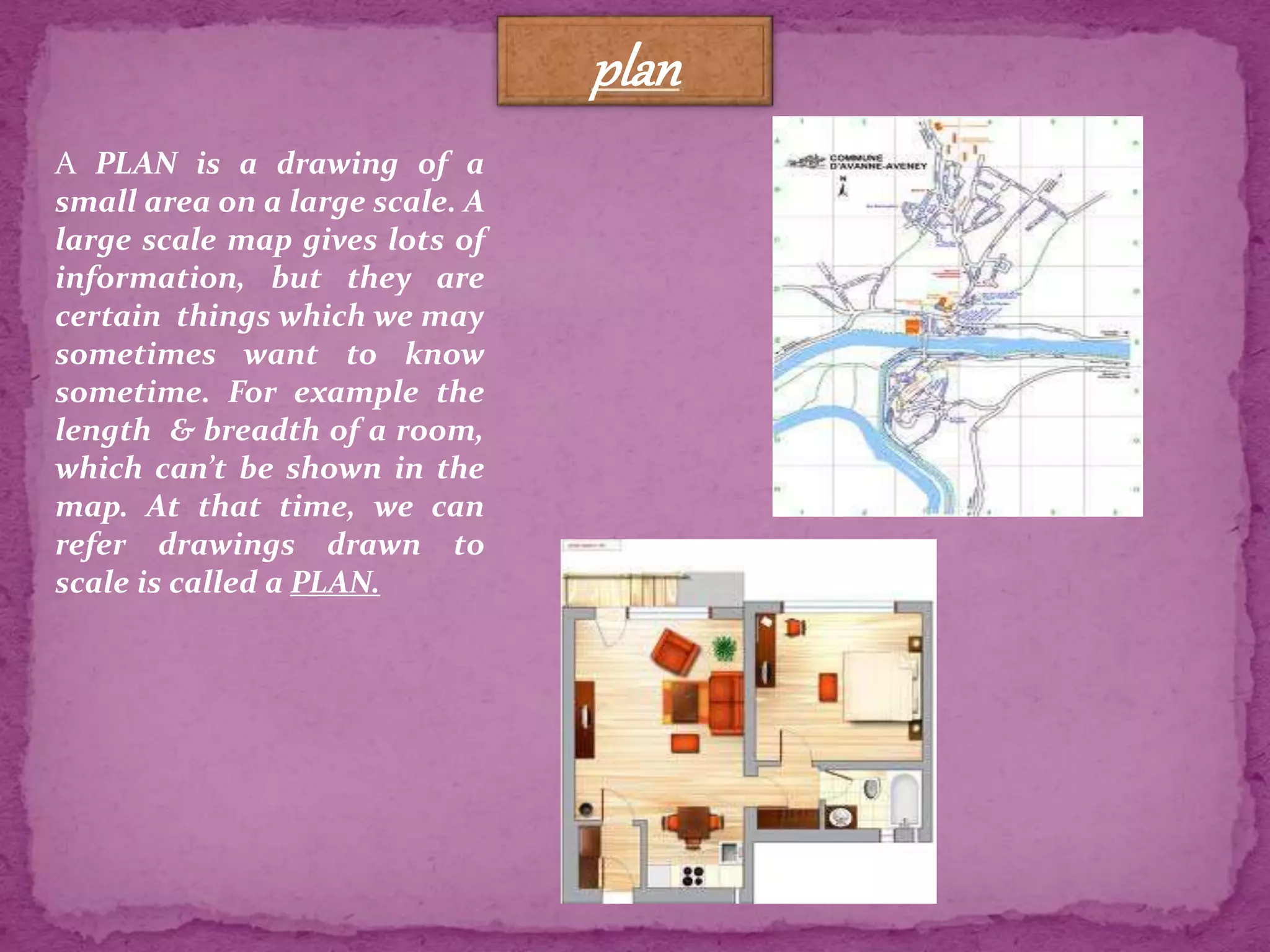
plan
A PLAN isa drawing of a
small area on a large scale. A
large scale map gives lots of
information, but they are
certain things which we may
sometimes want to know
sometime. For example the
length & breadth of a room,
which can’t be shown in the
map. At that time, we can
refer drawings drawn to
scale is called a PLAN.
Maps are drawingwhich reduce the entire world or a part of it to fit
on a sheet of paper. Or we can say maps are drawn to reduced scale. But this
reduction is done very carefully so that the distance between the places is real.
It can only be possible when a small distance on paper represents a large
distance on ground. Therefore, a scale is chosen for this purpose. Scale is the
ratio between the actual distance on the ground and the distance shown on the
map. For example, the distance between your school and your home is 10 Km.
If you show this 10 Km. distance by 2 Cm on a map, it means 1 Cm is 5 Km on
the ground. The scale your drawing will be, 1 Cm. is equal to 5 Km. Thus, scale
is very important in any map. If you know the scale, you will be able to
calculate the distance between any two place on a map.
When Large areas like continent or countries are to be shown on a
paper, then we use small scale. For example 5 Cm. on the map shows 500 Km.
of the ground. It is called a SMALL SCALE MAP.
When a small area like village or town is to be shown on paper, then a
use a large scale, i.e. 5 Cm on the map shows 500 Meter Only on the ground. It
is called LARGE SCALE MAP.
Large Scale Maps give us more information than Small Scale Map.
Distance
Back
9.
DIRECTION
Back
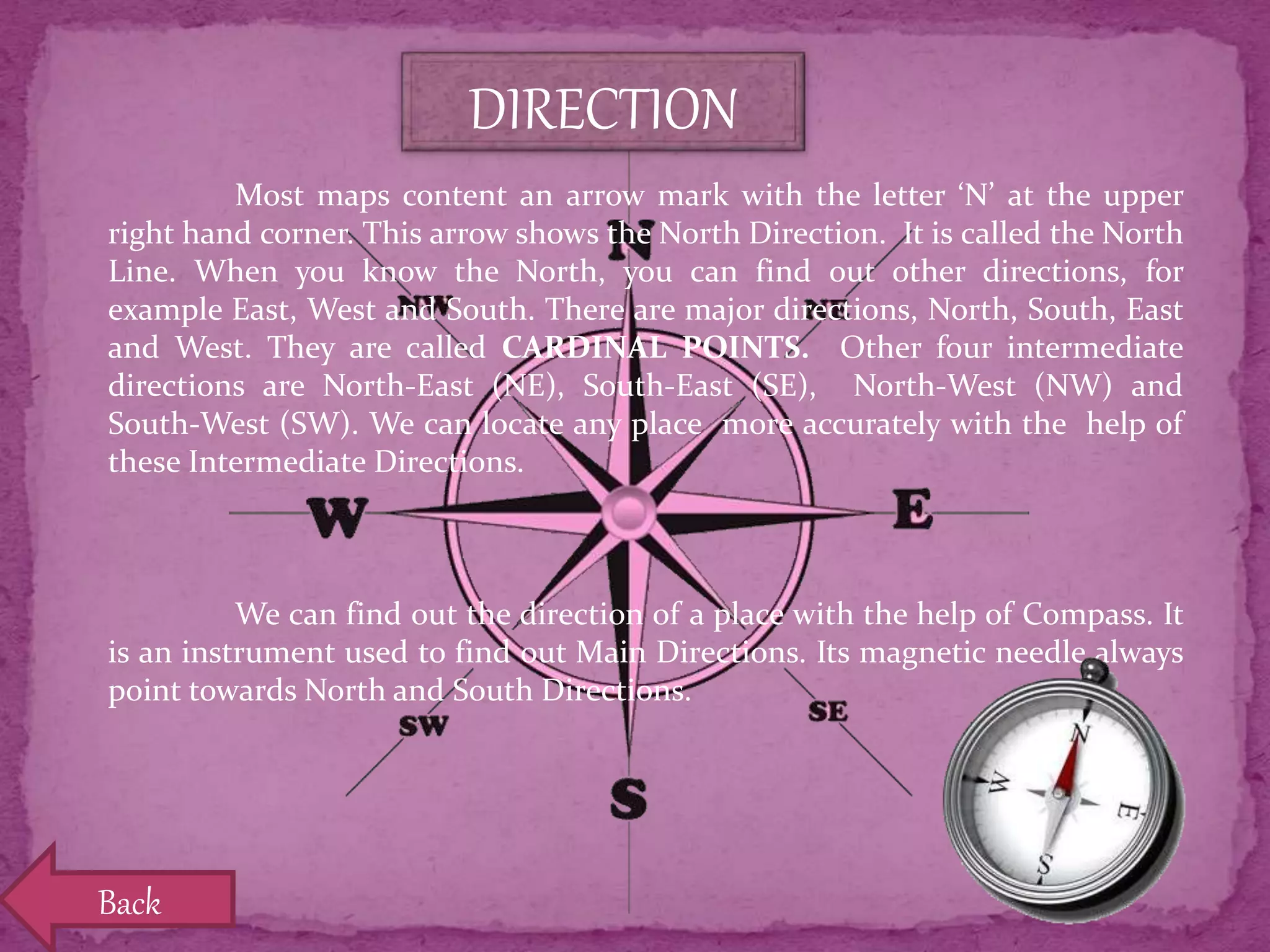
Most maps contentan arrow mark with the letter ‘N’ at the upper
right hand corner. This arrow shows the North Direction. It is called the North
Line. When you know the North, you can find out other directions, for
example East, West and South. There are major directions, North, South, East
and West. They are called CARDINAL POINTS. Other four intermediate
directions are North-East (NE), South-East (SE), North-West (NW) and
South-West (SW). We can locate any place more accurately with the help of
these Intermediate Directions.
We can find out the direction of a place with the help of Compass. It
is an instrument used to find out Main Directions. Its magnetic needle always
point towards North and South Directions.
10.
SYMBOL
Back
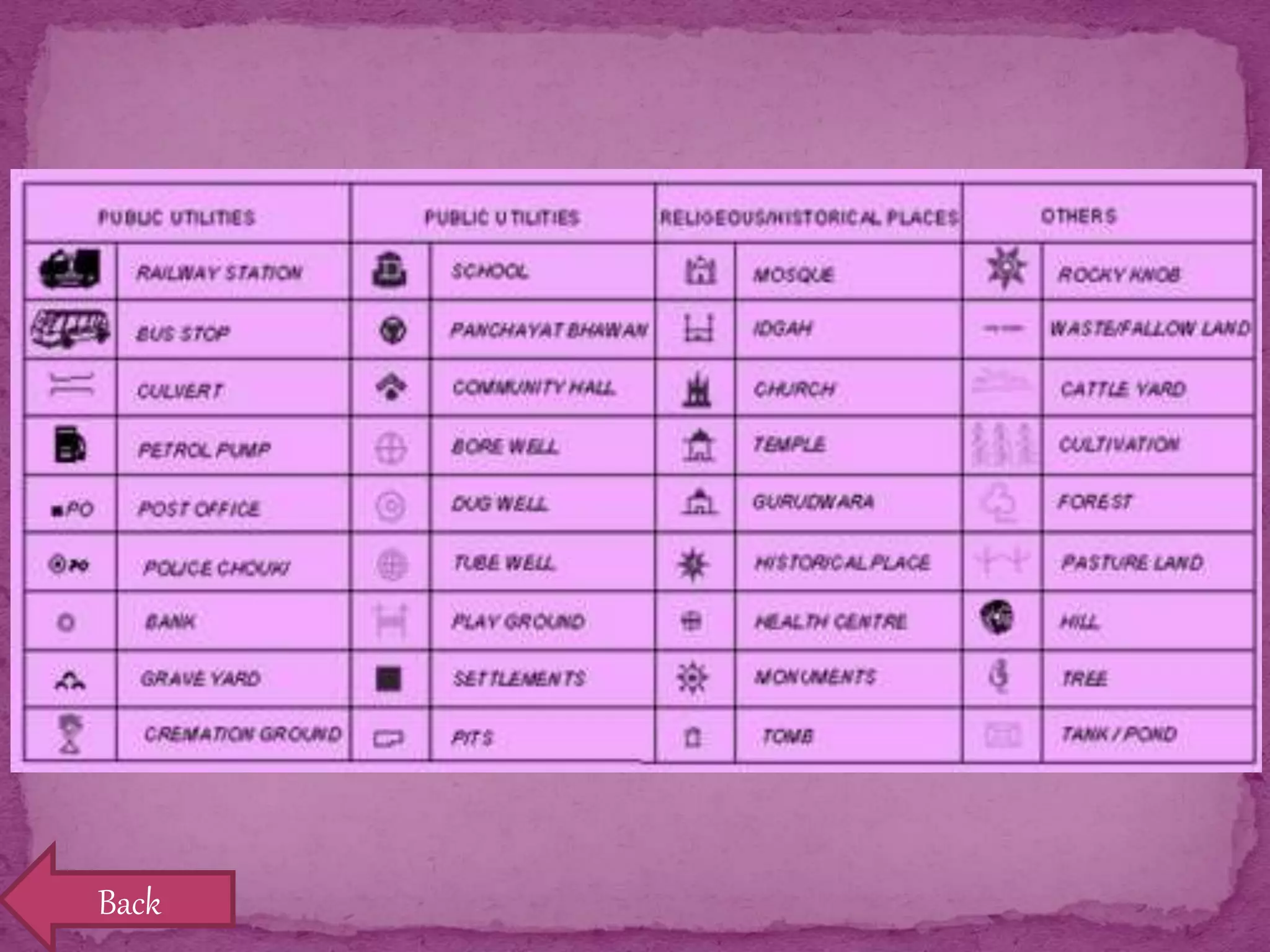
It is thethird important component of a map. It is not possible to
draw on a map the actual shape and size of different features such as buildings,
roads, bridges, trees, railway lines or a well. So, they are shown by certain
letters, shades, colours, pictures and lines . These symbols give a lot of
information in a limited space. With the use of these symbols, maps can be
drawn easily and are simple to read. Even if you don’t know the language of an
area and therefore cannot ask someone for directions , you can collect
information from maps with the help of these symbols. Maps have a universal
language that can be understood by all. There is an international agreement
regarding the use of these symbols. These are called CONVENTIONAL
SYMBOLS.
Various colours are used for this purpose. For example, generally blue
is used for showing water bodies, brown for mountain, yellow for plateau and
green is used for plains.
Click Here for some Symbols